
Marder M.P. Condensed Matter Physics
Подождите немного. Документ загружается.

Dislocations
383
t
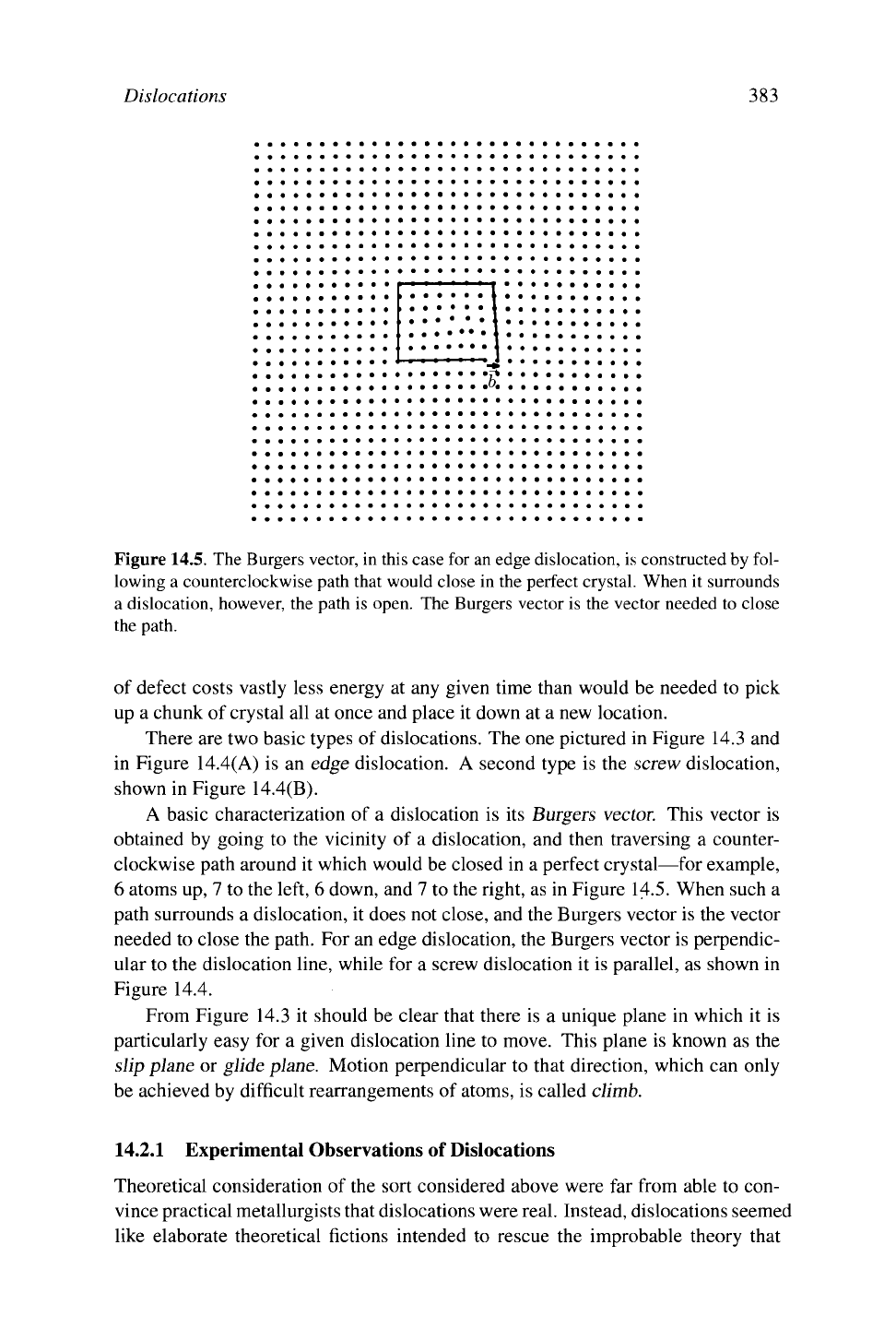
Figure 14.5. The Burgers vector, in this case for an edge dislocation, is constructed by fol-
lowing a counterclockwise path that would close in the perfect crystal. When it surrounds
a dislocation, however, the path is open. The Burgers vector is the vector needed to close
the path.
of defect costs vastly less energy at any given time than would be needed to pick
up a chunk of crystal all at once and place it down at a new location.
There are two basic types of dislocations. The one pictured in Figure 14.3 and
in Figure 14.4(A) is an edge dislocation. A second type is the screw dislocation,
shown in Figure 14.4(B).
A basic characterization of a dislocation is its Burgers vector. This vector is
obtained by going to the vicinity of a dislocation, and then traversing a counter-
clockwise path around it which would be closed in a perfect crystal—for example,
6 atoms up, 7 to the left, 6 down, and 7 to the right, as in Figure 14.5. When such a
path surrounds a dislocation, it does not close, and the Burgers vector is the vector
needed to close the path. For an edge dislocation, the Burgers vector is perpendic-
ular to the dislocation line, while for a screw dislocation it is parallel, as shown in
Figure 14.4.
From Figure 14.3 it should be clear that there is a unique plane in which it is
particularly easy for a given dislocation line to move. This plane is known as the
slip plane or glide plane. Motion perpendicular to that direction, which can only
be achieved by difficult rearrangements of atoms, is called climb.
14.2.1 Experimental Observations of Dislocations
Theoretical consideration of the sort considered above were far from able to con-
vince practical metallurgists that dislocations were
real.
Instead, dislocations seemed
like elaborate theoretical fictions intended to rescue the improbable theory that
384 Chapter 14. Dislocations and Cracks
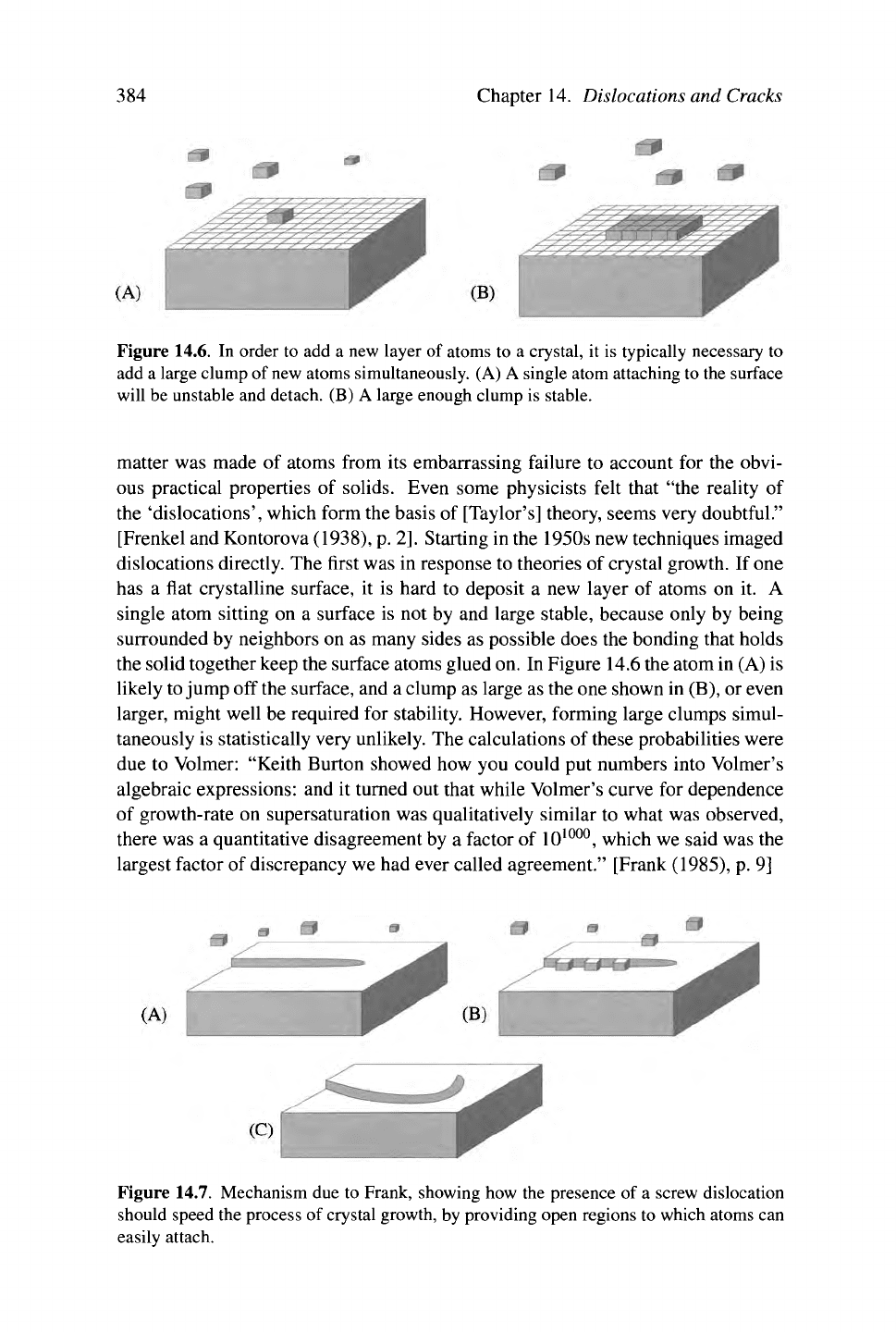
Figure 14.6. In order to add a new layer of atoms to a crystal, it is typically necessary to
add a large clump of
new
atoms simultaneously. (A)
A
single atom attaching to the surface
will be unstable and detach. (B)
A
large enough clump is stable.
matter was made of atoms from its embarrassing failure to account for the obvi-
ous practical properties of solids. Even some physicists felt that "the reality of
the 'dislocations', which form the basis of [Taylor's] theory, seems very doubtful."
[Frenkel and Kontorova (1938), p. 2]. Starting in the 1950s new techniques imaged
dislocations directly. The first was in response to theories of crystal growth. If one
has a flat crystalline surface, it is hard to deposit a new layer of atoms on it. A
single atom sitting on a surface is not by and large stable, because only by being
surrounded by neighbors on as many sides as possible does the bonding that holds
the solid together keep the surface atoms glued on. In Figure 14.6 the atom in (A) is
likely
to
jump off the surface, and a clump as large as the one shown in (B), or even
larger, might well be required for stability. However, forming large clumps simul-
taneously is statistically very unlikely. The calculations of these probabilities were
due to Volmer: "Keith Burton showed how you could put numbers into Volmer's
algebraic expressions: and it turned out that while Volmer's curve for dependence
of growth-rate on supersaturation was qualitatively similar to what was observed,
there was a quantitative disagreement by a factor of
10
1000
,
which we said was the
largest factor of discrepancy we had ever called agreement." [Frank (1985), p. 9]
Figure 14.7. Mechanism due to Frank, showing how the presence of a screw dislocation
should speed the process of crystal growth, by providing open regions to which atoms can
easily attach.
Dislocations 385
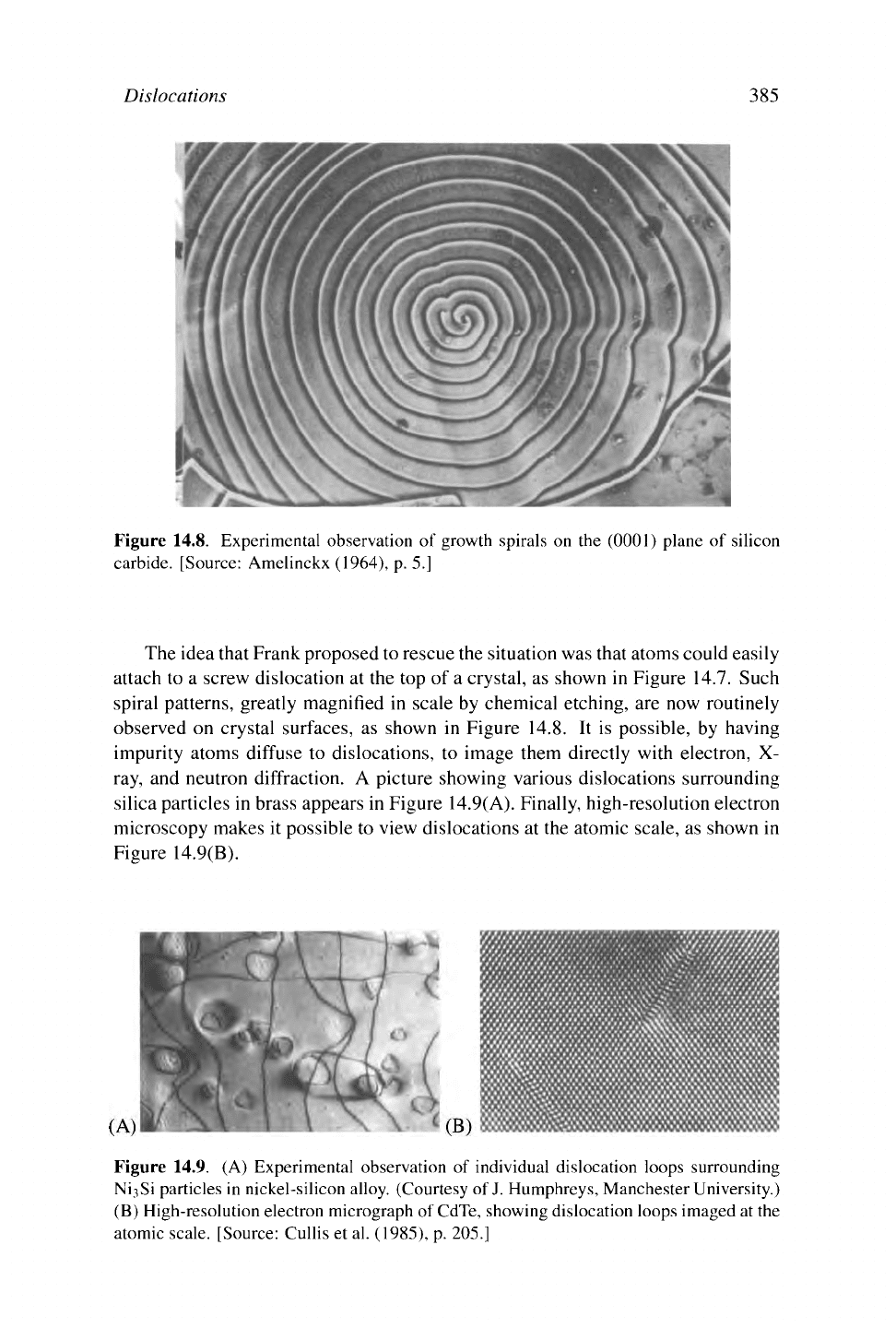
Figure 14.8. Experimental observation of growth spirals on the (0001) plane of silicon
carbide. [Source: Amelinckx (1964), p. 5.]
The idea that Frank proposed to rescue the situation was that atoms could easily
attach to a screw dislocation at the top of a crystal, as shown in Figure 14.7. Such
spiral patterns, greatly magnified in scale by chemical etching, are now routinely
observed on crystal surfaces, as shown in Figure 14.8. It is possible, by having
impurity atoms diffuse to dislocations, to image them directly with electron, X-
ray, and neutron diffraction. A picture showing various dislocations surrounding
silica particles in brass appears in Figure 14.9(A). Finally, high-resolution electron
microscopy makes it possible to view dislocations at the atomic scale, as shown in
Figure 14.9(B).
Figure 14.9. (A) Experimental observation of individual dislocation loops surrounding
N13SÌ particles in nickel-silicon alloy. (Courtesy of
J.
Humphreys, Manchester University.)
(B) High-resolution electron micrograph of
CdTe,
showing dislocation loops imaged at the
atomic scale. [Source: Cullis et al. (1985), p. 205.]
386 Chapter 14. Dislocations and Cracks
14.2.2 Force to Move a Dislocation
A virtual work argument can be used to determine the effectiveness of external
stresses in moving a dislocation. Viewing the dislocation as a line being pushed
through the crystal, define /, the force per length a needed to make the dislocation
move. If
the
dislocation in Figure 14.5 moves from right to left past N atomic sites,
then a layer N atoms long moves by the Burgers vector b. If an external shearing
force
F
ext
has been applied to the top and bottom of the sample, then the total work
done in the process is
F
ext
b
x
.
The work required to move the dislocation over one
lattice spacing is then
F
ext
b
x
/N,
and the force f
x
per length a required to move the
dislocation must be
fx
=
<7xyb
x
,
(14.6)
where
">
=
w
(I4J)
is the external stress appi' ~
J
to the crystal, with a the lattice spacing. Notice that
putting the crystal under tension, either with σ
χχ
(pulling along the x axis), or with
Oyy
(pulling along the y axis) has no power to move the dislocation. If L is a unit
vector pointing along the dislocation line (L = z in the case of Figure 14.5), then
Eq. (14.6) can be rewritten in coordinate independent form as
f=(a-b)xL (14.8)
The first term on the right-hand side of
Eq.
(14.8) indicates that one forms the 3x3
tensor σ and takes its dot product with the Burgers vector b. The direction of L is
chosen according to the right-hand rule; the Burgers vector is defined by taking a
counterclockwise path around the dislocation, and the direction L of
the
dislocation
is the direction the thumb points when the right-hand fingers curl around it. The
advantage of describing the force on the dislocation in this form, due to Peach
and Köhler (1950), is that it is independent of one's choice of coordinate system,
is equally true for edge or screw dislocations, and remains true for a dislocation
which curls about or forms a loop.
Equation (14.8) is useful when one supposes that there is a critical force f
c
needed per unit length to make the dislocation move. Equation (14.8) then de-
scribes the external stress that will be required for a crystal to begin to flow, if it is
populated with dislocations. It can also be used, for example, to decide when one
dislocation will begin to move because of stresses created by another dislocation.
14.2.3 One-Dimensional Dislocations: Frenkel-Kontorova Model
In order to understand how dislocations allow crystals to flow, it is necessary to
determine the critical force f
c
. This task is somewhat complicated in two- and
three-dimensional settings, so it is helpful to examine a one-dimensional model for
dislocations, the model of Frenkel and Kontorova (1938), where the job is easier.
Dislocations
387
F = F
crit
/2 ►
-5-4-3-2-10 12 3 4 5
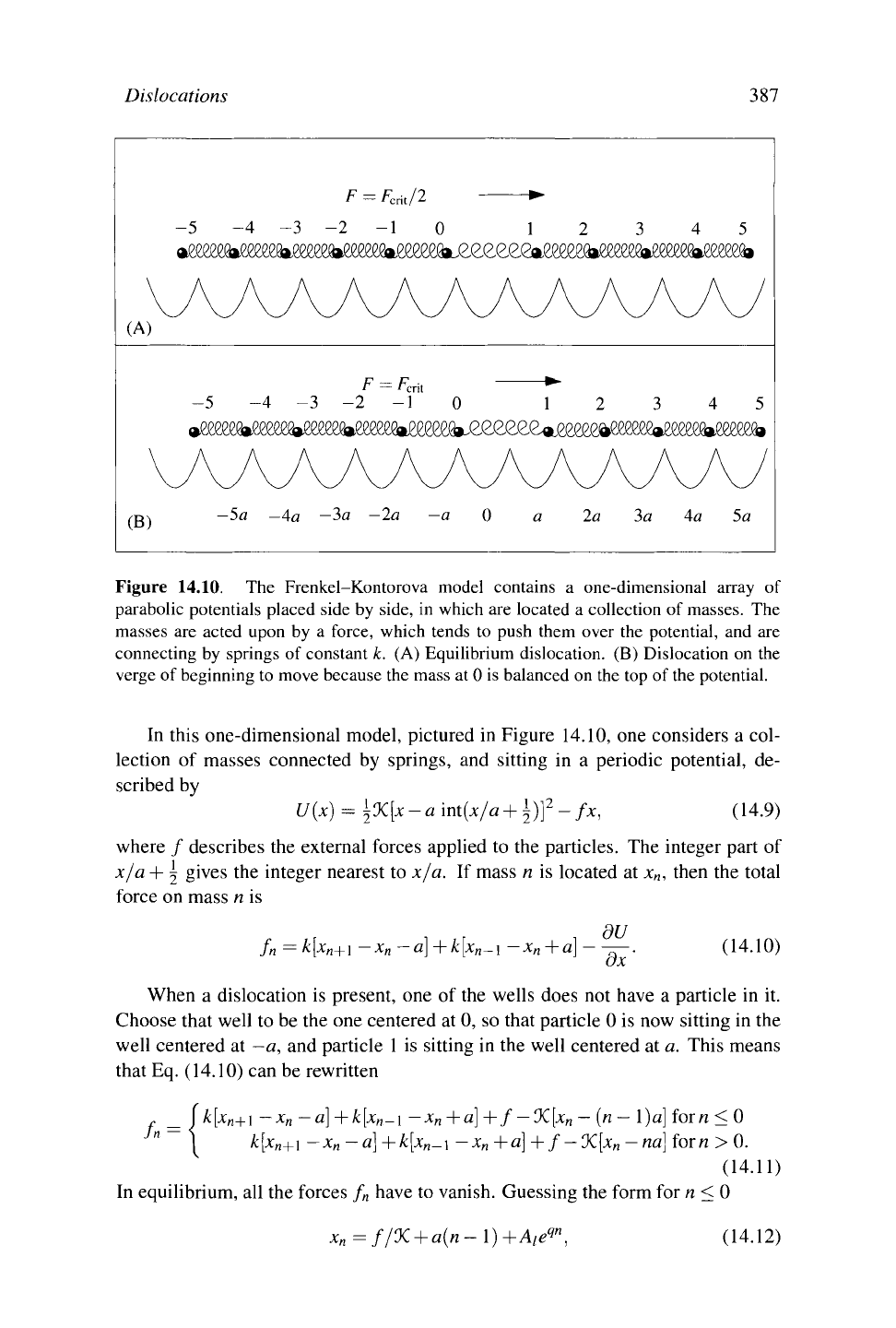
Figure 14.10. The Frenkel-Kontorova model contains a one-dimensional array of
parabolic potentials placed side by side, in which are located a collection of masses. The
masses are acted upon by a force, which tends to push them over the potential, and are
connecting by springs of constant k. (A) Equilibrium dislocation. (B) Dislocation on the
verge of beginning to move because the mass at 0 is balanced on the top of the potential.
In this one-dimensional model, pictured in Figure 14.10, one considers a col-
lection of masses connected by springs, and sitting in a periodic potential, de-
scribed by
U(x) = hX[x
—
a int(x/a +
l\i2
-fx,
(14.9)
where / describes the external forces applied to the particles. The integer part of
xja + \ gives the integer nearest to xja. If mass n is located at x
n
, then the total
force on mass n is
/„ =k[x
n+
\ -x
n
-a\+k[x
n
-\ -x
n
+a]
dU
dx
(14.10)
When a dislocation is present, one of the wells does not have a particle in it.
Choose that well to be the one centered at 0, so that particle 0 is now sitting in the
well centered at —a, and particle 1 is sitting in the well centered at a. This means
that Eq. (14.10) can be rewritten
h
k[x
n+
\ —x
n
—a\ +k[x„-i —x
n
+a] +f
—
X[x
n
—
(n— l)a] for« < 0
k[x
n
+\
—x
n
— a]
+k[x
n
-\
—
x
n
+
a]
+/
—
JC[x
n
—
na] forn > 0.
(14.11)
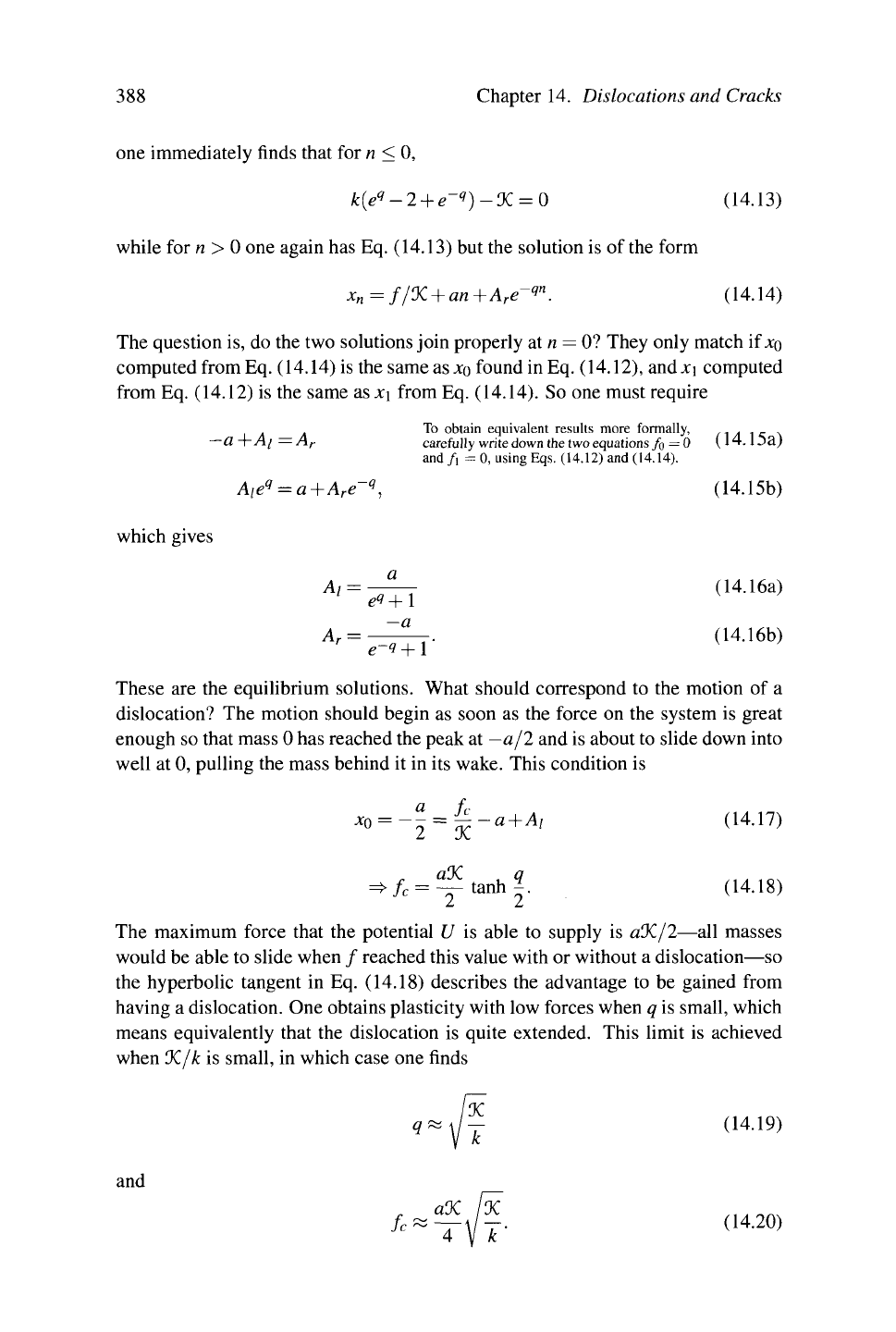
In equilibrium, all the forces /„ have to vanish. Guessing the form for n < 0
x
n
= f/X + a(n-\)+A
l
e'
in
, (14.12)
388
Chapter 14. Dislocations and Cracks
one immediately finds that for n < 0,
k{e
g
-2 + e-
q
)-JC = 0 (14.13)
while for n > 0 one again has Eq. (14.13) but the solution is of the form
x
n
= f/X + an+A
r
e-
qn
. (14.14)
The question is, do the two solutions join properly at n = 0? They only match if
XQ
computed from Eq. (14.14) is the same as
XQ
found in Eq. (14.12), andxi computed
from Eq. (14.12) is the same as x\ from Eq. (14.14). So one must require
To obtain equivalent results more formally, .
a-{-Ai=A
r
carefully write down the two equations/o = 0 (14.1ja)
and /, = 0, using Eqs. (14.12) and (14.14).
Aie
q
= a+A
r
e-\ (14.15b)
which gives
A/ = —°— (14.16a)
ei + \
A
r
=
~
a
. (14.16b)
These are the equilibrium solutions. What should correspond to the motion of a
dislocation? The motion should begin as soon as the force on the system is great
enough so that mass 0 has reached the peak at —a/2 and is about to slide down into
well at 0, pulling the mass behind it in its wake. This condition is
Xo =
~l
=
x~
a+Al
(1417)
=*/
c
= ^-tanh|. (14.18)
The maximum force that the potential U is able to supply is aX/2—all masses
would be able to slide when / reached this value with or without a dislocation—so
the hyperbolic tangent in Eq. (14.18) describes the advantage to be gained from
having a dislocation. One obtains plasticity with low forces when q is small, which
means equivalently that the dislocation is quite extended. This limit is achieved
when X/k is small, in which case one finds
(14.19)
y te
and
(14.20)
Two-Dimensional Dislocations and Hexatic Phases 389
14.3 Two-Dimensional Dislocations and Hexatic Phases
Dislocations play an interesting role in the statistical mechanics of two-dimensional
crystals. Two-dimensional crystals do not, in fact, technically exist. Long-range or-
der is almost always destroyed by thermal fluctuations in two dimensions. Another
type of order, orientational order, can however exist, and dislocations are central
actors in the phase transition that brings orientational order to an end. The mathe-
matics of this phase transition applies almost unchanged to a broad range of other
physical systems, ranging from two-dimensional electron gases to thin films of he-
lium, and provides a setting in which to gain an introduction to renormalization
group techniques.
14.3.1 Impossibility of Crystalline Order in Two Dimensions
Three dimensions are special in many respects. One surprising property, first re-
alized by Peierls (1934) and Landau (1937), is that three-dimensional space is the
lowest dimensionality in which long-range crystalline order is possible. Certainly,
one can draw pictures of crystals in two dimensions, but if one built them, they
would be destroyed at any nonzero temperature by fluctuations. This fact has al-
ready been demonstrated, because Problem 7 in Chapter 13 shows that sharp Bragg
peaks cannot survive in one and two dimensions as a result of quantum fluctuations.
The same conclusion follows from examining the effect of thermal fluctuations in
a purely classical context.
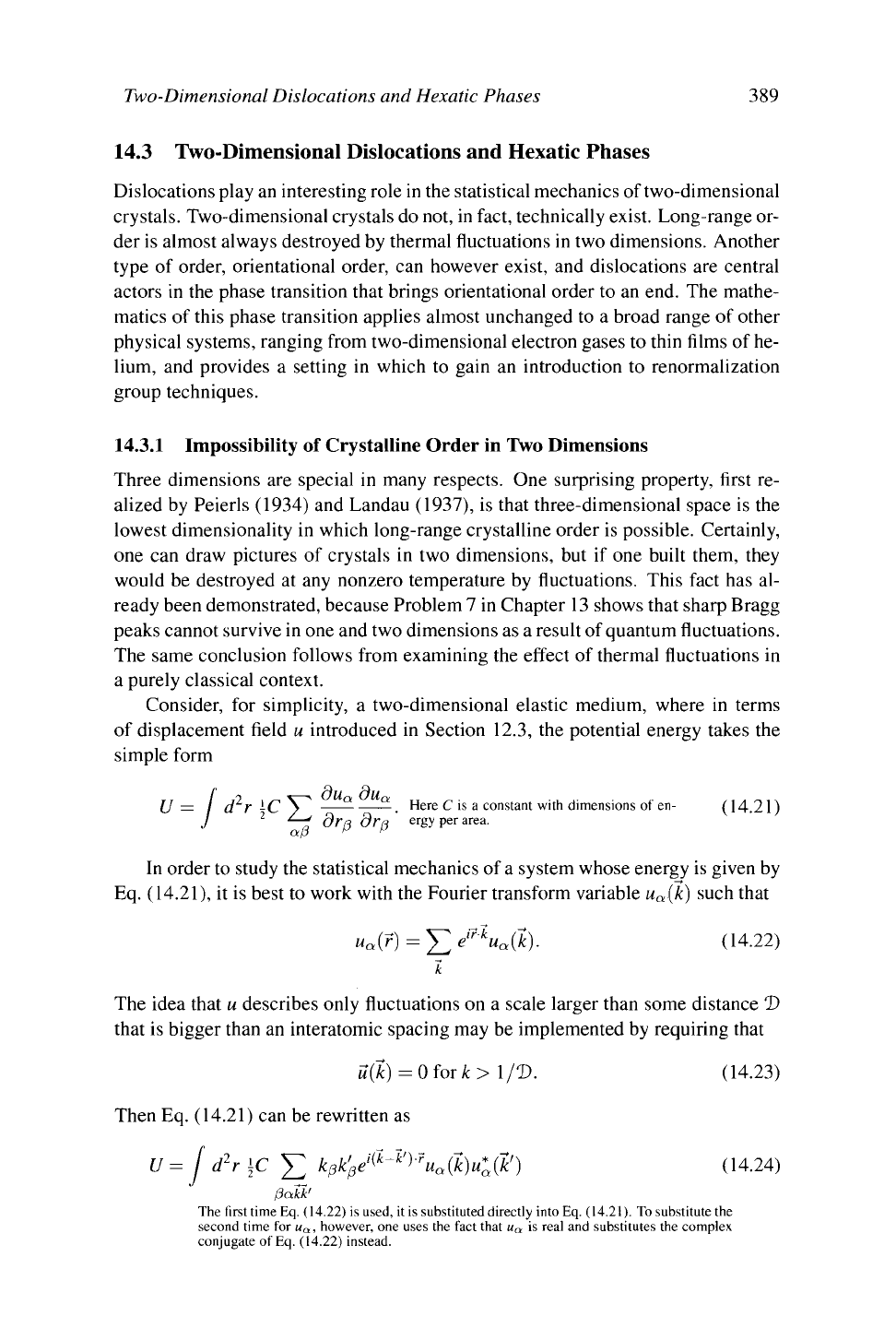
Consider, for simplicity, a two-dimensional elastic medium, where in terms
of displacement field u introduced in Section 12.3, the potential energy takes the
simple form
/
■) v-^ du
a
du
a
d r -C y . Here C is a constant with dimensions of en- (14.21)
2
*—£ drn drg ergy per area.
In order to study the statistical mechanics of
a
system whose energy is given by
Eq. (14.21), it is best to work with the Fourier transform variable u
a
(k) such that
u
a
(r) = Y^e
rrl
u
a
(k). (14.22)
The idea that u describes only fluctuations on a scale larger than some distance
T>
that is bigger than an interatomic spacing may be implemented by requiring that
u(k) = 0 for k> I/T>. (14.23)
Then Eq. (14.21) can be rewritten as
U = J d
2
r \C £ k
ß
k'
ß
e<
k
~
l
'y
r
u
a
(k)u*
a
{k') (14.24)
ßakk'
The first time Eq. (14.22) is used, it is substituted directly intoEq. (14.21). To substitute the
second time for «
Q
, however, one uses the fact that u
a
is real and substitutes the complex
conjugate of Eq. (14.22) instead.
390 Chapter 14. Dislocations and Cracks
VC
y^ k
\u
a
(k)\
UseV^, =fd
2
re
i(
-
l
-
V
>'
?
,
where Vis the
two-dimensional volume of the system.
(14.25)
ak
With this expression for the energy of a slightly deformed system, one can
perform statistical averages. First, examine the expectation value of the average
square displacement of particles from their original location, which is
(u
2
)
</
d
2
r
y UßCr)ußCr)) Here V is the two-dimensional volume of the (14.26)
^-—' system, and () is a thermal average.
= Σ<Μ*)Ι
2
>
ßk
This calculation is identical to the one that (14.27)
leads to Eq. (14.25), except that the deriva-
tives with respect to rß are missing.
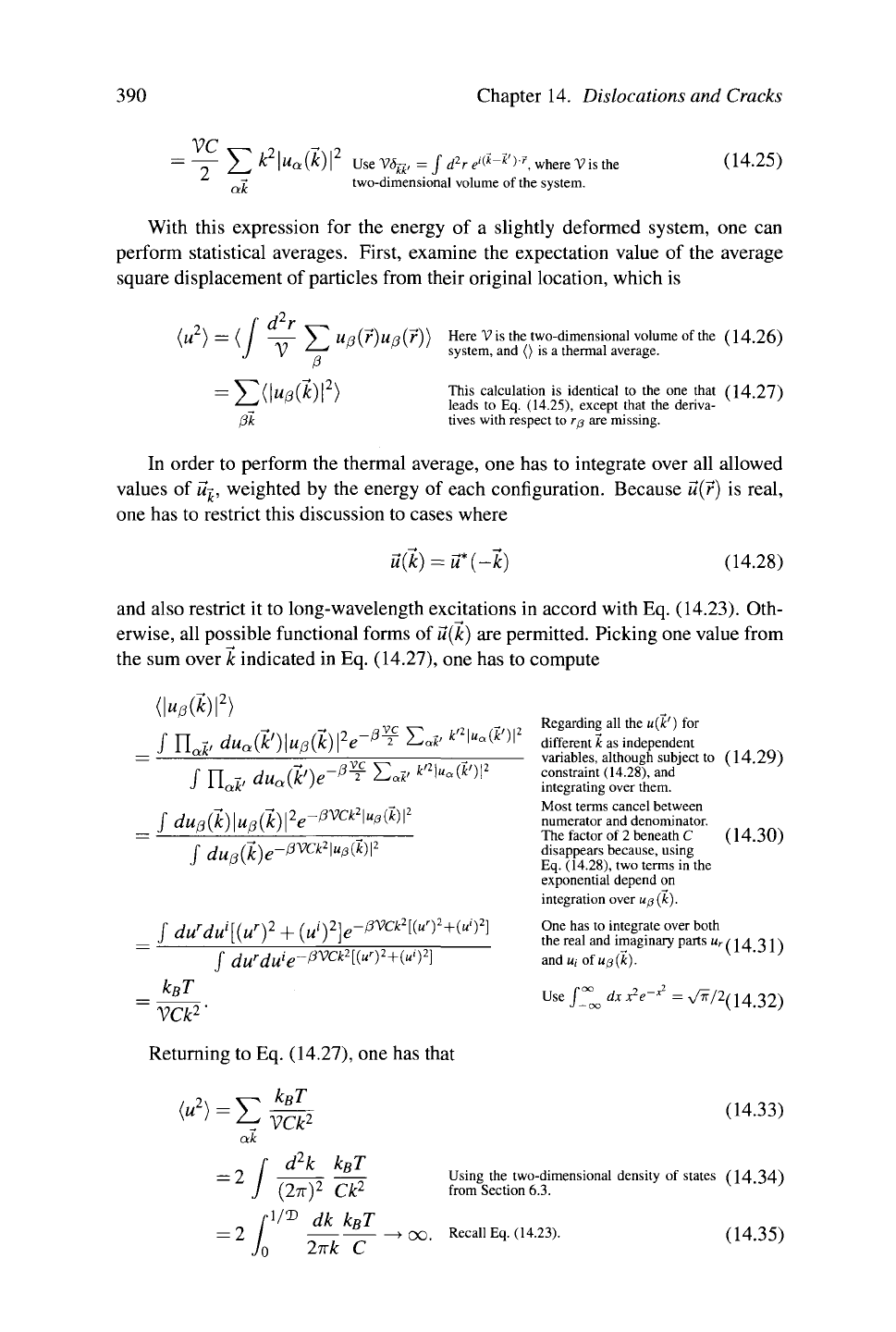
In order to perform the thermal average, one has to integrate over all allowed
values of u^, weighted by the energy of each configuration. Because u(r) is real,
one has to restrict this discussion to cases where
u(k) =
u*(—k)
(14.28)
and also restrict it to long-wavelength excitations in accord with Eq. (14.23). Oth-
erwise, all possible functional forms of u(k) are permitted. Picking one value from
the sum over k indicated in Eq. (14.27), one has to compute
(\u
ß
(k)\
2
)
I EU du
a
(k')\u
ß
(k)\
2
e-
■Ρψ ΣαΡ *'
2
ΙΜ*')Ι
2
!Yl
al
,du
a
Çk>)e-^T.
a
v^C
k
>)?
J du
ß
(k)\uß(k)\
7
-ßVCk
2
\u
ß
(k)\
2
J du
ß
(k)e-P
vck2
MW
J
du
r
du
i
[(u
r
)
2
+
(„y]
g
-roW+(*0
2
]
/ durdvte-PKWY+wn
k
B
T
'
VCk
2
'
Returning to Eq. (14.27), one has that
k
B
T
<"
Z
>
^
VCk
2
ak
. d
2
k k
B
T
(2TT)
2
Ck
2
V» dk k
B
T
2^k~C~
Regarding all the u(k') for
different k as independent
variables, although subject to (14.29)
constraint (14.28), and
integrating over them.
Most terms cancel between
numerator and denominator.
The factor of
2
beneath C (14.30)
disappears because, using
Eq. (14.28), two terms in the
exponential depend on
integration over
up(k).
One has to integrate over both
the real and imaginary parts Ur(\A
"Î1
Λ
and
Ui
of
up(k).
Use
ΓΊ
à**'"*
=
v^/2(i4.32)
(14.33)
Using the two-dimensional density of states (14.34)
from Section 6.3.
OO.
Recall Eq. (14.23).
(14.35)
Two-Dimensional Dislocations and Hexatic Phases
391
The integral in Eq. (14.35) diverges logarithmically for small k, just where
linear elasticity should be working the best. Assuming that deviations of the crys-
tal from equilibrium are small has led inevitably to the conclusion that they are
infinitely large and that long-range translational order is impossible in two dimen-
sions.
This result is known as the Mermin-Wagner theorem, after Mermin and
Wagner (1966). It does not mean that real two-dimensional systems are liquid at
any nonzero temperature, nor does it mean that lightning will smite him dead who
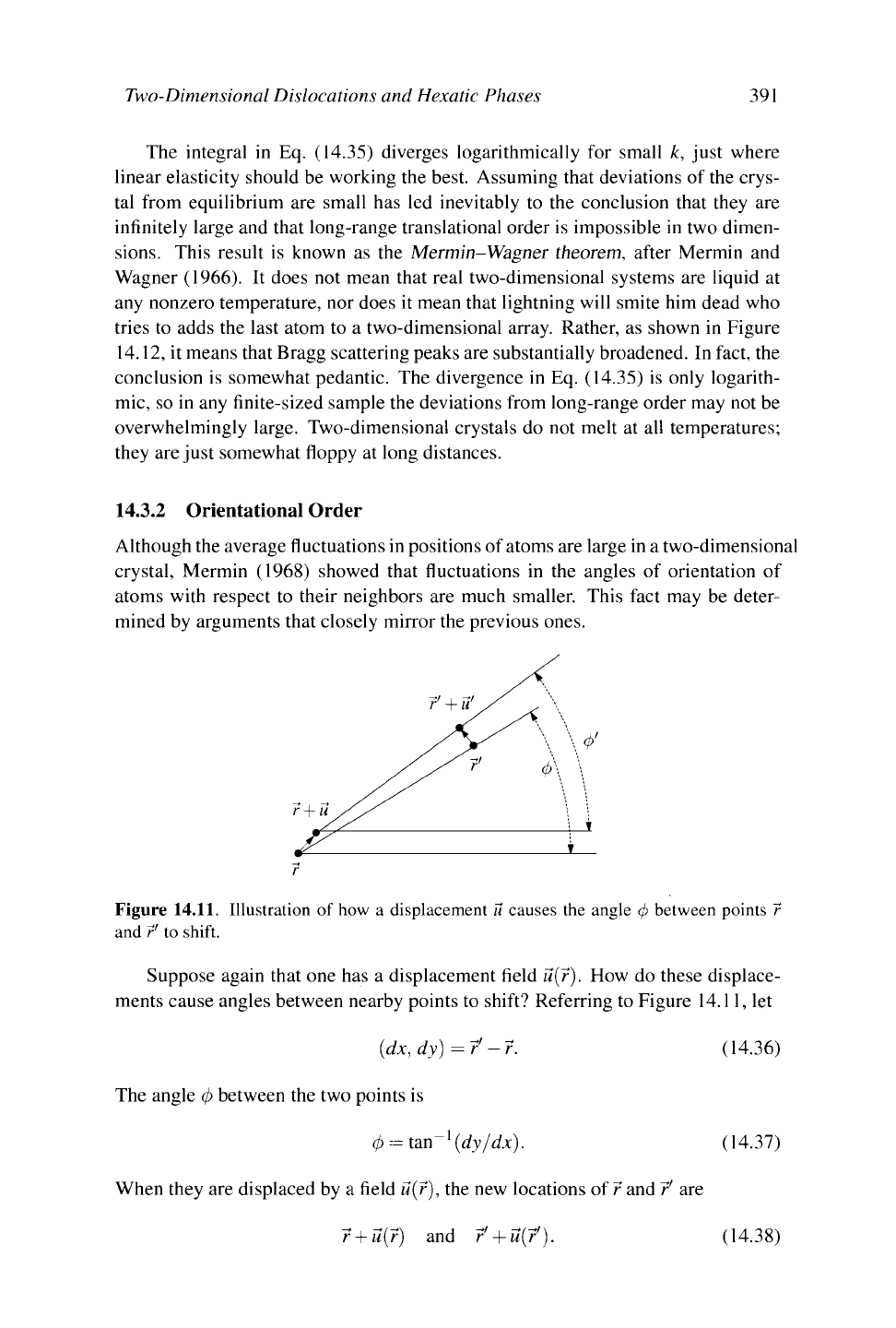
tries to adds the last atom to a two-dimensional array. Rather, as shown in Figure
14.12,
it means that Bragg scattering peaks are substantially broadened. In fact, the
conclusion is somewhat pedantic. The divergence in Eq. (14.35) is only logarith-
mic,
so in any finite-sized sample the deviations from long-range order may not be
overwhelmingly large. Two-dimensional crystals do not melt at all temperatures;
they are just somewhat floppy at long distances.
14.3.2 Orientational Order
Although the average fluctuations in positions of
atoms
are large in a two-dimensional
crystal, Mermin (1968) showed that fluctuations in the angles of orientation of
atoms with respect to their neighbors are much smaller. This fact may be deter-
mined by arguments that closely mirror the previous ones.
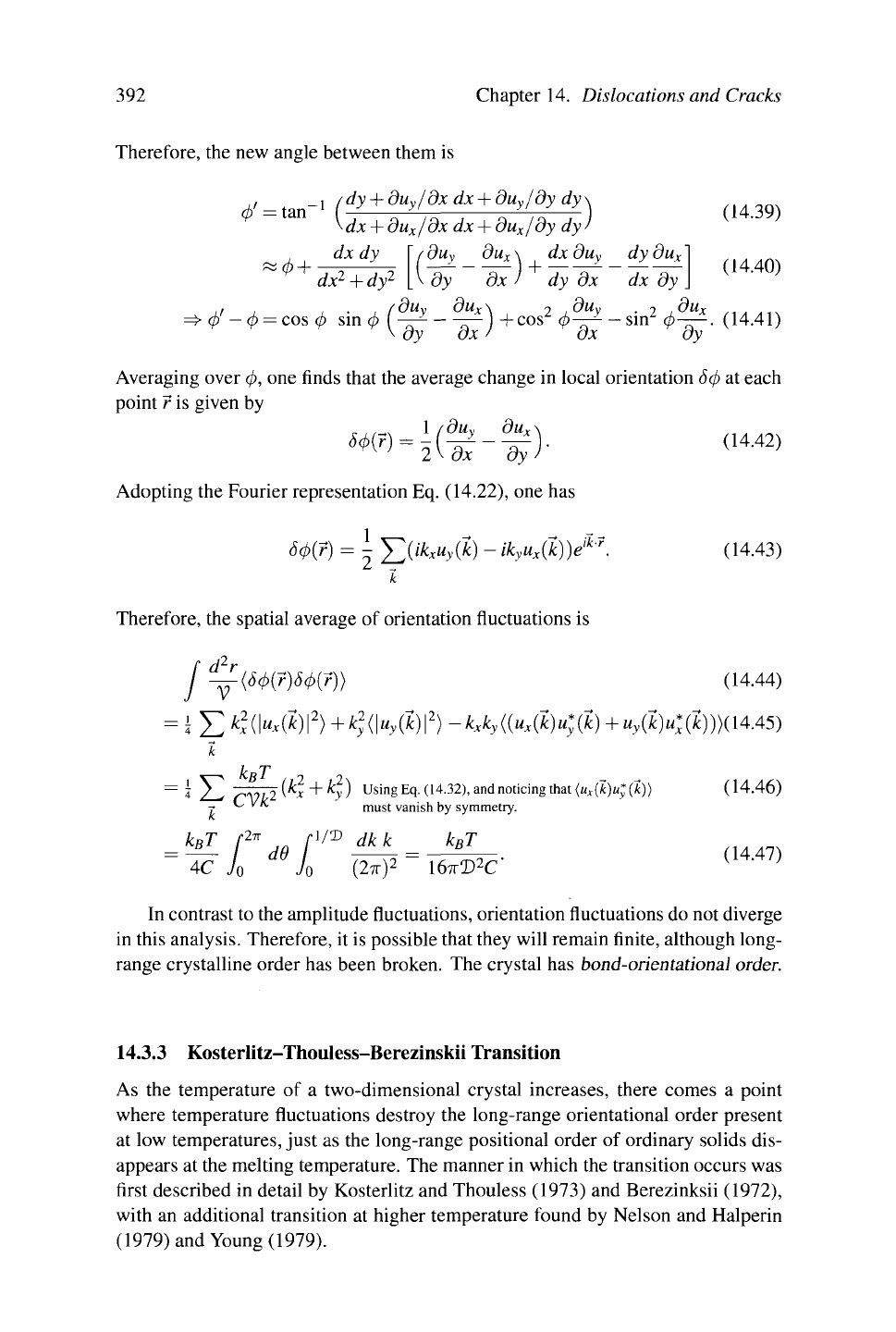
Figure
14.11.
Illustration of how a displacement
U
causes the angle φ between points r
and r' to shift.
Suppose again that one has a displacement field «(?). How do these displace-
ments cause angles between nearby points to shift? Referring to Figure
14.11,
let
(dx,dy)
= r'-r. (14.36)
The angle φ between the two points is
φ = tan'
1
(dy/dx). (14.37)
When they are displaced by a field w(r), the new locations of
7
and r' are
r + u(r) and r' +
u(r').
(14.38)
392 Chapter 14. Dislocations and Cracks
Therefore, the new angle between them is
z/
=tan
-i
f
d
y+
du
y/
dx
dx
+
du
y/°y
d
y\
(1439)
^ dx + du
x
/dx dx + du
x
/dy dy
'
dx dy
>+■
dx
2
+ dy
2
' du
y
du
x
\ dx du
y
dy du
x
- dy dx ' dy dx dx dy
(14.40)
,/ , · , /duy du
x
\ 2
,
du
y
.
7
,
du
x /Λ
Λ
ΛΛ
^
^φ'
-φ = οο$φ sin<£
(—
Σ
-—-
+cos
2
(^^-sin
2
φ—
1
. (14.41)
V
dy dx ' dx dy
Averaging over φ, one finds that the average change in local orientation δφ at each
point r is given by
Adopting the Fourier representation Eq. (14.22), one has
δ
Φ<?)
= \ Yj&xVh>$) - ikyu
x
(k)y
l7
. (14.43)
k
Therefore, the spatial average of orientation fluctuations is
^-(δφ{7)δφ{7)) (14.44)
Ç k
2
x
(\u
x
(k)\
2
) +k
2
y
(\u
y
(k)\
2
) -k
x
k
y
((u
x
(k)u;(k) +u
y
(k)u*
x
(k)))(l4A5)
k
k
B
T
ϊΣ^νΠ^
+ ^) UsingEq.(14.32),andnoticingthat<^(*)M;(A)> (14.46)
r
must vanish by symmetry.
kßT [
2π
,
n
PI"
13
dkk k
B
T
Jo
Jo
AC Jo Jo
(2TT)
2
16TTD
2
C'
(14.47)
In contrast to the amplitude fluctuations, orientation fluctuations do not diverge
in this analysis. Therefore, it is possible that they will remain finite, although long-
range crystalline order has been broken. The crystal has bond-orientatioml order.
14.3.3 Kosterlitz-Thouless-Berezinskii Transition
As the temperature of a two-dimensional crystal increases, there comes a point
where temperature fluctuations destroy the long-range orientational order present
at low temperatures, just as the long-range positional order of ordinary solids dis-
appears at the melting temperature. The manner in which the transition occurs was
first described in detail by Kosterlitz and Thouless (1973) and Berezinksii (1972),
with an additional transition at higher temperature found by Nelson and Halperin
(1979) and Young (1979).