
Marder M.P. Condensed Matter Physics
Подождите немного. Документ загружается.

The Kubo-Greenwood
Formula
623
The frequency w
p
is the plasma frequency, and it generalizes the quantity de-
fined by Eqs. (20.31) and (20.32). The optical mass m
opt
is defined by Eq. (20.52).
Thus general lessons to learn from Eq. (20.49) are as follows:
1.
A collection of absorbing modes whose frequency lies well below the probe
frequency w
m
acts like a collection of unbound electrons, and its influence
falls off as l/io
1
.
2.
A collection of absorbing modes whose frequency lies well above the probe
frequency
Lu
m
acts like a high-frequency dielectric constant e°°.
20.4 The Kubo-Greenwood Formula
One of the most important quantum-mechanical calculations in the theory of solids
concerns the linear response of a collection of electrons to an externally applied
electromagnetic field. Not only does this calculation permit one to find the electri-
cal conductivity of solids, it describes their interaction with light and also permits
a self-consistent description of the interaction of electrons with one another. The
strength of the calculation is that it starts from quantum-mechanical principles,
introducing few phenomenological assumptions. This feature is also its greatest
weakness, and for the purposes of studying thermoelectric properties of solids the
Boltzmann equation is more powerful.
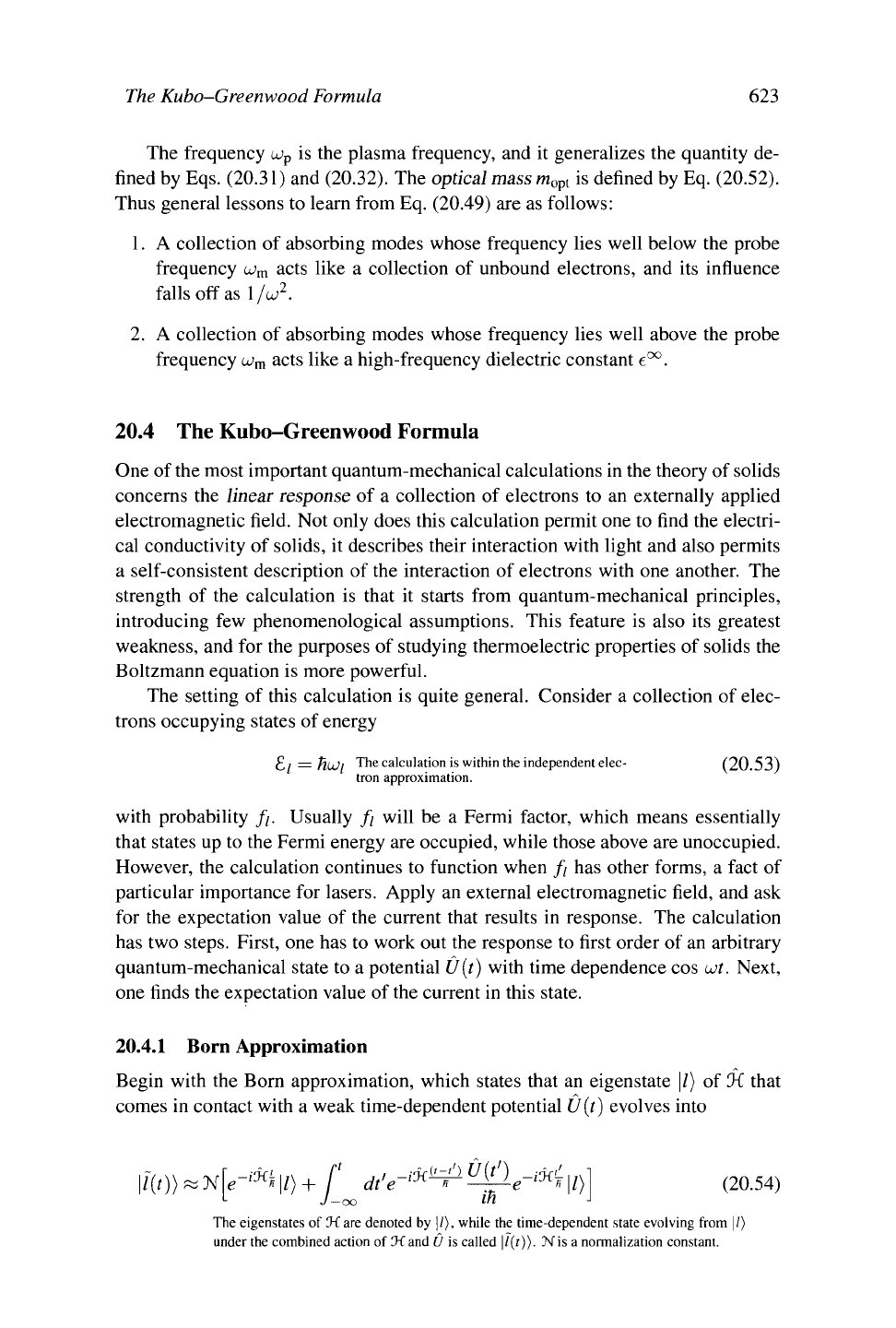
The setting of this calculation is quite general. Consider a collection of elec-
trons occupying states of energy
£.l=hcüi The calculation is within the independent elec- (20.53)
tron approximation.
with probability //. Usually // will be a Fermi factor, which means essentially
that states up to the Fermi energy are occupied, while those above are unoccupied.
However, the calculation continues to function when // has other forms, a fact of
particular importance for lasers. Apply an external electromagnetic field, and ask
for the expectation value of the current that results in response. The calculation
has two steps. First, one has to work out the response to first order of an arbitrary
quantum-mechanical state to a potential U(t) with time dependence cos uit. Next,
one finds the expectation value of the current in this state.
20.4.1 Born Approximation
Begin with the Born approximation, which states that an eigenstate |/) of "K that
comes in contact with a weak time-dependent potential U(t) evolves into
/>)) « ttfe-'**
|/>
+ / dt'e-^^r
1
Wile-™!;
\l)
(20.54)
oo
The eigenstates of 'K are denoted by ]/), while the time-dependent state evolving from |/)
under the combined action of 3-fand Û is called
|/(/)).
Nis a normalization constant.
624 Chapter 20. Phenomenological Theory
=
N
e
-
l0J
"
\l) +
J2
f dt'liy-^^'-^^^-e-^'-^"'] (20.55)
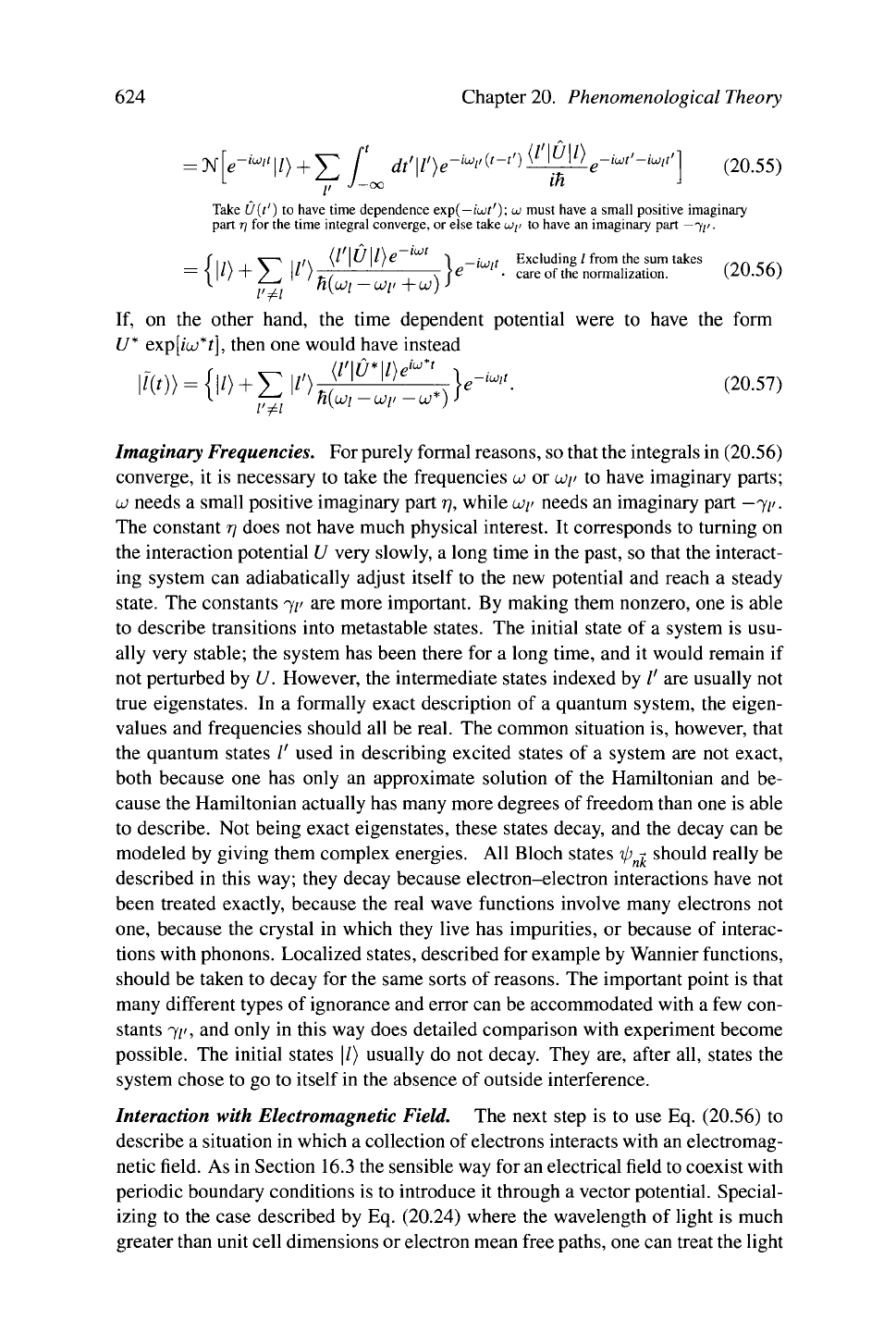
Take U(t') to have time dependence exp(—iuit'); to must have a small positive imaginary
part
77
for the time integral converge, or else take üj
t
i to have an imaginary part —y
t
i.
f\l\<\^\l'\
V I^IO
e lUJ
' \ -iuj.t Excluding / from the sum takes
= » t/J' /w ; 7 (
e
■ care of the normalization. (2U.56)
L
,Y/ Δ(w,-o;//+a;)J
If, on the other hand, the time dependent potential were to have the form
U*
exp[ico*t],
then one would have instead
<
«-^ (l'\Û*\l)e
iu}
*' 1
i'('>Hi'>
+
gi^-!^.)R
w
<
2
°-
57
>
Imaginary
Frequencies.
For purely formal reasons, so that the integrals in (20.56)
converge, it is necessary to take the frequencies
to
or
UJ/I
to have imaginary parts;
u)
needs a small positive imaginary part
r],
while
U[i
needs an imaginary part
—7//.
The constant
r\
does not have much physical interest. It corresponds to turning on
the interaction potential U very slowly, a long time in the past, so that the interact-
ing system can adiabatically adjust itself to the new potential and reach a steady
state.
The constants 7// are more important. By making them nonzero, one is able
to describe transitions into metastable states. The initial state of a system is usu-
ally very stable; the system has been there for a long time, and it would remain if
not perturbed by U. However, the intermediate states indexed by /' are usually not
true eigenstates. In a formally exact description of a quantum system, the eigen-
values and frequencies should all be real. The common situation is, however, that
the quantum states /' used in describing excited states of a system are not exact,
both because one has only an approximate solution of the Hamiltonian and be-
cause the Hamiltonian actually has many more degrees of freedom than one is able
to describe. Not being exact eigenstates, these states decay, and the decay can be
modeled by giving them complex energies. All Bloch states
ip
n
-^
should really be
described in this way; they decay because electron-electron interactions have not
been treated exactly, because the real wave functions involve many electrons not
one,
because the crystal in which they live has impurities, or because of interac-
tions with phonons. Localized states, described for example by Wannier functions,
should be taken to decay for the same sorts of
reasons.
The important point is that
many different types of ignorance and error can be accommodated with a few con-
stants 7/', and only in this way does detailed comparison with experiment become
possible. The initial states |/) usually do not decay. They are, after all, states the
system chose to go to itself in the absence of outside interference.
Interaction with Electromagnetic Field. The next step is to use Eq. (20.56) to
describe a situation in which a collection of electrons interacts with an electromag-
netic field. As in Section 16.3 the sensible way for an electrical field to coexist with
periodic boundary conditions is to introduce it through a vector potential. Special-
izing to the case described by Eq. (20.24) where the wavelength of light is much
greater than unit cell dimensions or electron mean free paths, one can treat the light
The Kubo-Greenwood
Formula
625
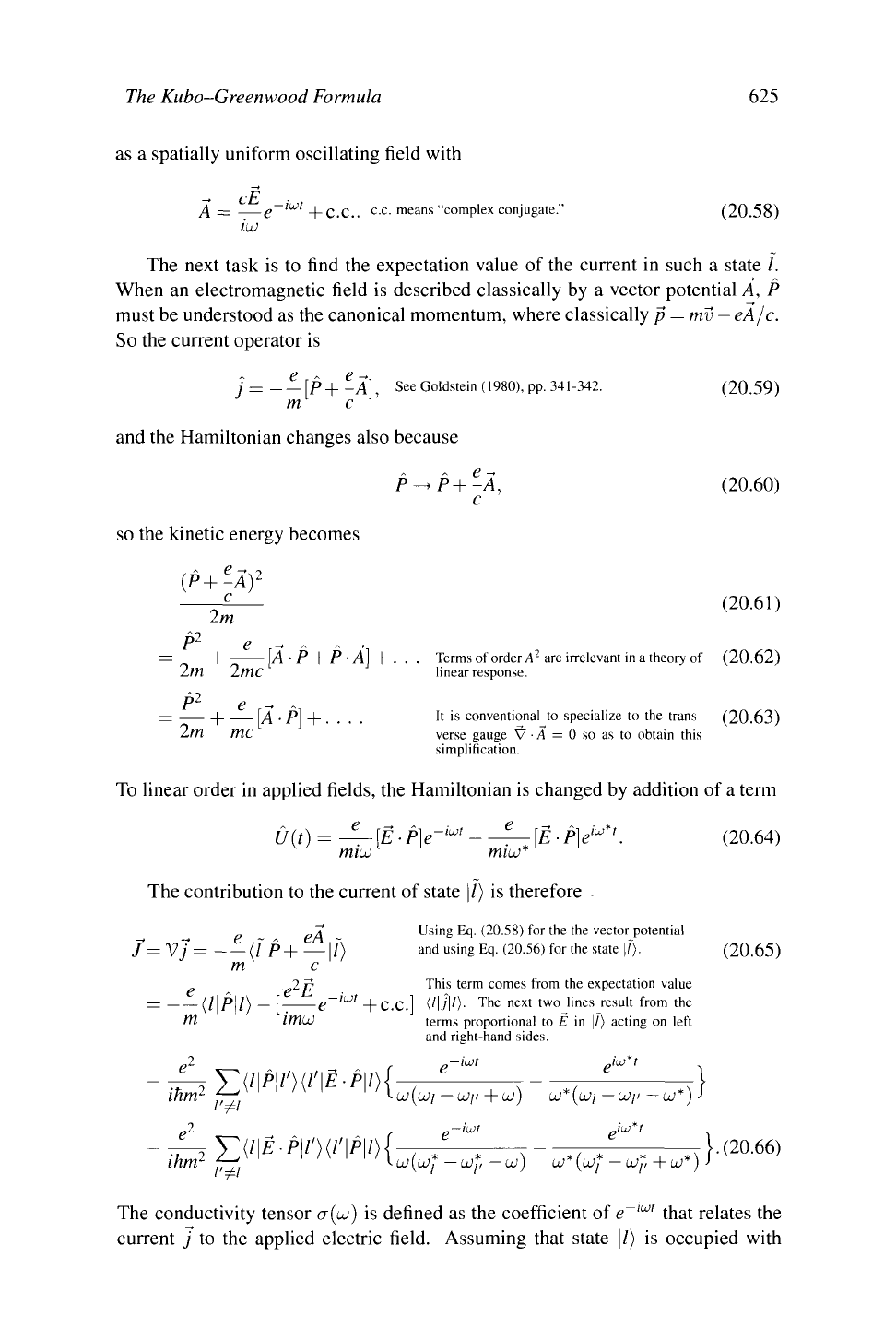
as
a
spatially uniform oscillating field with
cÈ
_
A =
e~
,iU>
-\-C.C.. c.c.
means "complex conjugate." (20.58)
The next task
is to
find
the
expectation value
of
the current
in
such
a
state
/.
When
an
electromagnetic field
is
described classically
by
a
vector potential
A,
P
must be understood as the canonical momentum, where classically
p =
mv
—
eAjc.
So the current operator
is
j
=
—
— [p+
-A], See Goldstein (1980), pp. 341-342. (20.59)
m
c
and the Hamiltonian changes also because
P-*P+-A,
(20.60)
c
so the kinetic energy becomes
{P+-AY
c
2m
P
2
e ^
(20.61)
H
[A-P + P-A]+ . . .
Terms
of
order/I
2
are irrelevant in a theory
of
(20.62)
2m 2mc
linear response.
P
2
e
r
- ~
n
= 1 \A
■
P\
-\-
. . . . "
>
s
conventional
to
specialize
to
the
trans- (20.63)
2m mc
verse gauge
V
■
A
= 0 so as to
obtain this
simplification.
To linear order in applied fields, the Hamiltonian
is
changed by addition
of
a term
Û(t) =
—\È-P]e-
iu}
'--^[Ë-P]e^'.
(20.64)
v
;
micu
l
J
miu*
L
J
The contribution
to
the current
of
state
|/) is
therefore
.
~t Using Eq. (20.58)
for
the
the
vector potential
J = Vj =
(I\P-\
\!)
and using Eq. (20.56)
for
the state
|/~).
(20.65)
m
c
2p This term comes from
the
expectation value
=
(/|P|/)
—
f
e~
lwt
+C.C.1 ClilO-
The
next
two
lines result from
the
m imtü terms proportional
to
E in |/)
acting
on
left
and right-hand sides.
e
2
*-, -, - r e~
iw
'
e
iu)
*'
i
-
4^
Y(l\P\l'){l'\E-P\l){-r-^
T r-
1
A
ihm
2
ff/
1
'
M !
' '
^ÜJ(UI-U,>+UJ) UJ*(UJI-LÜI>-U;*)}
e
2
(/lE-Pl/'X/'l/
5
!/)!—
—
-1.(20.66)
The conductivity tensor a{oj)
is
defined
as the
coefficient
of
e~'
w
' that relates
the
current
j
to the
applied electric field. Assuming that state
|/) is
occupied with
626 Chapter 20. Phenomenological Theory
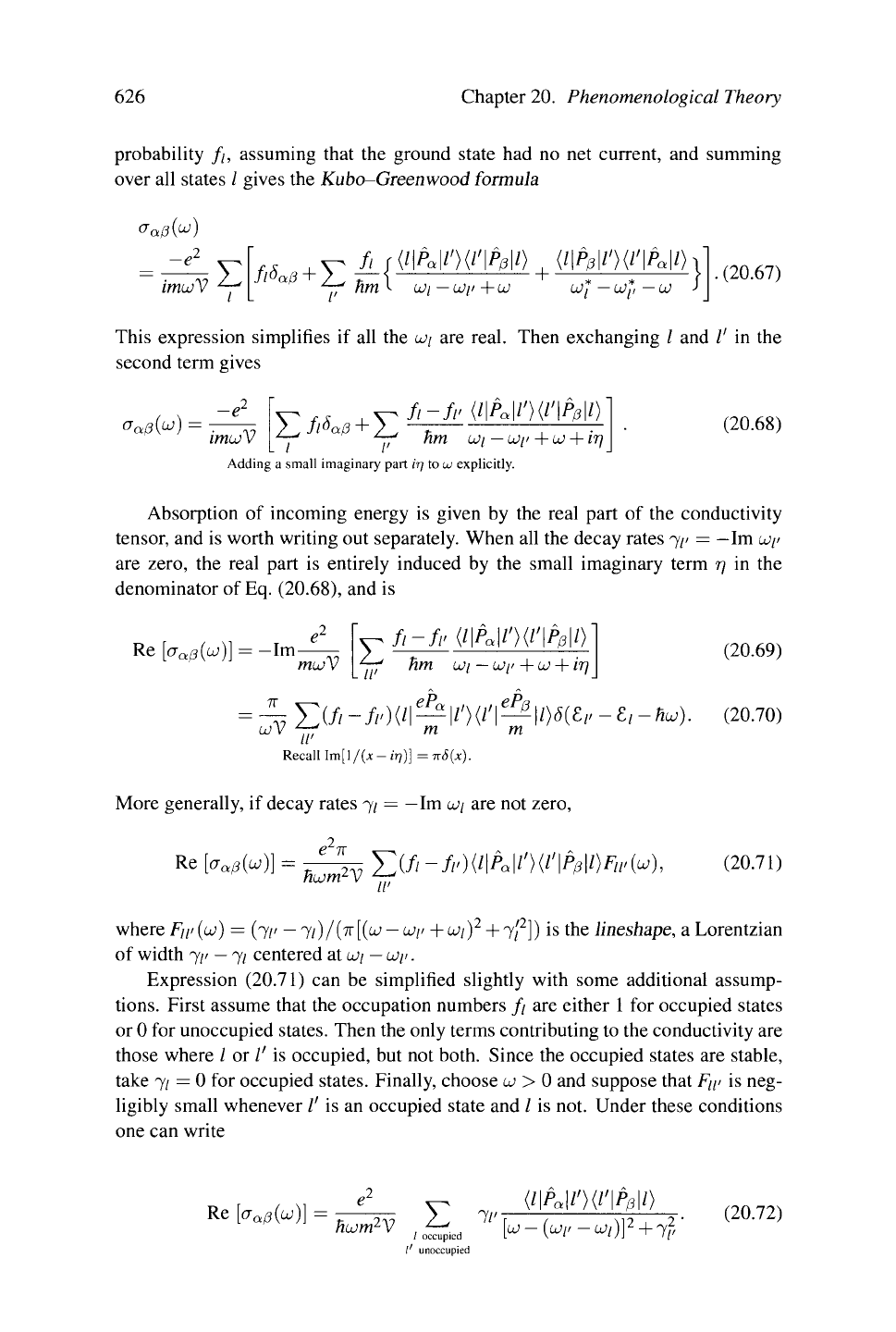
probability //, assuming that the ground state had no net current, and summing
over all states / gives the Kubo-Greenwood formula
°aß(u)
imuV
E
// f{i\p
a
\i')(i'\p
ß
\i)
{
{i\p
ß
\i')(i'\p
a
\i)
*-rf nm i-
u>i —
u>['
+
u)
uij
—
u)J,
— ui
. (20.67)
This expression simplifies if all the w/ are real. Then exchanging / and /' in the
second term gives
cr
a
ß(uj)
imcoV
E
fi
ö
ȧ +
E
fl-fy(l\P
a
\l')(l'\Pß\l)
Hm LÜI—LÜI'+(JJ + irj
i v
Adding
a small imaginary part
i-q
to
LO
explicitly.
(20.68)
Absorption of incoming energy is given by the real part of the conductivity
tensor, and is worth writing out separately. When all the decay rates 7/' = —Im uif
are zero, the real part is entirely induced by the small imaginary term r\ in the
denominator of Eq. (20.68), and is
Re [a
aß
{oj)} = -Im
musV
E
ft-fv{i\p
a
\i'){i'\h\i)'
Hm WI—U)[I+UJ + ir\
TÏ
£(//-//'WI
—1/')</'|^|/><5(£,'
w mm
£;
—Hui).
Recall
Im[l/(jc-
ir))]
=-K5(X).
(20.69)
(20.70)
More generally, if decay rates 7/ = — Im
LUI
are not zero,
Re [(J
a
ß(uj)}
2
e IT
hu)m
2
V
E(/'
-fi>)(l\P
a
\l')(l'\Pß\l)Fu>(u), (20.71)
where
FU>(UJ)
= (7/'
—
ji)/(TV[(LJ
—
UJI>
+w;)
2
+
7
/
'
2
])
is the Hneshape, a Lorentzian
of width 7//
—
7/ centered at
CJ;
—
uii>.
Expression (20.71) can be simplified slightly with some additional assump-
tions.
First assume that the occupation numbers // are either 1 for occupied states
or 0 for unoccupied states. Then the only terms contributing to the conductivity are
those where / or /' is occupied, but not both. Since the occupied states are stable,
take 7/ = 0 for occupied states. Finally, choose to > 0 and suppose that Fut is neg-
ligibly small whenever /' is an occupied state and / is not. Under these conditions
one can write
Re [a
a
ß(u)}
htum
2
V
E
IV
! occupied
/' unoccupied
(l\P
a
\l')(l'\P
ß
\l)
[u;-(uj
r
-uji)}
2
+ 'yj,
(20.72)
The Kubo-Greenwood
Formula
627
Equation (20.67) has a dual interpretation. For sufficiently small values of
u>
it
reduces to Eq. (16.29), and it describes the motion of electrons within a single band
with an effective mass. However, as
ui
rises toward optical frequencies, the effec-
tive mass picture breaks down, and Eq. (20.67) now describes transitions between
levels that become possible whenever there is a resonance such that
w/<
—UJI=UJ.
For a material in equilibrium, only low-lying states are occupied, higher-lying
states are empty, and the real part of the conductivity tensor (20.71) describes the
absorption of energy from incoming waves. However, if a material can be pre-
pared out of equilibrium, with higher-lying states occupied and low-lying states
empty, the sign of energy absorption reverses, and Eq. (20.71) describes stimulated
emission. Therefore, this equation describes the basic operation of the laser.
20.4.2 Susceptibility
A slight variant on the preceding calculation is valuable in order to produce es-
timates of the interactions of electrons with one another. The calculation differs
from the previous one in several respects. First and most important, electrical po-
tentials created by electrons in solids have wavelengths on the order of interatomic
spacings. The q
—>
0 limit employed until now is not legitimate, and the perturbing
potential U must be taken to behave as
U{q,uj)e^
7
'
iwt
+c.c. (20.73)
In compensation for the difficulties introduced by the extra spatial dependence of
U, it is customary to take the unperturbed electron states |/) simply to be plane
waves, not so much because the approximation is carefully justified as because
otherwise the expressions become unwieldy. The calculation is also simplified by
focusing upon the expectation value of the charge density rather than upon the
current, making expressions somewhat more compact.
The electron density n is defined to be
n(r, 0 = X) fl(Kt)\r)(m))- (20.74)
If one uses the simplification that \l) is a plane wave, takes the potential U to be an
electrical potential
U(q,
to) = ~eV(q, u), (20.75)
and proceeds in just the fashion that leads to Eq. (20.68), Problem 5 shows that
-en(q,
u>)
= xdq, v)V(q, u) (20.76)
with
xM")
=
e
2
Y.^ ^"^ ■
(20.77)
rr" nv
toy . ^ —
to-;
— u)
628
Chapter 20. Phenomenological Theory
Xc is not the dielectric susceptibility. It relates charge density to applied field,
rather than dipole moments to field. Its relation to the dielectric constant
e
is deter-
mined by writing
V
2
V = V
2
V
ex
t +
47re«
= 47ren
ext
+ 47ren SeeEq.(20.i0). (20.78)
^V
2
V = -V-D +
47T(?n
(20.79)
=>•
-q
2
V(q, to) = -iq-D +
47ren(q,
u) (20.80)
=* ~q
2
V{q, u) = -iq-b-4TT
Xc
{q, w)V(q, w) (20.81)
=►
(4vrXc-^
2
)^(^, w) = -iq-D (20.82)
=>•
{q
2
-
ATTXC)E
= q(q
■
D) Because £ = -iV^V. (20.83)
For longitudinal vibrations, where q-D
—
qD, one therefore has
e(& w) =
1
- ^^ (20.84)
In this form, e(q,
LO)
is called the dynamic Lindhard dielectric function.
20.4.3 Many-Body Green Functions
The Born approximation is only the first step in formal schemes that track the
effects of perturbations. The most powerful formal methods employ Green's func-
tions similar to those in Section 18.4.2, but generalized to describe many interact-
ing electrons. These methods make it possible to obtain a variety of
results,
includ-
ing expressions for electrons interacting with light and with each other. Many of
the results can also be obtained by more elementary means, although the elemen-
tary derivations are not as systematic and are sometimes less convincing. Some of
the many books describing many-body Green functions are Kadanoff and Baym
(1962),
Abrikosov et al. (1965), and Fetter and Walecka (1971).
Problems
1.
Numerical evaluation of Kramers-Kronig relations: While the Kramers-
Kronig relations in the form (20.39) are valuable for analytical work, they are
almost useless for practical evaluation of response functions. The integrals
are very singular and are hard to evaluate accurately.
One practical way to employ these relations is by returning to the arguments
from which they originally were derived. To illustrate the process, suppose
that the imaginary part of a dielectric constant has been measured and that the
experimental data give
ImeH = e
2
M « -^-«"A")
2
-
1
)
2
/* +
10e
-((-M)
2
-0
2
/5]
(20
.85)
with
u}\
= 4 Hz and w
2
= 13 Hz. (20.86)
The goal is to find Re[e(a;)] =
e\
(a;).
Problems
629
(a) Recall that e(t)
is
real. Show that
e\
(UJ)
is
an even function
of
LO
and that
62(0;) is an odd function of
u.
(b) Show that the inverse Fourier transform of e\{u) is an even function of
t,
and
that the inverse Fourier transform of 62(0;) is an odd function of
t.
(c) Given
e
2
(t) =
j^e-^e
2
(u
J
),
(20.87)
how can
ex
{t) =
j
^e-^'zxiu) (20.88)
be determined, using the fact that e(t)
=
0 for
t
< 0?
(d) Making use of these suggestions and employing numerical fast Fourier trans-
forms,
find the real part of the dielectric constant given by Eq. (20.85)
2.
Connection between Kubo formula and Boltzmann equation:
It is
reas-
suring to verify that the Boltzmann equation does indeed emerge as the low-
frequency limit of the Kubo formula for the conductivity. Expression (20.67)
becomes somewhat problematic
in
this limit, because from Eq. (20.58)
the
vector potential and hence the current diverge as
LO
—>
0. The dissipative pro-
cesses preventing this growth
can be
represented
by
taking
u
—> ui
+
i/r.
Making this substitution and sending the real part,
u, to
zero, verify that
Eq. (20.67) coincides with a result of the Boltzmann approach.
3.
Cubic symmetry: Show that
if
a conductivity tensor
a
a
ß is
invariant under
the cubic symmetry operations, then it must be a multiple of the unit tensor.
4.
Sums of
poles:
Consider the function
30
,
f(cv) =
J2 -•
(20-89)
^
LO
-
LO[
- IT]
(a) Plot this function for
LO
G [-1, 2] when
LO,
=
1/30 for
77
=
10~
4
,
77
=
10~
2
,
and
77
=
0.1.
(b) What integral does the sum correspond to for the larger values of
77?
What is
the value of the integral, and does it compare well with the sum?
(c) The function
/
makes
a
qualitative transition between one type of behavior
for small
77
and another type
of
behavior
for
large
77.
What determines the
value of
77
at which the transition takes place?
(d) What does this problem reveal about the relation between eigenvalues
of a
quantum mechanical Hamiltonian and the idea of a density of states? What is
the significance of
77?
630 Chapter 20. Phenomenological Theory
5.
Susceptibility
of
the electron gas:
(a) Writing the electron density
n
defined
in
Eq. (20.74)
in k
space, show that
n(q,
t) = j
dre-
r
^n{7,
t) = £
fi(ï\qi)(q + qi\ï) (20.90)
(b) Consider
a
potential
of
the form
U(r,
t) =
U(q,
Lü)e^
7
-
iu;t
/V.
(20.91)
Take
the
unperturbed states
|/) to be
plane waves. Show that
Eq.
(20.56)
produces
for n
eU(q,
u) y^ 1
V
n
ka
**ft
J
k+q
^
k
-^k+q
+UJ
^k-^l+q-^
(20.92)
To obtain this result, drop
a
term proportional
to
8$$
in
order
to
focus upon
spatially nonuniform conditions.
(c) Consequently, derive Eqs. (20.76)
and
(20.77).
6. Static Lindhard dielectric function:
(a) By relabeling the first sum
in
Eq. (20.77), show that
for
u>
= 0,
Xc
—
y /_^
2
fk~
la
)
1
q-k
m
+
fe
(20.93)
(b) Transform
Eq.
(20.93) into
an
integral over
k in
polar coordinates. First
integrate over
cos 6, and
next integrate over
k,
from
0 to kf. The
answer
should
be
me2(
44-*
2
)log(f^f)
+
4^
Xc
= -^ö ^-ql _
(m94)
(c) Take the limit
q
—>
0
and show that
Xc
8?
me kf
'
7T
2
h
2
'
(20.95)
7.
Screening
of
bare nuclei:
The
Lindhard dielectric function,
Eq.
(20.84),
can
be
used
in a
wide variety
of
physical contexts, both dynamic
and
static,
to solve problems involving
the
interaction
of
many electrons. Consider,
for
example,
a
nucleus
of
charge
Z
surrounded
by a
cloud
of
Z electrons, which
produces
a
potential
U for
the purposes
of
Eq.
(20.73) equal
to
U
ext
(q)
4-irZe
2
This
is the
Fourier transform
of
the Coulomb
potential —Ze
2
/r.
(20.96)
References 631
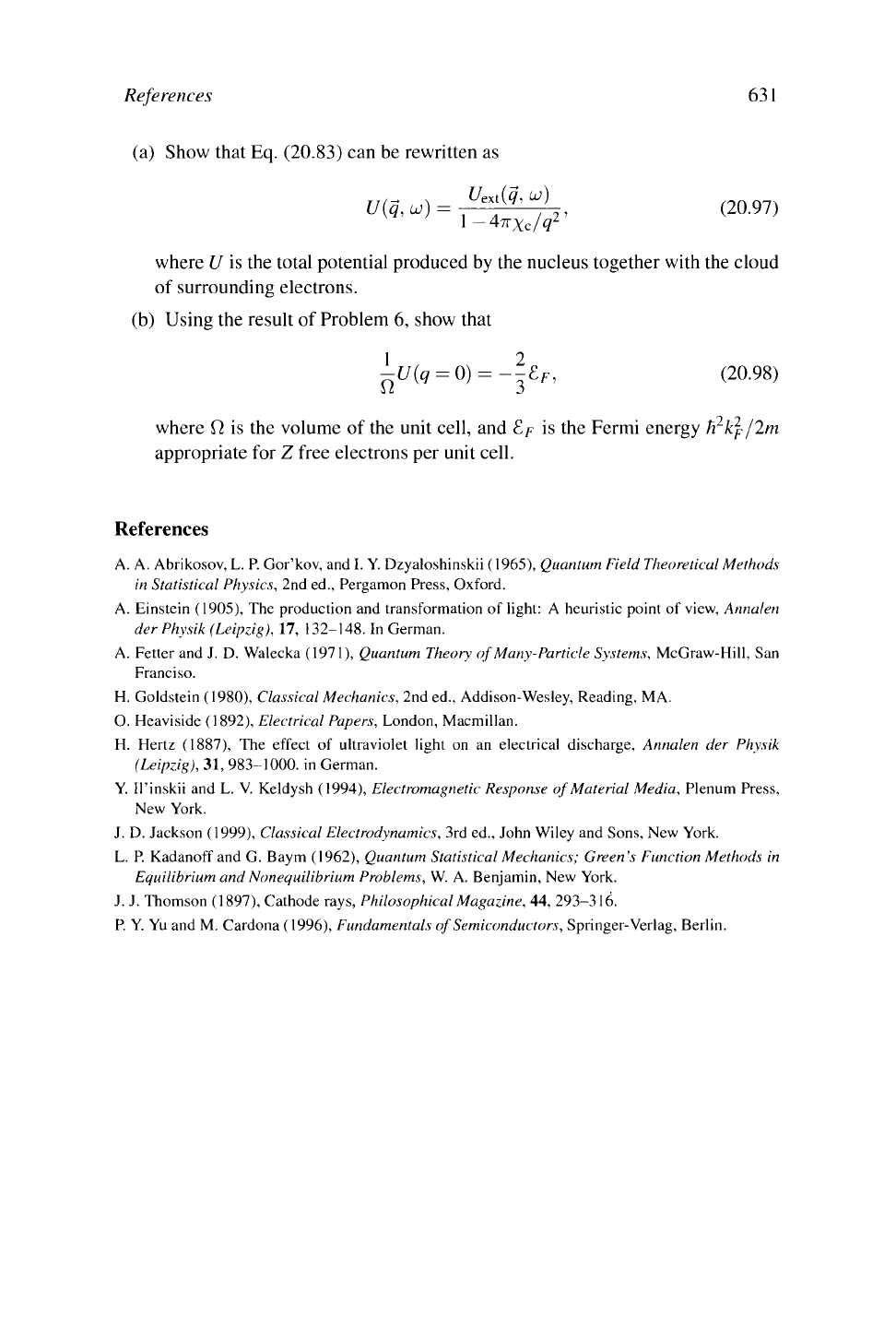
(a) Show that Eq. (20.83) can be rewritten as
jj/- \
U
e]i
t(q,w)
/inn-7\
U
W>
w =
"i—A
/~2' (20.97)
where U is the total potential produced by the nucleus together with the cloud
of surrounding electrons.
(b) Using the result of Problem 6, show that
Lu{q = 0) = ~E
F
, (20.98)
where 0 is the volume of the unit cell, and tip is the Fermi energy h
2
k
2
F
/2m
appropriate for Z free electrons per unit cell.
References
A. A. Abrikosov, L. P. Gor'kov, and I. Y. Dzyaloshinskii (1965), Quantum Field Theoretical Methods
in Statistical Physics, 2nd ed., Pergamon Press, Oxford.
A. Einstein (1905), The production and transformation of light: A heuristic point of view, Annalen
der Physik (Leipzig), 17, 132-148. In German.
A. Fetter and J. D. Walecka (1971), Quantum Theory of Many-Particle Systems, McGraw-Hill, San
Franci
so.
H. Goldstein (1980), Classical Mechanics, 2nd ed., Addison-Wesley, Reading, MA.
O. Heaviside (1892), Electrical
Papers,
London, Macmillan.
H. Hertz (1887), The effect of ultraviolet light on an electrical discharge, Annalen der Physik
(Leipzig),
31, 983-1000. in German.
Y. Il'inskii and L. V. Keldysh (1994), Electromagnetic Response of Material Media, Plenum Press,
New York.
J. D. Jackson
(
1999),
Classical Electrodynamics, 3rd ed., John Wiley and Sons, New York.
L. P. Kadanoff and G. Bay m (1962), Quantum Statistical Mechanics; Green's Function Methods in
Equilibrium and Nonequilibrium Problems, W. A. Benjamin, New York.
J. J. Thomson (1897), Cathode rays, Philosophical Magazine, 44, 293-316.
P.
Y. Yu and M. Cardona (1996), Fundamentals of Semiconductors, Springer-Verlag, Berlin.