
Marder M.P. Condensed Matter Physics
Подождите немного. Документ загружается.

Excitons
643
than a lattice spacing. In this limit, the exciton is called a Mott-Wannier exci-
ton.
The same arguments used in Section 18.3.1 to discuss interaction of electrons
with weak impurity potentials apply again. Assume that the characteristic distance
between electron and hole is much larger than a lattice spacing, so that the wave
functions for both electron and hole can be constructed as products of Bloch waves
with wave vector k near 0. Then the interactions of electron and hole with the pe-
riodic ionic potential can be eliminated from the Hamiltonian, provided that their
masses are replaced by the appropriate effective masses. That is, the electron and
hole obey
-h
2
^
2
-rt^i
V- + V-
2m*
r
" 2m*
r
''
e
2
e°\7n-r
n
\
-£
Wn,
r
P
0.
(21.24)
Equation (21.24) is exactly the equation obeyed by the electron and proton in
forming the hydrogen atom. It can be separated into two equations, one describing
the center-of-mass motion of the exciton and the other describing the binding by
defining
R
m*r„ +
m*
p
r
p
r = r,
to give
0
=
0
=
m*
+
m*
2(m*
+ m*)
-Vl-
*cm(fl)
-w-
2ß
e°r
*b(?),
cm= center of mass.
b=binding.
with the reduced mass /i given by
m*m*
m*
+ m*
(21.25)
(21.26)
(21.27)
(21.28)
(21.29)
There is no need to repeat the solution of the hydrogen atom any further. The bound
states of Eq. (21.28) have energies
\xe
V
2h
2
e°
2
l
2
me°
2
l
2
and are characterized by a radius
* _ e°h
2
ü
° ~ e
2
»
:
13.6 eV /=i...°c.
me
M
•
0.529 Â.
(21.30)
(21.31)
Because \x is typically half an electron mass or less, while e for a semiconductor
may be around 10, the scale on which the bound state lives is 20 times larger than
the usual hydrogen atom; therefore, the picture of the electron and hole sitting in a
classical background dielectric is consistent. Binding energies are on the order of a
644 Chapter 21. Optical Properties of Semiconductors
2.12 2.13 2.14 2.15 2.16
Energy (eV)
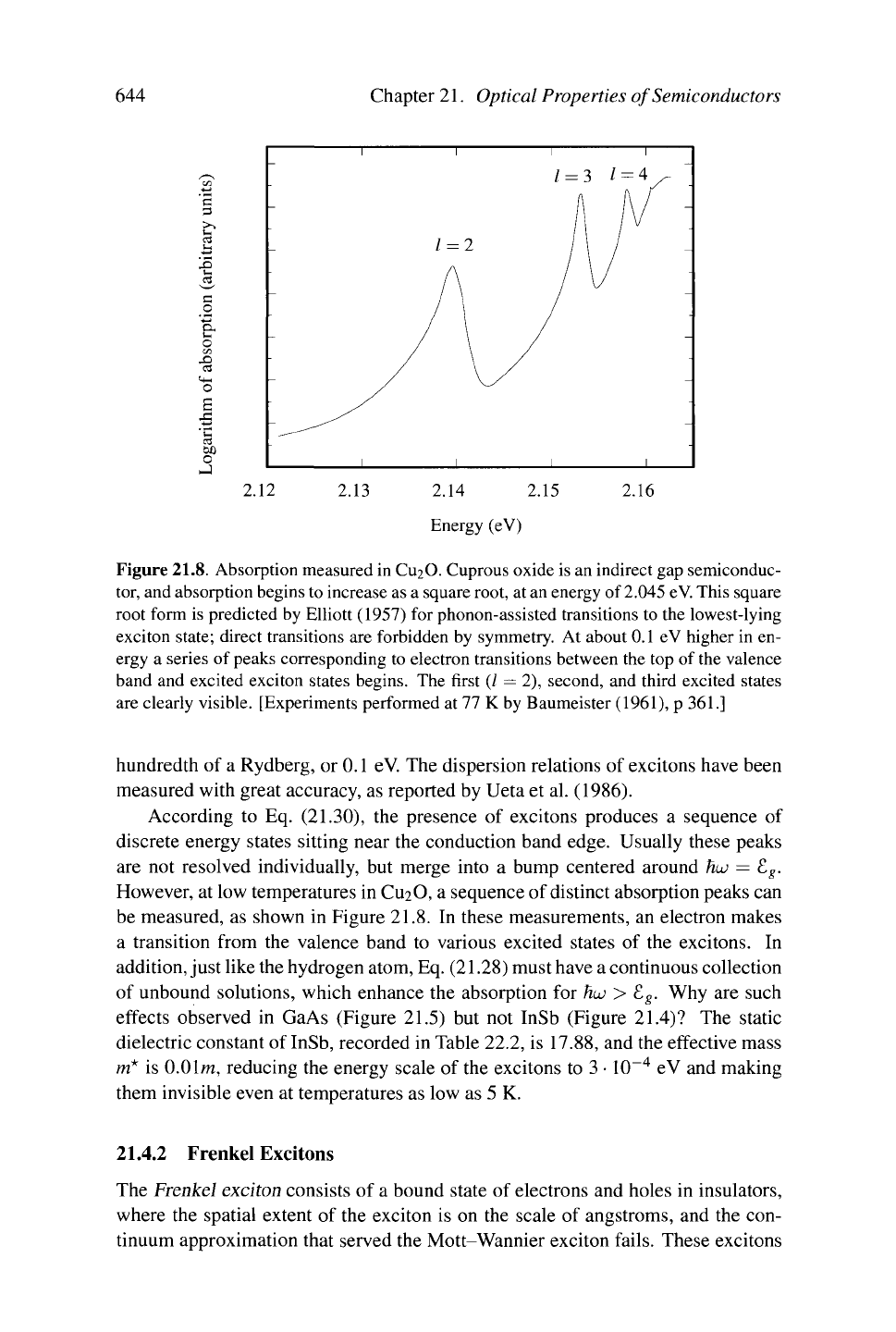
Figure 21.8. Absorption measured in
CU2O.
Cuprous oxide is an indirect gap semiconduc-
tor, and absorption begins to increase as a square root, at an energy of
2.045
eV.
This square
root form is predicted by Elliott (1957) for phonon-assisted transitions to the lowest-lying
exciton state; direct transitions are forbidden by symmetry. At about 0.1 eV higher in en-
ergy a series of peaks corresponding to electron transitions between the top of the valence
band and excited exciton states begins. The first (/ = 2), second, and third excited states
are clearly visible. [Experiments performed at 77 K by Baumeister (1961), p 361.]
hundredth of a Rydberg, or 0.1 eV. The dispersion relations of excitons have been
measured with great accuracy, as reported by Ueta et al. (1986).
According to Eq. (21.30), the presence of excitons produces a sequence of
discrete energy states sitting near the conduction band edge. Usually these peaks
are not resolved individually, but merge into a bump centered around hu = £,
g
.
However, at low temperatures in CU2O, a sequence of distinct absorption peaks can
be measured, as shown in Figure 21.8. In these measurements, an electron makes
a transition from the valence band to various excited states of the excitons. In
addition, just like the hydrogen atom, Eq. (21.28) must have a continuous collection
of unbound solutions, which enhance the absorption for
Hco
> E
g
. Why are such
effects observed in GaAs (Figure 21.5) but not InSb (Figure 21.4)? The static
dielectric constant of InSb, recorded in Table 22.2, is 17.88, and the effective mass
m*
is 0.01m, reducing the energy scale of the excitons to 3
■
10~
4
eV and making
them invisible even at temperatures as low as 5 K.
21.4.2 Frenkel Excitons
The Frenkel exciton consists of a bound state of electrons and holes in insulators,
where the spatial extent of the exciton is on the scale of angstroms, and the con-
tinuum approximation that served the Mott-Wannier exciton fails. These excitons
3
n
o
X>
o
E
J3
c3
o
Optoelectronics 645
have excited
states,
just like more conventional molecules, and transitions between
these excited states allow optical absorption in insulators. In addition, these exci-
tons are mobile and can travel through the lattice as particles. A calculation of their
properties, using the Hartree-Fock approximation, appears as Problems 4 and 5.
21.4.3 Electron-Hole Liquid
When a sufficiently large density of excitons is created in a semiconductor, by
strong illumination, the excitons can condense into a liquid-like state that manifests
itself as an electron-hole drop, first predicted by Keldysh and Kozlov (1967) and
reviewed by Hensel et al. (1977) and Rice (1977).
21.5 Optoelectronics
Semiconductor electronics can be made to interact with light in numerous different
ways,
ranging from the conversion of photons into electrical energy to the con-
version of electrical energy to laser beams. These various applications are largely
implicit in the Kubo formula, Eq. (20.70), but great ingenuity continues to be ex-
pended in obtaining efficient performance.
21.5.1 Solar Cells
A solar cell is essentially a diode that has been fabricated so as to absorb as much
light as possible in the neighborhood of
the
junction.
Every photon that is absorbed
generates an electron-hole pair. The pairs that are generated inside the depletion
region are immediately ripped apart by the enormous electric fields and sent to
opposite sides. Because the depletion region is very narrow, the formation of pairs
in the quasi-neutral regions is more important. Minority carriers formed within a
distance L
p
or L
n
of the depletion zone can diffuse there and are then swept across
to the other side of the junction. This picture predicts that shining light of intensity
/ on a diode will produce a current density
j = — 75 (L„ +L„) S is some constant of proportionality taking (21.32)
into account the efficiency of absorption, and
making the units come out right.
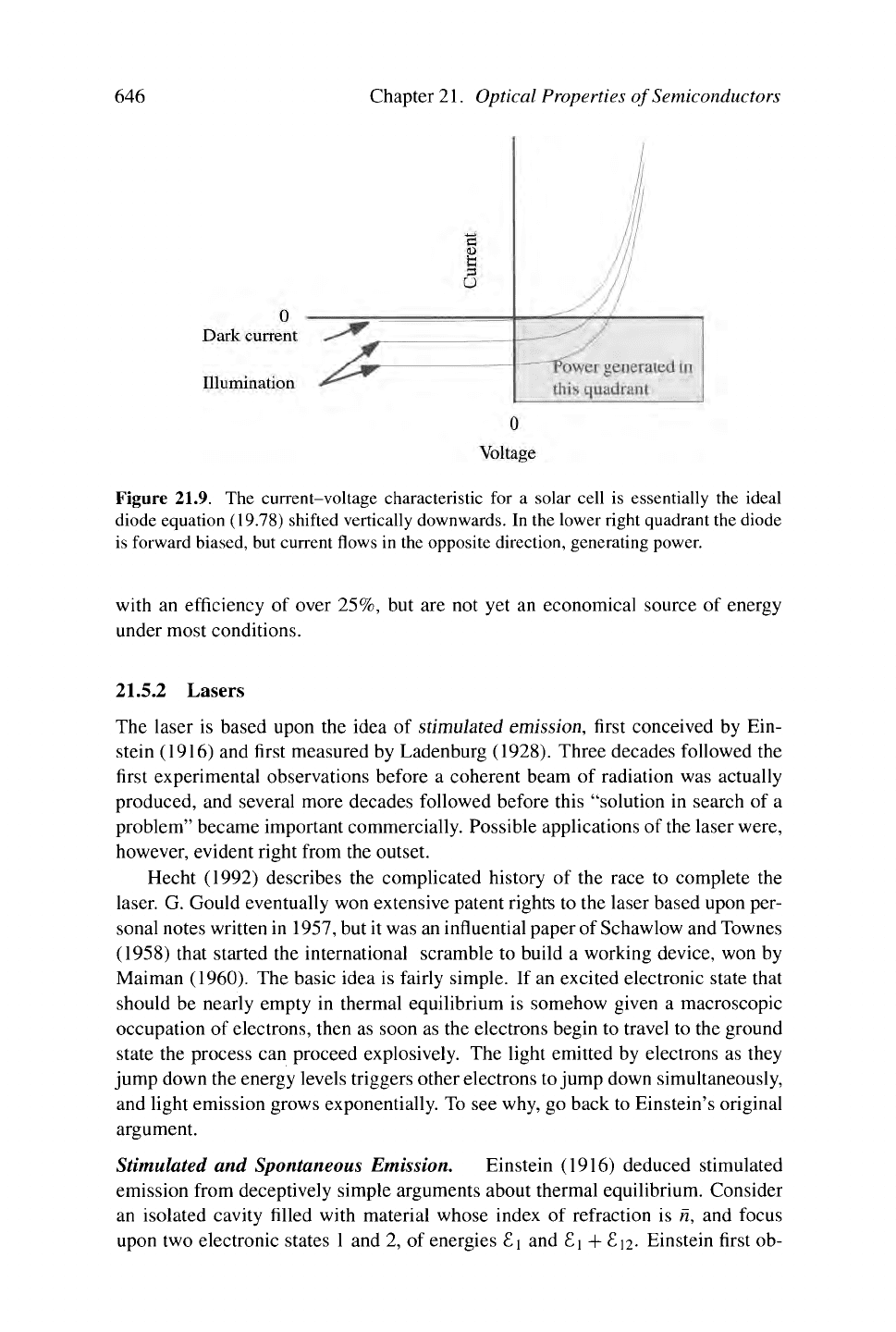
Because the sizes of the quasi-neutral regions are independent of the voltage
across the diode, the main effect of light is simply to lower the current-voltage
curve of the diode downwards, as shown in Figure 21.9. When the solar cell is
under illumination but not connected to a circuit, the separation of electron-hole
pairs causes the voltage across it to rise until the current-voltage curve intersects
the point where current vanishes, at a voltage on the order of kßT/e, or around
0.025 V. Connected to a load, the voltage drops slightly and current begins to flow,
generating power. There is an ideal load at which power generation is maximum,
while if the cell is connected across an open circuit the voltage across it drops to
zero,
and it again generates no power. Solar cells can convert sunlight to power
646 Chapter
21.
Optical Properties of Semiconductors
Figure 21.9. The current-voltage characteristic for a solar cell is essentially the ideal
diode equation (19.78) shifted vertically downwards. In the lower right quadrant the diode
is forward biased, but current flows in the opposite direction, generating power.
with an efficiency of over 25%, but are not yet an economical source of energy
under most conditions.
21.5.2 Lasers
The laser is based upon the idea of stimulated emission, first conceived by Ein-
stein (1916) and first measured by Ladenburg (1928). Three decades followed the
first experimental observations before a coherent beam of radiation was actually
produced, and several more decades followed before this "solution in search of a
problem" became important commercially. Possible applications of the laser were,
however, evident right from the outset.
Hecht (1992) describes the complicated history of the race to complete the
laser. G. Gould eventually won extensive patent rights to the laser based upon per-
sonal notes written in 1957, but it was an influential paper of Schawlow and Townes
(1958) that started the international scramble to build a working device, won by
Maiman (1960). The basic idea is fairly simple. If an excited electronic state that
should be nearly empty in thermal equilibrium is somehow given a macroscopic
occupation of electrons, then as soon as the electrons begin to travel to the ground
state the process can proceed explosively. The light emitted by electrons as they
jump down the energy levels triggers other electrons
to
jump down simultaneously,
and light emission grows exponentially. To see why, go back to Einstein's original
argument.
Stimulated and Spontaneous Emission. Einstein (1916) deduced stimulated
emission from deceptively simple arguments about thermal equilibrium. Consider
an isolated cavity filled with material whose index of refraction is n, and focus
upon two electronic states
1
and 2, of energies £i and £i +
£12-
Einstein first ob-
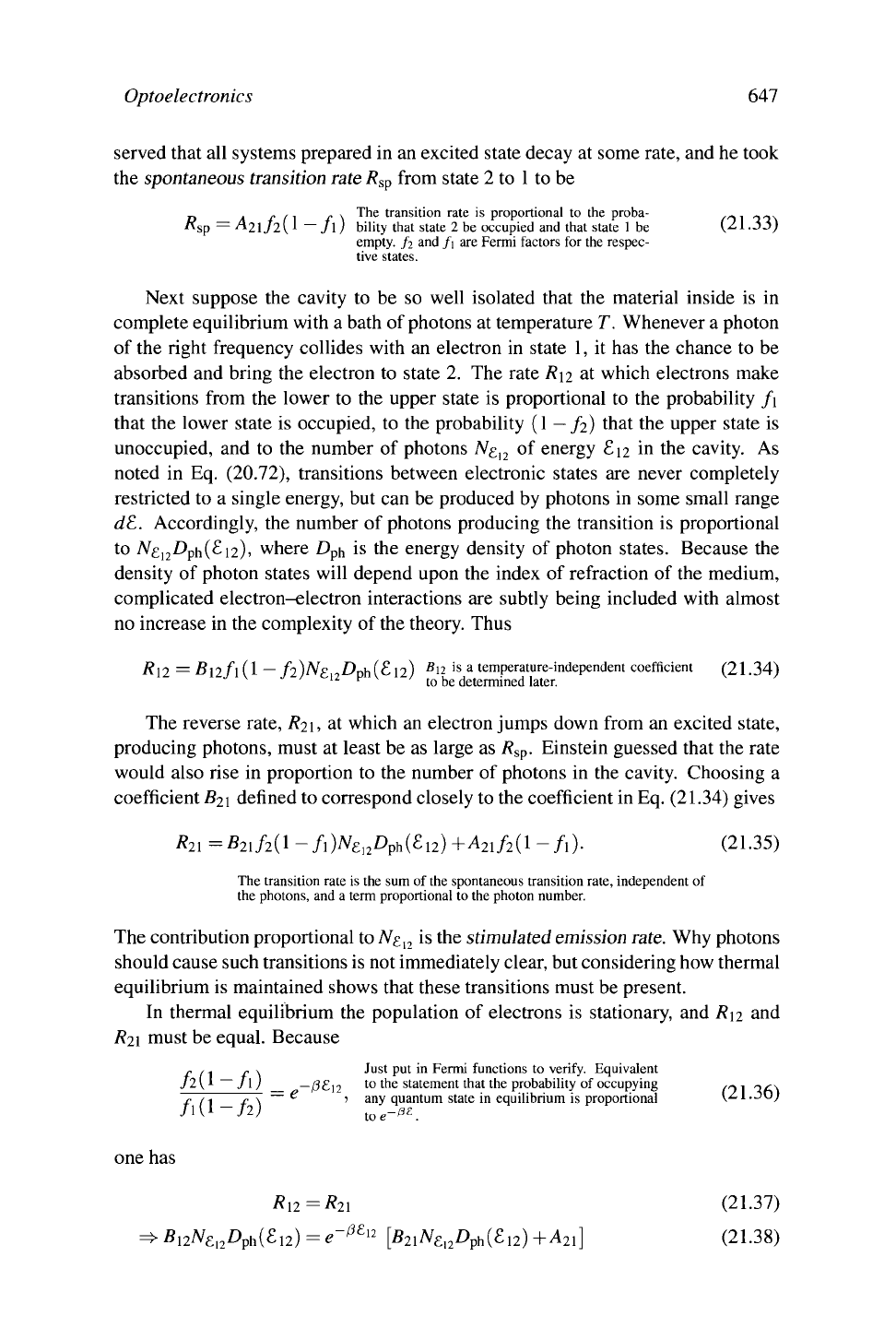
Optoelectronics 647
served that all systems prepared in an excited state decay at some rate, and he took
the spontaneous
transition rate
R
sp
from state 2 to
1
to be
D
f (\ f \ ^
e
transition rate >
s
proportional to the proba-
_ __
«sp
=
A2lJ2\
1
—
J\)
bility that state 2 be occupied and that state 1 be
{21.33)
empty,
fa
and
f\
are Fermi factors for the respec-
tive states.
Next suppose the cavity to be so well isolated that the material inside is in
complete equilibrium with a bath of photons at temperature T. Whenever a photon
of the right frequency collides with an electron in state 1, it has the chance to be
absorbed and bring the electron to state 2. The rate Rn at which electrons make
transitions from the lower to the upper state is proportional to the probability
f\
that the lower state is occupied, to the probability (1
—
fi)
that the upper state is
unoccupied, and to the number of photons Nß
n
of energy £12 in the cavity.
As
noted in Eq. (20.72), transitions between electronic states are never completely
restricted to a single energy, but can be produced by photons in some small range
d£. Accordingly, the number of photons producing the transition is proportional
to A
r
£
12
Dph(£i2), where D
p
h is the energy density of photon states. Because the
density of photon states will depend upon the index of refraction of the medium,
complicated electron-electron interactions are subtly being included with almost
no increase in the complexity of the theory. Thus
R
l2
= B\2f\(l
—
fl)N^
n
D„\
i
{^\2)
B
i2
is a
temperature-independent coefficient (21.34)
H
to be determined later.
The reverse rate,
R21,
at which an electron jumps down from an excited state,
producing photons, must at least be as large as R
sp
. Einstein guessed that the rate
would also rise in proportion to the number of photons in the cavity. Choosing
a
coefficient
#21
defined to correspond closely to the coefficient in Eq. (21.34) gives
Ä21=ß2l/2(l-/l)^e
12
Dph(£l2)+A2l/2(l-/l). (21.35)
The transition rate is the sum of the spontaneous transition rate, independent of
the photons, and a term proportional to the photon number.
The contribution proportional to Afe
12
is the stimulated emission
rate.
Why photons
should cause such transitions is not immediately clear, but considering how thermal
equilibrium is maintained shows that these transitions must be present.
In thermal equilibrium the population of electrons is stationary, and Rn and
/?2i must be equal. Because
ri-, r \
Just put in Fermi functions to verify. Equivalent
j1\\ J\)
— ßE\2 to the statement that the probability of occupying
,«, ~s\
r
1-1
r \ ^ >
any quantum state in equilibrium is proportional \L\..5\})
/l(,l-j2) toe-'
9£
.
one has
*12 =
*21
(21.37)
^ßi2^V
£l2
D
p
h(£i2)
=
^"
/3£l2
[ß2iAr
£|2
Dp
h
(£
12
)+A
21
] (21.38)
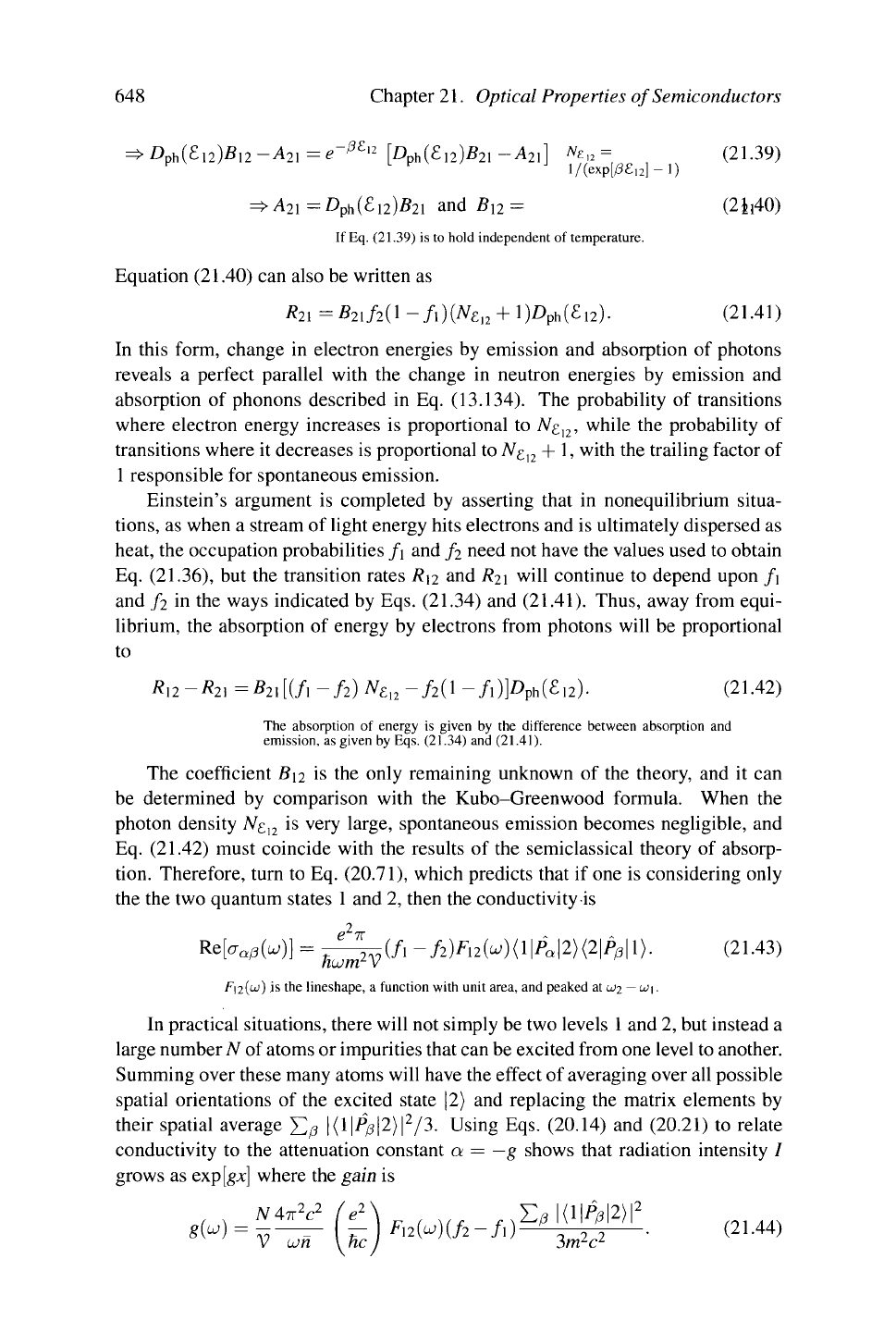
648
Chapter
21.
Optical Properties of Semiconductors
^D
ph
(£
12
)ß
12
-A
21
=
e
-
/3£
'
2
[D
ph
(£
12
)fi
2
,-A
2
i] "
£l2
= (21.39)
l/(exp[/3£i
2
]- 1)
^A
2l
=D
ph
(£i
2
)ß
2
i and 5
12
= (2|,40)
If Eq. (21.39) is to hold independent of temperature.
Equation (21.40) can also be written as
Ä21=fi2l/2(l-/l)(Afe
)2
+ l)0ph(£l2). (21-41)
In this form, change in electron energies by emission and absorption of photons
reveals a perfect parallel with the change in neutron energies by emission and
absorption of phonons described in Eq. (13.134). The probability of transitions
where electron energy increases is proportional to Nß
]2
, while the probability of
transitions where it decreases is proportional to N^
n
+ 1, with the trailing factor of
1 responsible for spontaneous emission.
Einstein's argument is completed by asserting that in nonequilibrium situa-
tions,
as when a stream of light energy hits electrons and is ultimately dispersed as
heat, the occupation probabilities f\ and /
2
need not have the values used to obtain
Eq. (21.36), but the transition rates R\
2
and R
2
\ will continue to depend upon f\
and f
2
in the ways indicated by Eqs. (21.34) and (21.41). Thus, away from equi-
librium, the absorption of energy by electrons from photons will be proportional
to
Rn-Ri\ =Ä2i [(/i -H)
N
El2
-/
2
(1 -/i)]Z)
pn
(£
12
). (21.42)
The absorption of energy is given by the difference between absorption and
emission, as given by Eqs. (21.34) and (21.41).
The coefficient B\
2
is the only remaining unknown of the theory, and it can
be determined by comparison with the Kubo-Greenwood formula. When the
photon density A^£
12
is very large, spontaneous emission becomes negligible, and
Eq. (21.42) must coincide with the results of the semiclassical theory of absorp-
tion. Therefore, turn to Eq. (20.71), which predicts that if one is considering only
the the two quantum states
1
and 2, then the conductivity is
2
Re[a
aß
(uj)} = ^^-(/i -f2)F
l2
(cü)(l\P
Q
\2)(2\P
ß
\l). (21.43)
F\2(ÜJ)
is the lineshape, a function with unit area, and peaked at
UJ
2
—
cj|
■
In practical situations, there will not simply be two levels
1
and 2, but instead a
large number N of atoms or impurities that can be excited from one level to another.
Summing over these many atoms will have the effect of averaging over all possible
spatial orientations of the excited state |2) and replacing the matrix elements by
their spatial average Y,ß lOI^I
2
)!
2
/
3
- Using Eqs. (20.14) and (20.21) to relate
conductivity to the attenuation constant a = — g shows that radiation intensity /
grows as exp[gx] where the gain is
*M = y— [te) *i2M(/2-/i)
3m2c2
■ (21.44)
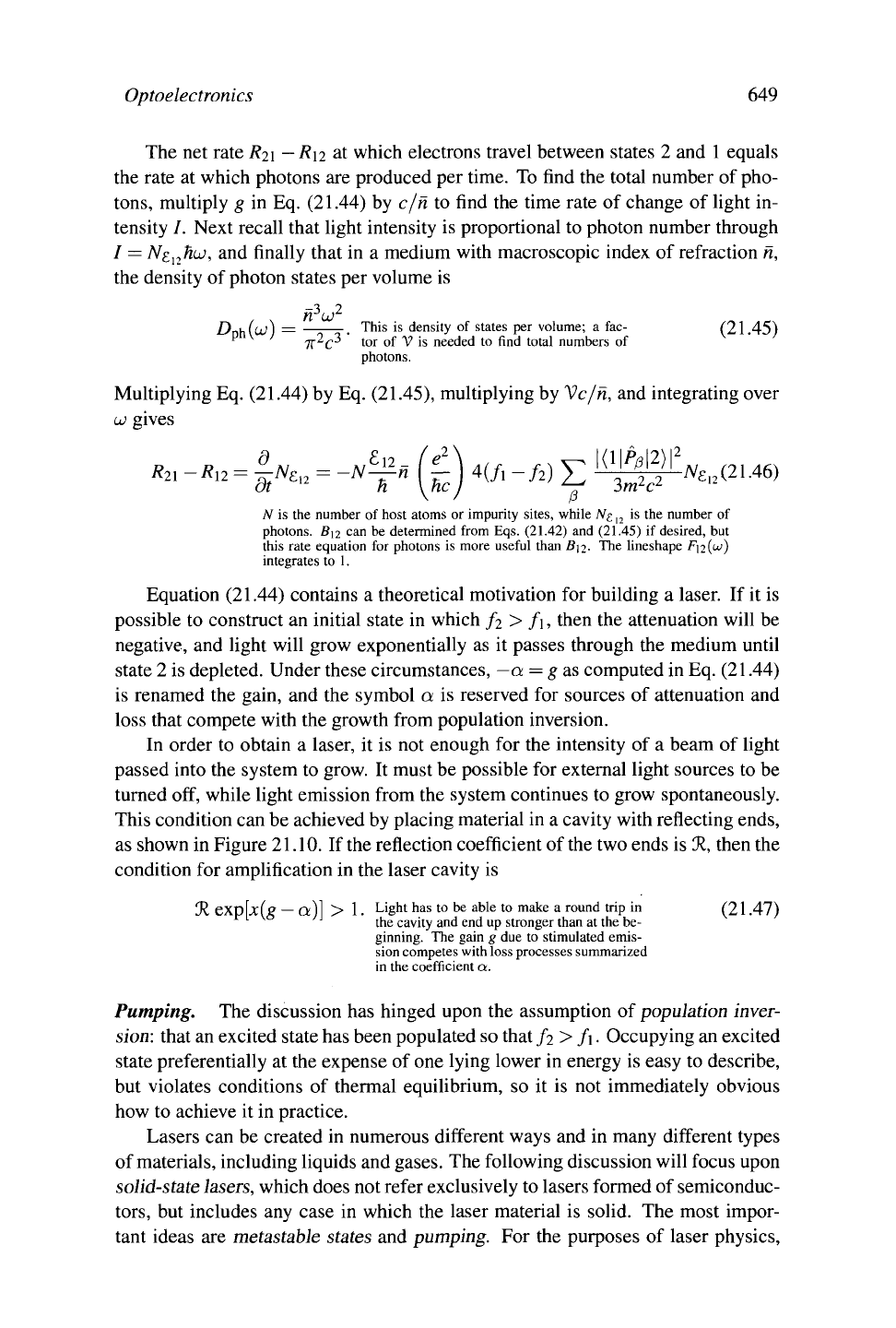
Optoelectronics
649
The net rate
R21 —R12
at which electrons travel between states 2 and
1
equals
the rate at which photons are produced per time. To find the total number of pho-
tons,
multiply g in Eq. (21.44) by c/n to find the time rate of change of light in-
tensity /. Next recall that light intensity is proportional to photon number through
/ = N£
n
hui, and finally that in a medium with macroscopic index of refraction n,
the density of photon states per volume is
-3 2
n ui
D
0
h(uj)
= . This is density of states per volume; a fac- (21.45)
7T^C^
tor of V is needed to find total numbers of
photons.
Multiplying Eq. (21.44) by Eq. (21.45), multiplying by Vc/n, and integrating over
LU
gives
«,,-«„
= !"«„ =
-^ g)
4(/,
-A)
£ KM
W£ii(21
.46)
N is the number of host atoms or impurity sites, while N^
l2
is the number of
photons. Bi2 can be determined from Eqs. (21.42) and (21.45) if desired, but
this rate equation for photons is more useful than B\i. The lineshape F\2(ui)
integrates to 1.
Equation (21.44) contains a theoretical motivation for building a laser. If it is
possible to construct an initial state in which fa > fa, then the attenuation will be
negative, and light will grow exponentially as it passes through the medium until
state 2 is depleted. Under these circumstances, — a = g as computed in Eq. (21.44)
is renamed the gain, and the symbol a is reserved for sources of attenuation and
loss that compete with the growth from population inversion.
In order to obtain a laser, it is not enough for the intensity of a beam of light
passed into the system to grow. It must be possible for external light sources to be
turned off, while light emission from the system continues to grow spontaneously.
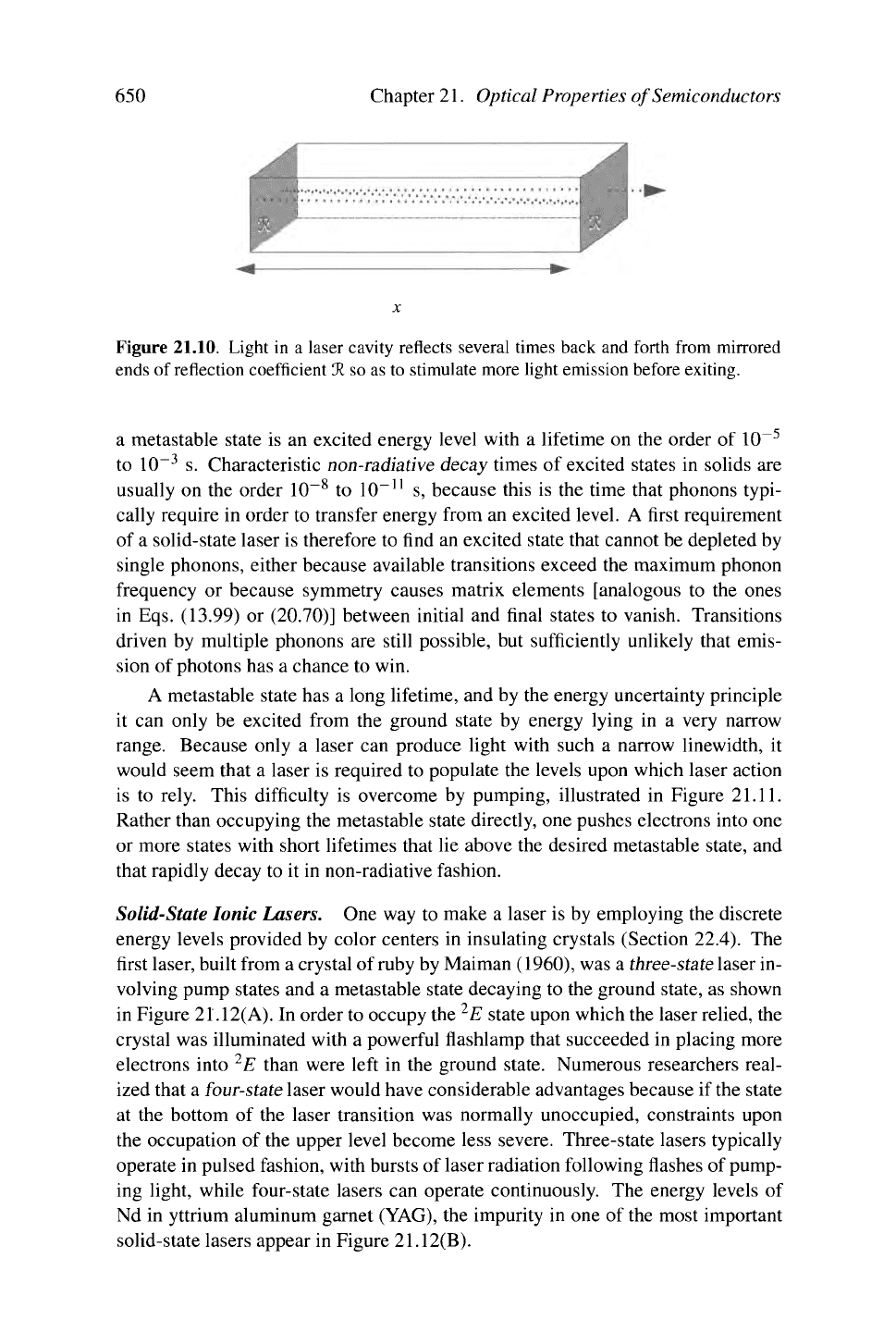
This condition can be achieved by placing material in a cavity with reflecting ends,
as shown in Figure 21.10. If
the
reflection coefficient of the two ends is % then the
condition for amplification in the laser cavity is
Ji exp[x(e — C()] > 1. Light has to be able to make a round trip in (21.47)
the cavity and end up stronger than at the be-
ginning. The gain g due to stimulated emis-
sion competes with loss processes summarized
in the coefficient a.
Pumping. The discussion has hinged upon the assumption of population inver-
sion:
that an excited state has been populated so that fa > fa. Occupying an excited
state preferentially at the expense of one lying lower in energy is easy to describe,
but violates conditions of thermal equilibrium, so it is not immediately obvious
how to achieve it in practice.
Lasers can be created in numerous different ways and in many different types
of materials, including liquids and gases. The following discussion will focus upon
solid-state
lasers,
which does not refer exclusively to lasers formed of semiconduc-
tors,
but includes any case in which the laser material is solid. The most impor-
tant ideas are metastable states and pumping. For the purposes of laser physics,
650 Chapter
21.
Optical Properties of Semiconductors
x
Figure 21.10. Light in a laser cavity reflects several times back and forth from mirrored
ends of reflection coefficient
CR
so as to stimulate more light emission before exiting.
a metastable state is an excited energy level with a lifetime on the order of 10~
5
to 10~
3
s. Characteristic non-radiative decay times of excited states in solids are
usually on the order 10~
8
to 10~
n
s, because this is the time that phonons typi-
cally require in order to transfer energy from an excited level. A first requirement
of a solid-state laser is therefore to find an excited state that cannot be depleted by
single phonons, either because available transitions exceed the maximum phonon
frequency or because symmetry causes matrix elements [analogous to the ones
in Eqs. (13.99) or (20.70)] between initial and final states to vanish. Transitions
driven by multiple phonons are still possible, but sufficiently unlikely that emis-
sion of photons has a chance to win.
A metastable state has a long lifetime, and by the energy uncertainty principle
it can only be excited from the ground state by energy lying in a very narrow
range. Because only a laser can produce light with such a narrow linewidth, it
would seem that a laser is required to populate the levels upon which laser action
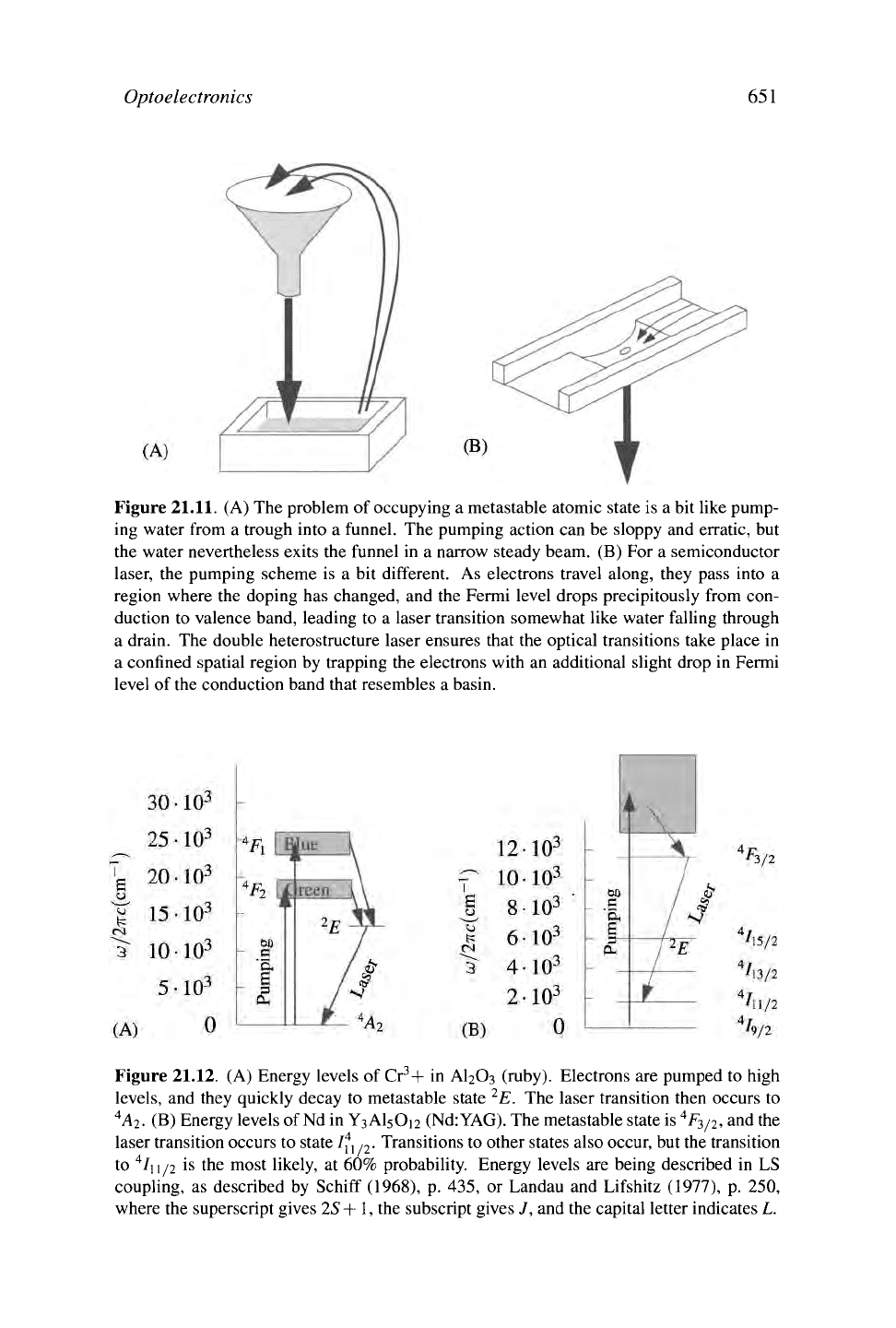
is to rely. This difficulty is overcome by pumping, illustrated in Figure
21.11.
Rather than occupying the metastable state directly, one pushes electrons into one
or more states with short lifetimes that lie above the desired metastable state, and
that rapidly decay to it in non-radiative fashion.
Solid-State Ionic Lasers. One way to make a laser is by employing the discrete
energy levels provided by color centers in insulating crystals (Section 22.4). The
first laser, built from a crystal of ruby by Maiman (1960), was a three-state laser in-
volving pump states and a metastable state decaying to the ground state, as shown
in Figure 21.12(A). In order to occupy the
2
E state upon which the laser relied, the
crystal was illuminated with a powerful flashlamp that succeeded in placing more
electrons into
2
E than were left in the ground state. Numerous researchers real-
ized that a four-state laser would have considerable advantages because if the state
at the bottom of the laser transition was normally unoccupied, constraints upon
the occupation of the upper level become less severe. Three-state lasers typically
operate in pulsed fashion, with bursts of laser radiation following flashes of pump-
ing light, while four-state lasers can operate continuously. The energy levels of
Nd in yttrium aluminum garnet (YAG), the impurity in one of the most important
solid-state lasers appear in Figure 21.12(B).
Optoelectronics
651
Figure
21.11.
(A) The problem of occupying a metastable atomic state is a bit like pump-
ing water from a trough into a funnel. The pumping action can be sloppy and erratic, but
the water nevertheless exits the funnel in a narrow steady beam. (B) For a semiconductor
laser, the pumping scheme is a bit different. As electrons travel along, they pass into a
region where the doping has changed, and the Fermi level drops precipitously from con-
duction to valence band, leading to a laser transition somewhat like water falling through
a drain. The double heterostructure laser ensures that the optical transitions take place in
a confined spatial region by trapping the electrons with an additional slight drop in Fermi
level of the conduction band that resembles a basin.
Figure 21.12. (A) Energy levels of Cr
3
+ in AI2O3 (ruby). Electrons are pumped to high
levels,
and they quickly decay to metastable state
2
E. The laser transition then occurs to
4
A
2
.
(B) Energy levels of Nd in Y
3
A1
5
0
12
(Nd:YAG). The metastable state is
4
F
3/2
,
and the
laser transition occurs to state
/f,
/2
-
Transitions to other states also occur, but the transition
to
4
/n/2 is the most likely, at 60% probability. Energy levels are being described in LS
coupling, as described by Schiff (1968), p. 435, or Landau and Lifshitz (1977), p. 250,
where the superscript gives
2S
+ 1, the subscript gives J, and the capital letter indicates L.
652 Chapter
21.
Optical Properties of Semiconductors
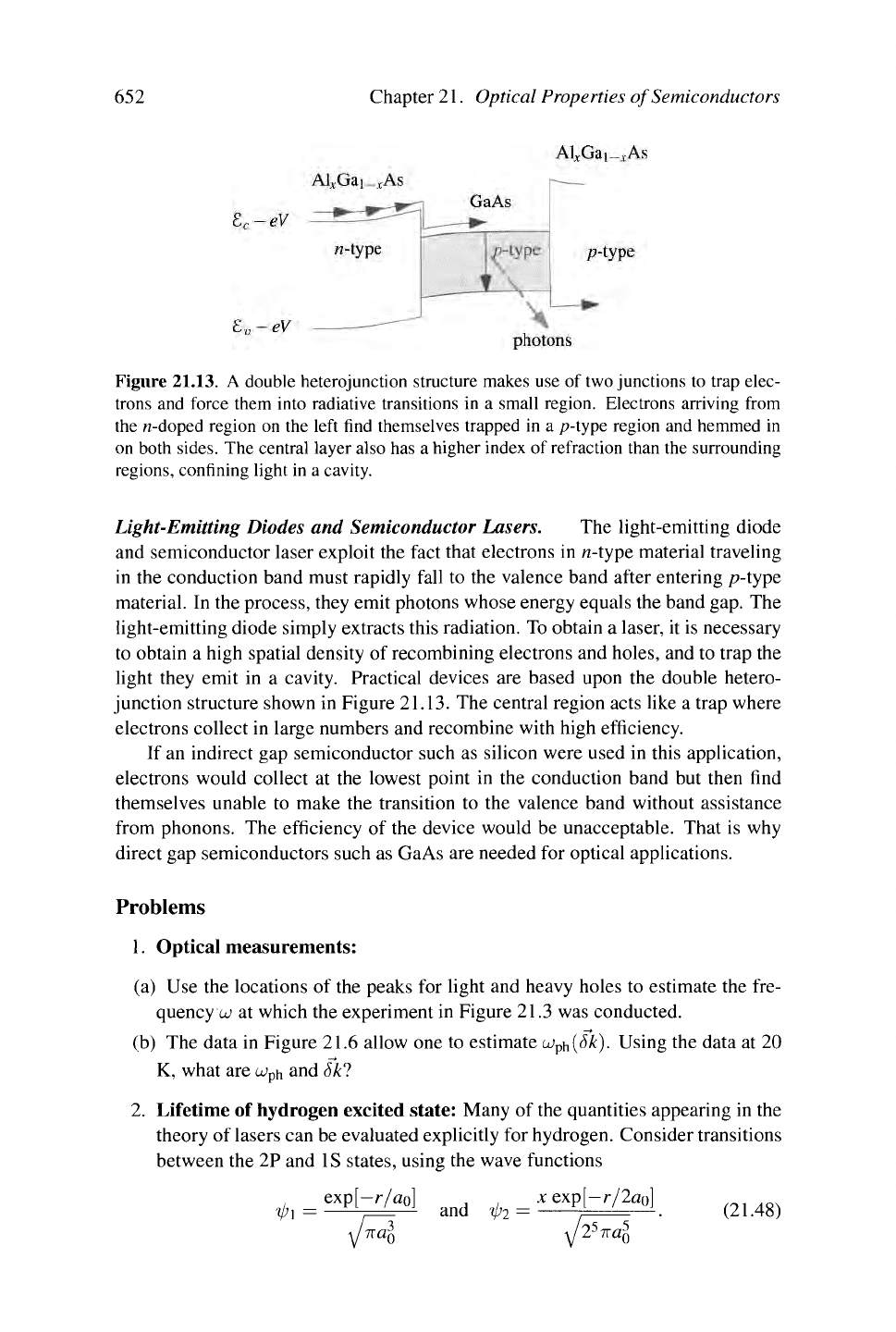
Figure 21.13. A double heterojunction structure makes use of two junctions to trap elec-
trons and force them into radiative transitions
in a
small region. Electrons arriving from
the n-doped region on the left find themselves trapped in
a
p-type
region and hemmed in
on both sides. The central layer also has a higher index of refraction than the surrounding
regions, confining light in a cavity.
Light-Emitting Diodes
and
Semiconductor Lasers. The light-emitting diode
and semiconductor laser exploit the fact that electrons
in
«-type material traveling
in the conduction band must rapidly fall
to
the valence band after entering
p-type
material. In the process, they emit photons whose energy equals the band gap. The
light-emitting diode simply extracts this radiation. To obtain
a
laser,
it
is necessary
to obtain
a
high spatial density of recombining electrons and holes, and to trap the
light they emit
in a
cavity. Practical devices are based upon the double hetero-
junction structure shown in Figure
21.13.
The central region acts like
a
trap where
electrons collect in large numbers and recombine with high efficiency.
If an indirect gap semiconductor such as silicon were used
in
this application,
electrons would collect
at
the lowest point
in
the conduction band but then find
themselves unable
to
make the transition
to
the valence band without assistance
from phonons. The efficiency
of
the device would be unacceptable. That
is
why
direct gap semiconductors such as GaAs are needed for optical applications.
Problems
1.
Optical measurements:
(a) Use the locations
of
the peaks for light and heavy holes to estimate the fre-
quency to at which the experiment in Figure 21.3 was conducted.
(b) The data
in
Figure 21.6 allow one to estimate uj
p
h(ök). Using the data
at
20
K, what are o;
p
h and
Ski
2.
Lifetime of hydrogen excited state: Many
of
the quantities appearing in the
theory of lasers can be evaluated explicitly for hydrogen. Consider transitions
between the 2P and
IS
states, using the wave functions
V,
=
eXp[
^.
ao]
and
y,
2
=
*
eXP
h^
fl
f (21.48)
2V-
5
"Kür,