
Marder M.P. Condensed Matter Physics
Подождите немного. Документ загружается.

Maxwell
's
Equations 613
20.2 Maxwell's Equations
Maxwell's equations are classical, and therefore they describe a quantum-mechan-
ical bath of photons in the limit where the number of photons is very large. For
a
diamond in sunlight or a semiconductor sample in a beamline, this limit is sensible.
The main failure of this semiclassical approximation is its inability to predict the
spontaneous emission of
photons.
Even for lasers, spontaneous emission is of rela-
tively minor importance, and it can fully be taken into account without resorting to
the full machinery of quantized photon fields, as will be demonstrated in Section
21.5.2.
There are really two versions
of
Maxwell's equations
in
common use.
One
of them describes the fundamental interactions of charged particles and propagat-
ing waves. The other is phenomenological, and it sweeps complicated long-range
interactions between vast numbers
of
particles into continuous functions such as
index of refraction or conductivity. This second form of Maxwell's equations is of
much greater value in condensed matter physics than the first. It provides not only
the best way to account for the interaction
of
light with solids, but also the best
way to find the effective interactions
of
electrons and phonons with one another
and themselves.
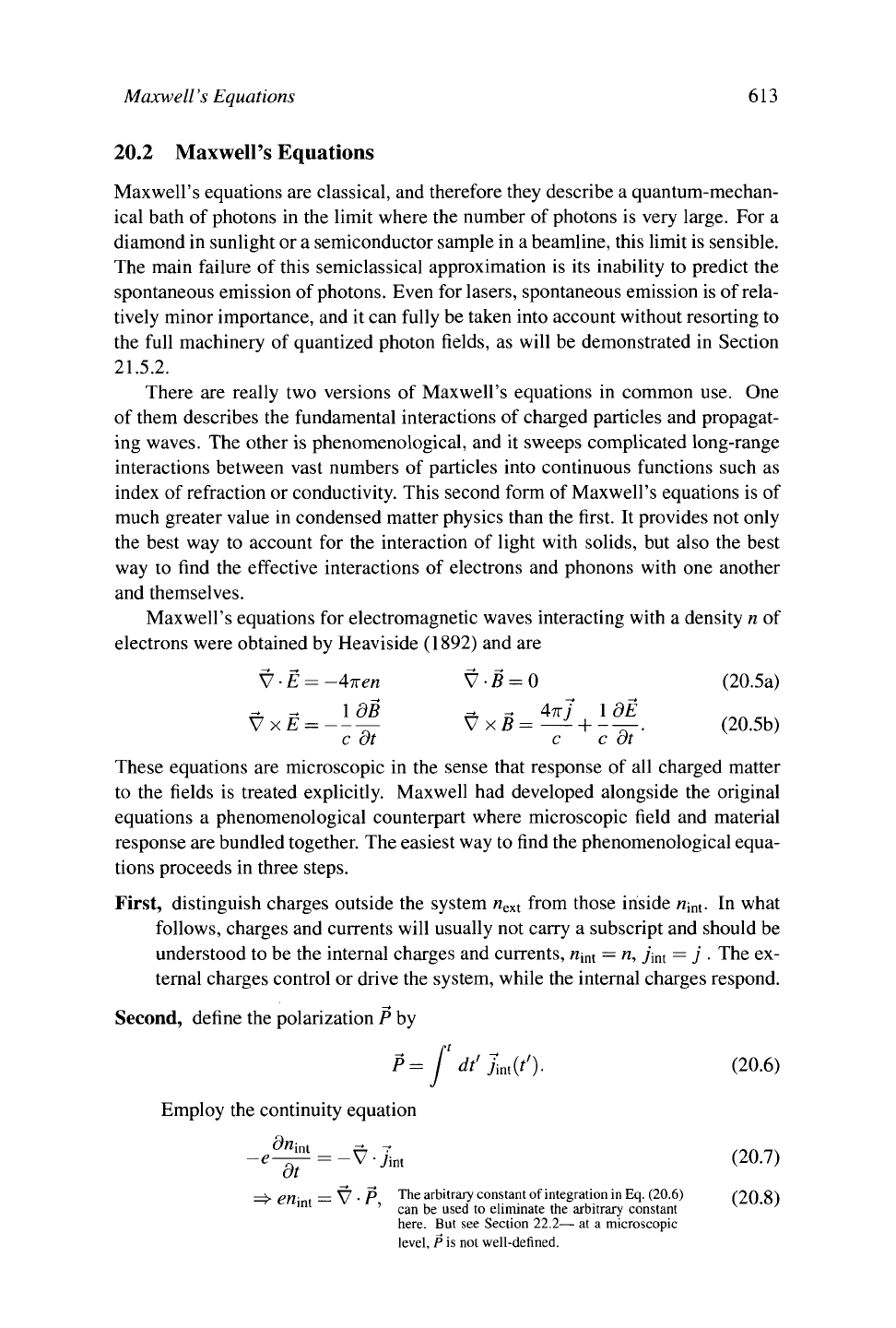
Maxwell's equations for electromagnetic waves interacting with a density n of
electrons were obtained by Heaviside (1892) and are
V
•
Ê = -Alien V
•
B
=
0 (20.5a)
A
-
1
dB
- - 4TT/ 1ÔÈ
Vx£
=
—— Vxß=—+
-
—. (20.5b)
c
ot c c ot
These equations are microscopic in the sense that response
of
all charged matter
to the fields
is
treated explicitly. Maxwell had developed alongside the original
equations
a
phenomenological counterpart where microscopic field and material
response are bundled together. The easiest way to find the phenomenological equa-
tions proceeds in three steps.
First, distinguish charges outside the system n
ext
from those inside n
mt
. In what
follows, charges and currents will usually not carry a subscript and should be
understood to be the internal charges and currents, n
mt
= n, j
m
=
j
. The ex-
ternal charges control or drive the system, while the internal charges respond.
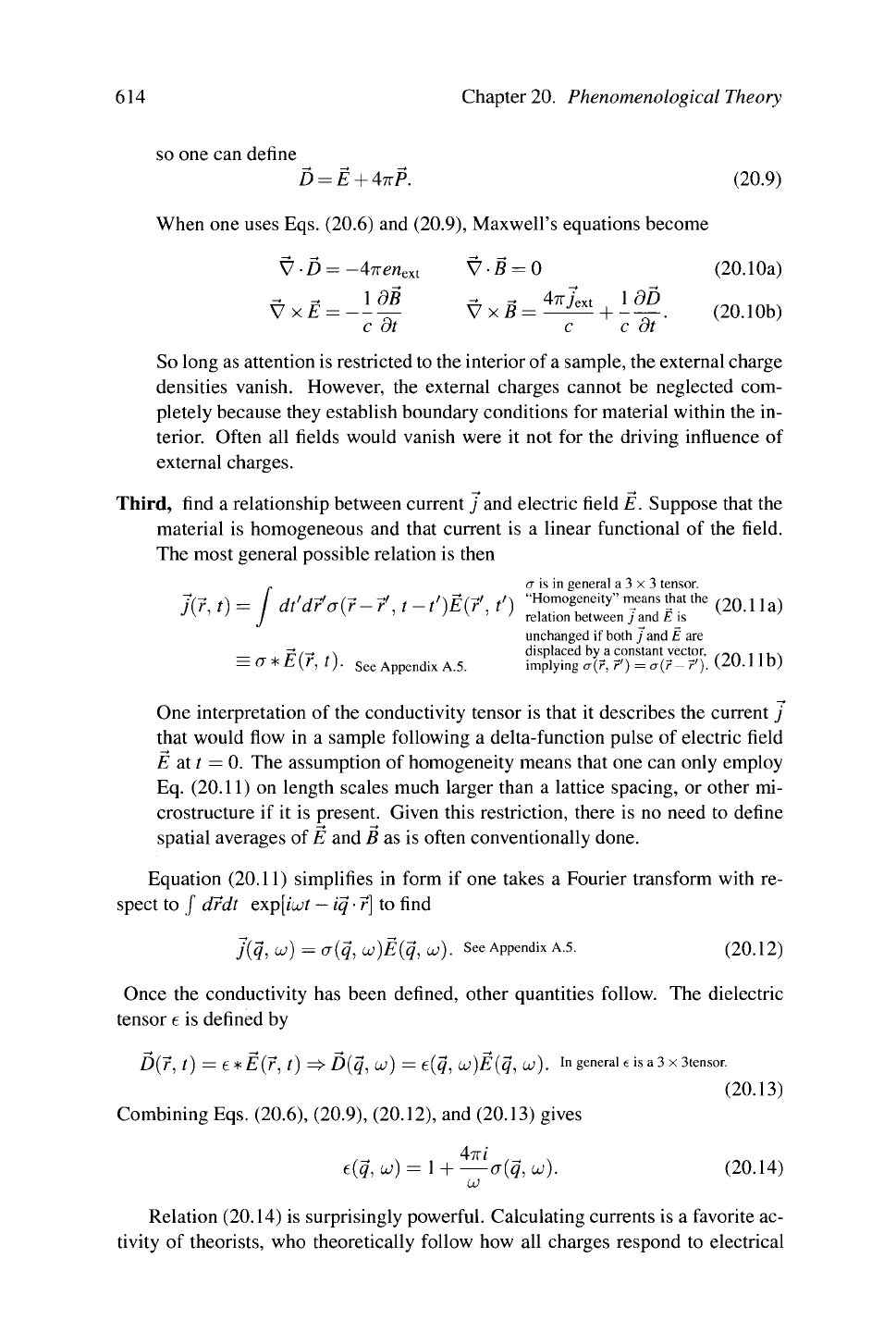
Second, define the polarization P by
P =
fdt'j
iat
(t').
(20.6)
Employ the continuity equation
-*^?
=
-V7int (20.7)
at
=>•
en . = V
•
P
The arbitrary constant of integration in Eq. (20.6) (20
8)
' can be used to eliminate the arbitrary constant
here.
But see Section 22.2—
at a
microscopic
level, P is not well-defined.
614 Chapter 20. Phenomenological Theory
so one can define
D = E +
A-nP.
(20.9)
When one uses Eqs. (20.6) and (20.9), Maxwell's equations become
V-D
=
-47Té>«
ext
Vß =
0 (20.10a)
Vxi?
= -!f
Vxß
= ^ + if.
(20.10b)
c
ot c c at
So long as attention is restricted to the interior of a sample, the external charge
densities vanish. However, the external charges cannot
be
neglected com-
pletely because they establish boundary conditions for material within the in-
terior. Often
all
fields would vanish were
it
not
for
the driving influence of
external charges.
Third, find a relationship between current
j
and electric field E. Suppose that the
material
is
homogeneous and that current
is a
linear functional
of
the field.
The most general possible relation is then
/
a is in general
a
3
x
3 tensor.
dt'df
f
(r(r-r
f
,t-t')È(r
f
,
t')
""o^neity" means that the
(20
.lla)
v
' '
v
' '
relation between
;
and
E is
unchanged
if
both
j
and
E
are
p/—
\
displaced by
a
constant vector,
,~„
1
., .
= a*h(r,t).
See
Appendix
A5
implying
air, ?') =
<r(r-r'). U
U
. 111>)
One interpretation
of
the conductivity tensor is that
it
describes the current
j
that would flow
in a
sample following
a
delta-function pulse
of
electric field
E at
t =
0. The assumption
of
homogeneity means that one can only employ
Eq. (20.11)
on
length scales much larger than
a
lattice spacing,
or
other mi-
crostructure
if it
is present. Given this restriction, there
is
no need
to
define
spatial averages of E and B as is often conventionally done.
Equation (20.11) simplifies
in
form
if
one takes
a
Fourier transform with re-
spect to
/
drdt exp[/cctf
—
iq
■ r]
to find
j(q,Lj)
=
<T{q,u;)È(q,Lj). See Appendix A.5. (20.12)
Once the conductivity has been defined, other quantities follow. The dielectric
tensor e is defined by
D(7,
t) =
€*E(j,
t) => D(q,
U>)
= e(q,
Uj)É(q,
Oj).
In
general
e
is
a
3
X
3tensor.
(20.13)
Combining Eqs. (20.6), (20.9), (20.12), and (20.13) gives
47TI
e(q,(j)
= l + a(q,u).
(20.14)
Relation (20.14) is surprisingly powerful. Calculating currents is
a
favorite ac-
tivity
of
theorists, who theoretically follow how
all
charges respond
to
electrical
Maxwell's Equations
615
fields and thereby obtain conductivities. Experimentalists have trouble following
the motion of charge in detail, particularly at optical frequencies. However, the
dielectric tensor is a classic experimental quantity, governing dispersion and ab-
sorption of waves. Connecting conductivity and dielectric constant with (20.14)
constitutes a connection between theoretical and experimental viewpoints.
Arbitrary Divisions. Maxwell's equations conventionally are presented in an-
other way. Charge is divided into two groups, bound and free. The bound charges
produce dielectric behavior, while the free charges participate in conductivity. In
addition, materials have a magnetic permeability ß that relates the microscopic
field B to a macroscopic field H.
Il'inskii and Keldysh (1994) emphasize that all these different phenomena are
in fact hidden within Eq. (20.11). The divisions between bound and free charge are
not fundamental. There is more than one possible way to define the polarization,
conductivity, and dielectric constant. Sometimes it may seem natural to divide
electrons into more than one group, bundling some in with the polarization and
dielectric constant and leaving others free. For example, the currents
j
core
due to
core electrons might be written as P = J
dt'abound
(t') but currents due to conduction
electrons left as
jf
ree
.
There is nothing necessary about such a division between free
and bound charges, although in a given experimental context it may seem natural.
For example, such a point of view was adopted to discuss impurities in semi-
conductors in Section
18.3.1.
The impurities, whether localized or conducting,
were placed in a medium with dielectric constant e° = 11.8. This dielectric con-
stant is actually due to the polarization of the valence electrons of silicon, but it
is very convenient to treat these valence electrons separately from the impurity
electrons and refer only to a dielectric constant.
Magnetic permeability seems to be missing. Where has it gone? The question
will arise again in Chapter 24. Magnetic permeability consists in the tendency of
incoming fields to excite current traveling in closed loops. The conductivity tensor
of (20.11) can describe such response, but only when the conductivity is nonlocal.
In Fourier space, the magnetic parts of
the
conductivity tensor will vary as q
2
, while
the dielectric parts are independent of q.
20.2.1 Traveling Waves
The quantities actually measured in experiment are closely related to the dielectric
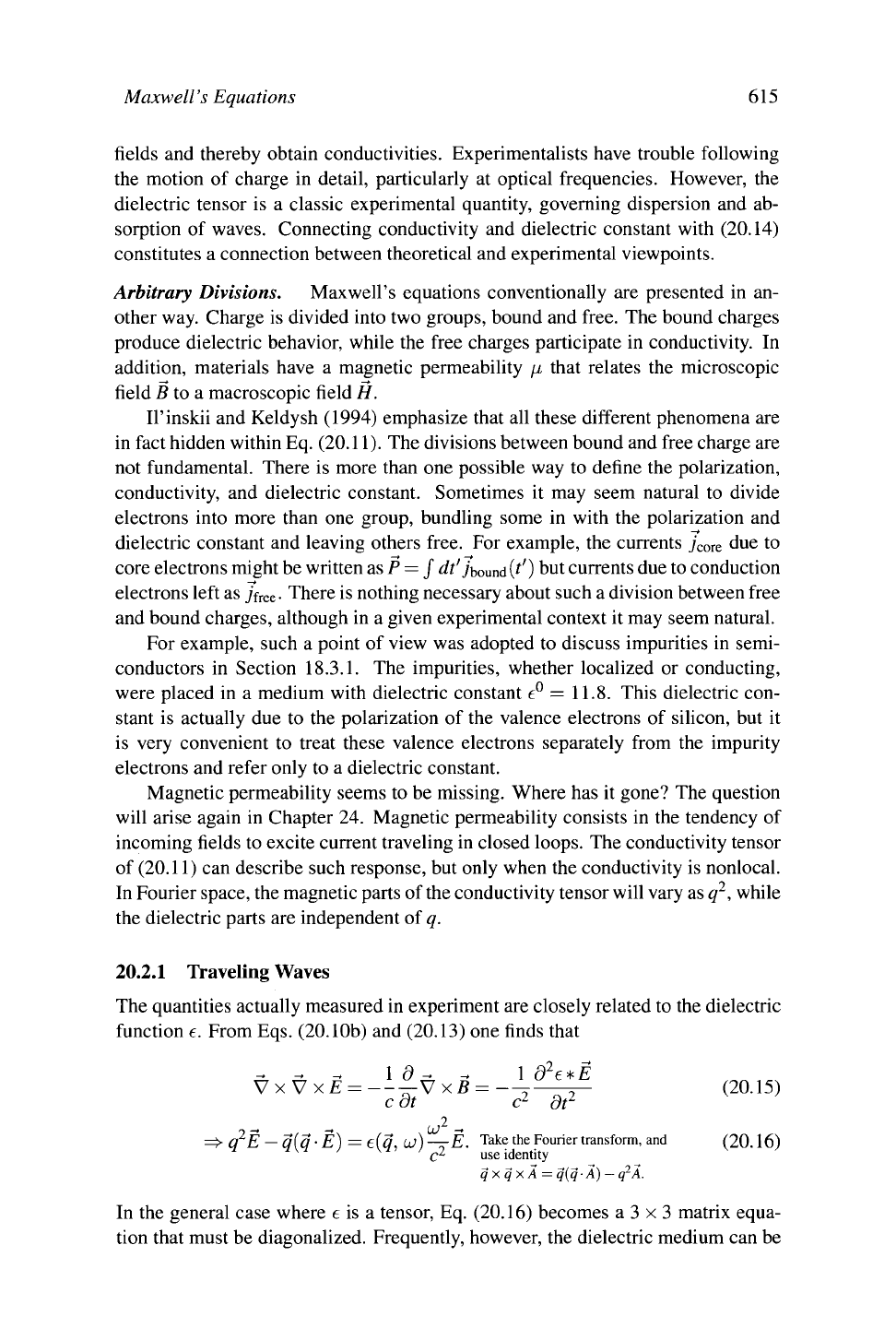
function e. From Eqs. (20.10b) and (20.13) one finds that
- -
p
19
A s
1 d
2
e*È
VxVx£ = ——Vxß = —
T
~—
c dt c
2
dt
2
=> q E — q{q
■
E) = e(3. Lü) —=-£.
Take the
Fourier transform, and
•* fV* } vi> ;
c
2
US
eidentity
qXqxÂ= q(q -A)
—
q
2
A.
In the general case where e is a tensor, Eq. (20.16) becomes a 3 x 3 matrix equa-
tion that must be diagonalized. Frequently, however, the dielectric medium can be
(20.15)
(20.16)
616
Chapter 20. Phenomenological Theory
treated
as
isotropic, which means that
e is a
multiple
of
the unit matrix
and can
be treated
as a
scalar. Not only fluids and polycrystals
are
isotropic,
but all
cubic
crystals
as
well, because the only
3x3
matrix able
to
survive the cubic symmetry
operations
is a
multiple
of
the unit matrix (Problem 3).
In
this case,
the
medium
supports precisely two sorts
of
waves, transverse and longitudinal.
Transverse.
For
transverse waves,
E is
perpendicular
to q, and so
Eq. (20.16)
becomes
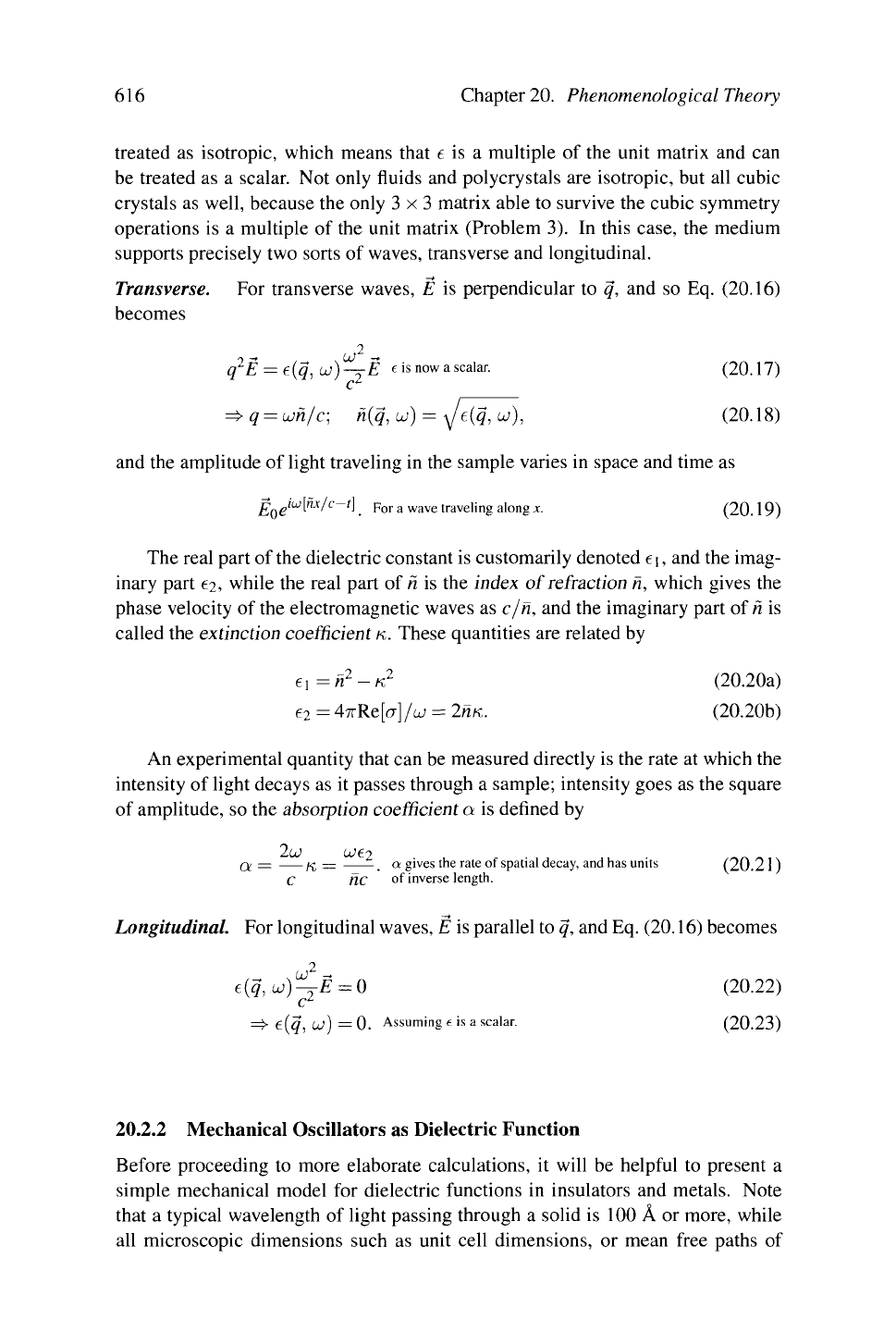
q
2
Ê = e(q,U))~Ë
e
is now a scalar. (20.17)
^>q = uih/c;
n(q,
ui)
= Je(q,
CJ),
(20.18)
and the amplitude
of
light traveling
in
the sample varies
in
space and time
as
£
0
g'
aJ
["
Jt:
/
c_f
].
For
a
wave traveling along x. (20.19)
The real part of the dielectric constant is customarily denoted e\, and the imag-
inary part €2, while the real part
of
n
is the
index of refraction h, which gives
the
phase velocity
of
the electromagnetic waves
as c/n,
and the imaginary part
of
h
is
called the extinction coefficient
K.
These quantities are related by
ei=
n
2
-K
2
(20.20a)
e
2
=
4TrRe[a}/iü
= Ihn.
(20.20b)
An experimental quantity that can be measured directly
is
the rate
at
which the
intensity
of
light decays as
it
passes through
a
sample; intensity goes as the square
of amplitude, so the absorption coefficient
a is
defined by
lui UJtl
Oi
= K = . a
gives the rate
of
spatial decay, and has units (20.21)
C
he of
inverse length.
Longitudinal. For longitudinal waves,
E
is parallel to q, and Eq. (20.16) becomes
ÜJ
2
e{q,Lü)^E
= 0
(20.22)
c
l
=>
e(q, U)) = 0.
Assuming e
is a
scalar. (20.23)
20.2.2 Mechanical Oscillators as Dielectric Function
Before proceeding
to
more elaborate calculations,
it
will
be
helpful
to
present
a
simple mechanical model
for
dielectric functions
in
insulators
and
metals. Note
that
a
typical wavelength
of
light passing through
a
solid
is
100
 or
more, while
all microscopic dimensions such
as
unit cell dimensions,
or
mean free paths
of
Maxwell
's
Equations
617
electrons, tend to be substantially less. Therefore, one can safely take applied
electric fields to be of the form
È(r,t)=Êe-
iuJt
, (20.24)
set q = 0 in dielectric and conductivity tensors, and then drop reference to q alto-
gether. For this reason, in the ensuing discussion the various response functions
will depend upon
to
alone.
In an insulator, charges cannot flow indefinitely in response to a static electric
field. A simple model consistent with this fact regards the insulator as composed
of a collection of charged particles bound to particular sites in a solid, with the
particles oscillating about the sites in response to external fields. Oscillators of
type /, with mass mi, charge —e, oscillatory frequency
u>i,
and damping time 77
obey
m{f=
—miLui? —
mfr/Ti
—
eE(r, t) (20.25)
»F
Assuming that E has the form
=>7(LÜ)
= —= 5- given in Eq.
(20.24).
(20.26)
nti(iüf
— iuj/Ti — to )
If the density of charges of this type is «/, the current associated with this motion
is
"=V ^ -iunie
2
E ,
nn
™
J\u)
= —r-2—~i 2V (20.27)
mi{üjf
— ILU/Tl — U)
A
)
so the conductivity is
-iumie
2
ff
H = f 2 I 2T
•
(
20
-
28
>
Making use of
Eq.
(20.14), the dielectric constant of a material with many different
types of oscillators is
e(w) = 1+2^ —
2—^1~-
(20.29)
In the subsequent discussion, dielectric functions of the form Eq. (20.29) will ap-
pear frequently. Sometimes the oscillators will be isolated impurity atoms, other
times they will be phonons, and they may also be electrons jumping between bands.
From the vantage point of dielectric constants, a conductor is actually just
a special type of insulator, one where charges are free to move large distances,
and one of the oscillation frequencies a;/ equals zero. Focusing upon this term in
Eq. (20.28), dropping the index /, gives for the conductivity and dielectric constant
2
ne T
a
(
u
) = — The same as Eq.
(20.4).
(20.30)
m{\ —iuiT)
e(u) = l-
p
(20.31)
LU{LO
+ I/T)
where the plasma frequency
co
p
is defined by
618 Chapter 20. Phenomenological Theory
IA-ïïiie
2
m
(20.32)
The dielectric function Eq. (20.29) has both real and imaginary parts, which
are
e
2
(o;) = Im[
e
M] = 5Z
4nnie
2
(ujf
—
w
2
)/m;
l
(iof-io^
+
icu/ny
47rnie
2
Lü/(Timi)
(20.33a)
(20.33b)
and individual terms in the sum have the characteristic shapes depicted in Figure
20.2.
Frequency
ui
Figure 20.2. Characteristic shapes of the real and imaginary parts of the dielectric function
described in Eq. (20.33). Only one term in the sum over / is depicted.
20.3 Kramers-Kronig Relations
Causality. The expression for the dielectric function in Eq. (20.33) was obtained
from a simplified mechanical model of solids, but it is a rather general expression
of the forms that dielectric constants are allowed to have. There is a constraint
upon dielectric constants, not considered until now, that of causality.
The electric displacement D is related to the electric field by
D(co) = e(iü)E(io) ^ D(t) = f dt' e{t')E{t-t'). (20.34)
The electric displacement is produced in response to external fields, so one can be
certain that if the electric field vanishes up until t = 0, the displacement D(t) must
Krame rs-Kwnig Relations
619
do so as well. In particular, suppose that E(t) =
toEo5(t)
is a brief intense pulse of
electric field at t = 0, where
to
is a constant with dimensions of time characterizing
the duration of the pulse. Then Eq. (20.34) becomes
D(t) = e{t)t
0
E
0
. (20.35)
Because D(t) must vanish for all t < 0, it follows that
e{t\ = 0 for t < 0. This requirement continues to hold if e is a (20.36)
tensor, or if the dependence of
e
on wave num-
ber q is retained.
The only property of
e
needed in order to obtain Eq. (20.36) is that it linearly
relates two quantities that must be causally connected. A host of other functions
have the same property. Some examples are the electric conductivity, which relates
current to electric field, the complex reflectivity, which relates light bouncing off a
sample to the light coming in, the flow of a fluid being stirred in a rheometer, the
vibration of a solid being pulled in a tensile testing apparatus, or the temperature
rise of a glass being injected with periodic pulses of heat. Somewhat surprising
consequences will flow from Eq. (20.36), and similar consequences should be un-
derstood to apply to all these other cases as well.
From Eq. (20.36) it follows that
roo
roo
/ dt e
iu3
'e(t). (20.37)
Jo
Allow
u)
to range over the complex plane. So long as the imaginary part of u is
greater than zero, the exponential function multiplying e(t) decays as t becomes
large, and the integral must be finite; this conclusion follows both because e van-
ishes for t < 0 and because as a response to an impulse at t = 0, one cannot expect
it to grow exponentially in time thereafter. Therefore e(u) cannot have any poles
when
UJ
lies in the upper half of the complex plane. From Cauchy's theorem, one
might write
[ dJ e(u')
e(uj) = (b . Close the contour in the upper half-plane. The (20.38)
J 271"/
LO
1
—
(jj — if]
on
ly P°'
e
is at a; +
ir\,
where
77
is very small,
and the contribution of this residue gives the
result.
However, Eq. (20.38) is not quite right, because in order for Cauchy's theorem to
be valid, the function inside the integral must drop off faster than a/ for large u/.
To get the proper result, it is necessary to have some idea of the form of
e(o>);
all
the approximate expressions derived so far behave as e°° + G(l/u/)
2
. The correct
version of
Eq.
(20.38) is therefore
/
du)'
e(uj
;
)
—
e°°
^ 1 . e°° is the value of
e
as
ui
-» 00. (20.39)
2717 LÜ
1
—
LÜ
— IT]
The Kramers-Kronig relations are completely contained in Eq. (20.39), but to
appreciate them, one must separate the equation into real and imaginary parts. The
620
Chapter 20. Phenomenological Theory
pole,u; = u/ \ = /
P°
le
-
Omitted in Eq. (20.40)
Figure 20.3. The integral at distance
r\
above the real axis can be deformed into a contour
integral on the real axis, with a contribution from a half-circuit around the pole at
LO
=
LÜ'.
easiest way to accomplish this task is to rewrite Eq. (20.39) so that all the terms in
the integrand multiplying e(o/) are purely imaginary. Figure 20.3 shows a change
in integration contour which makes it possible to send
r\
to zero and which gives
To take the principal part
3>
of the integral,
/
rit y *=!/ il /r°° *o iaK.e uic piincipai pan jr ui nie niiegiai,
v ' keep w' on the real axis, but integrate on the /of) 40)
Tj-j Qy to domain (—00,
ui —
rj\
[ui
+
r/,
00), finally al- ^ ' '
lowing
T] —>
0. The factor of 2 relative to
Eq. (20.39) is needed because the small lower
half-circle in Figure 20.3 is omitted.
One can now take the real and imaginary parts of
Eq.
(20.40) immediately, finding
Rel.M-n^/v'
1
"'^:'
001
C0.41a)
J
7T Lü' —
üJ
Because e(t) is real, one must have
e(uj)
=
e*(—uj),
which implies that the real
part of
e{uj)
is even and that the imaginary part is odd. Therefore, using e\ for the
real and
€2
for the imaginary part of
e
it is conventional to rewrite Eq. (20.41) as
«,(„)_«-
=
,
r5^!^L
(2
0.42a)
JO
7T OJ' -
LO
1
m
f°°
2üJ
dco' ei(w')-e°°
e
2
(u))
= -y V 9 •
(
20
-
42b
)
JO 7T UJ' -
LU
1
Equations (20.42) constitute the Kramers-Kronig relation.
20.3.1 Application to Optical Experiments
The Kramers-Kronig relation has important application to the optical behavior of
solids, because it means that measurements of the imaginary part of the dielec-
tric constant—absorption—can be used to find the real part—dispersion—or vice
versa. Suppose, for example, that one wishes to find the absorption of light in
metals or semiconductors at photon energies lying above the band gap. At these
frequencies, the absorption coefficient a is on the order of 10
6
cm
-1
, and light
penetrates only around 100 Â into the sample. Exceedingly thin samples would be
Kramers-Kronig Relations
621
needed to measure absorption. An alternative is to measure light reflection from a
thick sample. If the penetration depth is very small, the sample's surface will have
to be exceedingly flat and free of impurities to provide meaningful results, but such
surface preparation may well be easier than creating a 100-Â-fhick slice.
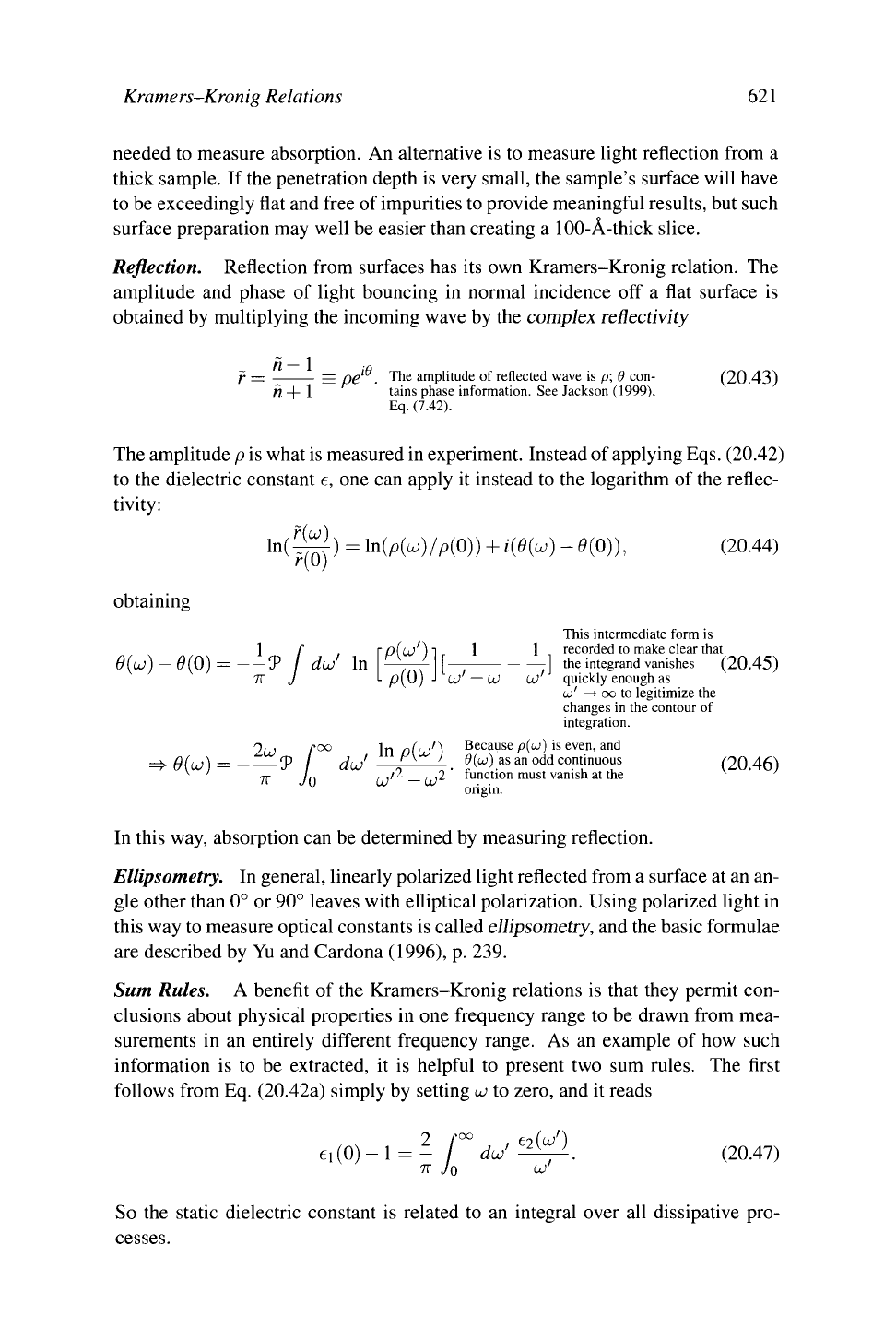
Reflection. Reflection from surfaces has its own Kramers-Kronig relation. The
amplitude and phase of light bouncing in normal incidence off a flat surface is
obtained by multiplying the incoming wave by the complex reflectivity
h
—
I
=
pe . The amplitude of reflected wave is p;
Ö
con- (20.43)
Yl
-\- 1 tains phase information. See Jackson
(
1999).
Eq.
(7.42).
The amplitude p is what is measured in experiment. Instead of applying
Eqs.
(20.42)
to the dielectric constant e, one can apply it instead to the logarithm of the reflec-
tivity:
H
"M
)=Hp{uj)/pm+muj)
-
ö(o))
'
(2
°-
44)
obtaining
0(LJ)-O(O) = --7 [dJ In
7T
J
This
intermediate form is
1
r ro(u/)l 1 1 recorded to make clear that
rn
/ J, .' i„ i-i—i [ ] the integrand vanishes (20.45)
■
p(0) J Lü' —
Lü
Lü' quickly enough as
u/
—>
oo to legitimize the
changes
in the contour of
integration.
9,
; /"oo I« fit, J\ Because p(w) is even, and
Z.UJ
r°° In nlLü I because
p(Lü)
is even, anu
Q(u) = 7 / rf^' 'l^^.e(u)) as an odd continuous (20.46)
K
' 'Kin LÜ — up-
runctl0n m
u
st
vanish at the
In this way, absorption can be determined by measuring reflection.
Ellipsometry. In general, linearly polarized light reflected from a surface at an an-
gle other than 0° or 90° leaves with elliptical polarization. Using polarized light in
this way to measure optical constants is called ellipsometry, and the basic formulae
are described by Yu and Cardona (1996), p. 239.
Sum Rules. A benefit of the Kramers-Kronig relations is that they permit con-
clusions about physical properties in one frequency range to be drawn from mea-
surements in an entirely different frequency range. As an example of how such
information is to be extracted, it is helpful to present two sum rules. The first
follows from Eq. (20.42a) simply by setting
to
to zero, and it reads
ei
(0) -
1
= - [°° du' ^ß, (20.47)
7T
JO ü/
So the static dielectric constant is related to an integral over all dissipative pro-
cesses.
622 Chapter 20. Phenomenological Theory
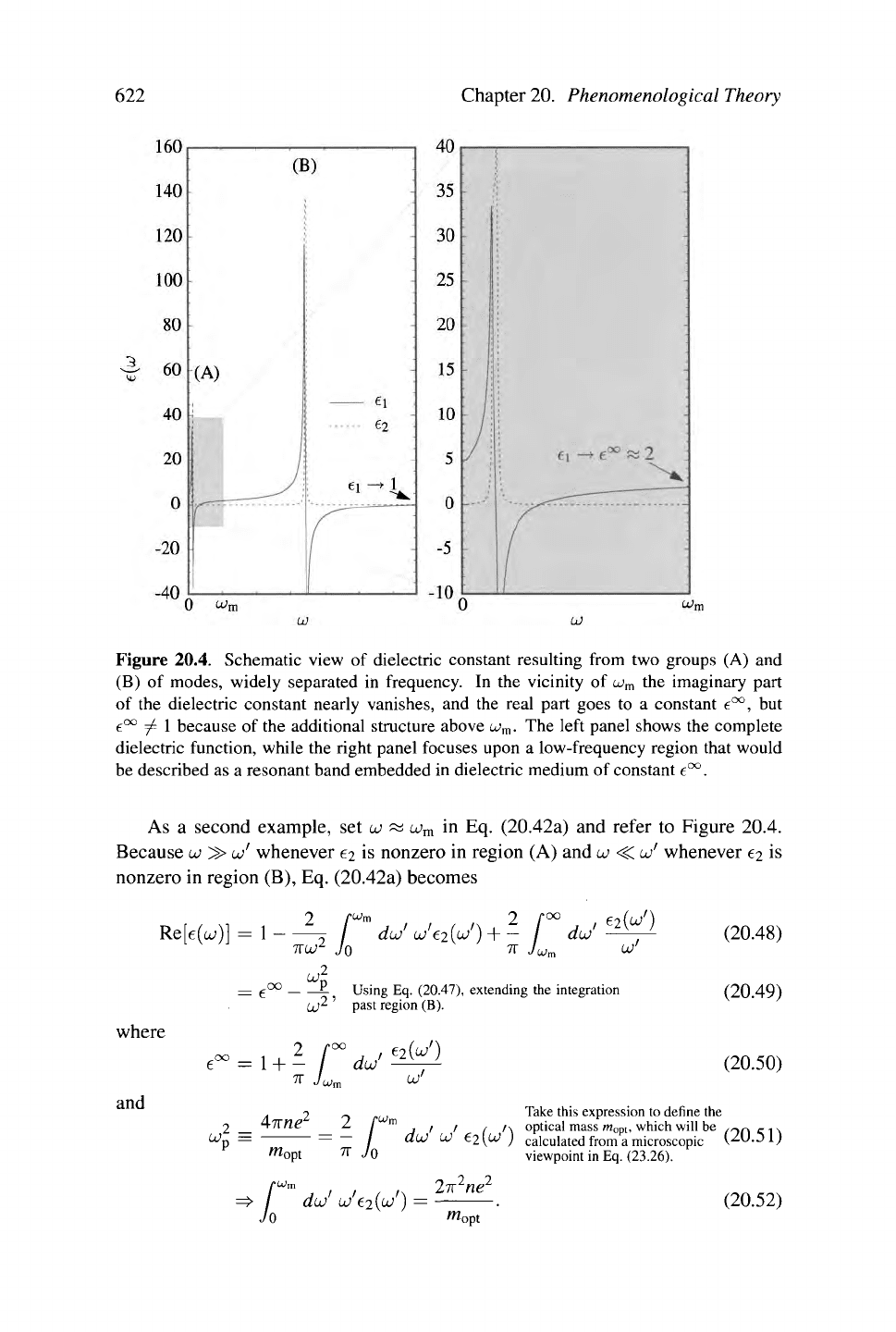
Figure 20.4. Schematic view of dielectric constant resulting from two groups (A) and
(B) of modes, widely separated in frequency. In the vicinity of tu
m
the imaginary part
of the dielectric constant nearly vanishes, and the real part goes to a constant e°°, but
e°°
T^
1 because of the additional structure above
u>
m
.
The left panel shows the complete
dielectric function, while the right panel focuses upon a low-frequency region that would
be described as a resonant band embedded in dielectric medium of constant e°°.
As a second example, set w « w
m
in Eq. (20.42a) and refer to Figure 20.4.
Because to ;» ui' whenever ei is nonzero in region (A) and to -C u/ whenever e
2
is
nonzero in region (B), Eq. (20.42a) becomes
2
r,,w^o
2 f
u
i" 2 f°°
FllQJ
Re[e{u)] =
1
- -A, / dJ u/e
2
(ü/) + - / dJ -^
KU
1
h 7T
J
UJm
Lü'
(20.48)
,2
where
and
= e
°° Ü Using Eq. (20.47), extending the integration (20.49)
Up-
' past region (B).
e
oo
=
l+2 [°°
d
j^l (20.50)
/I 2 o /-a; ^ake
t
'
1
'
s
ex
P
ress
i°
n
t0
define the
2 47T/?e 11™. i / i\ optical mass m
op
t. which will be ,
1f
. ...
p= —
—
/ dUJ LU €2{UJ ) calculated from a microscopic (AI.M)
Wopt VT Jo viewpoint in Eq. (23.26).
k-'r, =
Jo
2n
2
ne
2
dJ uj'e
2
(u') = . (20.52)
Wîopt