
Marder M.P. Condensed Matter Physics
Подождите немного. Документ загружается.

Metals at Low Frequencies 693
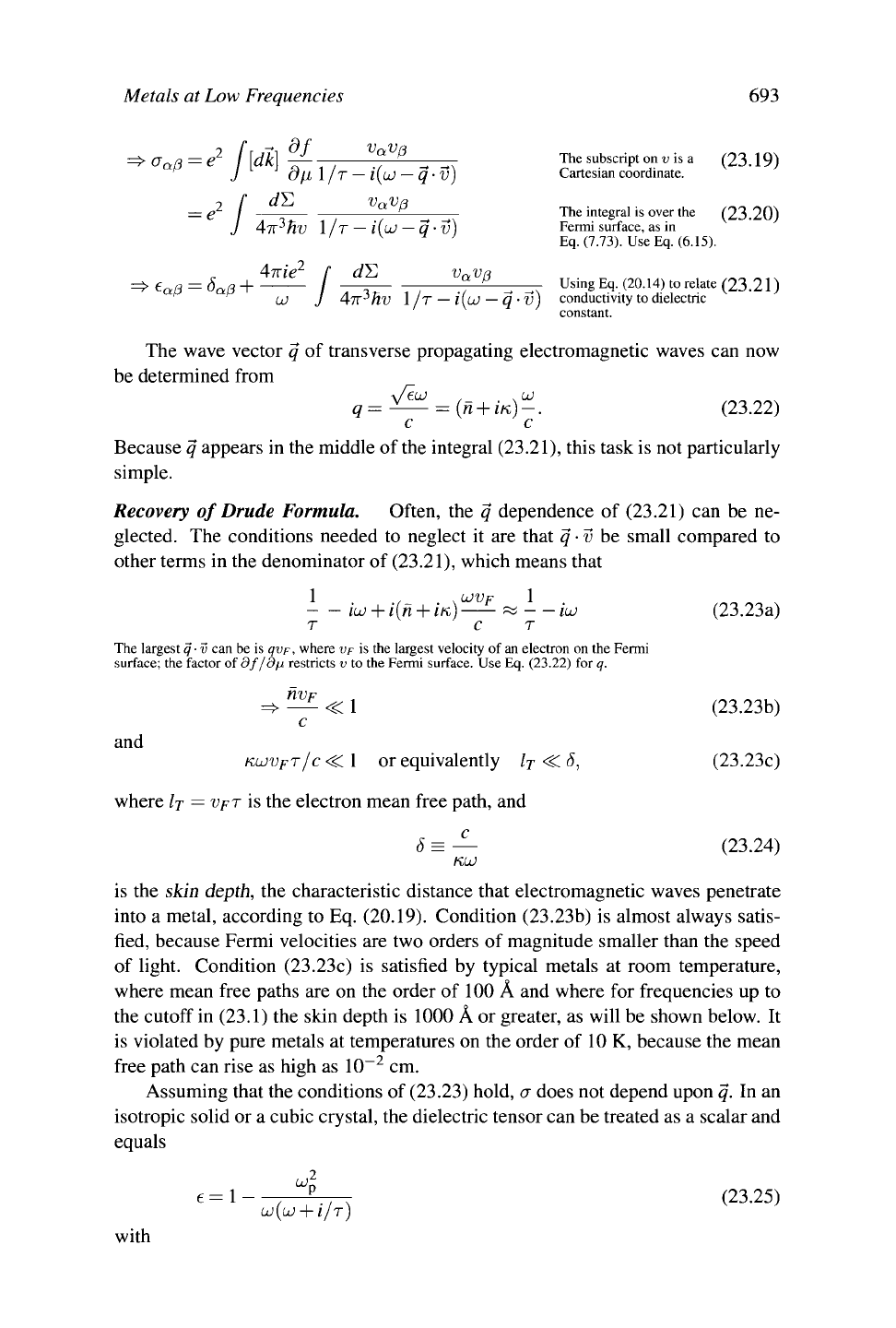
„2 / r^i
d
f
v
»
v
ß
V
a
0 = e / [dk] -^- — .
P
_ _ The subscript on t, is a (23.19)
Ofl l/T — i[U) — q
■
V) Cartesian coordinate.
e
L
I -— ~"~
M
The integral is over the (23.20)
J 4ir
3
Hv 1/T — i(iü — q-v) Fermi surface, as in
Eq. (7.73). Use Eq. (6.15).
4nie f dT, v
n
vn
=>e
aß
= S
a
ß + / -T-^ Ti -, ~ ^ Using Eq. (20.14) to relate (23.21)
LU J AlT^nv \/T — l[UJ — q -V) conductivity to dielectric
constant.
The wave vector q of transverse propagating electromagnetic waves can now
be determined from
q—
— (n
+
iK) —.
(23.22)
c c
Because q appears in the middle of the integral (23.21), this task is not particularly
simple.
Recovery of Drude Formula. Often, the q dependence of (23.21) can be ne-
glected. The conditions needed to neglect it are that q-v be small compared to
other terms in the denominator of (23.21), which means that
1 ...,_.. ,uv
F
1 .
iLU
+ iln +
iK)
sa lui (23.23a)
r c T
The largest q
■
v can be is qvp, where
VF
is the largest velocity of an electron on the Fermi
surface; the factor of df/dß restricts v to the Fermi surface. Use Eq. (23.22) for q.
HVF
=>
—- <
1
(23.23b)
c
and
KiovpTjc
<C 1
or equivalently IT -C
Ö,
(23.23c)
where lj = vpr is the electron mean free path, and
5 = — (23.24)
KUJ
is the skin depth, the characteristic distance that electromagnetic waves penetrate
into a metal, according to Eq. (20.19). Condition (23.23b) is almost always satis-
fied, because Fermi velocities are two orders of magnitude smaller than the speed
of light. Condition (23.23c) is satisfied by typical metals at room temperature,
where mean free paths are on the order of 100 Â and where for frequencies up to
the cutoff in (23.1) the skin depth is 1000 Â or greater, as will be shown below. It
is violated by pure metals at temperatures on the order of 10 K, because the mean
free path can rise as high as 10~
2
cm.
Assuming that the conditions of (23.23) hold, a does not depend upon q. In an
isotropic solid or a cubic crystal, the dielectric tensor can be treated as a scalar and
equals
e=l-
, ?.. , (23.25)
U)(üJ + l/T)
with
694 Chapter
23.
Optical Properties of Metals and Inelastic Scattering
9
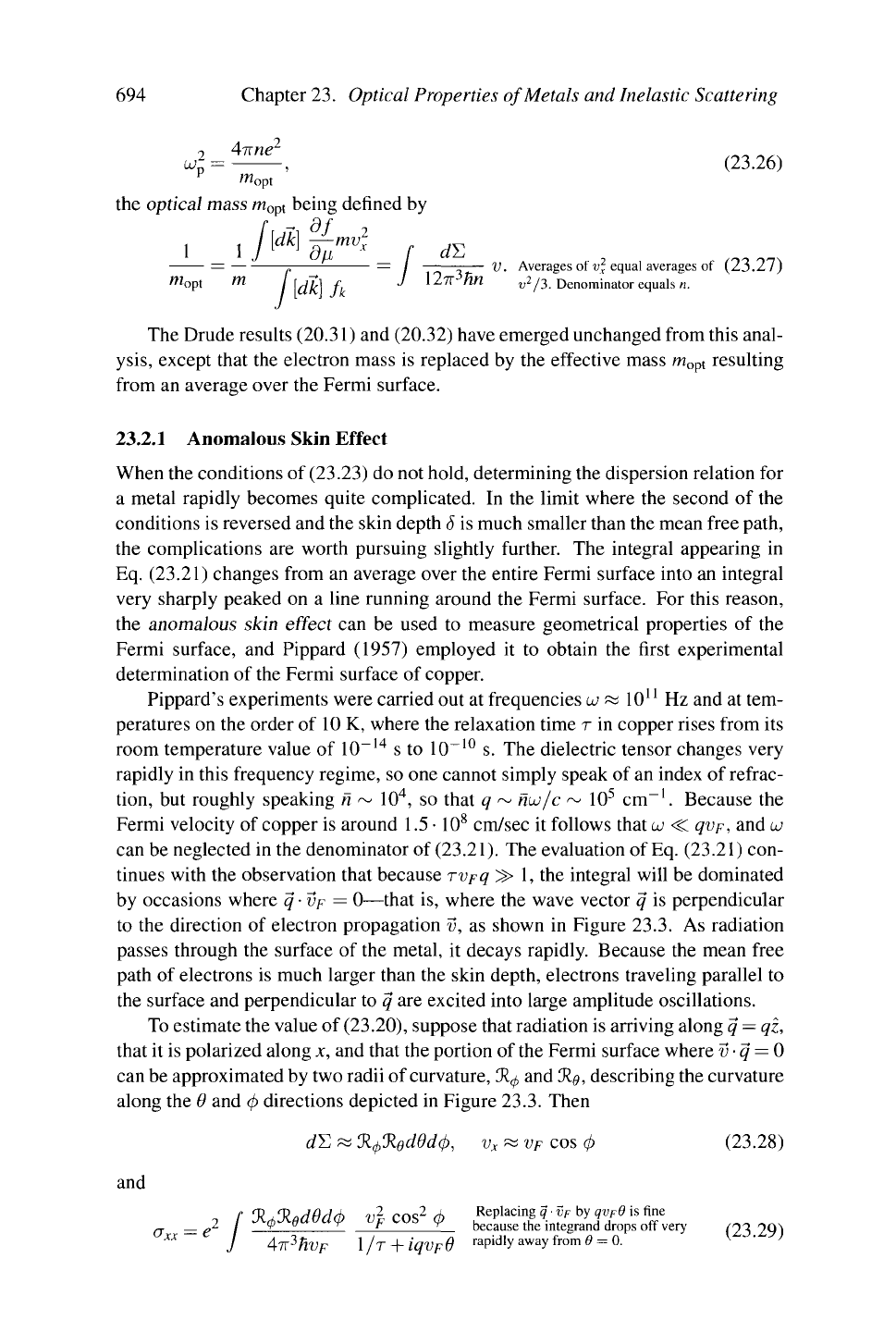
4irne
u?
v
= , (23.26)
'Wopt
the optical mass m
opt
being defined by
i
i I
[dl]
fr
1
_ f
dE
l
opt
Averages of v\ equal averages of (23.27)
[rfjfcl ft i-^VT «W
D
2
/3.
Denominator equals n.
The Drude results
(20.31 )
and (20.32) have emerged unchanged from this anal-
ysis,
except that the electron mass is replaced by the effective mass m
opt
resulting
from an average over the Fermi surface.
23.2.1 Anomalous Skin Effect
When the conditions of (23.23) do not hold, determining the dispersion relation for
a metal rapidly becomes quite complicated. In the limit where the second of the
conditions is reversed and the skin depth
Ö
is much smaller than the mean free path,
the complications are worth pursuing slightly further. The integral appearing in
Eq. (23.21) changes from an average over the entire Fermi surface into an integral
very sharply peaked on a line running around the Fermi surface. For this reason,
the anomalous skin effect can be used to measure geometrical properties of the
Fermi surface, and Pippard (1957) employed it to obtain the first experimental
determination of the Fermi surface of copper.
Pippard's experiments were carried out at frequencies
WK,
10
1
' Hz and at tem-
peratures on the order of 10 K, where the relaxation time r in copper rises from its
room temperature value of 10~
14
s to 10~
10
s. The dielectric tensor changes very
rapidly in this frequency regime, so one cannot simply speak of an index of refrac-
tion, but roughly speaking n ~ 10
4
, so that q ~ nu/c ~ 10
5
cm
-1
. Because the
Fermi velocity of copper is around 1.5
•
10
8
cm/sec it follows that
to <C
qv
F
, and u;
can be neglected in the denominator of
(23.21).
The evaluation of
Eq.
(23.21) con-
tinues with the observation that because
TV
F
q 3> 1, the integral will be dominated
by occasions where q
■
v
F
= 0—that is, where the wave vector q is perpendicular
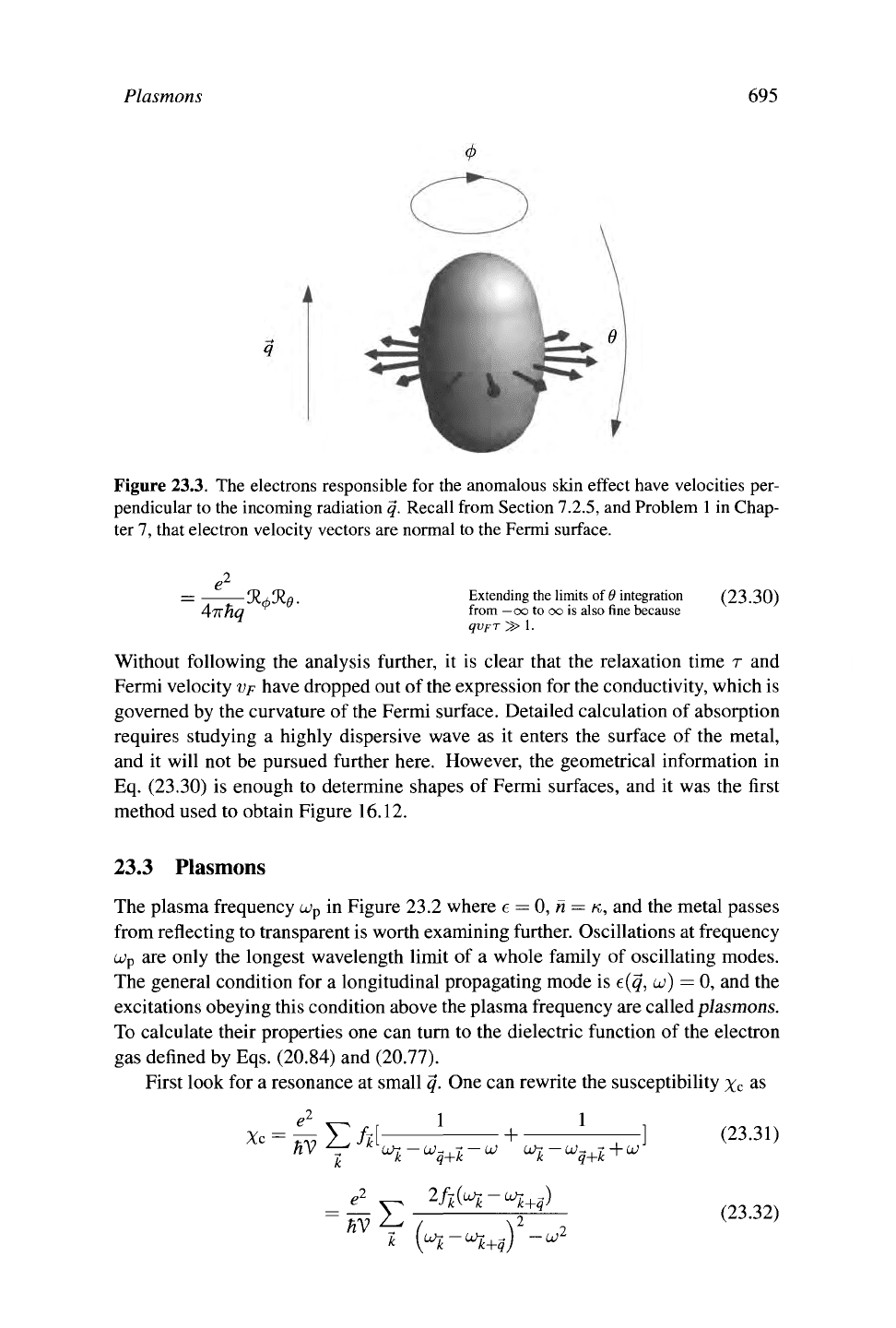
to the direction of electron propagation v, as shown in Figure 23.3. As radiation
passes through the surface of the metal, it decays rapidly. Because the mean free
path of electrons is much larger than the skin depth, electrons traveling parallel to
the surface and perpendicular to q are excited into large amplitude oscillations.
To estimate the value of
(23.20),
suppose that radiation is arriving along q
—
qz,
that it is polarized along x, and that the portion of the Fermi surface where v-q = 0
can be approximated by two radii of
curvature,
"R^
and Rg, describing the curvature
along the 0 and
4>
directions depicted in Figure
23.3.
Then
and
c» = e
JS « R^QdOdcf), v
x
« v
F
cos
4>
(23.28)
2
r R^edOdcf) V
F
COS (p becL^thelntegririd dropoff very (23 29)
J 4lT
3
hv
F
\/T + iqv
F
e rapidly away from ö = 0.
Plasmons
695
Figure 23.3. The electrons responsible for the anomalous skin effect have velocities per-
pendicular
to
the incoming radiation
q.
Recall from Section 7.2.5, and Problem
1
in Chap-
ter
7,
that electron velocity vectors are normal to the Fermi surface.
e
1
— 3L.3Ï0. Extending the limits of 0 integration (23.30)
4TTHÜ
from — oo to oo is also fine because
qv
F
T » 1.
Without following the analysis further, it is clear that the relaxation time r and
Fermi velocity vp have dropped out of
the
expression for the conductivity, which is
governed by the curvature of the Fermi surface. Detailed calculation of absorption
requires studying a highly dispersive wave as it enters the surface of the metal,
and it will not be pursued further here. However, the geometrical information in
Eq. (23.30) is enough to determine shapes of Fermi surfaces, and it was the first
method used to obtain Figure 16.12.
23.3 Plasmons
The plasma frequency
UJ
V
in Figure 23.2 where e = 0, n
—
K,
and the metal passes
from reflecting to transparent is worth examining further. Oscillations at frequency
cu
p
are only the longest wavelength limit of a whole family of oscillating modes.
The general condition for a longitudinal propagating mode is e(q, to) = 0, and the
excitations obeying this condition above the plasma frequency are called plasmons.
To calculate their properties one can turn to the dielectric function of the electron
gas defined by Eqs. (20.84) and (20.77).
First look for a resonance at small q. One can rewrite the susceptibility Xc as
xc =
it E
M
" +
1
—r-}
<
23
-
31
)
=
e y
_JkK
Ji
k+^_
("*-"*+?)'
696 Chapter 23. Optical Properties of Metals and Inelastic Scattering
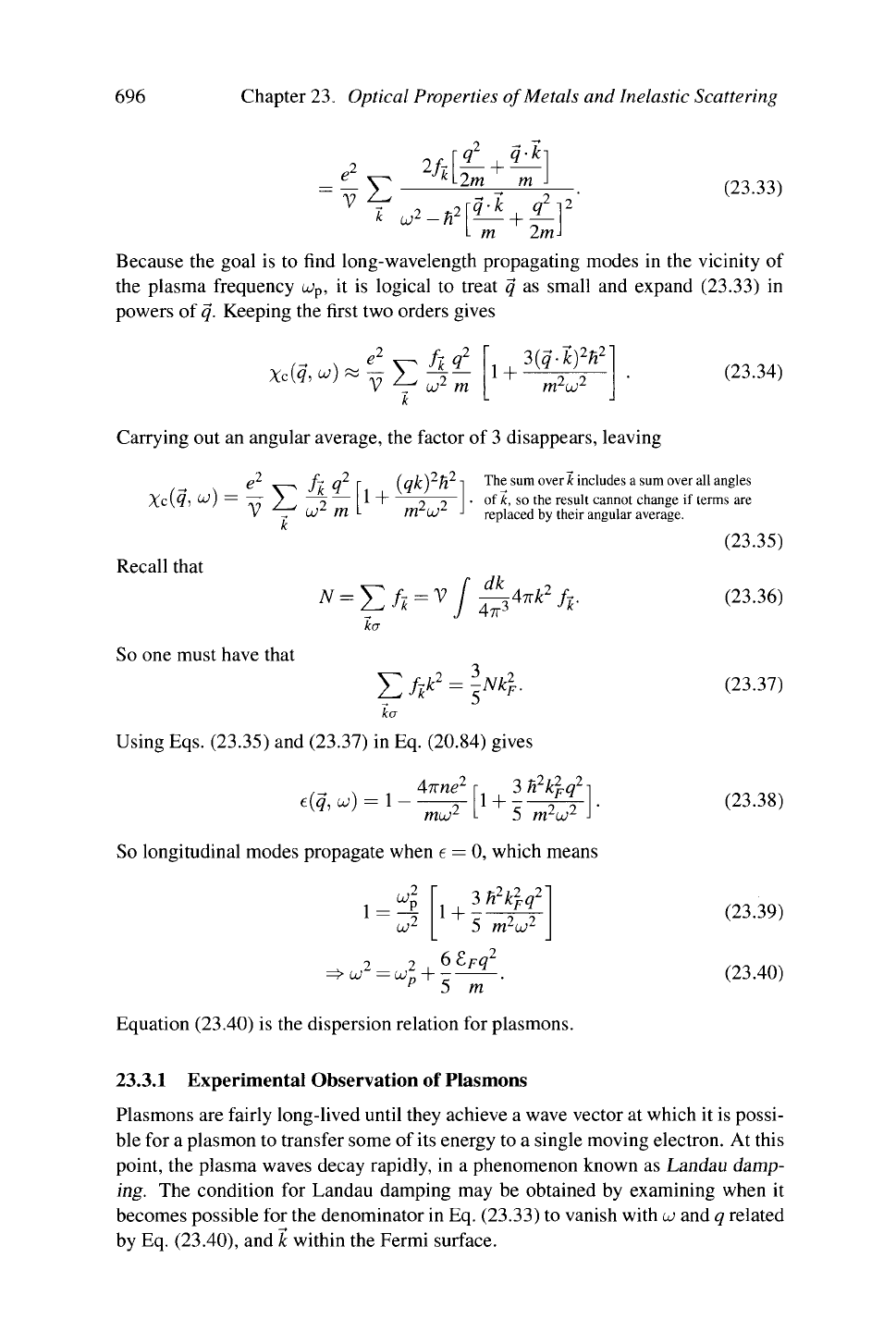
e
V
2
^
2
h
E —
2m m
Lü^
q-k ri
2
m 2ml
(23.33)
Because the goal is to find long-wavelength propagating modes in the vicinity of
the plasma frequency ui
p
, it is logical to treat q as small and expand (23.33) in
powers of q. Keeping the first two orders gives
Xc(q, w)
v
E
ht
up-
m
14
3(q-k)
2
h
2fe2'
m
2
ui
2
(23.34)
Carrying out an angular average, the factor of 3 disappears, leaving
?
2
V
(^ \
e
" v^ h q
Xc{q,u) = -- 2^ -2~
k
2
^
+
{qkfn
m
2
cu
2
2
R
2
n The
sum over k includes a sum over all angles
of k, so the result cannot change if terms are
replaced by their angular average.
Recall that
So one must have that
la
E/;*
2
-Nk
F-
(23.35)
(23.36)
(23.37)
/to-
Using Eqs. (23.35) and (23.37) in Eq. (20.84) gives
e(q,
u>)
1
4irne
mui^
2 r
2u2 „2
1 + T
3 trkfrq
5 m
2
io
2
-
(23.38)
So longitudinal modes propagate when e = 0, which means
3H
2
k
2
F
q
2
~
1
1
+
5 m
2
L0
2
2 2
,
6£
ff
F
5 m
(23.39)
(23.40)
Equation (23.40) is the dispersion relation for plasmons.
23.3.1 Experimental Observation of Plasmons
Plasmons are fairly long-lived until they achieve a wave vector at which it is possi-
ble for a plasmon to transfer some of its energy to a single moving electron. At this
point, the plasma waves decay rapidly, in a phenomenon known as Landau damp-
ing. The condition for Landau damping may be obtained by examining when it
becomes possible for the denominator in Eq. (23.33) to vanish with
UJ
and q related
by Eq. (23.40), and k within the Fermi surface.
Plasmons 697
120
100
1
80
o
o
c 60
o
% 40
20
"-20 0 20 40 60 80 100 120 140 160 180
Energy loss, — A£ (eV)
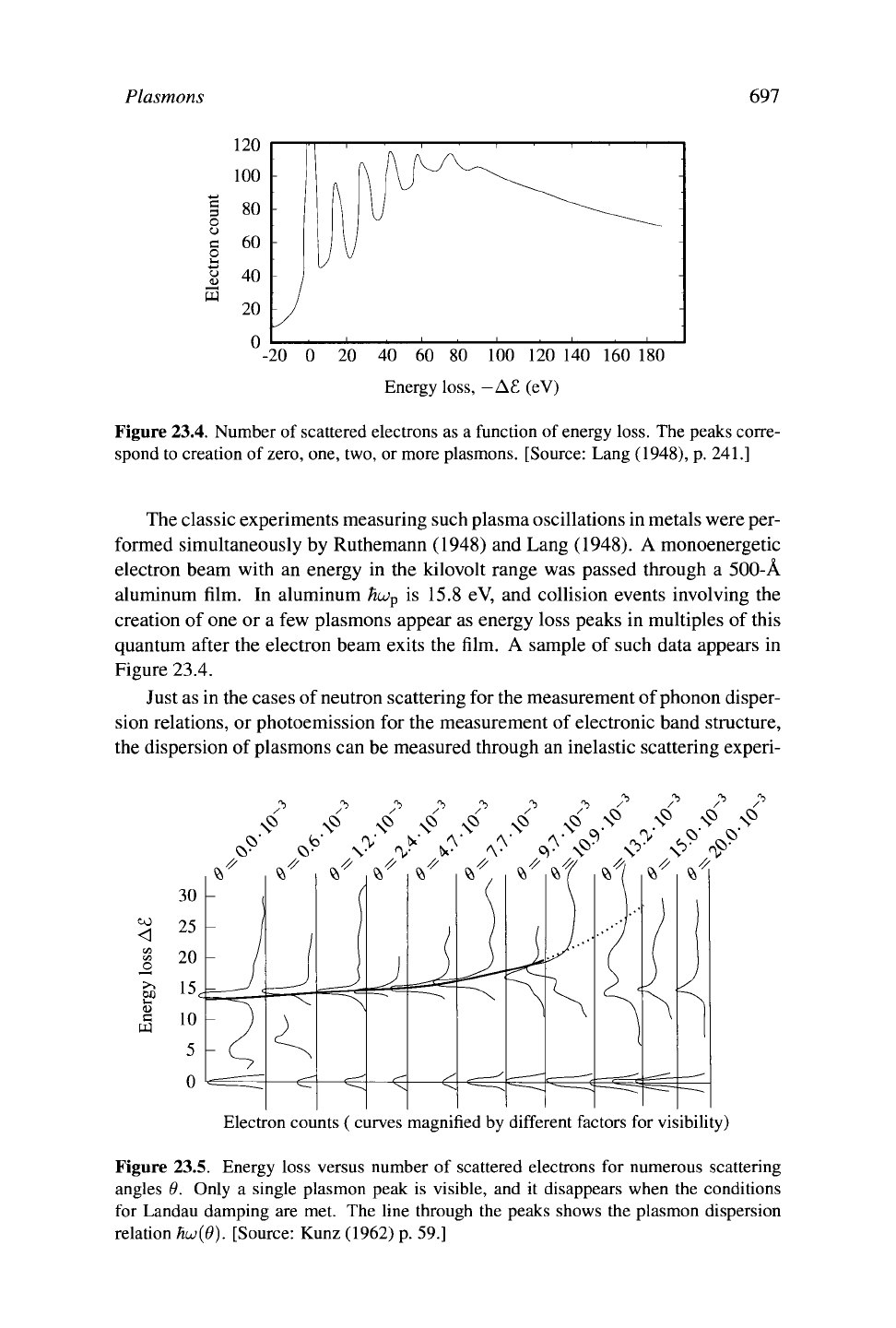
Figure 23.4. Number of scattered electrons as a function of energy loss. The peaks corre-
spond to creation of zero, one, two, or more plasmons. [Source: Lang (1948), p. 241.]
The classic experiments measuring such plasma oscillations in metals were per-
formed simultaneously by Ruthemann (1948) and Lang (1948). A monoenergetic
electron beam with an energy in the kilovolt range was passed through a 500-Â
aluminum film. In aluminum huo
v
is 15.8 eV, and collision events involving the
creation of one or a few plasmons appear as energy loss peaks in multiples of this
quantum after the electron beam exits the film. A sample of such data appears in
Figure 23.4.
Just as in the cases of neutron scattering for the measurement of phonon disper-
sion relations, or photoemission for the measurement of electronic band structure,
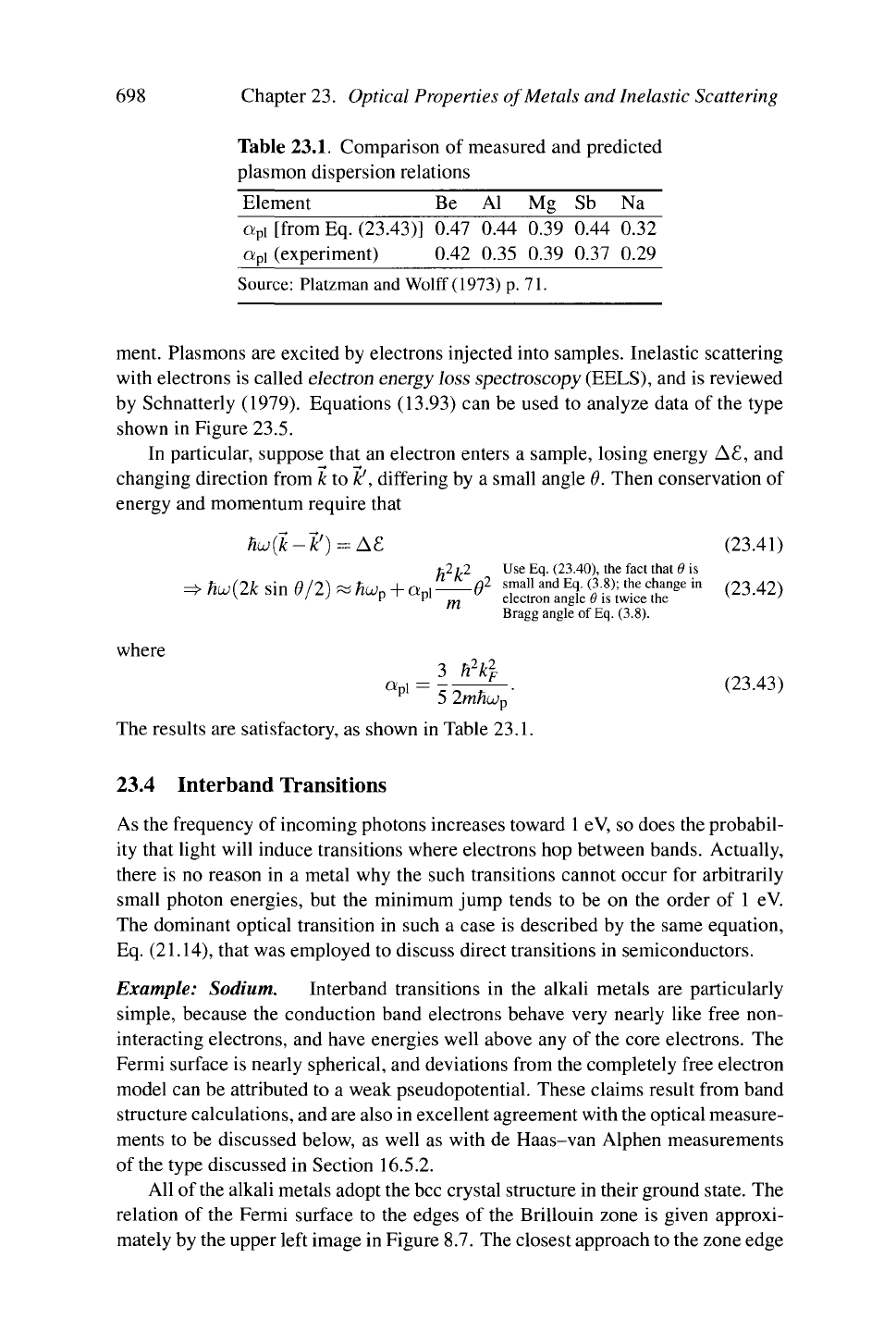
the dispersion of plasmons can be measured through an inelastic scattering experi-
Electron counts ( curves magnified by different factors for visibility)
Figure 23.5. Energy loss versus number of scattered electrons for numerous scattering
angles 9. Only a single plasmon peak is visible, and it disappears when the conditions
for Landau damping are met. The line through the peaks shows the plasmon dispersion
relation hu(9). [Source: Kunz (1962) p. 59.]
698 Chapter
23.
Optical Properties of Metals and Inelastic Scattering
Table 23.1. Comparison of measured and predicted
plasmon dispersion relations
Element Be AI Mg
a
p
i [from Eq. (23.43)] 0.47 0.44 0.39
a
p
i (experiment) 0.42 0.35 0.39
Sb Na
0.44 0.32
0.37 0.29
Source: Platzman and Wolff (1973) p. 71.
ment. Plasmons are excited by electrons injected into samples. Inelastic scattering
with electrons is called electron energy loss spectroscopy (EELS), and is reviewed
by Schnatterly (1979). Equations (13.93) can be used to analyze data of the type
shown in Figure 23.5.
In particular, suppose that an electron enters a sample, losing energy A£, and
changing direction from k to k', differing by a small angle 9. Then conservation of
energy and momentum require that
hcü(k-k') = A8. (23.41)
t2^2 Use Eq. (23.40), the fact that 0 is
=>
hLü(2k
sin 0/2) «hu
D
+ a
vl
6
2
™
a]
}
andE
t
(
„
38)
;
the
<*?
n
s
ein
(23.42)
v
' ' m electron angle 0 is twice the
v
'
Bragg angle of
Eq.
(3.8).
where
°V =
l£¥--
(23-43)
5
zmnujp
The results are satisfactory, as shown in Table 23.1.
23.4 Interband Transitions
As the frequency of incoming photons increases toward
1
eV, so does the probabil-
ity that light will induce transitions where electrons hop between bands. Actually,
there is no reason in a metal why the such transitions cannot occur for arbitrarily
small photon energies, but the minimum jump tends to be on the order of 1 eV.
The dominant optical transition in such a case is described by the same equation,
Eq. (21.14), that was employed to discuss direct transitions in semiconductors.
Example: Sodium. Interband transitions in the alkali metals are particularly
simple, because the conduction band electrons behave very nearly like free non-
interacting electrons, and have energies well above any of the core electrons. The
Fermi surface is nearly spherical, and deviations from the completely free electron
model can be attributed to a weak pseudopotential. These claims result from band
structure calculations, and are also in excellent agreement with the optical measure-
ments to be discussed below, as well as with de Haas-van Alphen measurements
of the type discussed in Section 16.5.2.
All of
the
alkali metals adopt the bcc crystal structure in their ground state. The
relation of the Fermi surface to the edges of the Brillouin zone is given approxi-
mately by the upper left image in Figure 8.7. The closest approach to the zone edge
Interband Transitions 699
is
at
point
N,
labeled in Figure 7.9, which
is at
distance 2ir/\/2a
=
4.44/a from
the origin, while the Fermi surface is at distance [67r
2
]
1//3
/a
=
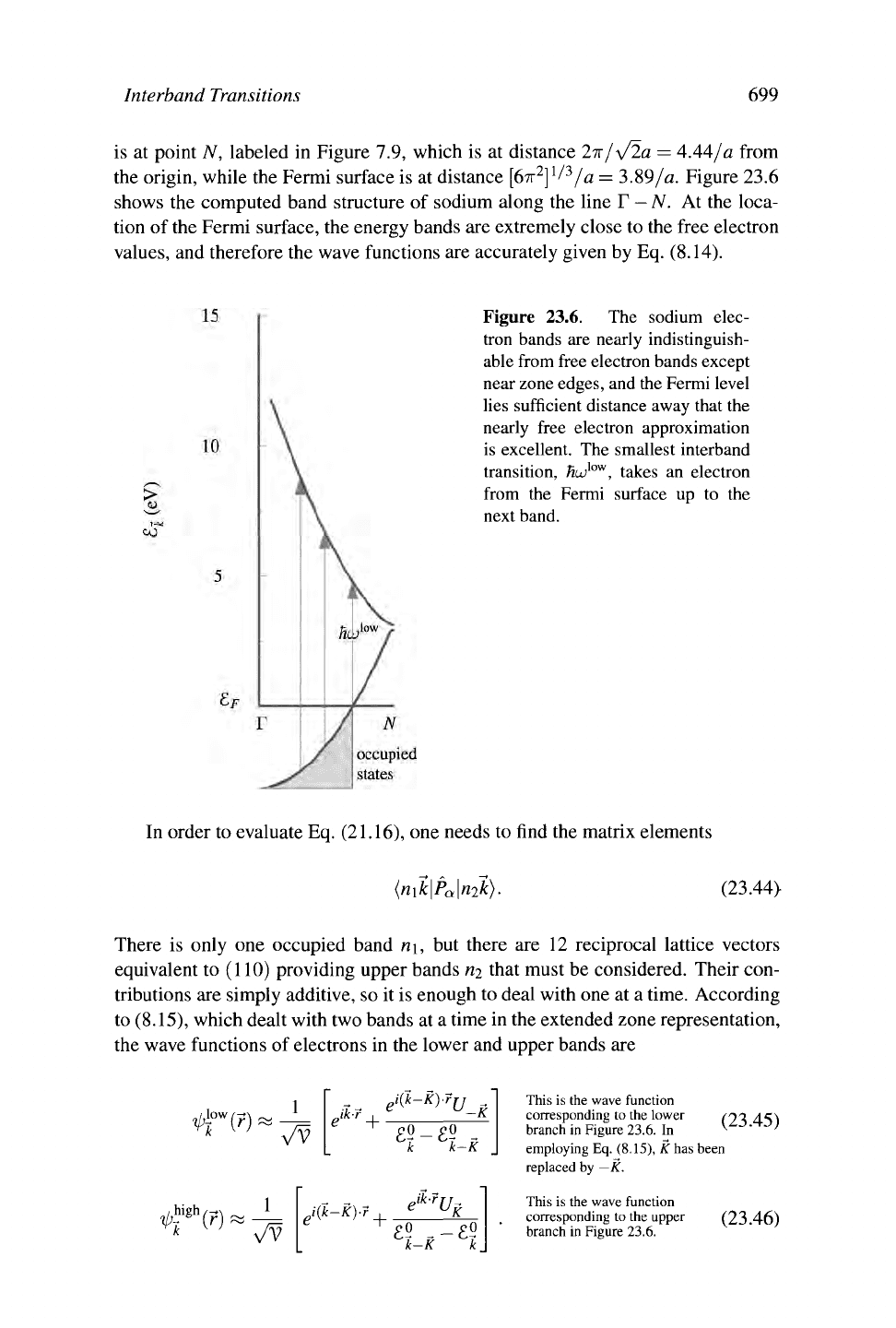
3.89/a. Figure 23.6
shows the computed band structure
of
sodium along the line F
—
N. At the loca-
tion of the Fermi surface, the energy bands are extremely close to the free electron
values, and therefore the wave functions are accurately given by Eq. (8.14).
Figure 23.6.
The
sodium elec-
tron bands are nearly indistinguish-
able from free electron bands except
near zone edges, and the Fermi level
lies sufficient distance away that the
nearly free electron approximation
is excellent. The smallest interband
transition, /zo>
low
, takes
an
electron
from the Fermi surface
up to the
next band.
In order to evaluate Eq. (21.16), one needs to find the matrix elements
(ni~k\P
a
\n2k).
(23.44)
There
is
only one occupied band
n\,
but there are 12 reciprocal lattice vectors
equivalent to (110) providing upper bands «2 that must be considered. Their con-
tributions are simply additive, so it is enough to deal with one at a time. According
to (8.15), which dealt with two bands at a time in the extended zone representation,
the wave functions of electrons in the lower and upper bands are
*rv*>^
Vf
h
(?)
e
i{k-K)r
ri]
e
ikr
+
-K
n
£9
.
k-K
V
j(k-R)-r
„ik-f
+
Ut
£°
-■
k-K
n
This is the wave function
corresponding to the lower
Cy\ AS\
branch in Figure 23.6.
In V • ^
employing Eq. (8.15), K has been
replaced by —K.
This is the wave function
corresponding to the upper
branch in Figure 23.6.
(23.46)
700 Chapter 23. Optical Properties of Metals and Inelastic Scattering
Most details are left to Problem 2. In
brief,
(20.70) becomes
Re[cr
a/
g](w) =
ne
2
h
2
1 ^ „ \Up\
2
KJÇp
sfsQ p0
-es
^e(HO)
v
k-K k
to m
2
V _
E h
(£L,-£5)
2
6{Q_
k
-Q-hu,) (23.47)
k is summed over the Brillouin zone, and K ranges over the vectors equivalent to (110)
under cubic symmetry operations.
a(LO
4e
2
7r
m
2
uj^
K
2
\Uz\
2
Di(hjj),
where the joint density of states Dj defined in Eq. (21.17) takes the form
H^)
=
\ E #(£JU-£j-M
„3
- (u;
high
~(jj)(ui- LÜ
]0VJ
) a vanishes for
LÜ
>
w
hi
8
h
and
m
with
LÜ
4TT
2
H
4
K
3
sh=
H
2
K(K + 2k
F
)
2hm
W
<LO'
1
U!
low
h
2
K(K-2k
F
)
2hm
(23.48)
(23.49)
(23.50)
(23.51)
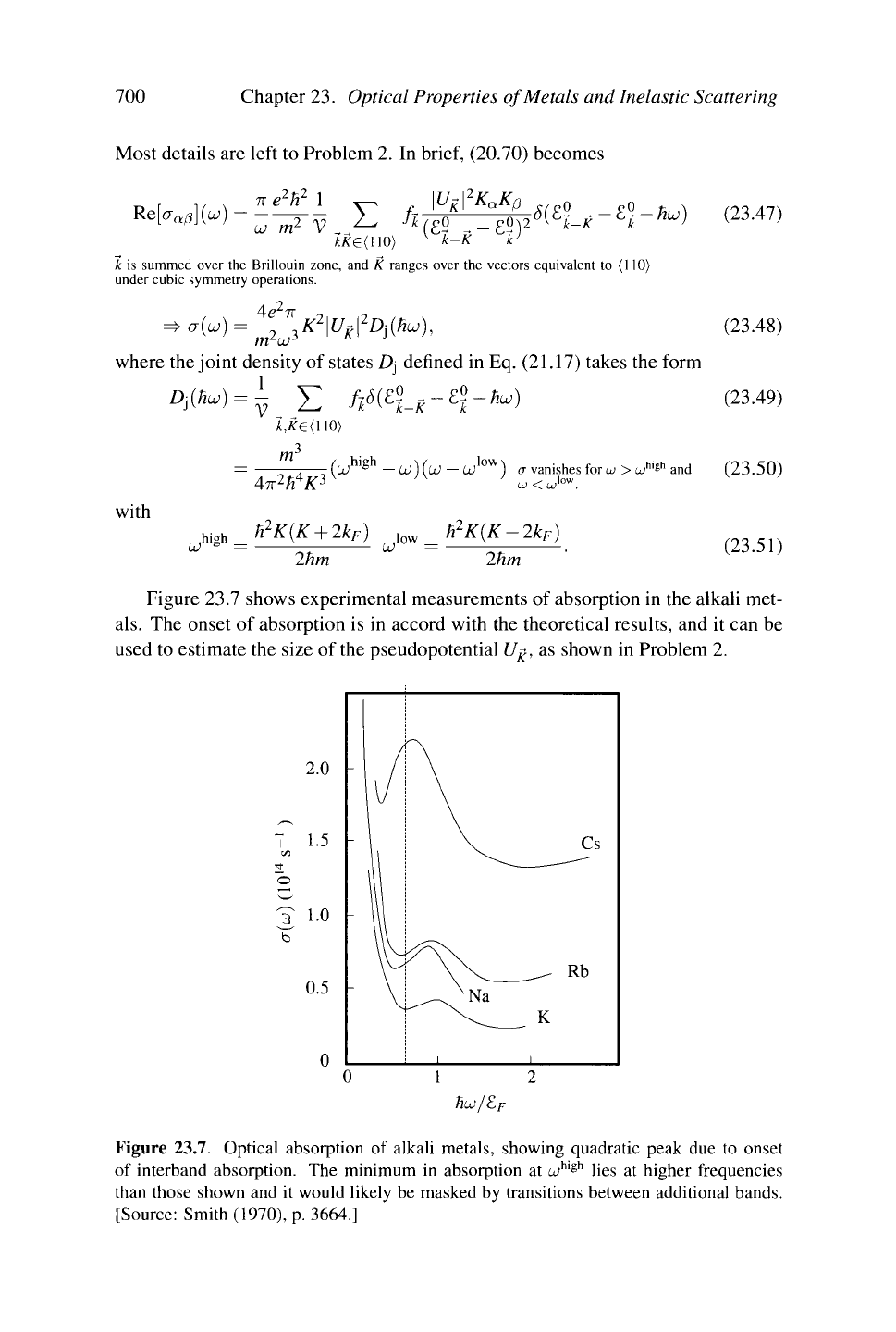
Figure 23.7 shows experimental measurements of absorption in the alkali met-
als.
The onset of absorption is in accord with the theoretical results, and it can be
used to estimate the size of the pseudopotential Ug, as shown in Problem 2.
2.0
-
1.5
2
10
0.5
Figure 23.7. Optical absorption of alkali metals, showing quadratic peak due to onset
of interband absorption. The minimum in absorption at w
hlgh
lies at higher frequencies
than those shown and it would likely be masked by transitions between additional bands.
[Source: Smith (1970), p. 3664.]
Brillouin and Raman Scattering 701
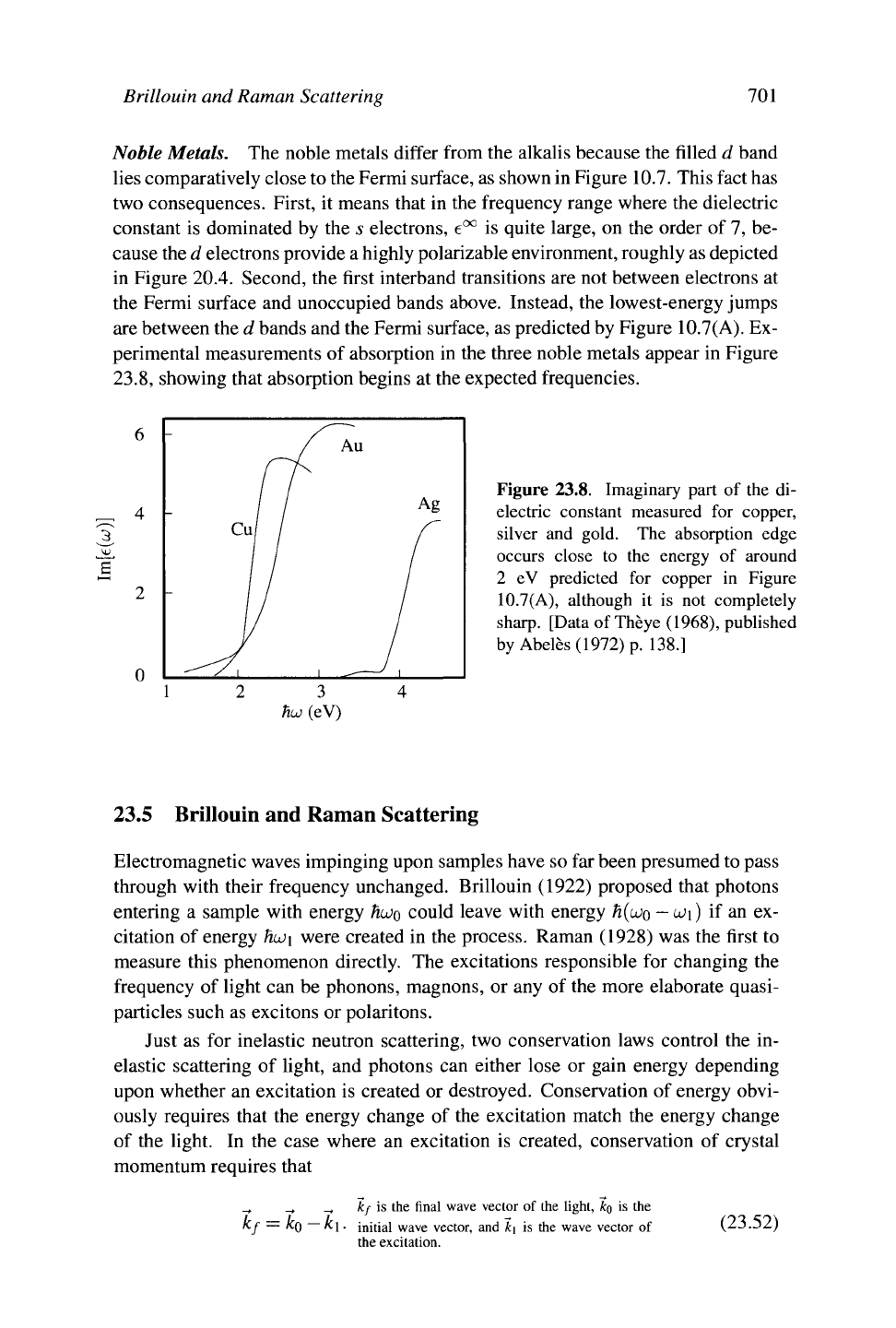
Noble Metals. The noble metals differ from the alkalis because the filled d band
lies comparatively close to the Fermi surface, as shown in Figure 10.7. This fact has
two consequences. First, it means that in the frequency range where the dielectric
constant is dominated by the 5 electrons, e°° is quite large, on the order of 7, be-
cause the d electrons provide a highly polanzable environment, roughly as depicted
in Figure 20.4. Second, the first interband transitions are not between electrons at
the Fermi surface and unoccupied bands above. Instead, the lowest-energy jumps
are between the d bands and the Fermi surface, as predicted by Figure 10.7(A). Ex-
perimental measurements of absorption in the three noble metals appear in Figure
23.8,
showing that absorption begins at the expected frequencies.
„ 4
3
Figure 23.8. Imaginary part of the di-
electric constant measured for copper,
silver and gold. The absorption edge
occurs close to the energy of around
2 eV predicted for copper in Figure
10.7(A), although it is not completely
sharp.
[Data of Thèye (1968), published
byAbelès(1972)p. 138.]
23.5 Brillouin and Raman Scattering
Electromagnetic waves impinging upon samples have so far been presumed to pass
through with their frequency unchanged. Brillouin (1922) proposed that photons
entering a sample with energy
hcuo
could leave with energy
h(coo — u>i)
if an ex-
citation of energy
Hu>\
were created in the process. Raman (1928) was the first to
measure this phenomenon directly. The excitations responsible for changing the
frequency of light can be phonons, magnons, or any of the more elaborate quasi-
particles such as excitons or polaritons.
Just as for inelastic neutron scattering, two conservation laws control the in-
elastic scattering of light, and photons can either lose or gain energy depending
upon whether an excitation is created or destroyed. Conservation of energy obvi-
ously requires that the energy change of the excitation match the energy change
of the light. In the case where an excitation is created, conservation of crystal
momentum requires that
_, _, -, kf is the final wave vector of the light, ko is the
kf
=
KO
k\. initial wave vector, and k\ is the wave vector of
the excitation.
(23.52)
702 Chapter
23.
Optical Properties of Metals and Inelastic Scattering
In a medium with index of refraction n, light obeys the dispersion relation u
—
ck/n,
so the two conservation laws can be combined to read
-(kf — ko) =
=fUJ\
( =F (kf — ko))-
The minus
si
§
n
creates an excitation, while (23.53)
n ^ 'the positive sign destroys one.
o>i
(k) is the
dispersion relation of the excitation. Com-
pare with Eq. (13.93).
Light whose frequency is reduced is Stokes
scattered
light, while light whose fre-
quency increases is anti-Stokes scattered light, and the frequency change is called
the Raman shift.
Brillouin's theory concerned the scattering of light from sound waves, so when
inelastic light scattering creates and destroys acoustic phonons it is known as Bril-
louin scattering, while Raman's experiments involved optical phonons, and inelas-
tic scattering from these excitations is called Raman scattering. Because of the
high photon fluxes available from synchrotrons, X-rays can be employed as well
as visible light, leading to the technique of inelastic X-ray scattering.
Referring to Figure
20.1,
the wave number of visible photons is several orders
of magnitude smaller than the wave number of phonons near the zone edge. For
this reason, Raman and Brillouin scattering are only able to look at phonons near
the zone center. Inelastic X-ray scattering, however, is able to explore phonon
dispersion relations through the entire Brillouin zone.
23.5.1 Brillouin Scattering
In the case of acoustic phonons,
(j, = c
n
k. c
p
is the sound speed of a transverse or longi- (23.54)
tudinal phonon.
Adopting the case of Stokes scattering—the minus sign in Eq. (23.53)—and taking
9 to be the angle between incoming and outgoing light, one has
nc
(k
f
-ko) = Jkj +
*§
- Ikfko cos 6 (23.55)
c v V
2nc
p
/1
—
cos 6
ko —
kfXiko
-\ . Because Cp/c-C
1,*/and
*Ö
can be set equal (23.56)
C V 2 to leading approximation on the right-hand
side.
.
LJo
-
u
,
f
='?^9EP
sin
e/2 (23.57)
The data shown in Figure 23.9 show Brillouin scattering from longitudinal and
transverse phonons in germanium. The phonon frequencies were already known
from acoustic measurements, so the data were used to extract the complex dielec-
tric constant h of germanium, with the width of the peaks providing a measure of
the extinction coefficient n.