
Marder M.P. Condensed Matter Physics
Подождите немного. Документ загружается.

24.
Classical Theories of Magnetism and
Ordering
24.1 Introduction
The ancient Greeks knew of the attraction between lodestone and iron; magnets
receive brief mention from Plato and Aristotle. Curious statements echo back from
antiquity, that "a loadstone rubbed with garlic does not attract iron...." [Gilbert
(1600),
p. 2], but the practical use of lodestone as a magnetic compass is also
quite old, dating at least before 1000 A.D. Unlike electrified amber, a lodestone's
attractive force is permanent, but strangely selective. It attracts iron, but not other
metals such as silver or gold. A magnet split in half produces two weaker magnets.
And "[a]pply a red-hot iron rod to a magnetized needle and the needle stands still,
not turning to the iron; but as soon as the temperature has fallen somewhat it at
once turns to it" [Gilbert (1600), p. 107].
If magnetism is the oldest great mystery of solids, it has also remained one of
the most difficult to explain. One reason is that the origin of magnetism is relent-
lessly quantum mechanical. No solid built of charged particles could have magnetic
properties in a world completely ruled by classical physics. Most magnetic effects
result from quantum-mechanical interactions of electrons with one another, inter-
actions that cannot even be accommodated within the single-electron theory that
has dominated study so far. To make matters even more interesting, magnetic ions
interact with each other over large distances, and their response to external stimuli
tend to be hysteretic and spatially complex. Some of the very simplest questions
one can possibly pose in the subject of magnetism are still unsolved.
24.2 Three Views of Magnetism
24.2.1 From Magnetic Moments
The macroscopic theory of magnetic media can begin with the claim that within
the solid there lives a population of magnetic moments M, whirling loops of charge
producing currents according to
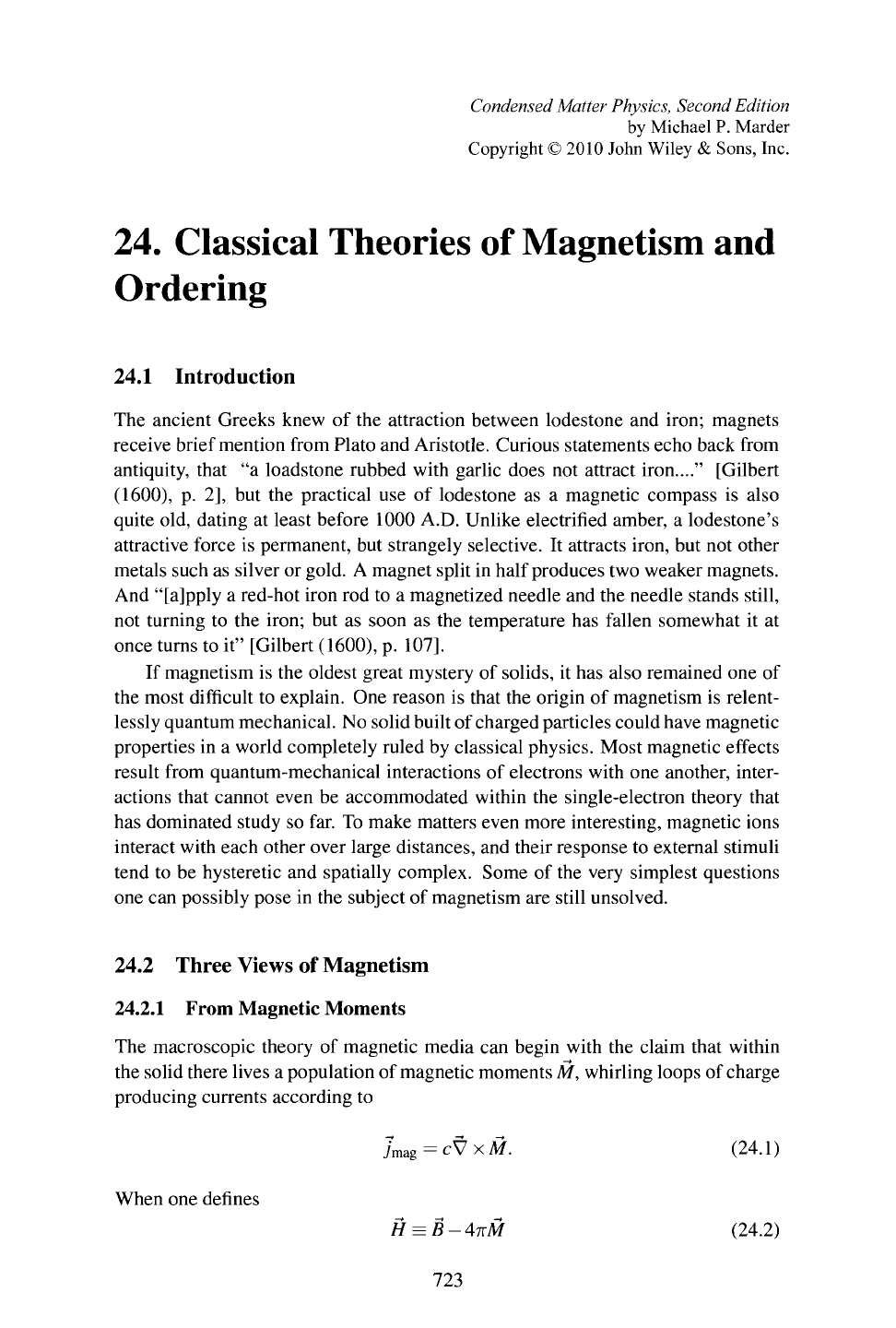
7mag = cVxM. (24.1)
When one defines
H = B-4TTM (24.2)
723
Condensed Matter
Physics,
Second Edition
by Michael P. Marder
Copyright © 2010 John Wiley & Sons, Inc.
724
Chapter 24. Classical Theories of Magnetism and Ordering
and separates y
mag
from other currents, the second of
Eqs.
(20.10b) becomes
Vxß=
7r
^
mag
-f
7F
-
/ext
-| Currents are separated into (24.3)
C C C Öt "external" and "magnetic."
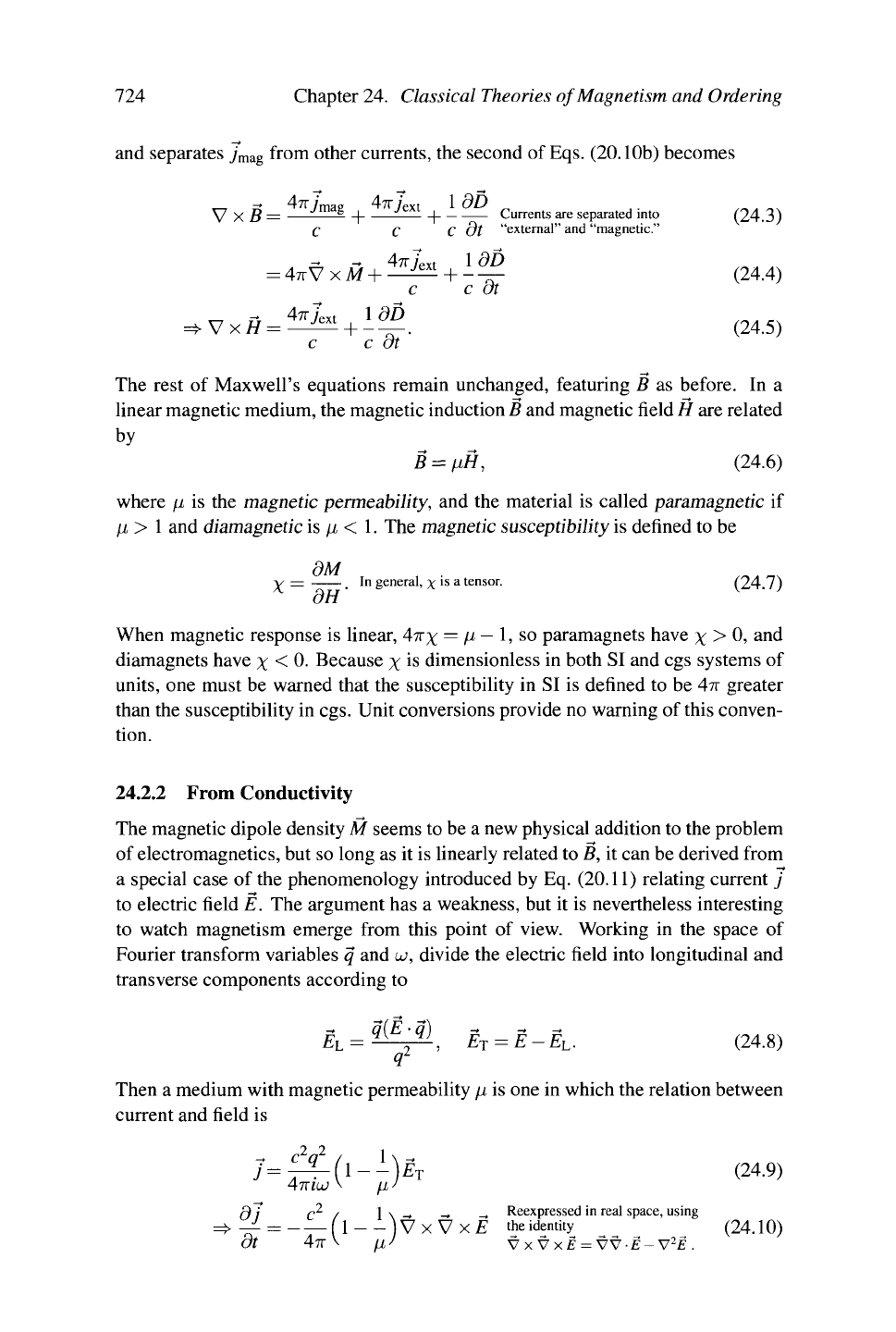
= 4^xÄ+^ + I^ (24.4)
c c ot
^VxH =
4
^ + if. (24.5)
c c ot
The rest of Maxwell's equations remain unchanged, featuring B as before. In a
linear magnetic medium, the magnetic induction B and magnetic field H are related
by
B = fiH, (24.6)
where \i is the magnetic permeability, and the material is called paramagnetic if
\i >
1
and diamagnetic is ß < 1. The magnetic susceptibility is defined to be
y = . In general, \ is a tensor. (24.7)
When magnetic response is linear, 47r% =
/U —
1, so paramagnets have x > 0, and
diamagnets have x < 0. Because x is dimensionless in both SI and cgs systems of
units,
one must be warned that the susceptibility in SI is defined to be 4ir greater
than the susceptibility in cgs. Unit conversions provide no warning of this conven-
tion.
24.2.2 From Conductivity
The magnetic dipole density M seems to be a new physical addition to the problem
of electromagnetics, but so long as it is linearly related to B, it can be derived from
a special case of the phenomenology introduced by Eq. (20.11) relating current j
to electric field E. The argument has a weakness, but it is nevertheless interesting
to watch magnetism emerge from this point of view. Working in the space of
Fourier transform variables q and u, divide the electric field into longitudinal and
transverse components according to
E
L
= ^-^-, È
T
= Ê-È
L
. (24.8)
<r
Then a medium with magnetic permeability ß is one in which the relation between
current and field is
j=^(l--)È
T
(24.9)
4TTILÜ V [l'
ß j fp' / \ \ — — -> Reexpressed '
n
real space, using
=>^f = 1— VxVx£ theidentity (24.10)
Ot 4lT V /// Vx Vx£ = VV-£-V
2
£.
Three Views of Magnetism
725
= — (l--)Vx— From Eq. (20.10b). (24.11)
4ir
V
n ) dt
-f c ( 1 \ -* — ->
=> j = (1 Vxfß- So) Bo is a time-independent field. (24.12)
47T
V
[I'
, \\- - 1 3D FromEq. (20.10b), and setting
=>Vxß= 1 JVxßH — B
0
to zero; the need to set B
0
to (24.13)
^ /i ' C Ot zero is the technical flaw in this
derivation.
- B -* -* 1 ÖD
=»Vx- = Vx# = - —. (24.14)
// c o?
24.2.3 From a Free Energy
The weakness in deriving Eq. (24.14) from Eq. (24.8) appears in Eq. (24.12); a
time-independent magnetic field Bo arises, and it must arbitrarily be set to zero
to obtain the conventional form of magnetic response. In addition, the derivation
assumes a linear relation between B and H. The goals of a proper thermodynamic
account of magnetism are first to remove this ambiguity, and second to deal with
the fact that many important magnetic phenomena are not linear. Without placing
magnetism on such a foundation, it is not possible to describe some of the more in-
teresting forms of magnetic response such as formation of ferromagnetic domains,
or superconductivity.
Begin by supposing the existence of an energy functional
£{ß(r)} (24.15)
that gives the energy of a magnetic system when the magnetic induction B(r) is
specified. In addition to isolated systems, it is often useful to consider a system
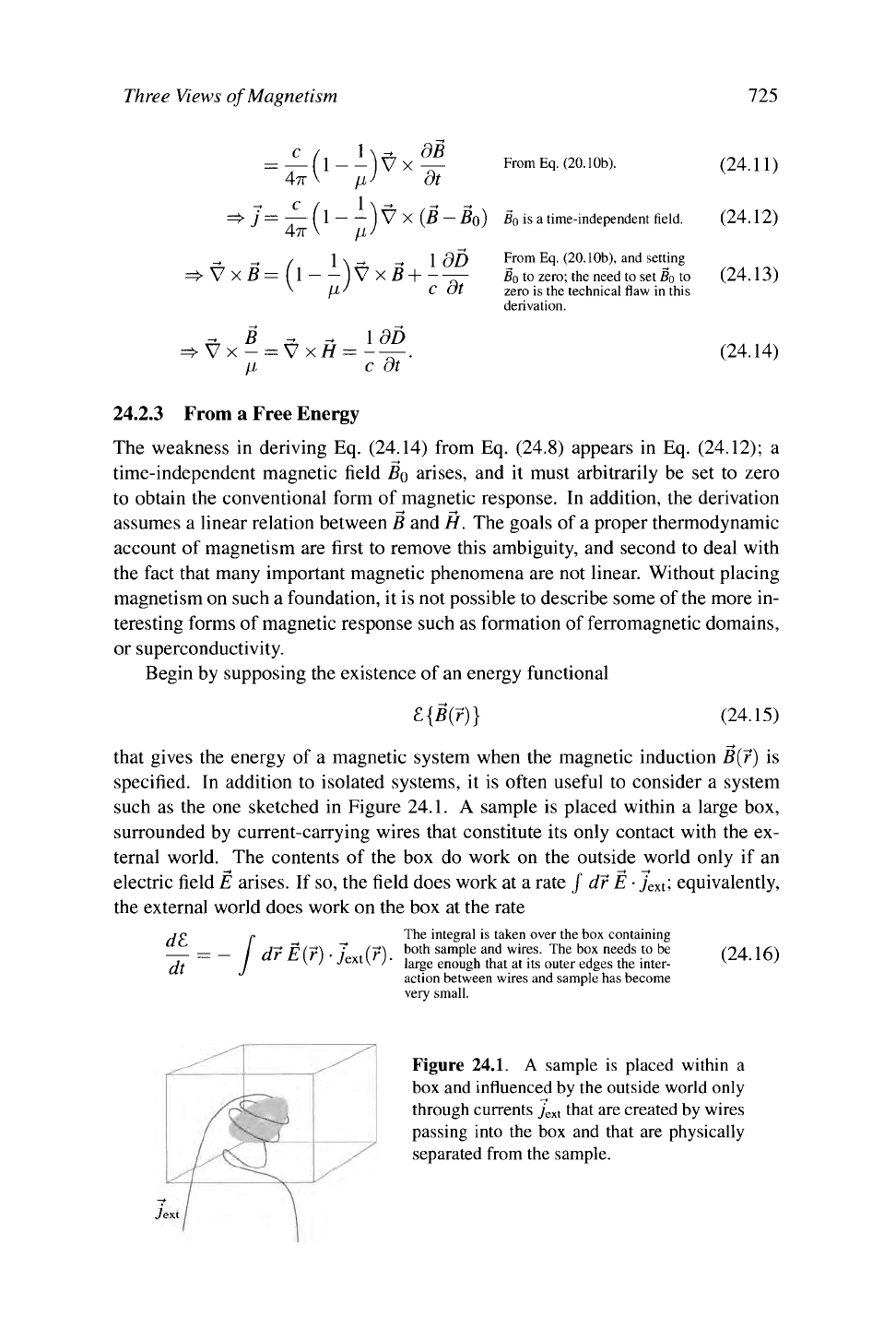
such as the one sketched in Figure 24.1. A sample is placed within a large box,
surrounded by current-carrying wires that constitute its only contact with the ex-
ternal world. The contents of the box do work on the outside world only if an
electric field E arises. If so, the field does work at a rate J dr E
■
j
ext
;
equivalently,
the external world does work on the box at the rate
JO
p The integral is taken over the box containing
/ d7 F(7)
■
7 (~r) k"
1
'
1
sam
P'
e
ar,
d wires. The box needs to be (1A
1
ft)
I \ J jextV )■ i
ar
g
e
enough that at its outer edges the inter- ^ ' '
dt
action between wires and sample has become
very small.
Figure 24.1. A sample is placed within a
box and influenced by the outside world only
through currents y
ext
that are created by wires
passing into the box and that are physically
separated from the sample.
726
Chapter 24. Classical Theories of Magnetism and Ordering
Supposing, however, that energy
£ as a
functional
of
induction
B in
the box
is
known, the change in energy can be computed in another way. Define
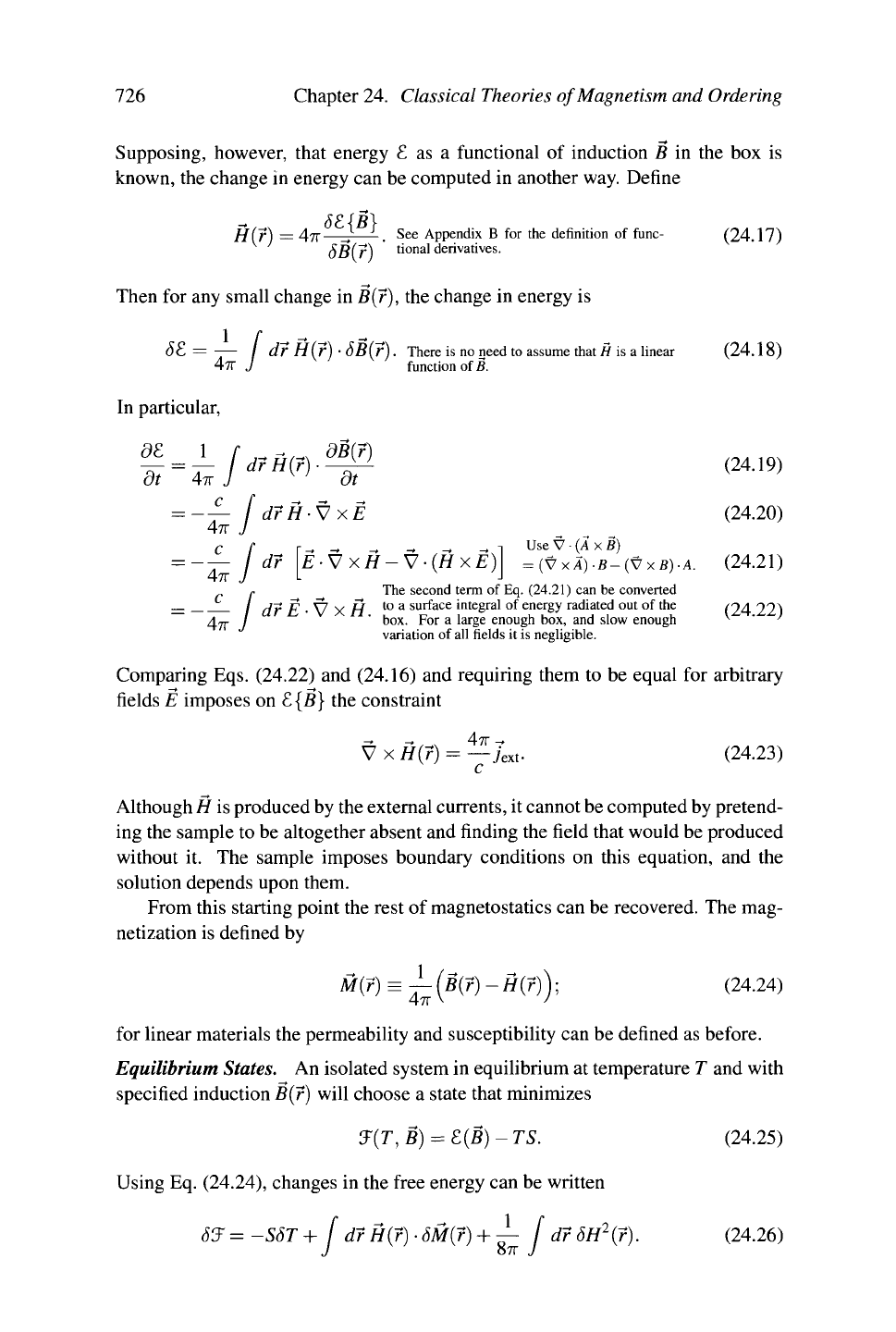
H(r)
=
4-7T—zr—-.
See
Appendix
B for the
definition
of
func-
(24.17)
ÖB(r) tional derivatives.
Then for any small change in B(r), the change in energy is
1
f
-.
- -.
8E
= — / dr
H(r)-SB(r). There is no need to assume that H is a linear (24.18)
4-7T
J
function of B.
In particular,
C
fdrHVxÈ (24.20)
4-7T
c
A-K
c
4TT
f
r
- - - - - - 1
Use V
■
(A
x ß)
/
dr
[£-Vx//-V-(//x£)j
=(VXÂ)-B-(VXB)-A.
(24.21)
/
The second term of
Eq.
(24.21) can be converted
d7
F
■
V
X
H
to a
sur
f
ace
integral
of
energy radiated
out of
the
/94 22^
box.
For
a
large enough
box, and
slow enough
^ ' '
Comparing Eqs. (24.22) and (24.16) and requiring them to be equal for arbitrary
fields E imposes on
£
{B} the constraint
-
4-7T
-
V
x
H{7)
=
— ;
ext
. (24.23)
Although H is produced by the external currents, it cannot be computed by pretend-
ing the sample to be altogether absent and finding
the
field
that would be produced
without it. The sample imposes boundary conditions on this equation, and the
solution depends upon them.
From this starting point the rest of magnetostatics can be recovered. The mag-
netization is defined by
M{r)
= ~{B{r)-H{r))-
(24.24)
for linear materials the permeability and susceptibility can be defined as before.
Equilibrium States. An isolated system in equilibrium at temperature
T
and with
specified induction B(r) will choose a state that minimizes
5(T,B)
=
E(B)-TS.
(24.25)
Using Eq. (24.24), changes in the free energy can be written
ÖJ = -SOT +
f
drH{?)- 5M{r)
+ ^- j
dr SH
2
(r). (24.26)
Magnetic Dipole Moments
727
If the system is connected to the world by external currents, as in Figure 24.1,
3~
is no longer the appropriate thermodynamic potential. By altering its magnetiza-
tion, the system can extract energy from the sources that maintain the current
j
e]it
fixed. Under these circumstances the thermodynamic potential to minimize is not
3,
but instead S, where
3 = 3"-— /drB{r)-H{7). (24.27)
47T J
A brief calculation to verify this claim is the subject of Problem 3. Small changes
in external currents produce changes in S
63 = -— I drB(r)-SH(r) (24.28)
47T J
= - f drM{r)-6H(r)-^- j dr H{r)
■
SH(r). (24.29)
When the field H is employed as an independent variable, then thermodynamic
equilibrium is given also by minima of
S = S + ^- / drH
2
{r) (24.30)
Φ7T J
for which
ÖS
=-SOT-
f
dfM-SH.
(24.31 )
The thermodynamic potential 9, which describes an ensemble at fixed temperature
T and field H, is a common starting point for studies of magnetic systems.
B versus H. A source of confusion is the question of when to employ B and when
to employ H. There are two competing considerations. As indicated in Eq. (24.23),
the source for H is external currents. Experiments that control external currents
therefore control H more directly than B, and they are frequently reported in terms
of H. In particular, for a long thin cylindrical sample with its axis pointing along
B,
Eq. (24.23) implies that no matter how the sample responds to B, the field H is
constant everywhere in space, because the component of H tangential to the sur-
face is continuous, and the normal component vanishes everywhere except at the
ends.
It is natural in this case to speak of H as the experimentally applied field. On
the other hand, the microscopic field perceived by nuclei or localized electrons is
clearly B. Thus experimental results should feature H, while microscopic Hamil-
tonians should employ B. The fact that this convention is not standard is probably
due to the fact that the magnetic permeability of many metals differs from
1
only
by parts in 10
5
(Table 25.4), so that in these materials B and H are equal for all
practical purposes.
24.3 Magnetic Dipole Moments
The magnetic dipole moment density M is really just a convenient way of viewing
closed loops of current, but it is worth exploring the properties of these dipoles a
728
Chapter 24. Classical Theories of Magnetism and Ordering
bit further to find their energy in external magnetic fields. The magnetic dipole
moment of a current distribution can be defined as
f 1
ffl = I d~p—f x j(7). In order for the magnetic moment to be inde- (24.32)
J 2c pendent of the choice of origin, the integral
of the current over space must vanish.
The Lorentz force on any current distribution is
p = - j dr J(r) x B{r). (24.33)
If the current distribution j forms a closed loop and then vanishes except in the
vicinity of some point, say the origin, then it makes sense to expand the magnetic
induction B as a Taylor series about that point, obtaining
F=-
[ dr J(r) x [5(0) + (r• V)fl(0) +. . .] (24.34)
=
0 + (ffl X V) X B
See
Problem 1 to verify this claim. (24.35)
= V(m
•
B)
See
Problem 1 to verify this claim. (24.36)
=4> [J = —ffi. B. U is the potential energy of the dipole in an (24.37)
external field.
According to Eq. (24.37), magnetic dipoles should tend to align along external
fields to minimize their energy, and solids should all be paramagnetic. However,
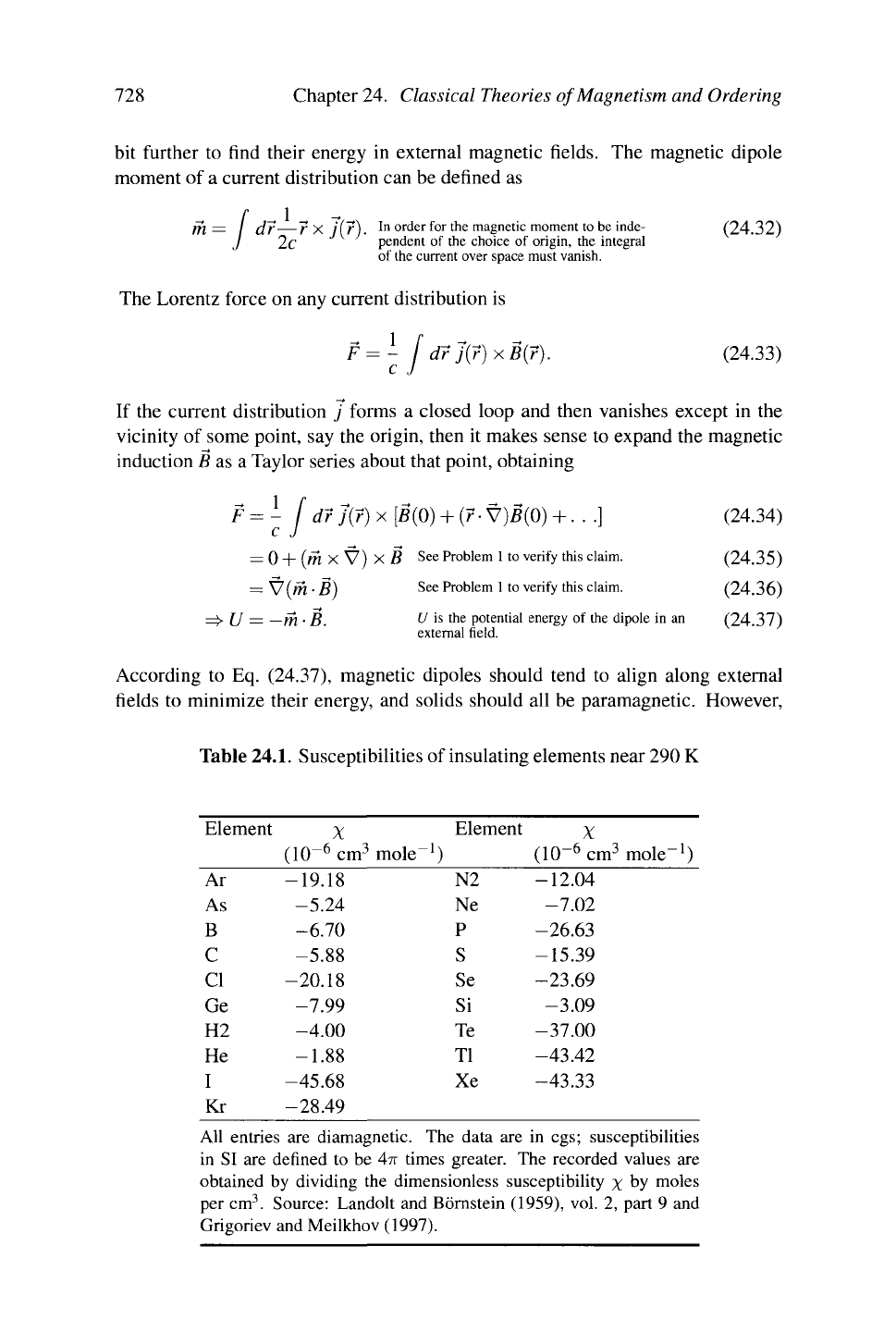
Table 24.1. Susceptibilities of insulating elements near 290 K
Element
Ar
As
B
C
Cl
Ge
H2
He
I
Kr
X
(10~
6
cm
3
mole~
-19.18
-5.24
-6.70
-5.88
-20.18
-7.99
-4.00
-1.88
-45.68
-28.49
Element
')
N2
Ne
P
S
Se
Si
Te
Tl
Xe
X
(10
-6
cm
3
mole"
1
)
-12.04
-7.02
-26.63
-15.39
-23.69
-3.09
-37.00
-43.42
-43.33
AU entries are diamagnetic. The data are in cgs; susceptibilities
in SI are defined to be 4n times greater. The recorded values are
obtained by dividing the dimensionless susceptibility x by moles
per cm
3
. Source: Landolt and Börnstein (1959), vol. 2, part 9 and
Grigoriev and Meilkhov (1997).
Magnetic Dipole Moments 729
the calculation assumes that somehow the current j flowing through the dipole
remains constant as the dipole orients itself in an external field, and it neglects the
work involved in maintaining the current.
In fact, a free charge circling in a magnetic field is diamagnetic. A positively
charged particle under the influence of a magnetic field in the positive z direction
circles in a clockwise direction, and according to Eq. (24.32), or the right-hand
rule,
it produces a magnetic moment in the negative z direction.
Both diamagnetism and paramagnetism are possible because some magnetic
moments really are permanent, while others arise only in response to applied fields.
The internal current loops of electrons are fixed by quantum mechanics, and they
cannot be altered by external fields. Therefore electrons orient their intrinsic mag-
netic moments in the direction of applied inductions and enhance them, producing
paramagnetic behavior with fi > 1. However, placing electrons in a box and con-
sidering the magnetic contributions due to their circular orbits in the external fields
tends to lead to diamagnetic behavior,
\L
< 1. Examples of diamagnetic materials
appear in Table 24.1.
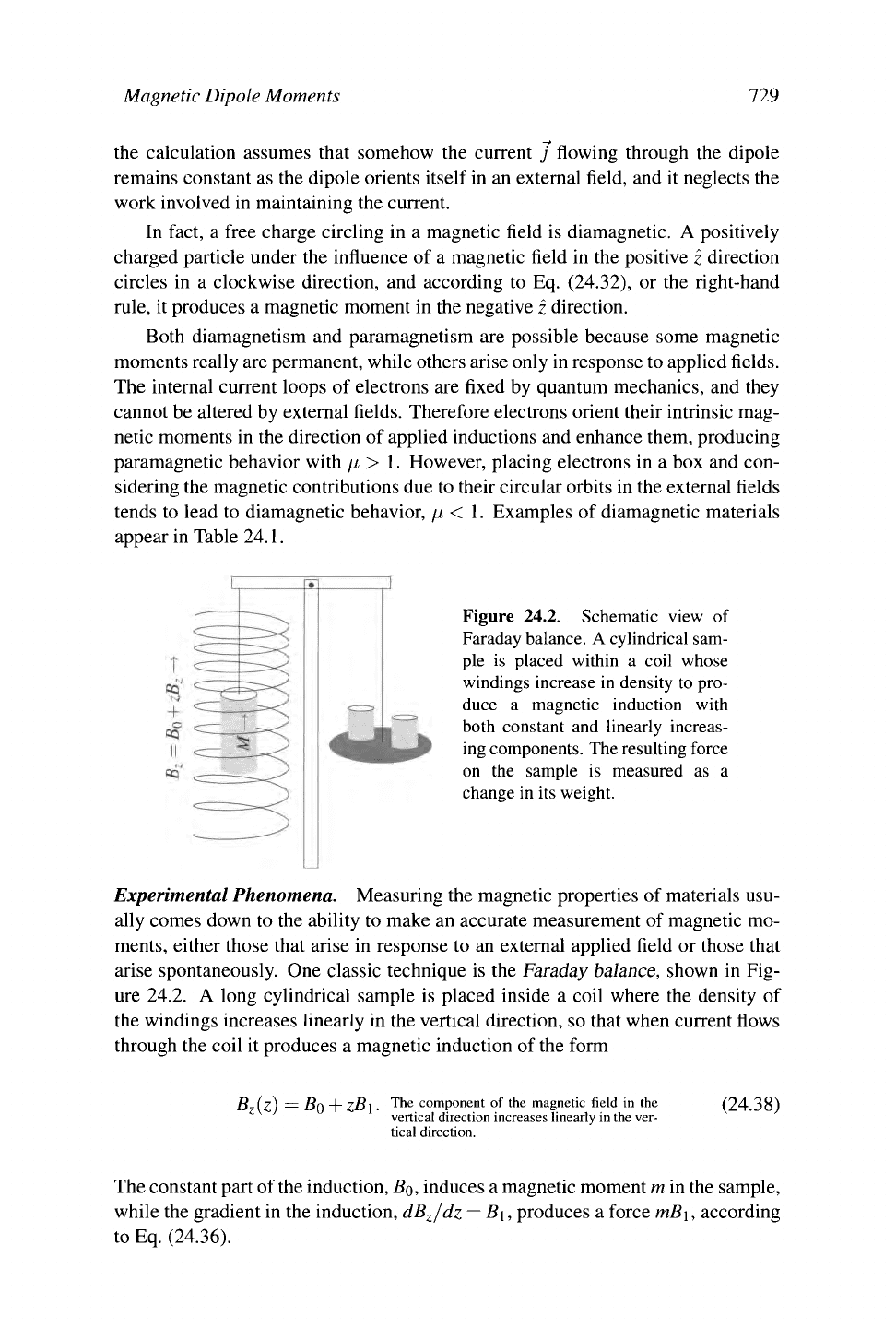
Figure 24.2. Schematic view of
Faraday
balance.
A
cylindrical sam-
ple is placed within a coil whose
windings increase in density to pro-
duce a magnetic induction with
both constant and linearly increas-
ing components. The resulting force
on the sample is measured as a
change in its weight.
Experimental Phenomena. Measuring the magnetic properties of materials usu-
ally comes down to the ability to make an accurate measurement of magnetic mo-
ments, either those that arise in response to an external applied field or those that
arise spontaneously. One classic technique is the
Faraday
balance,
shown in Fig-
ure 24.2. A long cylindrical sample is placed inside a coil where the density of
the windings increases linearly in the vertical direction, so that when current flows
through the coil it produces a magnetic induction of the form
B
7
{z) = Bn
~\~
zB\. The component of the magnetic field in the (24.38)
vertical direction increases linearly in the ver-
tical direction.
The constant part of
the
induction,
Bo,
induces a magnetic moment m in the sample,
while the gradient in the induction, dB
z
/dz = B\, produces a force mB\, according
to Eq. (24.36).
730
Chapter 24. Classical Theories of Magnetism and Ordering
24.3.1 Spontaneous Magnetization of Ferromagnets
So long as the response of a solid to magnetic fields remains linear, magnetism
is captured by Eq. (24.14). Most condensed matter specimens are either diamag-
netic or paramagnetic, particularly at elevated temperature. However, the study of
magnetism gains new interest when it begins to focus upon a set of spectacular
phenomena in which magnetic dipoles take on a life of their own and cannot be
described by any function of the instantaneous magnetic field, let alone a linear
one.
Below a critical temperature T
c
of 1042 K, iron develops a spontaneous mag-
netization, which rises continuously to a maximum value at very low temperatures.
This magnetization can be measured by conventional means, such as the Faraday
balance, but it is also possible to measure directly the intense magnetic fields seen
at each iron nucleus that are a signature of the magnetic order. Two separate ex-
perimental techniques are employed. The first is the Mössbauer effect, and data of
this type from which the internal magnetic fields were extracted appeared in Figure
13.20.
The second is nuclear magnetic resonance (NMR), the analog of electron
spin resonance discussed in Section
22.4.3.
The magnetic field at the nucleus is de-
duced by using the known magnetic moment m/ of the nucleus and then searching
for resonant absorption of oscillatory radiation when the nucleus is driven between
two spin states in a static magnetic field. Because the mass of nuclei is much larger
than the mass of electrons, the characteristic frequency for resonant absorption is
in the megahertz for nuclei, as opposed to gigahertz for electrons, but the principle
of the two resonant absorption experiments is the same. Resulting measurements
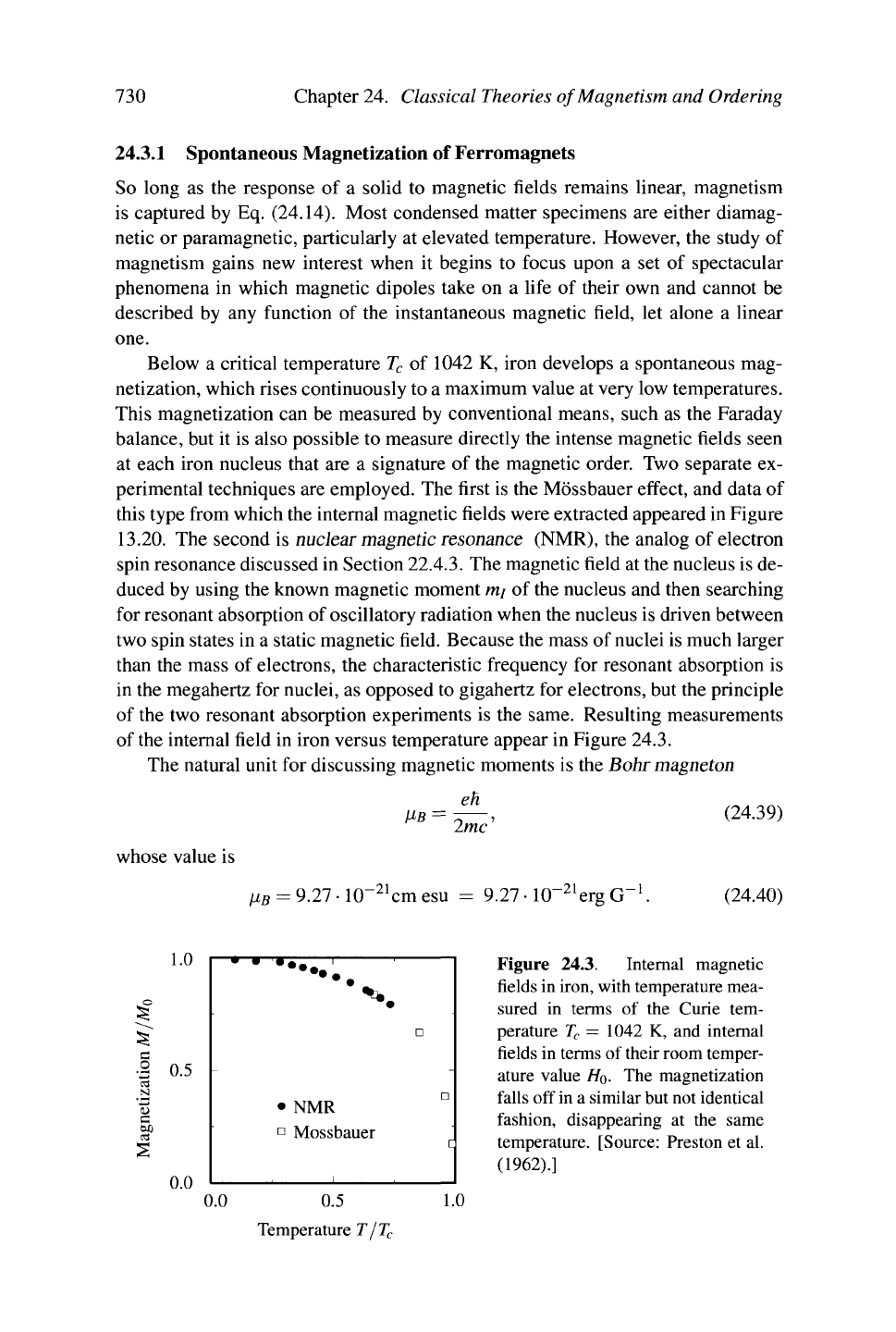
of the internal field in iron versus temperature appear in Figure 24.3.
The natural unit for discussing magnetic moments is the Bohr magneton
eH
ß
B
= ^, (24.39)
2mc
whose value is
9.27-10-
21
ergG
_1
. (24.40)
Figure 24.3. Internal magnetic
fields in iron, with temperature mea-
sured in terms of the Curie tem-
perature T
c
— 1042 K, and internal
fields in terms of their room temper-
ature value
HQ.
The magnetization
falls off in a similar but not identical
fashion, disappearing at the same
temperature. [Source: Preston et al.
(1962).]
Temperature T/T
c
21,
//
ß
= 9.27-10
_zl
cmesu
Magnetic Dipole Moments 731
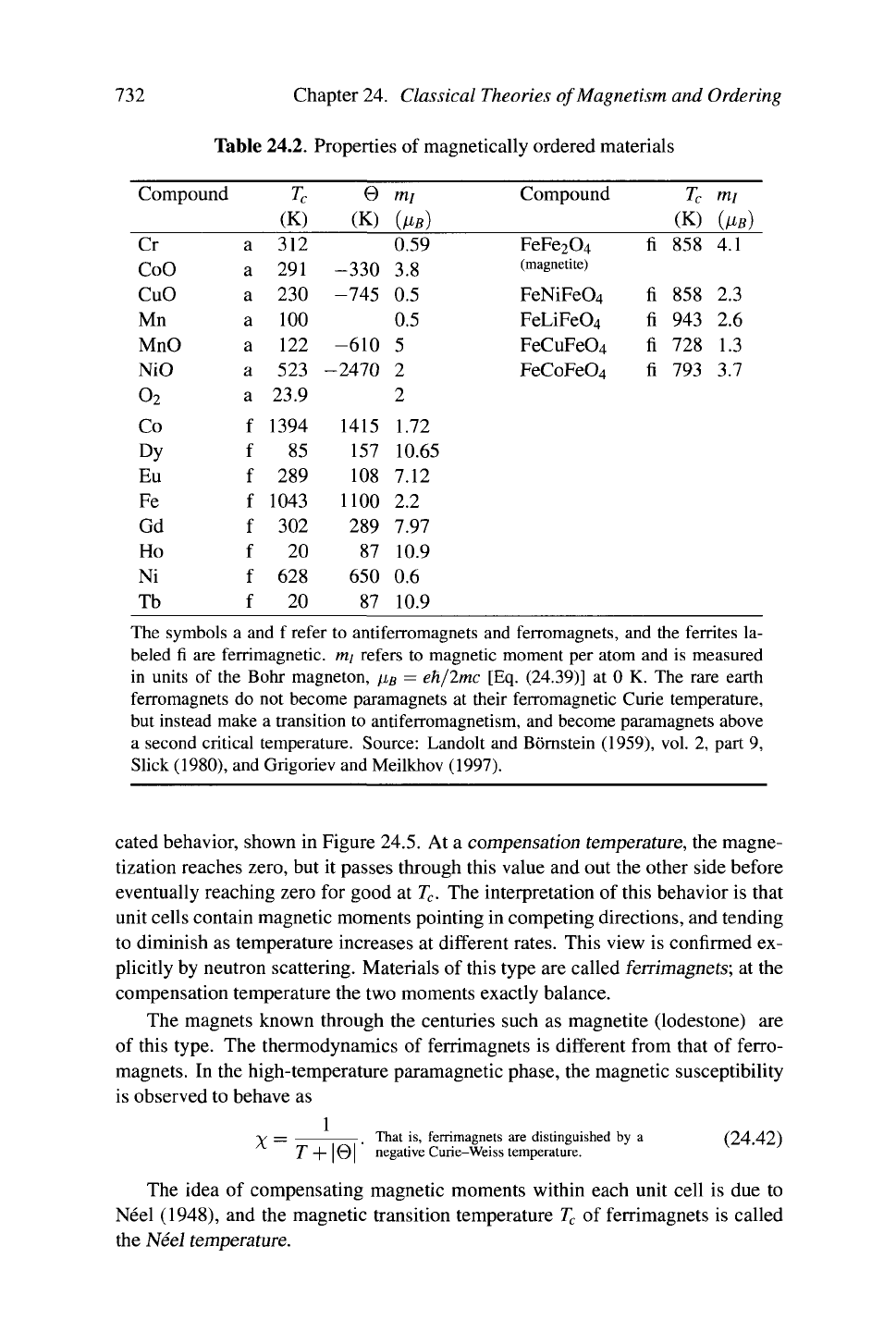
Magnetic moments for selected elements and compounds appear in Table 24.2.
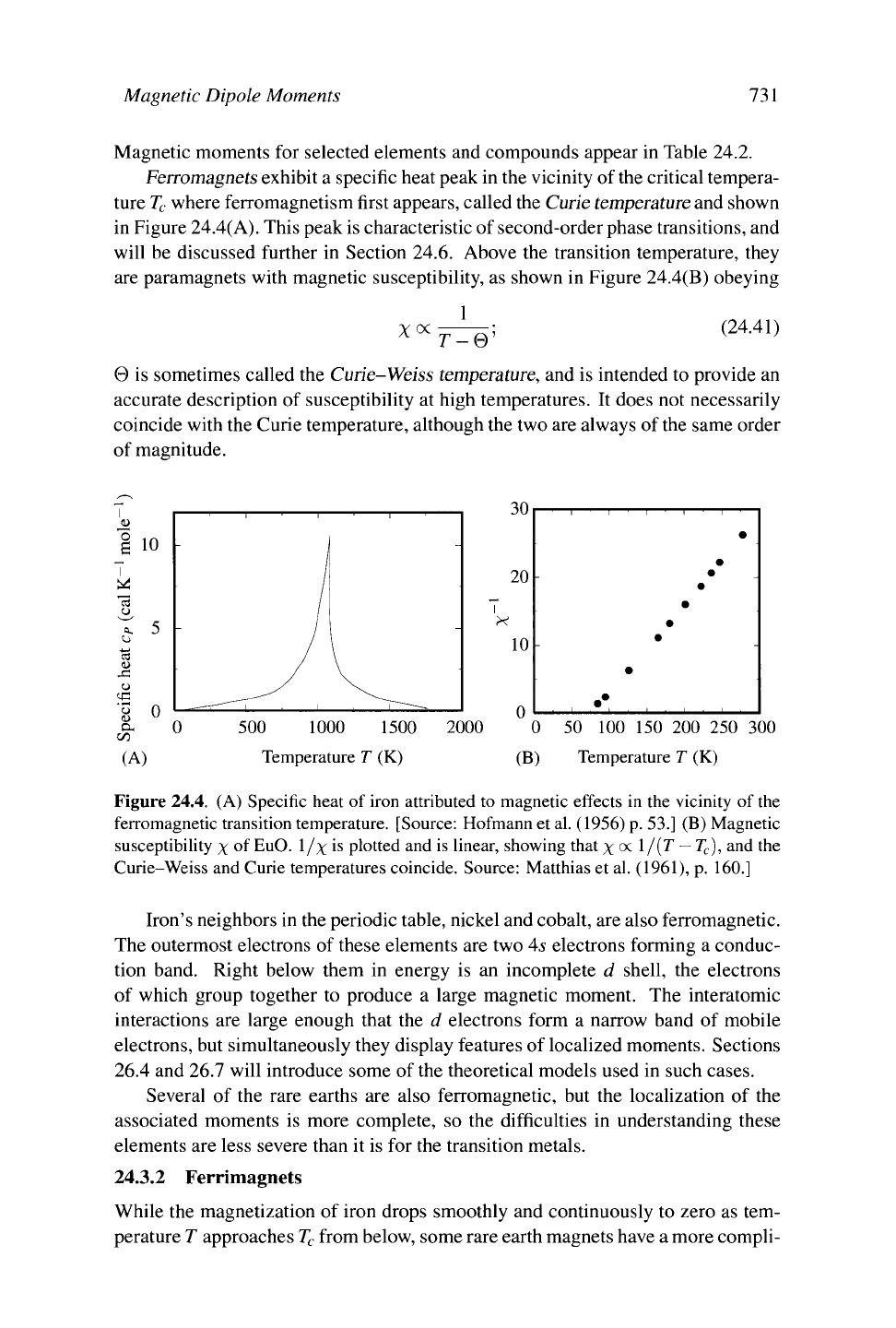
Ferromagnets exhibit a specific heat peak in the vicinity of the critical tempera-
ture T
c
where ferromagnetism first appears, called the Curie temperature and shown
in Figure 24.4(A). This peak is characteristic of second-order phase transitions, and
will be discussed further in Section 24.6. Above the transition temperature, they
are paramagnets with magnetic susceptibility, as shown in Figure 24.4(B) obeying
X^Y~Q
]
(24.41)
0 is sometimes called the Curie-Weiss temperature, and is intended to provide an
accurate description of susceptibility at high temperatures. It does not necessarily
coincide with the Curie temperature, although the two are always of the same order
of magnitude.
.i.i.i. i .
50 100 150 200 250 300
Temperature T (K)
Figure 24.4. (A) Specific heat of iron attributed to magnetic effects in the vicinity of the
ferromagnetic transition temperature. [Source: Hofmann et al. (1956) p. 53.] (B) Magnetic
susceptibility \ °f
EuO.
l/x is plotted and is linear, showing that \
c*
l/(^
—
T
c
), and the
Curie-Weiss and Curie temperatures coincide. Source: Matthias et al. (1961), p. 160.]
Iron's neighbors in the periodic table, nickel and cobalt, are also ferromagnetic.
The outermost electrons of these elements are two As electrons forming a conduc-
tion band. Right below them in energy is an incomplete d shell, the electrons
of which group together to produce a large magnetic moment. The interatomic
interactions are large enough that the d electrons form a narrow band of mobile
electrons, but simultaneously they display features of localized moments. Sections
26.4 and 26.7 will introduce some of the theoretical models used in such cases.
Several of the rare earths are also ferromagnetic, but the localization of the
associated moments is more complete, so the difficulties in understanding these
elements are less severe than it is for the transition metals.
24.3.2 Ferrimagnets
While the magnetization of iron drops smoothly and continuously to zero as tem-
perature T approaches T
c
from below, some rare earth magnets have a more compli-
1 10
X
a.
u
a.
C/5
(A)
30
20
x
10
0
500 1000 1500 2000 (
Temperature T (K) (B
732 Chapter 24. Classical Theories of Magnetism
and
Ordering
Table 24.2. Properties
of
magnetically ordered materials
Compound
T
c
9 mi Compound T
c
mi
(K) (K) (fjL
B
) (K) M
Cr
CoO
CuO
Mn
MnO
NiO
o
2
Co
Dy
Eu
Fe
Gd
Ho
Ni
Tb
a
a
a
a
a
a
a
f
f
f
f
f
f
f
f
312
291
230
100
122
523
23.9
1394
85
289
1043
302
20
628
20
-330
-745
-610
-2470
1415
157
108
1100
289
87
650
87
0.59
3.8
0.5
0.5
5
2
2
1.72
10.65
7.12
2.2
7.97
10.9
0.6
10.9
FeFe2Û4
(magnetite)
FeNiFe0
4
FeLiFeC>4
FeCuFe0
4
FeCoFe0
4
fi
fi
fi
fi
fi
858
858
943
728
793
4.1
2.3
2.6
1.3
3.7
The symbols
a and f
refer
to
antiferromagnets
and
ferromagnets,
and the
ferrites
la-
beled
fi are
ferrimagnetic.
mj
refers
to
magnetic moment
per
atom
and is
measured
in units
of the
Bohr magneton,
/x
fl
=
eh/2mc
[Eq.
(24.39)]
at 0 K. The
rare earth
ferromagnets
do not
become paramagnets
at
their ferromagnetic Curie temperature,
but instead make
a
transition
to
antiferromagnetism, and become paramagnets above
a second critical temperature. Source: Landolt
and
Bernstein (1959), vol.
2,
part
9,
Slick (1980), and Grigoriev and Meilkhov (1997).
cated behavior, shown
in
Figure 24.5.
At a
compensation temperature,
the
magne-
tization reaches zero,
but it
passes through this value
and out the
other side before
eventually reaching zero
for
good
at T
c
. The
interpretation
of
this behavior
is
that
unit cells contain magnetic moments pointing
in
competing directions,
and
tending
to diminish
as
temperature increases
at
different rates. This view
is
confirmed
ex-
plicitly
by
neutron scattering. Materials
of
this type
are
called ferrimagnets;
at the
compensation temperature
the two
moments exactly balance.
The magnets known through
the
centuries such
as
magnetite (lodestone)
are
of this type.
The
thermodynamics
of
ferrimagnets
is
different from that
of
ferro-
magnets.
In the
high-temperature paramagnetic phase,
the
magnetic susceptibility
is observed
to
behave
as
■y
= . That is, ferrimagnets are distinguished by a (24.42)
T + 101 negative Curie-Weiss temperature.
The idea
of
compensating magnetic moments within each unit cell
is due to
Néel (1948),
and the
magnetic transition temperature
T
c
of
ferrimagnets
is
called
the Néel temperature.