
Marder M.P. Condensed Matter Physics
Подождите немного. Документ загружается.

Photoemission
703
a
a
a
R
_L
-6-4-20246
Frequency shift
LO/2TTC
(cm
-1
)
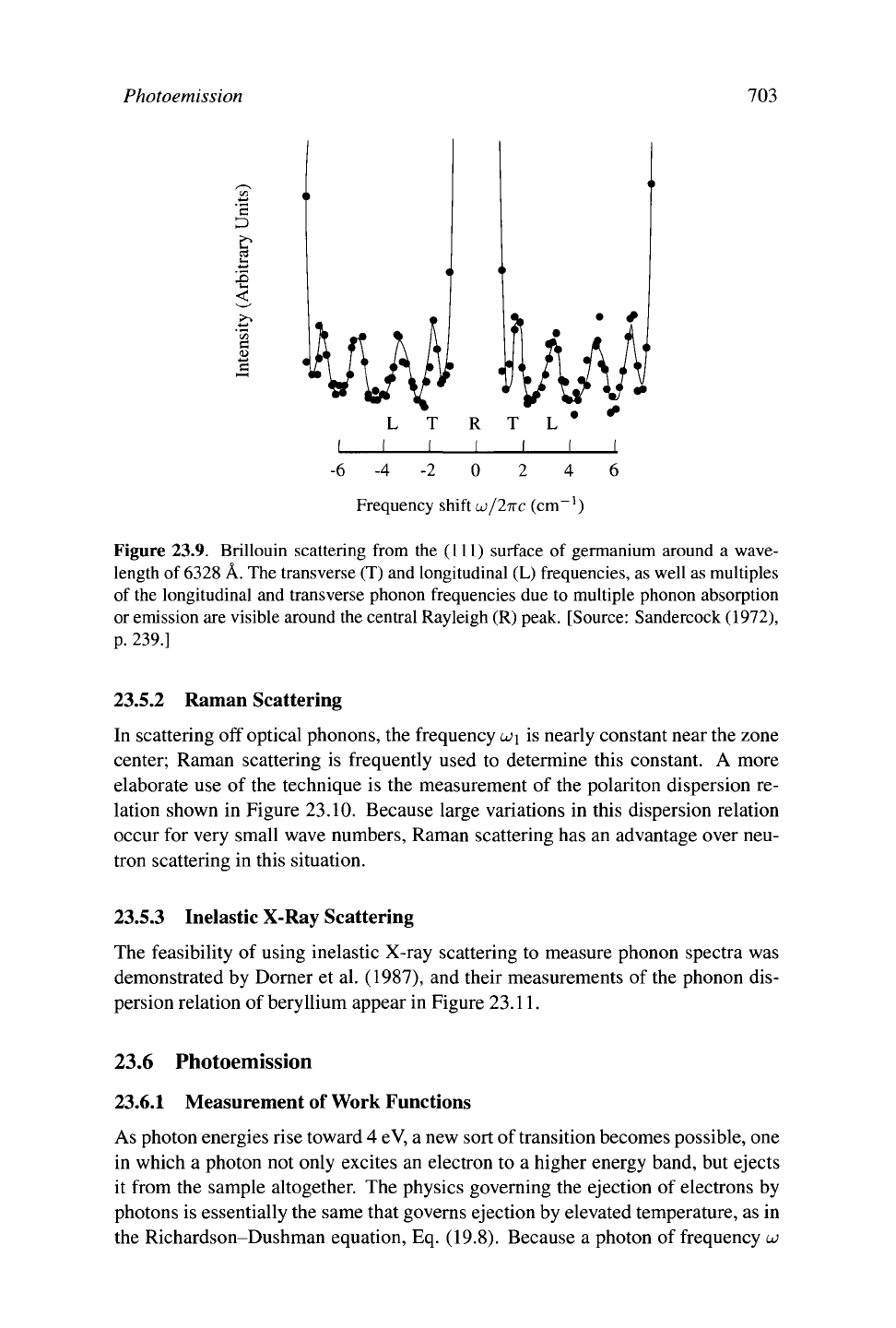
Figure 23.9. Brillouin scattering from the (111) surface of germanium around a wave-
length of
6328
Â. The transverse (T) and longitudinal (L) frequencies, as well as multiples
of the longitudinal and transverse phonon frequencies due to multiple phonon absorption
or emission are visible around the central Rayleigh (R) peak. [Source: Sandercock (1972),
p.
239.]
23.5.2 Raman Scattering
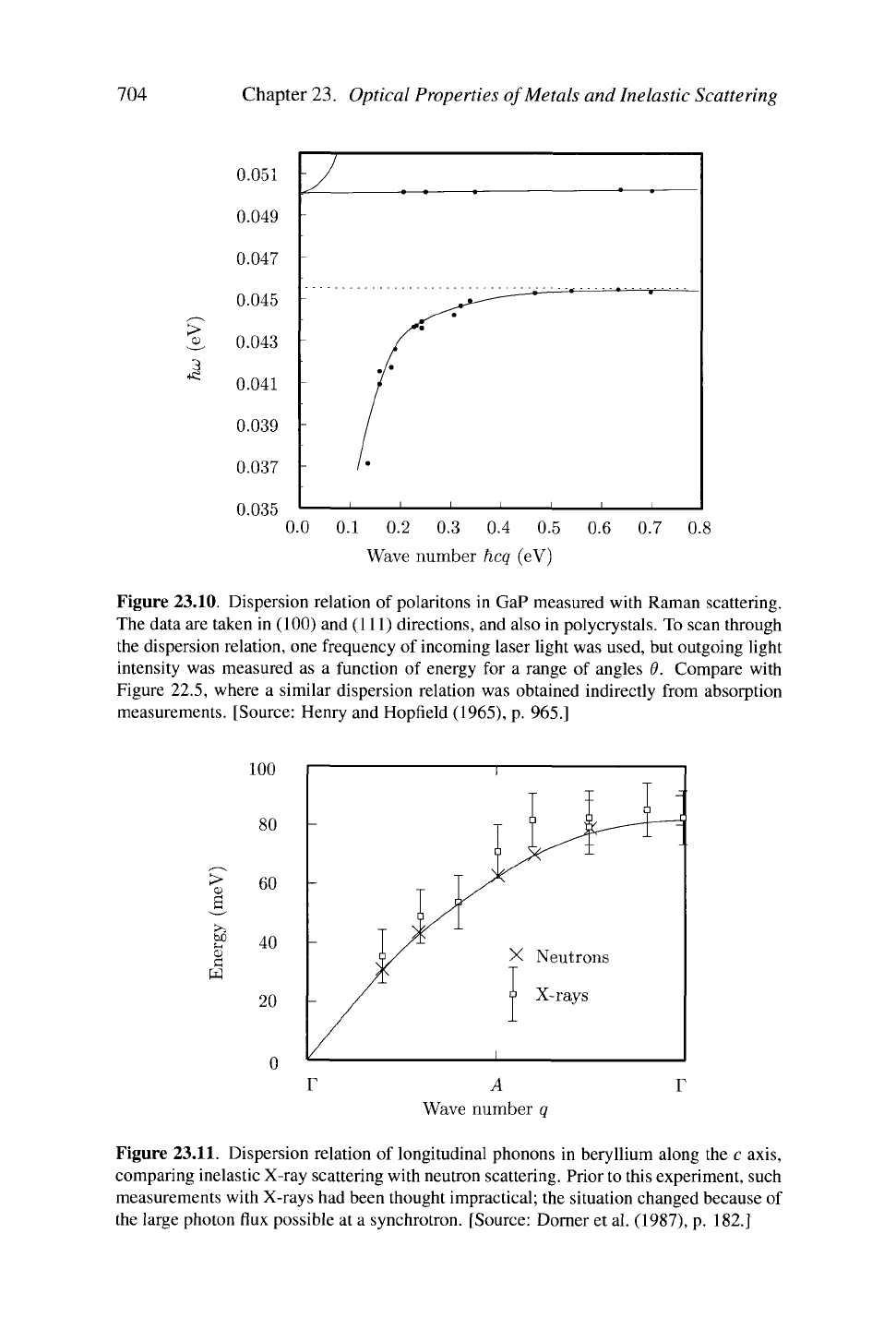
In scattering off optical phonons, the frequency u\ is nearly constant near the zone
center; Raman scattering is frequently used to determine this constant. A more
elaborate use of the technique is the measurement of the polariton dispersion re-
lation shown in Figure 23.10. Because large variations in this dispersion relation
occur for very small wave numbers, Raman scattering has an advantage over neu-
tron scattering in this situation.
23.5.3 Inelastic X-Ray Scattering
The feasibility of using inelastic X-ray scattering to measure phonon spectra was
demonstrated by Dorner et al. (1987), and their measurements of the phonon dis-
persion relation of beryllium appear in Figure
23.11.
23.6 Photoemission
23.6.1 Measurement of Work Functions
As photon energies rise toward 4 eV, a new sort of transition becomes possible, one
in which a photon not only excites an electron to a higher energy band, but ejects
it from the sample altogether. The physics governing the ejection of electrons by
photons is essentially the same that governs ejection by elevated temperature, as in
the Richardson-Dushman equation, Eq. (19.8). Because a photon of frequency
ui
704 Chapter 23. Optical Properties of Metals and Inelastic Scattering
>
CU
3
0.051
0.049
0.1 0.2 0.3 0.4 0.5
Wave number hcq (eV)
0.6 0.7 0.8
Figure 23.10. Dispersion relation of polaritons in GaP measured with Raman scattering.
The data are taken in (100) and (111) directions, and also in polycrystals. To scan through
the dispersion relation, one frequency of incoming laser light was used, but outgoing light
intensity was measured as a function of energy for a range of angles 9. Compare with
Figure 22.5, where a similar dispersion relation was obtained indirectly from absorption
measurements. [Source: Henry and Hopfield (1965), p. 965.]
100
>
CD
G
60
40
20
Wave number q
Figure
23.11.
Dispersion relation of longitudinal phonons in beryllium along the c axis,
comparing inelastic X-ray scattering with neutron scattering. Prior to this experiment, such
measurements with X-rays had been thought impractical; the situation changed because of
the large photon flux possible at a synchrotron. [Source: Dorner et al. (1987), p. 182.]
Photoemission 705
can supply energy hu to an electron, the effect of light upon a sample is to reduce
the work function to 0
—
hu>,
and when hu >
</>,
electrons are free to flow out, in
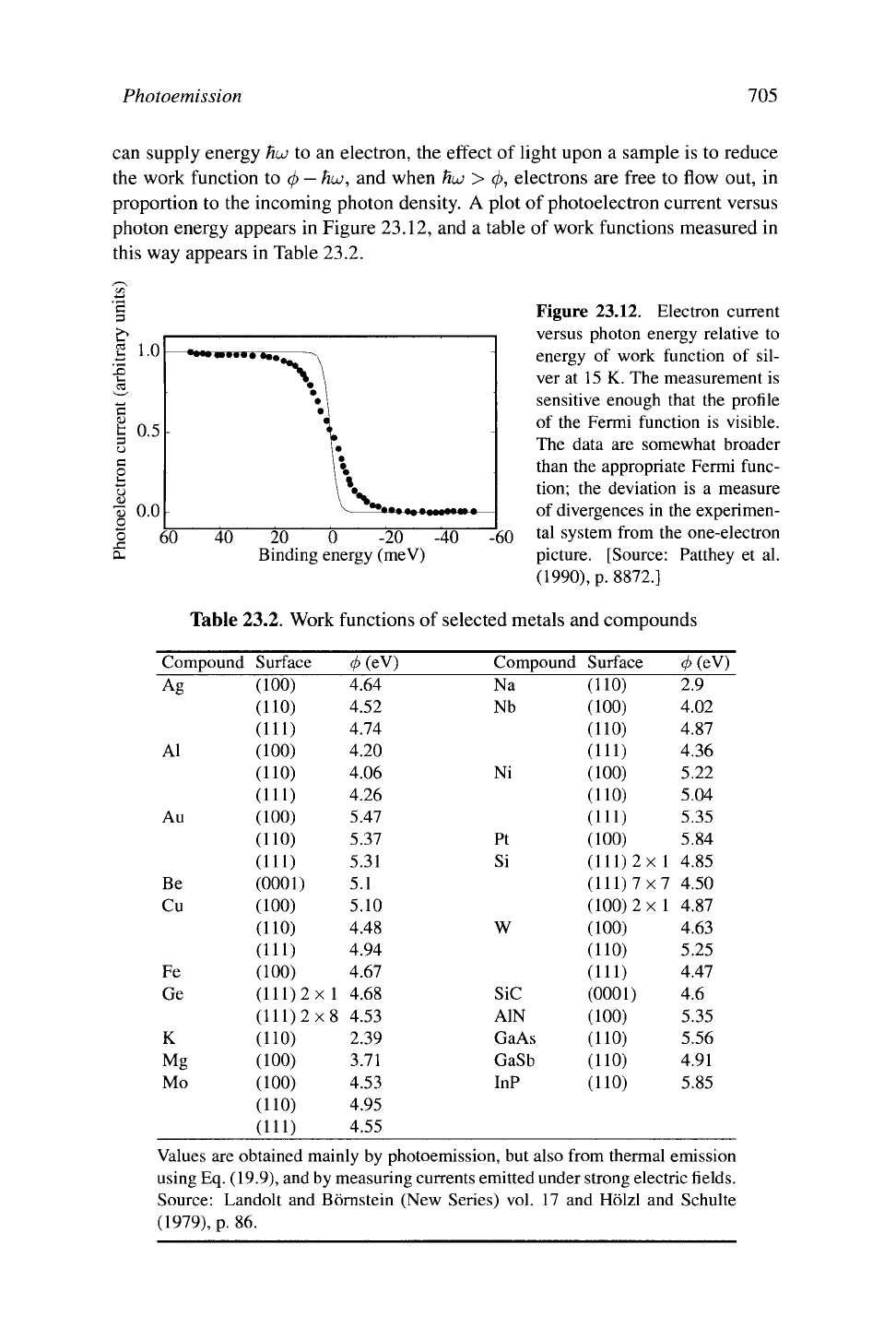
proportion to the incoming photon density. A plot of photoelectron current versus
photon energy appears in Figure 23.12, and a table of work functions measured in
this way appears in Table 23.2.
Figure 23.12. Electron current
versus photon energy relative to
energy of work function of sil-
ver at 15 K. The measurement is
sensitive enough that the profile
of the Fermi function is visible.
The data are somewhat broader
than the appropriate Fermi func-
tion; the deviation is a measure
of divergences in the experimen-
tal system from the one-electron
picture. [Source: Patthey et al.
(1990),
p. 8872.]
Table 23.2. Work functions of selected metals and compounds
Compound
Ag
Al
Au
Be
Cu
Fe
Ge
K
Mg
Mo
Surface
(100)
(110)
(111)
(100)
(110)
(111)
(100)
(110)
(111)
(0001)
(100)
(110)
(111)
(100)
(111) 2 x 1
(111)2x8
(110)
(100)
(100)
(110)
(HI)
<MeV)
4.64
4.52
4.74
4.20
4.06
4.26
5.47
5.37
5.31
5.1
5.10
4.48
4.94
4.67
4.68
4.53
2.39
3.71
4.53
4.95
4.55
Compound
Na
Nb
Ni
Pt
Si
W
SiC
A1N
GaAs
GaSb
InP
Surface
(110)
(100)
(110)
(111)
(100)
(110)
(111)
(100)
(lll)2x 1
(111)7x7
(100) 2 x 1
(100)
(110)
(111)
(0001)
(100)
(110)
(110)
(110)
^(eV)
2.9
4.02
4.87
4.36
5.22
5.04
5.35
5.84
4.85
4.50
4.87
4.63
5.25
4.47
4.6
5.35
5.56
4.91
5.85
Values are obtained mainly by photoemission, but also from thermal emission
using Eq. (19.9), and by measuring currents emitted under strong electric fields.
Source: Landolt and Börnstein (New Series) vol. 17 and Hölzl and Schulte
(1979),
p. 86.
| 60 40 20 0 -20 -40 -60
a. Binding energy (meV)
706 Chapter 23. Optical Properties of Metals and Inelastic Scattering
23.6.2 Angle-Resolved Photoemission
Because of the close association of photoemission experiments with the work func-
tion and because the work function is connected with transitions between solid and
vacuum, for a long time it was thought that photoemission could measure only
properties of solid surfaces. It can be used very effectively for that purpose, but has
even more important application in measuring bulk energy bands. Angle-resolved
photoemission spectroscopy (ARPES) has become the most important experimen-
tal tool for probing the electronic properties of solids, and makes it possible to map
out energy bands directly.
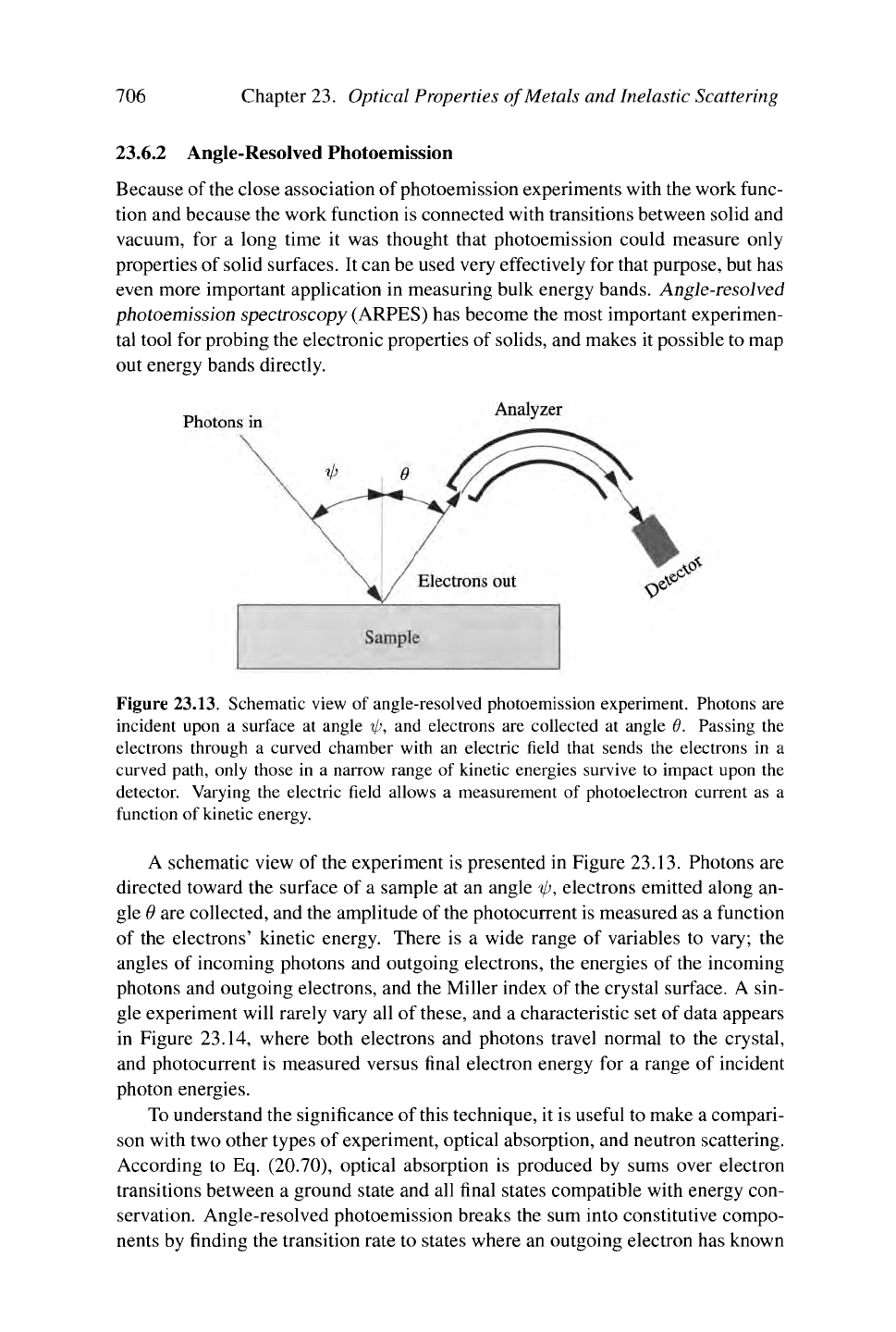
Figure 23.13. Schematic view of angle-resolved photoemission experiment. Photons are
incident upon a surface at angle
%p,
and electrons are collected at angle 0. Passing the
electrons through a curved chamber with an electric field that sends the electrons in a
curved path, only those in a narrow range of kinetic energies survive to impact upon the
detector. Varying the electric field allows a measurement of photoelectron current as a
function of kinetic energy.
A schematic view of the experiment is presented in Figure
23.13.
Photons are
directed toward the surface of a sample at an angle ip, electrons emitted along an-
gle 0 are collected, and the amplitude of the photocurrent is measured as a function
of the electrons' kinetic energy. There is a wide range of variables to vary; the
angles of incoming photons and outgoing electrons, the energies of the incoming
photons and outgoing electrons, and the Miller index of the crystal surface. A sin-
gle experiment will rarely vary all of these, and a characteristic set of data appears
in Figure 23.14, where both electrons and photons travel normal to the crystal,
and photocurrent is measured versus final electron energy for a range of incident
photon energies.
To understand the significance of this technique, it is useful to make a compari-
son with two other types of experiment, optical absorption, and neutron scattering.
According to Eq. (20.70), optical absorption is produced by sums over electron
transitions between a ground state and all final states compatible with energy con-
servation. Angle-resolved photoemission breaks the sum into constitutive compo-
nents by finding the transition rate to states where an outgoing electron has known
Photoemission 707
energy and momentum. Ideally one would like to think of the experiment as being
entirely analogous to neutron scattering, with the photon taking the place of
the
in-
going neutron, while the outgoing electron takes the place of the outgoing neutron.
Just as neutron scattering contained enough information to obtain phonon disper-
sion relations, angle-resolved photoemission should contain enough information
to obtain electron band dispersion relations. In the spirit of Section
13.4.1,
one
can write down the consequences of energy and momentum conservation. Energy
conservation demands
<^
+ £kin-(-£ß)=^, (23.58)
where £#, the binding energy is the negative of the electron's energy before im-
pact by the photon, and
</>
+ £kin, work function plus kinetic energy, is its energy
after being ejected. Because photon momentum is negligible, crystal momentum
conservation would demand that the final wave vector kf of the ejected electron
be equal to its initial wave vector up to the inevitable addition or subtraction of a
reciprocal lattice vector so as to lie in the first Brillouin zone. So Eq. (23.58) would
become
£ß(&final) = Hid —
(f)
— £ki
n
, Map k
f
back into the first Brillouin zone if (23.59)
necessary.
and energy levels £ß(&finai) could be mapped out as a function of
fonai-
In fact this
is almost exactly how the experiments are interpreted, but there are considerable
grounds for worry. The old view that photoemission should be tremendously sen-
sitive to the surface was not all wrong, and the difficulty manifests itself in the fact
that momentum of the electron in the direction perpendicular to the sample surface
has no reason to be conserved. Right at the onset of photoemission this claim is
very easy to understand. A photon travels into the sample and transfers energy to
an electron that most likely already has some momentum hk± in the direction of the
surface. On its way out of the sample the electron decelerates, and finally emerges
with almost no momentum at all, so hkx is certainly not conserved. Momentum
parallel to the sample surface is conserved because the symmetry that produces the
conservation law still holds; the system remains invariant when translated through
a lattice vector parallel to the surface. It clearly does not remain invariant when
displaced perpendicular to the surface, so the conservation law in this direction is
lost.
In principle the missing information about the original momentum of the elec-
tron can be recovered by conducting experiments with different crystal surfaces,
and then combining the information from the multiple experiments. While such
experiments have been done, there is an easier solution in practice. A classical
particle passing rapidly through a short-ranged force loses very little momentum.
To be more precise, a particle traveling along x through a potential that varies by
amount AU in a short distance experiences a change in momentum
f dU AU
/\p = I dt ~ Assuming that the velocity v can be taken (23.60)
J Qx V ' nearly constant.
708 Chapter
23.
Optical Properties of Metals and Inelastic Scattering
^
<?
^ ^*
>&
tf tf tf ^
Q*
& <f n°P <f ^ dpP x* s*
////////////////////// // // // // // // //
^jj> ^J>
<^
<$>>
^? ^P
<fS>
<^p ^P <^P ^P ^jp ^p ^p ^P ^p ^P ^P
Photoelectron current (arbitrary units and offset)
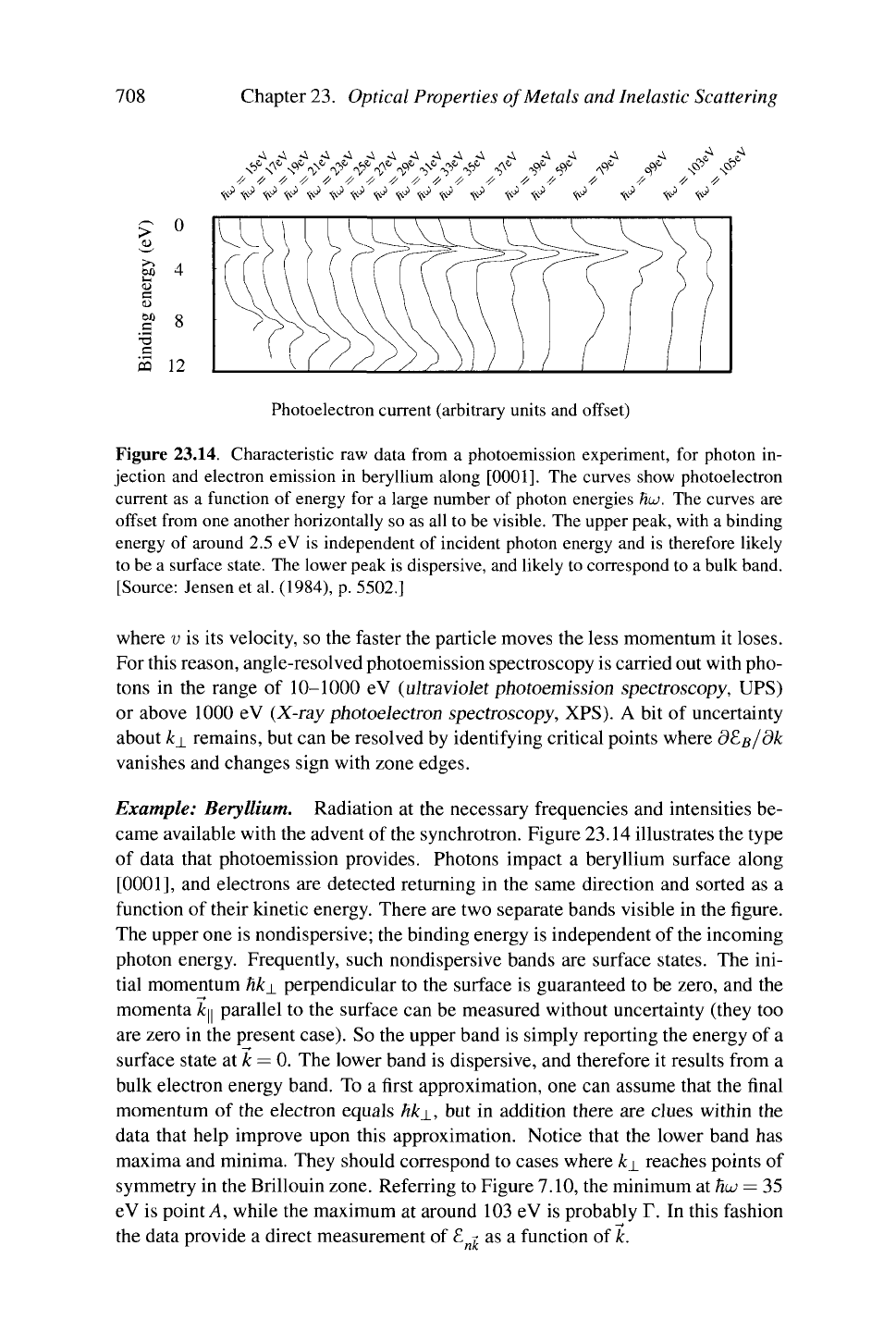
Figure 23.14. Characteristic raw data from a photoemission experiment, for photon in-
jection and electron emission in beryllium along [0001]. The curves show photoelectron
current as a function of energy for a large number of photon energies
Viw.
The curves are
offset from one another horizontally so as all to be visible. The upper peak, with a binding
energy of around 2.5 eV is independent of incident photon energy and is therefore likely
to be a surface state. The lower peak is dispersive, and likely to correspond to a bulk band.
[Source: Jensen et
al.
(1984), p. 5502.]
where v is its velocity, so the faster the particle moves the less momentum it loses.
For this reason, angle-resolved photoemission spectroscopy is carried out with pho-
tons in the range of 10-1000 eV (ultraviolet photoemission spectroscopy, UPS)
or above 1000 eV (X-ray photoelectron spectroscopy, XPS). A bit of uncertainty
about k± remains, but can be resolved by identifying critical points where dEg/dk
vanishes and changes sign with zone edges.
Example: Beryllium. Radiation at the necessary frequencies and intensities be-
came available with the advent of the synchrotron. Figure 23.14 illustrates the type
of data that photoemission provides. Photons impact a beryllium surface along
[0001],
and electrons are detected returning in the same direction and sorted as a
function of their kinetic energy. There are two separate bands visible in the figure.
The upper one is nondispersive; the binding energy is independent of the incoming
photon energy. Frequently, such nondispersive bands are surface states. The ini-
tial momentum hk± perpendicular to the surface is guaranteed to be zero, and the
momenta
k\\
parallel to the surface can be measured without uncertainty (they too
are zero in the present case). So the upper band is simply reporting the energy of a
surface state at k = 0. The lower band is dispersive, and therefore it results from a
bulk electron energy band. To a first approximation, one can assume that the final
momentum of the electron equals Hk±, but in addition there are clues within the
data that help improve upon this approximation. Notice that the lower band has
maxima and minima. They should correspond to cases where k± reaches points of
symmetry in the Brillouin zone. Referring to Figure 7.10, the minimum at
hco
= 35
eV is point A, while the maximum at around 103 eV is probably I\ In this fashion
the data provide a direct measurement of £ r as a function of k.
Photoemission 709
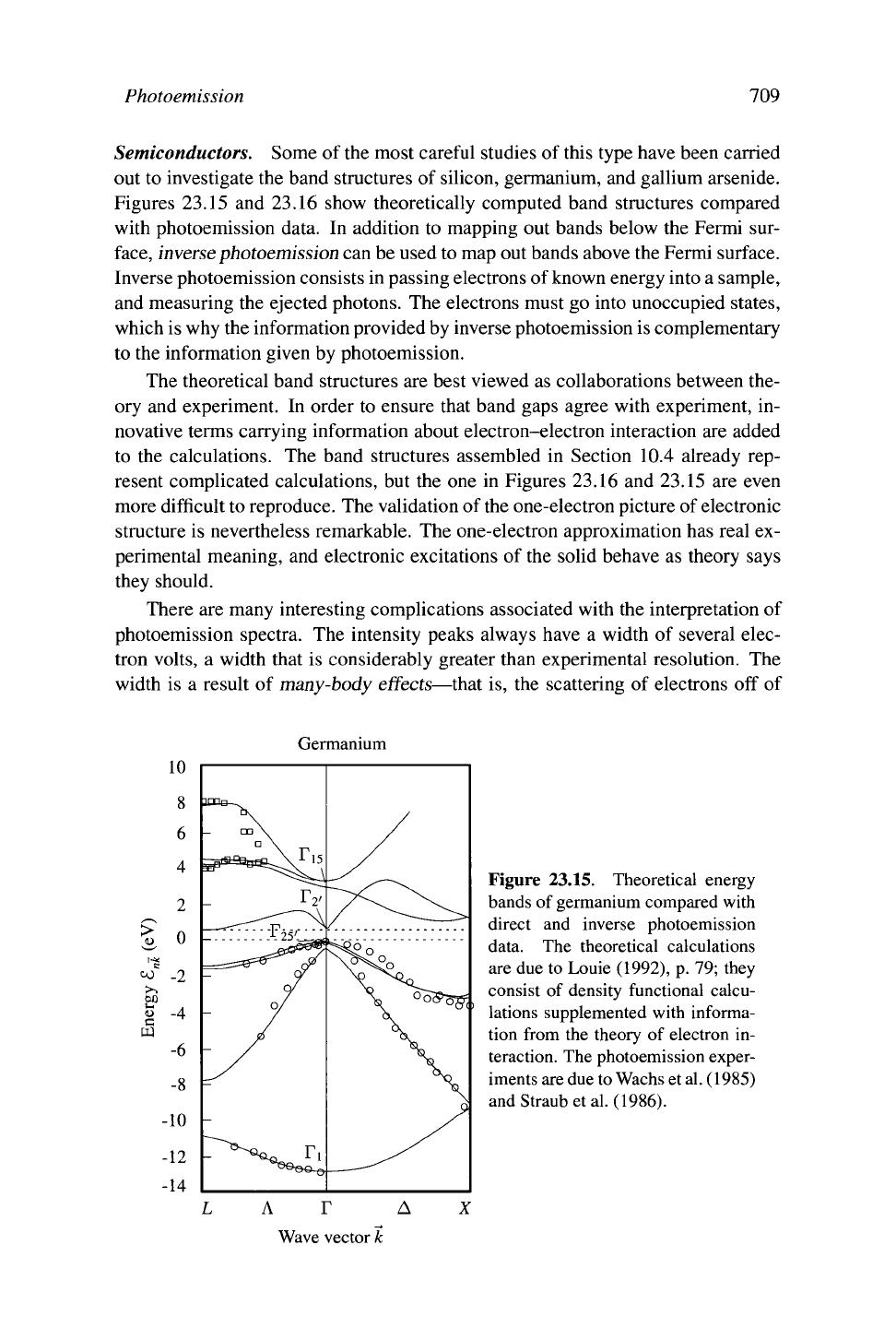
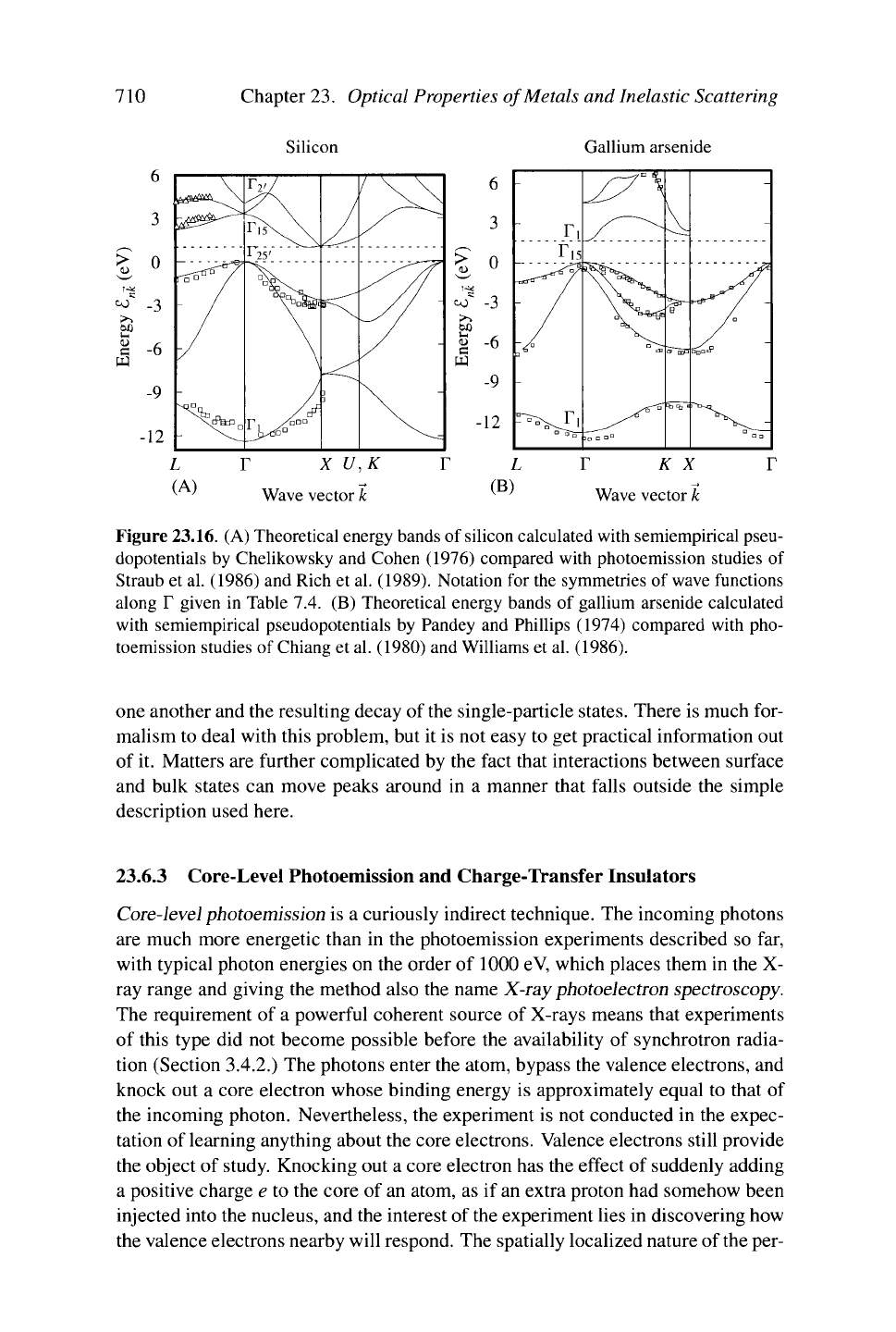
Semiconductors. Some of the most careful studies of this type have been carried
out to investigate the band structures of silicon, germanium, and gallium arsenide.
Figures 23.15 and 23.16 show theoretically computed band structures compared
with photoemission data. In addition to mapping out bands below the Fermi sur-
face,
inverse photoemission can be used to map out bands above the Fermi surface.
Inverse photoemission consists in passing electrons of known energy into a sample,
and measuring the ejected photons. The electrons must go into unoccupied states,
which is why the information provided by inverse photoemission is complementary
to the information given by photoemission.
The theoretical band structures are best viewed as collaborations between the-
ory and experiment. In order to ensure that band gaps agree with experiment, in-
novative terms carrying information about electron-electron interaction are added
to the calculations. The band structures assembled in Section 10.4 already rep-
resent complicated calculations, but the one in Figures 23.16 and 23.15 are even
more difficult to reproduce. The validation of the one-electron picture of electronic
structure is nevertheless remarkable. The one-electron approximation has real ex-
perimental meaning, and electronic excitations of the solid behave as theory says
they should.
There are many interesting complications associated with the interpretation of
photoemission spectra. The intensity peaks always have a width of several elec-
tron volts, a width that is considerably greater than experimental resolution. The
width is a result of many-body effects—that is, the scattering of electrons off of
Germanium
Figure 23.15. Theoretical energy
bands of germanium compared with
direct and inverse photoemission
data. The theoretical calculations
are due to Louie (1992), p. 79; they
consist of density functional calcu-
lations supplemented with informa-
tion from the theory of electron in-
teraction. The photoemission exper-
iments
are due to Wachs
et
al.
(1985)
and Straub et
al.
(1986).
L A T A X
Wave vector
k
710 Chapter 23. Optical Properties of Metals and Inelastic Scattering
Silicon Gallium arsenide
L
r
x U,K
r
L
r
K x
r
^ ' Wave vector k ^ ' Wave vector k
Figure 23.16. (A) Theoretical energy bands of silicon calculated with semiempirical pseu-
dopotentials by Chelikowsky and Cohen (1976) compared with photoemission studies of
Straub et al. (1986) and Rich et al. (1989). Notation for the symmetries of wave functions
along T given in Table 7.4. (B) Theoretical energy bands of gallium arsenide calculated
with semiempirical pseudopotentials by Pandey and Phillips (1974) compared with pho-
toemission studies of Chiang et al. (1980) and Williams et al. (1986).
one another and the resulting decay of the single-particle states. There is much for-
malism to deal with this problem, but it is not easy to get practical information out
of it. Matters are further complicated by the fact that interactions between surface
and bulk states can move peaks around in a manner that falls outside the simple
description used here.
23.6.3 Core-Level Photoemission and Charge-Transfer Insulators
Core-level photoemission is a curiously indirect technique. The incoming photons
are much more energetic than in the photoemission experiments described so far,
with typical photon energies on the order of 1000 eV, which places them in the X-
ray range and giving the method also the name X-ray photoelectron spectroscopy.
The requirement of a powerful coherent source of X-rays means that experiments
of this type did not become possible before the availability of synchrotron radia-
tion (Section 3.4.2.) The photons enter the atom, bypass the valence electrons, and
knock out a core electron whose binding energy is approximately equal to that of
the incoming photon. Nevertheless, the experiment is not conducted in the expec-
tation of learning anything about the core electrons. Valence electrons still provide
the object of study. Knocking out a core electron has the effect of suddenly adding
a positive charge e to the core of an atom, as if an extra proton had somehow been
injected into the nucleus, and the interest of the experiment lies in discovering how
the valence electrons nearby will respond. The spatially localized nature of the per-
Photoemission 711
turbation naturally leads to information about the solid with a localized character.
The type of information that can be extracted and the way it is interpreted is best
illustrated with a particular example.
Transition Metal Oxides. Even during the first days that the single-electron band
theory of solids was being constructed, it was realized that there existed solids that
violated its predictions in a qualitative way. The prototypical example is NiO, as
discussed by Mott (1949). The transition metal oxides, from VO through ZnO,
have many features in common. Most of them adopt the NaCl structure (Figure
2.7).
Density functional theory predicts them to be metals. In fact, they are all
insulators, with an optical band gap of 1-4 eV, and all antiferromagnetic (Figures
3.14 and 24.6). The difficulty presented by these compounds is particularly ev-
ident for VO, MnO, and CoO, which have an odd number of electrons in each
unit cell. The valence bands are not filled, so one can state with certainty in the
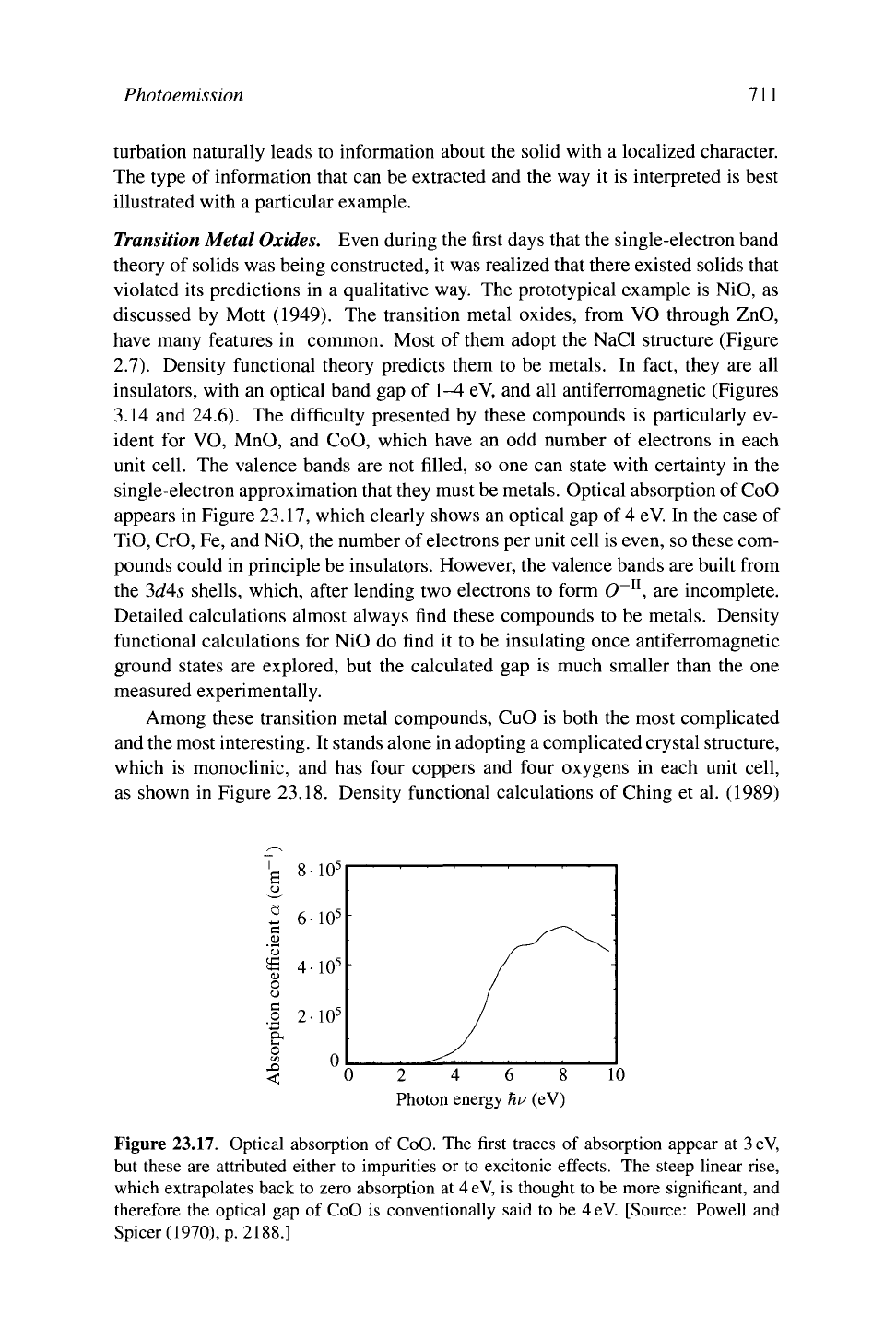
single-electron approximation that they must be metals. Optical absorption of CoO
appears in Figure 23.17, which clearly shows an optical gap of 4 eV In the case of
TiO,
CrO, Fe, and NiO, the number of electrons per unit cell is even, so these com-
pounds could in principle be insulators. However, the valence bands are built from
the 2dAs shells, which, after lending two electrons to form 0~
11
, are incomplete.
Detailed calculations almost always find these compounds to be metals. Density
functional calculations for NiO do find it to be insulating once antiferromagnetic
ground states are explored, but the calculated gap is much smaller than the one
measured experimentally.
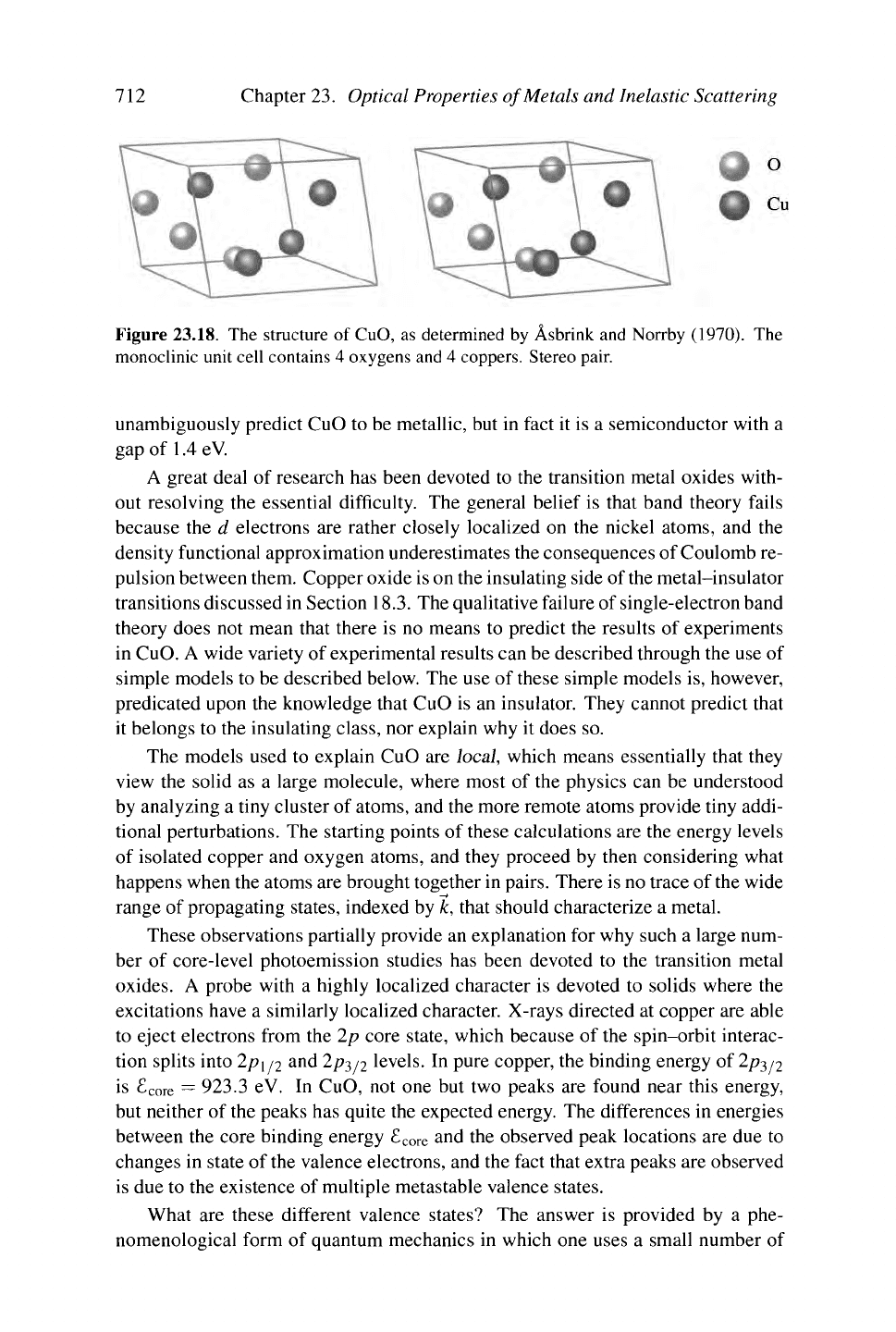
Among these transition metal compounds, CuO is both the most complicated
and the most interesting. It stands alone in adopting a complicated crystal structure,
which is monoclinic, and has four coppers and four oxygens in each unit cell,
as shown in Figure 23.18. Density functional calculations of Ching et al. (1989)
-—-
1
s
o
s
—'
Φ
e
<D
O
H
3
u
o
o
G
O
a-
o
<
8
6
4
2
10
5
in
5
10
s
10
5
u
Photon energy hv (eV)
Figure 23.17. Optical absorption of CoO. The first traces of absorption appear at
3
eV,
but these are attributed either to impurities or to excitonic effects. The steep linear rise,
which extrapolates back to zero absorption at
4
eV,
is thought to be more significant, and
therefore the optical gap of CoO is conventionally said to be 4eV. [Source: Powell and
Spicer(1970), p. 2188.]
712 Chapter
23.
Optical Properties of Metals and Inelastic Scattering
Figure 23.18. The structure of
CuO,
as determined by Âsbrink and Norrby (1970). The
monoclinic unit cell contains 4 oxygens and 4 coppers. Stereo pair.
unambiguously predict CuO to be metallic, but in fact it is a semiconductor with a
gap of 1.4 eV.
A great deal of research has been devoted to the transition metal oxides with-
out resolving the essential difficulty. The general belief is that band theory fails
because the d electrons are rather closely localized on the nickel atoms, and the
density functional approximation underestimates the consequences of Coulomb re-
pulsion between them. Copper oxide is on the insulating side of
the
metal-insulator
transitions discussed in Section 18.3. The qualitative failure of single-electron band
theory does not mean that there is no means to predict the results of experiments
in CuO. A wide variety of experimental results can be described through the use of
simple models to be described below. The use of these simple models is, however,
predicated upon the knowledge that CuO is an insulator. They cannot predict that
it belongs to the insulating class, nor explain why it does so.
The models used to explain CuO are local, which means essentially that they
view the solid as a large molecule, where most of the physics can be understood
by analyzing a tiny cluster of atoms, and the more remote atoms provide tiny addi-
tional perturbations. The starting points of these calculations are the energy levels
of isolated copper and oxygen atoms, and they proceed by then considering what
happens when the atoms are brought together in pairs. There is no trace of the wide
range of propagating states, indexed by k, that should characterize a metal.
These observations partially provide an explanation for why such a large num-
ber of core-level photoemission studies has been devoted to the transition metal
oxides. A probe with a highly localized character is devoted to solids where the
excitations have a similarly localized character. X-rays directed at copper are able
to eject electrons from the 2p core state, which because of the spin-orbit interac-
tion splits into 2p\/2 and 2p
3
/
2
levels. In pure copper, the binding energy of 2p
3
/
2
is £
C
ore = 923.3 eV. In CuO, not one but two peaks are found near this energy,
but neither of the peaks has quite the expected energy. The differences in energies
between the core binding energy £
core
and the observed peak locations are due to
changes in state of the valence electrons, and the fact that extra peaks are observed
is due to the existence of multiple metastable valence states.
What are these different valence states? The answer is provided by a phe-
nomenological form of quantum mechanics in which one uses a small number of