
Marder M.P. Condensed Matter Physics
Подождите немного. Документ загружается.

Magnetic Dipole Moments
733
0 100 200 300 400 500 600 700
Temperature T (K)
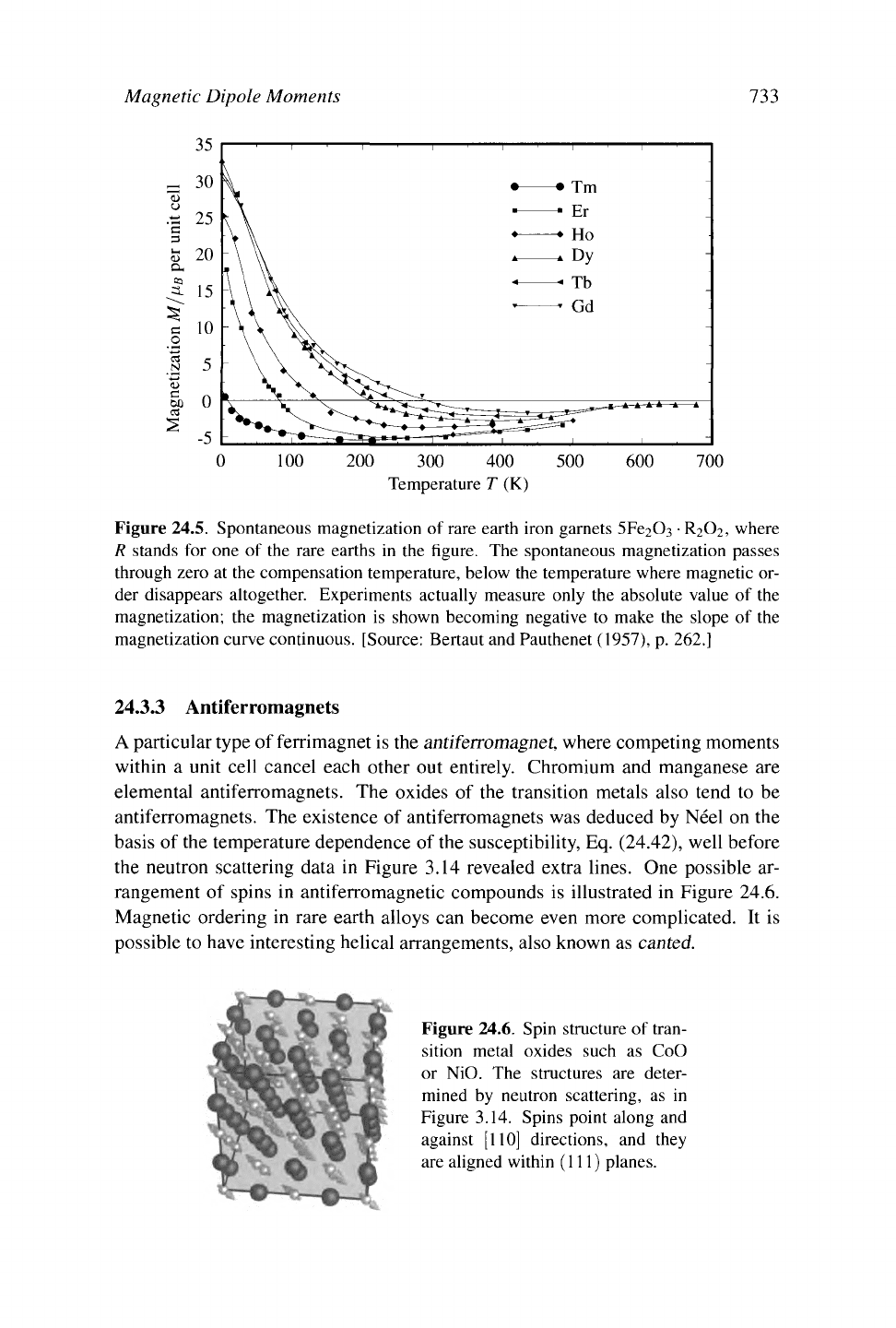
Figure 24.5. Spontaneous magnetization of rare earth iron garnets 5Fe2Û3 R2O2, where
R stands for one of the rare earths in the figure. The spontaneous magnetization passes
through zero at the compensation temperature, below the temperature where magnetic or-
der disappears altogether. Experiments actually measure only the absolute value of the
magnetization; the magnetization is shown becoming negative to make the slope of the
magnetization curve continuous. [Source: Bertaut and Pauthenet (1957), p. 262.]
24.3.3 Antiferromagnets
A particular type of ferrimagnet is the antiferromagnet, where competing moments
within a unit cell cancel each other out entirely. Chromium and manganese are
elemental antiferromagnets. The oxides of the transition metals also tend to be
antiferromagnets. The existence of antiferromagnets was deduced by Néel on the
basis of the temperature dependence of the susceptibility, Eq. (24.42), well before
the neutron scattering data in Figure 3.14 revealed extra lines. One possible ar-
rangement of spins in antiferromagnetic compounds is illustrated in Figure 24.6.
Magnetic ordering in rare earth alloys can become even more complicated. It is
possible to have interesting helical arrangements, also known as
canted.
Figure 24.6. Spin structure of tran-
sition metal oxides such as CoO
or NiO. The structures are deter-
mined by neutron scattering, as in
Figure 3.14. Spins point along and
against [110] directions, and they
are aligned within (111) planes.
734
Chapter 24. Classical Theories of Magnetism and Ordering
24.4 Mean Field Theory and the Ising Model
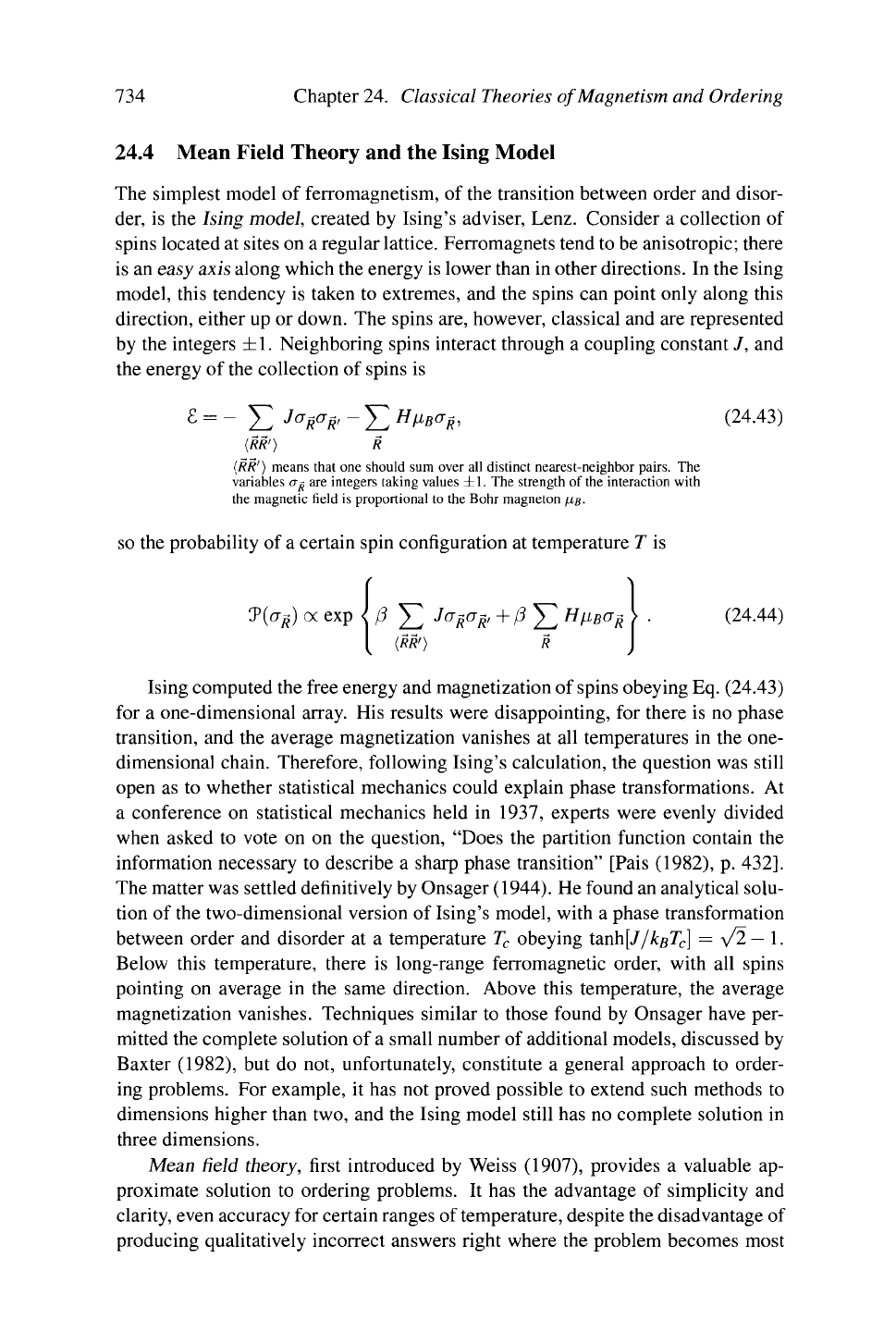
The simplest model of ferromagnetism, of the transition between order and disor-
der, is the Ising model, created by Ising's adviser, Lenz. Consider a collection of
spins located at sites on a regular
lattice.
Ferromagnets tend to be anisotropic; there
is an easy axis along which the energy is lower than in other directions. In the Ising
model, this tendency is taken to extremes, and the spins can point only along this
direction, either up or down. The spins are, however, classical and are represented
by the integers ±
1.
Neighboring spins interact through a coupling constant J, and
the energy of the collection of spins is
£ = - Y.
3
°R
a
R>
~ E
H
^
a
«> <
24
-
43
)
(RR'} R
(RR'} means that one should sum over all distinct nearest-neighbor pairs. The
variables a^ are integers taking values ±
1.
The strength of the interaction with
the magnetic field is proportional to the Bohr magneton ßß-
so the probability of a certain spin configuration at temperature T is
7(a
n
) oc exp ^ ß ^ Ja
R
a
ä
,+ß ^ Hfi
B
a
ä
(RR') R
(24.44)
Ising computed the free energy and magnetization of spins obeying Eq. (24.43)
for a one-dimensional array. His results were disappointing, for there is no phase
transition, and the average magnetization vanishes at all temperatures in the one-
dimensional chain. Therefore, following Ising's calculation, the question was still
open as to whether statistical mechanics could explain phase transformations. At
a conference on statistical mechanics held in 1937, experts were evenly divided
when asked to vote on on the question, "Does the partition function contain the
information necessary to describe a sharp phase transition" [Pais (1982), p. 432].
The matter was settled definitively by Onsager (1944). He found an analytical solu-
tion of the two-dimensional version of Ising's model, with a phase transformation
between order and disorder at a temperature T
c
obeying tanh[J / kßT
c
] = \/2— 1.
Below this temperature, there is long-range ferromagnetic order, with all spins
pointing on average in the same direction. Above this temperature, the average
magnetization vanishes. Techniques similar to those found by Onsager have per-
mitted the complete solution of a small number of additional models, discussed by
Baxter (1982), but do not, unfortunately, constitute a general approach to order-
ing problems. For example, it has not proved possible to extend such methods to
dimensions higher than two, and the Ising model still has no complete solution in
three dimensions.
Mean field theory, first introduced by Weiss (1907), provides a valuable ap-
proximate solution to ordering problems. It has the advantage of simplicity and
clarity, even accuracy for certain ranges of temperature, despite the disadvantage of
producing qualitatively incorrect answers right where the problem becomes most
Mean Field Theory
and
the Ising Model 735
interesting,
in the
vicinity
of the
phase transition.
The
idea
is to
replace
a
sys-
tem
of
interacting spins
by a
single spin sitting
in the
mean,
or
average, magnetic
field produced
by all its
neighbors. This average magnetic field
is
calculated
self-
consistently
by
asking what magnetic field
the
single spin must produce when
it
sits
in a
uniform external field
and by
demanding that
the two
fields agree.
The
qualitative error
in
this calculation
is the
neglect
of
correlations.
For
example,
near
a
phase transition, magnetic spins aggregate into blobs
of
spins pointing
in the
same direction, while different blobs point in different
ways.
The average magnetic
field may
be
zero while simultaneously
the
chance
of a
spin
and its
near neighbors
pointing
in the
same direction
is
very high. Mean field theory cannot correctly
characterize this situation, because
if the
average field
is
zero, mean field theory
predicts
no
correlation between
a
spin
and its
neighbors.
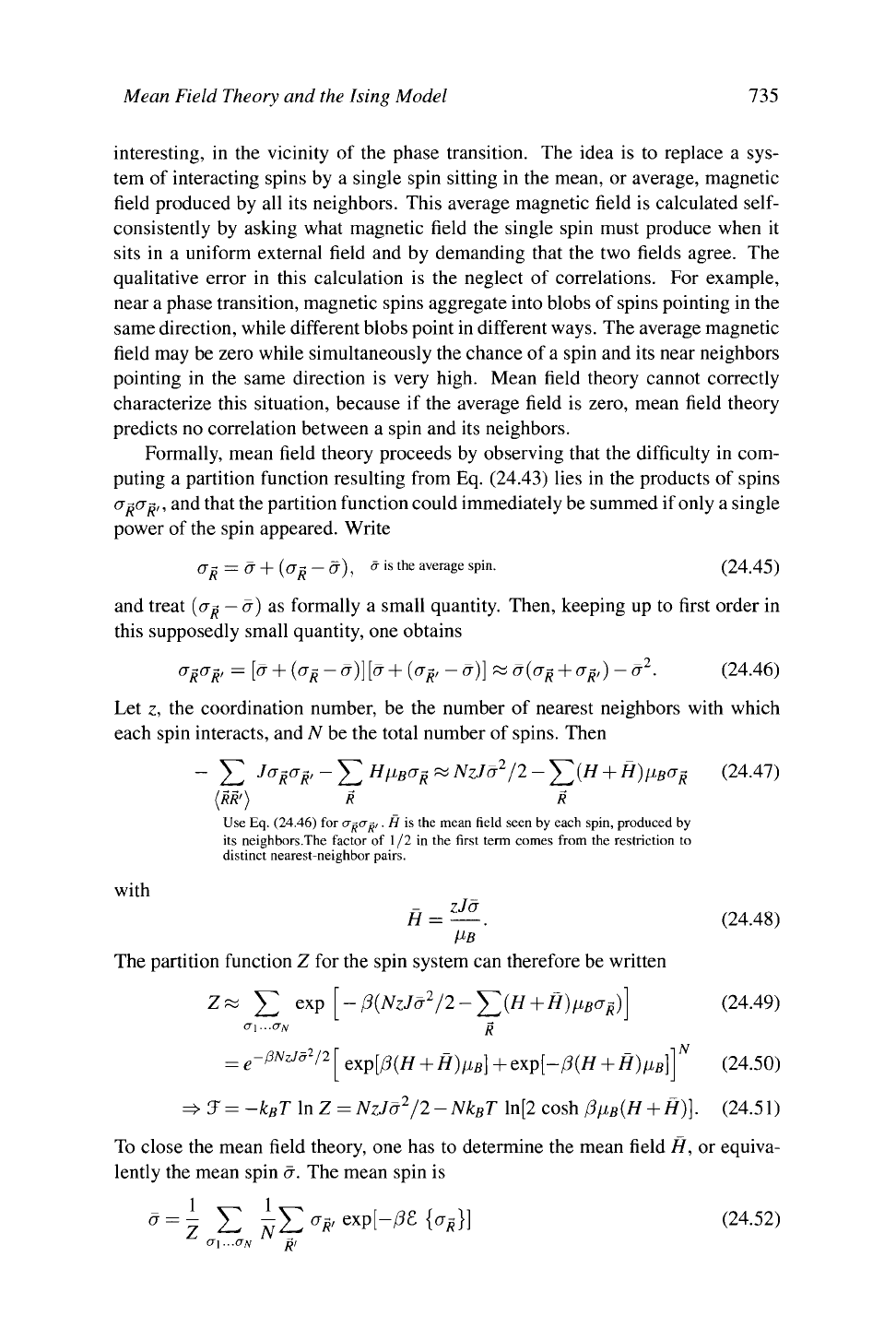
Formally, mean field theory proceeds
by
observing that
the
difficulty
in
com-
puting
a
partition function resulting from Eq. (24.43) lies
in the
products
of
spins
cr^cr^,, and that the partition function could immediately be summed if only
a
single
power
of
the spin appeared. Write
°R
= a + \?R ~ v)
a
is the
average spin.
(24.45)
and treat (er^
—
a) as
formally
a
small quantity. Then, keeping
up to
first order
in
this supposedly small quantity, one obtains
a
R
a
R'
=
W
+
(
U
R
-
u
)\
I
er
+
(°R>
~
cr
)]
-o{a
n
+ a
ä
,)-a
-2
(24.46)
Let
z, the
coordination number,
be the
number
of
nearest neighbors with which
each spin interacts, and
N be the
total number
of
spins. Then
-
E
Ja
R
a
R>
- E
H
^
a
R ~
NzJ(J
2
/2
-Y^{H
+ H)ß
B
a
ä
(24.47)
W)
R
Use Eq. (24.46)
for
cr^a^,.
H is the
mean field seen
by
each spin, produced
by
its neighbors.The factor
of 1/2 in the
first term comes from
the
restriction
to
distinct nearest-neighbor pairs.
with
H
=
zJu
Ms
'
The partition function
Z for
the spin system
can
therefore
be
written
Z«
J2
ex
P
\-ß{NzJ(T
2
/2-Y,{H + H)ß
B
cj
li
)
a\...ON
-ßNzJä
2
/2
exp[ß{H
+
H)ii
B
]
+
exp[-ß(H
+
H)/i
B
}
(24.48)
(24.49)
(24.50)
^J=-k
B
T
In Z =
NzJâ
z
/2-Nk
B
T ln[2 cosh ßß
B
{H + H)}. (24.51)
To close
the
mean field theory,
one has to
determine
the
mean field
H, or
equiva-
lent^
the
mean spin
ä. The
mean spin
is
^=7
E 7?E
a
R>
exp[-/3£
W
R
}}
Z
^ N'
O\...UN
RI
(24.52)
736 Chapter 24. Classical Theories of Magnetism and Ordering
= - V ———exp[-/3£ {a A] See
Eq.
(24.43). (24.53)
Z ^ ßNu
B
dH
FL H x RIS
= Because
3
r
=-k
B
TlaZ.
(24 54)
N fi
B
dH
= tanh/3/iß (// + //) Employing the approximation of
Eq.
(24.51). (24.55)
=>■
ä = tanh ß[zJä + ß
B
H}. (24.56)
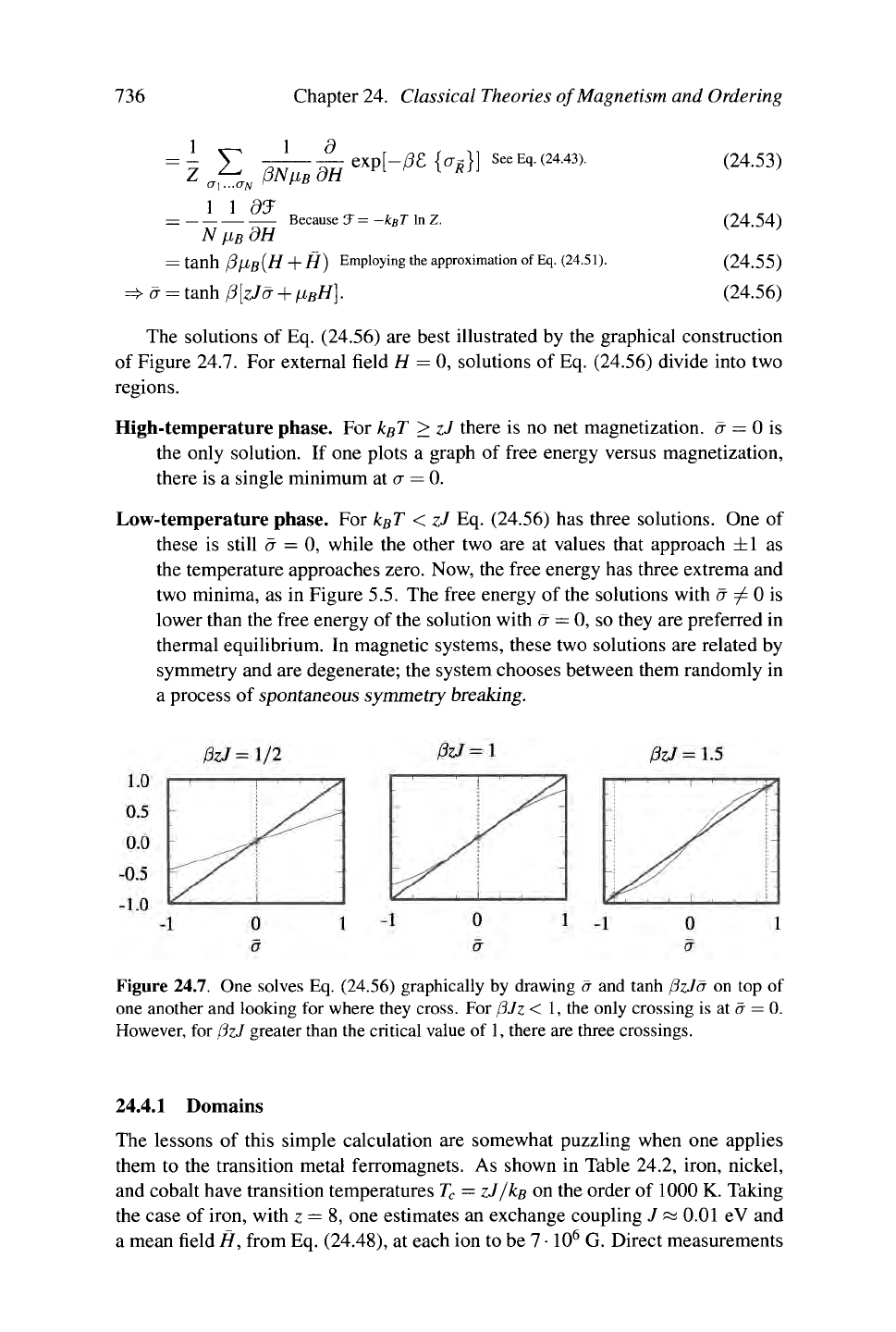
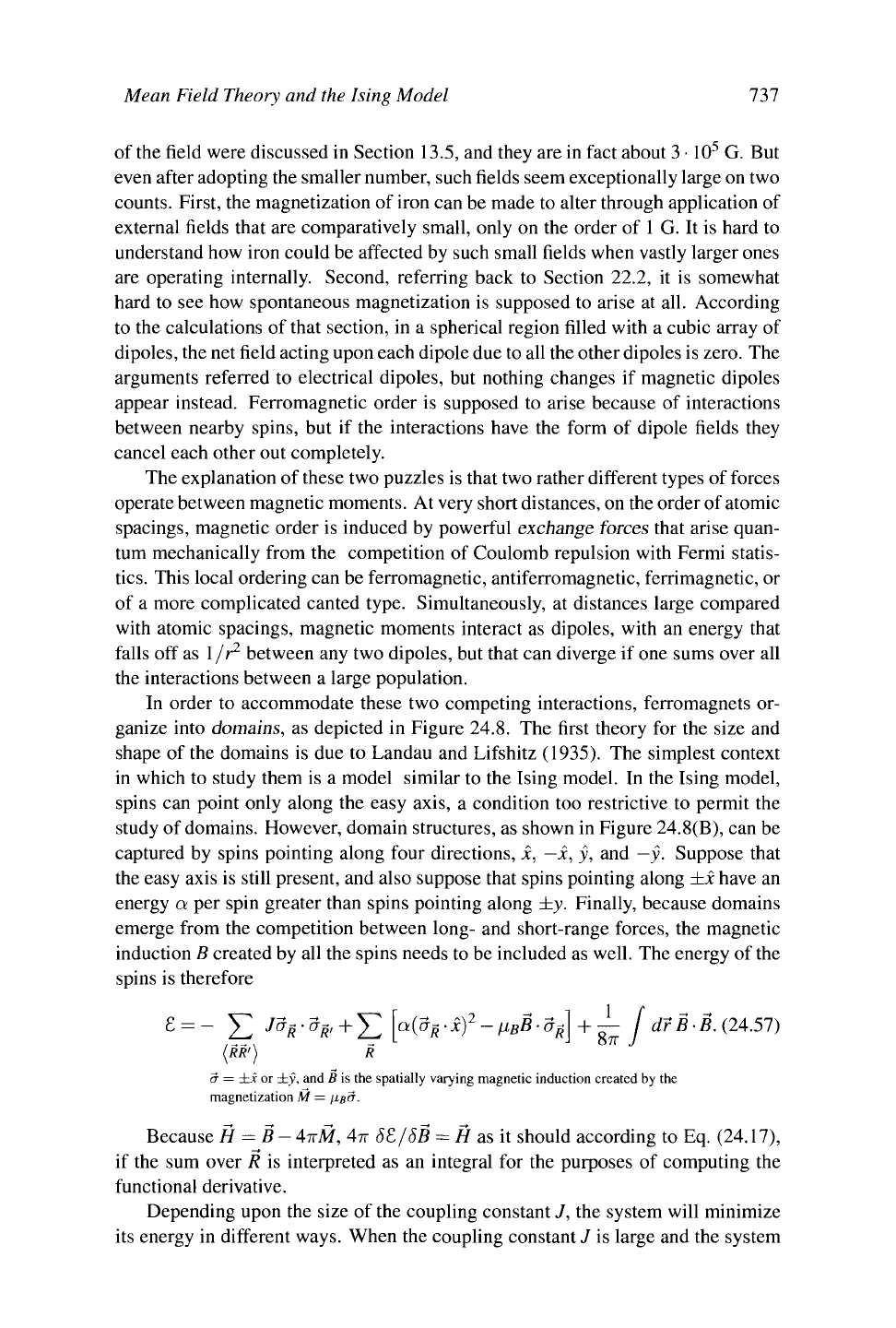
The solutions of Eq. (24.56) are best illustrated by the graphical construction
of Figure 24.7. For external field H = 0, solutions of Eq. (24.56) divide into two
regions.
High-temperature phase. For kßT > zJ there is no net magnetization, a
—
0 is
the only solution. If one plots a graph of free energy versus magnetization,
there is a single minimum at a = 0.
Low-temperature phase. For kßT < zJ Eq. (24.56) has three solutions. One of
these is still ä = 0, while the other two are at values that approach ±1 as
the temperature approaches zero. Now, the free energy has three extrema and
two minima, as in Figure 5.5. The free energy of the solutions with ä / 0 is
lower than the free energy of the solution with a = 0, so they are preferred in
thermal equilibrium. In magnetic systems, these two solutions are related by
symmetry and are degenerate; the system chooses between them randomly in
a process of spontaneous symmetry breaking.
Figure 24.7. One solves Eq. (24.56) graphically by drawing a and tanh ßzJä on top of
one another and looking for where they cross. For ßJz < 1, the only crossing is at ä = 0.
However, for ßzJ greater than the critical value of
1,
there are three crossings.
24.4.1 Domains
The lessons of this simple calculation are somewhat puzzling when one applies
them to the transition metal ferromagnets. As shown in Table 24.2, iron, nickel,
and cobalt have transition temperatures T
c
= zJ/kß on the order of 1000 K. Taking
the case of iron, with z = 8, one estimates an exchange coupling J « 0.01 eV and
a mean field H, from Eq. (24.48), at each ion to be 7
•
10
6
G. Direct measurements
Mean Field Theory and the hing Model
131
of the field were discussed in Section 13.5, and they are in fact about
3 •
10
5
G. But
even after adopting the smaller number, such fields seem exceptionally large on two
counts. First, the magnetization of iron can be made to alter through application of
external fields that are comparatively small, only on the order of
1
G. It is hard to
understand how iron could be affected by such small fields when vastly larger ones
are operating internally. Second, referring back to Section 22.2, it is somewhat
hard to see how spontaneous magnetization is supposed to arise at all. According
to the calculations of that section, in a spherical region filled with a cubic array of
dipoles, the net field acting upon each dipole due to all the other dipoles is zero. The
arguments referred to electrical dipoles, but nothing changes if magnetic dipoles
appear instead. Ferromagnetic order is supposed to arise because of interactions
between nearby spins, but if the interactions have the form of dipole fields they
cancel each other out completely.
The explanation of these two puzzles is that two rather different types of forces
operate between magnetic moments. At very short distances, on the order of atomic
spacings, magnetic order is induced by powerful exchange forces that arise quan-
tum mechanically from the competition of Coulomb repulsion with Fermi statis-
tics.
This local ordering can be ferromagnetic, antiferromagnetic, ferrimagnetic, or
of a more complicated canted type. Simultaneously, at distances large compared
with atomic spacings, magnetic moments interact as dipoles, with an energy that
falls off as
1
/r
2
between any two dipoles, but that can diverge if one sums over all
the interactions between a large population.
In order to accommodate these two competing interactions, ferromagnets or-
ganize into domains, as depicted in Figure 24.8. The first theory for the size and
shape of the domains is due to Landau and Lifshitz (1935). The simplest context
in which to study them is a model similar to the Ising model. In the Ising model,
spins can point only along the easy axis, a condition too restrictive to permit the
study of
domains.
However, domain structures, as shown in Figure 24.8(B), can be
captured by spins pointing along four directions, x,
—x,
y, and
—y.
Suppose that
the easy axis is still present, and also suppose that spins pointing along ±x have an
energy a per spin greater than spins pointing along ±y. Finally, because domains
emerge from the competition between long- and short-range forces, the magnetic
induction B created by all the spins needs to be included as well. The energy of the
spins is therefore
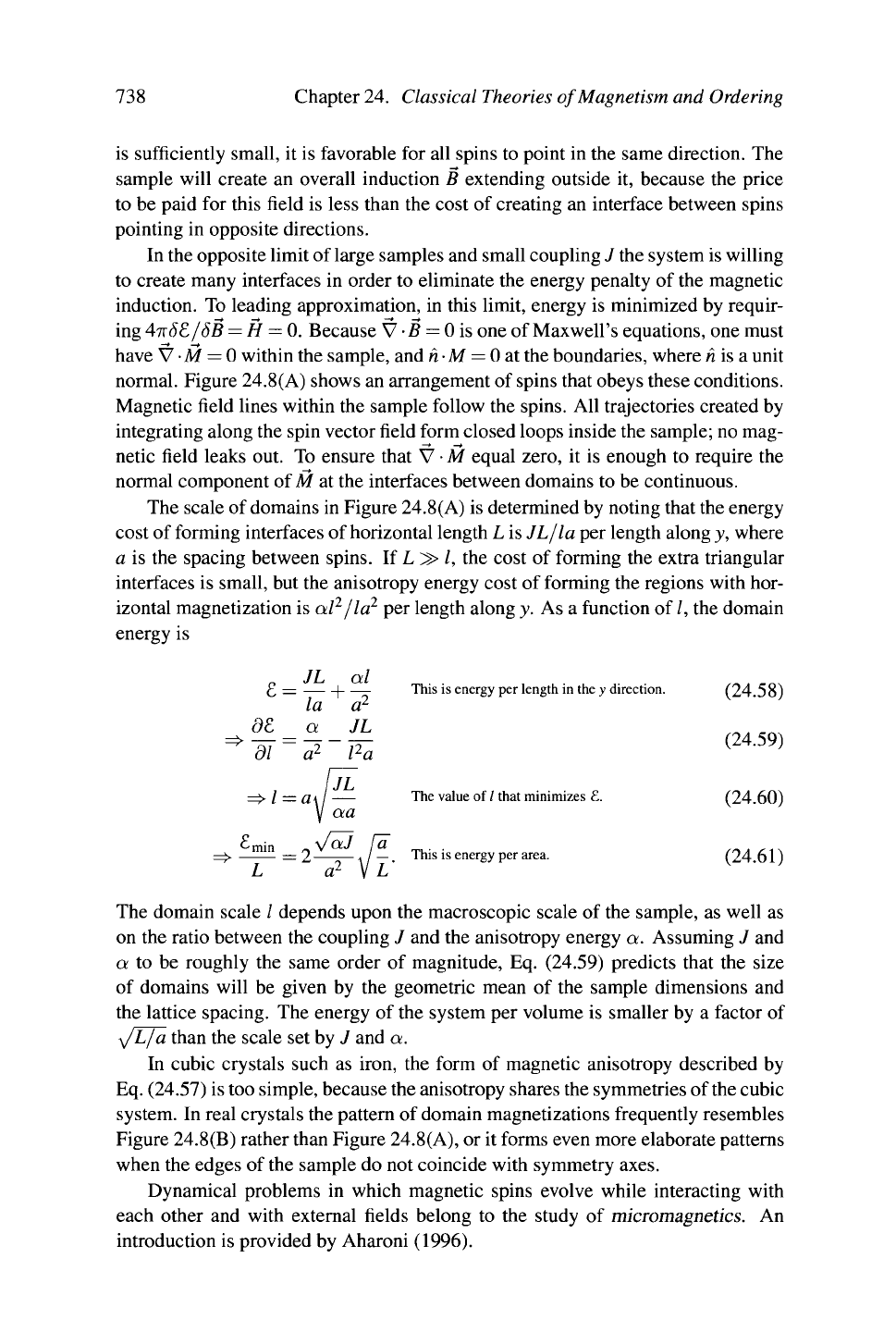
£ = - J2
J
°R-VR>
+ Y1 [a(o"
s
-x)
2
-fi
B
B-â
â
+— j drB-fl. (24.57)
(RR
1
) R
a
= ±x or ±)>, and B is the spatially varying magnetic induction created by the
magnetization
M = /xg<r.
Because H =
B-4TTM,
ATZ
SE./SB = H as it should according to Eq. (24.17),
if the sum over R is interpreted as an integral for the purposes of computing the
functional derivative.
Depending upon the size of the coupling constant J, the system will minimize
its energy in different ways. When the coupling constant J is large and the system
738 Chapter 24. Classical Theories of Magnetism and Ordering
is sufficiently small, it is favorable for all spins to point in the same direction. The
sample will create an overall induction B extending outside it, because the price
to be paid for this field is less than the cost of creating an interface between spins
pointing in opposite directions.
In the opposite limit of large samples and small coupling J the system is willing
to create many interfaces in order to eliminate the energy penalty of the magnetic
induction. To leading approximation, in this limit, energy is minimized by requir-
ing 4irô£/ÔB = H = 0. Because V
•
B = 0 is one of Maxwell's equations, one must
have V
•
M = 0 within the sample, and h
•
M = 0 at the boundaries, where « is a unit
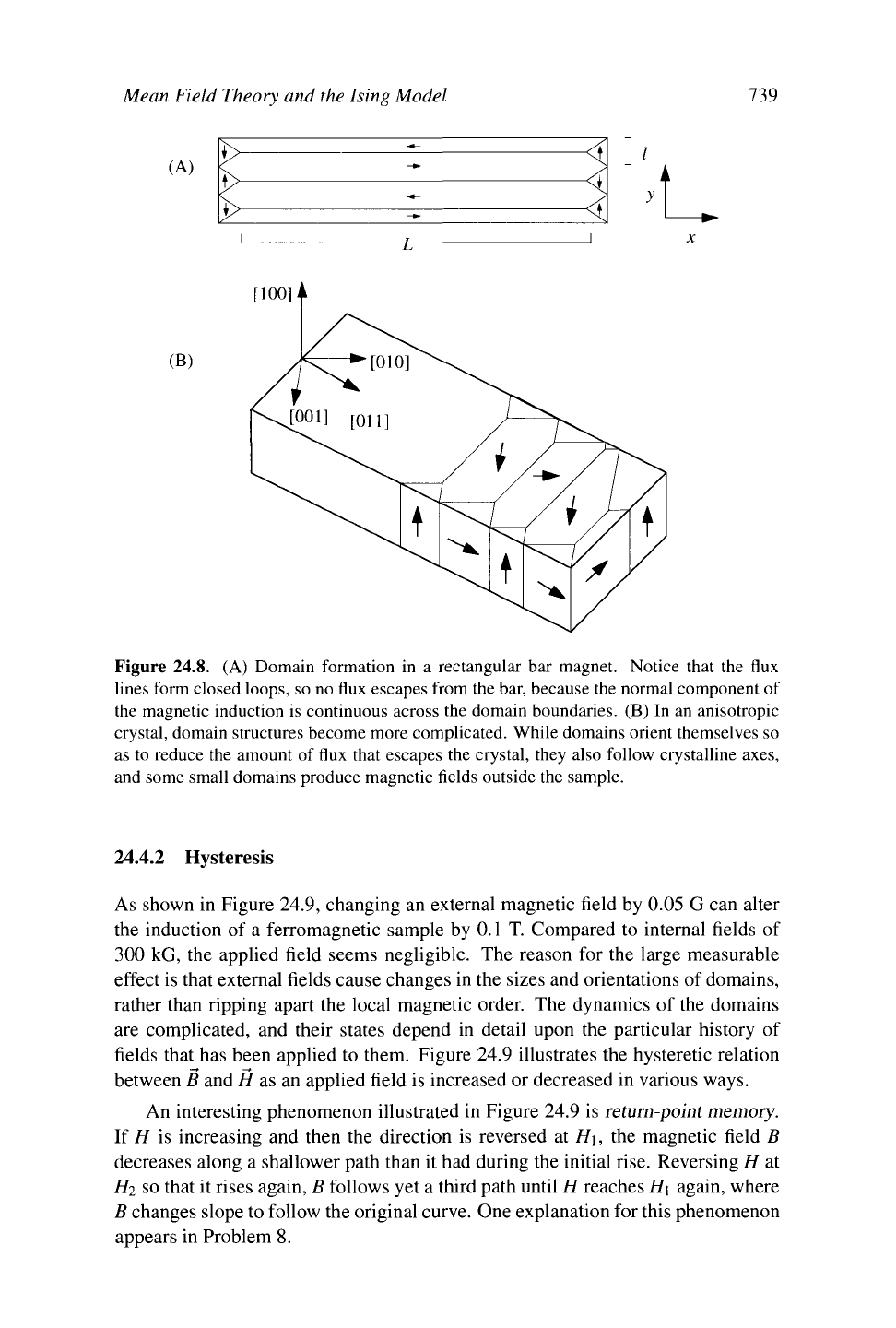
normal. Figure 24.8(A) shows an arrangement of spins that obeys these conditions.
Magnetic field lines within the sample follow the spins. All trajectories created by
integrating along the spin vector field form closed loops inside the sample; no mag-
netic field leaks out. To ensure that V
•
M equal zero, it is enough to require the
normal component of M at the interfaces between domains to be continuous.
The scale of domains in Figure 24.8(A) is determined by noting that the energy
cost of forming interfaces of horizontal length L is JL/la per length along y, where
a is the spacing between spins. If L 3> /, the cost of forming the extra triangular
interfaces is small, but the anisotropy energy cost of forming the regions with hor-
izontal magnetization is al
1
/la
2
per length along y. As a function of /, the domain
energy is
This is energy per length in the y direction. (24.58)
(24.59)
The value of / that minimizes £. (24.60)
This is energy per area. (24.61 )
The domain scale / depends upon the macroscopic scale of the sample, as well as
on the ratio between the coupling J and the anisotropy energy a. Assuming J and
a to be roughly the same order of magnitude, Eq. (24.59) predicts that the size
of domains will be given by the geometric mean of the sample dimensions and
the lattice spacing. The energy of the system per volume is smaller by a factor of
\jLfa than the scale set by J and a.
In cubic crystals such as iron, the form of magnetic anisotropy described by
Eq. (24.57) is too simple, because the anisotropy shares the symmetries of the cubic
system. In real crystals the pattern of domain magnetizations frequently resembles
Figure 24.8(B) rather than Figure 24.8(A), or it forms even more elaborate patterns
when the edges of the sample do not coincide with symmetry axes.
Dynamical problems in which magnetic spins evolve while interacting with
each other and with external fields belong to the study of micromagnetics. An
introduction is provided by Aharoni (1996).
Mean Field Theory and the hing Model 739
(A)
(B)
Figure 24.8. (A) Domain formation in a rectangular bar magnet. Notice that the flux
lines form closed loops, so no flux escapes from the bar, because the normal component of
the magnetic induction is continuous across the domain boundaries. (B) In an anisotropic
crystal, domain structures become more complicated. While domains orient themselves so
as to reduce the amount of flux that escapes the crystal, they also follow crystalline axes,
and some small domains produce magnetic fields outside the sample.
24.4.2 Hysteresis
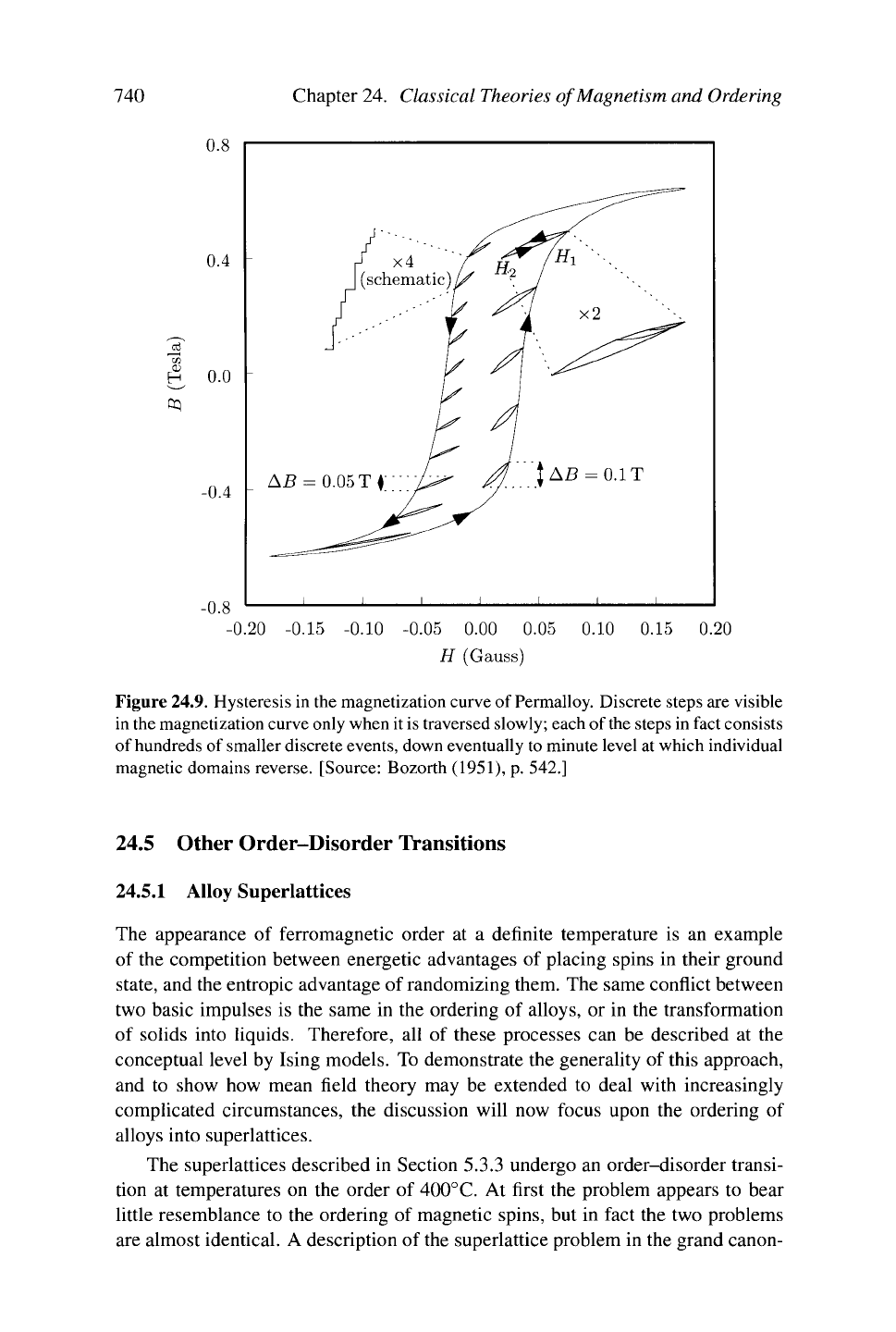
As shown in Figure 24.9, changing an external magnetic field by 0.05 G can alter
the induction of a ferromagnetic sample by 0.1 T. Compared to internal fields of
300 kG, the applied field seems negligible. The reason for the large measurable
effect is that external fields cause changes in the sizes and orientations of domains,
rather than ripping apart the local magnetic order. The dynamics of the domains
are complicated, and their states depend in detail upon the particular history of
fields that has been applied to them. Figure 24.9 illustrates the hysteretic relation
between B and H as an applied field is increased or decreased in various ways.
An interesting phenomenon illustrated in Figure 24.9 is return-point memory.
If H is increasing and then the direction is reversed at H\, the magnetic field B
decreases along a shallower path than it had during the initial rise. Reversing H at
H2 so that it rises again, B follows yet a third path until H reaches H\ again, where
B changes slope to follow the original curve. One explanation for this phenomenon
appears in Problem 8.
740
Chapter 24. Classical Theories of Magnetism and Ordering
0.8
-0.20 -0.15 -0.10 -0.05 0.00 0.05 0.10 0.15 0.20
H (Gauss)
Figure
24.9.
Hysteresis in the magnetization curve of
Permalloy.
Discrete steps are visible
in the magnetization curve only when it
is
traversed slowly; each of the steps
in
fact consists
of
hundreds
of smaller discrete
events,
down eventually to minute level at which individual
magnetic domains reverse. [Source: Bozorth (1951), p. 542.]
24.5 Other Order-Disorder Transitions
24.5.1 Alloy Superlattices
The appearance of ferromagnetic order at a definite temperature is an example
of the competition between energetic advantages of placing spins in their ground
state,
and the entropie advantage of randomizing them. The same conflict between
two basic impulses is the same in the ordering of alloys, or in the transformation
of solids into liquids. Therefore, all of these processes can be described at the
conceptual level by Ising models. To demonstrate the generality of this approach,
and to show how mean field theory may be extended to deal with increasingly
complicated circumstances, the discussion will now focus upon the ordering of
alloys into superlattices.
The superlattices described in Section 5.3.3 undergo an order-disorder transi-
tion at temperatures on the order of 400°C. At first the problem appears to bear
little resemblance to the ordering of magnetic spins, but in fact the two problems
are almost identical. A description of the superlattice problem in the grand canon-
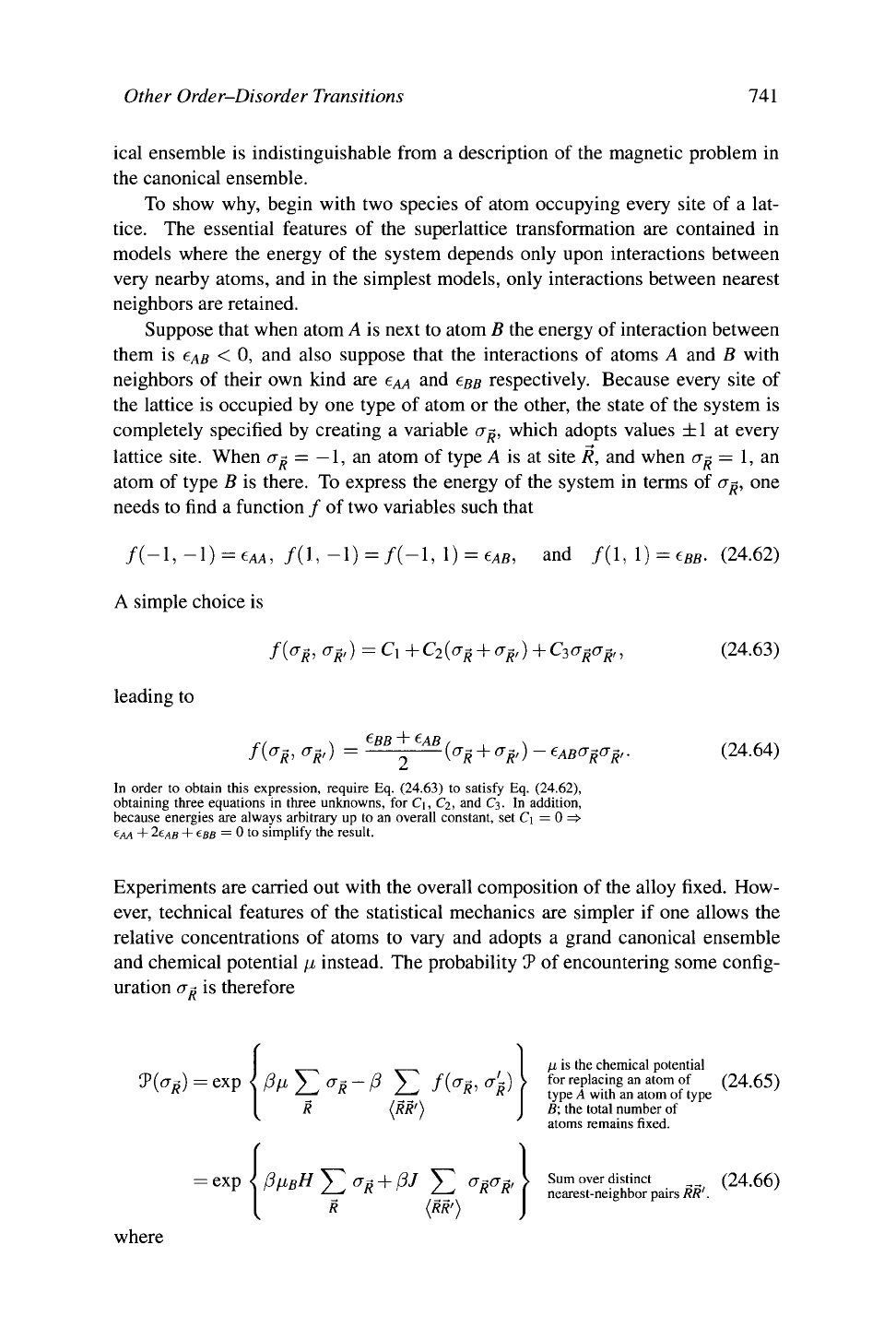
Other Order-Disorder Transitions 741
ical ensemble
is
indistinguishable from
a
description of the magnetic problem in
the canonical ensemble.
To show why, begin with two species
of
atom occupying every site
of a
lat-
tice.
The essential features
of
the superlattice transformation are contained
in
models where the energy
of
the system depends only upon interactions between
very nearby atoms, and in the simplest models, only interactions between nearest
neighbors are retained.
Suppose that when atom A is next to atom B the energy of interaction between
them
is
EAB
<
0, and also suppose that the interactions
of
atoms
A
and
B
with
neighbors
of
their own kind are
EAA
and
EBB
respectively. Because every site of
the lattice is occupied by one type of atom or the other, the state of the system
is
completely specified by creating
a
variable a^, which adopts values ±1
at
every
lattice site. When
a^ =
—1,
an atom of type A
is at
site R, and when
a^
—
1,
an
atom of type
B
is there. To express the energy of the system in terms
of
ag, one
needs to find a function
/
of two variables such that
f(-l,-l) = e
AA
, /(l,-l)=/(-l,
l) =
e
AB
,
and /(l,
1)
=
e
BB
. (24.62)
A simple choice is
f(
a
R
'
a
R'
)
= C
l +
C
2
(<7jj
+ 0>
)
+
C
3
O$0ft,
(24.63)
leading to
r, N £BB + £AB, . s
J{VR,
VR>)
= ~
K^R
+ ^R'l-^AB^Rfrft-
(24.64)
In order
to
obtain this expression, require Eq. (24.63)
to
satisfy Eq. (24.62),
obtaining three equations
in
three unknowns, for C\, C2, and C3.
In
addition,
because energies are always arbitrary up to an overall constant, set C\
= 0
=S>
£A4
+
2EAB
+
ess
=
0 to simplify the result.
Experiments are carried out with the overall composition of the alloy fixed. How-
ever, technical features
of
the statistical mechanics are simpler
if
one allows the
relative concentrations
of
atoms
to
vary and adopts
a
grand canonical ensemble
and chemical potential
ß
instead. The probability
7
of encountering some config-
uration a^ is therefore
.
. ß is the chemical potential
9(<Tg)
= exp i ßa V ag - ß V f(a
S
, a'
B
) } for replacing an
atom
of (24.65)
\
RJ r \rr /_^ R ^ J \ RI R) i
ty
pe
A
with an atom of
type
where
type A with an atom of type
R
(ÜR
1
) I
B; the total number of
atoms remains fixed.
exp
<
ßßBH
Y^
a
R
+
ß
J
Yl
a
R
a
R'
R (M')
> Sum over distinct
_ (24.66)
nearest-neighbor pairs RR'.
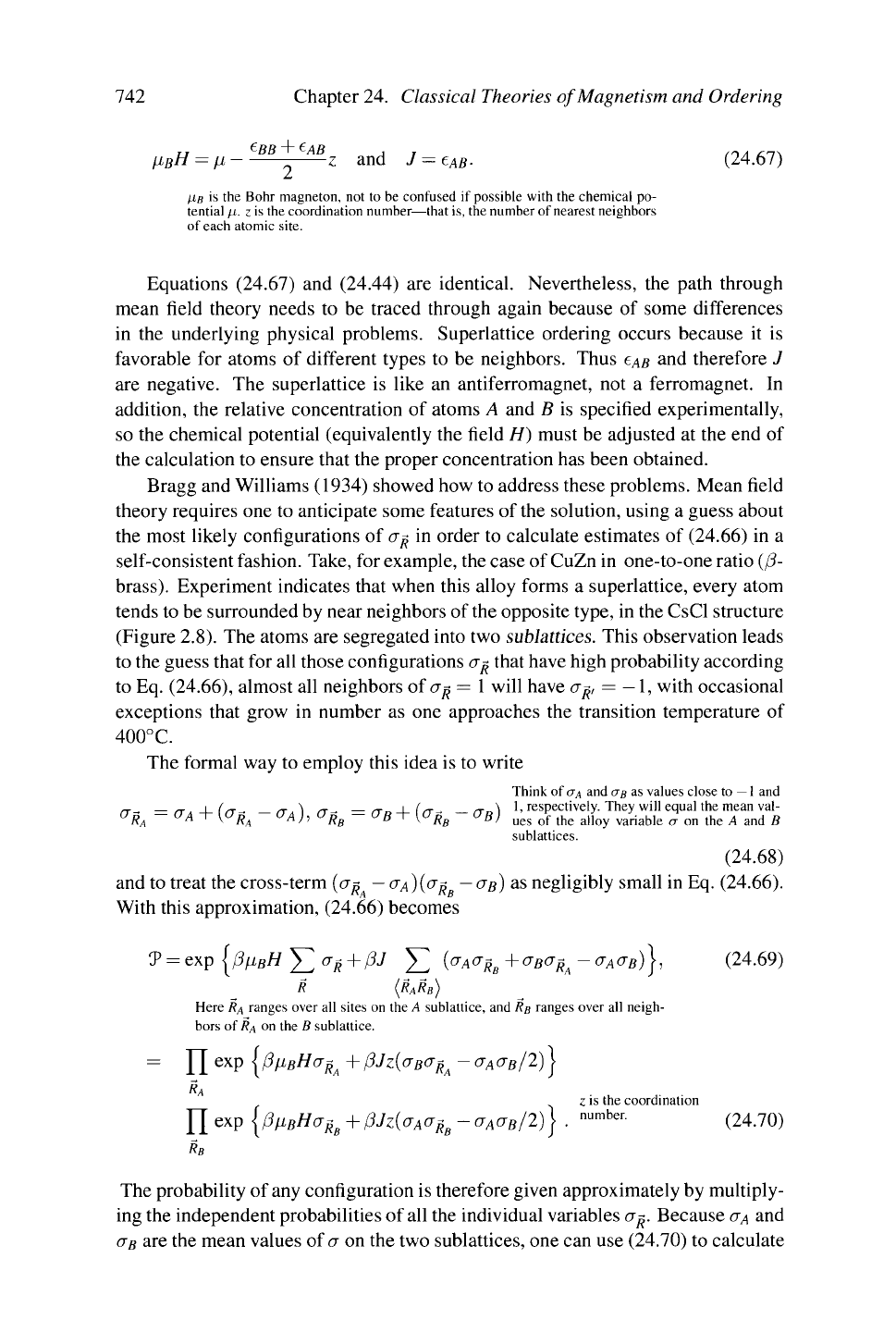
742
Chapter 24. Classical Theories of Magnetism and Ordering
[i
B
H = [i z and J = e
AB
. (24.67)
HB
is the Bohr magneton, not to be confused if possible with the chemical po-
tential
ß.
z.
is the coordination number—that is, the number of
nearest
neighbors
of
each atomic
site.
Equations (24.67) and (24.44) are identical. Nevertheless, the path through
mean field theory needs to be traced through again because of some differences
in the underlying physical problems. Superlattice ordering occurs because it is
favorable for atoms of different types to be neighbors. Thus
CAB
and therefore J
are negative. The superlattice is like an antiferromagnet, not a ferromagnet. In
addition, the relative concentration of atoms A and B is specified experimentally,
so the chemical potential (equivalently the field H) must be adjusted at the end of
the calculation to ensure that the proper concentration has been obtained.
Bragg and Williams (1934) showed how to address these problems. Mean field
theory requires one to anticipate some features of the solution, using a guess about
the most likely configurations of a^ in order to calculate estimates of (24.66) in a
self-consistent fashion. Take, for example, the case of CuZn in one-to-one ratio (ß-
brass).
Experiment indicates that when this alloy forms a superlattice, every atom
tends to be surrounded by near neighbors of the opposite type, in the CsCl structure
(Figure 2.8). The atoms are segregated into two sublattices. This observation leads
to the guess that for all those configurations a^ that have high probability according
to Eq. (24.66), almost all neighbors of a$ =
1
will have a^, =
—
1,
with occasional
exceptions that grow in number as one approaches the transition temperature of
400°C.
The formal way to employ this idea is to write
Think
of a
A
and
<xg
as values close to
—
1
and
\ I
n
rr \ rr n
-i-( rr
rr \
'■
respectively.
They will equal the mean val-
0
R
A
—°^^~\°R
A
°^>^
0
R
B
—°B^-\
0
R
B
°ß^ ues of the alloy variable a on the/I and ß
sublattices.
(24.68)
and to treat the cross-term (a^
—
a
A
)(a^
—
&B)
as negligibly small in Eq. (24.66).
With this approximation, (24.66) becomes
7 = exp {ßp
B
H ^a^ + ßJ ^ {°AG$
B
+
a
B
a
R
A
~
°AOB)},
(24.69)
R {R
A
RB)
Here
R
A
ranges over all sites on the A sublattice, and
RB
ranges over all neigh-
bors
of R
A
on the B sublattice.
Yl exp lyßiißHa^ +ßJz(a
B
o
R
-
A
-a
A
a
B
/2)j
HA
z
is the coordination
J] exp {ßn
B
Ha
h
+ ßJz(a
A
a
äe
- a
A
a
B
/2)} .
number
- (24.70)
RB
The probability of any configuration is therefore given approximately by multiply-
ing the independent probabilities of all the individual variables a^. Because a
A
and
OB
are the mean values of a on the two sublattices, one can use (24.70) to calculate