
Marder M.P. Condensed Matter Physics
Подождите немного. Документ загружается.

Critical Phenomena 743
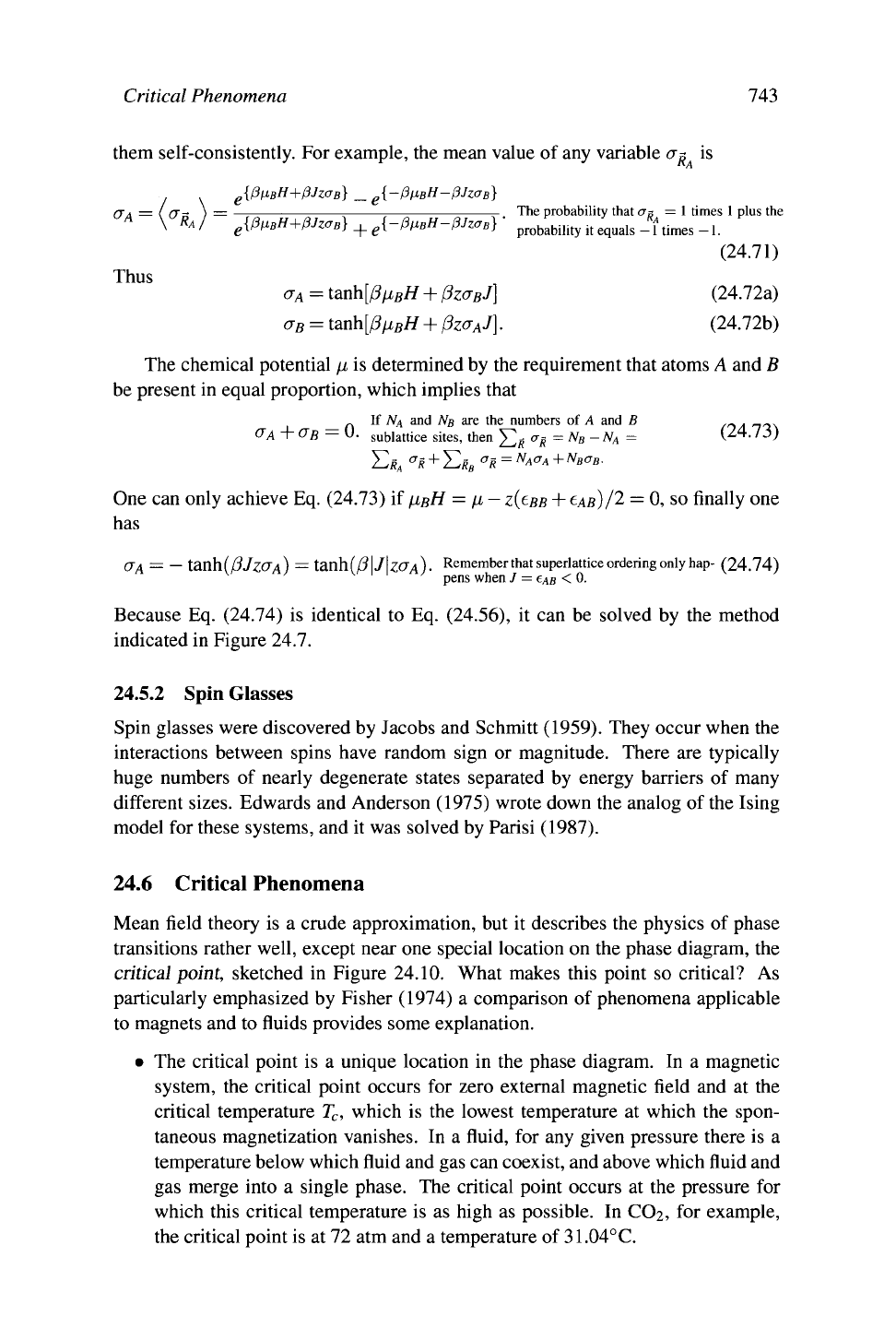
them self-consistently. For example, the mean value of any variable a^
is
e
{ß
ßB
H+ßJza
B
} _
e
{-ßp
B
H-ßJz<T
B
}
-
\ =
The probability that as
=
1
times
1
plus the
RA
/
e
{ß
ßB
H+ßJza
B
}
+ e
{-ß
m
H-ßJza
B
}
■
probabmty
jt
equals
_«j>
[imes
_
L
(24.71)
Thus
a
A
= tanh [ß^
B
H + ßza
B
J] (24.72a)
a
B
= tanh[ßß
B
H + ßza
A
J]. (24.72b)
The chemical potential
JJL
is determined by the requirement that atoms A and B
be present in equal proportion, which implies that
_
If
N
A
and N
B
are the numbers of A and
B
<JA+&B
=
U. sublattice
sites,
then J2R
a
R =
N
B
~
N
A
=
(24.7i)
J2R
A
a
R
+
ER
8
a
R
=NA°A+
N
B
a
B
.
One can only achieve Eq. (24.73) if
[x
B
H
= /i
—
z(e
BB
+ CA
B
)/2 = 0, so finally one
has
<JA
=
—
tanh(
ßJzCTA)
=
tanh(ß\
J\ZCTA).
Remember that
superlattice
ordering only
hap-
(24.74)
pens
when
J
= e
AB
< 0.
Because Eq. (24.74)
is
identical to Eq. (24.56),
it
can be solved by the method
indicated in Figure 24.7.
24.5.2 Spin Glasses
Spin glasses were discovered by Jacobs and Schmitt (1959). They occur when the
interactions between spins have random sign or magnitude. There are typically
huge numbers
of
nearly degenerate states separated by energy barriers
of
many
different sizes. Edwards and Anderson (1975) wrote down the analog of the Ising
model for these systems, and it was solved by Parisi (1987).
24.6 Critical Phenomena
Mean field theory is
a
crude approximation, but it describes the physics of phase
transitions rather well, except near one special location on the phase diagram, the
critical point, sketched in Figure 24.10. What makes this point so critical?
As
particularly emphasized by Fisher (1974)
a
comparison of phenomena applicable
to magnets and to fluids provides some explanation.
• The critical point is
a
unique location in the phase diagram. In
a
magnetic
system, the critical point occurs for zero external magnetic field and at the
critical temperature T
c
, which is the lowest temperature at which the spon-
taneous magnetization vanishes. In
a
fluid, for any given pressure there is
a
temperature below which fluid and gas can coexist, and above which
fluid
and
gas merge into
a
single phase. The critical point occurs at the pressure for
which this critical temperature is as high as possible. In CO2, for example,
the critical point is at 72 atm and a temperature of 31.04°C.
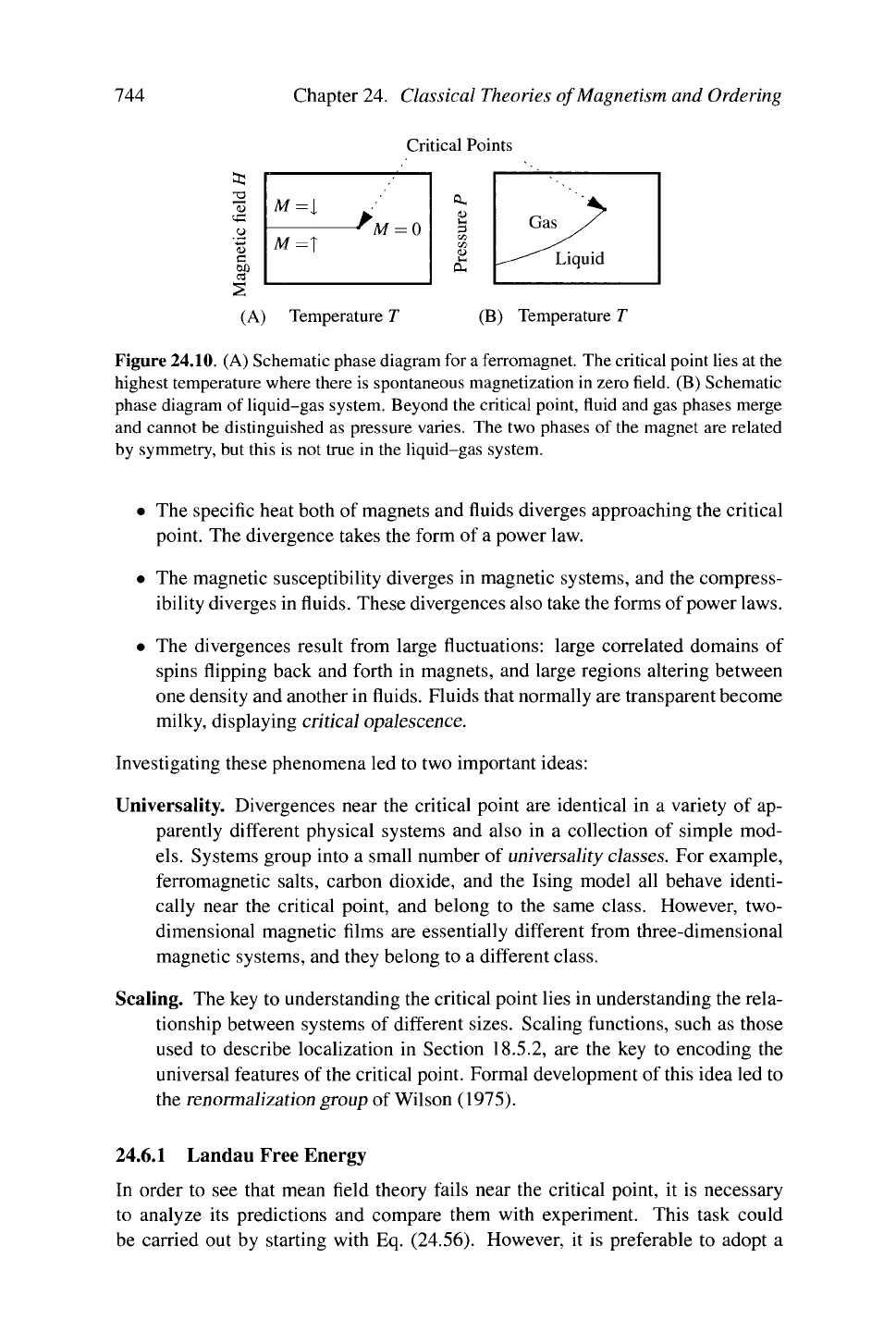
744 Chapter 24. Classical Theories of Magnetism and Ordering
Critical Points
a:
D
<C
O
u
c
60
C3
/W
M -
=
|
=î
* M -
=
0
(A) Temperature T (B) Temperature T
Figure 24.10. (A) Schematic phase diagram for a ferromagnet. The critical point lies at the
highest temperature where there is spontaneous magnetization in zero field. (B) Schematic
phase diagram of liquid-gas system. Beyond the critical point, fluid and gas phases merge
and cannot be distinguished as pressure varies. The two phases of the magnet are related
by symmetry, but this is not true in the liquid-gas system.
• The specific heat both of magnets and fluids diverges approaching the critical
point. The divergence takes the form of a power law.
• The magnetic susceptibility diverges in magnetic systems, and the compress-
ibility diverges in fluids. These divergences also take the forms of power laws.
• The divergences result from large fluctuations: large correlated domains of
spins flipping back and forth in magnets, and large regions altering between
one density and another in fluids. Fluids that normally are transparent become
milky, displaying critical opalescence.
Investigating these phenomena led to two important ideas:
Universality. Divergences near the critical point are identical in a variety of ap-
parently different physical systems and also in a collection of simple mod-
els.
Systems group into a small number of universality
classes.
For example,
ferromagnetic salts, carbon dioxide, and the Ising model all behave identi-
cally near the critical point, and belong to the same class. However, two-
dimensional magnetic films are essentially different from three-dimensional
magnetic systems, and they belong to a different class.
Scaling. The key to understanding the critical point lies in understanding the rela-
tionship between systems of different sizes. Scaling functions, such as those
used to describe localization in Section 18.5.2, are the key to encoding the
universal features of the critical point. Formal development of this idea led to
the renormalization group of Wilson (1975).
24.6.1 Landau Free Energy
In order to see that mean field theory fails near the critical point, it is necessary
to analyze its predictions and compare them with experiment. This task could
be carried out by starting with Eq. (24.56). However, it is preferable to adopt a
Critical Phenomena
745
framework developed by Landau (1937) that exhibits clearly the minimal set of
assumptions needed to obtain the results of mean field theory.
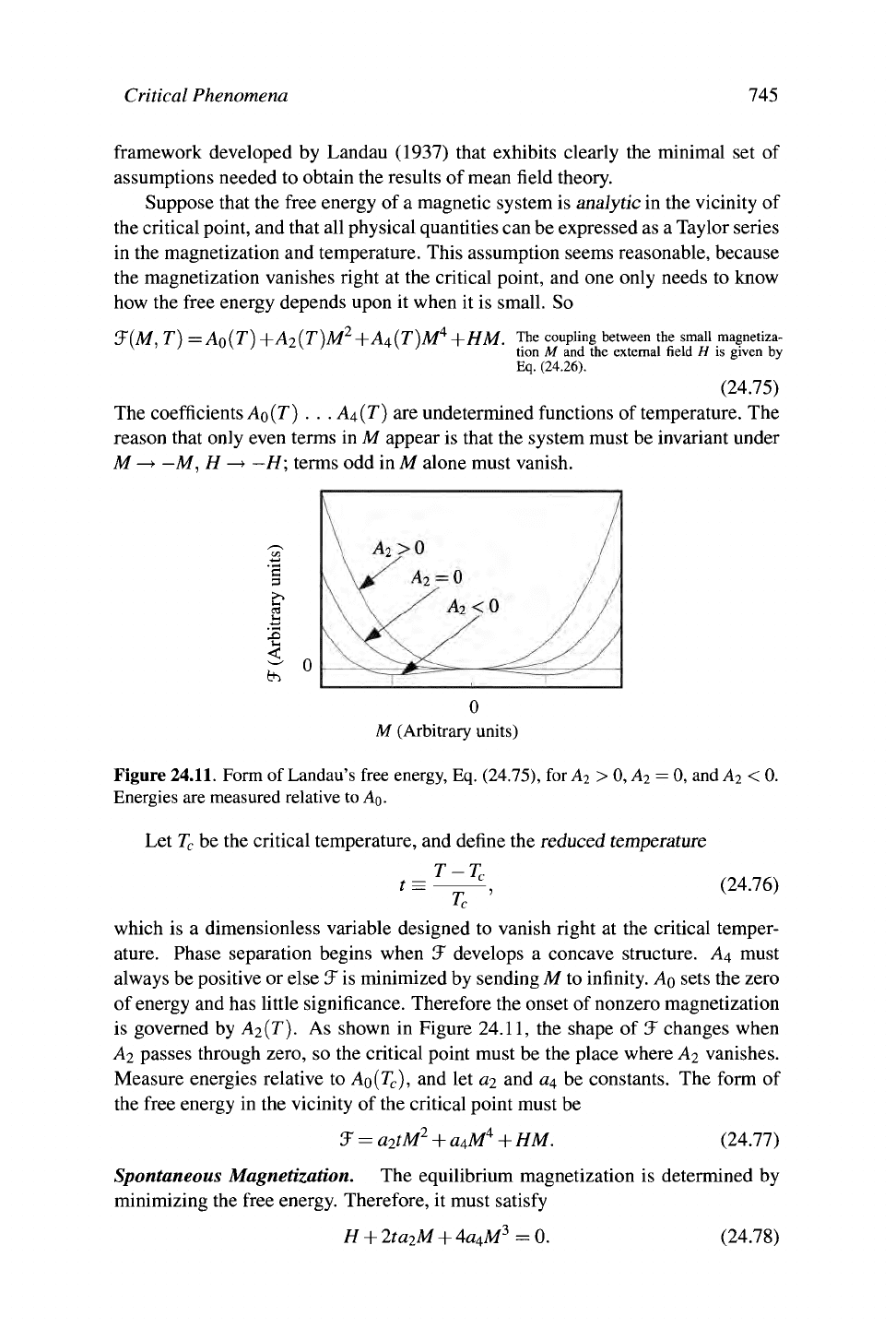
Suppose that the free energy of a magnetic system is analytic in the vicinity of
the critical point, and that all physical quantities can be expressed as a Taylor series
in the magnetization and temperature. This assumption seems reasonable, because
the magnetization vanishes right at the critical point, and one only needs to know
how the free energy depends upon it when it is small. So
3{M, T) =A
0
(T)+A
2
(T)M
2
+A
4
(T)M
4
+HM. The coupling between the small magnetiza-
tion
M and the external field H is given by
Eq.
(24.26).
(24.75)
The coefficients
AQ(T)
. . . A
4
(T) are undetermined functions of temperature. The
reason that only even terms in M appear is that the system must be invariant under
M
—>
—M, H
—►
—H;
terms odd in M alone must vanish.
c
3
cd
l-i
f-i
g»
0
M (Arbitrary units)
Figure
24.11.
Form of Landau's free energy, Eq. (24.75), for
A2
> 0, Ai = 0,
and A2
< 0.
Energies are measured relative
to
An.
Let T
c
be the critical temperature, and define the reduced temperature
T-T
r
c
Tc
(24.76)
which is a dimensionless variable designed to vanish right at the critical temper-
ature. Phase separation begins when 5" develops a concave structure. A4 must
always be positive or else
3"
is minimized by sending M to infinity.
AQ
sets the zero
of energy and has little significance. Therefore the onset of nonzero magnetization
is governed by A2(T). As shown in Figure
24.11,
the shape of 3 changes when
A2 passes through zero, so the critical point must be the place where
A2
vanishes.
Measure energies relative to AQ(T
C
), and let ai and 04 be constants. The form of
the free energy in the vicinity of the critical point must be
3"
=
a
2
tM
2
+
a
4
M
4
+ HM. (24.77)
Spontaneous Magnetization. The equilibrium magnetization is determined by
minimizing the free energy. Therefore, it must satisfy
H + 2ta
2
M +
4a
4
M
3
= 0. (24.78)
746 Chapter 24. Classical Theories of Magnetism
and
Ordering
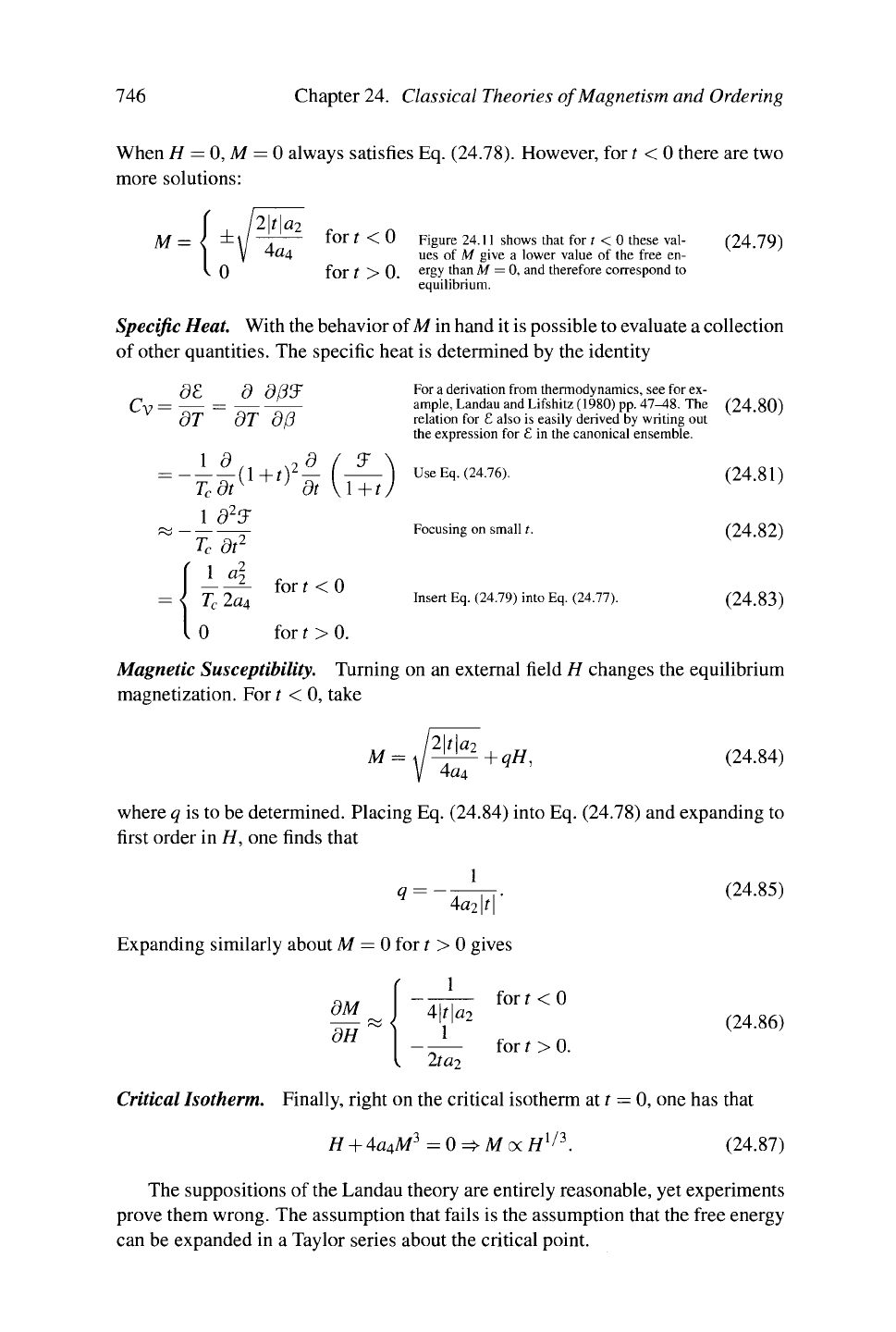
When
H = 0, M = 0
always satisfies
Eq.
(24.78). However,
for t < 0
there
are two
more solutions:
, /2|f|<22
r
M=l
^\l2
forî<0 Figure
24.11
shows that
for! <0
these
val-
(24.79)
I
y 4^4
ues 0
f M
give
a
lower value
of the
free
en-
l. 0 for t > 0.
er
êy
man
M = 0, and
therefore correspond
to
equilibrium.
Specific
Heat.
With the behavior of M
in
hand
it
is possible to evaluate
a
collection
of other quantities.
The
specific heat
is
determined
by the
identity
<9£
d 003^ ^
or a
derivation from thermodynamics,
see for ex-
C
v
=
=
—
ample, Landau
and
Lifshitz
(
1980)
pp. 47^18.
The
(24.80)
QT
QT dß
relation
for £
also
is
easily derived
by
writing
out
the expression
for £ in the
canonical ensemble.
1
d d ( 5" \
(l+O^frrr)
UseEc
i-(
24
-
76
)-
(24.81)
Focusing
on
small
t.
(24.82)
T
c
dt
y
' dt \l+t
1
d
2
3
T
c
dt
2
1
al
T
c
2a
4
°
r ? K
Insert
Eq.
(24.79) into Eq. (24.77). (24.83)
0
for t > 0.
Magnetic Susceptibility. Turning
on an
external field
H
changes
the
equilibrium
magnetization.
For t < 0,
take
2\t\a
2
M=sl^±+qH,
(24.84)
where
q is to be
determined. Placing Eq. (24.84) into Eq. (24.78)
and
expanding
to
first order
in H, one
finds that
1
(24.85)
4a
2
k|
Expanding similarly about
M = 0 for t > 0
gives
1
dM
~dH
for
t < 0
for
t > 0.
4
I{I
02
(24.86)
2/Û2
Critical Isotherm. Finally, right
on the
critical isotherm
at t
—
0, one has
that
H
+
4a
4
M
3
= 0^M(xH
l/3
.
(24.87)
The suppositions
of
the Landau theory
are
entirely reasonable,
yet
experiments
prove them wrong.
The
assumption that fails
is the
assumption that
the
free energy
can
be
expanded
in a
Taylor series about
the
critical point.
Critical Phenomena IM
Correspondence between Liquids and Magnets. Experiments on critical point
phenomena have been conducted both in magnets, and in liquid-gas systems. The
two systems act almost identically in the vicinity of the critical point, once corre-
sponding variables have been identified.
A correspondence between magnetic and liquid-gas systems can be constructed
in a manner similar to that used for superlattices in Section 5.3.3. Imagine that the
material of type A in that section is a fluid, while the material of type B is gas.
Then the equations describing the superlattice can immediately be interpreted as
describing liquid-gas phase transitions. At temperatures below the transition, fluid
prefers to group with fluid and gas prefers to group with gas, meaning that the en-
ergy
€AB
is positive, and the fluid-gas system corresponds to a ferromagnet, with
positive J in Eq. (24.43). Above the transition temperature, fluid and gas mix to-
gether, forming a single homogeneous phase, while below the transition, gas and
liquid phase separate.
Based on this discussion, one forms the following correspondence: The mag-
netization M corresponds to the difference in particle density An between liquid
and gas. The thermodynamic variable conjugate to M is the magnetic field H, so
the variable conjugate to An, which is the chemical potential
/J,,
must correspond
to magnetic field. The chemical potential is hard to measure directly. However,
according to the Gibbs-Duhem relation
dP = sdT + ndß, See Landau and Lifshitz (1980), p. 72; s is the (24.88)
entropy per volume.
o
D
"X
CuK
2
Cl
4
•
2H
2
0
Cu(NH
4
)
2
Cl
4
•
2H
2
0
CuRb
2
Cl
4
•
2H
2
0
Cu(NH
4
)
2
Br
4
-2H
2
0
•
1
•
•
u
wrt*i* ....
i
•
-
•o«<»
|fj I VVI ^^ I I I I I I I
' 0.0 0.5 1.0 1.5 2.0
T/T
c
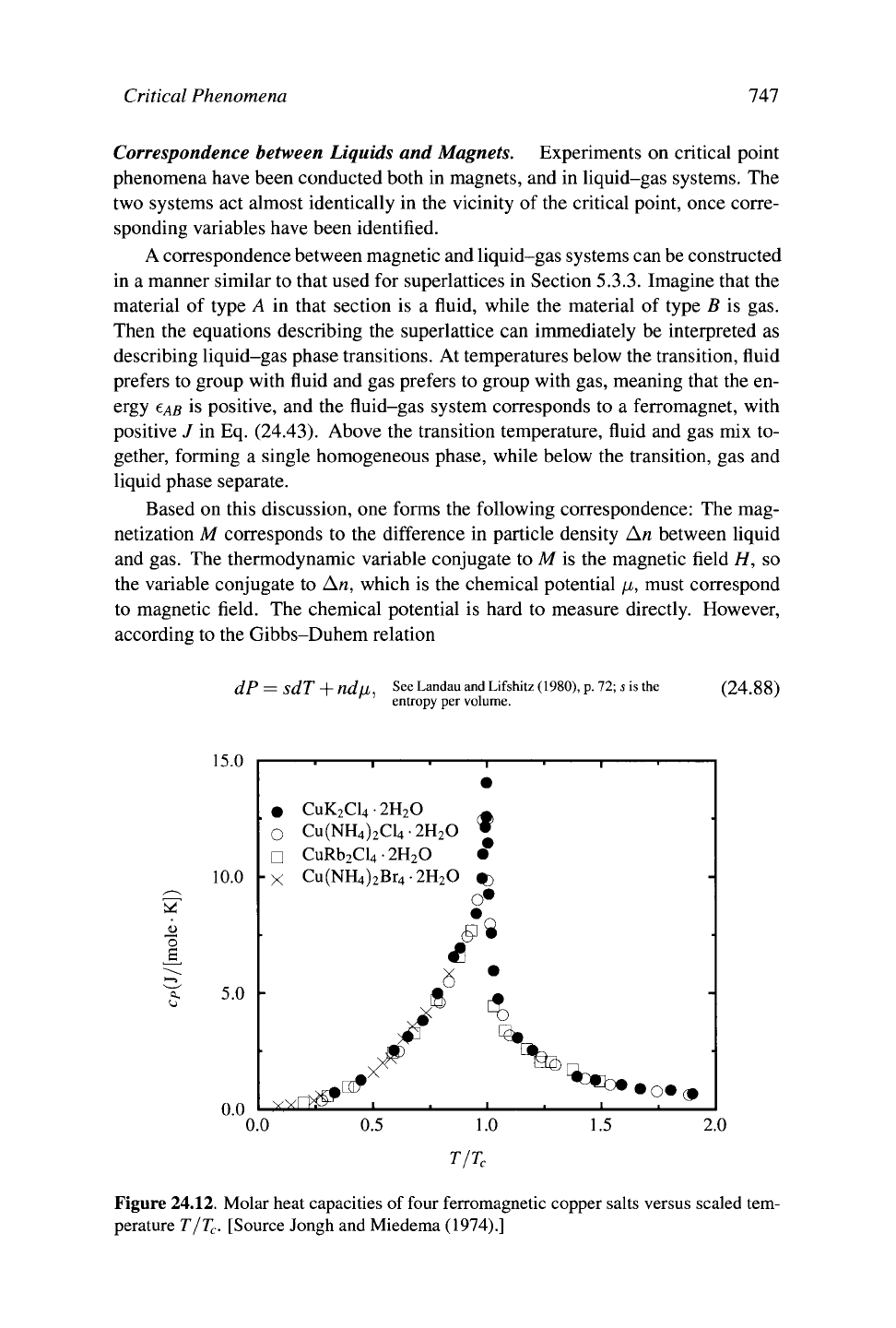
Figure
24.12.
Molar heat capacities of four ferromagnetic copper salts versus scaled tem-
perature T/T
c
. [Source Jongh and Miedema (1974).]
748
Chapter 24. Classical Theories of Magnetism and Ordering
so that
if
temperature is fixed, pressure is proportional to chemical potential, and
pressure can therefore be used instead of chemical potential as the analog of mag-
netic field.
Six exponents are conventionally defined to characterize various quantities that
become singular near the critical point.
Specific Heat—a. The specific heat both in fluids and in magnets diverges as
C
v
(f)
~
\t\~
a
;
(24.89)
data for magnets appear in Figure 24.12. Mean field theory predicts a discontinuity
in the specific heat, not a divergence.
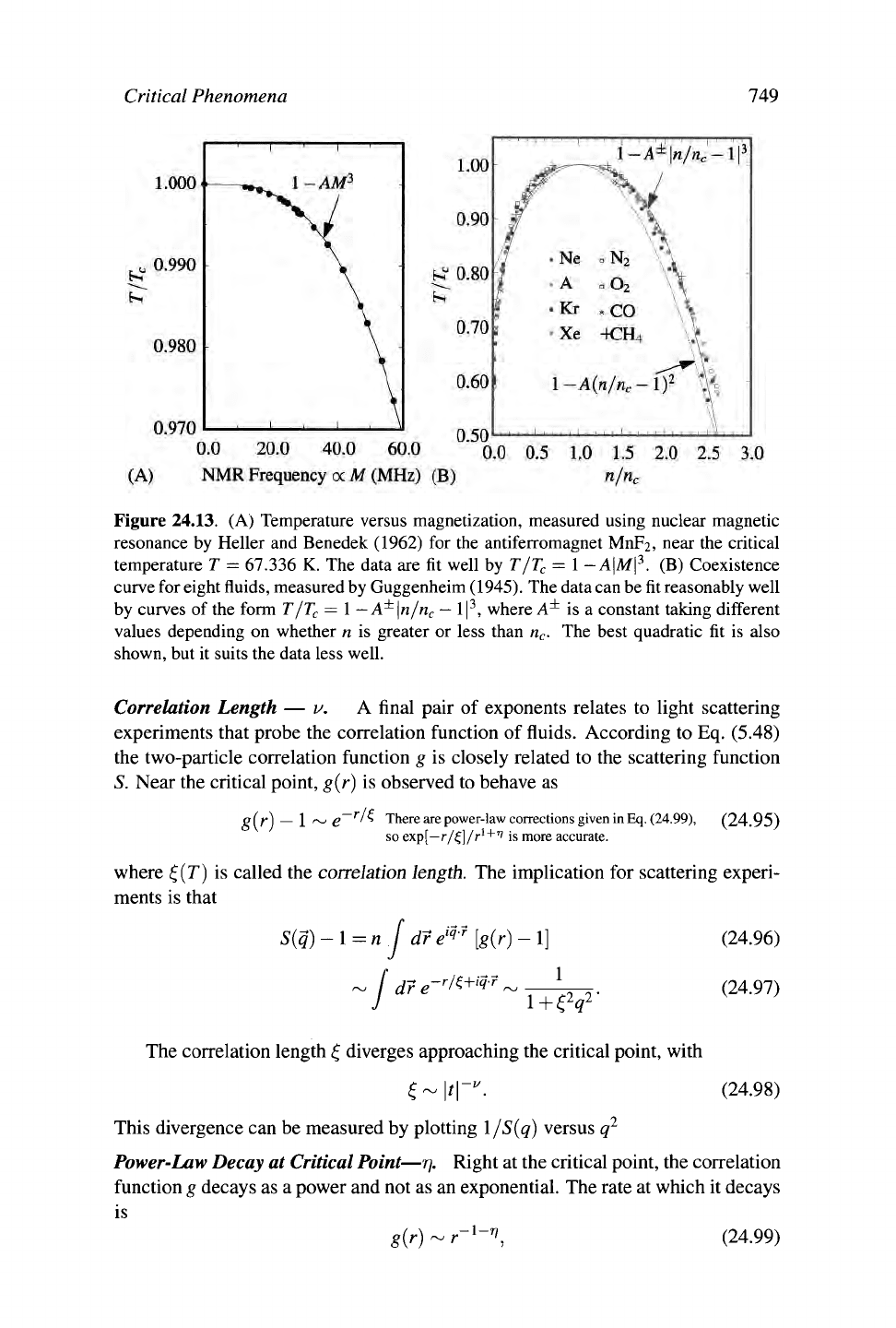
Magnetization and Density—ß. Figure 24.13(A) displays experimental measure-
ments of temperature versus magnetization near the critical point. According to
Eq. (24.79),
T
should approach T
c
as M
2
. The data however show that
T
ap-
proaches T
c
as M
3
. Figure 24.13(B) shows that temperature versus density at con-
stant pressure for a collection of liquid-gas systems is characterized by the same
exponent. So
M~\tf
and
An~\t\
ß
. (24.90)
Letting n
c
be the density at the critical point, one can take An to be «liquid
—
n
c
,
n
c
— «gas> Or H|iq
U
id
«gas-
Compressibility and Susceptibility—7. The isothermal compressibility of fluids
diverges near the critical point:
^ =
1
^~
1
^~l'l"
7
"
(24
-
91)
n aP
n
c
oP
The analogous divergence for a magnet is
dM
ä/7 = x~kr
7
-
(24
-
92)
Mean field theory predicts 7=1, but the measurements find a slightly larger expo-
nent.
Critical Isotherm—8. A next critical exponent occurs by making measurements
right at T
c
on the critical isotherm
P~\ÙM\
S
,
(24.93)
and for a magnet
\M\~\H\
X,S
.
(24.94)
The mean field prediction is 6
=
3, but the measurements find ö
~
5.
Critical Phenomena 749
Figure 24.13. (A) Temperature versus magnetization, measured using nuclear magnetic
resonance by Heller and Benedek (1962) for the antiferromagnet MnF2, near the critical
temperature T = 67.336 K. The data are fit well by T/T
c
=
1
-A|M|
3
. (B) Coexistence
curve for eight fluids, measured
by
Guggenheim
(1945).
The data
can be
fit reasonably well
by curves of the form T/T
c
=
1
—A
±
\n/n
c
— 1|
3
, where
A
1
*
1
is a constant taking different
values depending on whether n is greater or less than n
c
. The best quadratic fit is also
shown, but it suits the data less well.
Correlation Length — v. A final pair of exponents relates to light scattering
experiments that probe the correlation function of fluids. According to Eq. (5.48)
the two-particle correlation function g is closely related to the scattering function
S. Near the critical point, g(r) is observed to behave as
g(r) — 1 ~ e~
r
'^ There are power-law corrections given in Eq. (24.99), (24.95)
so exp[—r/£]/r
i+rl
is more accurate.
where £(T) is called the correlation length. The implication for scattering experi-
ments is that
S(q) -l=nf dr S*
[g{r)
-
1]
(24.96)
~ / dr
e-
r
/t
+i
*
7
~
1
K .
.
(24.97)
The correlation length £ diverges approaching the critical point, with
£~|f|
-,/
.
(24.98)
This divergence can be measured by plotting
l
/S(q) versus q
2
Power-Law Decay at Critical
Point—77.
Right at the critical point, the correlation
function g decays as a power and not as an exponential. The rate at which it decays
is
g(r)~r-
1
"^, (24.99)
750
Chapter 24. Classical Theories of Magnetism
and
Ordering
discontinuity
l
2
1
3
0.11-0.12
0.35-0.37
1.21-1.35
4.0-4.6
0.61-0.64
0.02-0.06
0.110
0.325
1.241
4.82
0.63
0.032
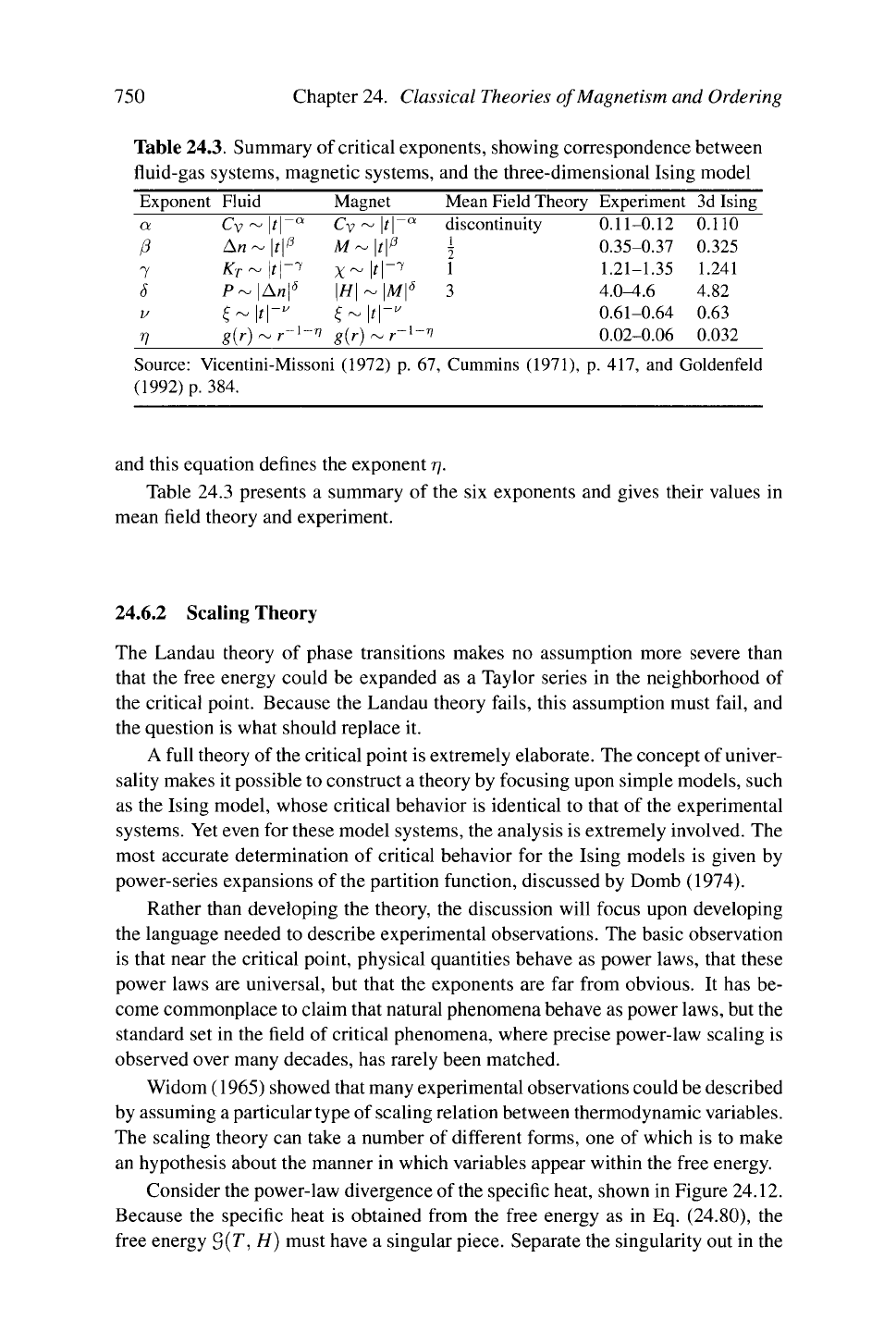
Table 24.3. Summary
of
critical exponents, showing correspondence between
fluid-gas systems, magnetic systems,
and the
three-dimensional Ising model
Exponent Fluid Magnet Mean Field Theory Experiment
3d
Ising
~ä
C
v
~ |/|~
Q
C
v
~ \t\~
c
ß
An~|f|" M~\tf
7
ÄV
~
|f |—'
x~kl
-7
Ö P~\An\
s
\H\~\M\
6
v
Z~W
V
__
Z~\t\~
v
_
V
g{
r
) ~
r
'
v
g(
r
) ~
r
'
Source: Vicentini-Missoni (1972)
p. 67,
Cummins (1971),
p. 417, and
Goldenfeld
(1992) p.
384.
and this equation defines
the
exponent
r\.
Table
24.3
presents
a
summary
of the six
exponents
and
gives their values
in
mean field theory
and
experiment.
24.6.2 Scaling Theory
The Landau theory
of
phase transitions makes
no
assumption more severe than
that
the
free energy could
be
expanded
as a
Taylor series
in the
neighborhood
of
the critical point. Because
the
Landau theory fails, this assumption must fail,
and
the question
is
what should replace
it.
A full theory
of
the
critical point
is
extremely elaborate. The concept
of
univer-
sality makes
it
possible
to
construct
a
theory
by
focusing upon simple models, such
as
the
Ising model, whose critical behavior
is
identical
to
that
of
the experimental
systems. Yet even
for
these model systems,
the
analysis
is
extremely involved.
The
most accurate determination
of
critical behavior
for the
Ising models
is
given
by
power-series expansions
of
the partition function, discussed
by
Domb (1974).
Rather than developing
the
theory,
the
discussion will focus upon developing
the language needed
to
describe experimental observations.
The
basic observation
is that near
the
critical point, physical quantities behave
as
power laws, that these
power laws
are
universal,
but
that
the
exponents
are far
from obvious.
It has be-
come commonplace to claim that natural phenomena behave
as
power laws,
but the
standard
set in the
field
of
critical phenomena, where precise power-law scaling
is
observed over many decades,
has
rarely been matched.
Widom (1965) showed that many experimental observations could be described
by assuming
a
particular type
of
scaling relation between thermodynamic variables.
The scaling theory
can
take
a
number
of
different forms,
one of
which
is to
make
an hypothesis about
the
manner
in
which variables appear within
the
free energy.
Consider the power-law divergence
of
the specific heat, shown
in
Figure 24.12.
Because
the
specific heat
is
obtained from
the
free energy
as in Eq.
(24.80),
the
free energy
5(T, H)
must have
a
singular piece. Separate
the
singularity
out in the
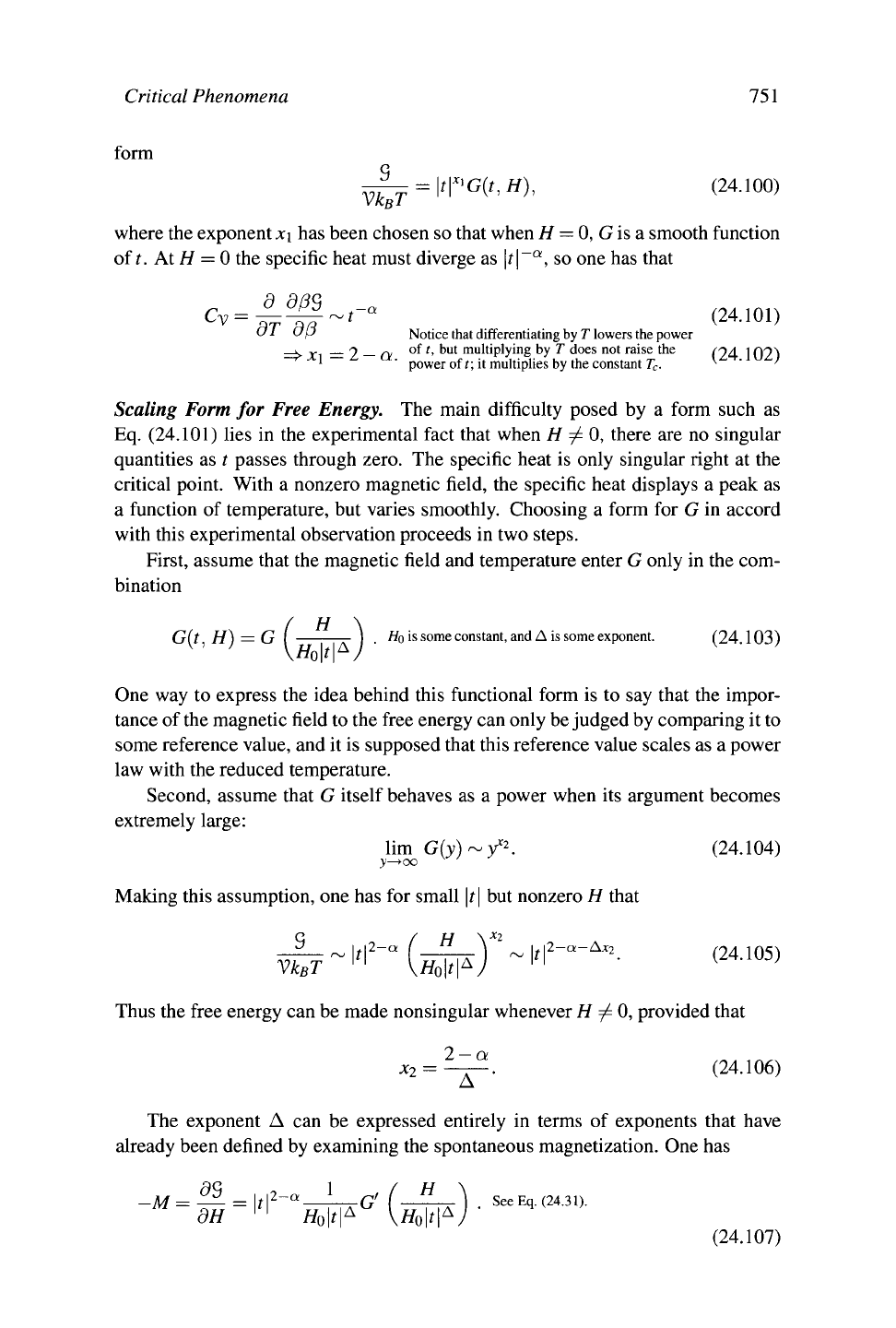
Critical Phenomena 751
form
—3—
=
\t\
x
>G(t,H), (24.100)
Vk
B
T
"
v
'
y
'
v
'
where the exponent
x\
has been chosen
so
that when
H =
0, G is
a
smooth function
of
r.
At // = 0 the
specific heat must diverge
as \t\~
a
, so one
has that
Cv
~~äT~f)R~~
t
(24.101)
ul
U
S
J
Notice that differentiating by
T
lowers the power
_v
y _ 9 _ rv oft, but
multiplying
by T
does
not
raise
the (24 102^
1
'
power
off; it
multiplies
by the
constant T
c
.
^ ' '
Scaling Form
for
Free Energy.
The
main difficulty posed
by a
form such
as
Eq. (24.101) lies
in the
experimental fact that when
H ^ 0,
there
are no
singular
quantities
as t
passes through zero.
The
specific heat
is
only singular right
at the
critical point. With
a
nonzero magnetic field,
the
specific heat displays
a
peak
as
a function
of
temperature,
but
varies smoothly. Choosing
a
form
for G in
accord
with this experimental observation proceeds
in
two steps.
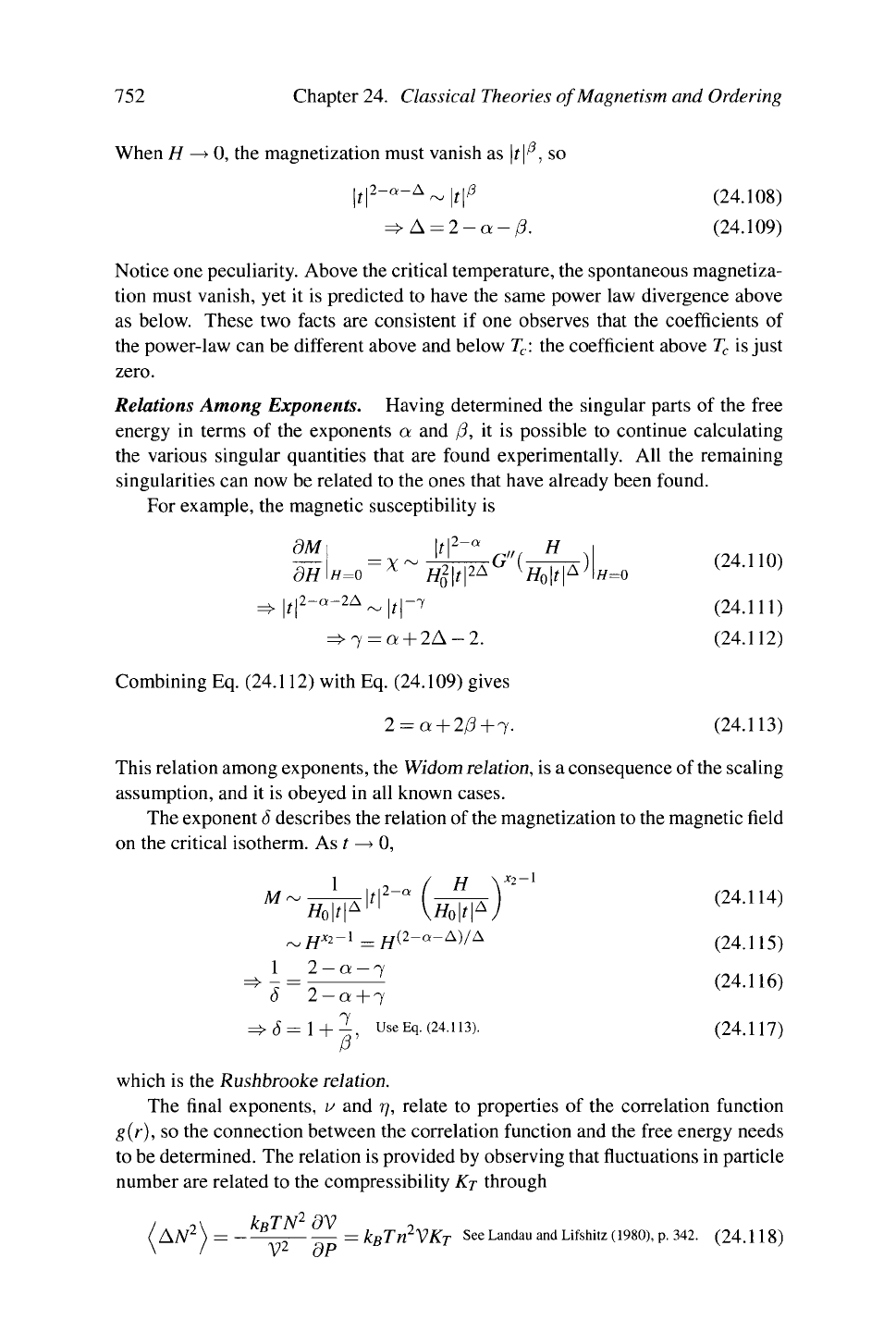
First, assume that
the
magnetic field
and
temperature enter
G
only
in the
com-
bination
G(t H) = G ( I . ^o is
some constant,
and A is
some exponent. (24.103)
One
way to
express
the
idea behind this functional form
is to say
that
the
impor-
tance
of
the magnetic field
to the
free energy can only
be
judged by comparing
it to
some reference value,
and it is
supposed that this reference value scales
as a
power
law with
the
reduced temperature.
Second, assume that
G
itself behaves
as a
power when
its
argument becomes
extremely large:
lim G(v)~/
2
. (24.104)
y—>oo
Making this assumption,
one has for
small \t\
but
nonzero
H
that
A
2
~
a
(T4TKY
2
~ \t\
2
~
a
~
Ax2
-
(24.105)
r^/
Vk
B
T
' '
\H
0
\t\
A
Thus
the
free energy
can be
made nonsingular whenever
H ^ 0,
provided that
x
2
= ^.
(24.106)
The exponent
A can be
expressed entirely
in
terms
of
exponents that have
already been defined
by
examining
the
spontaneous magnetization. One
has
-M= — =
l?|
2
"
Q
G' I I See
Eq. (24.31).
(24.107)
752
Chapter 24. Classical Theories of Magnetism and Ordering
When
H
—>
0, the
magnetization must vanish
as
\t\&,
so
\t\
2
-
a
-
A
~\
t
f
^A
=
2-a-ß.
(24.108)
(24.109)
Notice one peculiarity. Above the critical temperature, the spontaneous magnetiza-
tion must vanish,
yet it is
predicted
to
have
the
same power law divergence above
as below. These
two
facts
are
consistent
if one
observes that
the
coefficients
of
the power-law can
be
different above and below T
c
: the coefficient above T
c
is
just
zero.
Relations Among Exponents. Having determined
the
singular parts
of
the free
energy
in
terms
of the
exponents
a and ß, it is
possible
to
continue calculating
the various singular quantities that
are
found experimentally.
All the
remaining
singularities can now
be
related
to
the ones that have already been found.
For example,
the
magnetic susceptibility
is
dM
dH
\f\2—a
H=O~
X
'
H
2
\t\
2A
?
|2-a-2A_|,|-
7
=>7
= a +
2A-2.
G"(
H
Ho\t\
A
'
H=0
Combining Eq. (24.112) with Eq. (24.109) gives
2
= a +
2/3
+
7.
(24.110)
(24.111)
(24.112)
(24.113)
This relation among exponents, the Widom
relation,
is a consequence
of
the
scaling
assumption, and
it is
obeyed
in all
known cases.
The exponent S describes the relation of the magnetization to the magnetic field
on the critical isotherm. As
t
—>
0,
M
1
2-Q
H
H
0
\t\
Al1
\H
0
\t\
A
~H
X2
~
l
=
//(2-«-A)/A
1
2—a—7
S
=
x
2
-l
^6=1
+
2 —a
+ 7
7
ß'
Use Eq. (24.113).
(24.114)
(24.115)
(24.116)
(24.117)
which
is
the Rushbrooke relation.
The final exponents,
v and
r\, relate
to
properties
of the
correlation function
g(r),
so the
connection between the correlation function and the free energy needs
to be determined. The relation is provided by observing that fluctuations in particle
number are related
to
the compressibility
Kj
through
'AN
2
k
B
TN
2
dV
keTn
2
VKT See Landau and Lifshitz(1980), p. 342. (24.118)