
Marder M.P. Condensed Matter Physics
Подождите немного. Документ загружается.

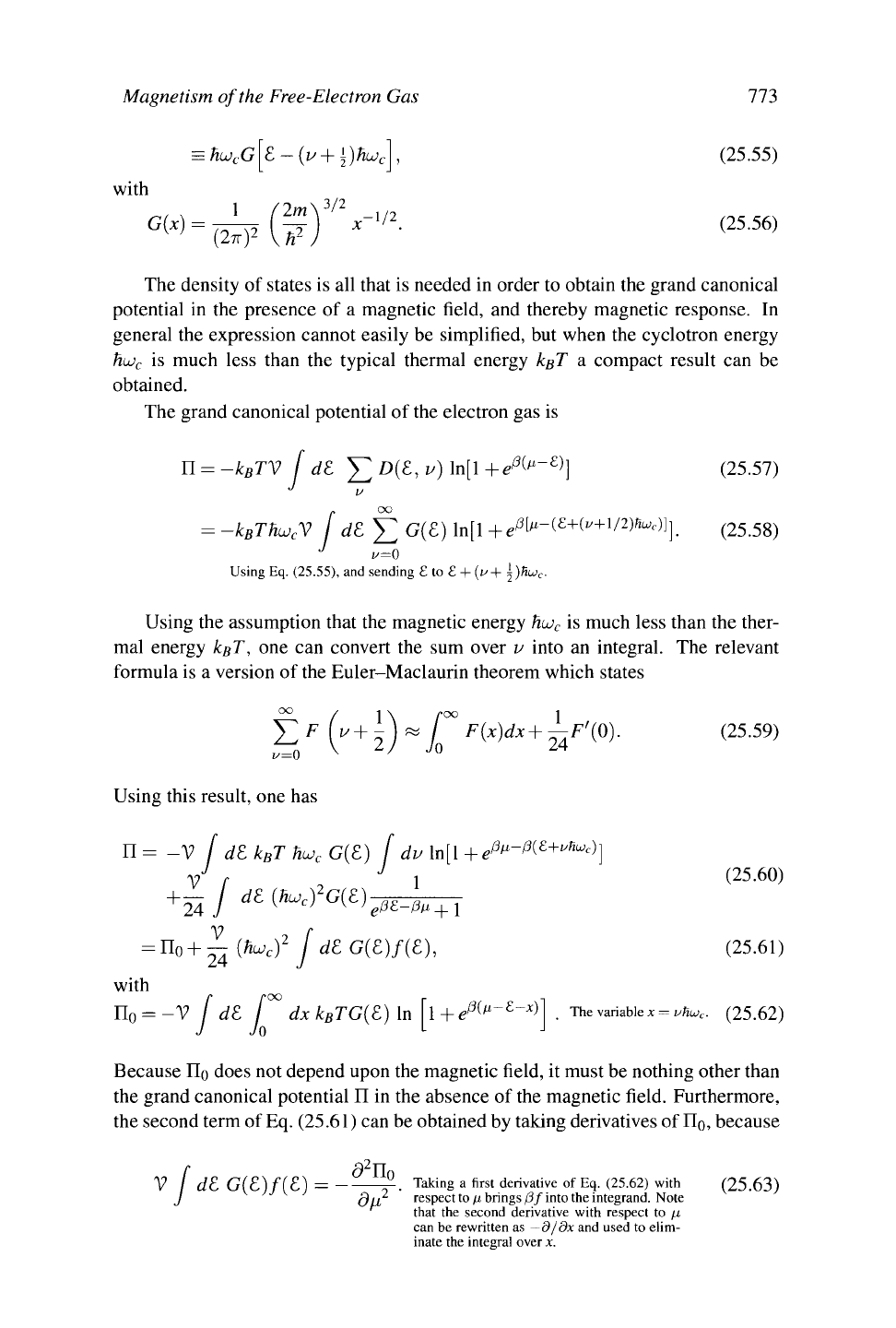
Magnetism of the Free-Electron Gas 773
=
hu
c
G\£ — {v + {)h<jj
c
\.
with
(25.55)
(25.56)
The density of states is all that is needed in order to obtain the grand canonical
potential in the presence of a magnetic field, and thereby magnetic response. In
general the expression cannot easily be simplified, but when the cyclotron energy
hu:
c
is much less than the typical thermal energy k
B
T a compact result can be
obtained.
The grand canonical potential of the electron gas is
n = -k
B
TV ! d£ ^D(£,z/)ln[l+^-
£
)]
/
oo
d£ Yl G(E)ln[l+e
./3[/x-(2+(
I
/+l/2)ßw
r
)]
1
(25.57)
(25.58)
Using
Eq.
(25.55),
and sending £ to £
4-
(v + |)hui
c
Using the assumption that the magnetic energy
HLO
C
is much less than the ther-
mal energy k
B
T, one can convert the sum over v into an integral. The relevant
formula is a version of the Euler-Maclaurin theorem which states
f=0
oo 1
F(x)dx+—F'(0).
0
24
(25.59)
Using this result, one has
n = -V f dl k
B
T hüj
c
G(£) I dv ln[l +e
dl (HLÜ
C
)
2
G{E)
ßß-ß(E.+uhw
c
h
+
V
24
e
ߣ-ßß
+
l
U
0
+
^(hcü
c
)
2
I rf£G(£)/(£),
with
n
0
= -v
dB.
I dxk
B
TG(S.) In
'o
1
_l_
g
^(M-£--ï)
(25.60)
(25.61)
The
variable* = uhw
c
. (25.62)
Because IIo does not depend upon the magnetic field, it must be nothing other than
the grand canonical potential II in the absence of the magnetic field. Furthermore,
the second term of
Eq.
(25.61 )
can be obtained by taking derivatives of
IIo,
because
V f rf£G(£)/(£)
#n
0
Taking
a first derivative of Eq. (25.62) with (25.63)
2
respect
to
ß brings ßf into the
integrand.
Note
that
the second derivative with respect to \a
can
be rewritten as —d/dx and used to elim-
inate
the integral over x.
774 Chapter
25.
Magnetism of Ions and Electrons
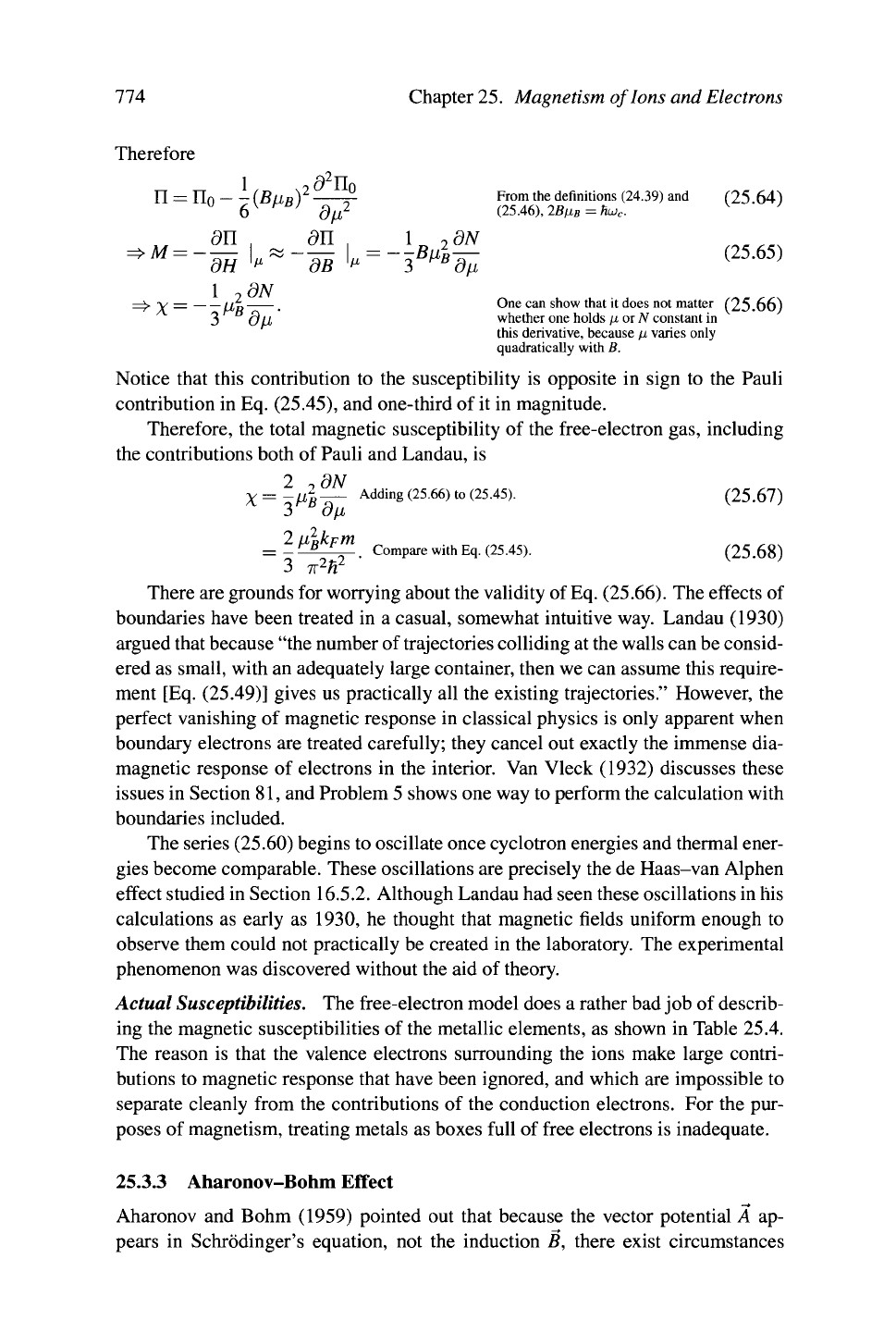
Therefore
Il
= n
0
- -
(Bu
B
)
2
£■
From the definitions (24.39) and (25.64)
6
Ö/x
2
(25.46), 2Bii
B
=fiw
c
.
ön . dU . 1
2
dN
„
erB
^
^
M=
-ëH^-SB^
=
-3
B
>"ir»
(25
'
65)
=>■
y = u
D
.
C"
ne can snow tnat
it does not matter (25.66)
3
Qix
whether one holds
ß
or N constant in
this derivative, because
\x
varies only
quadratically with B.
Notice that this contribution to the susceptibility
is
opposite in sign to the Pauli
contribution in Eq. (25.45), and one-third of it in magnitude.
Therefore, the total magnetic susceptibility of the free-electron gas, including
the contributions both of Pauli and Landau, is
X=-lÂ
Adding (25.66) to (25.45). (25.67)
3
o/i
=
-
ßB F
™
. Compare with Eq. (25.45). (25.68)
3 ir
2
h
2
There are grounds for worrying about the validity of
Eq.
(25.66). The effects of
boundaries have been treated in a casual, somewhat intuitive way. Landau (1930)
argued that because "the number of trajectories colliding at the walls can be consid-
ered as small, with an adequately large container, then we can assume this require-
ment [Eq. (25.49)] gives us practically all the existing trajectories." However, the
perfect vanishing of magnetic response in classical physics is only apparent when
boundary electrons are treated carefully; they cancel out exactly the immense dia-
magnetic response
of
electrons in the interior. Van Vleck (1932) discusses these
issues in Section
81,
and Problem 5 shows one way to perform the calculation with
boundaries included.
The series (25.60) begins to oscillate once cyclotron energies and thermal ener-
gies become comparable. These oscillations are precisely the de Haas-van Alphen
effect studied in Section 16.5.2. Although Landau had seen these oscillations in his
calculations as early as 1930, he thought that magnetic fields uniform enough
to
observe them could not practically be created in the laboratory. The experimental
phenomenon was discovered without the aid of theory.
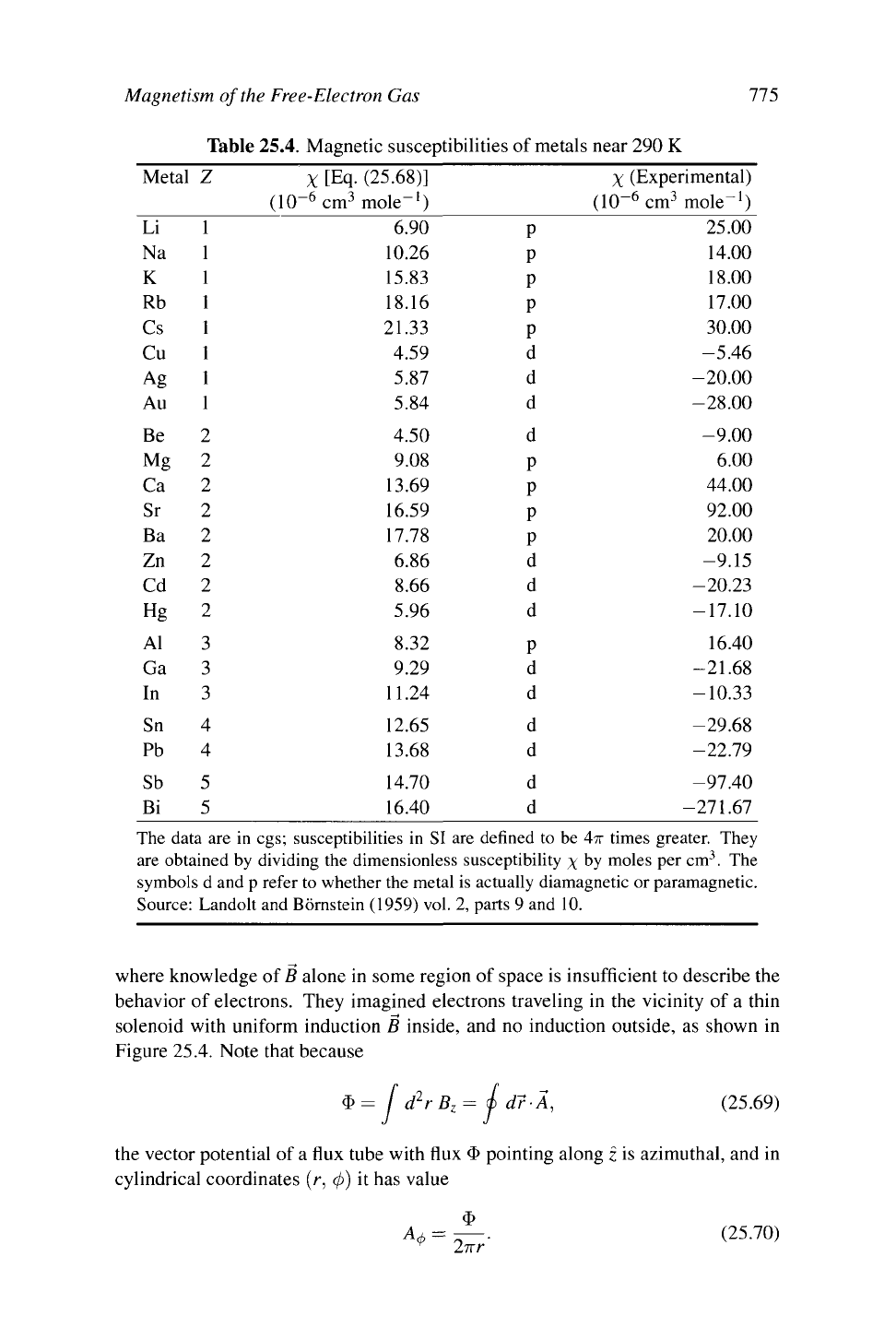
Actual Susceptibilities. The free-electron model does a rather bad job of describ-
ing the magnetic susceptibilities of the metallic elements, as shown in Table 25.4.
The reason
is
that the valence electrons surrounding the ions make large contri-
butions to magnetic response that have been ignored, and which are impossible to
separate cleanly from the contributions of the conduction electrons. For the pur-
poses of magnetism, treating metals as boxes full of free electrons is inadequate.
25.3.3 Aharonov-Bohm Effect
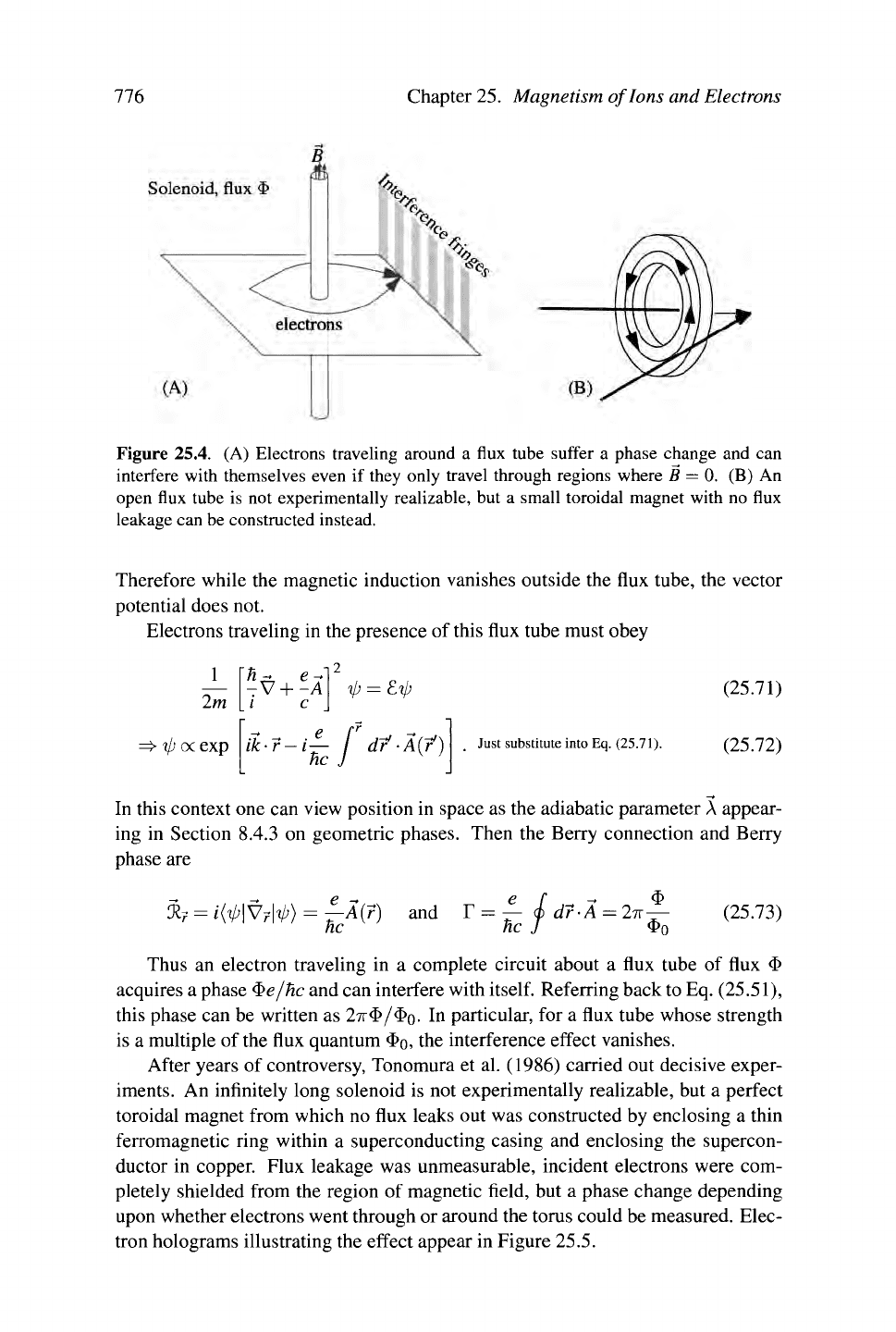
Aharonov and Böhm (1959) pointed out that because the vector potential
A
ap-
pears
in
Schrödinger's equation, not the induction B, there exist circumstances
Magnetism
of
the Free-Electron
Gas
775
Table 25.4. Magnetic susceptibilities
of
metals near
290 K
Metal
Li
Na
K
Rb
Cs
Cu
Ag
Au
Be
Mg
Ca
Sr
Ba
Zn
Cd
Hg
Al
Ga
In
Sn
Pb
Sb
Bi
Z
2
2
2
2
2
2
2
2
3
3
3
4
4
5
5
X [Eq. (25.68)]
(10"
6
cm
3
mole"
1
)
6.90
10.26
15.83
18.16
21.33
4.59
5.87
5.84
4.50
9.08
13.69
16.59
17.78
6.86
8.66
5.96
8.32
9.29
11.24
12.65
13.68
14.70
16.40
P
P
P
P
P
d
d
d
d
P
P
P
P
d
d
d
P
d
d
d
d
d
d
X (Experimental)
(10
-6
cm
3
mole
-1
)
25.00
14.00
18.00
17.00
30.00
-5.46
-20.00
-28.00
-9.00
6.00
44.00
92.00
20.00
-9.15
-20.23
-17.10
16.40
-21.68
-10.33
-29.68
-22.79
-97.40
-271.67
The data
are in
cgs; susceptibilities
in SI are
denned
to be
4TT
times greater. They
are obtained
by
dividing
the
dimensionless susceptibility
\ by
moles
per
cm
3
.
The
symbols
d and p
refer
to
whether the metal
is
actually diamagnetic
or
paramagnetic.
Source: Landolt and Börnstein (1959) vol.
2,
parts
9 and 10.
where knowledge
of B
alone
in
some region
of
space
is
insufficient
to
describe
the
behavior
of
electrons. They imagined electrons traveling
in the
vicinity
of a
thin
solenoid with uniform induction
B
inside,
and no
induction outside,
as
shown
in
Figure 25.4. Note that because
$
d
l
rB
z
=
é dr-A,
(25.69)
the vector potential
of a
flux tube with flux
$
pointing along
z is
azimuthal,
and in
cylindrical coordinates
(r,
(j>)
it has
value
2-7rr
(25.70)
776
Chapter 25. Magnetism of Ions and Electrons
Figure 25.4. (A) Electrons traveling around a flux tube suffer a phase change and can
interfere with themselves even if they only travel through regions where 5 = 0. (B) An
open flux tube is not experimentally realizable, but a small toroidal magnet with no flux
leakage can be constructed instead.
Therefore while the magnetic induction vanishes outside the flux tube, the vector
potential does not.
Electrons traveling in the presence of this flux tube must obey
1
2m
-ip
cxexp
-V + -A
i c
ik-7— i
he
T
dr'-AÇr
Just substitute into Eq. (25.71).
(25.71)
(25.72)
In this context one can view position in space as the adiabatic parameter
A
appear-
ing in Section 8.4.3 on geometric phases. Then the Berry connection and Berry
phase are
Jvp
:
|V,|'
h
À
^
and T
He J
dr-A =
2-K
(25.73)
Thus an electron traveling in a complete circuit about a flux tube of flux $
acquires a phase $e/hc and can interfere with
itself.
Referring back to Eq. (25.51),
this phase can be written as 27r$/$o- In particular, for a flux tube whose strength
is a multiple of the flux quantum
<J?o>
the interference effect vanishes.
After years of controversy, Tonomura et al. (1986) carried out decisive exper-
iments. An infinitely long solenoid is not experimentally realizable, but a perfect
toroidal magnet from which no flux leaks out was constructed by enclosing a thin
ferromagnetic ring within a superconducting casing and enclosing the supercon-
ductor in copper. Flux leakage was unmeasurable, incident electrons were com-
pletely shielded from the region of magnetic field, but a phase change depending
upon whether electrons went through or around the torus could be measured. Elec-
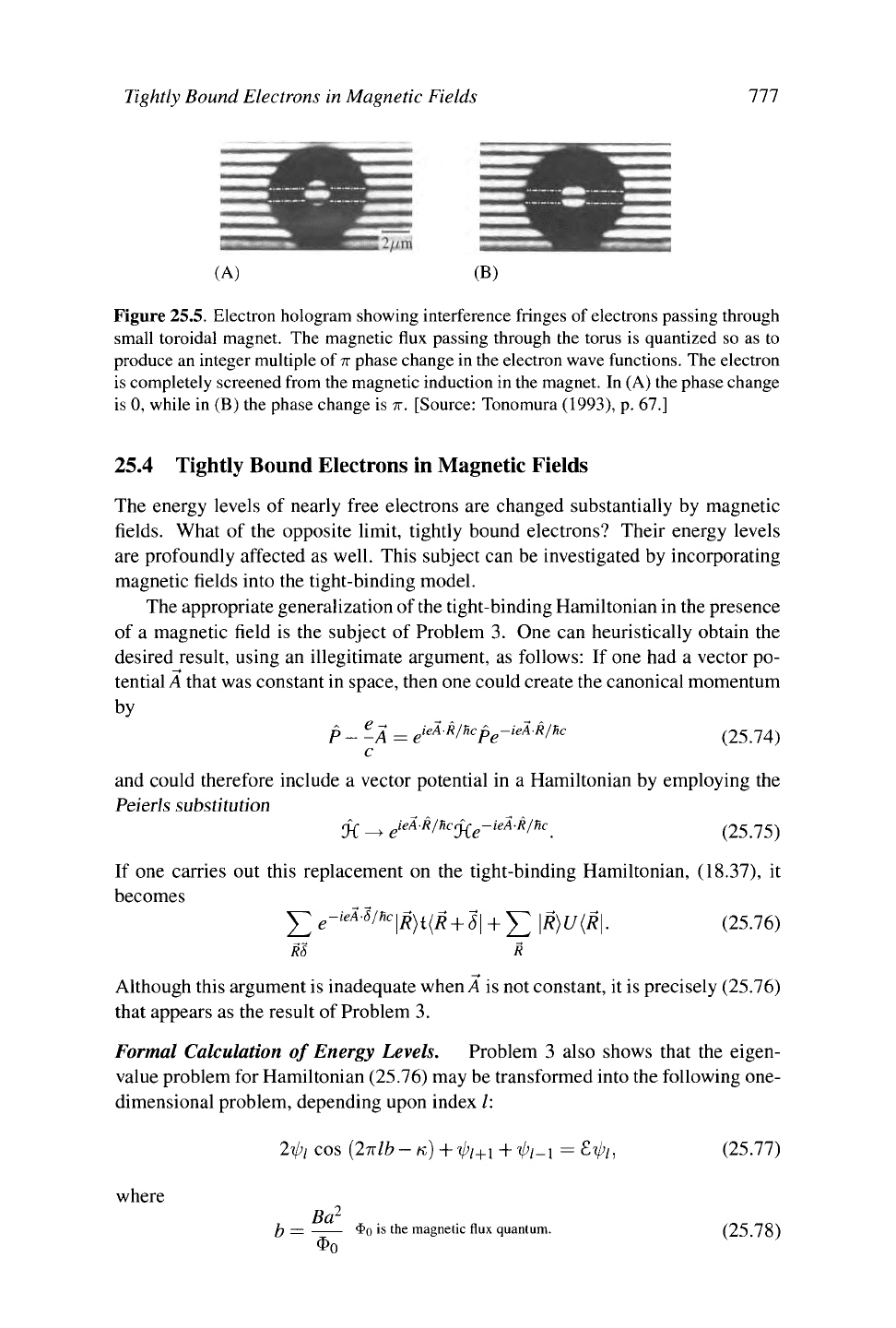
tron holograms illustrating the effect appear in Figure 25.5.
Tightly Bound Electrons in Magnetic Fields
111
(A) (B)
Figure 25.5. Electron hologram showing interference fringes of electrons passing through
small toroidal magnet. The magnetic flux passing through the torus is quantized so as to
produce an integer multiple of
-K
phase change in the electron wave functions. The electron
is completely screened from the magnetic induction in the magnet. In (A) the phase change
is 0, while in (B) the phase change is n. [Source: Tonomura (1993), p. 67.]
25.4 Tightly Bound Electrons in Magnetic Fields
The energy levels of nearly free electrons are changed substantially by magnetic
fields.
What of the opposite limit, tightly bound electrons? Their energy levels
are profoundly affected as well. This subject can be investigated by incorporating
magnetic fields into the tight-binding model.
The appropriate generalization of the tight-binding Hamiltonian in the presence
of a magnetic field is the subject of Problem 3. One can heuristically obtain the
desired result, using an illegitimate argument, as follows: If one had a vector po-
tential A that was constant in space, then one could create the canonical momentum
by
P--Â
=
e
M-R/ncp
e
-ieÂ-R/nc (25.74)
c
and could therefore include a vector potential in a Hamiltonian by employing the
Peierls substitution
<}i _>
e
ieÂ-R/hcçx
e
-ieÂ-R/Hc^
(25.75)
If one carries out this replacement on the tight-binding Hamiltonian, (18.37), it
becomes
Y, e-
ieÂrs/Hc
\R)t{R +
ô\
+ Yl
\R)
U
(*\-
(
25
-
76
)
RS R
Although this argument is inadequate when A is not constant, it is precisely (25.76)
that appears as the result of Problem 3.
Formal Calculation of Energy Levels. Problem 3 also shows that the eigen-
value problem for Hamiltonian (25.76) may be transformed into the following one-
dimensional problem, depending upon index /:
2^;
cos (2irlb-K) + ilJi
+
i+ipi-i = £?/>/, (25.77)
where
Ba
2
\j = $0 is the magnetic flux quantum. (25.78)
<£>0
778
Chapter 25. Magnetism of Ions and Electrons
and
/ç
= ak
x
. k
x
is a Bloch wave-vector; the energy eigen- (25.79)
values will be indexed by
K.
Suppose that b
= p/q
is rational. Then Bloch's theorem implies that the energy
levels should split into q bands, because the potential in Eq. (25.81) is periodic with
period q. The reason is that, according to Bloch's theorem,
^+4
= ^/.
(25.80)
Thus only
q
of the coefficients
ipi
in Eq. (25.77) are independent, and Eq. (25.77)
is therefore
a q x q
matrix equation with
q
energy bands depending upon k. This
result is peculiar, because changing the magnetic induction from
b
— 1
/2
to b =
5001/10000 changes the number
of
bands from
2 to
10000. Nevertheless,
it is
correct.
To proceed
in
calculating these energy bands, rewrite Eq. (25.80)
in
transfer
matrix form:
/^/
+1
\
=
/£-2cos(27r7&-K) -1W V/
W/
) v i o ; U/-i
(25.81)
From Bloch's theorem,
w
::Ht'HM::)
with
£-2COS(27T/£-K)
-1
Q=n(
!
"o
)
(25
-
83)
= 0. (25.84)
=»DetQ(£, K)-e
iqk
Q is only a 2
x
2 matrix, and multiplying out Eq. (25.84) gives
Det{Q(£,K)}
+
e
2
^-Tr{Q(£,K)}^
=
0. (25.85)
Because Q(£, K) is the product of matrices of determinant 1, it has determinant
1
as well, from which follows that
Tr{Q(£,
K)}
=
2COS^, (25.86)
for any given value of
n.
Consider Tr {Q(£, K)} as a function of
K.
If one replaces
K
by
K!
=
K
+
2-ir/q,
then
Tr{Q(£,K)}
=
Tr{Q(£,
K
')} (25.87)
because from Eq. (25.83) one sees that Q(£,
K
+ 2ir/q) is built from
a
product of
exactly the same matrices that make up Q(£, K), although in
a
different order, but
the trace is invariant under cyclic permutation. Thus
oo
Tr{Q(£,
K)}= Y,
F
'
eiqKl
-
(
25
-
88
)
Tightly Bound Electrons in Magnetic Fields 779
On the other hand the highest Fourier component e'
K
that can appear in Q is
e
iqK
,
by inspecting Eq. (25.83). So
Tr{Q(£,K)} = F
0
(ß) + Fi(E)e
u
'
K
+ F
l
*(E)e-
iqK
(25.89)
By inspection of Eq. (25.83) one can pick out the terms which involve maximal
powers of e'
K
. These are contained in
IK'
J(2nlb—K)
+
e
-i(2ixlb—K)
(25.90)
and can be seen to give
<?
—2-ïïilb
F,(£)=(-i)*n«"
i=i
\q -2nbiq(q+\)/2
(-l)V
(25.91)
(25.92)
In order to find Fo, observe that if one can find a value
KQ
such that the terms
involving
F\
vanish, then
Fo(£)=Tr{Q(£,K
0
)}.
(25.93)
From Eqs. (25.92) and (25.89) one finds that the sum of terms depending upon
K
is
(-l)
?
2cos [2vrè (q
2
+ q) /2-qn] . (25.94)
Because the argument of the cosine can be rewritten
np(q+
1
)—<?«,
the cosine can be made to vanish by choosing
7T
KQ
2q
(25.95)
(25.96)
Thus it follows from Eq. (25.86) that
Tr {Q(£,
K)}
= 2 cos qk = Tr {Q(£, 7r/2g)} + 2 cos irb(q
2
+
q)
+
irq — qK
.
(25.97)
Because k and
K
can be varied freely, £ is an allowed eigenvalue so long as
Tr {Q(£, n/2q)}
<4.
(25.98)
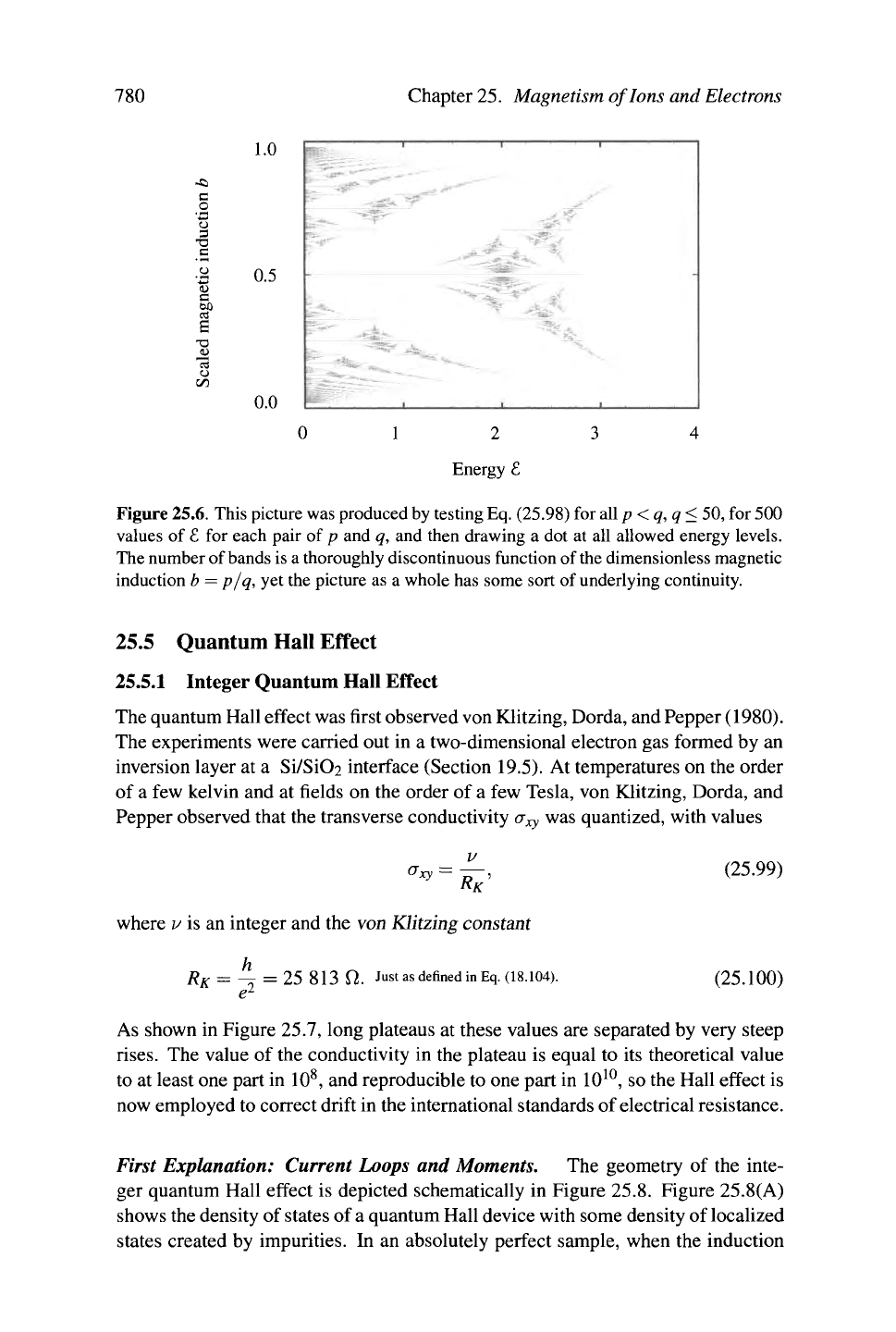
The spectrum of allowed energy levels predicted by Eq. (25.98) was first cal-
culated by Hof stadter
( 1976)
and appears in Figure 25.6. Minute changes in B pro-
duce great changes in the effective periodicity of the electron problem and cause
rapid changes in the number of distinct energy bands.
780
Chapter
25.
Magnetism of Ions and Electrons
1.0
e
o
o
3
-a
c
o
G
60
S
-o
S
o
t/3
0.5
0.0
Energy £
Figure
25.6.
This picture
was
produced
by
testing
Eq.
(25.98) for all p<
q,
q
<
50,
for 500
values of £ for each pair of p and q, and then drawing a dot at all allowed energy levels.
The
number of bands is
a
thoroughly discontinuous function of the dimensionless magnetic
induction b = p/q, yet the picture as a whole has some sort of underlying continuity.
25.5 Quantum Hall Effect
25.5.1 Integer Quantum Hall Effect
The quantum Hall effect was first observed von Klitzing, Dorda, and Pepper (1980).
The experiments were carried out in a two-dimensional electron gas formed by an
inversion layer at a Si/SiC<2 interface (Section 19.5). At temperatures on the order
of a few kelvin and at fields on the order of a few Tesla, von Klitzing, Dorda, and
Pepper observed that the transverse conductivity a^ was quantized, with values
Gxy =
RK
where v is an integer and the von Klitzing constant
h
RK
= 25 813 ft. Just
as
defined in
Eq.
(18.104).
(25.99)
(25.100)
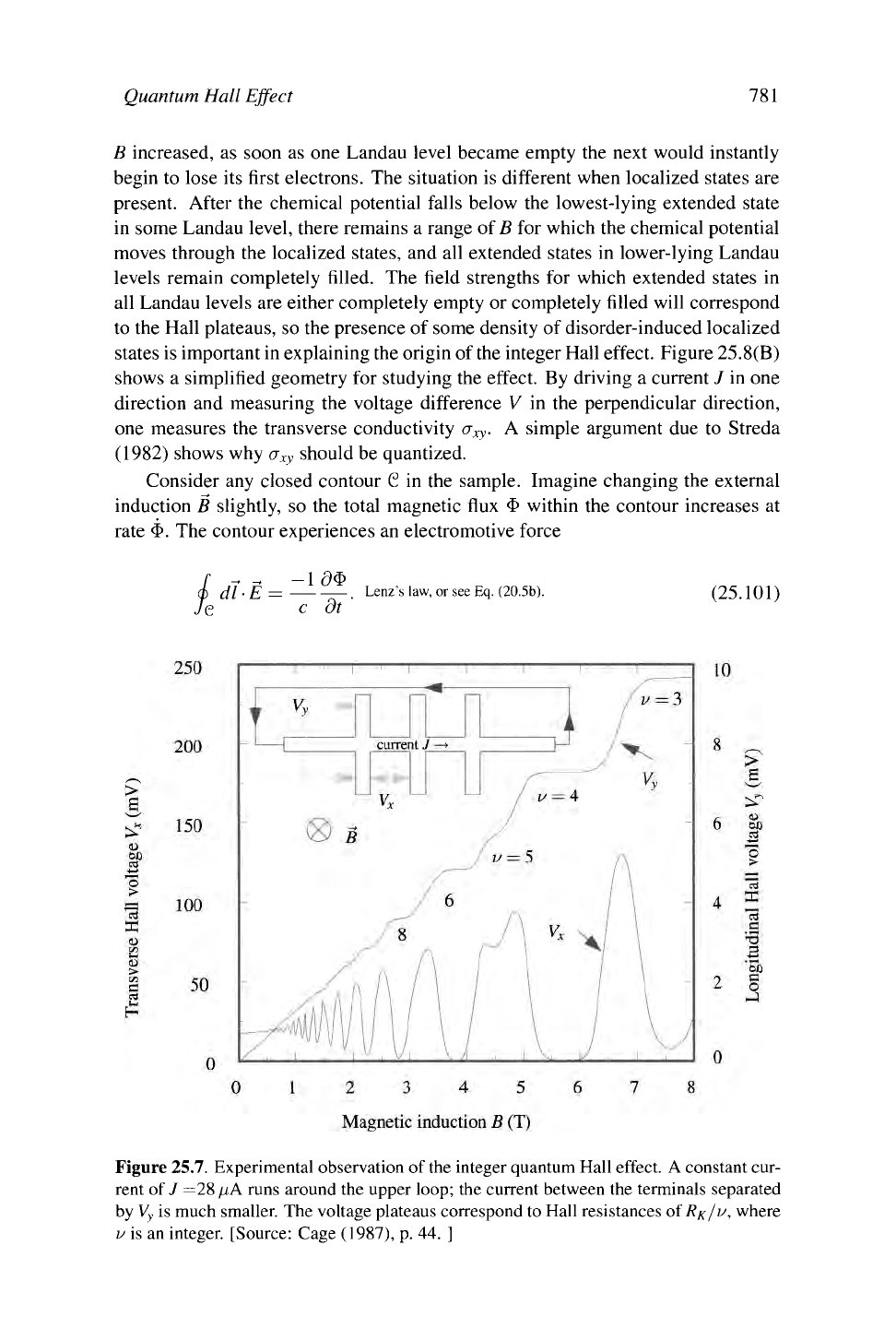
As shown in Figure 25.7, long plateaus at these values are separated by very steep
rises.
The value of the conductivity in the plateau is equal to its theoretical value
to at least one part in 10
8
, and reproducible to one part in 10
10
, so the Hall effect is
now employed to correct drift in the international standards of electrical resistance.
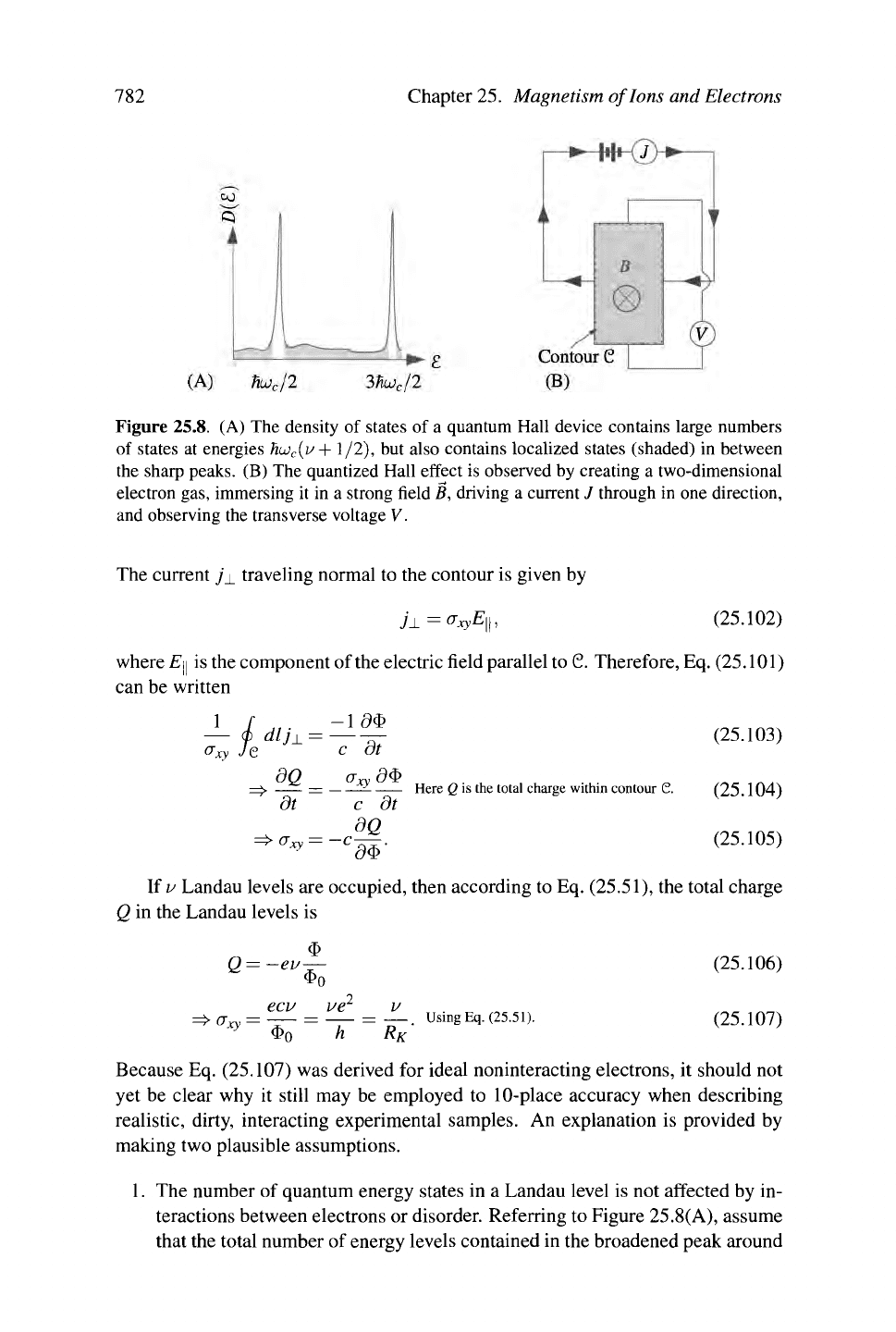
First Explanation: Current Loops and Moments. The geometry of the inte-
ger quantum Hall effect is depicted schematically in Figure 25.8. Figure 25.8(A)
shows the density of states of a quantum Hall device with some density of localized
states created by impurities. In an absolutely perfect sample, when the induction
Quantum Hall Effect
781
B increased, as soon as one Landau level became empty the next would instantly
begin to lose its first electrons. The situation is different when localized states are
present. After the chemical potential falls below the lowest-lying extended state
in some Landau level, there remains a range of B for which the chemical potential
moves through the localized states, and all extended states in lower-lying Landau
levels remain completely filled. The field strengths for which extended states in
all Landau levels are either completely empty or completely filled will correspond
to the Hall plateaus, so the presence of some density of disorder-induced localized
states is important in explaining the origin of
the
integer Hall effect. Figure 25.8(B)
shows a simplified geometry for studying the effect. By driving a current / in one
direction and measuring the voltage difference V in the perpendicular direction,
one measures the transverse conductivity a^. A simple argument due to Streda
(1982) shows why a
xy
should be quantized.
Consider any closed contour C in the sample. Imagine changing the external
induction B slightly, so the total magnetic flux
<£>
within the contour increases at
rate
<i>.
The contour experiences an electromotive force
- - -19$
dl-E= . Lenz's law, or see Eq. (20.5b). (25.101)
e c dt
Figure 25.7. Experimental observation of
the
integer quantum Hall effect.
A
constant cur-
rent of
7
=28/iA runs around the upper loop; the current between the terminals separated
by
V
y
is much smaller. The voltage plateaus correspond to Hall resistances of
RK/V,
where
v is an integer. [Source: Cage (1987), p. 44. ]
782
Chapter 25. Magnetism of Ions and Electrons
Figure 25.8. (A) The density of states of a quantum Hall device contains large numbers
of states at energies hu
c
(v+ 1/2), but also contains localized states (shaded) in between
the sharp peaks. (B) The quantized Hall effect is observed by creating a two-dimensional
electron gas, immersing it in a strong
field
B, driving a current J through in one direction,
and observing the transverse voltage V.
The current
j±
traveling normal to the contour is given by
j
±
=
a
xy
E
ll
,
(25.102)
where
E\\
is the component of the electric field parallel to
C.
Therefore, Eq. (25.101)
can be written
r
_
1
f)<f>
(25.103)
Here
Q
is the total charge within contour 6.
(25.104)
(25.105)
If
v
Landau levels are occupied, then according to Eq. (25.51), the total charge
Q in the Landau levels
is
ß = _eiJL (25.106)
q>o
ecu
ve v
^a
xy
= = = .
Using Eq. (25.51). (25.107)
$o
h R
K
Because Eq. (25.107) was derived for ideal noninteracting electrons,
it
should not
yet be clear why
it
still may
be
employed
to
10-place accuracy when describing
realistic, dirty, interacting experimental samples. An explanation
is
provided by
making two plausible assumptions.
1.
The number of quantum energy states in
a
Landau level is not affected by in-
teractions between electrons or disorder. Referring to Figure 25.8(A), assume
that the total number of energy levels contained in the broadened peak around
—
f
dlj±
=
Vxy Je
dQ
dt
=>•
Pxy
=
-10$
~c~~dt
Vxyd®
c
dt
dQ
c
d$'