
Marder M.P. Condensed Matter Physics
Подождите немного. Документ загружается.

Quantum Hall Effect
783
hu}
c
/2 remains <&/<£>o even after impurities and electron-electron interactions
are considered. The large energy gap between the first and second Landau
levels makes this assumption increasingly plausible as the induction strength
B increases.
2.
Assume that the densities of localized states constituting the shaded regions
in Figure 25.8(A) are rigid and do not change as B changes.
As B increases, the total number of states in the Landau level increases in propor-
tion. If the numbers of localized states in the tail of the Landau level do not change,
virtually all of the increase occurs through a rise in the number of extended states
at the center of the level. So long as \i lies within the region of localized states,
changes in the total number of charges N contained in the current loop must con-
tinue to be given by Eq. (25.51). The accuracy with which the Hall conductivity
is quantized depends upon the accuracy with which the two assumptions about
energy levels are obeyed; experimentally, the accuracy is at the level of parts per
billion.
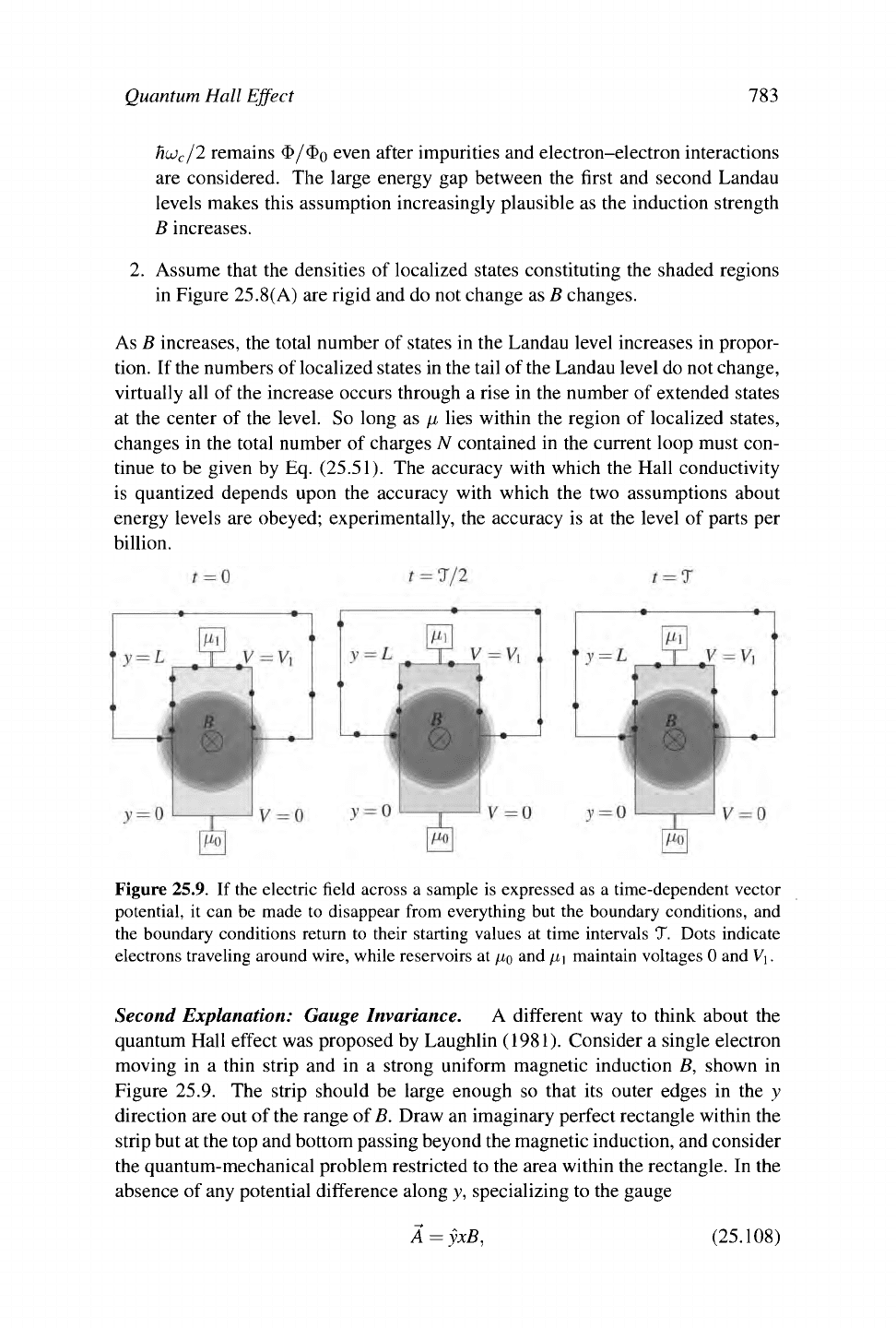
Figure 25.9. If the electric field across a sample is expressed as a time-dependent vector
potential, it can be made to disappear from everything but the boundary conditions, and
the boundary conditions return to their starting values at time intervals T. Dots indicate
electrons traveling around wire, while reservoirs at
/ÂQ
and ß\ maintain voltages 0 and V\.
Second Explanation: Gauge Invariance. A different way to think about the
quantum Hall effect was proposed by Laughlin (1981). Consider a single electron
moving in a thin strip and in a strong uniform magnetic induction B, shown in
Figure 25.9. The strip should be large enough so that its outer edges in the y
direction are out of the range of B. Draw an imaginary perfect rectangle within the
strip but at the top and bottom passing beyond the magnetic induction, and consider
the quantum-mechanical problem restricted to the area within the rectangle. In the
absence of any potential difference along y, specializing to the gauge
A=yxB,
(25.108)
784 Chapter
25.
Magnetism of Ions and Electrons
Schrödinger's equation is
-h
2
d
2
1 (h d exB\
2
._
0
-2nT^
+
2
m
{l¥y
+
-)
+U
^~
E
U(r)
is a potential that
lb
(7) = 0 includes effects of the
*■
' ' crystal, and impurities.
(25.109)
Now introduce a slight complication that for the moment will seem artificial. There
is some boundary condition that must be imposed when solving the Schrödinger
equation; whatever it may be, it can be indicated as a linear condition
E[^(JC,L)]=0, (25.110)
where
23
is some operator that gives the boundary conditions. Now define t/>
7
(?) to
be eigenfunctions of the equation such that
£[V>
7
(;c, L)e
h
}=0. (25.111)
These eigenfunctions can certainly be found for any applied field and any 7, al-
though it is not clear why one should care.
Now put an electric field E(r) onto the sample, and assume it points only in the
y direction. This field is not just the applied field, but could also include the field
generated by Coulomb charges within the strip. Employ the method of Section
16.3,
which derives electron fields from time-dependent vector potentials, as in
Eq. (16.30). The Hamiltonian becomes
-h
2
d
2
1 fh d exB
1 (H
0
exB
^
, - V rr,^
o
2m dx 2m \ i dy
V>(r) = 0. (25.112)
Because
of the explicit time dependence in the vector potential, this equation
does
not follow from the time-dependent Schrödinger
equation.
However, as in
Section
16.3,
the errors introduced in this way are exponentially small.
The electric field can be eliminated formally from the problem by writing
iP
=
e
ieV
'/
R
4>,
(25.113)
where V is the electric potential defined by
£ = -W. (25.114)
Because near y = 0 (the bottom of the rectangle)
and
y = L (the top of
the
rectangle)
there is no magnetic field and the strip is metallic, the voltage is constant in space to
high accuracy. In particular, the electric potential at the top of the strip, V(L)
—
V\
is independent of
x.
The function
ip
therefore obeys precisely the same equation as
ij)
in the absence of a field, but it obeys boundary condition
r
B[e-
ietVl/n
4>(x,L)} = 0. (25.115)
In other words, ip is of the form indicated in Eq. (25.111) with
7 = -^. (25.116)
n
Quantum Hall Effect 785
Now consider what happens when
eVit
~h~
This condition occurs after a time
2vr. (25.117)
T=-£-. (25.118)
The boundary condition has returned to its value at t = 0, so all the single-particle
states
ip
are the same as the states
tp.
The occupation of the states might be differ-
ent. That is, as time progresses from 0 to T, each state / must evolve until finally
at time 7 it turns into some other state /'. All the quantum states at t = 7 must
be identical to those at t = 0, but they are not necessarily occupied in the same
way. In fact, if some Landau level is incompletely filled, the occupation of states
should be expected to change. However, if the Fermi level lies within the region of
localized states between Landau levels, the occupation of states at t = T must be
precisely what it was at t = 0. First consider the localized states. They are trapped
in potential wells, with wave functions that are exponentially small at the system
boundaries, so as the boundary condition indicated by Eq. (25.116) changes, they
change exponentially little. Next consider the extended states within a filled Lan-
dau level. All of these states are occupied at t = 0, and when t arrives at T they
must all remain occupied.
In short, one can be quite sure that the system at t = 7
is
indistinguishable from
the system at t = 0. Because the voltage at top and bottom is imposed without
allowing current to flow along y, the most that could have happened is that an
integer number v of electrons was transported through the sample in the x direction,
as indicated in Figure 25.9. The current that has passed through the system is
therefore
J
x
= -= = —r
1
, (25.119)
T h
which means that the conductance is
2
e
v
<7
xy
= v— = —. (25.120)
25.5.2 Fractional Quantum Hall Effect
The integer quantum Hall effect depends crucially upon the presence of disorder,
which allows the Fermi level to lie in a gap between extended states and thereby
produces plateaus in the transverse conductivity. Tsui et al. (1982) created two-
dimensional electron gases in GaAs-AlGaAs with electron mobilities [Eq. (19.65)]
on the order of
5 •
10
5
cm
2
V
-1
s
_1
, 100 times larger than the mobilities in samples
where the integer Hall effect was observed. The importance of impurities was
786
Chapter
25.
Magnetism of Ions and Electrons
100
75
50 -
« 25
2 10
«2
50 100
Induction ß (kG)
200
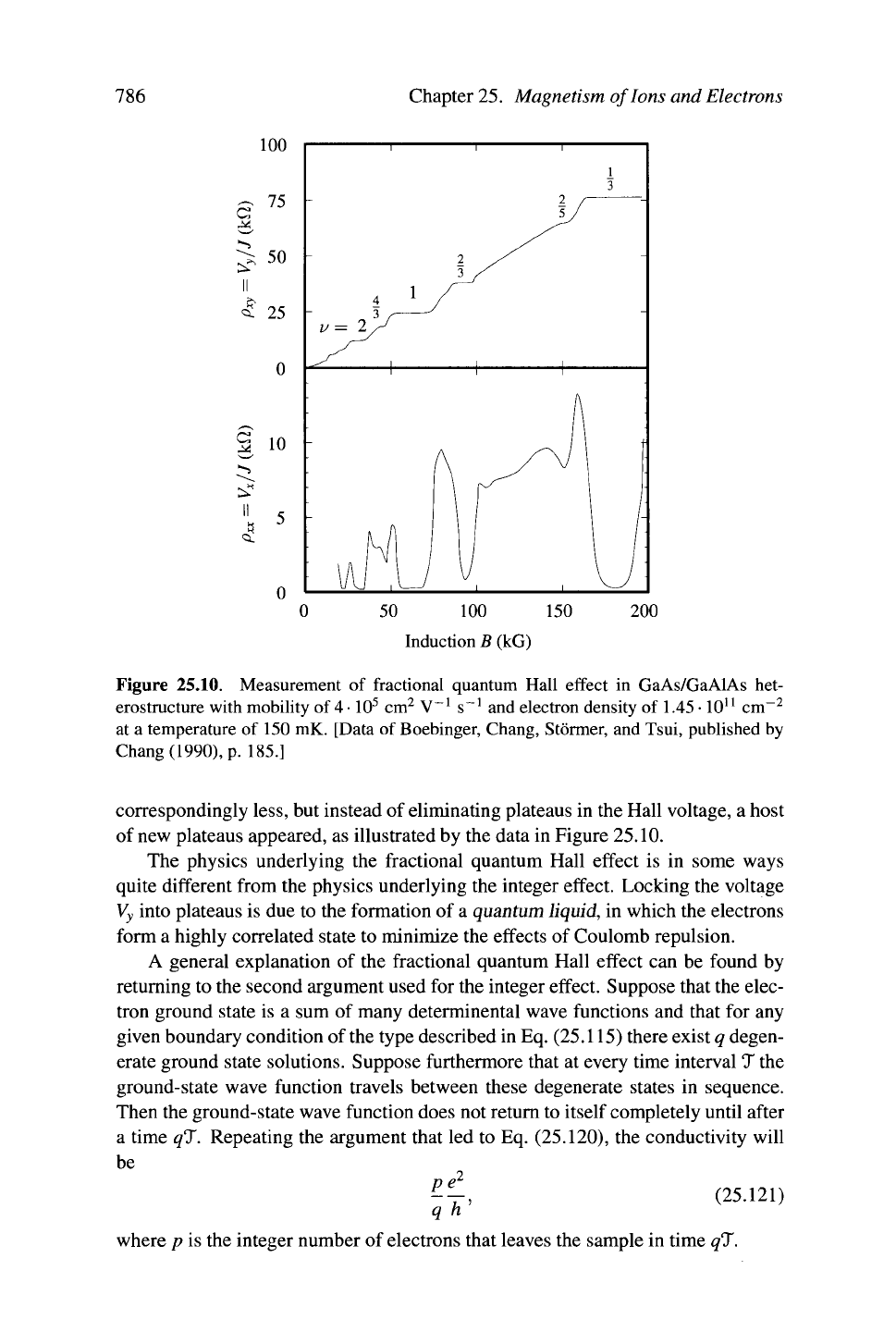
Figure 25.10. Measurement of fractional quantum Hall effect in GaAs/GaAlAs het-
erostructure with mobility of 4-10
5
cm
2
V"
1
s~' and electron density of
1.45-10
11
cm
-2
at a temperature of 150 mK. [Data of Boebinger, Chang, Stornier, and Tsui, published by
Chang (1990),
p.
185.]
correspondingly less, but instead of eliminating plateaus in the Hall voltage, a host
of new plateaus appeared, as illustrated by the data in Figure 25.10.
The physics underlying the fractional quantum Hall effect is in some ways
quite different from the physics underlying the integer effect. Locking the voltage
V
y
into plateaus is due to the formation of a quantum
liquid,
in which the electrons
form a highly correlated state to minimize the effects of Coulomb repulsion.
A general explanation of the fractional quantum Hall effect can be found by
returning to the second argument used for the integer effect. Suppose that the elec-
tron ground state is a sum of many determinental wave functions and that for any
given boundary condition of
the
type described in Eq. (25.115) there exist q degen-
erate ground state solutions. Suppose furthermore that at every time interval T the
ground-state wave function travels between these degenerate states in sequence.
Then the ground-state wave function does not return to itself completely until after
a time q7. Repeating the argument that led to Eq. (25.120), the conductivity will
be
2
p e
q h '
where p is the integer number of electrons that leaves the sample in time q7.
(25.121)
Quantum Hall Effect 787
It is obvious to ask in the wake of the argument about the type of microscopic
state which supports this degeneracy. In addition, with few exceptions, only odd
denominators p have ever been seen. This fact also calls out for a microscopic
explanation.
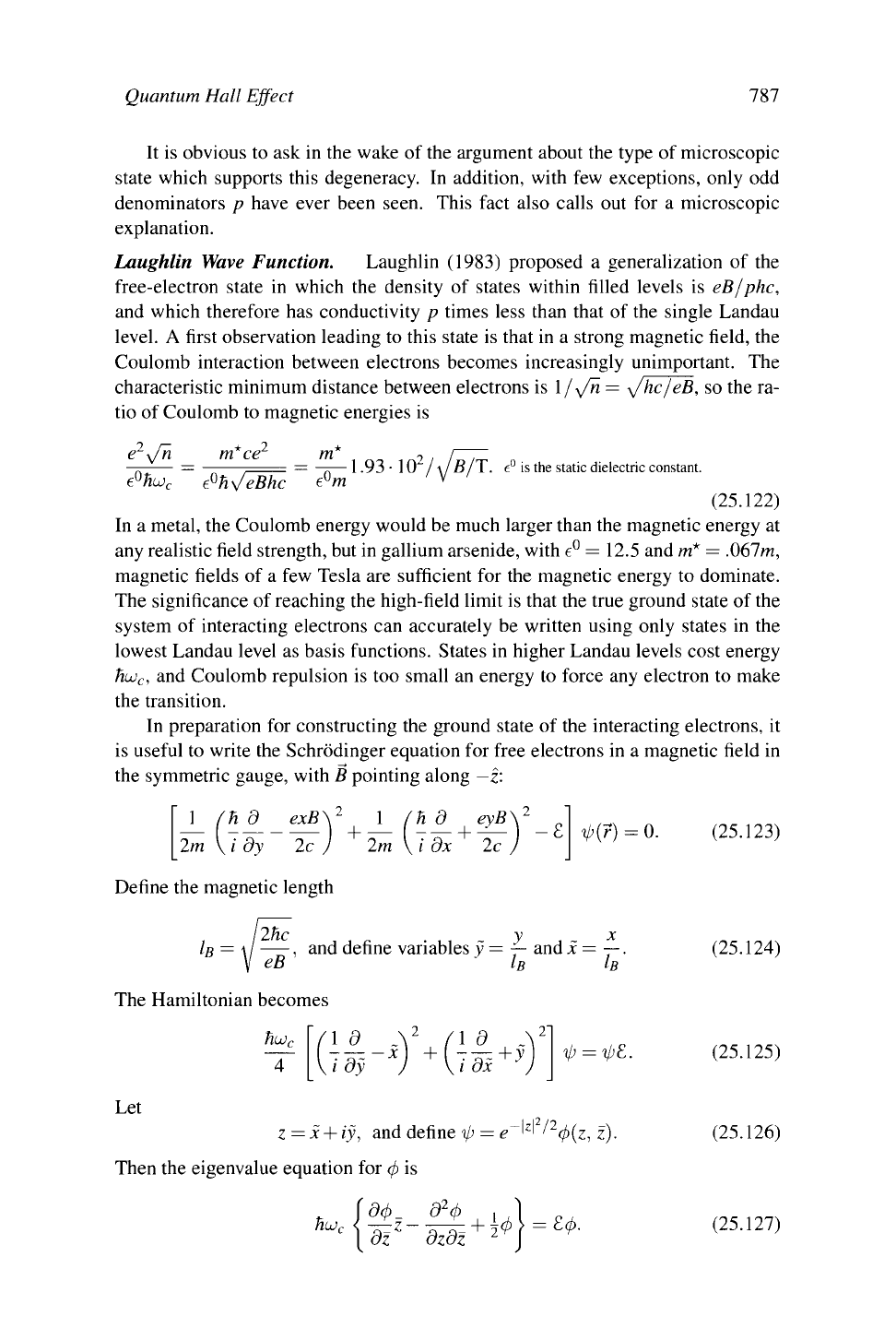
Laughlin Wave Function. Laughlin (1983) proposed a generalization of the
free-electron state in which the density of states within filled levels is eB/phc,
and which therefore has conductivity p times less than that of the single Landau
level. A first observation leading to this state is that in a strong magnetic field, the
Coulomb interaction between electrons becomes increasingly unimportant. The
characteristic minimum distance between electrons is
1/'sjn
= ^hc/eB, so the ra-
tio of Coulomb to magnetic energies is
e
2
^/n m*ce
2
1.93-107
yjB/T.
e°
is the static dielectric constant.
e°hio
c
e°hs/eBhc e°m
(25.122)
In a metal, the Coulomb energy would be much larger than the magnetic energy at
any realistic field strength, but in gallium arsenide, with e° = 12.5 and
m*
= .061m,
magnetic fields of a few Tesla are sufficient for the magnetic energy to dominate.
The significance of reaching the high-field limit is that the true ground state of the
system of interacting electrons can accurately be written using only states in the
lowest Landau level as basis functions. States in higher Landau levels cost energy
hw
c
, and Coulomb repulsion is too small an energy to force any electron to make
the transition.
In preparation for constructing the ground state of the interacting electrons, it
is useful to write the Schrodinger equation for free electrons in a magnetic field in
the symmetric gauge, with B pointing along
—z:
1 fh d exB\
2
1 (h d eyB\
2
2m
V
' dy 2c ) 2m \ i dx 2c )
Define the magnetic length
ip(r) = 0. (25.123)
/2Hc y x
h = \ , and define variables y = — and i =—. (25.124)
V eB l
B
l
B
The Hamiltonian becomes
\ f) \
2
/1 n \
2
~
i/>
=
ip£..
(25.125)
4
\_d_ \
l
nd_ :
i dy J \ i dx
Let
z
= x + iy, and define
tp
= e^
2/2
cf)(z, z). (25.126)
Then the eigenvalue equation for
<fi
is
hu
c
l^z-^_
+
±A
=
£4>.
(25.127)
788
Chapter
25.
Magnetism of Ions and Electrons
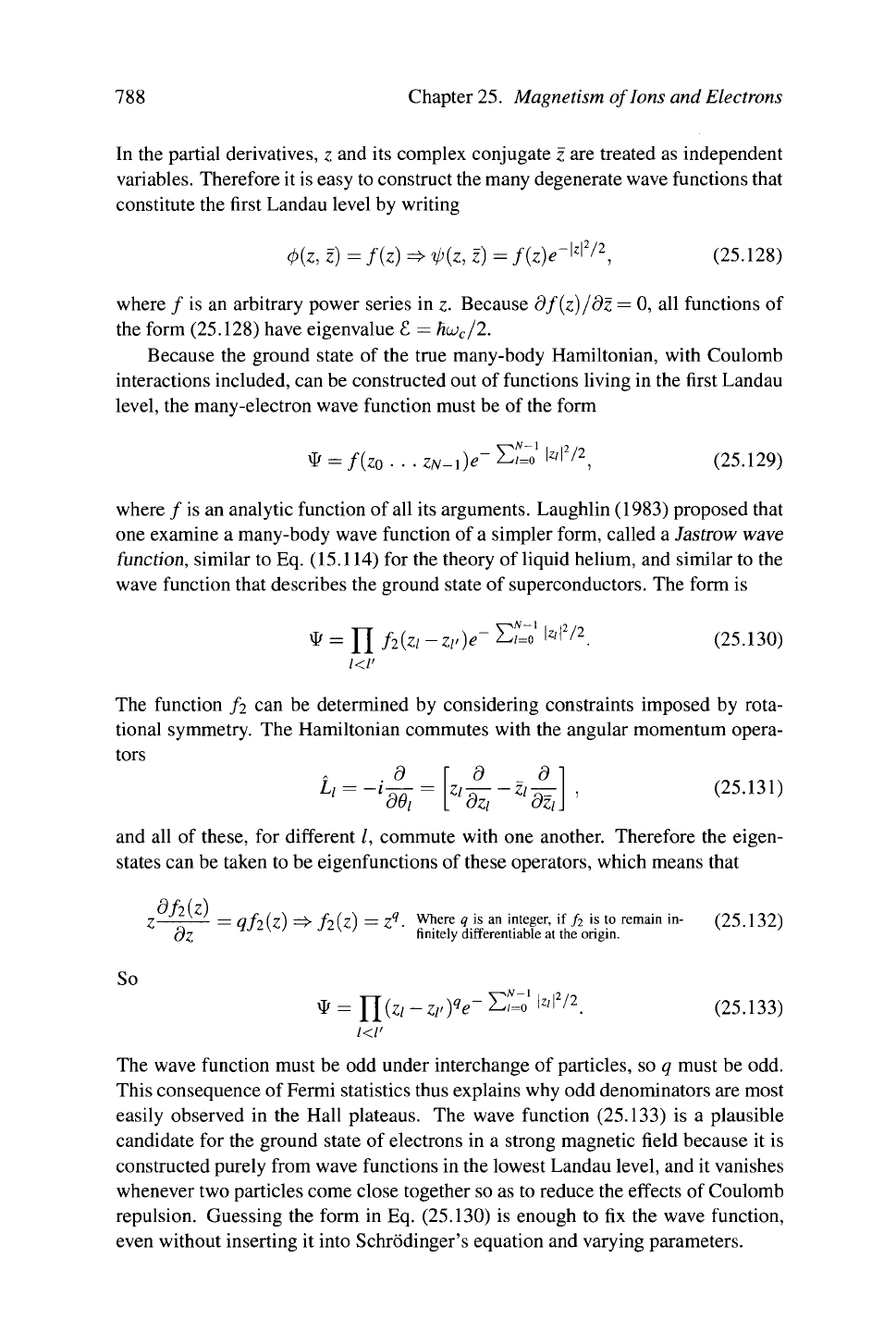
In the partial derivatives, z and its complex conjugate z are treated as independent
variables. Therefore it is easy to construct the many degenerate wave functions that
constitute the first Landau level by writing
<Kz, z) = f(z) => ^(z, z)
=
f{z)e-^l\ (25.128)
where
/
is an arbitrary power series in z. Because df(z)/dz
=
0, all functions of
the form (25.128) have eigenvalue £ =
HLO
C
/2.
Because the ground state of the true many-body Hamiltonian, with Coulomb
interactions included, can be constructed out of functions living in the first Landau
level, the many-electron wave function must be of the form
* = /(zo
. .
. ZN-\)e~ ^i=o I
2
'
1
'/
2
, (25.129)
where
/
is an analytic function of all its arguments. Laughlin (1983) proposed that
one examine a many-body wave function of a simpler form, called a Jastrow wave
function, similar to Eq. (15.114) for the theory of liquid helium, and similar to the
wave function that describes the ground state of superconductors. The form is
tf
= Y[
f
2
(
Zl
-
z
v
)e~ ^i=o
|z
'
|2/2
. (25.130)
The function
f
2
can be determined by considering constraints imposed by rota-
tional symmetry. The Hamiltonian commutes with the angular momentum opera-
tors
.3_
~
l
dO
t
a
__
a
OZl
OZl
(25.131)
and all of these, for different /, commute with one another. Therefore the eigen-
states can be taken to be eigenfunctions of these operators, which means that
Z } = qfl{z)^>h{z)=Z
q
.
Where
9
is an
inte
g
er
-
if
h
is to remain in- (25.132)
Qz
finitely differentiable at the origin.
So
*
=
l[(zi -zv)
q
e~ So' M
2
/2_ (25.133)
/</'
The wave function must be odd under interchange of particles, so q must be odd.
This consequence of Fermi statistics thus explains why odd denominators are most
easily observed in the Hall plateaus. The wave function (25.133) is a plausible
candidate for the ground state of electrons in a strong magnetic field because it is
constructed purely from wave functions in the lowest Landau level, and it vanishes
whenever two particles come close together so as to reduce the effects of Coulomb
repulsion. Guessing the form in Eq. (25.130) is enough to
fix
the wave function,
even without inserting it into Schrodinger's equation and varying parameters.
Quantum Hall Effect 789
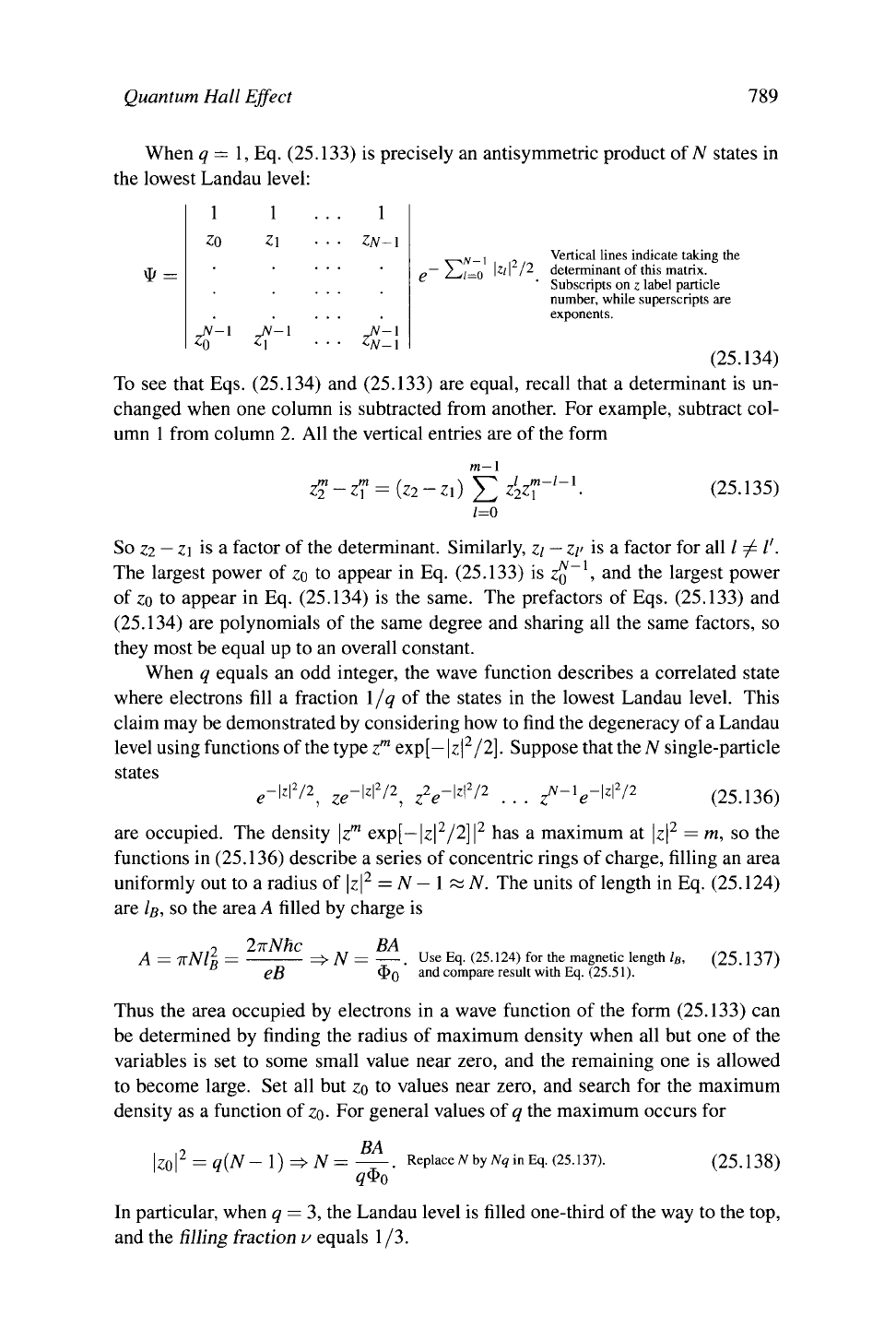
When q=\, Eq. (25.133) is precisely an antisymmetric product of N states in
the lowest Landau level:
# =
1
zo
1
Z\
zT
1
z7"
1
ZN-l
ZN-
A
,_
1
Vertical lines indicate taking the
Z-<;=o
l
z
'l /
2
determinant of
this
matrix.
Subscripts
on z label particle
number,
while superscripts are
exponents.
(25.134)
To see that Eqs. (25.134) and (25.133) are equal, recall that a determinant is un-
changed when one column is subtracted from another. For example, subtract col-
umn
1
from column 2. All the vertical entries are of the form
Zi
-Z? =
(Z2-Z
l
m-\
E
J
m-l-l
Z
2
Z
Y
1=0
(25.135)
So zi
— Z]
is a factor of the determinant. Similarly, zi
—
zv is a factor for all / ^ V.
The largest power of
zo
to appear in Eq. (25.133) is z^
_1
, and the largest power
of
zo
to appear in Eq. (25.134) is the same. The prefactors of Eqs. (25.133) and
(25.134) are polynomials of the same degree and sharing all the same factors, so
they most be equal up to an overall constant.
When q equals an odd integer, the wave function describes a correlated state
where electrons fill a fraction \/q of the states in the lowest Landau level. This
claim may be demonstrated by considering how to find the degeneracy of a Landau
level using functions of
the
type z
m
exp[—
|z|
2
/2].
Suppose that the N single-particle
states
-1*172
ze
-W/2
z
2
e~
1*172
z
N
~
-W72
(25.136)
are occupied. The density \z
m
exp[—|z|
2
/2]|
2
has a maximum at \z\
2
= m, so the
functions in (25.136) describe a series of concentric rings of charge, filling an area
uniformly out to a radius of \z\
2
= N
— 1
PZN. The units of length in Eq. (25.124)
are
IB,
so the area A filled by charge is
■■irNli
2TTNHC
eB
■N
BA
Use
Eq. (25.124) for the magnetic length /g,
and
compare result with Eq.
(25.51).
(25.137)
Thus the area occupied by electrons in a wave function of the form (25.133) can
be determined by finding the radius of maximum density when all but one of the
variables is set to some small value near zero, and the remaining one is allowed
to become large. Set all but zo to values near zero, and search for the maximum
density as a function of
zo-
For general values of q the maximum occurs for
\
Z0
\
2
= q(N - I) ^ N
■-
BA
q$o'
Replace
N by Nq in Eq.
(25.137).
(25.138)
In particular, when q = 3, the Landau level is filled one-third of the way to the top,
and the tilling fraction v equals 1/3.
790 Chapter 25. Magnetism of Ions and Electrons
Fractional Charge. Laughlin furthermore proposed that the excitations of the
fractional quantum Hall state carry fractional charge. Imagine constructing an ex-
tremely thin solenoid with uniform induction B inside and no induction outside,
and passing it through the two-dimensional electron gas. Imagine beginning with
no flux through the solenoid, and then slowly increasing B until finally the total flux
in the solenoid is
<&Q.
According to the discussion of Section
25.3.3,
an electron
traveling a circuit around an infinitely thin flux tube with flux of
<£>o
will undergo
a phase change of 2n, and no physical measurement can detect the presence of the
tube.
Therefore the electron gas after the tube reaches flux
<3>o
must be in an eigen-
state of the original Hamiltonian. This state cannot be the ground state because
turning on the flux tube at the origin drives charge away from the origin, and so
one has constructed an excited state.
To see that charge is driven away from the origin, and to calculate how much,
note that turning on the flux tube creates an azimuthal electric field,
1 ô$
1
H
(25.139)
c 2nr dt
Traveling far from the flux tube, the current produced by this electric field is per-
pendicular to it, because only a
xy
is nonzero, and the total charge Q transported
away from the flux tube is
1<9$
,xy
~c~di
1 v
Q
■ I dt 2irr j± = - / dt a
x
CRK
-4>o = —
ve.
(25.140)
(25.141)
i
N
X
3
O
C
o
JS
C/3
0 100 200 300 400 500 600 700
Current J (pA)
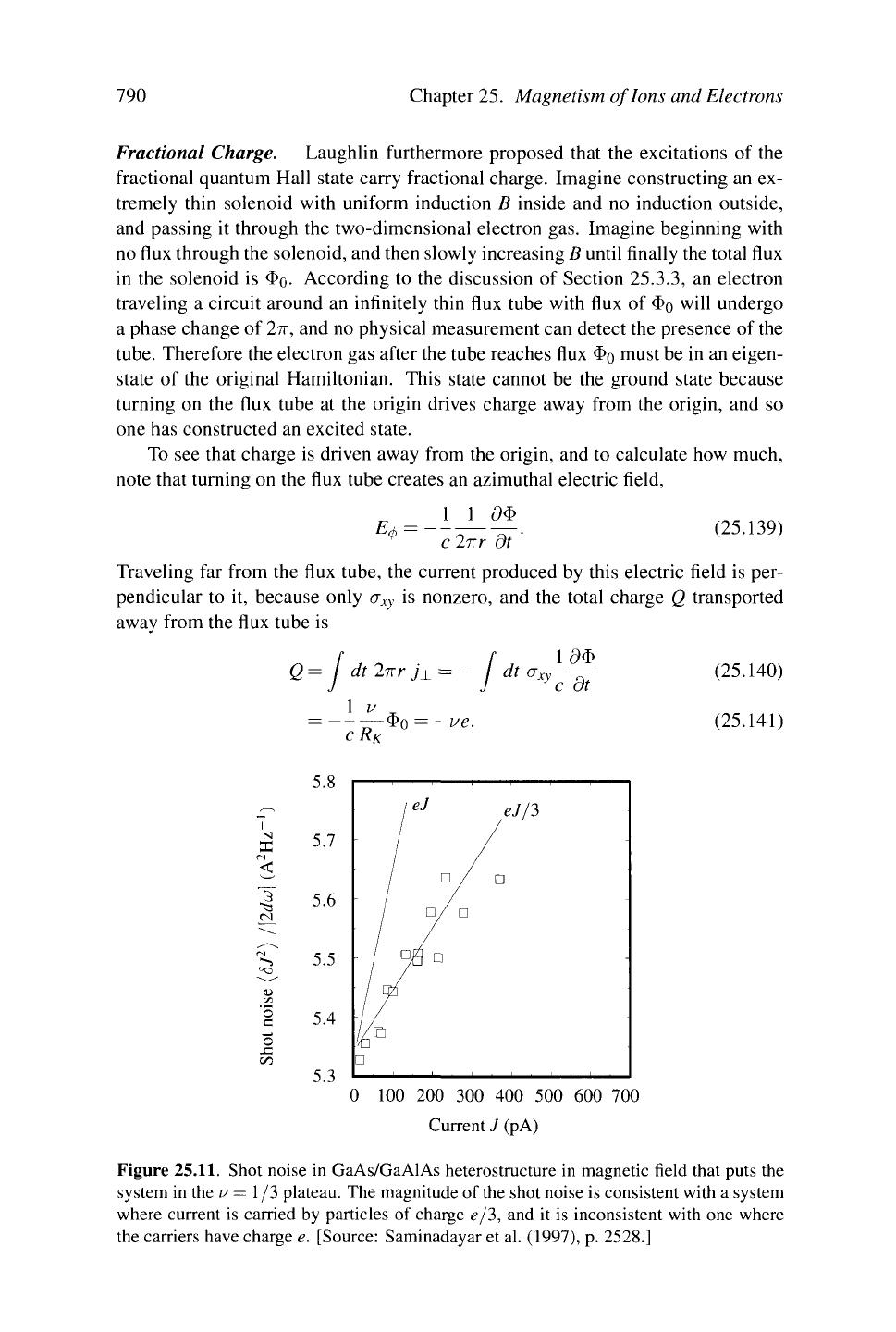
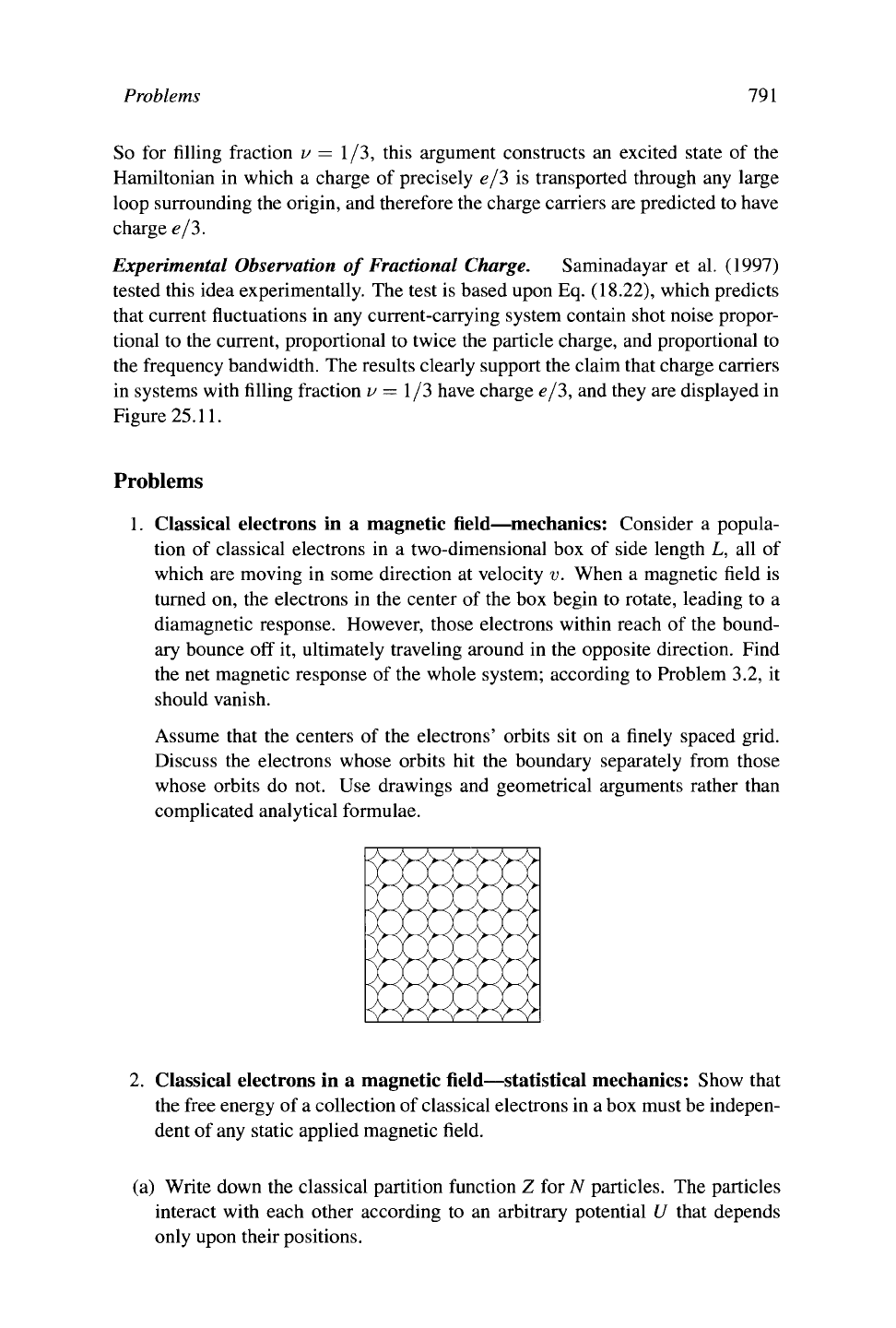
Figure
25.11.
Shot noise in GaAs/GaAlAs heterostructure in magnetic field that puts the
system in the v = 1/3 plateau. The magnitude of the shot noise is consistent with a system
where current is carried by particles of charge e/3, and it is inconsistent with one where
the carriers have charge e. [Source: Saminadayar et al. (1997), p. 2528.]
Problems 791
So for filling fraction v = 1/3, this argument constructs an excited state of the
Hamiltonian in which a charge of precisely e/3 is transported through any large
loop surrounding the origin, and therefore the charge carriers are predicted to have
charge e/3.
Experimental Observation of Fractional Charge. Saminadayar et al. (1997)
tested this idea experimentally. The test is based upon Eq. (18.22), which predicts
that current fluctuations in any current-carrying system contain shot noise propor-
tional to the current, proportional to twice the particle charge, and proportional to
the frequency bandwidth. The results clearly support the claim that charge carriers
in systems with filling fraction u = 1/3 have charge e/3, and they are displayed in
Figure
25.11.
Problems
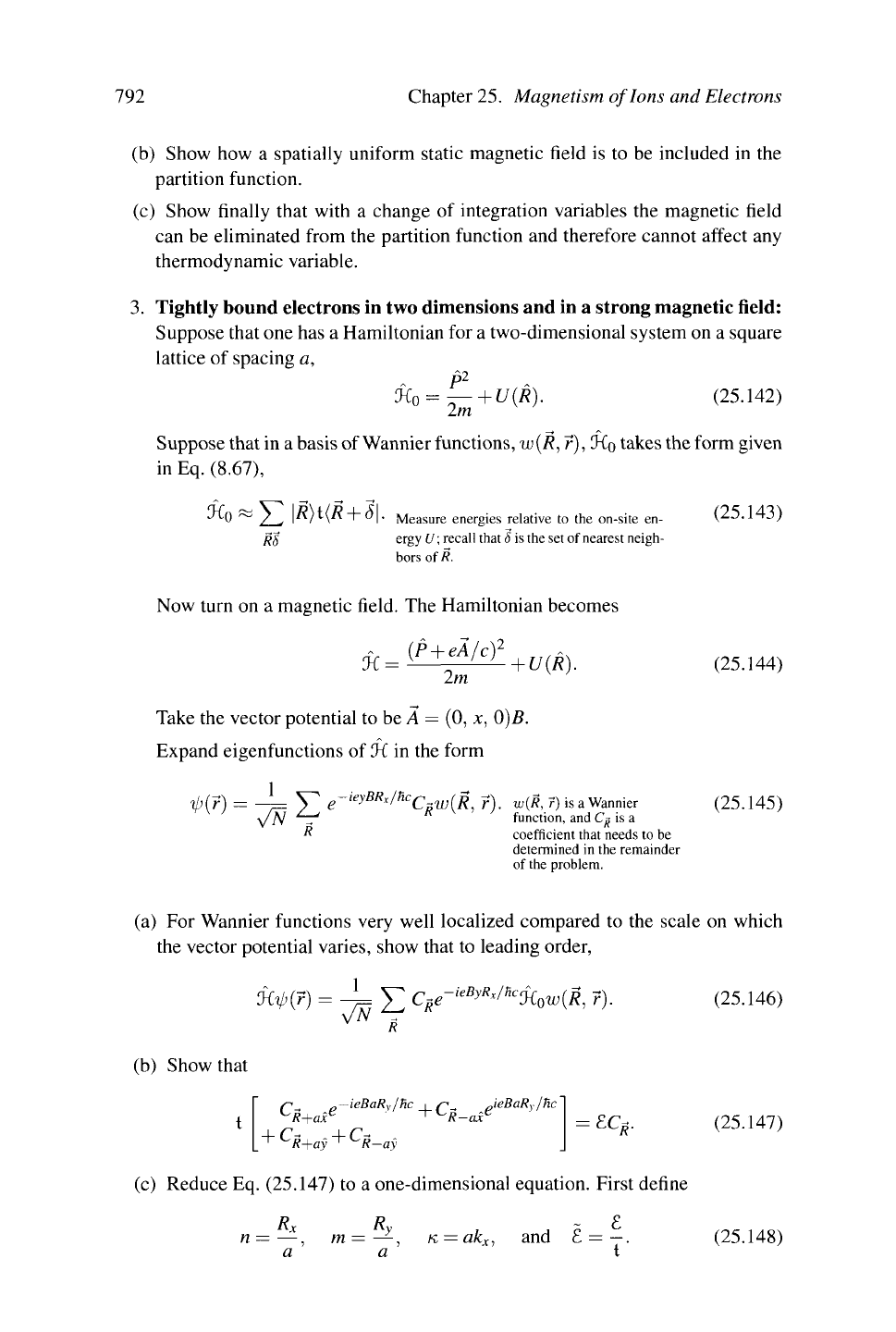
1.
Classical electrons in a magnetic field—mechanics: Consider a popula-
tion of classical electrons in a two-dimensional box of side length L, all of
which are moving in some direction at velocity v. When a magnetic field is
turned on, the electrons in the center of the box begin to rotate, leading to a
diamagnetic response. However, those electrons within reach of the bound-
ary bounce off it, ultimately traveling around in the opposite direction. Find
the net magnetic response of the whole system; according to Problem 3.2, it
should vanish.
Assume that the centers of the electrons' orbits sit on a finely spaced grid.
Discuss the electrons whose orbits hit the boundary separately from those
whose orbits do not. Use drawings and geometrical arguments rather than
complicated analytical formulae.
2.
Classical electrons in a magnetic field—statistical mechanics: Show that
the free energy of a collection of classical electrons in a box must be indepen-
dent of any static applied magnetic field.
(a) Write down the classical partition function Z for N particles. The particles
interact with each other according to an arbitrary potential U that depends
only upon their positions.
792
Chapter
25.
Magnetism of Ions and Electrons
(b) Show how a spatially uniform static magnetic field is to be included in the
partition function.
(c) Show finally that with a change of integration variables the magnetic field
can be eliminated from the partition function and therefore cannot affect any
thermodynamic variable.
3.
Tightly bound electrons in two dimensions and in a strong magnetic field:
Suppose that one has a Hamiltonian for a two-dimensional system on a square
lattice of spacing a,
X
0
= — + U(R). (25.142)
2m
Suppose that in a basis of Wannier functions, w(R, r), $io takes the form given
in Eq. (8.67),
0 ~ / ,, \1\) t\K ~r 0 \. Measure energies relative to the on-site en- (.Zj.l'+j;
j?(5 ergy
U
;
recall that
5
is the set
of
nearest neigh-
bors
of R.
Now turn on a magnetic field. The Hamiltonian becomes
(P
+ eAlc)
2
J{=i
rt^
+
(25.144)
2m
Take the vector potential to be A = (0, x, 0)B.
Expand eigenfunctions of
"K
in the form
i>(T) = -^=y" e-
ieyBR
^
hc
C^%ü{R, r). w(R, 7) is a Wannier (25.145)
yTV ^f function, and Cg is a
R
coefficient that needs
to be
determined
in the
remainder
of the problem.
(a) For Wannier functions very well localized compared to the scale on which
the vector potential varies, show that to leading order,
£^(r) = A=Y, C^e-
ieByRx/nc
^ow(R, r). (25.146)
R
(b) Show that
C
p
~ieBaR
y
/hc _|_ p
p
ieBaR
y
/hc
EC
â
. (25.147)
C
e
~ieBaRy/hc
_i_
p JeBaR
y
/Hc
^ ^R+ay ^ ^R-ay
(c) Reduce Eq. (25.147) to a one-dimensional equation. First define
R R F
n = —, m=—,
K
= ak
x
, and £ = —. (25.148)
a a t