
Marder M.P. Condensed Matter Physics
Подождите немного. Документ загружается.

Heisenberg Model 803
and dynamics of spins, at either the quantum-mechanical or classical level, which
makes it worthwhile to sketch a brief derivation.
Consider a lattice of ions, and describe the electronic states in this lattice in
terms of Wannier functions w(R, r), chosen because of their convenient ability
to describe electrons localized on atomic sites R, and with functions at different
sites orthogonal to one another. The lesson from studying two electrons is that
even when the spatial wave functions of all electrons are fixed, the system can
adopt various energies according to the way that spin and space degrees of freedom
interact to conform to Fermi statistics. Therefore, consider the space of states
spanned by a fixed collection of Wannier functions and all possible spin states of
the many electrons. For N electrons the Hamiltonian is
N
p
2
/] ~ \-U = ^kinetic + ^int, (26.22)
where U can either be the Coulomb interaction or else some more elaborate ef-
fective two-body potential such as a screened Coulomb interaction. Focus on the
interaction term, which contains all the magnetic effects, and rewrite it in second
quantized form using the Wannier functions as basis functions. Use |/?/) for the
state vector such that {r\Ri) = w(Ri,r), and denote the creation and annihilation
operators for these states by c] and
Q.
According to Eq. (C.10), the Hamiltonian
in second quantized form is
Ä
int
= Y. (^/'|t>l^/"^/'")44
CT
'^"V'C/»
CT
. (26.23)
a'i" i'"
GO
The spin states of Ri and /?;// must be the same, as must be those of R
t
i and
R////,
or else the matrix element vanishes because U is independent of spin.
The approximation that leads Eq. (26.23) to reproduce the Heisenberg Hamiltonian
assumes either that
Rim
= R
t
i and /?/» = Ri or that Ri" = /?/' and
Rim
= R
t
. This
approximation can be motivated either by pointing out that the Wannier functions
are localized within a unit cell, so the matrix elements are small unless the wave
■
functions group in pairs, or else by pointing out that these are the unique groupings
of Wannier function indices that allow (26.23) to produce a nonzero result at lowest
order in perturbation theory. Adopting in any event this approximation,
£
int
=v <^H?»>44^^^
(2624)
t-^ _l_ D.D.. \TT\D..B.\£t & £. .£..
v
'
W
<7<T'
+
(R
l
R
l
,\U\R
ll
Ri)cl
a
c]
llTl
ct
t
T>ci>
IT
{RiR
v
\Û\RiRii)c\
a
c\
lal
ci'a'Ci
ff
^ +
{RiRi>\Û\Ri>Ri)[n
la
8
w
-c\
a
c
la
,c\
la
,c
Va
\.
w
on
The final term of Eq. (26.25) is called the exchange term, and it can be put in the
form of an interaction between spins. To do so, note the identities
5
Z
=
2 [4^T
~ 4^1
=
2
^
T
~"^ (26.26a)
804 Chapter 26. Quantum Mechanics of Interacting Magnetic Moments
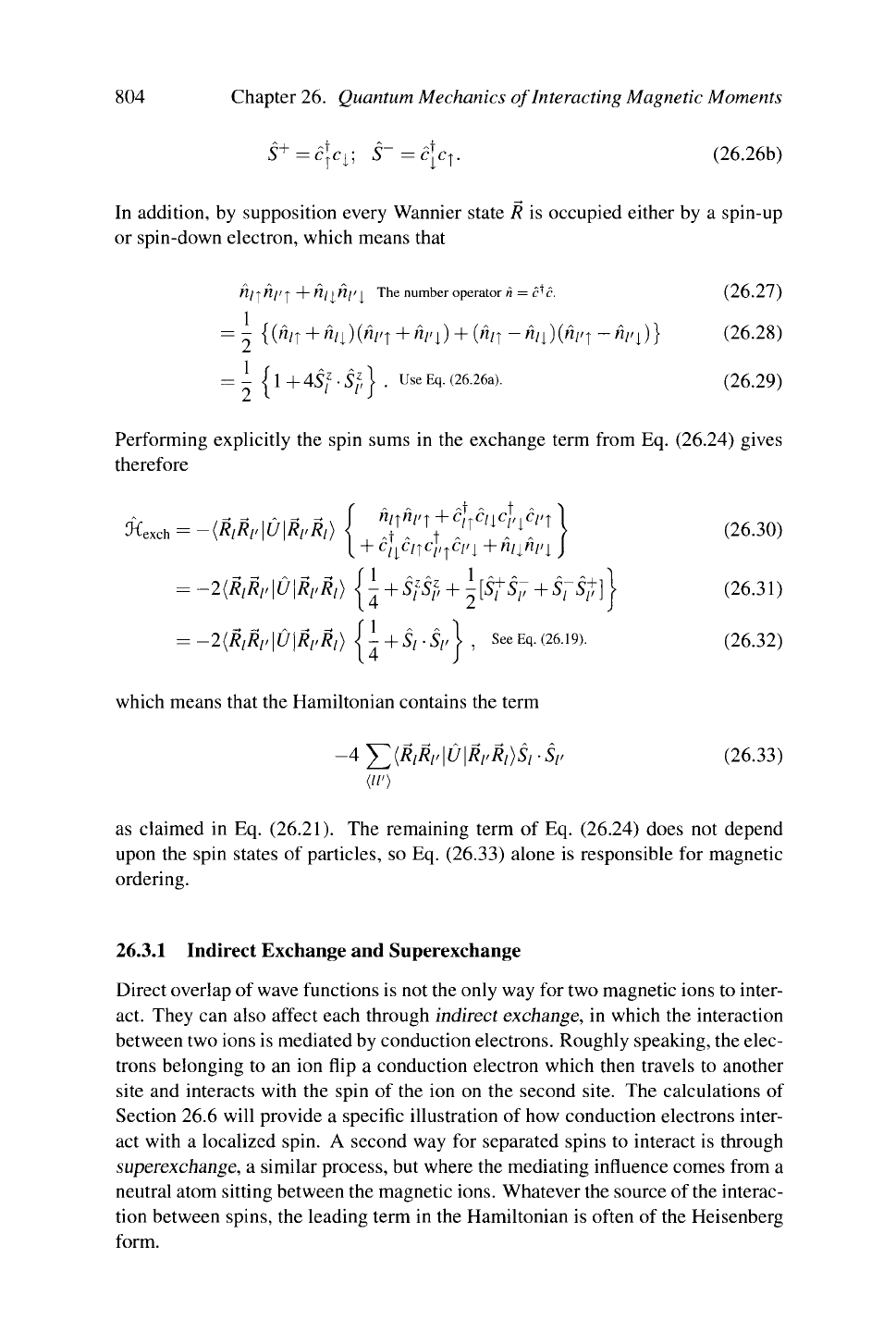
5
+
=c{q; S~=c\c
v
(26.26b)
In addition, by supposition every Wannier state R is occupied either by a spin-up
or spin-down electron, which means that
W/TW/'T
+ n/1 Hf
I
The number operator n = c^c. (26.27)
= 2 {("/T+"u)("/'T+"/'i) + ("'T
_
"u)("/'T-"/'i)} (26.28)
= - {
1
+ 4Sf
■
Sf,
}
.
Use
Eq.
(26.26a).
(26.29)
Performing explicitly the spin sums in the exchange term from Eq. (26.24) gives
therefore
Ä
exch
=
-m^lRrRÙ (
T'^^
ên4
^
}
(26-30)
[ + cl
l
c
n
c<
n
c
n
+ni
i
n
n
)
= -2{R,R
v
\Û\R
v
Ri) |^
+SfSf,
+ ^[SfSj;+Srs£]\ (26.31)
= -2{R
l
R
l
,\Û\Ri>Ri)
j-
+S
r
SA ,
See
Eq.
(26.19).
(26.32)
which means that the Hamiltonian contains the term
-4 J2(RiRi'\Û\Ri>Ri)S
r
S
r
(26.33)
(in
as claimed in Eq. (26.21). The remaining term of Eq. (26.24) does not depend
upon the spin states of particles, so Eq. (26.33) alone is responsible for magnetic
ordering.
26.3.1 Indirect Exchange and Superexchange
Direct overlap of wave functions is not the only way for two magnetic ions to inter-
act. They can also affect each through indirect exchange, in which the interaction
between two ions is mediated by conduction electrons. Roughly speaking, the elec-
trons belonging to an ion flip a conduction electron which then travels to another
site and interacts with the spin of the ion on the second site. The calculations of
Section 26.6 will provide a specific illustration of how conduction electrons inter-
act with a localized spin. A second way for separated spins to interact is through
superexchange, a similar process, but where the mediating influence comes from a
neutral atom sitting between the magnetic ions. Whatever the source of the interac-
tion between spins, the leading term in the Hamiltonian is often of the Heisenberg
form.
Heisenberg Model
805
26.3.2 Ground State
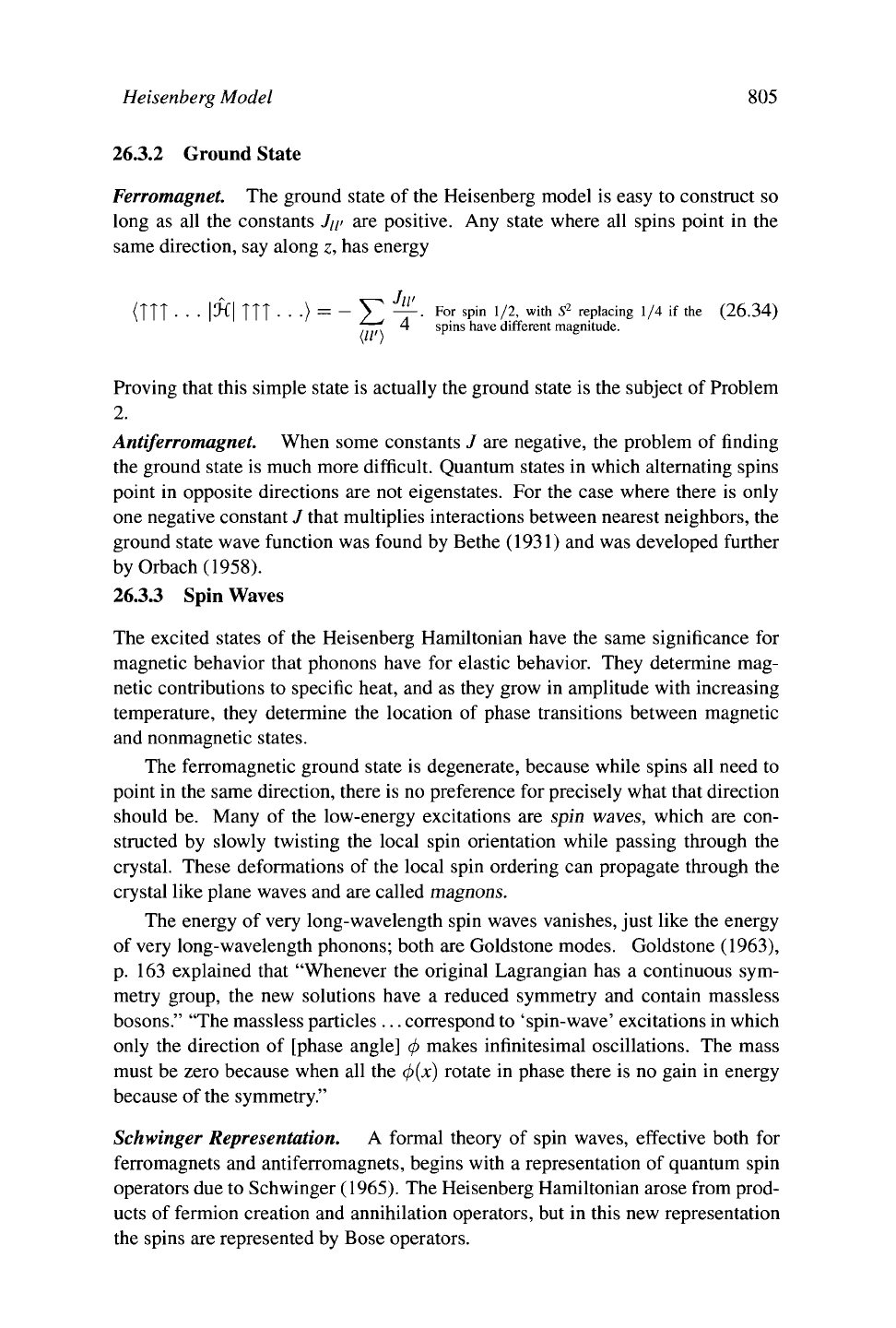
Ferromagnet. The ground state of the Heisenberg model is easy to construct so
long as all the constants //// are positive. Any state where all spins point in the
same direction, say along z, has energy
(ÎTÎ ... |Ä| ÎÎÎ ...) = - V" —. For spin 1/2, with S
2
replacing 1/4 if the (26.34)
~~~i 4 spins have different magnitude.
Proving that this simple state is actually the ground state is the subject of Problem
2.
Antiferromagnet. When some constants J are negative, the problem of finding
the ground state is much more difficult. Quantum states in which alternating spins
point in opposite directions are not eigenstates. For the case where there is only
one negative constant J that multiplies interactions between nearest neighbors, the
ground state wave function was found by Bethe (1931) and was developed further
byOrbach(1958).
26.3.3 Spin Waves
The excited states of the Heisenberg Hamiltonian have the same significance for
magnetic behavior that phonons have for elastic behavior. They determine mag-
netic contributions to specific heat, and as they grow in amplitude with increasing
temperature, they determine the location of phase transitions between magnetic
and nonmagnetic states.
The ferromagnetic ground state is degenerate, because while spins all need to
point in the same direction, there is no preference for precisely what that direction
should be. Many of the low-energy excitations are spin waves, which are con-
structed by slowly twisting the local spin orientation while passing through the
crystal. These deformations of the local spin ordering can propagate through the
crystal like plane waves and are called magnons.
The energy of very long-wavelength spin waves vanishes, just like the energy
of very long-wavelength phonons; both are Goldstone modes. Goldstone (1963),
p.
163 explained that "Whenever the original Lagrangian has a continuous sym-
metry group, the new solutions have a reduced symmetry and contain massless
bosons." "The massless particles ... correspond to 'spin-wave' excitations in which
only the direction of [phase angle]
<j>
makes infinitesimal oscillations. The mass
must be zero because when all the
<p(x)
rotate in phase there is no gain in energy
because of the symmetry."
Schwinger Representation. A formal theory of spin waves, effective both for
ferromagnets and antiferromagnets, begins with a representation of quantum spin
operators due to Schwinger (1965). The Heisenberg Hamiltonian arose from prod-
ucts of fermion creation and annihilation operators, but in this new representation
the spins are represented by Bose operators.
806 Chapter 26. Quantum Mechanics of Interacting Magnetic Moments
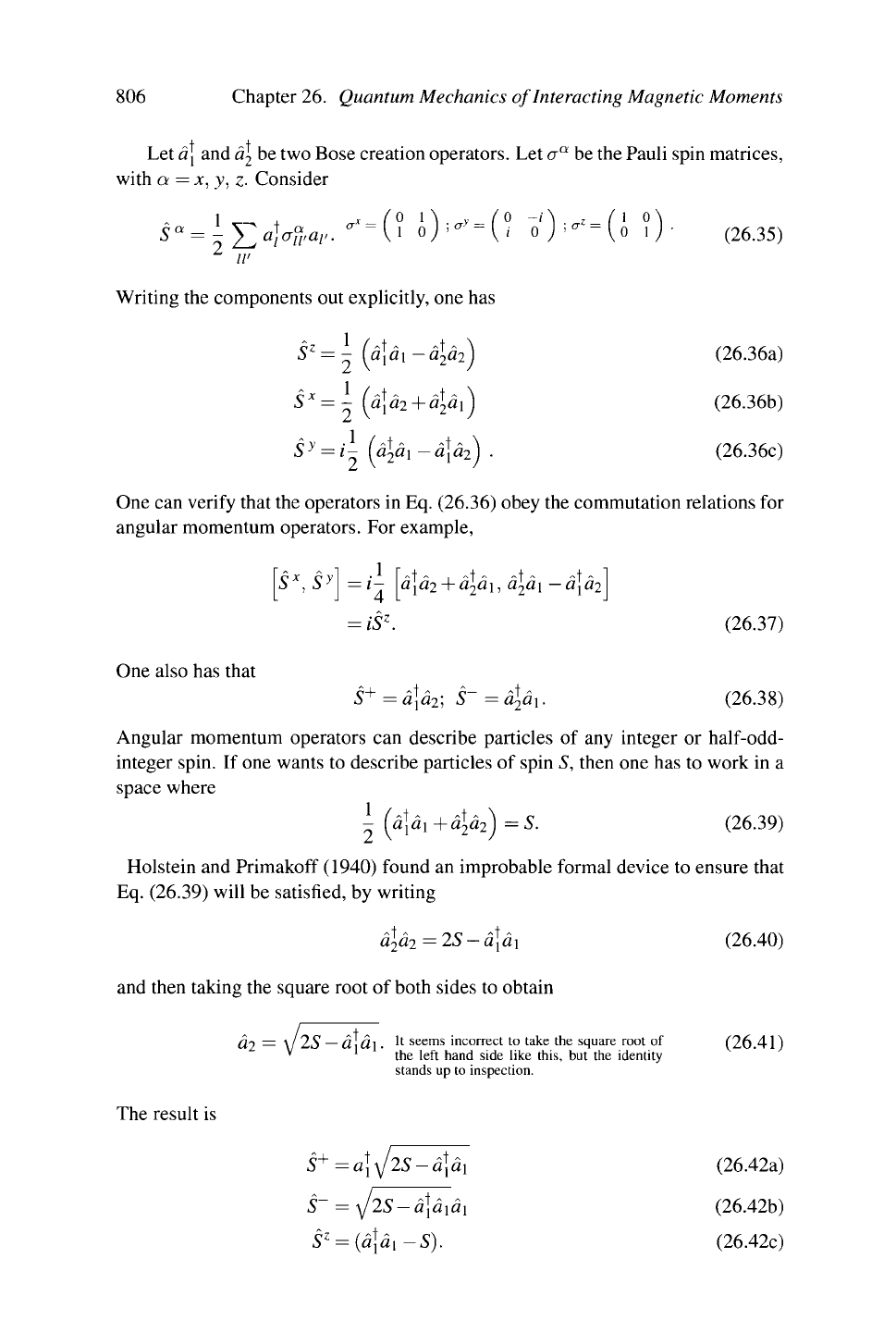
Let a\ and a\ be two Bose creation operators. Let a
a
be the Pauli spin matrices,
with a = x, y, z- Consider
S
a
=
W
a
Wi'
a
v-
a
*
=
(°
l
Ö)
;CT>
'
=
0
O')
;CTZ
=(O
?)• (26.35)
Writing the components out explicitly, one has
S =
—
\a\a\ —a^aj
â\â2 +
â\â\ j
S
y
= i- iâ
2
â\— â\â2j ■
(26.36a)
(26.36b)
(26.36c)
One can verify that the operators in Eq. (26.36) obey the commutation relations for
angular momentum operators. For example,
S\S
y
1
4
A
-iS
z
.
*t;
a\a2 + a
2
a\, a
2
a\ —a\a2
(26.37)
One also has that
â\â2; S
■
â
2
â\. (26.38)
Angular momentum operators can describe particles of any integer or half-odd-
integer spin. If one wants to describe particles of spin S, then one has to work in a
space where
- (âjâi +â
2
â2) = S. (26.39)
Holstein and Primakoff (1940) found an improbable formal device to ensure that
Eq. (26.39) will be satisfied, by writing
a
2
a2 =
2,i>
—
a\a\
and then taking the square root of both sides to obtain
(26.40)
d
2
= \l 25 — a\â]. I' seems incorrect to take the square root of
the left hand side like this, but the identity
stands up to inspection.
(26.41)
The result is
5+_,t
^t;
a\ \/2S
—
â\â
\a\
2S
—
â\â\â
[«1«!
S
z
= (âjâi —S).
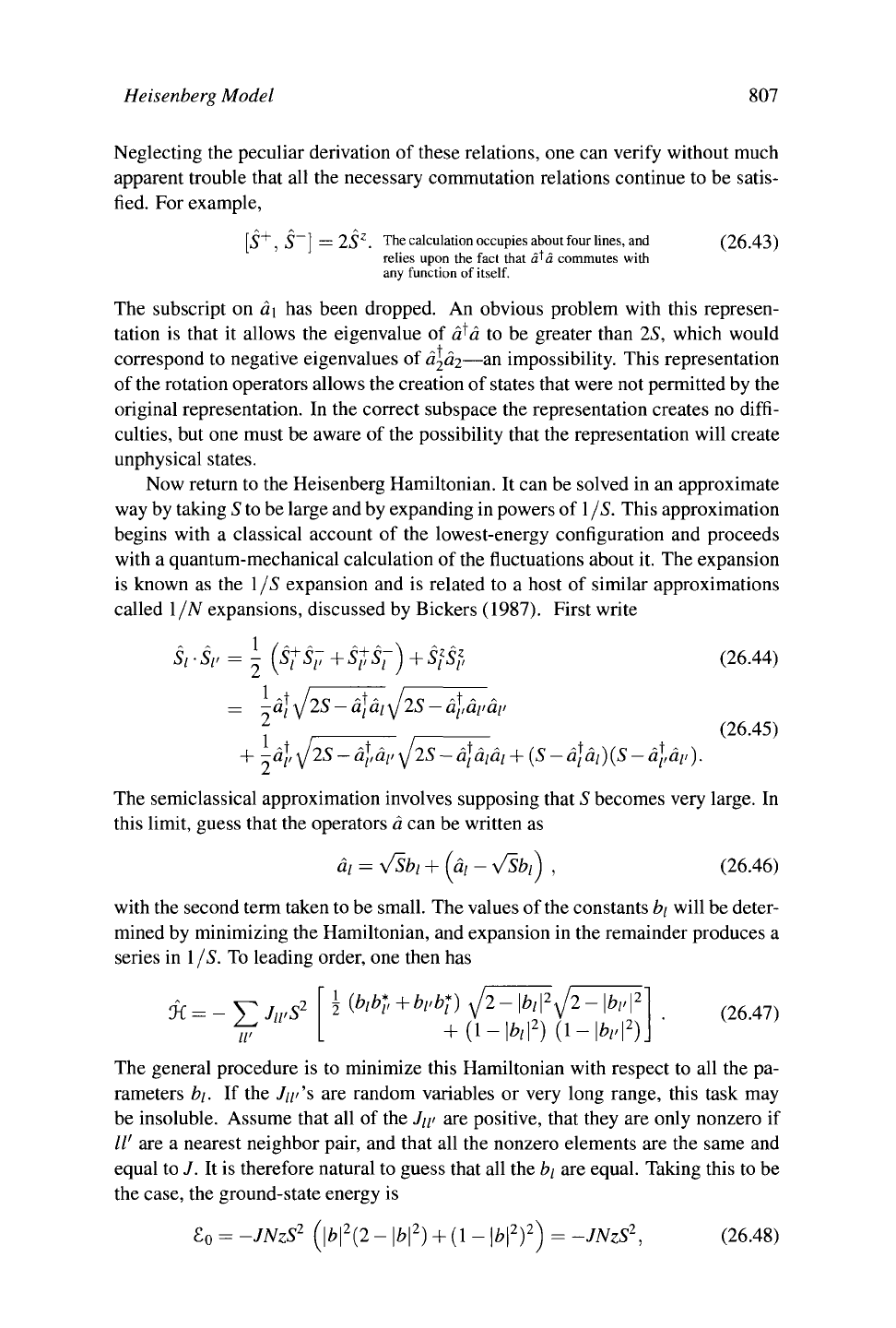
(26.42a)
(26.42b)
(26.42c)
Heisenberg Model 807
Neglecting the peculiar derivation of these relations, one can verify without much
apparent trouble that all the necessary commutation relations continue to be satis-
fied. For example,
[S
+
, S~] = 2S
Z
. The calculation occupies about four
lines,
and (26.43)
relies upon the fact that â^â commutes with
any function of
itself.
The subscript on â\ has been dropped. An obvious problem with this represen-
tation is that it allows the eigenvalue of â^â to be greater than 2S, which would
correspond to negative eigenvalues of â\â2—an impossibility. This representation
of the rotation operators allows the creation of states that were not permitted by the
original representation. In the correct subspace the representation creates no diffi-
culties, but one must be aware of the possibility that the representation will create
unphysical states.
Now return to the Heisenberg Hamiltonian. It can be solved in an approximate
way by taking S to be large and by expanding in powers of
1
/S. This approximation
begins with a classical account of the lowest-energy configuration and proceeds
with a quantum-mechanical calculation of the fluctuations about it. The expansion
is known as the
1
/S expansion and is related to a host of similar approximations
called \/N expansions, discussed by Bickers (1987). First write
Si -S
r
= ^ (s+5
;
7 + SfS]-) +
SfSf,
(26.44)
(26.45)
2
1
2
â]\J2S
—
â\âi\J2S
—
â^âi'âi'
+
-â],
\J2S —
â
v
â\i
y
25 — âjâiâi
+
(S — âJâi)(S —
âj/âf
).
The semiclassical approximation involves supposing that 5 becomes very large. In
this limit, guess that the operators â can be written as
a, =
y/sbi
+ (at -
y/Sbi)
, (26.46)
with the second term taken to be small. The values of
the
constants bi will be deter-
mined by minimizing the Hamiltonian, and expansion in the remainder produces a
series in
1
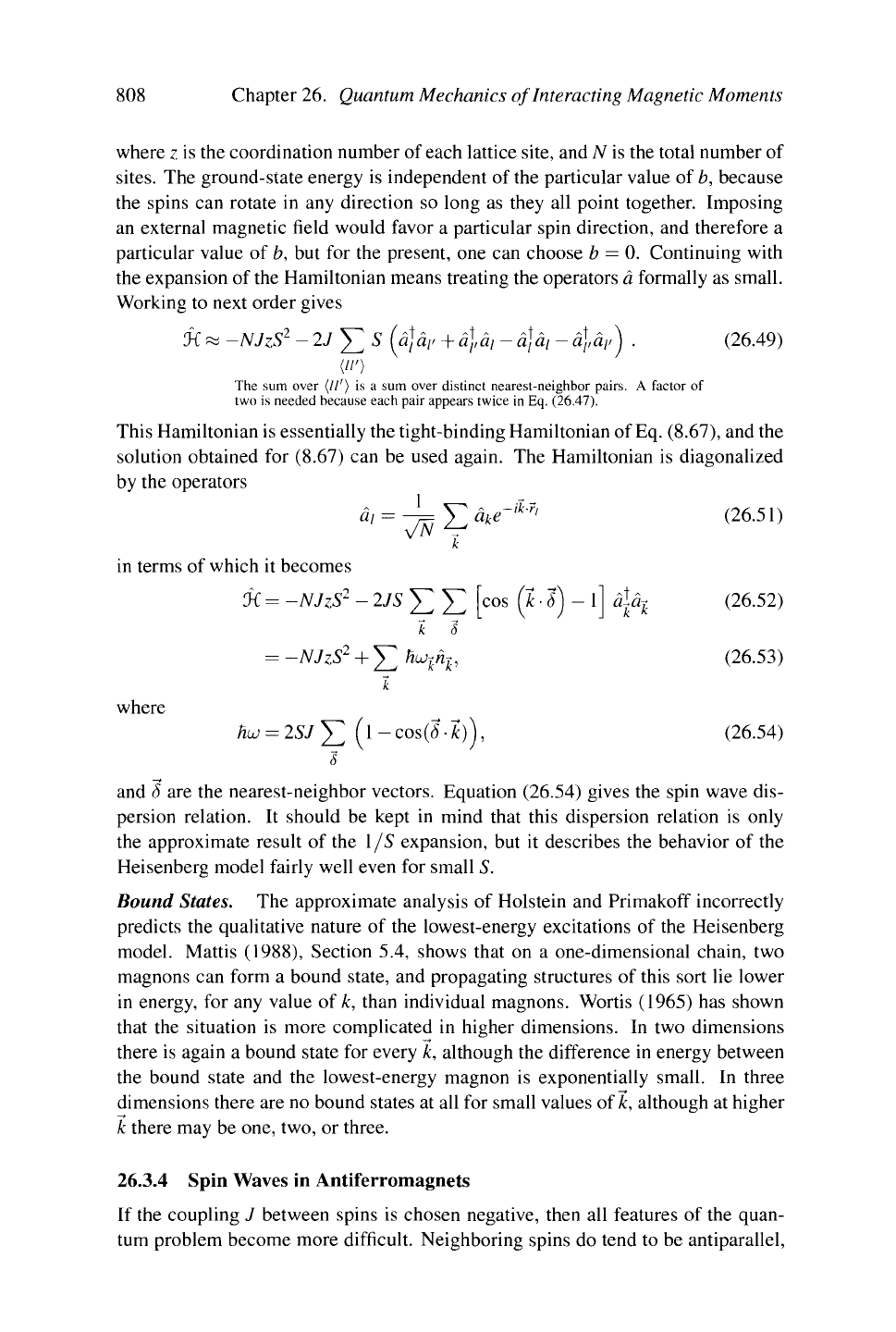
/S. To leading order, one then has
Jt
—
- zl
Jii
'
s
\
(bibf
+
b
v
b*)
p
+ (1-
-|*zrV
2
N
2
)(i-
~\bv\
2
IM
2
)
(26.47)
The general procedure is to minimize this Hamiltonian with respect to all the pa-
rameters b[. If the Jw's are random variables or very long range, this task may
be insoluble. Assume that all of the Jw are positive, that they are only nonzero if
//' are a nearest neighbor pair, and that all the nonzero elements are the same and
equal to J. It is therefore natural to guess that all the bi are equal. Taking this to be
the case, the ground-state energy is
£
0
= -JNzS
2
(\b\
2
{2
- \b\
2
) +
(1
- |è|
2
)
2
) = -JNzS
2
, (26.48)
808 Chapter 26. Quantum Mechanics of Interacting Magnetic Moments
where z is the coordination number of each lattice site, and N is the total number of
sites.
The ground-state energy is independent of the particular value of
b,
because
the spins can rotate in any direction so long as they all point together. Imposing
an external magnetic field would favor a particular spin direction, and therefore a
particular value of b, but for the present, one can choose b = 0. Continuing with
the expansion of the Hamiltonian means treating the operators â formally as small.
Working to next order gives
"K « —NJzS
—
27 2_J S [â]âi' +
àj,âi —
âjâi
—
âj
;
â// ) . (26.49)
The
sum over (//') is a sum over distinct nearest-neighbor
pairs.
A factor of
two
is needed because each pair appears twice in Eq.
(26.47).
This Hamiltonian is essentially the tight-binding Hamiltonian of
Eq.
(8.67), and the
solution obtained for (8.67) can be used again. The Hamiltonian is diagonalized
by the operators
I
in terms of which it becomes
Ä =
-NJzS
2
-2JS^2Y1
cos
(*
'
V ~
X
âtâr (26.52)
k
K
k
5
-NJzS
2
+ ^2
hüJ
k
ü
v (26.53)
where
HLU
=
2SJY
1
- cos(5
■
k) ), (26.54)
and 5 are the nearest-neighbor vectors. Equation (26.54) gives the spin wave dis-
persion relation. It should be kept in mind that this dispersion relation is only
the approximate result of the 1/5 expansion, but it describes the behavior of the
Heisenberg model fairly well even for small 5.
Bound States. The approximate analysis of Holstein and Primakoff incorrectly
predicts the qualitative nature of the lowest-energy excitations of the Heisenberg
model. Mattis (1988), Section 5.4, shows that on a one-dimensional chain, two
magnons can form a bound state, and propagating structures of this sort lie lower
in energy, for any value of k, than individual magnons. Wortis (1965) has shown
that the situation is more complicated in higher dimensions. In two dimensions
there is again a bound state for every k, although the difference in energy between
the bound state and the lowest-energy magnon is exponentially small. In three
dimensions there are no bound states at all for small values of
k,
although at higher
k there may be one, two, or three.
26.3.4 Spin Waves in Antiferromagnets
If the coupling J between spins is chosen negative, then all features of the quan-
tum problem become more difficult. Neighboring spins do tend to be antiparallel,
Heisenberg Model
809
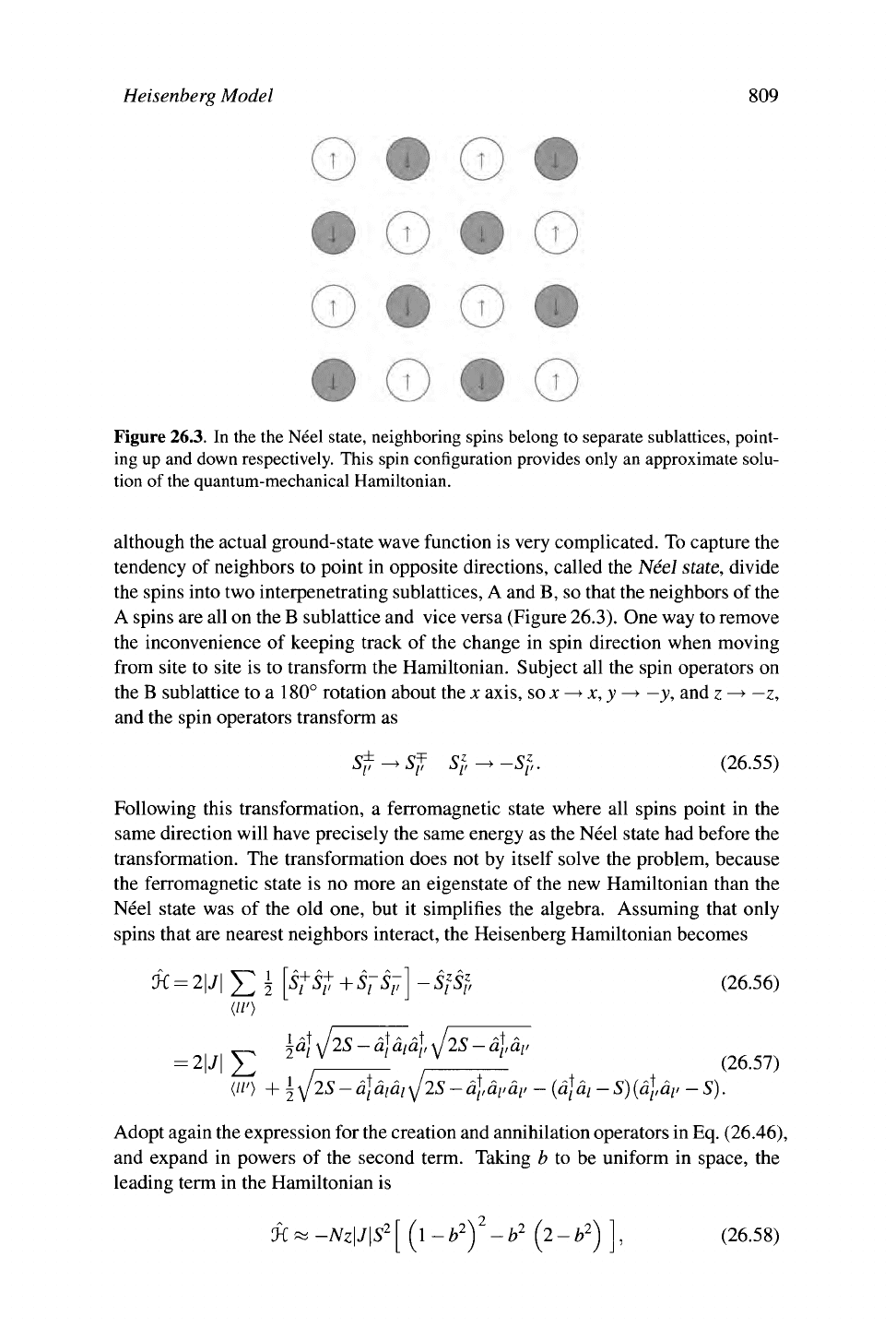
Figure
26.3.
In the the Néel state, neighboring spins belong to separate sublattices, point-
ing up and down respectively. This spin configuration provides only an approximate solu-
tion of
the
quantum-mechanical Hamiltonian.
although the actual ground-state wave function is very complicated. To capture the
tendency of neighbors to point in opposite directions, called the Néel state, divide
the spins into two interpenetrating sublattices, A and B, so that the neighbors of the
A spins are all on the B sublattice and vice versa (Figure
26.3).
One way to remove
the inconvenience of keeping track of the change in spin direction when moving
from site to site is to transform the Hamiltonian. Subject all the spin operators on
the B sublattice to a 180° rotation about the x axis, so x
—>
x, y
—>
—y,
and z
—►
—
z,
and the spin operators transform as
Sp^tf S/,->-S/,. (26.55)
Following this transformation, a ferromagnetic state where all spins point in the
same direction will have precisely the same energy as the Néel state had before the
transformation. The transformation does not by itself solve the problem, because
the ferromagnetic state is no more an eigenstate of the new Hamiltonian than the
Néel state was of the old one, but it simplifies the algebra. Assuming that only
spins that are nearest neighbors interact, the Heisenberg Hamiltonian becomes
(26.56)
(26.57)
S)(â],âii-S).
Adopt again the expression for the creation and annihilation operators in Eq. (26.46),
and expand in powers of the second term. Taking b to be uniform in space, the
leading term in the Hamiltonian is
'K =
2\J\Y
J
\
[5+5++575,7
- S
Z
S
Z
=
2|/|E
â]
y 25
—
âjâiâj, y2S
— cr^ây
AU.A à
(//') + i
Y
25
—
âjâiâiy 25
—
â,,â/'â//
—
(âjâi
ai
•K
« -^Vz|7|5
2
[
(l -
Z?
2
)
- b
2
(l - è
2
) ], (26.58)
810 Chapter 26. Quantum Mechanics of Interacting Magnetic Moments
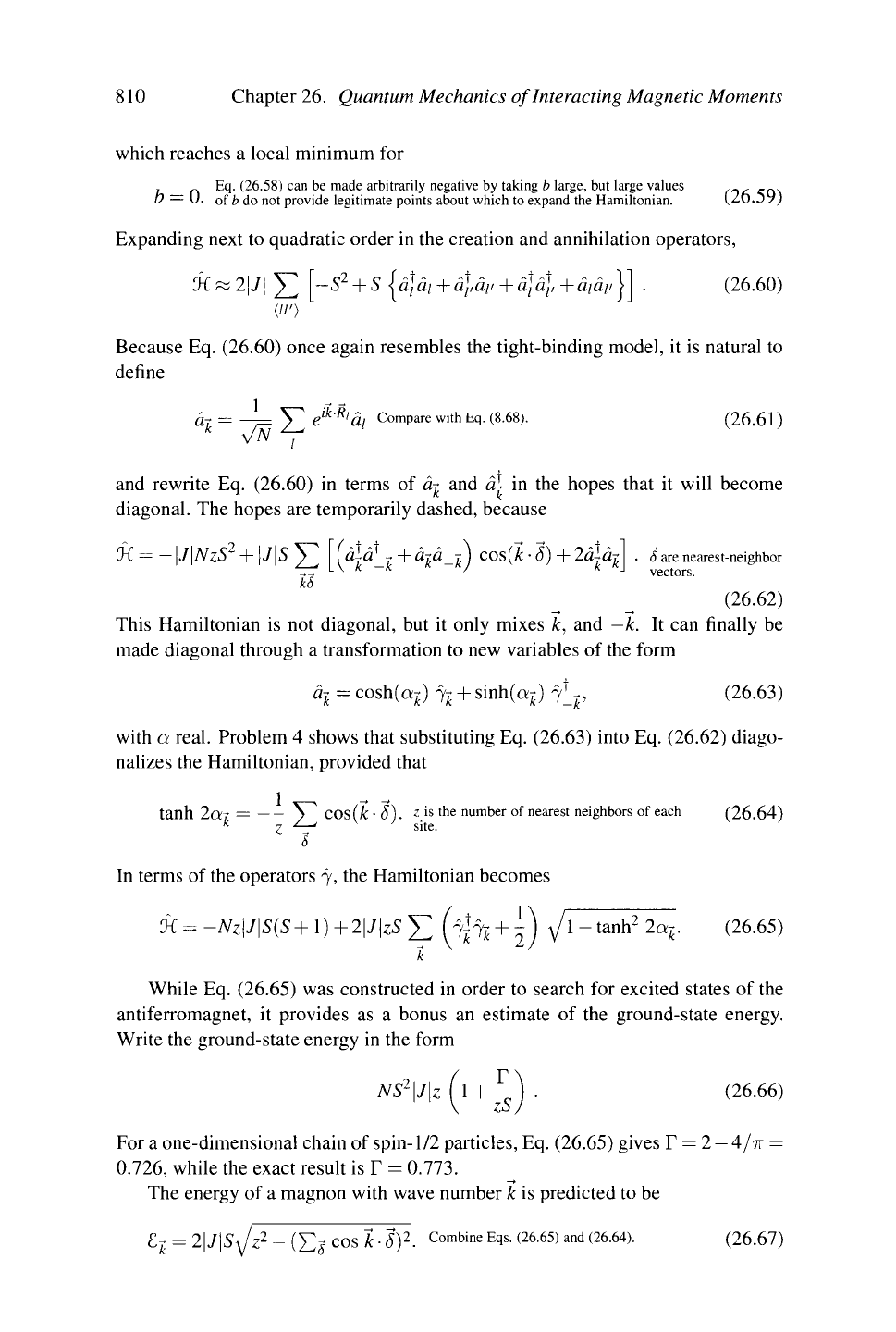
which reaches a local minimum for
,
n
Eq. (26.58) can be made arbitrarily negative by taking b large, but large values ._ , ,„
b = U. of b do not provide legitimate points about which to expand the Hamiltonian. (2t>.Dy)
Expanding next to quadratic order in the creation and annihilation operators,
!K~2|y|2_] \-~S +S l ajâi + âj,â//
+â|âj,
+ â/â//
>\
. (26.60)
Because Eq. (26.60) once again resembles the tight-binding model, it is natural to
define
ay = —= Y"
e
ik
'
R
'âi
Compare with Eq. (8.68). (26.61)
and rewrite Eq. (26.60) in terms of
ct^
and at in the hopes that it will become
diagonal. The hopes are temporarily dashed, because
Jt =
-\J\N
Z
S
2
+ \J\SJ2 [(
â
l
â]
_i +
â
k
â
-k) cos{k-5)+2at&
k
kS
<5
are nearest-neighbor
vectors.
(26.62)
This Hamiltonian is not diagonal, but it only mixes k, and —k. It can finally be
made diagonal through a transformation to new variables of the form
a\ = cosh(a^) \ + sinh(a^) 7^, (26.63)
with a real. Problem 4 shows that substituting Eq. (26.63) into Eq. (26.62) diago-
nalizes the Hamiltonian, provided that
tanh 7.0-; = V^ COs(£
•
S).
z
.
is the
number of nearest neighbors of each (26.64)
<5
In terms of the operators 7, the Hamiltonian becomes
X = -Nz\J\S(S+\) +
2\J\zSY^
(^ + ^)
y/1-tanh
2
20^. (26.65)
k
While Eq. (26.65) was constructed in order to search for excited states of the
antiferromagnet, it provides as a bonus an estimate of the ground-state energy.
Write the ground-state energy in the form
-yV5
2
|7|z (l + ^V (26.66)
For a one-dimensional chain of spin-1/2 particles, Eq. (26.65) gives F = 2
—
4/TT
=
0.726, while the exact result is F = 0.773.
The energy of a magnon with wave number k is predicted to be
£r = 2\J\SJz
2
-{T,7jC°sk-6)
2
. Combine Eqs. (26.65) and (26.64). (26.67)
Ferromagnetism in Transition Metals
811
Unlike ferromagnetic magnons, the energy of antiferromagnetic magnons rises lin-
early for small k.
The approximate prediction in Eq. (26.67) compares well with the exact one-
dimensional results for single magnon excitations. However, the lowest-energy
excitations for any given k are once again bound states, as shown by Fadeev and
Takhtajan(1981).
26.3.5 Comparison with Experiment
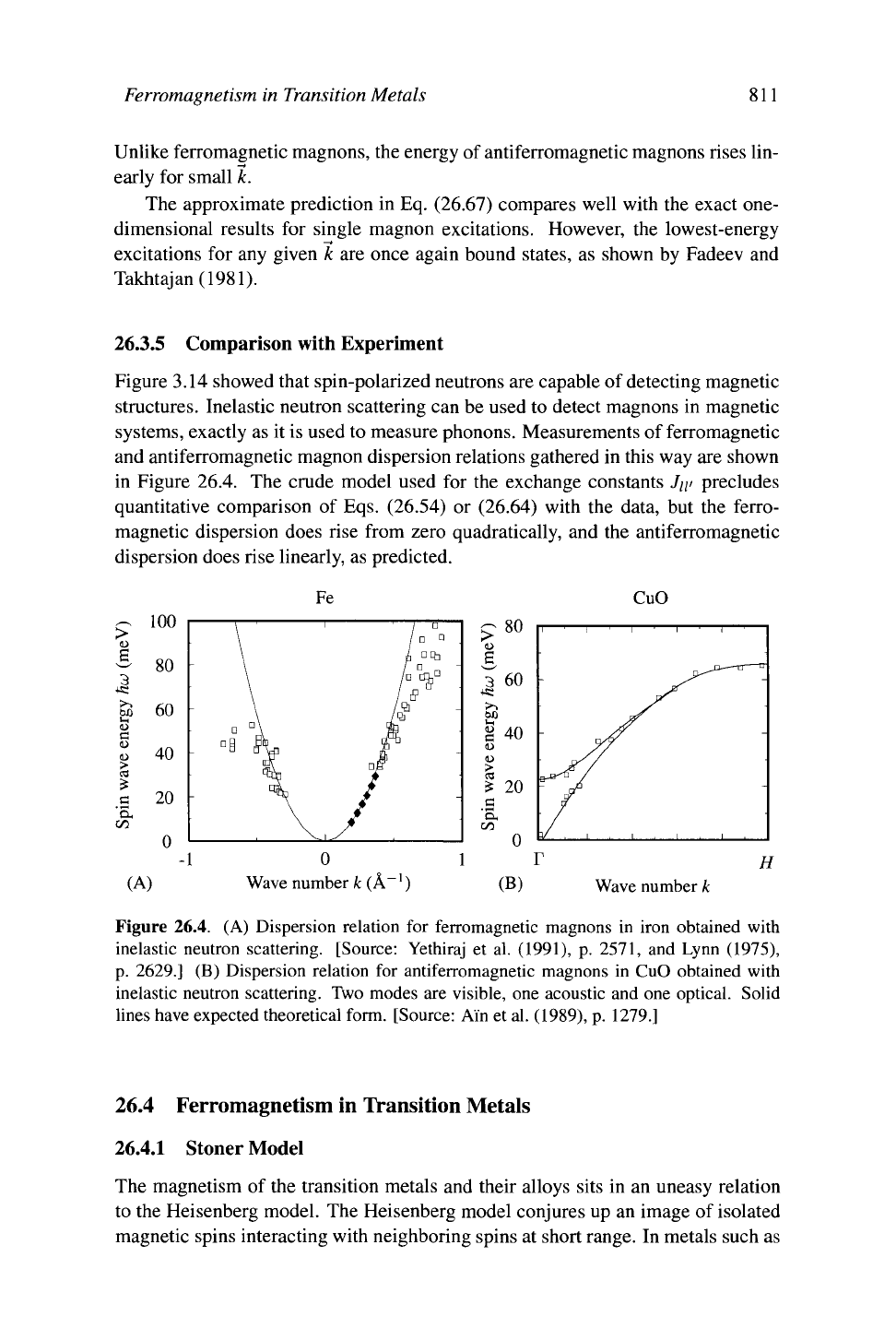
Figure 3.14 showed that spin-polarized neutrons are capable of detecting magnetic
structures. Inelastic neutron scattering can be used to detect magnons in magnetic
systems, exactly as it is used to measure phonons. Measurements of ferromagnetic
and antiferromagnetic magnon dispersion relations gathered in this way are shown
in Figure 26.4. The crude model used for the exchange constants //// precludes
quantitative comparison of Eqs. (26.54) or (26.64) with the data, but the ferro-
magnetic dispersion does rise from zero quadratically, and the antiferromagnetic
dispersion does rise linearly, as predicted.
Fe CuO
>
F
~ 80
3
«
M 60
t—t
O
e
o
u
>
c
'Si
40
20
(A)
Wave number k (Â
Wave number k
Figure 26.4. (A) Dispersion relation for ferromagnetic magnons in iron obtained with
inelastic neutron scattering. [Source: Yethiraj et al. (1991), p. 2571, and Lynn (1975),
p.
2629.] (B) Dispersion relation for antiferromagnetic magnons in CuO obtained with
inelastic neutron scattering. Two modes are visible, one acoustic and one optical. Solid
lines have expected theoretical form. [Source: Ain et al. (1989), p. 1279.]
26.4 Ferromagnetism in Transition Metals
26.4.1 Stoner Model
The magnetism of the transition metals and their alloys sits in an uneasy relation
to the Heisenberg model. The Heisenberg model conjures up an image of isolated
magnetic spins interacting with neighboring spins at short range. In metals such as
812 Chapter 26. Quantum Mechanics of Interacting Magnetic Moments
iron, the conduction electrons participate in the magnetism; they are itinerant and
carry a net magnetic moment, although they are spread throughout the crystal.
Stoner (1934) showed how to think about the coexistence of magnetism with
one-electron band theory. The two are not in conflict. A collection of Bloch elec-
trons can display a net magnetic moment if it is energetically favorable to occupy
one spin direction more heavily than the other. Depopulating one spin direction in
favor of another is guaranteed to incur a cost in kinetic and potential energy. The
size of the penalty is indicated by the inverse of the density of states D(£f
).
If the
density of states is large, many electrons can be moved into higher-energy states
that sit only a tiny bit above (what was thought to be) the Fermi energy; but if it
is small, the energies of electrons rapidly rise as they transfer from one spin direc-
tion to the other. The exchange interaction between overlapping electrons favors
ferromagnetism, so the question is which of the two effects wins.
As observed in Section 8.4.4, Wannier functions for metals can be defined, but
cannot necessarily be localized at atomic sites, and may interact with other atoms
over a long range. Writing down the exchange interaction (26.21), one should
expect very large numbers of spins to interact with each other; in the extreme case,
the interaction could become something like —J[Yli St}
2
- Because the sum over all
spin operators is a macroscopic quantity, the total magnetic moment of a crystal,
it should behave classically. Under these conditions, it should be appropriate to
replace the quantum spin operators by their average value (S).
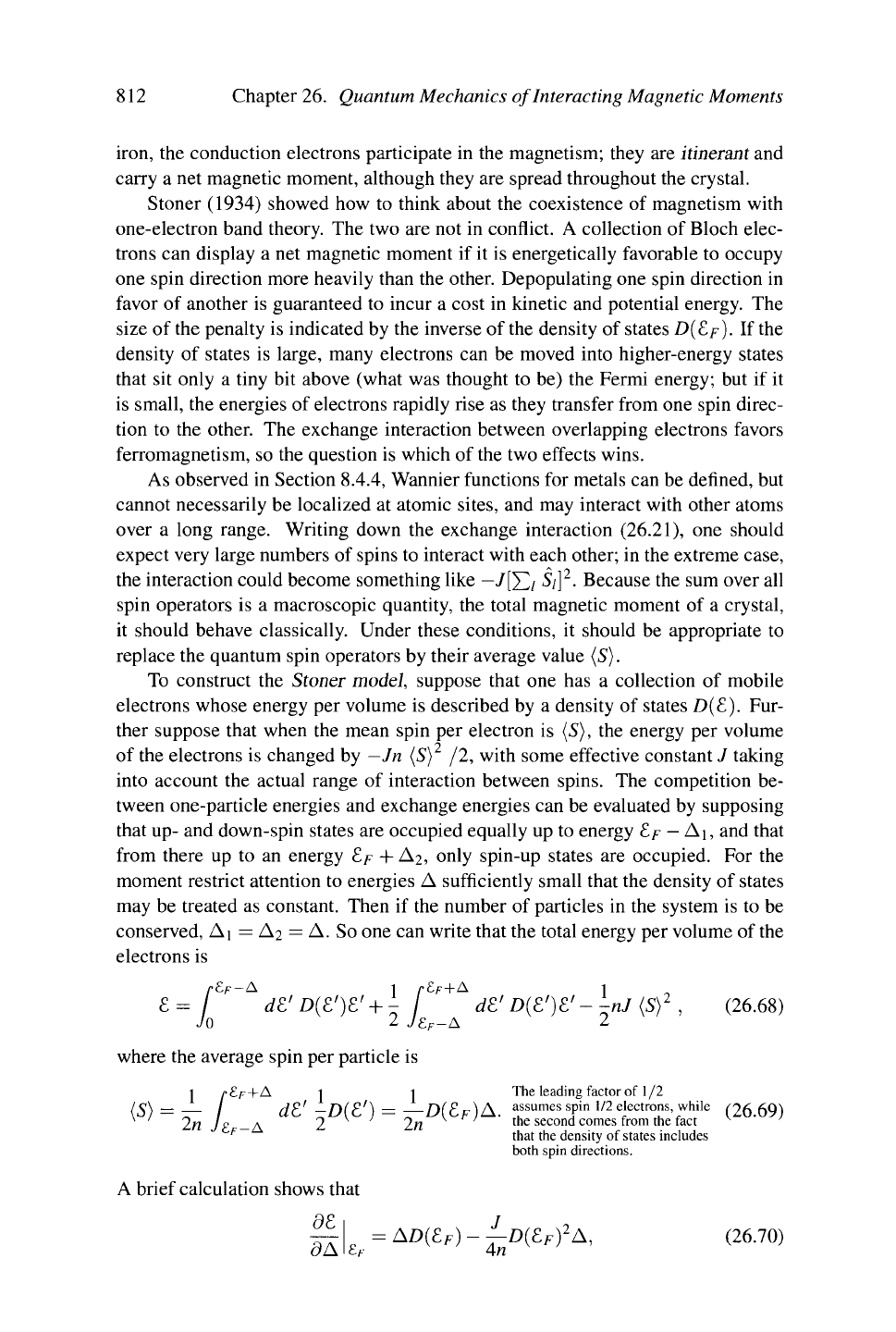
To construct the Stoner model, suppose that one has a collection of mobile
electrons whose energy per volume is described by a density of states 0(£). Fur-
ther suppose that when the mean spin per electron is (5), the energy per volume
of the electrons is changed by — Jn (S) /2, with some effective constant J taking
into account the actual range of interaction between spins. The competition be-
tween one-particle energies and exchange energies can be evaluated by supposing
that up- and down-spin states are occupied equally up to energy 8,f
—
Ai, and that
from there up to an energy £/r -f A2, only spin-up states are occupied. For the
moment restrict attention to energies A sufficiently small that the density of states
may be treated as constant. Then if the number of particles in the system is to be
conserved, Ai = A2 = A. So one can write that the total energy per volume of the
electrons is
r
£
F
-A 1 r£.
F
+A 1
£=/
d£'D(£')£' + - / dt' D(£')£' - -nJ (S)
2
, (26.68)
Jo 2 JE
F
-A 2
where the average spin per particle is
A brief calculation shows that
IfL=
AD
<
£
'>-i
D(£F
>
2A
-
(26
-
70)
The
leading factor of
1
/2
assumes
spin 1/2 electrons, while (26 69)
the
second comes from the fact
that
the density of states includes
both
spin directions.