
Marder M.P. Condensed Matter Physics
Подождите немного. Документ загружается.

Ferromagnetism in Transition Metals 813
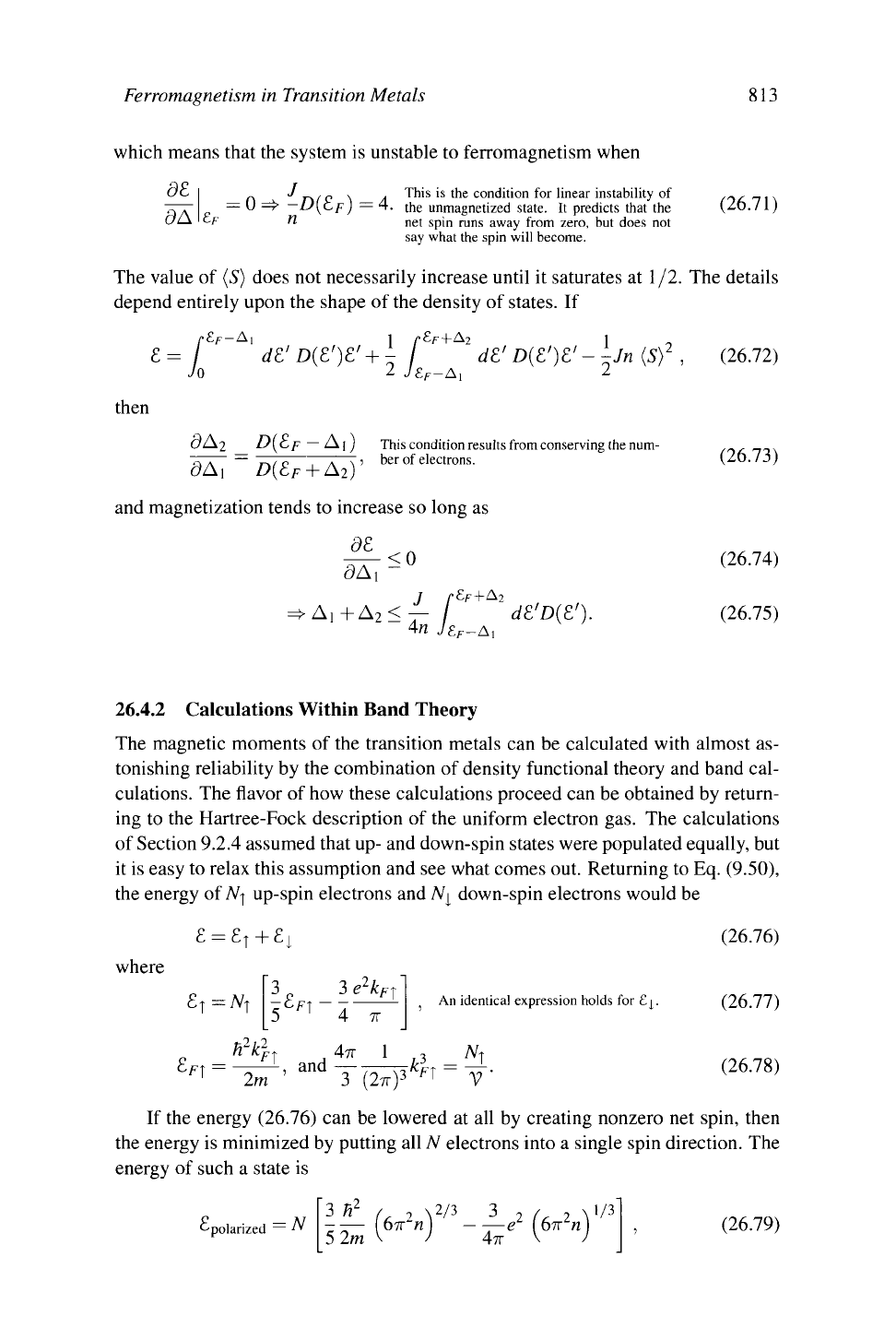
which means that the system is unstable to ferromagnetism when
dA
„ •* TWO \ A
This
is the
condition
for
linear
instability
of
0 =r> — L^Gf) = 4. the
unmagnetized
state. It
predicts
that
the
W net
spin
runs away
from
zero, but
does
not
say
what
the
spin
will
become.
(26.71)
The value of (S) does not necessarily increase until it saturates at 1/2. The details
depend entirely upon the shape of the density of states. If
J£'D(£')£'
1
2 JEf-At
£F+A
2
I
dE' D(E')8.'- ~Jn {Sy
then
0A
2
D(E
F
-Ai)
This
condition
results
from
conserving
the num-
ber of
electrons.
ÖA, D(£
f
+ A
2
)'
and magnetization tends to increase so long as
öS
dA
<0
j
r
E
F
+A
2
A,+A
2
< — / </£'£>(£').
4« i£
f
-A,
(26.72)
(26.73)
(26.74)
(26.75)
26.4.2 Calculations Within Band Theory
The magnetic moments of the transition metals can be calculated with almost as-
tonishing reliability by the combination of density functional theory and band cal-
culations. The flavor of how these calculations proceed can be obtained by return-
ing to the Hartree-Fock description of the uniform electron gas. The calculations
of Section 9.2.4 assumed that up- and down-spin states were populated equally, but
it is easy to relax this assumption and see what comes out. Returning to Eq. (9.50),
the energy of
A^
up-spin electrons and
A^
down-spin electrons would be
£ = £
T
+ £
where
^T
■
Nt
n kfr
2m
^T
, and
3e
4
A-K
2
k
F]
TT
1
An
identical
expression
holds
for £^.
3 (2vr)
3*fT
Af
T
(26.76)
(26.77)
(26.78)
If the energy (26.76) can be lowered at all by creating nonzero net spin, then
the energy is minimized by putting all N electrons into a single spin direction. The
energy of such a state is
t-polarized
— Ar
3 h
2
5 2m
(ÔTT
2
«)
2/3
4TT
6TT n)
1/3
(26.79)
814 Chapter 26. Quantum Mechanics of Interacting Magnetic Moments
and
it
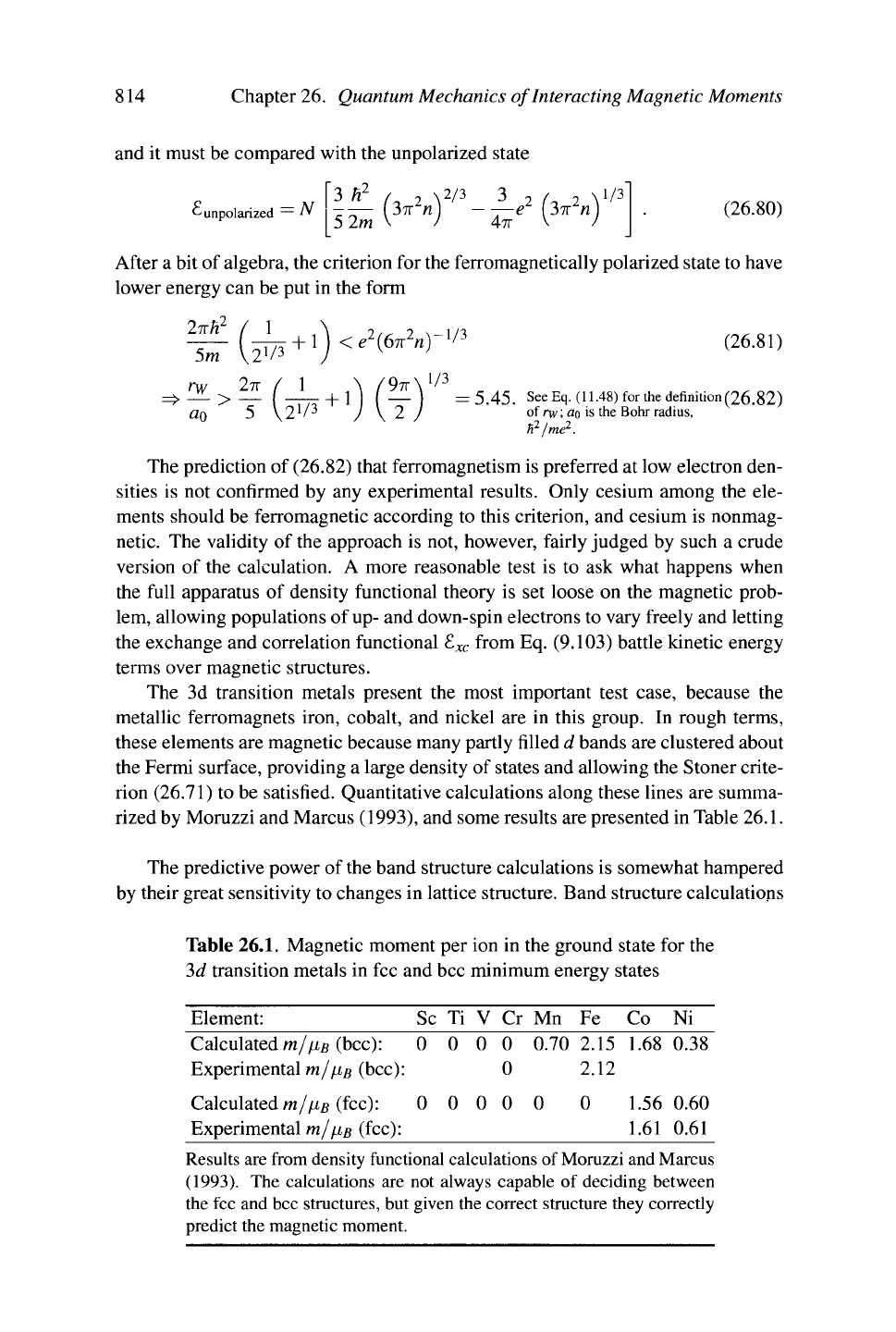
must be compared with the unpolarized state
s2
-unpolarized
= N
3^
Z
/, 2 \
2
/
3
3
2
/
2
Nl/3
3-7T
n e 37T n
5 2m
V
) ATT V 7
(26.80)
After a bit of algebra, the criterion for the ferromagnetically polarized state to have
lower energy can be put in the form
2-KH
2
5m
(^
+
l)<^
2
(67r
2
n)-
1
/
3
(26.81)
rw 27T / 1 \ /97r\ '/
3
—
> -TH + ! 1 ( =
5
-
45
-
SeeEq
-
(U-48) for
the
definition (26.82)
ÛQ
5 \
21/^
/ \ 2 / of
nv;
ao is the Bohr radius,
2/
m
„2
/i
/me
The prediction
of
(26.82) that ferromagnetism is preferred at low electron den-
sities
is
not confirmed by any experimental results. Only cesium among the ele-
ments should be ferromagnetic according to this criterion, and cesium is nonmag-
netic.
The validity
of
the approach
is
not, however, fairly judged by such
a
crude
version
of
the calculation.
A
more reasonable test
is to
ask what happens when
the full apparatus
of
density functional theory
is
set loose on the magnetic prob-
lem, allowing populations of
up-
and down-spin electrons to vary freely and letting
the exchange and correlation functional
£
xc
from Eq. (9.103) battle kinetic energy
terms over magnetic structures.
The
3d
transition metals present
the
most important test case, because
the
metallic ferromagnets iron, cobalt, and nickel are
in
this group.
In
rough terms,
these elements are magnetic because many partly filled
d
bands are clustered about
the Fermi surface, providing a large density
of
states and allowing the Stoner crite-
rion
(26.71 )
to be satisfied. Quantitative calculations along these lines are summa-
rized by Moruzzi and Marcus (1993), and some results are presented in Table 26.1.
The predictive power of the band structure calculations is somewhat hampered
by their great sensitivity to changes in lattice structure. Band structure calculations
Table 26.1. Magnetic moment per ion in the ground state for the
3d transition metals in fee and bec minimum energy states
Element:
Sc Ti V Cr Mn Fe Co Ni
Calculated
m/ßß
(bec):
0 0 0
Experimental
m/ßß
(bec):
Calculated m//x
ß
(fee):
0 0 0
Experimental
m/ßß
(fee):
Results are from density functional calculations of
Moruzzi
and Marcus
(1993).
The calculations are not always capable
of
deciding between
the fee and bec structures, but given the correct structure they correctly
predict the magnetic moment.
0
0
0
0.70
2.15
2.12
0
0
1.68
1.56
1.61
0.38
0.60
0.61
Spintronics
815
usually fail to predict experimental lattice constants to better than a few percent,
and they may have trouble correctly deciding which of several candidate lattices is
the true ground state. Equilibrium magnetic properties can vary quickly with small
changes in lattice constant, so if experiment and calculation disagree on what the
lattice constant should be, it is not clear what should be used to find the mag-
netic moment. Some remarkable predictions are nevertheless possible. Iron is bcc
at room temperature, but calculations predict that if it were fee, and if its lattice
constant were expanded by around 5% above equilibrium, it should become ferro-
magnetic with a moment of 2/^g per ion. Pescia et al. (1987) tested this prediction
by depositing a thin epitaxial layer of iron on fee copper, and they found that it was
indeed ferromagnetic.
26.5 Spintronics
Conventional electronics depends upon the manipulation of
charge.
Switches con-
trol the flow of charge currents, and the currents carry information. One hope for
the future of information processing is to move from control of charge to spin. In
one respect, spin has long been used to hold information; domains of aligned spin
form bits in magnetic recording. The vision of spintronics is to move beyond con-
trol of domains with external fields to new devices, where packets of spin travel
through wires, carrying bits as packets of charge do now. The hope is that these
devices will have lower dissipation and faster switching times than ones now used.
26.5.1 Giant Magnetoresistance
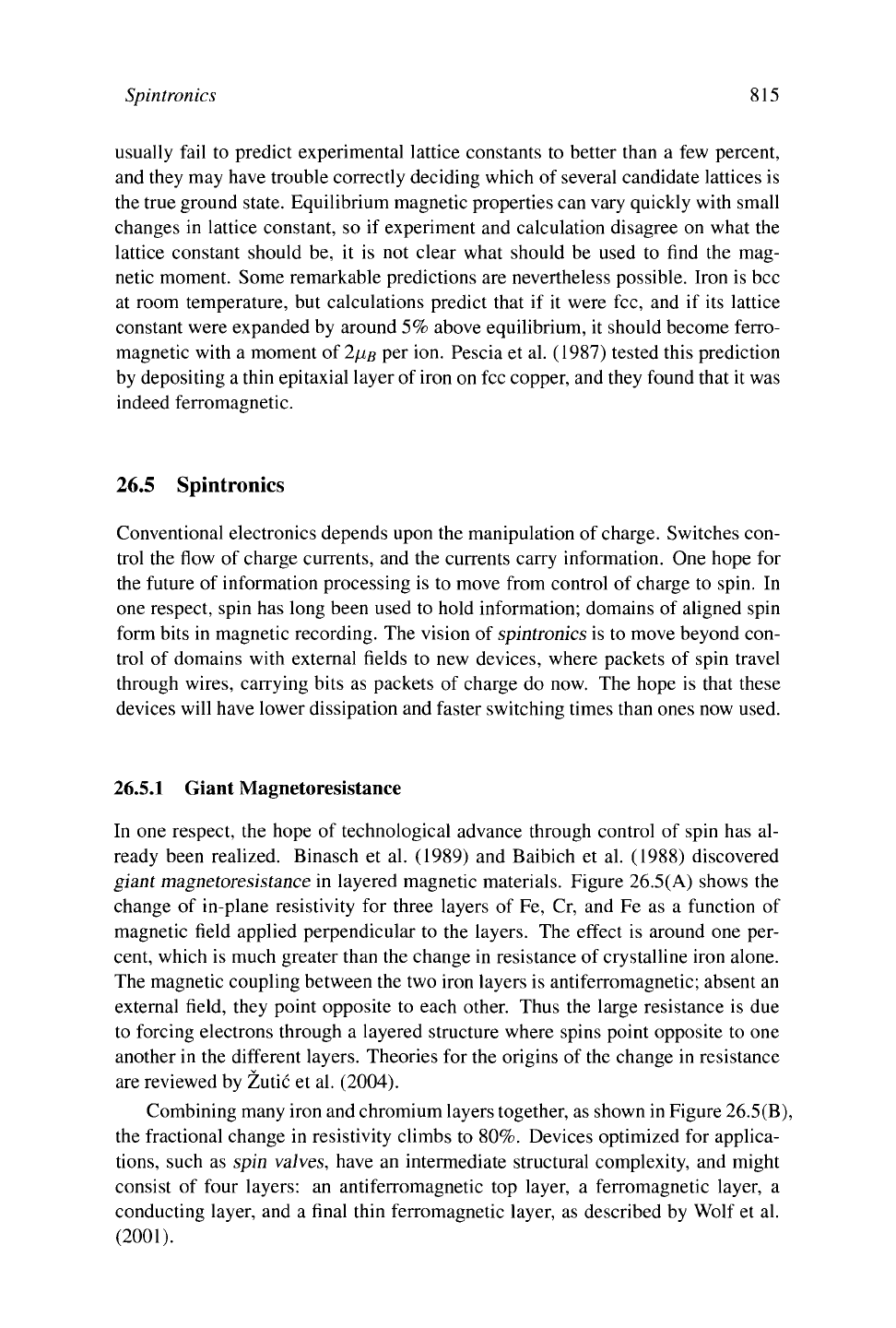
In one respect, the hope of technological advance through control of spin has al-
ready been realized. Binasch et al. (1989) and Baibich et al. (1988) discovered
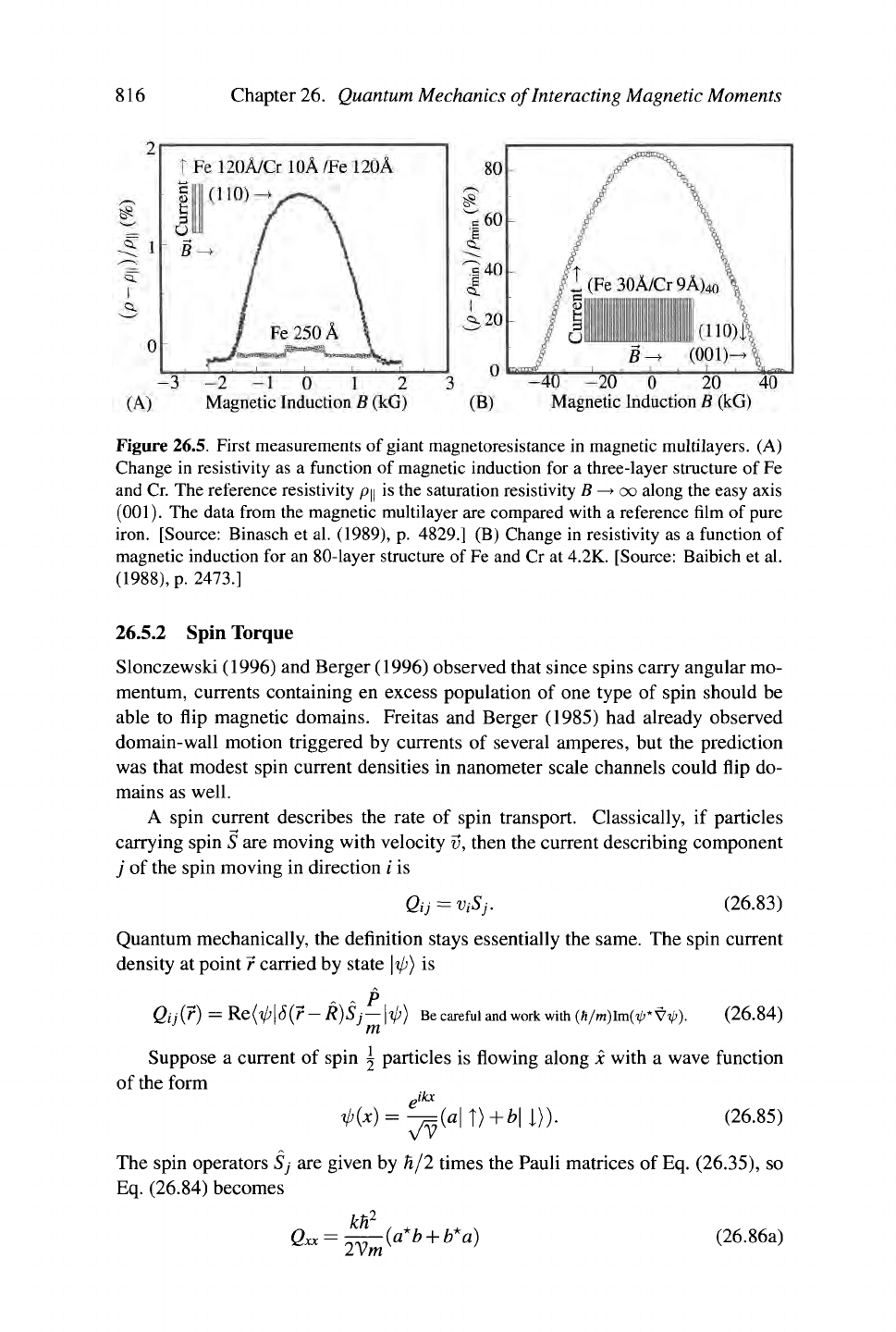
giant magnetoresistance in layered magnetic materials. Figure 26.5(A) shows the
change of in-plane resistivity for three layers of Fe, Cr, and Fe as a function of
magnetic field applied perpendicular to the layers. The effect is around one per-
cent, which is much greater than the change in resistance of crystalline iron alone.
The magnetic coupling between the two iron layers is antiferromagnetic; absent an
external field, they point opposite to each other. Thus the large resistance is due
to forcing electrons through a layered structure where spins point opposite to one
another in the different layers. Theories for the origins of the change in resistance
are reviewed by Zutic et al. (2004).
Combining many iron and chromium layers together, as shown in Figure 26.5(B),
the fractional change in resistivity climbs to 80%. Devices optimized for applica-
tions,
such as spin valves, have an intermediate structural complexity, and might
consist of four layers: an antiferromagnetic top layer, a ferromagnetic layer, a
conducting layer, and a final thin ferromagnetic layer, as described by Wolf et al.
(2001).
816 Chapter 26. Quantum Mechanics of Interacting Magnetic Moments
Figure 26.5. First measurements of giant magnetoresistance in magnetic multilayers. (A)
Change in resistivity as a function of magnetic induction for a three-layer structure of Fe
and Cr. The reference resistivity py is the saturation resistivity B
—>
oo along the easy axis
(001).
The data from the magnetic multilayer are compared with a reference film of pure
iron. [Source: Binasch et al. (1989), p. 4829.] (B) Change in resistivity as a function of
magnetic induction for an 80-layer structure of Fe and Cr at 4.2K. [Source: Baibich et al.
(1988),
p. 2473.]
26.5.2 Spin Torque
Slonczewski (1996) and Berger (1996) observed that since spins carry angular mo-
mentum, currents containing en excess population
of
one type
of
spin should
be
able
to
flip magnetic domains. Freitas and Berger (1985) had already observed
domain-wall motion triggered by currents
of
several amperes, but the prediction
was that modest spin current densities in nanometer scale channels could flip do-
mains as well.
A spin current describes the rate
of
spin transport. Classically,
if
particles
carrying spin
S
are moving with velocity
v,
then the current describing component
j of the spin moving in direction
i
is
Qij
=
vtSj. (26.83)
Quantum mechanically, the definition stays essentially the same. The spin current
density at point
r
carried by state \tp)
is
Qijij)
=
Re(lp\Ö(r
-
R)Sj—\lp) Be careful and work with (H/m)lm(ip* Vip).
(26.84)
Suppose
a
current
of
spin
\
particles
is
flowing along
x
with
a
wave function
of the form
*P(x)
= ^=(a\1)+b\l)).
(26.85)
The spin operators
Sj
are given by H/2 times the Pauli matrices of Eq. (26.35),
so
Eq. (26.84) becomes
kh
2
Qxx
=
^
r
{a
k
b + b*a) (26.86a)
2vm
Spintronics 817
Incoming spin current Ferromagnet
f//
e
2
o
a,
Potential seen by spin down electrons
2A
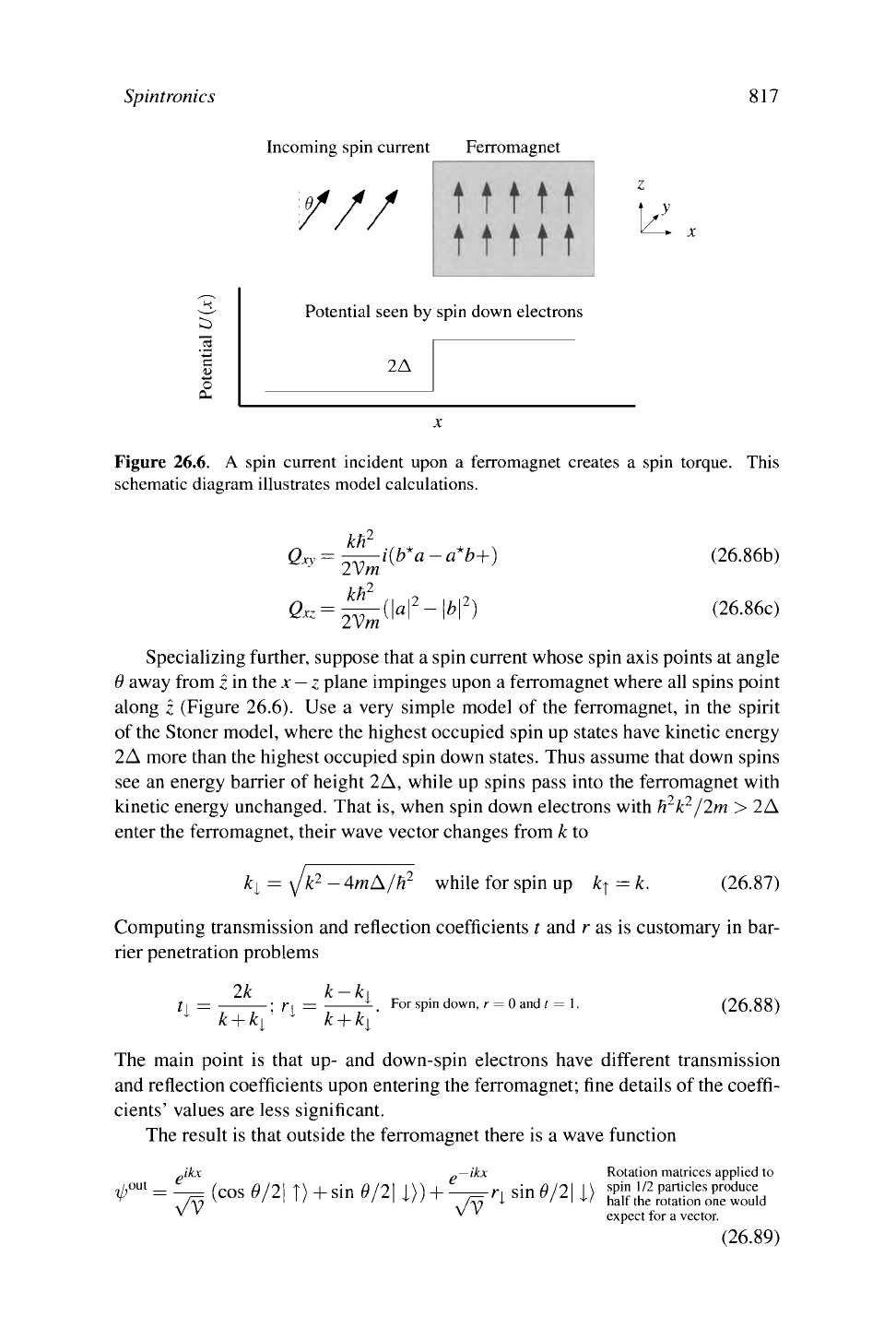
Figure 26.6. A spin current incident upon a ferromagnet creates a spin torque. This
schematic diagram illustrates model calculations.
Qxz =
kh
2
2Xhn
i(b*a-a*b+)
\a\
2
-\b\
2
)
(26.86b)
(26.86c)
Specializing further, suppose that a spin current whose spin axis points at angle
9 away from z in the x
—
z plane impinges upon a ferromagnet where all spins point
along z (Figure 26.6). Use a very simple model of the ferromagnet, in the spirit
of the Stoner model, where the highest occupied spin up states have kinetic energy
2A more than the highest occupied spin down states. Thus assume that down spins
see an energy barrier of height 2A, while up spins pass into the ferromagnet with
kinetic energy unchanged. That is, when spin down electrons with h
2
k
2
/2m > 2A
enter the ferromagnet, their wave vector changes from k to
c
l
k
2
—
4mA/H
2
while for spin up &j = k. (26.87)
Computing transmission and reflection coefficients t and r as is customary in bar-
rier penetration problems
h
2k
k + k
k-k
. a
k + k
For spin down, r = 0 and t = 1.
(26.88)
The main point is that up- and down-spin electrons have different transmission
and reflection coefficients upon entering the ferromagnet; fine details of the coeffi-
cients'
values are less significant.
The result is that outside the ferromagnet there is a wave function
Jkx
^—ikx
r
(cos 9/2\ Î) + sin 9/2\ [)) + -^
n
sin 6/2\ |) ffi?^£ÄtSd
V
Rotation matrices applied to
spin 1/2 particles pr
half the rotation one
expect for a vector.
(26.89)
818 Chapter 26. Quantum Mechanics of Interacting Magnetic Moments
100
(A)
0 0.4
Current (mA)
>
I
(B)
Time (ns)
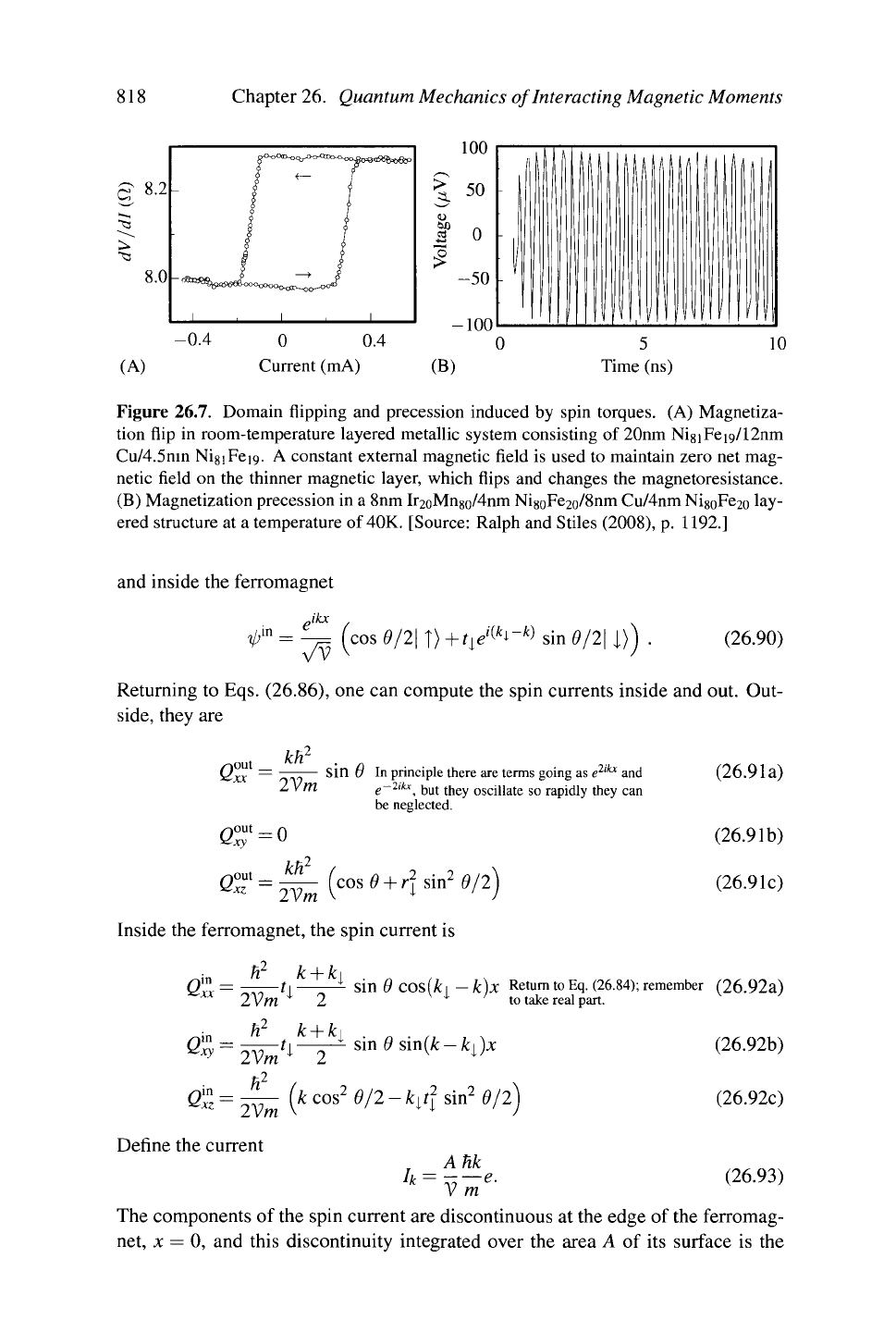
Figure 26.7. Domain flipping and precession induced by spin torques. (A) Magnetiza-
tion flip in room-temperature layered metallic system consisting of 20nm Ni
81
Fei9/12nm
Cu/4.5nm Ni
81
Fei
9
. A constant external magnetic field is used to maintain zero net mag-
netic field on the thinner magnetic layer, which flips and changes the magnetoresistance.
(B) Magnetization precession in a 8nm Ir
2
oMn
8
o/4nm Ni
8
oFe
2
o/8nm Cu/4nm Ni
80
Fe
2
o lay-
ered structure at a temperature of
40K.
[Source: Ralph and Stiles (2008), p. 1192.]
and inside the ferromagnet
„ikx
V>"
?-= (cos 0/2| T) +t
i
e^-V sin e/2\ I)) . (26.90)
Returning to Eqs. (26.86), one can compute the spin currents inside and out. Out-
side,
they are
^ 2Vm
kh
2
^
xz
2Vm
Sin u In principle there are terms going as
e
2lkx
and
x
, but they oscillate so rapidly they can
be neglected.
cos 0 + r^ sin
sin
2
6/2)
(26.91a)
(26.91b)
(26.91c)
Inside the ferromagnet, the spin current is
h
l
-}v
k + k\
O
m
-
^
xx
2Vm' 2
Sin 9 COs(k\ - k)x Return to Eq. (26.84); remember (26.92a)
to take real part.
h
l
k + ki
'-
xy
~2Xhn
ti
^2~
O
m
=
sin 6 sin(£
—
k±)x
Q
m
=
h
l
-
xz
2Vm
Define the current
(k cos
2
9/2-k^l sin
2
6/2)
w
Ahk
h=-r.—e.
V m
(26.92b)
(26.92c)
(26.93)
The components of the spin current are discontinuous at the edge of the ferromag-
net, x = 0, and this discontinuity integrated over the area A of its surface is the
Kondo Effect 819
torque N:
Use
Eq.
(26.88). (26.94a)
(26.94b)
Use?2 + r[ = l. (26.94c)
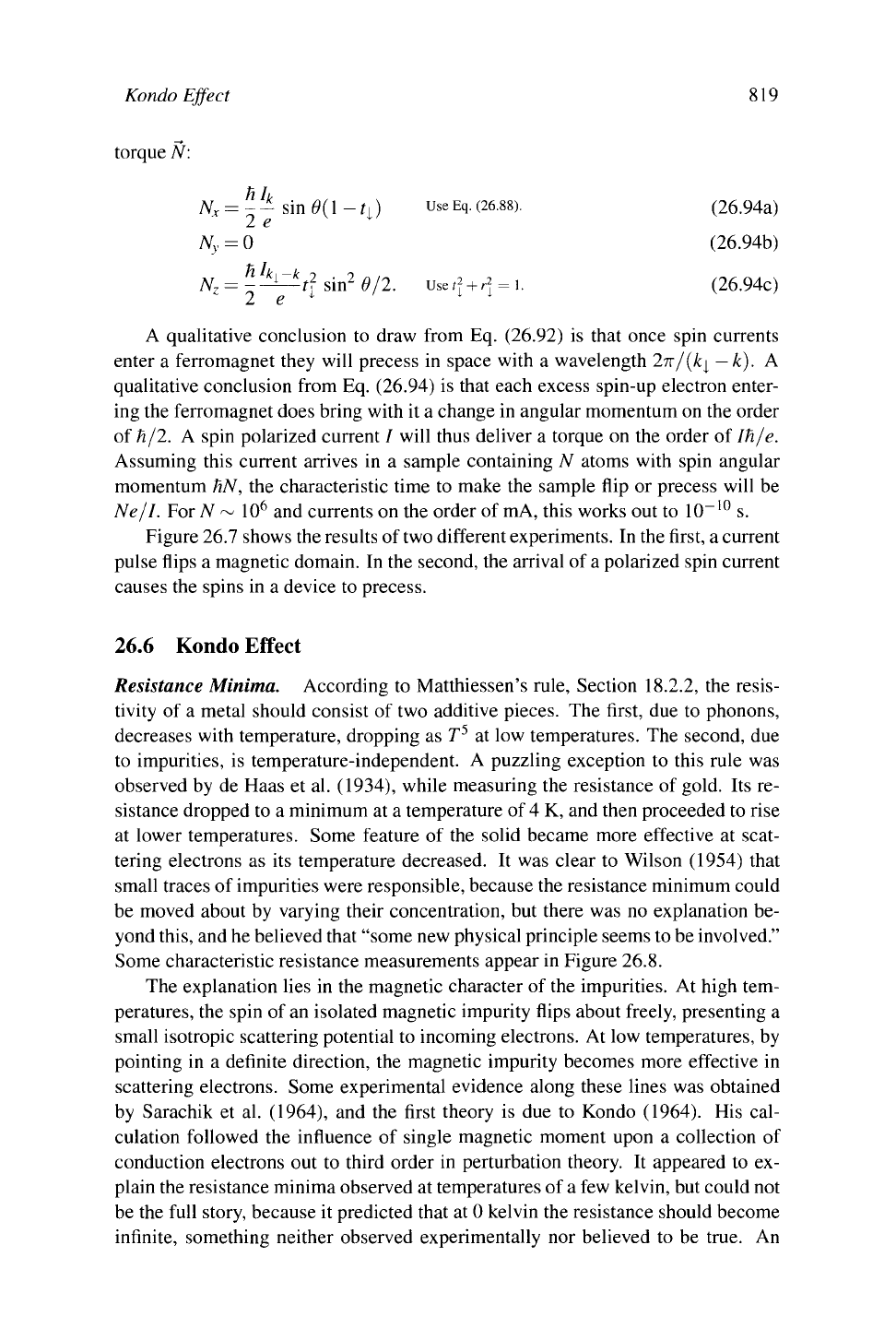
A qualitative conclusion to draw from Eq. (26.92) is that once spin currents
enter a ferromagnet they will precess in space with a wavelength 2n/{ki —k). A
qualitative conclusion from Eq. (26.94) is that each excess spin-up electron enter-
ing the ferromagnet does bring with it a change in angular momentum on the order
of h/2. A spin polarized current / will thus deliver a torque on the order of IH/e.
Assuming this current arrives in a sample containing N atoms with spin angular
momentum
HN,
the characteristic time to make the sample flip or precess will be
Ne
11.
For N ~ 10
6
and currents on the order of mA, this works out to 10~
10
s.
Figure 26.7 shows the results of
two
different experiments. In the first, a current
pulse flips a magnetic domain. In the second, the arrival of a polarized spin current
causes the spins in a device to precess.
26.6 Kondo Effect
Resistance Minima. According to Matthiessen's rule, Section 18.2.2, the resis-
tivity of a metal should consist of two additive pieces. The first, due to phonons,
decreases with temperature, dropping as T
5
at low temperatures. The second, due
to impurities, is temperature-independent. A puzzling exception to this rule was
observed by de Haas et al. (1934), while measuring the resistance of gold. Its re-
sistance dropped to a minimum at a temperature of
4
K, and then proceeded to rise
at lower temperatures. Some feature of the solid became more effective at scat-
tering electrons as its temperature decreased. It was clear to Wilson (1954) that
small traces of impurities were responsible, because the resistance minimum could
be moved about by varying their concentration, but there was no explanation be-
yond this, and he believed that "some new physical principle seems to be involved."
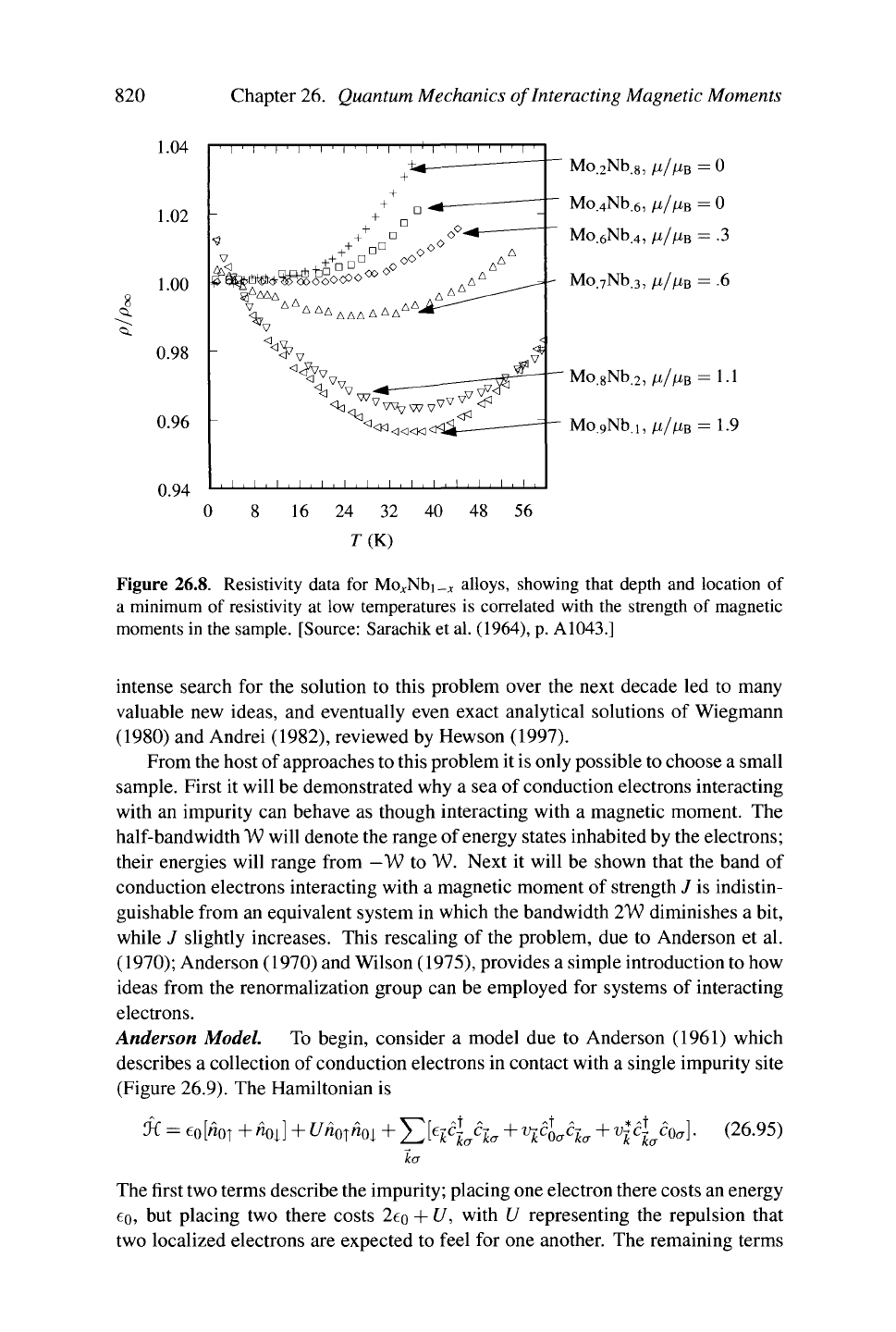
Some characteristic resistance measurements appear in Figure 26.8.
The explanation lies in the magnetic character of the impurities. At high tem-
peratures, the spin of an isolated magnetic impurity flips about freely, presenting a
small isotropic scattering potential to incoming electrons. At low temperatures, by
pointing in a definite direction, the magnetic impurity becomes more effective in
scattering electrons. Some experimental evidence along these lines was obtained
by Sarachik et al. (1964), and the first theory is due to Kondo (1964). His cal-
culation followed the influence of single magnetic moment upon a collection of
conduction electrons out to third order in perturbation theory. It appeared to ex-
plain the resistance minima observed at temperatures of a few kelvin, but could not
be the full story, because it predicted that at 0 kelvin the resistance should become
infinite, something neither observed experimentally nor believed to be true. An
N
x
= ~j sin 6(\-
tl
)
N
y
:
Hz'-
= 0
~ 2 e
-k
fj sin
0/2.
820 Chapter 26. Quantum Mechanics of Interacting Magnetic Moments
Mo.
2
Nb.
8
, ß/ß
B
=0
Mo.
4
Nb
6
, ß/ßB = 0
Mo.6Nb.4, ß/ßB
—
-3
Mo.
7
Nb.
3
, ß/ßB = -6
Mo.
8
Nb.
2
, ß/ßB = 1-1
Mo.
9
Nb.i, ß/ßB = 1-9
0 8 16 24 32 40 48 56
T(K)
Figure 26.8. Resistivity data for Mo^Nbi_
x
alloys, showing that depth and location of
a minimum of resistivity at low temperatures is correlated with the strength of magnetic
moments in the sample. [Source: Sarachik et
al.
(1964),
p.
A1043.]
intense search for the solution to this problem over the next decade led to many
valuable new ideas, and eventually even exact analytical solutions of Wiegmann
(1980) and Andrei (1982), reviewed by Hewson (1997).
From the host of approaches to this problem it is only possible to choose a small
sample. First it will be demonstrated why a sea of conduction electrons interacting
with an impurity can behave as though interacting with a magnetic moment. The
half-bandwidth W will denote the range of energy states inhabited by the electrons;
their energies will range from —
TV
to W. Next it will be shown that the band of
conduction electrons interacting with a magnetic moment of strength J is indistin-
guishable from an equivalent system in which the bandwidth 2W diminishes a bit,
while J slightly increases. This rescaling of the problem, due to Anderson et al.
(1970);
Anderson (1970) and Wilson (1975), provides a simple introduction to how
ideas from the renormalization group can be employed for systems of interacting
electrons.
Anderson
Model.
To begin, consider a model due to Anderson (1961) which
describes a collection of conduction electrons in contact with a single impurity site
(Figure 26.9). The Hamiltonian is
Ä = £0 [«0Î +
«Oil
+ £/«0î«0i + J2 h
è
\/ka + ^Aa^ka +
V
*A
a
e
°^
■
<
26
-
95
)
la
The first two terms describe the impurity; placing one electron there costs an energy
eo,
but placing two there costs
2EQ
+ U, with U representing the repulsion that
two localized electrons are expected to feel for one another. The remaining terms
8
1.U4
1.02
1.00
#«£•*$!<
\
AA
AAA
AAAA
A
A
AA
0.98
0.96
<W
<l<]<K3
<1
^'
"
I
. I . I . I . I . I . I . I . I I I . I
Kondo Effect 821
describe the conduction electrons and provide terms proportional to v^ that allow
them to interact with the impurity. In actual physical contexts, the impurity is likely
to be an atom with an unfilled outer d or f shell, and the shell will usually have
more than one orbital state available. Because the spin degrees of freedom included
in Eq. (26.95) are quite enough to produce many interesting effects, additional
orbital degeneracy can be neglected on a first pass through the theory.
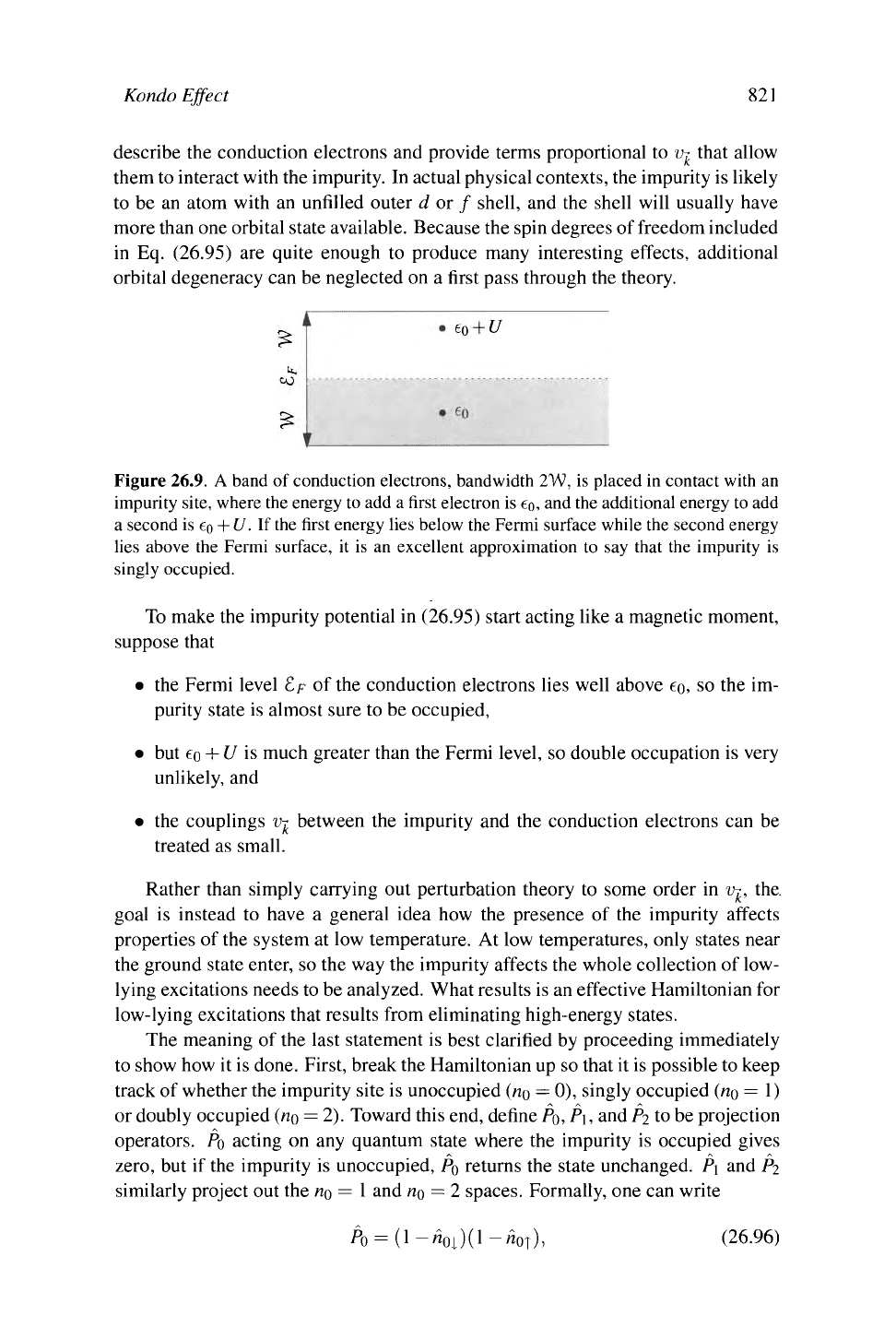
Figure 26.9. A band of conduction electrons, bandwidth 2W, is placed in contact with an
impurity site, where the energy to add a first electron is eo, and the additional energy to add
a second is
€o
+ U. If the first energy lies below the Fermi surface while the second energy
lies above the Fermi surface, it is an excellent approximation to say that the impurity is
singly occupied.
To make the impurity potential in (26.95) start acting like a magnetic moment,
suppose that
• the Fermi level £f of the conduction electrons lies well above eo, so the im-
purity state is almost sure to be occupied,
• but eo + U is much greater than the Fermi level, so double occupation is very
unlikely, and
• the couplings v-
k
between the impurity and the conduction electrons can be
treated as small.
Rather than simply carrying out perturbation theory to some order in
v-^,
the.
goal is instead to have a general idea how the presence of the impurity affects
properties of the system at low temperature. At low temperatures, only states near
the ground state enter, so the way the impurity affects the whole collection of low-
lying excitations needs to be analyzed. What results is an effective Hamiltonian for
low-lying excitations that results from eliminating high-energy states.
The meaning of the last statement is best clarified by proceeding immediately
to show how it is done. First, break the Hamiltonian up so that it is possible to keep
track of whether the impurity site is unoccupied («o = 0), singly occupied (no = 1)
or doubly occupied («o = 2). Toward this end, define PQ,P\, and
P2
to be projection
operators. Po acting on any quantum state where the impurity is occupied gives
zero,
but if the impurity is unoccupied,
PQ
returns the state unchanged. P\ and P2
similarly project out the no = 1 and no = 2 spaces. Formally, one can write
â) = (l-«0i)(l-«0î), (26.96)
822 Chapter 26. Quantum Mechanics of Interacting Magnetic Moments
with similar expressions for the other operators.
Next, letting
\ip)
be some quantum state of many electrons, let
|^o)=A#},
|Vi>=ÂM,andh/>2>=/^>. (26.97)
Also,
define
„
~ ,
For
example,
3<io gives the
Ji
u
, = PiKPv
action of the Hamiltonian on (26.98)
whatever
piece of a wave
function
has the impurity state
empty,
and it selects from the
result
whatever part is singly
occupied.
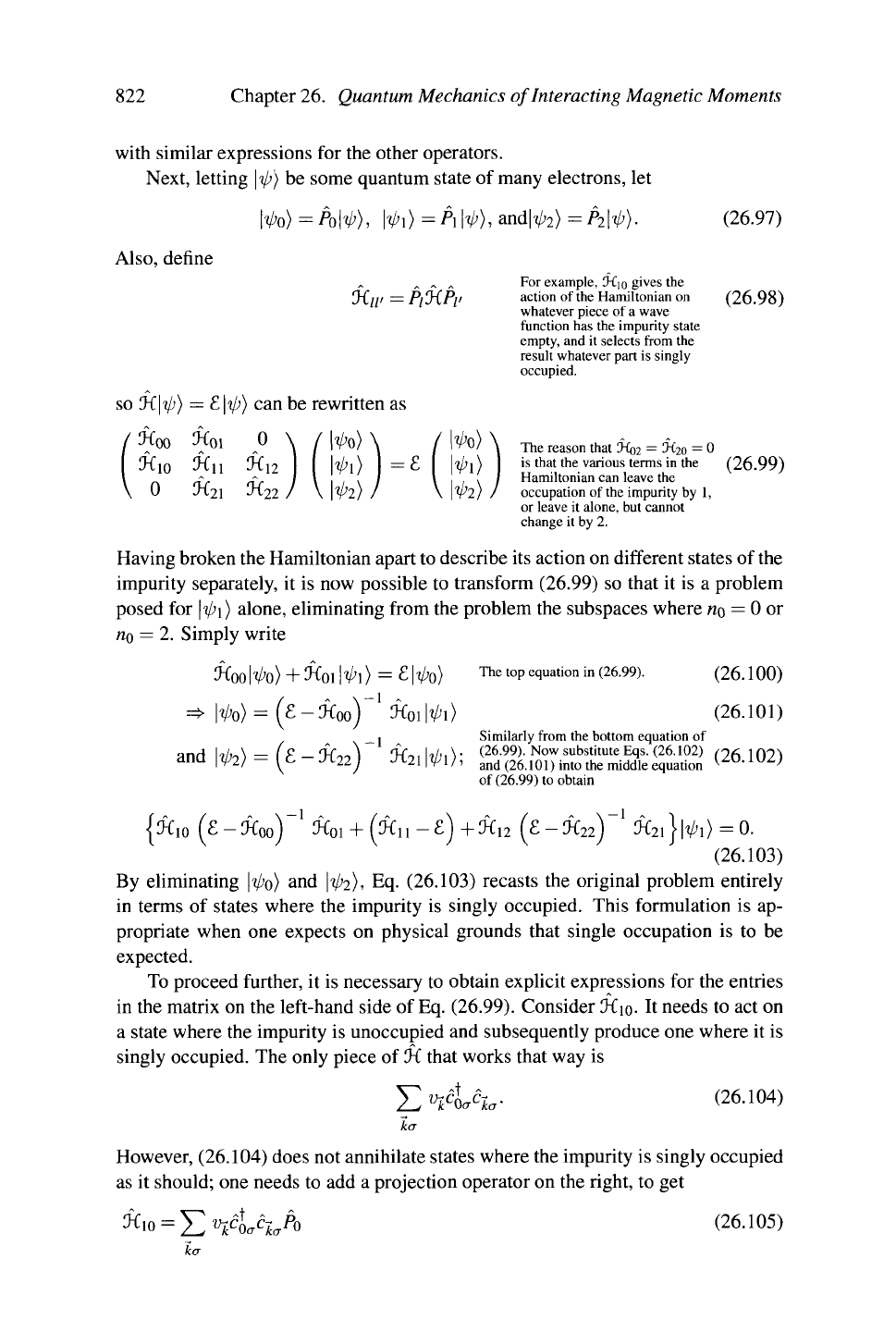
so 3i\ip) =
£.\ip)
can be rewritten as
The
reason that %%
=
3<20
=
0
is
that the various terms in the (26.99)
Hamiltonian
can leave the
occupation
of
the
impurity by 1,
or
leave it
alone,
but cannot
change
it by 2.
Having broken the Hamiltonian apart to describe its action on different states of the
impurity separately, it is now possible to transform (26.99) so that it is a problem
posed for
\ip\ )
alone, eliminating from the problem the subspaces where
no
=
0 or
no = 2. Simply write
Ä
00
|^o)+Äoi|^l)
=
£|^o) The top equation in
(26.99).
(26.100)
=>
|Vo}
=
(fi-Äoo)^
1
Ä01IV1) (26.101)
_
I
Similarly from the bottom equation of
and|^2)
=
(£-Ä
22
)' Ä
21
|^>; %^&£^%%® Q6.102)
of (26.99) to obtain
{Äio (£-Äoo)
-1
Ä
0
i
+
(Ä
1
i-£)+Äi2 (£-Ä22)
_1
Ä
2
i}^i)=0.
(26.103)
By eliminating |^o) and |^
2
), Eq. (26.103) recasts the original problem entirely
in terms of states where the impurity is singly occupied. This formulation is ap-
propriate when one expects on physical grounds that single occupation is to be
expected.
To proceed further, it is necessary to obtain explicit expressions for the entries
in the matrix on the left-hand side of
Eq.
(26.99). Consider
CKi
0
.
It needs to act on
a state where the impurity is unoccupied and subsequently produce one where it is
singly occupied. The only piece of
"K
that works that way is
£
H^la-
(
26
-
104
)
ka
However, (26.104) does not annihilate states where the impurity is singly occupied
as it should; one needs to add a projection operator on the right, to get
Ä
IO
=
E¥O/J/O (26.105)
ka