
Marder M.P. Condensed Matter Physics
Подождите немного. Документ загружается.

Kondo Effect 823
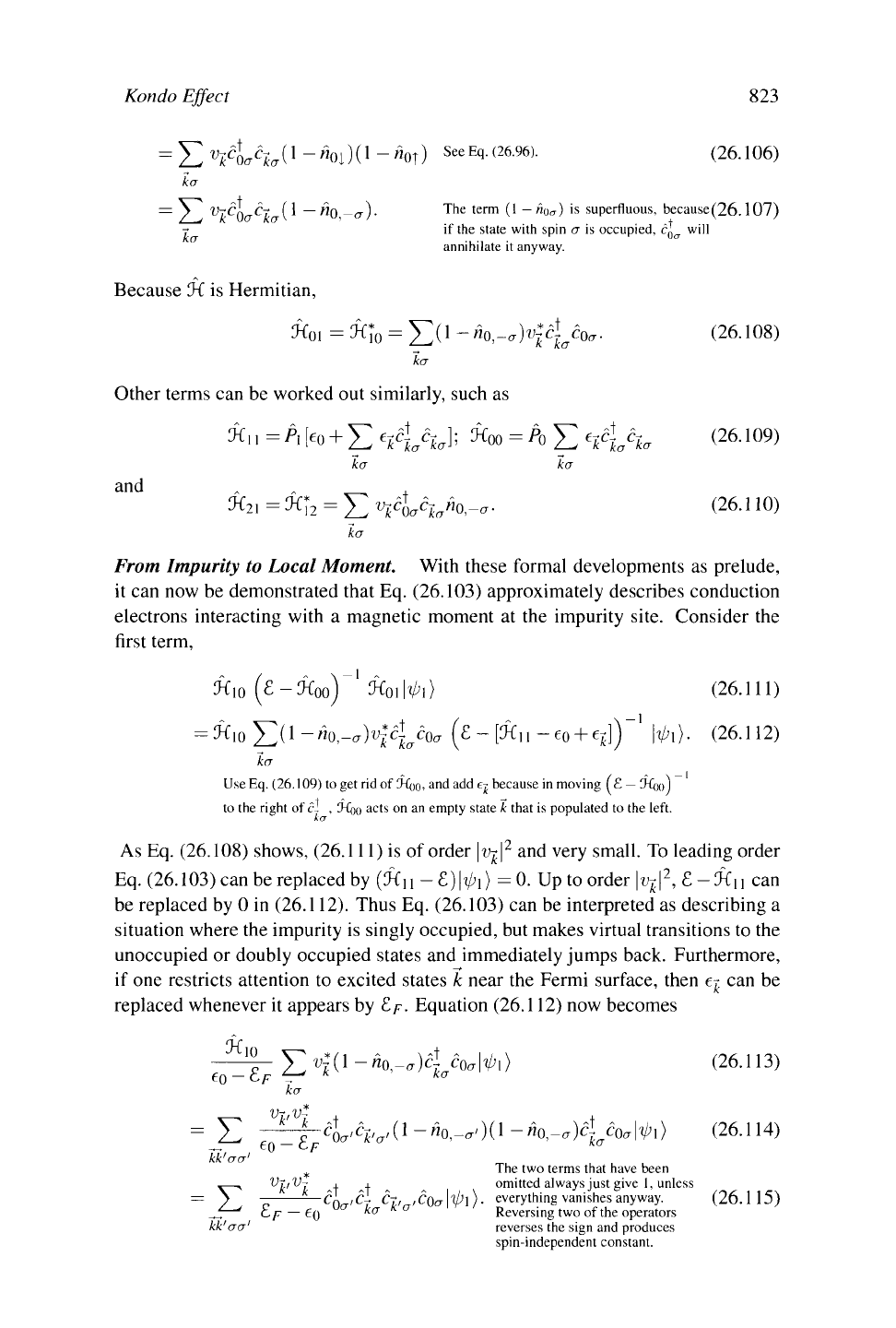
E VL^(1-"0I)(1-"0T)
See Eq.
(26.96).
(26.106)
ka
=
2_,
v
^0a^~k(T^ ~
"0,-cr)-
The term
(' -"ou) is superfluous, because(26.107)
r
if the state with spin a is occupied, cj will
annihilate
it anyway.
Because "K is Hermitian,
Äoi =
Äto
= Ç(l -«
0
,->f4>- (26.108)
to-
other terms can be worked out similarly, such as
t^];Äoo
=
A)E^L
and
^2i = ^Î2 = E V(U*>.-- (26-
110
)
From Impurity to Local Moment. With these formal developments as prelude,
it can now be demonstrated that Eq. (26.103) approximately describes conduction
electrons interacting with a magnetic moment at the impurity site. Consider the
first term,
Ä,o(£-Äoo)
_1
Äoi|^i) (26.111)
= Ä
lo
C(l-no,->|4>- (S-IÄn-eo + erj)"' |Vi). (26.112)
la
UseEq. (26.109) to get
rid of
CKoo,
and add
ej
because in moving
(£
—
9^oo)
to the right
of ct ,
CK«) acts
on an
empty state
k
that
is
populated
to
the left.
ko
As Eq. (26.108) shows, (26.111) is of order
|urj
2
and very small. To leading order
Eq. (26.103) can be replaced by (Jiw
—
£)|^i) = 0. Up to order
|f^|
2
,
£
—
An can
be replaced by 0 in (26.112). Thus Eq. (26.103) can be interpreted as describing a
situation where the impurity is singly occupied, but makes virtual transitions to the
unoccupied or doubly occupied states and immediately jumps back. Furthermore,
if one restricts attention to excited states k near the Fermi surface, then er can be
' k
replaced whenever it appears by £/?. Equation (26.112) now becomes
5(10
£^*(l-/fo,-
ff
)c| co^i) (26.113)
en
—
£F - * '
kcr
ka
■ ^ -^cL'^a'(
1
-"o,-
ff
')(l-«o,-<r)êLêo
ff
|V'i> (26.114)
eo t,f
kk'aa'
The
two terms that have been
E
f^,fy . i ^ omitted
always
just give 1, unless
~c
^OCT'^7
Cpn-iC0o\lp\)- everything vanishes anyway.
(26.115)
Cf
— Co *
CT
Reversing two
of
the operators
kk'aa'
reverses the sign and produces
spin-independent constant.
824 Chapter 26. Quantum Mechanics of Interacting Magnetic Moments
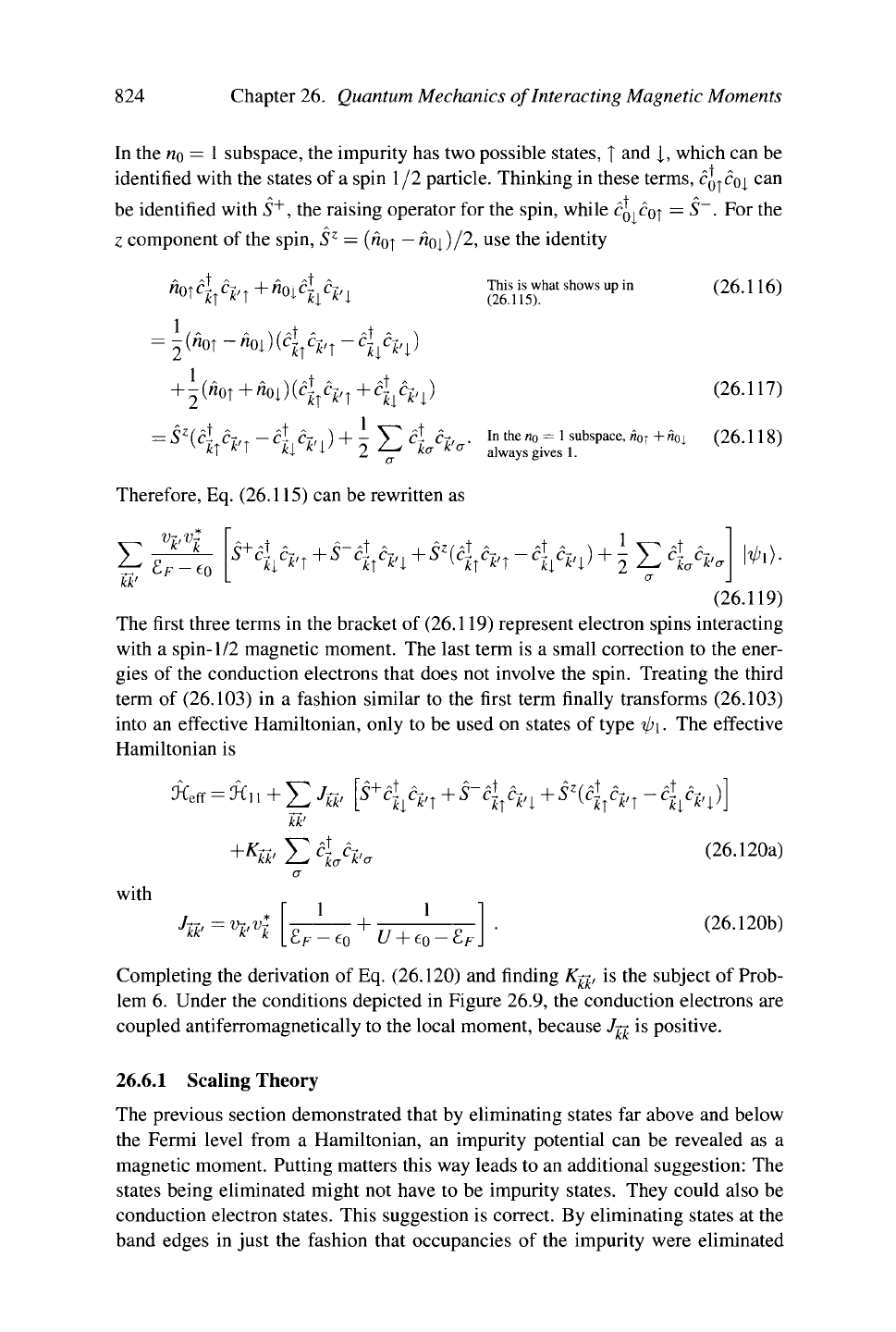
In the no =
1
subspace, the impurity has two possible states, | and
j,
which can be
identified with the states of a spin 1/2 particle. Thinking in these terms,
cLcoj.
can
be identified with S
+
, the raising operator for the spin, while cj, cof = S~. For the
z component of the spin, S
z
—
(«of
—
"o|)/2, use the identity
not ci er,
t
+ n
0
, cî cv,,
This is what shows
U
P
in
(26.116)
U|
*î *'î
Ui
k[ k'l
(26.115).
+
2 ("OT
+
«Oi ) (c|
T
c^,
T
+ cî^
cj,
x
)
(26.117)
— S
z
(cl Cr
/f
—
cl,Cr,,) + - Y^ cl Cr, . In the «
0
=
1
subspace, n
0
T +
«0|
(26.118)
V
tî *'î k[ k'l> 2 ^ ka k'a
alwaysgivesl
.
v ;
Therefore, Eq. (26.115) can be rewritten as
V
v
l'
v
l
^ £F"€0
kk!
§+ê
li
ê
ï'î
+§
~
ê
h
ê
î>i
+§
%
ê
^-
e
li
ê
î'iï
+ 2
£ 4/^
IV'i)-
(26.119)
The first three terms in the bracket of (26.119) represent electron spins interacting
with a spin-1/2 magnetic moment. The last term is a small correction to the ener-
gies of the conduction electrons that does not involve the spin. Treating the third
term of (26.103) in a fashion similar to the first term finally transforms (26.103)
into an effective Hamiltonian, only to be used on states of type ip\. The effective
Hamiltonian is
Äeff = Ä,i +Ç J
Tk
, [s+cl^+S-cl^^ +S
z
{c
]
M
c
l
,
]
-c\
i
c
lli
)_
kk'
+%E4A„
(
26
-
120a
)
with
, * r i . i
+
£
f
- e
0
U + e
0
-
8-F
(26.120b)
Completing the derivation of Eq. (26.120) and finding K^, is the subject of Prob-
lem 6. Under the conditions depicted in Figure 26.9, the conduction electrons are
coupled antiferromagnetically to the local moment, because
J-g,
is positive.
26.6.1 Scaling Theory
The previous section demonstrated that by eliminating states far above and below
the Fermi level from a Hamiltonian, an impurity potential can be revealed as a
magnetic moment. Putting matters this way leads to an additional suggestion: The
states being eliminated might not have to be impurity states. They could also be
conduction electron states. This suggestion is correct. By eliminating states at the
band edges in just the fashion that occupancies of the impurity were eliminated
Kondo Effect
825
before, the coupling between conduction electrons and a local magnetic moment
can be made to grow. A whole family of different Hamiltonians is thereby shown
to be equivalent, some with strong coupling to the spin and a small bandwidth,
others with a weak coupling to the spin and a large bandwidth. The final result is
quite simple, and it appears in Eq. (26.129).
The starting Hamiltonian is a simplified version of the Hamiltonian found in
Eq. (26.120):
J<-
V eve! er +V; Is'cl cp, +S
+
clc
llt
+S
C
kfk'î
C
ki
C
k'l
kk'
(26.121)
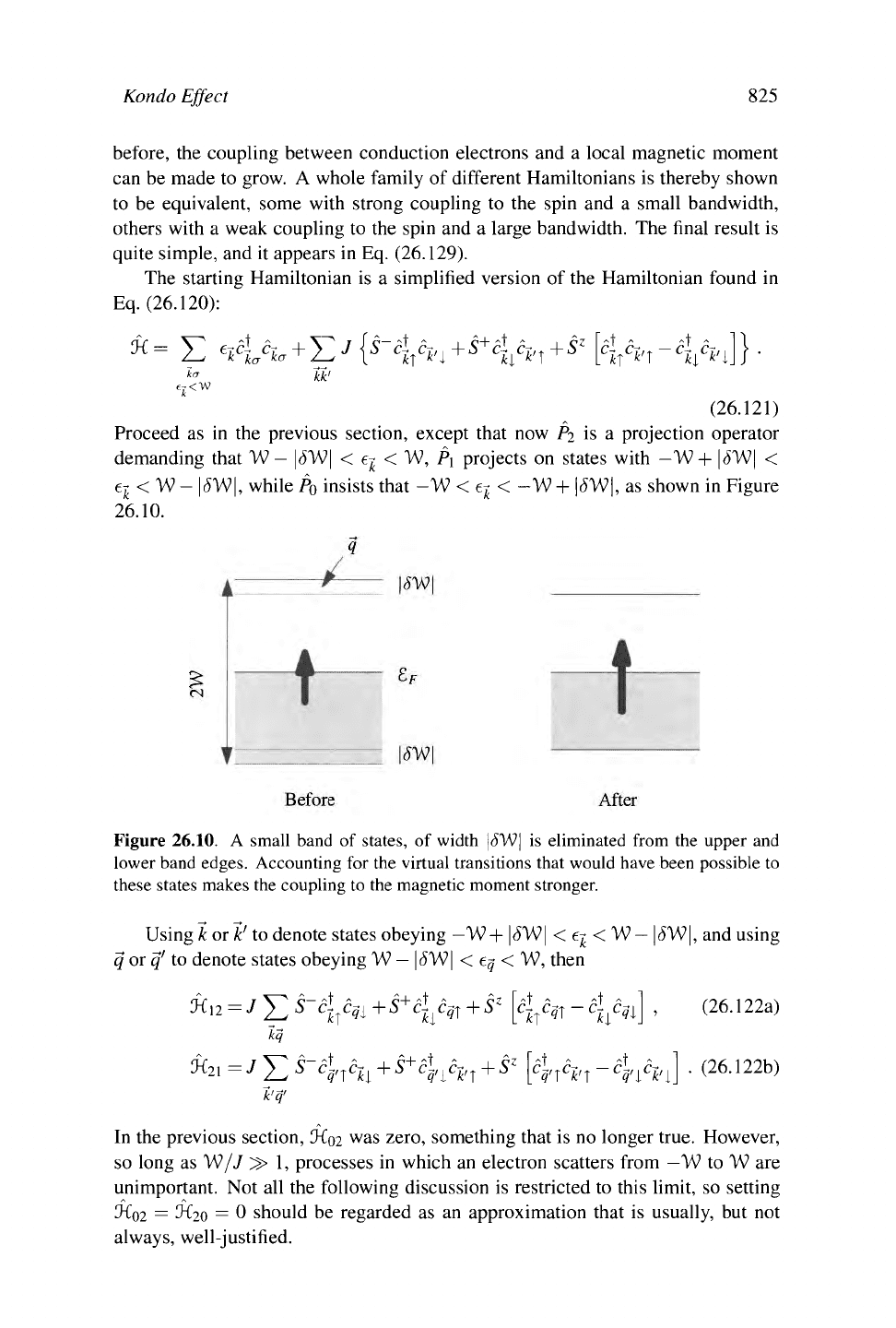
Proceed as in the previous section, except that now Pj is a projection operator
demanding that W
—
\SW\ < ej < W, P\ projects on states with —W+ |<5W| <
e^ < W
—
|<5W|, while
PQ
insists that —"W < e^ < —W+ |<5W|, as shown in Figure
26.10.
Figure 26.10. A small band of states, of width |<$W| is eliminated from the upper and
lower band edges. Accounting for the virtual transitions that would have been possible to
these states makes the coupling to the magnetic moment stronger.
Using kork' to denote states obeying —"W+ \SW\ < ej < "W— |<TW|, and using
q or q' to denote states obeying W
—
|<TW| < e^ < W, then
iin = J £ S-c\c
ni
+S
+
c\c^+S
k[
kq
Ä
2
1=7^5 4'î%+^
+
4l^'î
+
^
ê
\f®-
è
ïM
C
q'fk'}
C
q'ï
C
k'[
(26.122a)
(26.122b)
k'q'
In the previous section, Ä02 was zero, something that is no longer true. However,
so long as W/J S> 1, processes in which an electron scatters from —W to W are
unimportant. Not all the following discussion is restricted to this limit, so setting
Ä02 = Ä20 = 0 should be regarded as an approximation that is usually, but not
always, well-justified.
826 Chapter 26. Quantum Mechanics of Interacting Magnetic Moments
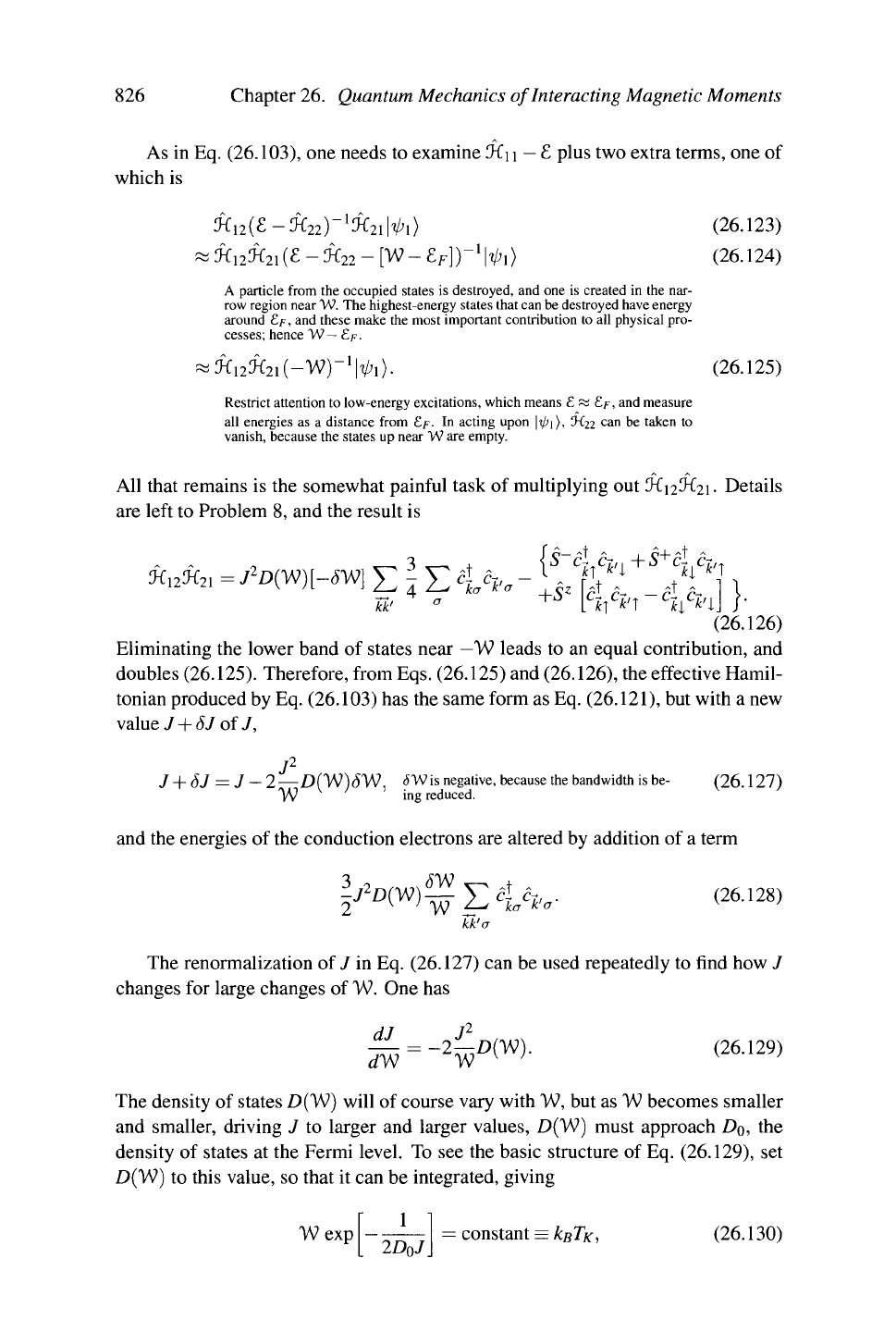
As in Eq. (26.103), one needs to examine Äi
i —
£ plus two extra terms, one of
which
is
^(fi-^-'ÄzilVi) (26.123)
«ftÄCE-Ä^-riV-^])-
1
^!)
(
26
-
124
)
A
particle from the occupied states is destroyed, and one is created in the nar-
row
region near W. The highest-energy states that can be destroyed have energy
around
£f,
and these make the most important contribution to all physical
pro-
cesses;
hence W—
£f.
-£12^21 (-W)->|Vi>- (26.125)
Restrict
attention to low-energy
excitations,
which means
£
ss
£f,
and measure
all
energies as
a
distance from
£f.
In acting upon
\tpi),
Ä22 can be taken
to
vanish,
because the states up near W are empty.
All that remains is the somewhat painful task
of
multiplying out
Ä12Ä21.
Details
are left to Problem 8, and the result is
Ä„Ä
2I
=j>D<w[-m
E \ E
t^-fe^
n+È+
fc
P
\
x
(26.126)
Eliminating the lower band
of
states near —W leads to an equal contribution, and
doubles (26.125). Therefore, from
Eqs.
(26.125) and (26.126), the effective Hamil-
tonian produced by Eq. (26.103) has the same form as Eq. (26.121), but with a new
value J + 8J of
J,
ß
J
+ fiJ
=
J
— 2—D(W)S'W,
<5W
is
negative, because the bandwidth is be- (26.127)
W
'
ing reduced.
and the energies of the conduction electrons are altered by addition of a term
^)W?i
;
iv
(26.128)
kk'o
The renormalization of 7 in Eq. (26.127) can be used repeatedly to find how J
changes for large changes of W. One has
^
=
-2^(W). (26.129)
The density of states D(W) will of course vary with W, but as W becomes smaller
and smaller, driving
J to
larger and larger values, D(W) must approach Do,
the
density
of
states at the Fermi level. To see the basic structure of Eq. (26.129),
set
D(W) to this value, so that it can be integrated, giving
"W
exp
1
2D
0
J
constant
=
ICBTK,
(26.130)
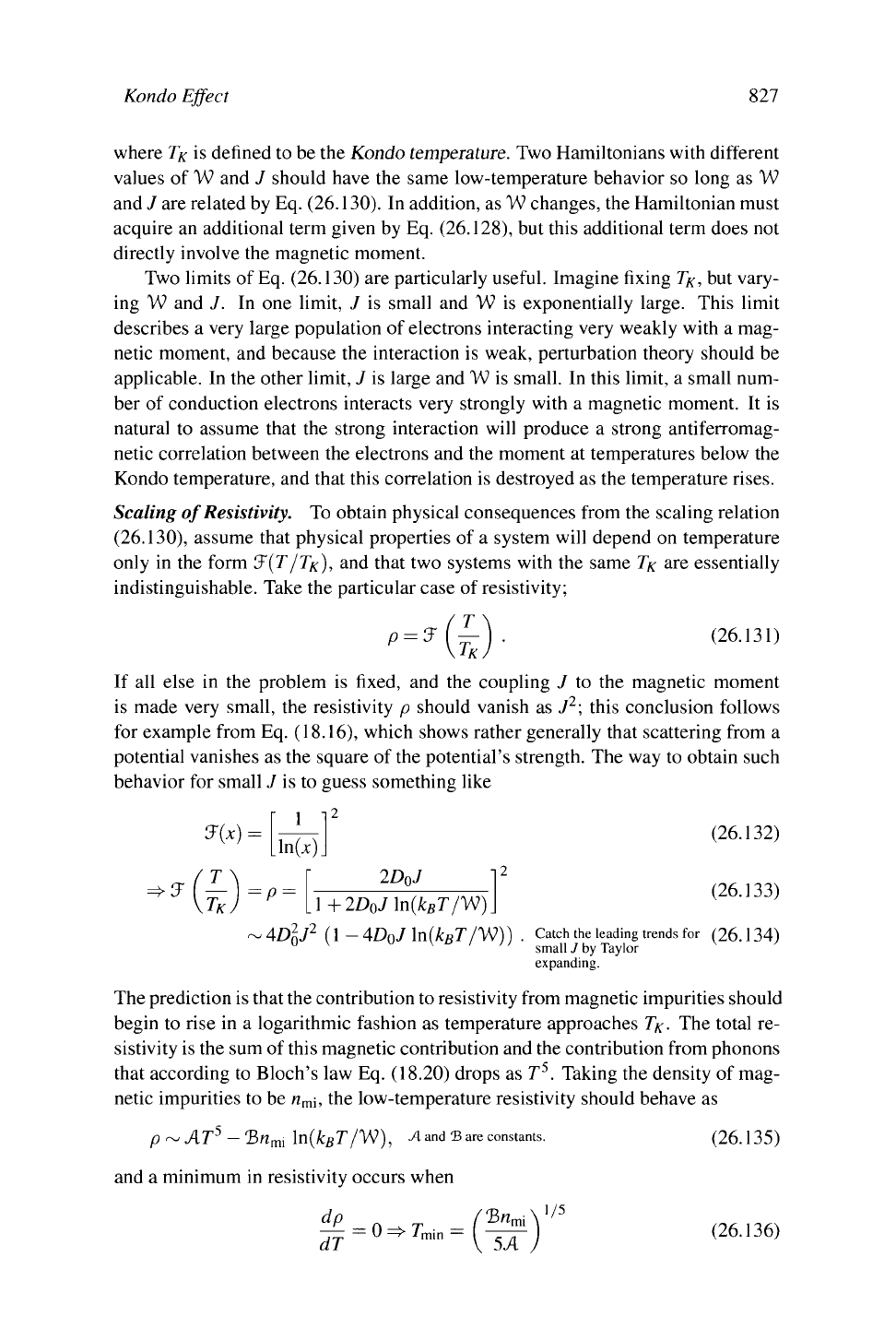
Kondo Effect
827
where
TK
is defined to be the Kondo
temperature.
Two Hamiltonians with different
values of
"W
and J should have the same low-temperature behavior so long as W
and J are related by Eq. (26.130). In addition, as
"W
changes, the Hamiltonian must
acquire an additional term given by Eq. (26.128), but this additional term does not
directly involve the magnetic moment.
Two limits of
Eq.
(26.130) are particularly useful. Imagine fixing
TK,
but vary-
ing W and J. In one limit, J is small and "W is exponentially large. This limit
describes a very large population of electrons interacting very weakly with a mag-
netic moment, and because the interaction is weak, perturbation theory should be
applicable. In the other limit, J is large and W is small. In this limit, a small num-
ber of conduction electrons interacts very strongly with a magnetic moment. It is
natural to assume that the strong interaction will produce a strong antiferromag-
netic correlation between the electrons and the moment at temperatures below the
Kondo temperature, and that this correlation is destroyed as the temperature rises.
Scaling of Resistivity. To obtain physical consequences from the scaling relation
(26.130), assume that physical properties of a system will depend on temperature
only in the form "J(T /TK), and that two systems with the same
TK
are essentially
indistinguishable. Take the particular case of resistivity;
P
-V
(26.131)
If all else in the problem is fixed, and the coupling / to the magnetic moment
is made very small, the resistivity p should vanish as J
2
; this conclusion follows
for example from Eq. (18.16), which shows rather generally that scattering from a
potential vanishes as the square of the potential's strength. The way to obtain such
behavior for small J is to guess something like
3"
?(x) =
T
TK
1
i2
ln(jc)
2D
Q
J
l2
>4Dlfi
\+2D
Q
J\n{k
B
T/W)
1
(26.132)
(26.133)
4D
0
J \n(k
B
T/VJ)) . Catch the leading trends for (26.134)
small J by Taylor
expanding.
The prediction is that the contribution to resistivity from magnetic impurities should
begin to rise in a logarithmic fashion as temperature approaches 7>. The total re-
sistivity is the sum of this magnetic contribution and the contribution from phonons
that according to Bloch's law Eq. (18.20) drops as T
5
. Taking the density of mag-
netic impurities to be n
mi
, the low-temperature resistivity should behave as
■
AT
5
- Bn
mi
ln(k
B
T/W),
-A
and
23
are constants.
P'
and a minimum in resistivity occurs when
dp
dT
=
0=>
T
min
=
£nmi\
1/5
5A
(26.135)
(26.136)
828 Chapter 26. Quantum Mechanics of Interacting Magnetic Moments
The shape of the resistivity minimum in Figure 26.8 and the movement of the min-
imum with magnetic impurity density
n„à
are well accounted for by Eq. (26.135).
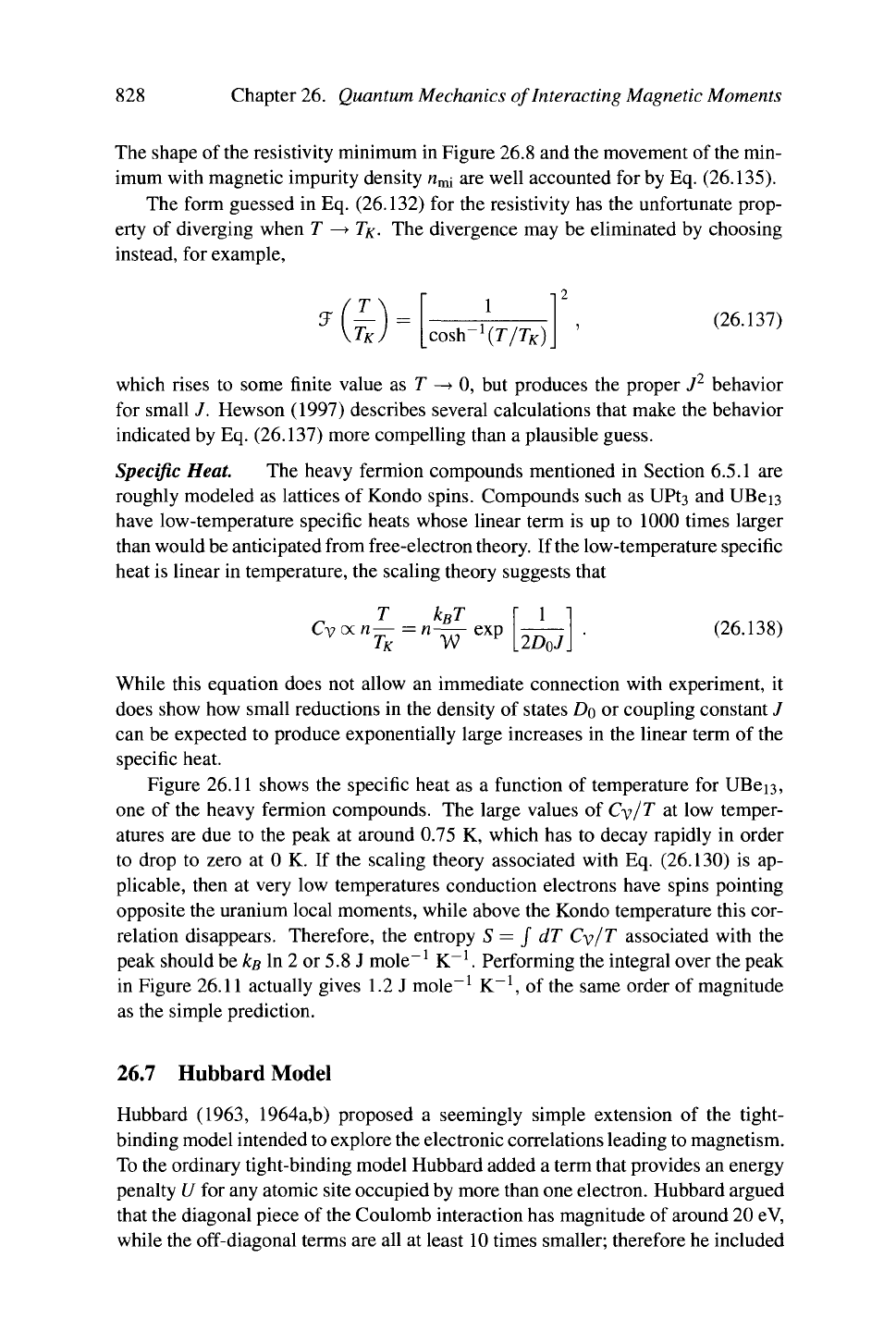
The form guessed in Eq. (26.132) for the resistivity has the unfortunate prop-
erty of diverging when T
—>
7^. The divergence may be eliminated by choosing
instead, for example,
*(£)-
which rises to some finite value as T
—>
0, but produces the proper J
2
behavior
for small J. Hewson (1997) describes several calculations that make the behavior
indicated by Eq. (26.137) more compelling than a plausible guess.
Specific Heat. The heavy fermion compounds mentioned in Section 6.5.1 are
roughly modeled as lattices of Kondo spins. Compounds such as UPt3 and UBe^
have low-temperature specific heats whose linear term is up to 1000 times larger
than would be anticipated from free-electron theory. If the low-temperature specific
heat is linear in temperature, the scaling theory suggests that
r
T k
B
T
C
v
ocn— =n~— exp
T
K
W
While this equation does not allow an immediate connection with experiment, it
does show how small reductions in the density of states Do or coupling constant J
can be expected to produce exponentially large increases in the linear term of the
specific heat.
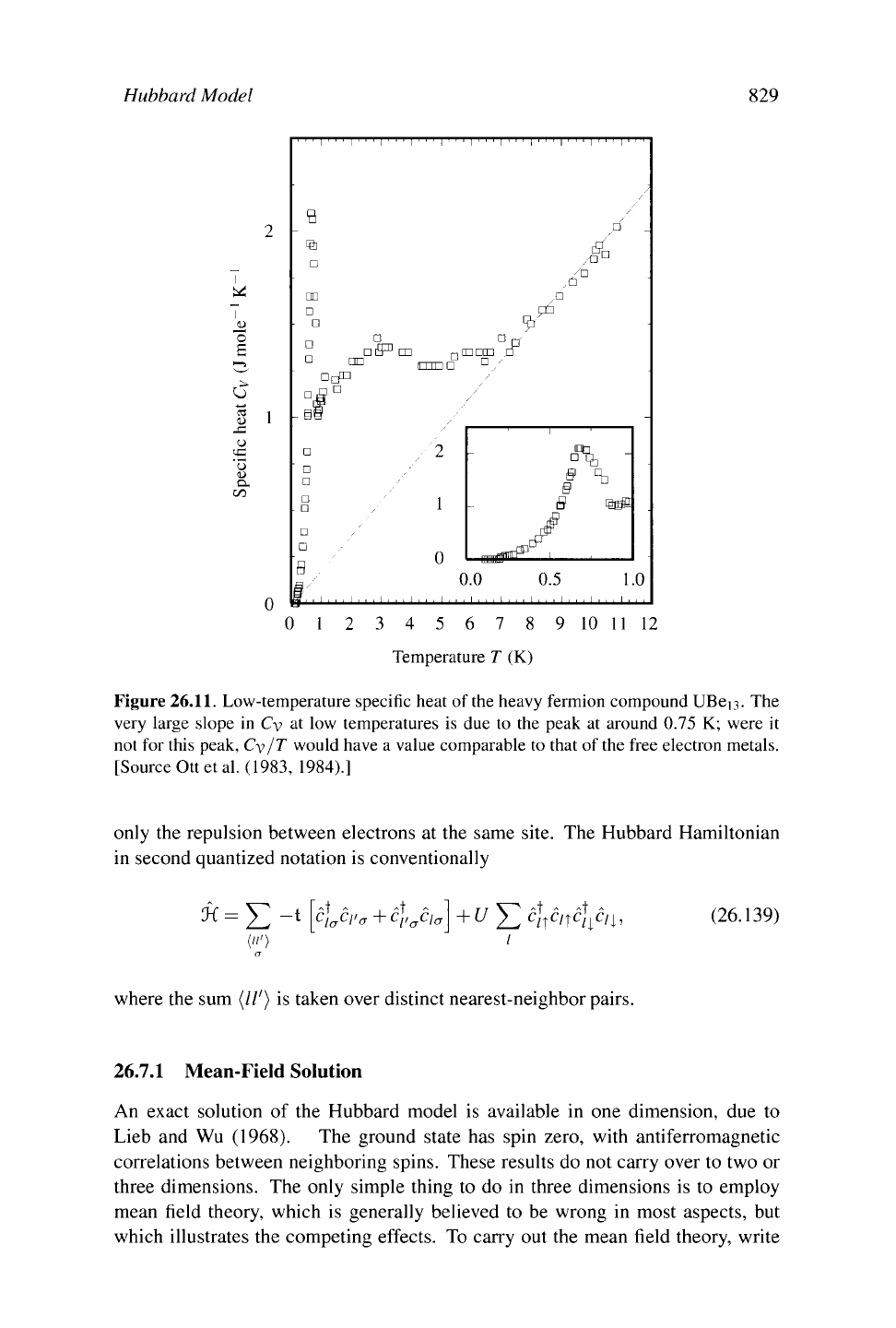
Figure 26.11 shows the specific heat as a function of temperature for UBen,
one of the heavy fermion compounds. The large values of Cy/T at low temper-
atures are due to the peak at around 0.75 K, which has to decay rapidly in order
to drop to zero at 0 K. If the scaling theory associated with Eq. (26.130) is ap-
plicable, then at very low temperatures conduction electrons have spins pointing
opposite the uranium local moments, while above the Kondo temperature this cor-
relation disappears. Therefore, the entropy S = J dT C-ç/T associated with the
peak should be kß In 2 or 5.8 J mole
-1
K
-1
. Performing the integral over the peak
in Figure 26.11 actually gives 1.2 J mole
-1
K
-1
, of the same order of magnitude
as the simple prediction.
26.7 Hubbard Model
Hubbard
(1963,
1964a,b) proposed a seemingly simple extension of the tight-
binding model intended to explore the electronic correlations leading to magnetism.
To the ordinary tight-binding model Hubbard added a term that provides an energy
penalty U for any atomic site occupied by more than one electron. Hubbard argued
that the diagonal piece of the Coulomb interaction has magnitude of around 20 eV,
while the off-diagonal terms are all at least 10 times smaller; therefore he included
cosh
-1
(777k)
(26.137)
2D
0
J
(26.138)
Hubbard Model
"3
o
'o
C/3
9
on
D
D
D
D
D
D
D
- D
D
D
a
.
"M
c
D
D
/
'
TJl^
a
ffD
__
T
CD
__
"M
111
!
ft
Q
ŒDDCD
.0
irrm
a
a
/'
y '2
1
0
0 .0
"I
111
!
111
!
11
d
yU
DÙ
1
do
& D
e
D
/
H
-
0.5 1.0
0 1 23456789 10 11 12
Temperature T (K)
Figure
26.11.
Low-temperature specific heat of the heavy fermion compound UBe^. The
very large slope in C\? at low temperatures is due to the peak at around 0.75 K; were it
not for this peak, C\r/T would have a value comparable to that of the free electron metals.
[Source Ott et al.
(1983,
1984).]
only the repulsion between electrons at the same site. The Hubbard Hamiltonian
in second quantized notation is conventionally
ê
l
ê
i'*+4*
ê
i<?
+
U^2c
t
n
c
n
c]
i
c
n
(26.139)
where the sum (//') is taken over distinct nearest-neighbor pairs.
26.7.1 Mean-Field Solution
An exact solution of the Hubbard model is available in one dimension, due to
Lieb and Wu (1968). The ground state has spin zero, with antiferromagnetic
correlations between neighboring spins. These results do not carry over to two or
three dimensions. The only simple thing to do in three dimensions is to employ
mean field theory, which is generally believed to be wrong in most aspects, but
which illustrates the competing effects. To carry out the mean field theory, write
830 Chapter 26. Quantum Mechanics of Interacting Magnetic Moments
the model as
^=Y.-
i
[
£
\a
ë
i^ + c\,
a
cia\ +UY, n/T«U- (26.140)
a
The difficulty resides in the last term, which is quartic in fermion operators. In the
standard steps of mean field theory, try
"la = n
a
+ (nia ~ n
a
)
■
(26.141)
Choosing the average value of n to be the same on all sites prejudices matters in
favor of ferromagnetism, which Hubbard had devised the model to explain. Ex-
panding to quadratic order, one finds that
Ä~5Z
_t
c\
a
c
Vu
+ c\,
a
c
la
+U^2n
n
n
i
+n
]
n
n
-n
]
n
i
. (26.142)
(T
Going into k space, the Hamiltonian becomes diagonal, and equals
^ — tel Cj
a
COS 5-k + U ^2 "jfcî"!
+"î"itj.
— n
\
n
l- 5 are nearest-neighbor vectors.
kSa k
(26.143)
The mean field theory is closed by setting the mean occupancy of up and down
electrons equal to nj and n^, respectively. Further progress depends upon choosing
a particular lattice and dimension in which to work. It is easiest to work in one
dimension, where all the algebra is simple. Because the up and down electrons can
have different densities, one must suppose that they are described by two separate
Fermi levels. If a is the lattice spacing and N is the total number of lattice sites,
then
f
k
n
dk
Nn^=Na / — (26.144)
J-k
n
27T
=>■
7rn| =
akp-[-
(26.145)
Doing the integral in Eq. (26.143), the ground-state energy is
N
£o =
—
[—2t] [sin nm + sin irn\] +NUmn\. (26.146)
The total number of electrons in the metal is always fixed; assume that the band is
half filled, so that «| +
n^
= 1. Then the ground-state energy becomes
-4tN
£
0
= simrn^+NUn^ (1-«
T
) . (26.147)
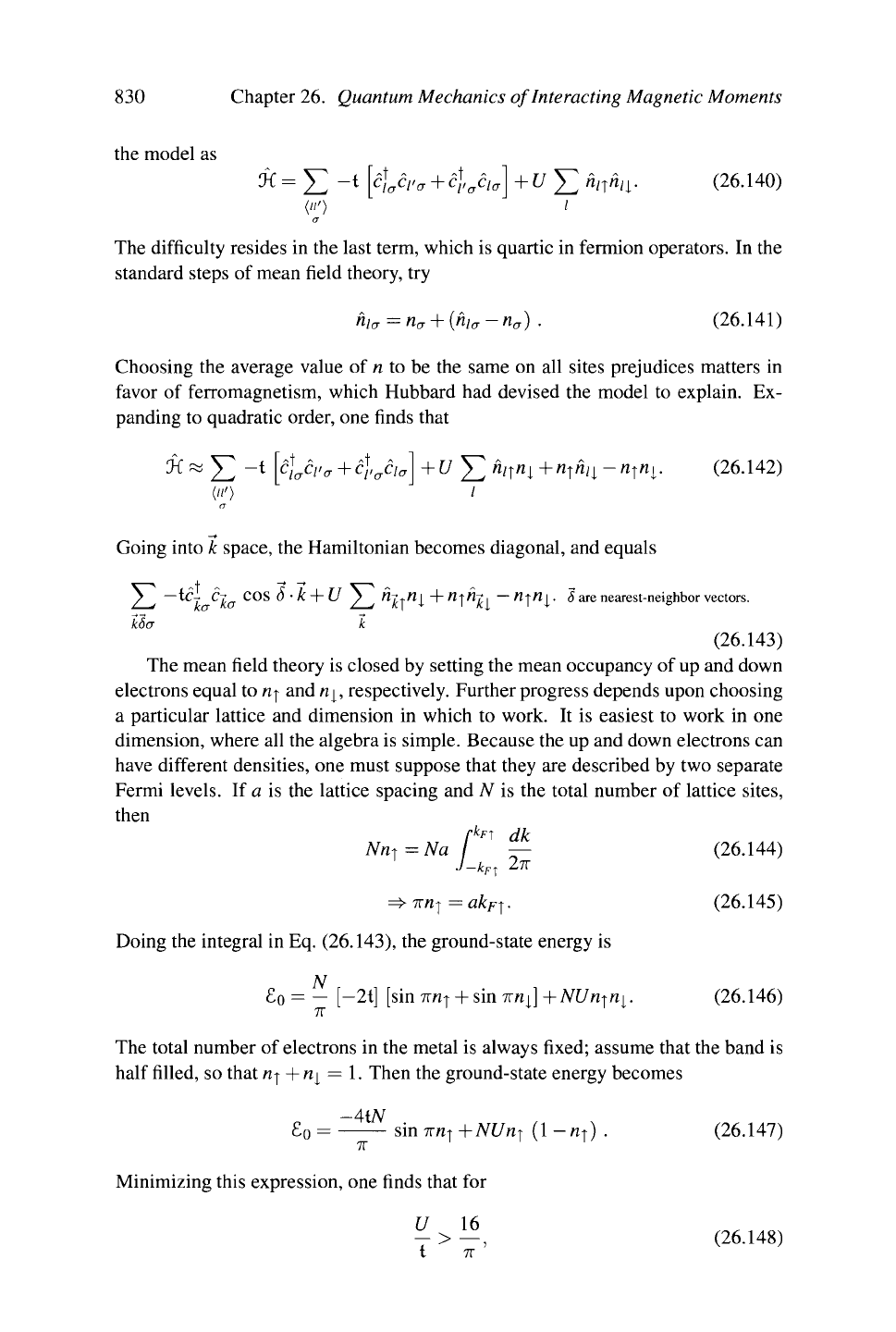
Minimizing this expression, one finds that for
^ > —, (26.148)
t 7T
Hubbard Model 831
100
10
to|-
0.0 0.2 0.4 0.6 0.8 1.0 0.0 0.2 0.4 0.6 0.8 1.0 0.0 0.2 0.4 0.6 0.8 1.0
A A A
10,
, 10
to
Georges et ai. (1996)
Mott Insulator
Coexistence,
Sordi et al. (2010)
Mott Insulator .
Metal
Coexistence
2
2 0
0.5
1 1.5
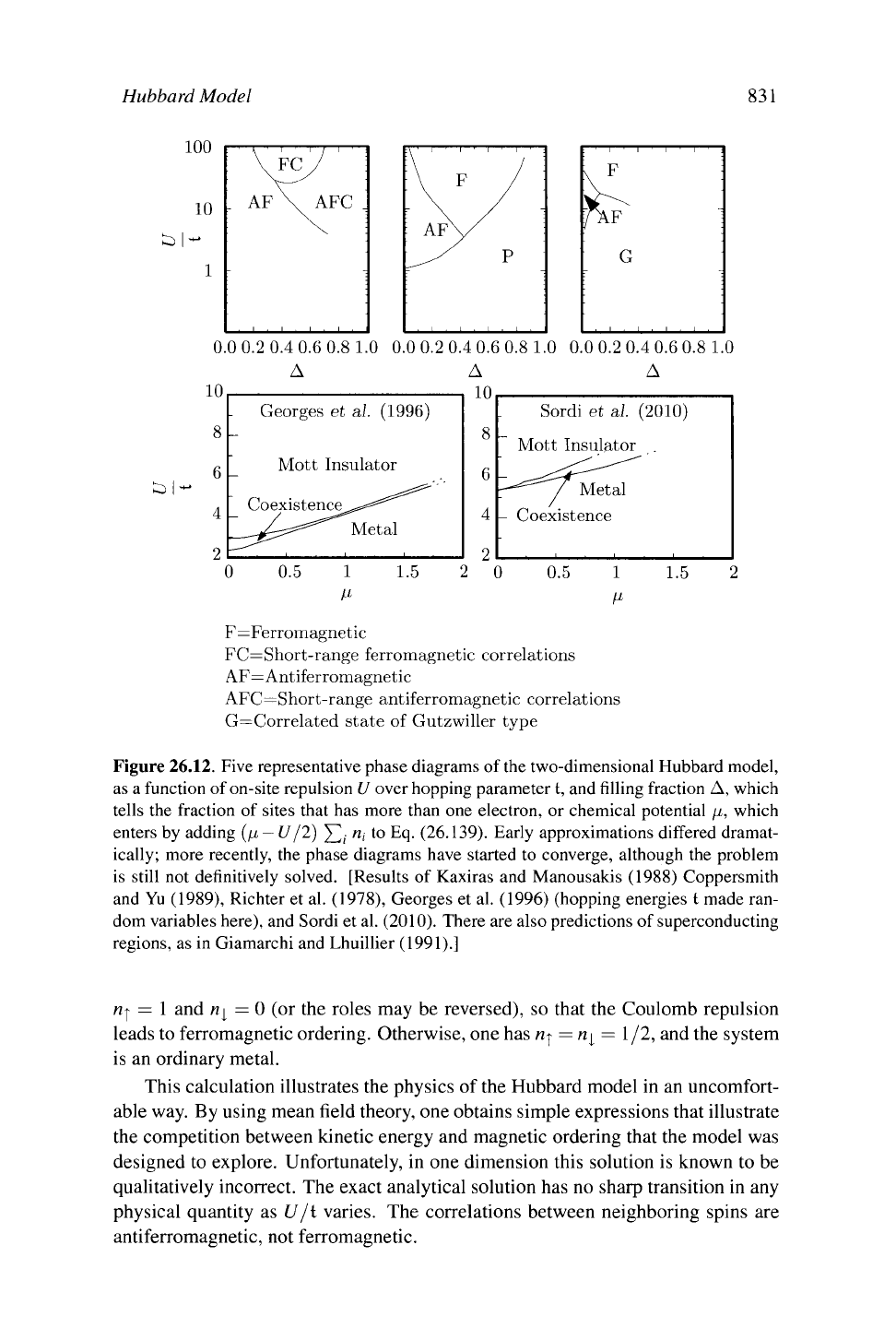
F=Ferromagnetic
FC=Short-range ferromagnetic correlations
AF=Antiferromagnetic
AFC=Short-range antiferromagnetic correlations
G=Correlated state of Gutzwiller type
Figure 26.12. Five representative phase diagrams of the two-dimensional Hubbard model,
as a function of on-site repulsion U over hopping parameter t, and filling fraction A, which
tells the fraction of sites that has more than one electron, or chemical potential fi, which
enters by adding (/i
—
U/2) ]T\ n, to Eq. (26.139). Early approximations differed dramat-
ically; more recently, the phase diagrams have started to converge, although the problem
is still not definitively solved. [Results of Kaxiras and Manousakis (1988) Coppersmith
and Yu (1989), Richter et al. (1978), Georges et al. (1996) (hopping energies t made ran-
dom variables here), and Sordi et al. (2010). There are also predictions of superconducting
regions, as in Giamarchi and Lhuillier (1991).]
«1 = 1 and nj, = 0 (or the roles may be reversed), so that the Coulomb repulsion
leads to ferromagnetic ordering. Otherwise, one has
n-j-
=
n±
= 1/2, and the system
is an ordinary metal.
This calculation illustrates the physics of the Hubbard model in an uncomfort-
able way. By using mean field theory, one obtains simple expressions that illustrate
the competition between kinetic energy and magnetic ordering that the model was
designed to explore. Unfortunately, in one dimension this solution is known to be
qualitatively incorrect. The exact analytical solution has no sharp transition in any
physical quantity as U/t varies. The correlations between neighboring spins are
antiferromagnetic, not ferromagnetic.
832 Chapter 26. Quantum Mechanics of Interacting Magnetic Moments
In two and three dimensions, there is only one point of general agreement. At
half filling, where the number of electrons precisely equals the number of lattice
sites,
and for large enough U, the ground state is antiferromagnetic. Some reasons
for this conclusion are explored in Problem 9. This conclusion has considerable
physical importance, because it provides the simplest way to see how solids like
CuO (Section 23.6.3) that should be metals according to band theory actually turn
out to be antiferromagnetic insulators, called Mott-Hubbard or Mort insulators.
Even this statement needs to be qualified, because charge transfer between oxygen
and copper as discussed in Section 23.6.3 is not included in the Hubbard model,
which is hard enough to solve without it. Away from half filling, the problem is
not completely solved. Figure 26.12 displays five characteristic phase diagrams
describing the ground state of the Hubbard model as a function of U/t and of A
or chemical potential /i; A gives the fraction of electrons per site in excess of half
filling, so there is one electron per site when A = 0, and two electrons per site when
A = 1. The chemical potential ß enters the model by adding (//
—
U/2) J2i
n
ito
Eq. (26.139).
The fact that the properties of the two-dimensional Hubbard model are not
yet known with certainty is unsatisfactory because the Hubbard model is widely
viewed as the simplest context in which to try to obtain exact results for many inter-
acting electrons; this model has been investigated with a ferocious intensity since
the discovery of high-temperature superconductors. There is no better illustration
of the difficulties involved in progressing systematically beyond the one-electron
pictures of solids.
Problems
1.
Wave functions with cusps: Show that the energy of
\cj)\
in Figure 26.2
can certainly be lowered by smoothing out the cusp. One way to perform
the demonstration is to flatten out the wave function as shown in the figure
throughout some small volume v and then estimate the effect on kinetic and
potential energies.
2.
Ferromagnetic ground state: Consider the Hamiltonian (26.21) with all J
positive, and take S$ to describe spin 1/2 particles.
(a) Show with the aid of the identity in Eq. (26.19) that the state where all spins
are eigenvalues of S
z
with eigenvalue 1/2 is an eigenfunction of the Hamilto-
nian.
(b) Show that the largest value that (^\S^
•
S$,
|\I/)
can assume for R ^ R' in any
wave function \I> is less than or equal to the largest eigenvalue of S^
■
S^,. By
expanding out the square of S^ + S^,, show that the largest eigenvalue of this
operator is 1/4.
(c) Therefore show that the ferromagnetic state provides the ground state of the
Heisenberg Hamiltonian.