
Marder M.P. Condensed Matter Physics
Подождите немного. Документ загружается.

Phenomenology of Superconductivity 843
Taking
the
curl
of
Eq. (27.20)
to
ensure that
the
final results
are
gauge-invariant
gives
ß
+
A£
VxVxß
= 0,
(27.21)
recovering Eq. (27.5).
Equation (27.21)
is not
quite
as
general
as
Eq. (27.5) because
the
first involves
B while
the
second involves
B/ß. A
magnetic permeability different from unity
can
be
introduced
if one
takes
G
a
ß to be the sum of
two terms,
one of the
form
(27.14)
and the
second
of
the form (27.18).
The
physical interpretation
of
adding
these two terms together
is
that some electrons
in a
solid, such
as the
valence elec-
trons,
are
confined
to
individual atoms
and
create
a
magnetic response
ß.
Another
population
of
electrons creates superconductivity. Adding together these
two re-
sponses continues
to
produce
a
superconductor,
but the
penetration depth changes
and
is
given
by
Eq. (27.6).
27.2.2 Thermodynamics
of
Superconductors
Suppose
one
takes
a
long thin cylinder
of
superconducting material
and
places
it
in
an
external magnetic field
of
strength
H
that points along
the
cylinder axis.
The
long cylindrical shape
is
desirable because its demagnetizing factor is zero,
and the
normal component
of
the magnetic field automatically vanishes along most
of its
surface. Experimentally, Meissner
and
Ochsenfeld (1933) found that
at a
critical
applied field
H
c
the
superconductivity
is
destroyed
and
magnetic flux penetrates
the sample.
The
transition
is
completely reversible,
so
right
at
this critical field
the
superconducting state
and
normal state
of
the material must be
in
equilibrium.
The
free energy
per
volume
of
the metal
in the
normal state must be just
3"
=
^normal
+ Ö ^c
•
(27.22)
ÖTTß
Because
the
superconducting state expels
the
magnetic induction,
its
free energy
is
JUSt Jsuperconducting-
There
now
appears
to be a
problem.
The
free energy
of the
normal state
is
greater than that
of
the superconducting one,
and the
magnetic field energy
is
also
positive.
Yet
when
the
critical field
H
c
is
applied, (27.22)
is
supposed
to
equal
^superconducting- What
has
gone wrong?
The
answer
is
that thermodynamics
is be-
ing used improperly.
The
reversible experiments
are
carried
out by
slowly varying
external currents,
not by
controlling
B
directly.
In the
instant that the normal metal
expels
B and
becomes superconducting,
a
host
of
magnetic flux lines blasts
off to
infinity. The work done during this instant must be accounted for; equivalently,
one
must choose
to
work with thermodynamic variables that really
do
vary smoothly
during
the
change from normal metal
to
superconductor.
The
correct thermody-
namic potential,
as in Eq.
(24.27),
is
S
= ?-B-% = ?
nonnal
--
]
-B
2
c
.
(27.23)
844
Chapter 27. Superconductivity
Therefore the difference in free energy per volume at any given temperature be-
tween superconducting and normal metal must be exactly
A 5 = Sn,
normal -^superconducting
87T//
(27.24)
Because \i
R*
1
for superconducting metals, Eq. (27.24) is often written
AJ=#.
8TT
(27.25)
One should remember, as mentioned in Section
24.2.3,
that the magnetic field H
inside a long thin cylinder with axis along the field is always spatially uniform and
equal to the externally applied field. It is magnetic induction B that is expelled
from superconducting samples, not the magnetic field H.
By differentiating Eq. (27.25) with respect to temperature, one finds immedi-
ately that the excess entropy of normal metal relative to the superconductor must
be
d
AS=—
AJ:
dT
H
c
dH
c
4^W
(27.26)
Meissner and Ochsenfeld determined that as temperature rises towards the critical
temperature T
c
where superconductivity vanishes in zero magnetic field, the critical
field H
c
also goes to zero. It follows immediately from Eq. (27.26) that the latent
heat of transformation is zero, and therefore the transition is second order.
27.2.3 Landau-Ginzburg Free Energy
The most productive phenomenological description of superconductivity combines
ideas from the free energy (27.10) with the idea that the superconductivity resides
in a population of superconducting electrons whose density vanishes at a critical
temperature T
c
. Landau and Ginzburg (1950) described the superconducting state
through a macroscopic wave function
*&
that plays a role for superconductivity
identical to the role played by the wave function
<I>
employed in Eq. (15.98) for su-
perfluid helium. If the supercurrent density n = \^\
2
vanishes at T
c
, then it should
be possible to expand G
a
ß (see Eq. (27.10)) in powers of l^l
2
. Landau and Ginz-
burg guessed the free energy to be
J:
dr
2
ßi
T
4
+
l
8^
B
2
+
1
2m*
i c
*(r)
(27.27)
The first two terms in Eq. (27.27) are procured directly from Landau's general
theory of second-order phase transformations, discussed in Section
24.6.1.
The
remaining terms provide a particular realization of Eq. (27.10) and were inspired
by the idea that the superconducting electron wave function might interact with
the vector potential like a single macroscopic particle. The effective charge e* =
Phenomenology of Superconductivity
845
2e multiplying A is due to the fact that pairs of electrons are responsible for the
superconductivity. Minimizing Eq. (27.27) with respect to A leads to
Vxß= —/, (27.28)
c
with
2eh - - 4<?
2
-
j(r) =
[**V*
- #V#*1 A***. (27.29a)
2im*
m*c
Minimizing with respect to
\I>*
leads to
0:
a+
^
+
i(»vA-)
Integrate so that all spatial derivatives
xjj act on
SP,
then take functional iy-i 9QM
derivative with respect to \P*. ^ ' '
Equations (27.29) are the Landau-Ginzburg equations.
Boundary Condition. To solve problems in particular geometries, it is always
necessary to specify the behavior of * at the boundary of a sample. When a super-
conductor contacts vacuum no current can flow out of the boundary, so
/H^ 2e ~\
n
•
I
—
V
H
A I ty = 0
Here
" is normal to the boundary; see Lan- (27 30)
\i c ' ' dau and Ginzburg (1950), de Gennes
(
1992),
'Via. 2e
->\
W =
U.
p.
177, or Wertheim (1969), p. 327.
Landau and Ginzburg observe that "it is natural to demand that the wave function
at the boundary of
the
metal should vanish" but such an additional boundary condi-
tion on the superconducting wave function would eliminate solutions in thin films
except for quantized values of the film thickness. Because this phenomenon is not
observed, the seemingly natural boundary condition \I/ = 0 must be rejected.
27.2.4 Type I and Type II Superconductors
The Landau-Ginzburg equations depend upon two lengths. The first is a coherence
length £ that sets the scale for spatial variations of the order parameter ^/. This
length is given by
2
n
2
2m*\a\
The second length is the London penetration depth. In terms of Landau and Ginz-
burg's parameters it is given by
A5
= T5^Ü- C"2>
47r|a|(2e)
2
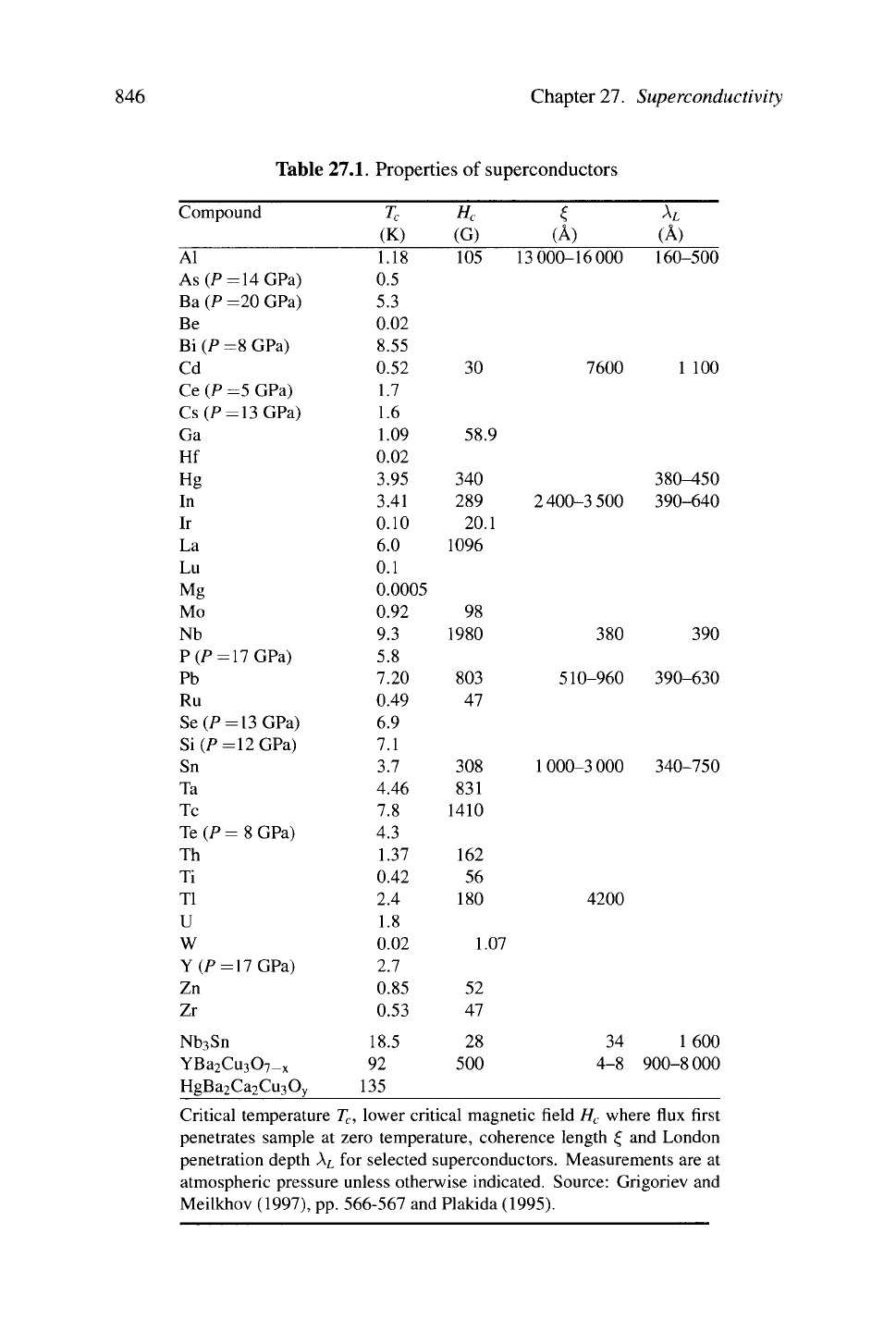
The coherence length and penetration depth, as well as critical temperature and
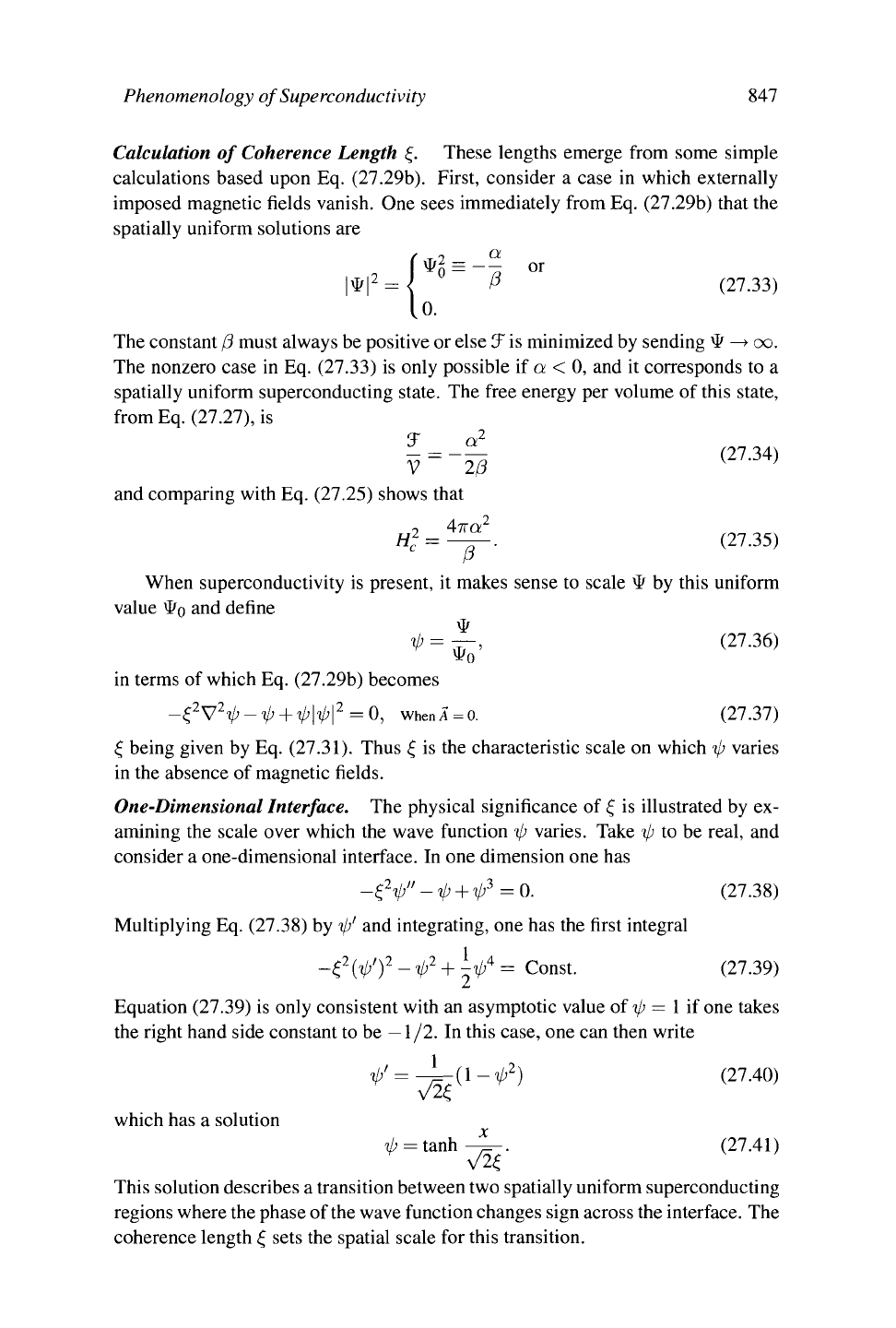
lower critical field are tabulated in Table 27.1.
846
Chapter 27. Superconductivity
Table 27.1. Properties of superconductors
Compound
Al
As (P =14 GPa)
Ba (P =20 GPa)
Be
Bi (P =8 GPa)
Cd
Ce (P =5 GPa)
Cs(P=13GPa)
Ga
Hf
Hg
In
Ir
La
Lu
Mg
Mo
Nb
P(P=17GPa)
Pb
Ru
Se (P =13 GPa)
Si (P =12 GPa)
Sn
Ta
Tc
Te (P = 8 GPa)
Th
Ti
Tl
U
W
Y (P =17 GPa)
Zn
Zr
Nb
3
Sn
YBa
2
Cu
3
0
7
_
x
HgBa
2
Ca
2
Cu
3
O
y
T
c
(K)
1.18
0.5
5.3
0.02
8.55
0.52
1.7
1.6
1.09
0.02
3.95
3.41
0.10
6.0
0.1
0.0005
0.92
9.3
5.8
7.20
0.49
6.9
7.1
3.7
4.46
7.8
4.3
1.37
0.42
2.4
1.8
0.02
2.7
0.85
0.53
18.5
92
135
H
c
(G)
105
30
58.9
340
289
20.1
1096
98
1980
803
47
308
831
1410
162
56
180
1.07
52
47
28
500
£
(Â)
13
000-16000
7600
2400-3 500
380
510-960
1000-3 000
4200
34
4-8
A
L
(Â)
160-500
1 100
380-450
390-640
390
390-630
340-750
1600
900-8 000
Critical temperature T
c
, lower critical magnetic field H
c
where flux first
penetrates sample at zero temperature, coherence length £ and London
penetration depth \
L
for selected superconductors. Measurements are at
atmospheric pressure unless otherwise indicated. Source: Grigoriev and
Meilkhov (1997), pp. 566-567 and Plakida (1995).
Phenomenology of Superconductivity
847
Calculation of Coherence Length £. These lengths emerge from some simple
calculations based upon Eq. (27.29b). First, consider a case in which externally
imposed magnetic fields vanish. One sees immediately from Eq. (27.29b) that the
spatially uniform solutions are
|*|
2
= I P
(27.33)
u
The constant ß must always be positive or else
5F
is minimized by sending
<I> —>
oo.
The nonzero case in Eq. (27.33) is only possible if a < 0, and it corresponds to a
spatially uniform superconducting state. The free energy per volume of this state,
from Eq. (27.27), is
3"
a
2
v—v
(2
"
4)
and comparing with Eq. (27.25) shows that
«? - *f. (2735,
When superconductivity is present, it makes sense to scale \& by this uniform
value \I/o and define
iP
= l
Q
, (27.36)
in terms of which Eq. (27.29b) becomes
-£
2
V
2
V>-V> + V#|
2
= 0,
WhenA = 0.
(27.37)
£ being given by Eq. (27.31). Thus £ is the characteristic scale on which tp varies
in the absence of magnetic fields.
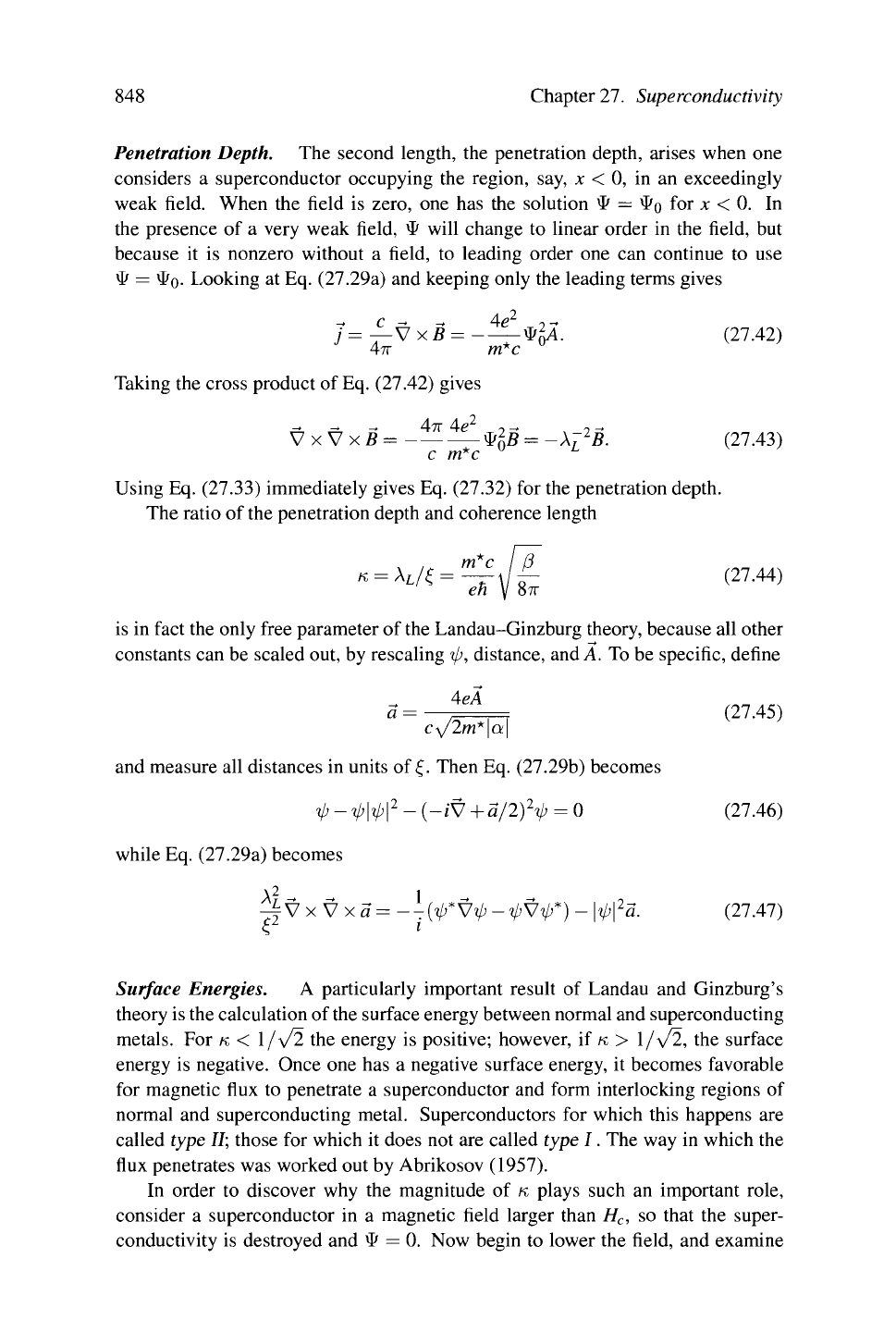
One-Dimensional Interface. The physical significance of £ is illustrated by ex-
amining the scale over which the wave function ip varies. Take tp to be real, and
consider a one-dimensional interface. In one dimension one has
-ÊV-V' + ^
3
=0- (27.38)
Multiplying Eq. (27.38) by tp' and integrating, one has the first integral
-Ç
2
(ip')
2
-ip
2
+ -ip
A
= Const (27.39)
Equation (27.39) is only consistent with an asymptotic value of
ip
=
1
if one takes
the right hand side constant to be
— 1
/2.
In this case, one can then write
T// = -L-(1-V
2
) (27.40)
which has a solution
?/; = tanh-^. (27.41)
v2£
This solution describes a transition between two spatially uniform superconducting
regions where the phase of
the
wave function changes sign across the interface. The
coherence length £ sets the spatial scale for this transition.
848
Chapter 27. Superconductivity
Penetration Depth.
The
second length,
the
penetration depth, arises when
one
considers
a
superconductor occupying
the
region, say,
x < 0, in an
exceedingly
weak field. When
the
field
is
zero,
one has the
solution
* =
\E»o
for x < 0. In
the presence
of a
very weak field,
^
will change
to
linear order
in the
field,
but
because
it is
nonzero without
a
field,
to
leading order
one can
continue
to use
\I>
=
*o- Looking
at
Eq. (27.29a) and keeping only the leading terms gives
c
- - 4e
2
-,-
j=— Vxß = -mlA.
(27.42)
47T m*c
Taking the cross product
of
Eq. (27.42) gives
VxVxß= *gß
=
-Ar
2
ß. (27.43)
c
m*c
L
Using Eq. (27.33) immediately gives Eq. (27.32)
for
the penetration depth.
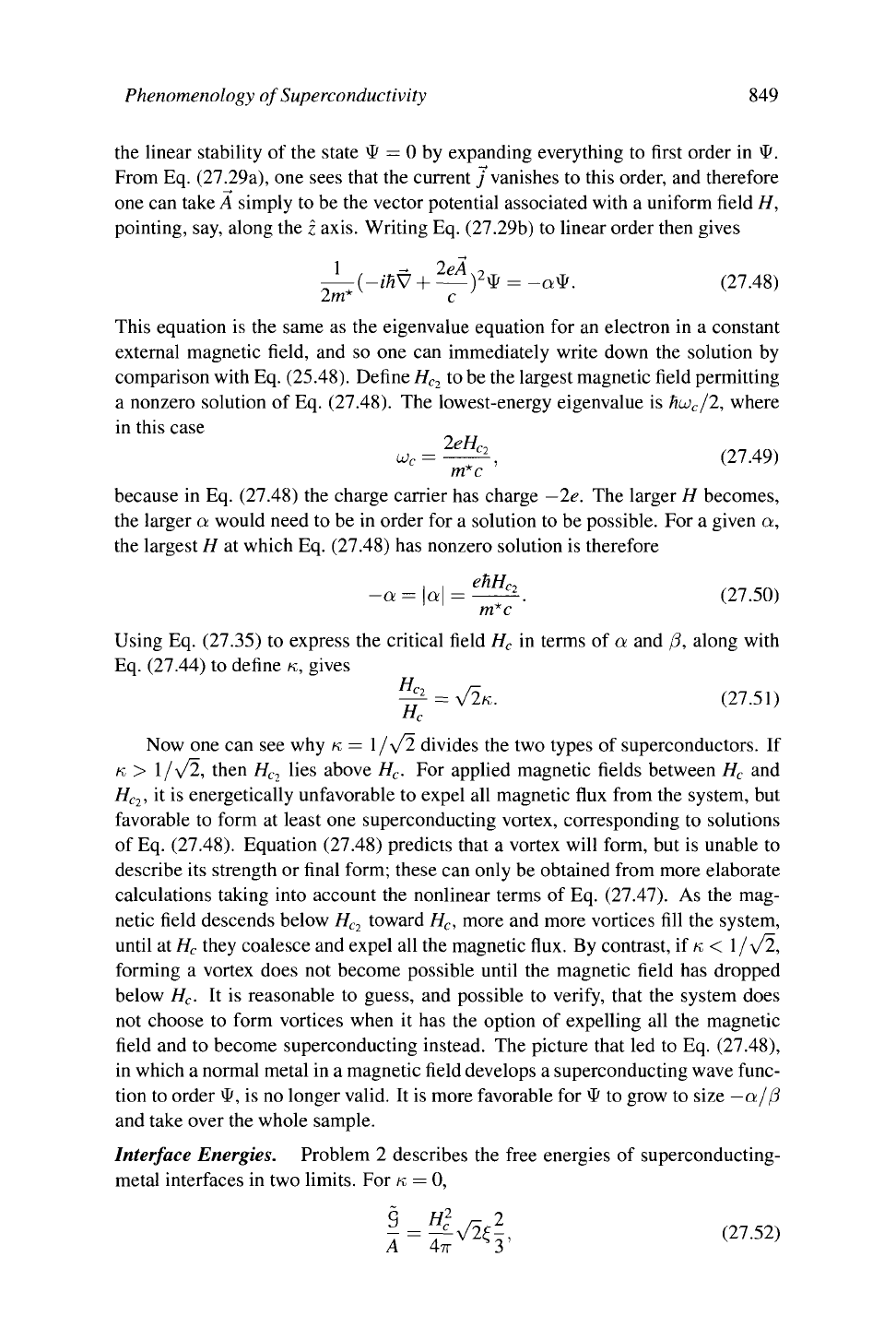
The ratio
of
the penetration depth and coherence length
*LlS
= -r\iz
(27-44)
is
in
fact the only free parameter
of
the Landau-Ginzburg theory, because all other
constants can
be
scaled out,
by
rescaling ip, distance, and
A.
To
be
specific, define
4M
(27.45)
C\j2nï
k
\a\
and measure
all
distances
in
units
of
£. Then Eq. (27.29b) becomes
ip-ip\tp\
2
-(-iV
+
ä/2)
2
ip
= 0
(27.46)
while Eq. (27.29a) becomes
A
2
1
-f V x V x a =
-
T
(^*
V^ - ^Vf) - |Vfa. (27.47)
s '
Surface Energies. A particularly important result of Landau and Ginzburg's
theory is the calculation of
the
surface energy between normal and superconducting
metals. For K < \j\fl the energy is positive; however, if
K
> l/\/2, the surface
energy is negative. Once one has a negative surface energy, it becomes favorable
for magnetic flux to penetrate a superconductor and form interlocking regions of
normal and superconducting metal. Superconductors for which this happens are
called type II; those for which it does not are called type I. The way in which the
flux penetrates was worked out by Abrikosov (1957).
In order to discover why the magnitude of K plays such an important role,
consider a superconductor in a magnetic field larger than H
c
, so that the super-
conductivity is destroyed and ^ = 0. Now begin to lower the field, and examine
Phenomenology of Superconductivity
849
the linear stability of the state \I> = 0 by expanding everything to first order in *.
From Eq. (27.29a), one sees that the current j vanishes to this order, and therefore
one can take A simply to be the vector potential associated with a uniform field H,
pointing, say, along the z axis. Writing Eq. (27.29b) to linear order then gives
1
' -jfiV +
—)
2
*
=
-Q*.
(27.48)
2m*
c
This equation is the same as the eigenvalue equation for an electron in a constant
external magnetic field, and so one can immediately write down the solution by
comparison with Eq. (25.48). Define
H
C2
to be the largest magnetic field permitting
a nonzero solution of Eq. (27.48). The lowest-energy eigenvalue is hco
c
/2, where
in this case
"c = ^, (27.49)
m*c
because in Eq. (27.48) the charge carrier has charge — 2e. The larger H becomes,
the larger a would need to be in order for a solution to be possible. For a given a,
the largest H at which Eq. (27.48) has nonzero solution is therefore
—a = \a\ = -. (27.50)
m*c
Using Eq. (27.35) to express the critical field H
c
in terms of a and ß, along with
Eq. (27.44) to define
K,
gives
-^ = V2K. (27.51)
He
Now one can see why
K
= \/\/2 divides the two types of superconductors. If
K
> l/\/2, then
H
C2
lies above H
c
. For applied magnetic fields between H
c
and
H
C2
, it is energetically unfavorable to expel all magnetic flux from the system, but
favorable to form at least one superconducting vortex, corresponding to solutions
of Eq. (27.48). Equation (27.48) predicts that a vortex will form, but is unable to
describe its strength or final form; these can only be obtained from more elaborate
calculations taking into account the nonlinear terms of Eq. (27.47). As the mag-
netic field descends below
H
C2
toward H
c
, more and more vortices fill the system,
until at H
c
they coalesce and expel all the magnetic flux. By contrast, if
K
< l/\/2,
forming a vortex does not become possible until the magnetic field has dropped
below H
c
. It is reasonable to guess, and possible to verify, that the system does
not choose to form vortices when it has the option of expelling all the magnetic
field and to become superconducting instead. The picture that led to Eq. (27.48),
in which a normal metal in a magnetic field develops a superconducting wave func-
tion to order
\&,
is no longer valid. It is more favorable for
<&
to grow to size —a/ß
and take over the whole sample.
Interface Energies. Problem 2 describes the free energies of superconducting-
metal interfaces in two limits. For
K
= 0,
hf^l
(27
-
52
>
850
Chapter 27. Superconductivity
and forming the interface costs a finite positive energy per unit area
A.
For K
—>
oo,
Ç H
2
7 = -^ (27.53)
A
87T
because this energy is negative, the system will respond by trying to form as much
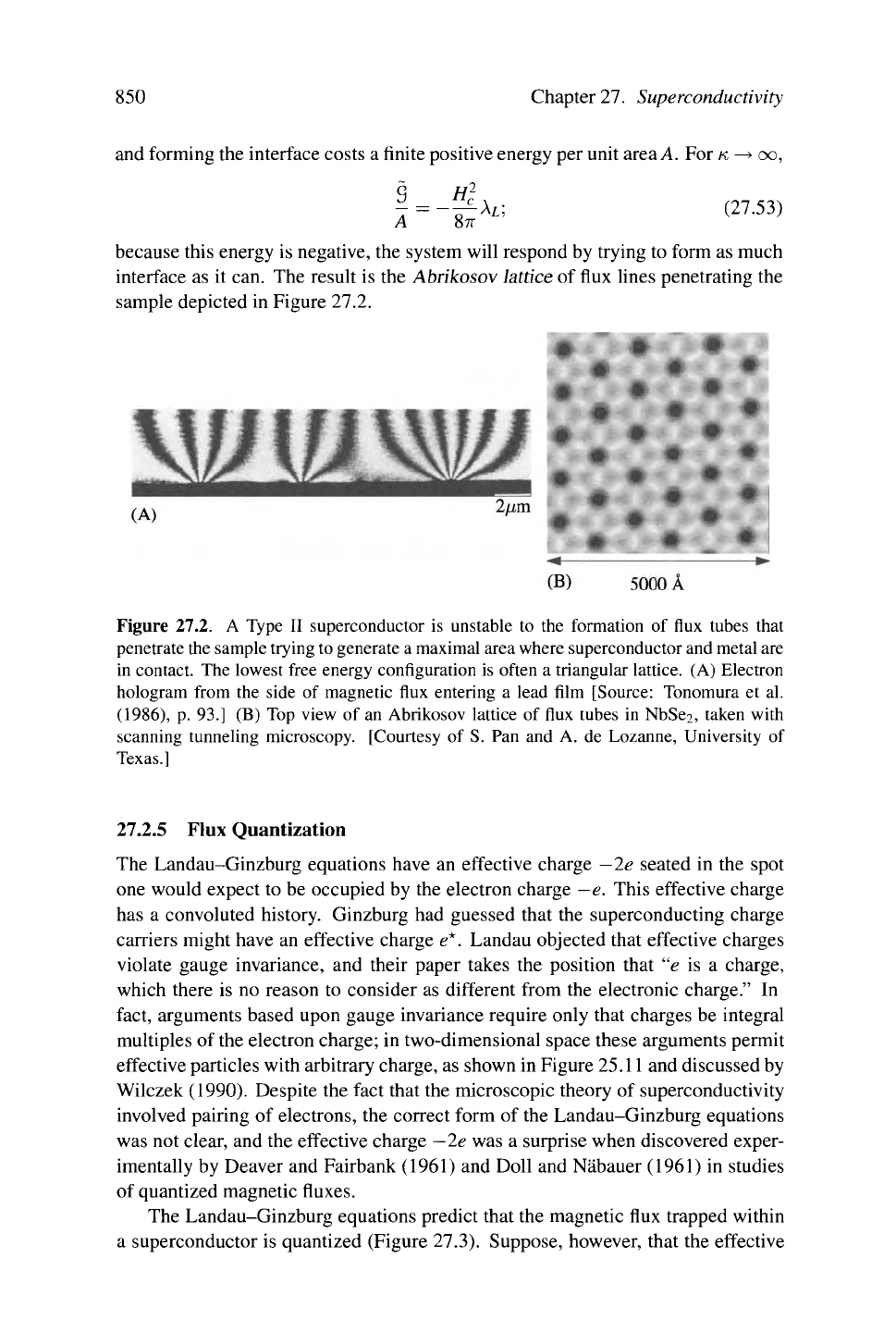
interface as it can. The result is the Abrikosov lattice of flux lines penetrating the
sample depicted in Figure 27.2.
Figure 27.2. A Type II superconductor is unstable to the formation of flux tubes that
penetrate the sample trying to generate a maximal area where superconductor and metal are
in contact. The lowest free energy configuration is often a triangular lattice. (A) Electron
hologram from the side of magnetic flux entering a lead film [Source: Tonomura et al.
(1986),
p. 93.] (B) Top view of an Abrikosov lattice of flux tubes in NbSe2, taken with
scanning tunneling microscopy. [Courtesy of S. Pan and A. de Lozanne, University of
Texas.1
27.2.5 Flux Quantization
The Landau-Ginzburg equations have an effective charge — 2e seated in the spot
one would expect to be occupied by the electron charge —e. This effective charge
has a convoluted history. Ginzburg had guessed that the superconducting charge
carriers might have an effective charge e*. Landau objected that effective charges
violate gauge invariance, and their paper takes the position that "e is a charge,
which there is no reason to consider as different from the electronic charge." In
fact, arguments based upon gauge invariance require only that charges be integral
multiples of the electron charge; in two-dimensional space these arguments permit
effective particles with arbitrary charge, as shown in Figure 25.11 and discussed by
Wilczek (1990). Despite the fact that the microscopic theory of superconductivity
involved pairing of electrons, the correct form of the Landau-Ginzburg equations
was not clear, and the effective charge —2e was a surprise when discovered exper-
imentally by Deaver and Fairbank (1961) and Doll and Näbauer (1961) in studies
of quantized magnetic fluxes.
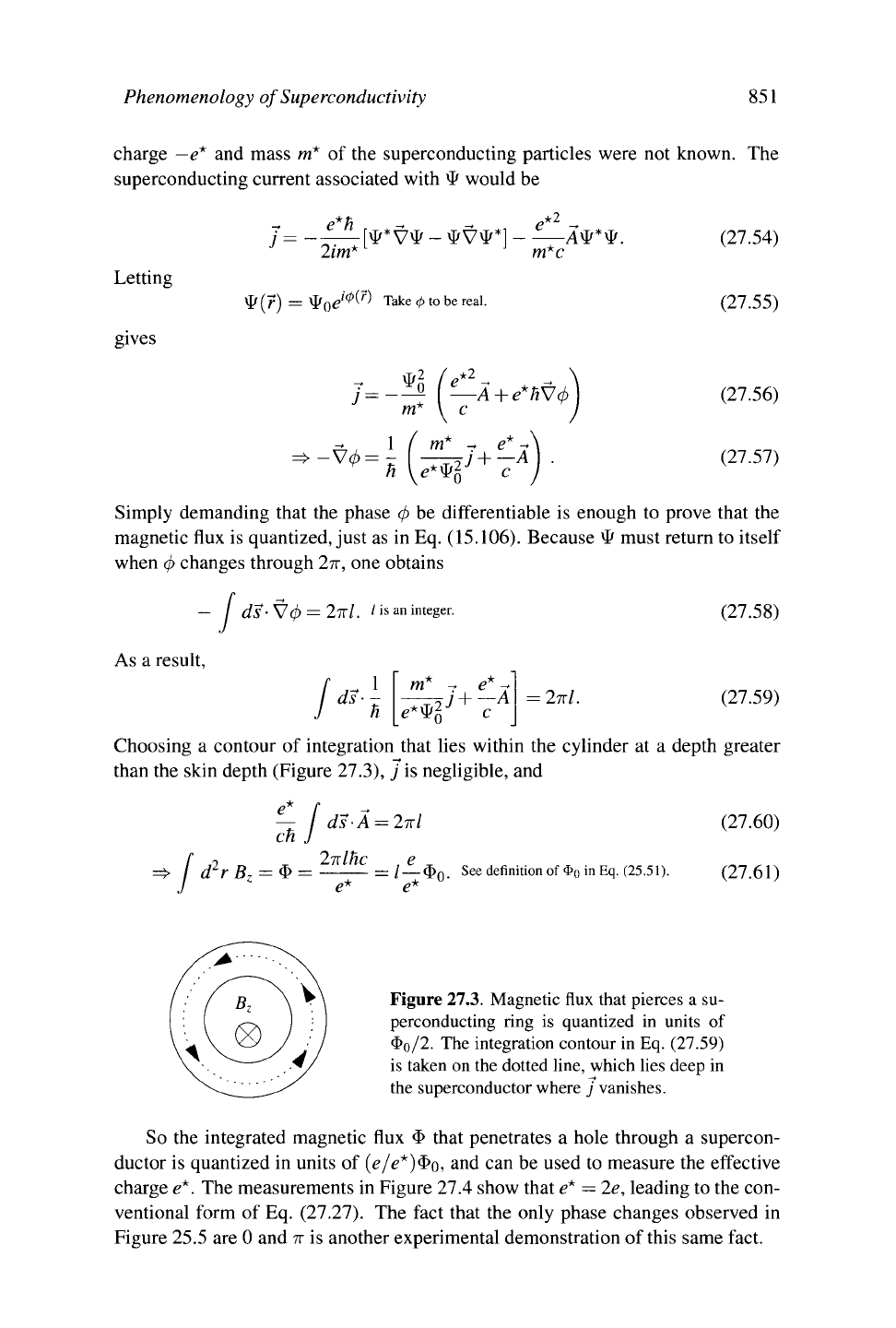
The Landau-Ginzburg equations predict that the magnetic flux trapped within
a superconductor is quantized (Figure 27.3). Suppose, however, that the effective
Phenomenology of Superconductivity 851
charge — e* and mass m* of the superconducting particles were not known. The
superconducting current associated with \I> would be
Letting
gives
e*H - - e*
2
-*
lim*
m*c
M?)
\&(f) = fy
0
e"
P(r>
Take
<j>
to be real.
-v<t>=-
e*\
A +
e*H\7(f>
m -f e ->
H
\
e*^>l
J
c
(27.54)
(27.55)
(27.56)
(27.57)
Simply demanding that the phase
</>
be differentiable is enough to prove that the
magnetic flux is quantized, just as in Eq. (15.106). Because \I/ must return to itself
when
<j>
changes through 27r, one obtains
ds- V(j> = 2nl.
l is an
integer.
As a result,
/
ds-
-
n
m -> e ->
e*^l c
2vr/.
(27.58)
(27.59)
Choosing a contour of integration that lies within the cylinder at a depth greater
than the skin depth (Figure 27.3), j is negligible, and
ch
I
d
2
r B
7
= $
ds-A = 2-nl (27.60)
2irlhc e
= / — $
0
. See definition of $
0
in Eq. (25.51). (27.61)
e* e*
Figure 27.3. Magnetic flux that pierces a su-
perconducting ring is quantized in units of
$o/2.
The integration contour in Eq. (27.59)
is taken on the dotted line, which lies deep in
the superconductor where j vanishes.
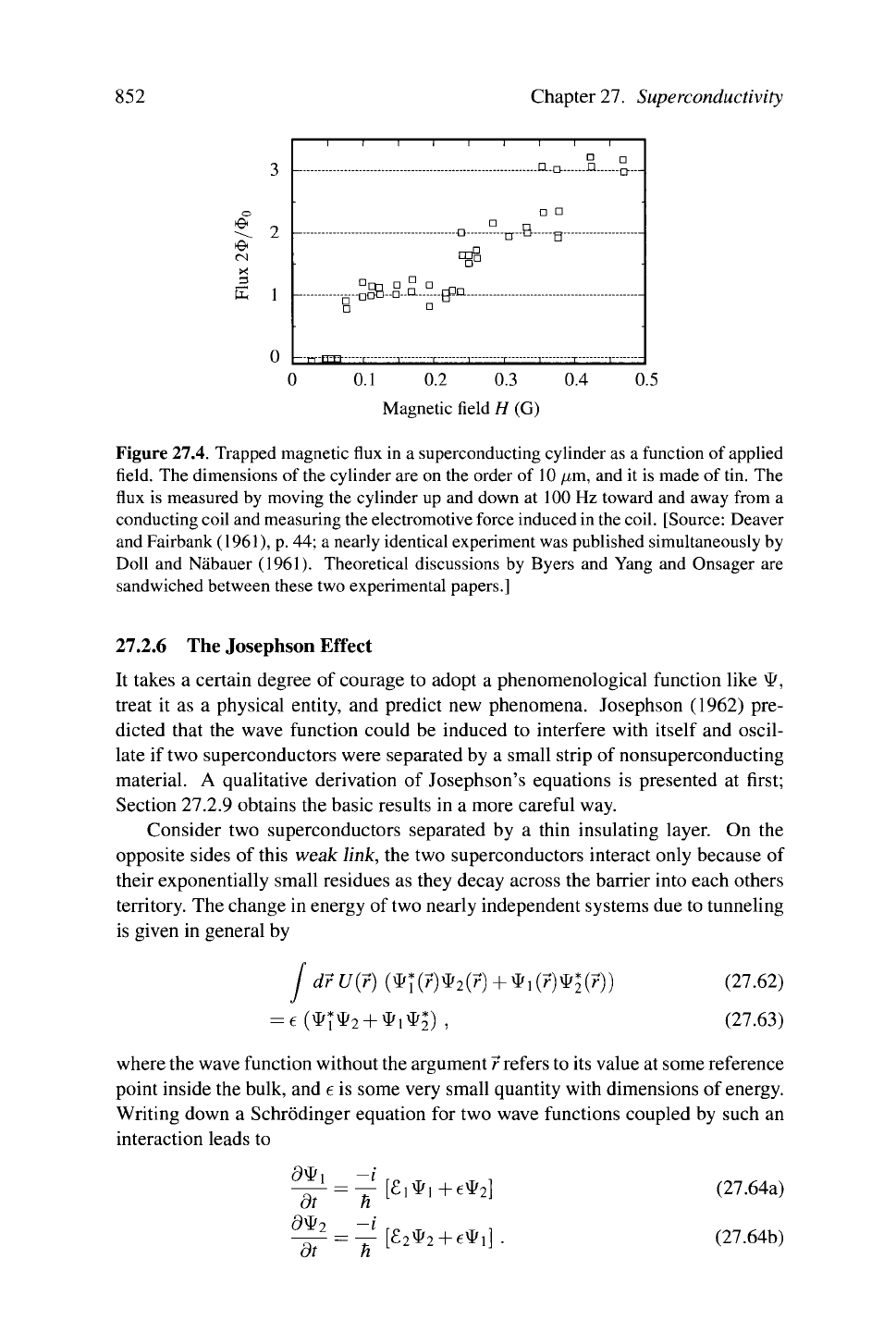
So the integrated magnetic flux $ that penetrates a hole through a supercon-
ductor is quantized in units of (e/e*)&o, and can be used to measure the effective
charge e*. The measurements in Figure 27.4 show that e* — 2e, leading to the con-
ventional form of Eq. (27.27). The fact that the only phase changes observed in
Figure 25.5 are 0 and ir is another experimental demonstration of this same fact.
852
Chapter
27.
Superconductivity
X
3
E
0.1 0.2 0.3 0.4
Magnetic field H (G)
0.5
Figure 27.4. Trapped magnetic flux in a superconducting cylinder as a function of applied
field. The dimensions of the cylinder are on the order of 10 /im, and it is made of tin. The
flux is measured by moving the cylinder up and down at 100 Hz toward and away from a
conducting coil and measuring the electromotive force induced in the coil. [Source: Deaver
and Fairbank
(1961
),
p. 44; a nearly identical experiment was published simultaneously by
Doll and Näbauer (1961). Theoretical discussions by Byers and Yang and Onsager are
sandwiched between these two experimental papers.]
27.2.6 The Josephson Effect
It takes a certain degree of courage to adopt a phenomenological function like \l/,
treat it as a physical entity, and predict new phenomena. Josephson (1962) pre-
dicted that the wave function could be induced to interfere with itself and oscil-
late if two superconductors were separated by a small strip of nonsuperconducting
material. A qualitative derivation of Josephson's equations is presented at first;
Section 27.2.9 obtains the basic results in a more careful way.
Consider two superconductors separated by a thin insulating layer. On the
opposite sides of this weak
link,
the two superconductors interact only because of
their exponentially small residues as they decay across the barrier into each others
territory. The change in energy of two nearly independent systems due to tunneling
is given in general by
I drU{r) (^(r)*
2
(r) + ^
1
(r)^(r))
(27.62)
(27.63)
where the wave function without the argument r refers to its value at some reference
point inside the bulk, and e is some very small quantity with dimensions of energy.
Writing down a Schrodinger equation for two wave functions coupled by such an
interaction leads to
0*1
h
[£i*i+e#
2
]
dt
0^7 -i
-2.
[£A
+
£
*,,
(27.64a)
(27.64b)