
Marder M.P. Condensed Matter Physics
Подождите немного. Документ загружается.

Phenomenology of Superconductivity 853
Taking each wave function now to be of the form
ty =
^fiiJ*!
(27.65)
gives
(\-^+iJn~\(i>
]
)e
i4
" = —^ \Z\Jh~le
i<tn
+e^e
i4
'
2
} . A similar equation
\/ft\ I n L J holds with indices
reversed.
(27.66)
The superconducting electron densities n\ and n
2
within the superconducting re-
gions are the same and constant, apart from some extremely small variations, so by
taking the real and imaginary parts of
Eq.
(27.66), one finds
• Superconducting particles are
ri\ = 2— sin U
2
-(f>\) = -ri
2
= — ,
flowin
i
fro
T,!.
on
,
esu
P^
con
f
ductor
(27.67a)
fe v-rz. -ri/ i. ry to another; this time rate or
x
'
change is the total current.
1 The factor of two appears at the
02 -
01
= - (£
1
- £2) = 2<?(V
2
-
V\
)ln.
end b
™/
he
e
"
er
ê
ies
f
(27.67b)
^ ^ ^ h correspond to energies of electron
v
'
pairs.
In the presence of magnetic fields, Eqs. (27.67) are not correct because the phase
of a wave function changes in the presence of a magnetic field. To make a wave
function phase gauge-invariant, add 2e/(Hc) f
0
d~s-A
to the phase, where the line
integral is taken from some arbitrary reference point. Incorporating this general-
ization, Josephson's equations become
/= Jo sin(0
2
-<t>\+Y
c
dI
'^ (27.68a)
~(Z
2
-Zi)
=
2eV/h=j
t
U
2
-^
+
Y
c
I ds-A\ .
(27.68b)
V is the voltage difference between the two superconductors, and the factor of
two appears because the energies £; are energies of electron pairs.
Equations (27.68) have peculiar properties. If one places two superconductors
at different voltages in contact (£1
—
£2
7^
0), then
4>
2
—
4>\
drifts in time, so n\ and
«2 oscillate about their mean values at 484 MHz/^V—the AC Josephson effect.
On the other hand, if £
1 —
£2 = 0, then
(f)
2
—
<t>\
does not change in time, but does
not have to vanish, so Eq. (27.68a) permits steady current flow—the DC Josephson
effect. If
a
current source injects electrons into a Josephson junction, then the phase
difference
4>
2
—
4>\
simply adjusts to a nonzero value, up to a maximum value of
7r/2.
Current flow in the absence of a voltage difference is a defining properties of
superconductors.
The experiment that was decisive in bringing about acceptance of the Joseph-
son effect was performed by Anderson and Rowell (1963). It consisted of mea-
suring the relationship between current and voltage in a Josephson junction as a
function of magnetic field. Later experiments probed more exotic interference ef-
fects;
those shown in Figure 27.5 provide a clear demonstration that Eqs. (27.68)
are sound. Calculation of the form of the interference is left to Problem 3.
854
Chapter 27. Superconductivity
^
#
J>
^
JC
Jf
^
#
&
j?
$b
A
<
Λ
c
ai
fcl
3
u
(B)
-3-2-10 1 2
Magnetic field H (G)
Figure 27.5. (A) Setting for Fraunhofer diffraction in a Josephson junction. (B) The
critical Josephson current J
c
is the maximum zero-voltage current that can flow through
a Josephson junction. The data show a measurement of J
c
in an Sn-SnO-Sn junction at
T = 1.9 K. [Results of R. C Jaklevic, reported by Mercereau (1969), p. 402]
21.2.1 Circuits with Josephson Junction Elements
When used as a circuit element, the Josephson junction has both some resistance
R and capacitance C. So the circuit element containing the Josephson junction is
described by
V
\-JQ
sin
d>
-\- CV = J Leave out magnetic fields for the moment so
R as not to have to carry along the integrals of
the vector potential.
(27.69)
where
<j>
= ^2
—
<j>\-
Eq. (27.69) constitutes the resistively shunted junction (RSJ)
model. In the absence of magnetic fields
= 2eV/h,
(27.70)
because the difference in Fermi energies between the two superconductors is just
2eV. Therefore
<t>fi
T
. , CH
he.,.
n
2e* 2eR
S
d_
[—(fiJ
—
JQ
COS
(27.71)
(27.72)
Equation (27.72) has a mechanical analog, the motion of a damped particle in
a potential. The potential slopes downwards, but with periodic bumps as shown
Phenomenology of Superconductivity
855
o
o
I
Figure 27.6. The washboard poten-
tial in Eq. (27.72).
in Figure 27.6: It is called a tilted
washboard
potential. One can understand the
behavior of the Josephson junction based on the mechanical analogy without going
through complicated analysis. First, make the equations dimensionless by measur-
ing time in units of
to = ^n, (27.73)
so that Eq. (27.72) becomes
ß<t>
+
4>-
d
where
ß-
2<?V?'
Jo
J
0
R
2
C2e
n
'
cos
(27.74)
(27.75)
If ß » 1, then the particle is very heavy, and the junction is hysteretic. To see
why, suppose the current J to be less than
JQ.
The particle sits in one of the basins,
perhaps rocking back and forth slightly, meaning that the voltage oscillates weakly
about zero. Next suppose the current J to be raised above
JQ.
Then the particle
rolls down the washboard. This continual motion corresponds to a voltage V. If
the current is lowered again to its original value, the ball has acquired momentum,
and because the damping is weak, it will continue to roll across the washboard. The
nonzero voltage maintains
itself,
although the current is less than critical. This hys-
teretic behavior is prevented when the particle is overdamped, which corresponds
to a small shunting resistance R.
27.2.8 SQUIDS
Superconducting quantum interference devices (SQUIDS) are Josephson junctions
employed as very sensitive detectors of magnetic flux. DC SQUIDS consist of
superconducting loops containing two junctions. Consider the contour depicted in
Figure 27.7. Assuming that the superconductors are thicker than the penetration
depth, along with Eq. (27.57), one obtains V(j) = — 4TTA/$O everywhere in the
superconductor. Therefore
ds-A =
<&
[ ds-A-p- I
ds-V(j)+
[
ds-Ä-^-
f
74 47T J\ J
2
47T J
3
ds-
V<A
(27.76)
856
Chapter 27. Superconductivity
^$
=
where
714 =
_$
0
47T
=
04-
(723-
-01
+
"714
47T
$0
).
i:
(27.77)
ds-A.
With
an
identical expression
for
723.
(27.78)
If the weak links were absent,
the
phase changes 714
and
723 would have
to be
multiples
of
2ir, giving back
the
flux quantization condition (27.61).
The
gaps
between the superconductors allow arbitrary amounts
of
flux to creep into the loop,
but then place
a
constraint on the phases
of
the wave function.
Figure
27.7.
A
DC SQUID consists of
two
Josephson junctions in parallel. The assembly
is extremely sensitive to the enclosed magnetic flux. The dotted line
is
a contour used
to
calculate Eq. (27.76).
According
to
Eq. (27.68a), the total current passing through the DC SQUID
is
J =
J
0
sin(7i
4
)
+/o
sin(7
23
) (27.79)
=
•/<>
sin(723-47r$/$o)+sin(72
3
) . Inserting Eq. (27.77). (27.80)
The current oscillates as a function
of
the phase
$
in the SQUID, and
it
can be used
as
a
sensitive measure
of
magnetic fields.
In
practice,
Eq.
(27.69) must
be
used
to describe
the
behavior
of
the phase, rather than Eq. (27.68a),
and
the junctions
are resistively shunted
so as to
eliminate the hysteresis that would accompany
the
completely nondissipative case.
27.2.9 Origin
of
Josephson's Equations
Section 27.2.1 described the derivation
of
superconductivity from hypotheses con-
cerning
a
free energy.
A
broadening
of
this point
of
view
to
encompass dynamical
phenomena allows
for a
very general derivation
of
Josephson's equations.
The new point
of
view focuses upon the field
0
appearing
in
the macroscopic
wave function \I>o
exp
i<fi.
According
to
Eq. (27.57), so long
as
<I>o
is
constant,
the
current
j
can
be
put
in
the form
-?_
|\I>o|
2
87re/j
^V0+I
47T
The magnetic flux quantum
<3>o
is
defined
in (27 81)
Eq. (25.51).
Therefore
x =
$o0/47r enters the theory
in
exactly the same fashion
as
the field
x
in electrodynamics used
to
generate gauge transformations
of
the vector potential.
The most economical theory
of
superconductivity begins with two postulates:
Phenomenology of Superconductivity
857
1.
The
field
x
generating phase changes
has
become
a
macroscopic field with
physically measurable consequences.
The
vector potential always appears
in
combination with
x
as Ä
+
Vx, while the scalar potential
V
always appears
in
combination with
x
as V
—
x/c.
2.
When
<f>
=
4irx/$o appears
in the
theory,
it
does
so in the
form exp [/</>],
so
<p
only
has
significance
up to
multiples
of 2n.
These postulates describe
a
spontaneous breaking of gauge symmetry.
Having determined that the gauge potential
x
should
be
part
of
the theory,
one
can write down
a
Lagrangian
in the
spirit
of
Section
B.3 for
superconductivity
in
the form
drdt
£ = /
dfdt
I —
G (A
+
Vx,
V
-
x/c)
>
.
v
is the scalar
potential.
(27.82)
Use
1
dA
_W__
and
B =
VxA.
(27.83)
c
at
Problem
4
demonstrates through straightforward computations that
5L
dG
=
0
=>
= —ne ~
ne
1S the
charge density. (27.84a)
ÔV
dV
ÖL
dG J
—
=0=»^
=
--.
(27.84b)
ÔA
8A c
The Lagrangian must also vanish with respect
to
variations
in x, so
ÔL
n
-. dG d
1
dG
n tn nc
—
=o^V-^-— -—-=0 (27.85
ôx 3A dtcdV
d
- -
=4> —[—fie]
=
—V •
/'.
This
is
just the equation
of
continuity, ob- (27.86)
dt tained by substituting in Eqs. (27.84).
The Lagrangian depends upon
the
fields
A, V, and x, as
well
as
upon
the
time
derivatives of A
and x-
Therefore,
the
Hamiltonian
is
-?
dL dtl
3-f
= A
■
U
y ZJ
Just the definition of the Hamiltonian, as on
(27 87)
ßl
OX '
P-346 of Goldstein (1980).
There is no need to calculate any properties of the Hamiltonian explicitly in order
to derive the Josephson effect. One has only to observe that the Hamiltonian
is
conserved and must equal the energy of the system. According to Eq. (27.84a), the
canonical momentum corresponding to
x
is proportional to the charge density,
^
= -^.
(27.88)
ox
c
858 Chapter 27. Superconductivity
Therefore Hamilton's equations for x must be
Identify Q with x
an
d P with —ne/c. This (27.89a)
equation is ^g- = —P.
This equation is ^ = Q. (27.89b)
The derivative of the energy
"K
with respect to the electron density n is precisely
the electron electrochemical potential
\x.
Finally,
cu ■ 2a 2eV „
X = =>(j)= - = . Use
x
= #c/2
e
. (27.90)
e h h
If two points differ in voltage by an amount SV = <5/i/(—<?), then the phase
dif-
ference
8(j)
between these points changes at a rate
öcfi —
2eSV/H.
Because all
physical quantities are periodic functions of
4>
+
4ir
J
ds-A/<&o
with period 2ir,
the current must oscillate with frequency 2eôV/h. The arguments leading to this
conclusion depend only upon the assumption that (/> is a physical field and that
physical quantities depend upon exp [/(/>]. Oscillations of Josephson junctions there-
fore provide the most precise measurement of the Josephson constant Kj = 2e/h.
While Eq. (27.68b) depends only upon fundamental constants, and is correct to
very high accuracy, Eq. (27.68a) is less fundamental. The function sin
<f>
appearing
in Eq. (27.68a) could be replaced by other functions, just so long as they had the
same periodicity.
27.3 Microscopic Theory of Superconductivity
The phenomenological theories of superconductivity are in many respects quite
complete. Yet there are certain types of questions that they cannot answer. Why
are some materials superconducting and others not? What determines the critical
temperature T
c
and critical field H
c
l What sets the coherence length and penetra-
tion depth A/.? These are issues that a microscopic theory should address. Because
the single-electron Hamiltonians that are amenable to exact or numerical solution
do not produce superconductivity and because the full many-electron Hamiltonian
is intractable, decades passed after the experimental discovery of superconductivity
with little theoretical progress:
Bloch, in a famous theorem later extended by Böhm to many-body sys-
tems,
showed that in the absence of a magnetic field the most stable state
of an electron system is that of zero current. Because of the frustra-
tions which the many theorists who worked on the problem encountered,
Bloch jokingly proposed a second theorem—that "any theory of super-
conductivity can be refuted." —Bardeen (1963), p. 3
cm he
dx c
d'K _ .
d\—ne/c]
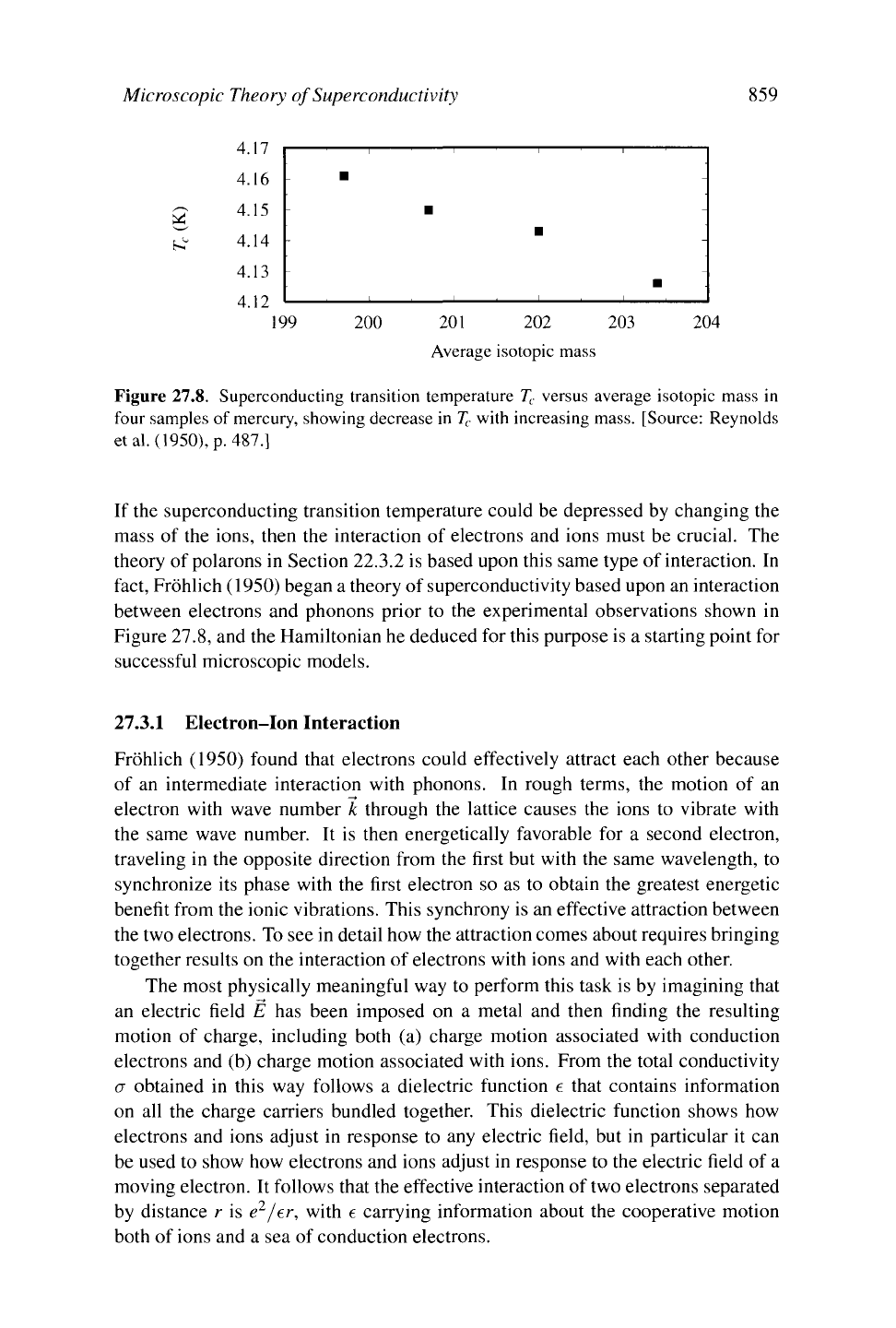
A crucial step on the path to a microscopic theory was the discovery of the
isotope effect by Maxwell (1950) and Reynolds et
al.
(1950), shown in Figure 27.8.
Microscopic Theory of Superconductivity
859
4.17
4.16
^ 4.14
4.13
4.12
199 200 201 202 203 204
Average isotopic mass
Figure 27.8. Superconducting transition temperature T
c
versus average isotopic mass in
four samples of mercury, showing decrease in
T
c
with increasing mass. [Source: Reynolds
etal. (1950),
p.
487.]
If the superconducting transition temperature could be depressed by changing the
mass of the ions, then the interaction of electrons and ions must be crucial. The
theory of polarons in Section 22.3.2 is based upon this same type of interaction. In
fact, Fröhlich
( 1950)
began a theory of superconductivity based upon an interaction
between electrons and phonons prior to the experimental observations shown in
Figure 27.8, and the Hamiltonian he deduced for this purpose is a starting point for
successful microscopic models.
27.3.1 Electron-Ion Interaction
Fröhlich (1950) found that electrons could effectively attract each other because
of an intermediate interaction with phonons. In rough terms, the motion of an
electron with wave number k through the lattice causes the ions to vibrate with
the same wave number. It is then energetically favorable for a second electron,
traveling in the opposite direction from the first but with the same wavelength, to
synchronize its phase with the first electron so as to obtain the greatest energetic
benefit from the ionic vibrations. This synchrony is an effective attraction between
the two electrons. To see in detail how the attraction comes about requires bringing
together results on the interaction of electrons with ions and with each other.
The most physically meaningful way to perform this task is by imagining that
an electric field Ê has been imposed on a metal and then finding the resulting
motion of charge, including both (a) charge motion associated with conduction
electrons and (b) charge motion associated with ions. From the total conductivity
a obtained in this way follows a dielectric function e that contains information
on all the charge carriers bundled together. This dielectric function shows how
electrons and ions adjust in response to any electric field, but in particular it can
be used to show how electrons and ions adjust in response to the electric field of a
moving electron. It follows that the effective interaction of two electrons separated
by distance r is e
1
/er, with e carrying information about the cooperative motion
both of ions and a sea of conduction electrons.
860 Chapter 27. Superconductivity
Conduction Electron Current. Equations (20.75) and (20.76) describe how
conduction electrons move in response to external potentials V. Because a =
u}(e —
\)/4iri from (20.14), Eq. (20.84) says that for longitudinal waves, the con-
duction electron contribution to the conductivity is
o"d = ^-- (27.91)
T
Equation (27.91) looks simple until one contemplates writing
Xc
out in its full
splendor. Evaluation of Eq. (20.76) can be simplified in two steps:
1.
Only the low-frequency susceptibility is needed. The reason is that electrons
will only experience an attractive interaction when they oscillate at frequen-
cies characteristic of phonons. As shown in Figure
20.1,
characteristic phonon
energies and frequencies are around two orders of magnitude less than char-
acteristic electron energies and frequencies, so Xc can be evaluated at
UJ
= 0,
allowing the electrons to respond adiabatically to the phonons.
2.
Only the long wavelength susceptibility is needed. When u
—>
0, Problem
20.6 shows that
Xc
takes the form
Xc = -~ ^^ (27.92)
7T
2
/r 8(?
and that in the low q limit
me
2
kp K? ,„„
Xc = 2^ = ~T--
(
27
-
93
)
7T
2
/T 47T
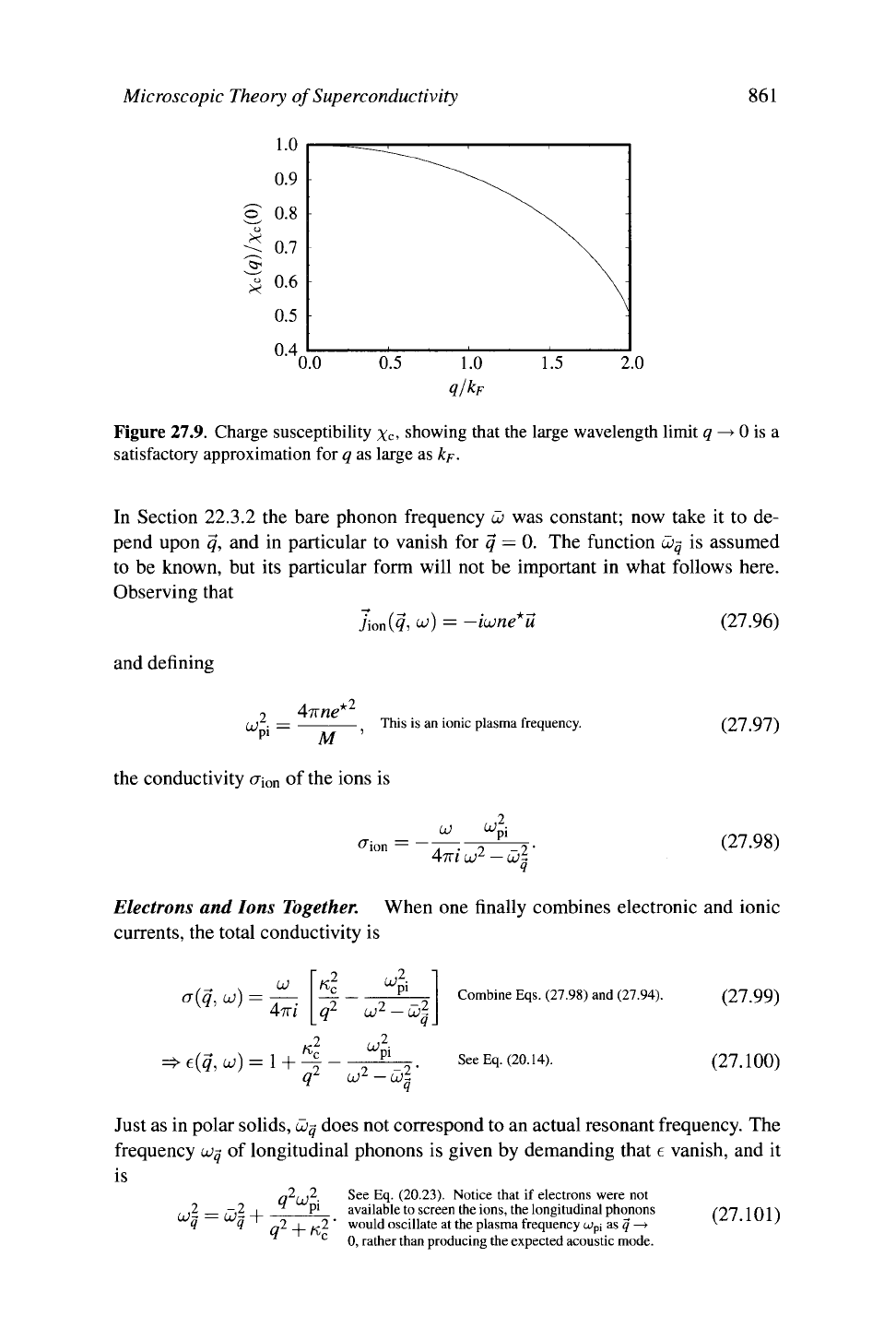
There seems not to be much justification for going to the low q limit because
the interest will be in q in the neighborhood of kp. However, the plot of
Xc(#)/Xc(0) in Figure 27.9 shows that the error is hardly significant, because
X changes only by 10% by the time q reaches kp.
The final result is that the contribution of electrons to the conductivity is
*ei = ^%. (27.94)
47Tjg
z
Ion Current. Section 22.3.2 showed how an electron moving in a polar solid
would cause ions to move. The analysis relevant for superconductivity is very
similar, but it must be modified slightly because the important phonons are acoustic
rather than optical.
Returning to Eq. (22.18), suppose that ionic displacements u respond to applied
electric fields by obeying
—
p*F ^
or sma
" ?' E should probably be replaced by £
ce
ii, but
— e c in view of other uncertainties the replacement is pedantic. (71 QS)
2\
M(co
2
— u)
Microscopic Theory of Superconductivity
861
Figure 27.9. Charge susceptibility
Xc>
showing that the large wavelength limit q
—>
0 is a
satisfactory approximation for
q
as large as k
F
.
In Section 22.3.2 the bare phonon frequency ü was constant; now take it to de-
pend upon q, and in particular to vanish for q = 0. The function ü^ is assumed
to be known, but its particular form will not be important in what follows here.
Observing that
7ion(<7, w) = -iume*u (27.96)
and defining
Airne
,*2
UJ,
pi
M
This is an ionic plasma frequency.
(27.97)
the conductivity a\
on
of the ions is
LO
W*
0"t on —
4717 LO
1
— Ujl
(27.98)
Electrons and Ions Together. When one finally combines electronic and ionic
currents, the total conductivity is
o(q, u)
u
Am
e(q,
u) =
1
+
■
<t
0J„
UJ^
Ws
w,
pi
o;
2
-φ)2'
Combine Eqs. (27.98) and (27.94).
See Eq. (20.14).
(27.99)
(27.100)
Just as in polar solids, ü^ does not correspond to an actual resonant frequency. The
frequency
LO^
of longitudinal phonons is given by demanding that e vanish, and it
is
2,
,2
Wj=W
3
+
q"u.
pi
See Eq. (20.23). Notice that if electrons were not
available to screen the ions, the longitudinal phonons
Q Q2 I p-2 ' would oscillate at the plasma frequency
o>
p
j
as q -
c
0, rather than producing the expected acoustic mode.
(27.101)
862 Chapter 27. Superconductivity
Using this definition, a bit of algebra shows that
1 Q
2
e{q,uj) q
2
+
K
2
c
0,2-4
(27.102)
Effective Interaction. Suppose now that two electrons move through a solid
whose dielectric function is given by Eq. (27.102). If they have wave vectors k\
and
&2
and energies
£ i
and £2, then the charge density of the two of them oscillates
as
|^ic
/
*'-
?
-
£
"/
Ä
+
^
2
c
/
*
2
-
ï
'-
e2r/fi
|
2
oc
const. + cos[(îfci
— ik
2
) -
r
—
(£1
—
£
2
)r/Ä].
(27.103)
Their effective interaction is therefore
U
t
Aire
1
Aire
1
eff
e(q,u)q
2
q
2
+ K\
1 +
2 -2
UJ~ — CJ-
1 q
7 2
with
&2 and
Hu>
= £1
—
£2-
(27.104a)
(27.104b)
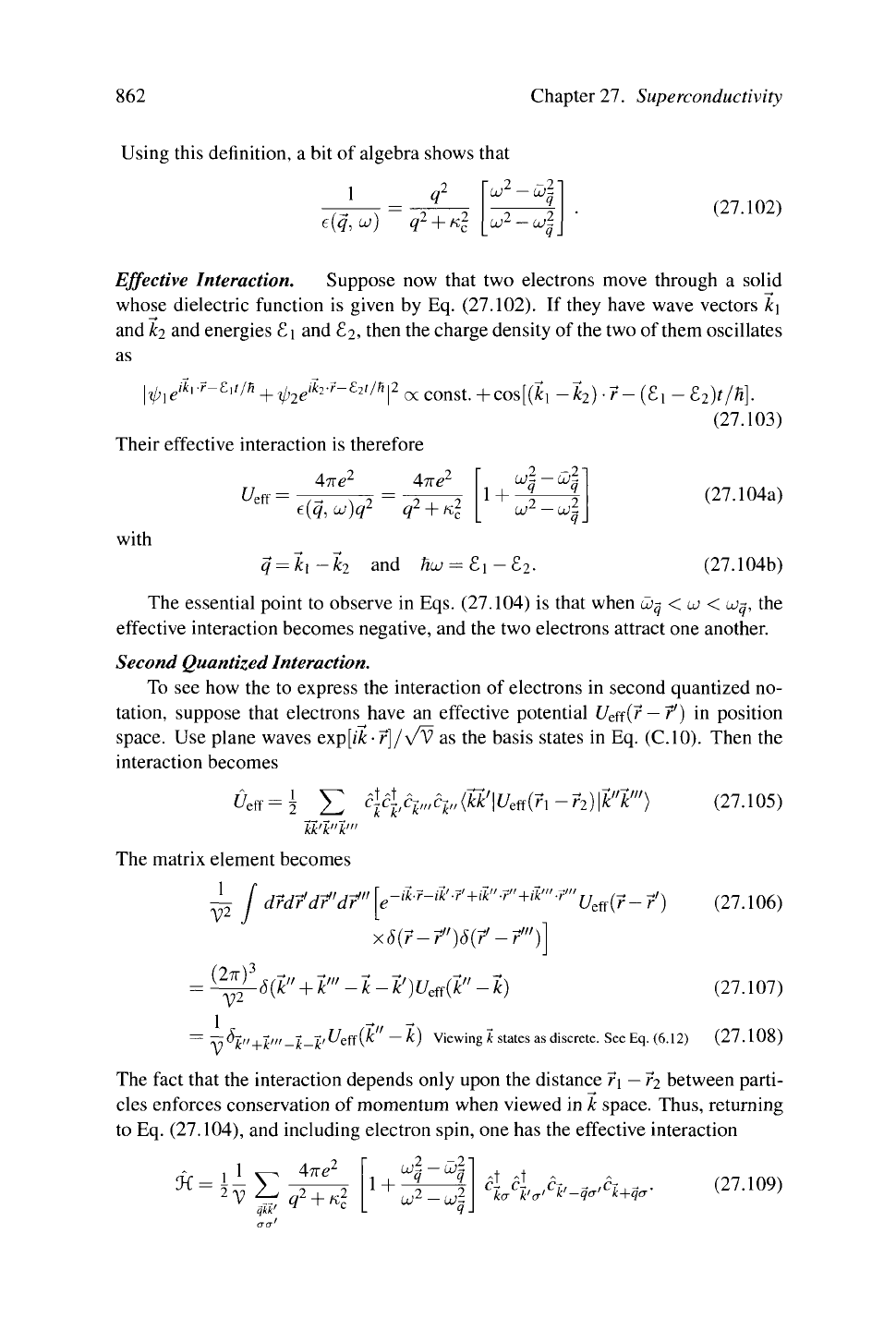
The essential point to observe in Eqs. (27.104) is that when
co^
< to <
u>^,
the
effective interaction becomes negative, and the two electrons attract one another.
Second Quantized Interaction.
To see how the to express the interaction of electrons in second quantized no-
tation, suppose that electrons have an effective potential
U
e
ff(r
—
r') in position
space. Use plane waves exp[ik
■
r]/VV as the basis states in Eq. (C.10). Then the
interaction becomes
f4ff =2 ^2
ê
l
ê
p
ê
k'"
ê
î"(kk'\U
ef
f(r\
-r
2
)\k"k"
kk'k"k'"
The matrix element becomes
-^ / drdr'd/'dr"'
V2
V
2
-ik-r-ik'■?+ik"-r"+ik'"-r'"
■
e '
r
U
sf
f(r-r
x6(r-r)6(7-7")
S(k"
+
k'"
-k-k')U
ef
f(k" -k)
(27.105)
(27.106)
(27.107)
=
V)^ï"+k'"-lc-ï'^
e
^^
~ k) Viewing £ states as discrete. See Eq. (6.12) (27.108)
The fact that the interaction depends only upon the distance r\
— ?2
between parti-
cles enforces conservation of momentum when viewed in k space. Thus, returning
to Eq. (27.104), and including electron spin, one has the effective interaction
'K:
, 1 ^ 4-rre
2
2 -2
U)~
—
Lü~
i i
g q
' 1 2
ka k'u' k'-qa' k+qa
(27.109)