
Marder M.P. Condensed Matter Physics
Подождите немного. Документ загружается.

Microscopic Theory of Superconductivity
863
27.3.2 Instability of the Normal State: Cooper Problem
Cooper (1956) performed the first calculation showing how a small attractive inter-
action between electrons destabilizes the conventional electronic ground state. The
idea is the following. Consider a state containing N particles that occupy k states
up to a Fermi level. This state will denoted by \G), and the first guess is that it is
the ground state of the Hamiltonian, or at least close to it. Formally,
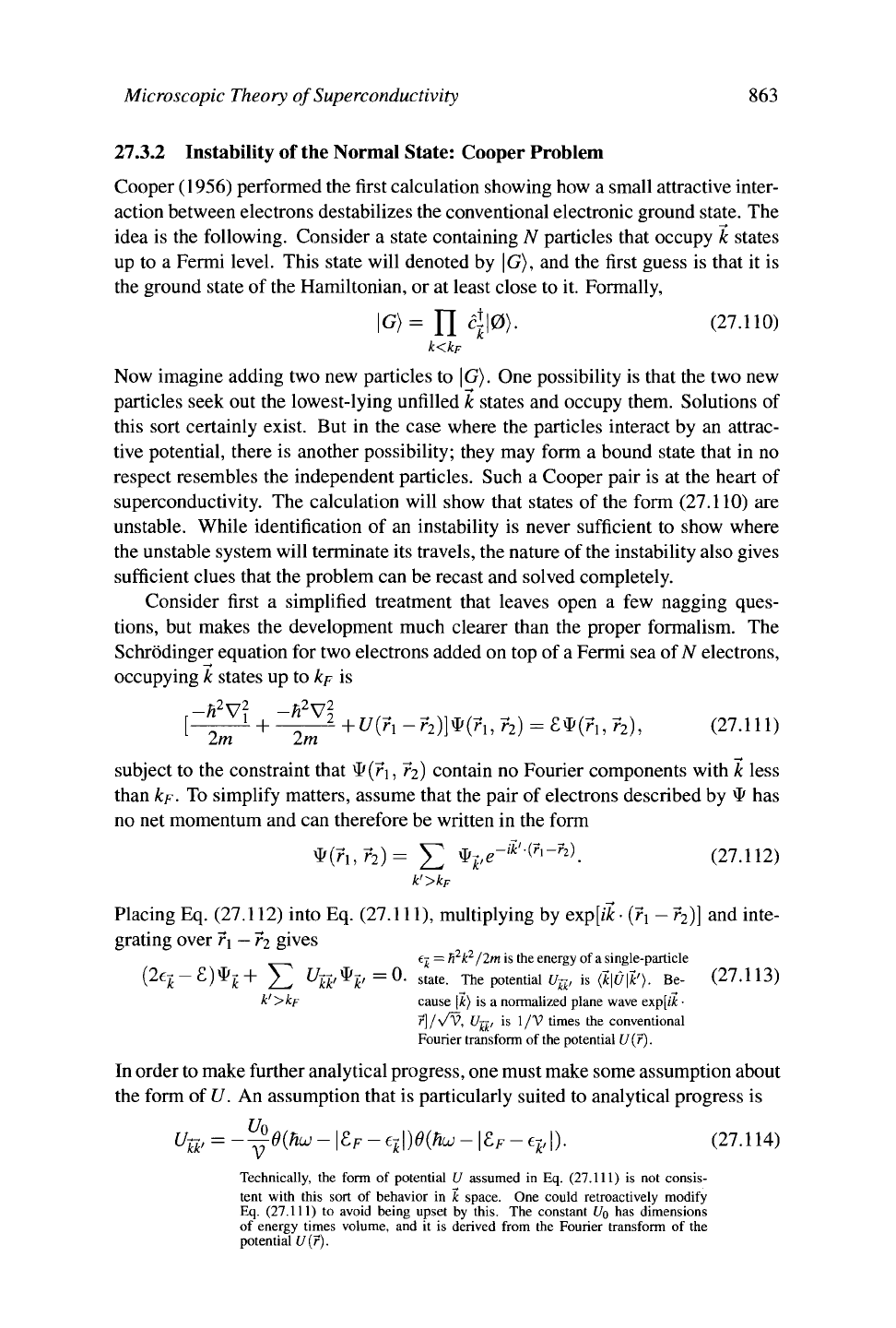
\G)=\{^0).
(27.110)
k<k
F
Now imagine adding two new particles to \G). One possibility is that the two new
particles seek out the lowest-lying unfilled k states and occupy them. Solutions of
this sort certainly exist. But in the case where the particles interact by an attrac-
tive potential, there is another possibility; they may form a bound state that in no
respect resembles the independent particles. Such a Cooper pair is at the heart of
superconductivity. The calculation will show that states of the form (27.110) are
unstable. While identification of an instability is never sufficient to show where
the unstable system will terminate its travels, the nature of the instability also gives
sufficient clues that the problem can be recast and solved completely.
Consider first
a
simplified treatment that leaves open
a
few nagging ques-
tions,
but makes the development much clearer than the proper formalism. The
Schrödinger equation for two electrons added on top of a Fermi sea ofN electrons,
occupying k states up to
kf
is
r
-fi V
1
+
-fi_V2
+£/(?i
_^^
(?i
^
) =
£
^
(?i
^^ (27.111)
2m
1m
subject to the constraint that ^(r\,
'r-i)
contain no Fourier components with k less
than kf. To simplify matters, assume that the pair of electrons described by
W
has
no net momentum and can therefore be written in the form
Wuh)=
£
^e-^-V.
(27.112)
k'>k
F
Placing Eq. (27.112) into Eq. (27.111), multiplying by exp[ik
•
(n
—
r^)] and inte-
grating over
7\
— ?2
gives
e^=H
2
k
2
/2mis the energy of
a
single-particle
(2e£ — £)*£
+ £
U~kk'^k'
=
®-
state
- The potential {/£,
is
(it|(/|/t').
Be-
(27.113)
k'>kf cause \k) is a normalized plane wave exp[ik
■
~r\/VV,
U-g^i
is
1/V times the conventional
Fourier transform of the potential U(r).
In order to make further analytical progress, one must make some assumption about
the form of U. An assumption that is particularly suited to analytical progress is
Uo,
V
U& = -^0{hu>-\£
F
-e
i
\)0(fiw-\E
F
-<%{). (27.114)
Technically, the form of potential U assumed in Eq. (27.111) is not consis-
tent with this sort
of
behavior in
k
space. One could retroactively modify
Eq. (27.111) to avoid being upset by this. The constant Uo has dimensions
of energy times volume, and
it
is derived from the Fourier transform of the
potential U(r).
864
Chapter 27. Superconductivity
When one lets
k
max
be the largest value of k for which
Hui —
\8p
—
ej| is positive,
Eq. (27.113) takes the form
j j Kmax
(2er - £)*r = — y^ %,.
True so lon
g
as
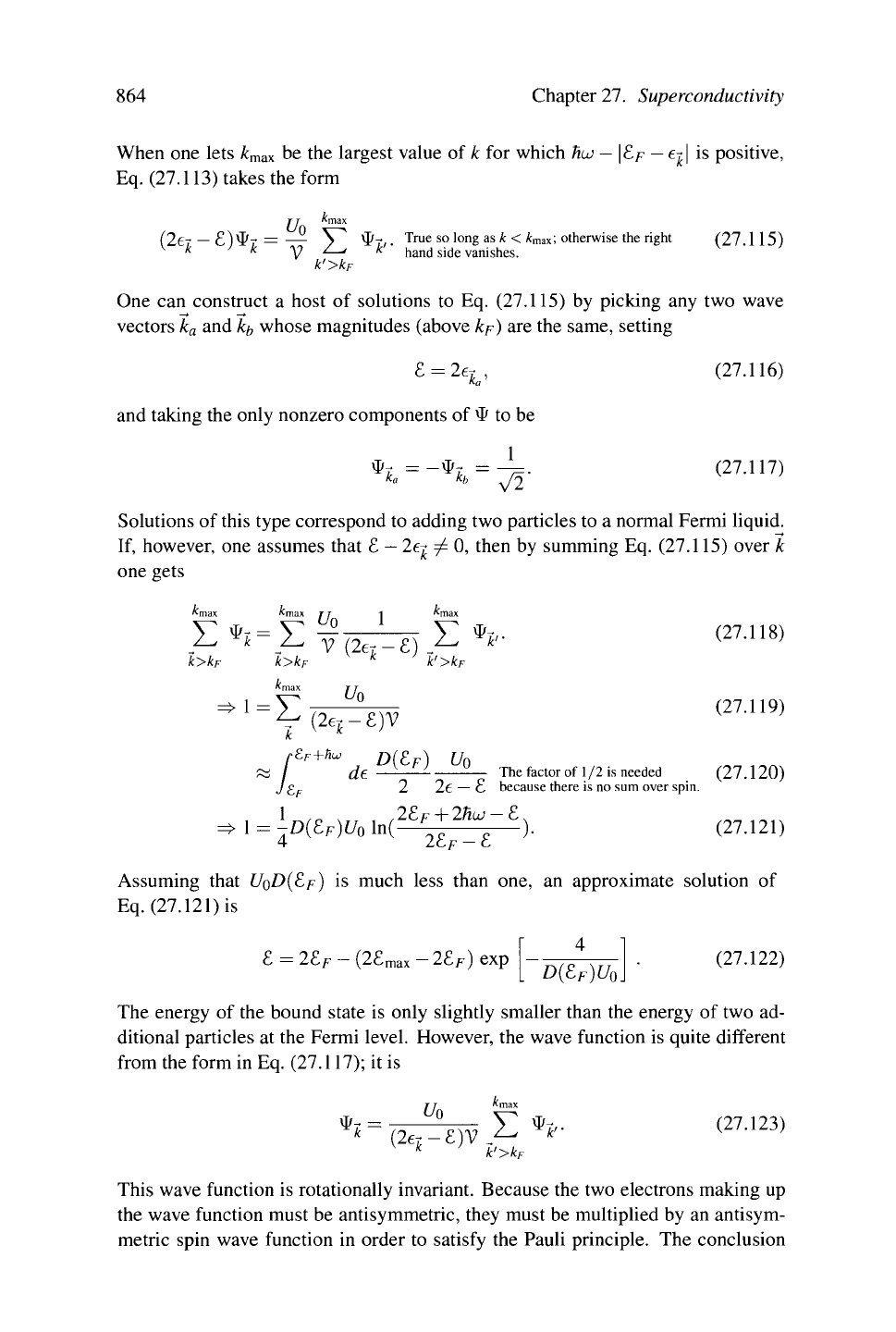
* < *max; otherwise the right (27.115)
k
k \f z_-/ k hand side vanishes.
One can construct a host of solutions to Eq. (27.115) by picking any two wave
vectors k
a
and
k\,
whose magnitudes (above kp) are the same, setting
£ = 2ej, (27.116)
and taking the only nonzero components of ^ to be
1
H
=
-*h
=
-*-
(27
-
117)
Solutions of this type correspond to adding two particles to a normal Fermi liquid.
If, however, one assumes that £
—
2e^
^ 0, then by summing Eq. (27.115) over k
one gets
^rnax ^max j j -t &max
k>k
F
k>k
F
k
k'>k
F
^max
T
j
k
E
F
+hw
D(E
F
) U
0
de
— The factor of 1/2 is needed (27.120)
£
2 2e — £ because there is no sum over spin.
^l
=
lD(£^
0
ln(
2£
^7
£
). (27.121)
Assuming that UQD{8F) is much less than one, an approximate solution of
Eq. (27.121) is
£ = 28
F
- (2£
max
- 28,
F
) exp
D{8
F
)U
0
\
(27.122)
The energy of the bound state is only slightly smaller than the energy of two ad-
ditional particles at the Fermi level. However, the wave function is quite different
from the form in Eq. (27.117); it is
j j Kmax
V
* ' k'>k
F
This wave function is rotationally invariant. Because the two electrons making up
the wave function must be antisymmetric, they must be multiplied by an antisym-
metric spin wave function in order to satisfy the Pauli principle. The conclusion
Microscopic Theory of Superconductivity 865
is that two electrons in an antisymmetric spin state, and with opposite k vectors so
as to have no net momentum, can form a bound pair if they are added on top of
collection of other electrons that are assumed not to have formed pairs of this type.
But then the assumption that the other electrons have not already formed bound
pairs is clearly wrong, and one has to start all over at the beginning. However, be-
fore doing so, it is worth recasting the Cooper problem in the language of second
quantization, to set the stage for the Hamiltonian actually used to study supercon-
ductivity.
27.3.3 Self-Consistent Ground State
Model Hamiltonian. Given the observation that pairs of electrons with opposite
wave vectors and spins seem capable of binding into pairs, Bardeen, Cooper, and
Schrieffer (1957) proposed the BCS model Hamiltonian, which abstracts from all
the preceding complicated discussion a simple solvable model. It is
ÄBCS
= £
^
l(j
c
la
+ Ç £fe4r*!V-*i^r
(27
-
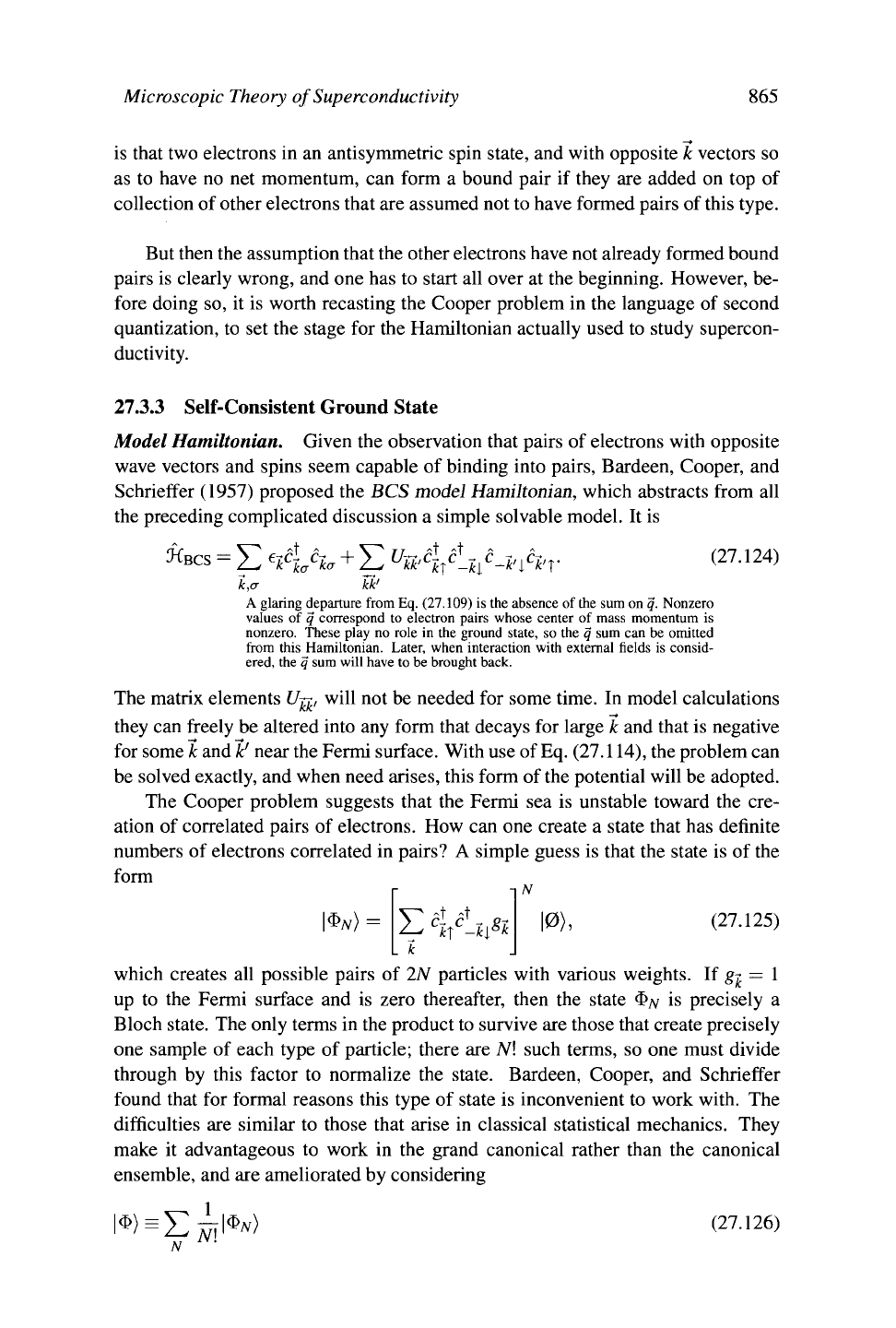
124)
k,a kk'
A
glaring departure from Eq. (27.109) is the absence of the sum on q. Nonzero
values
of q correspond to electron pairs whose center of mass momentum is
nonzero.
These play no role in the ground
state,
so the q sum can be omitted
from
this Hamiltonian. Later, when interaction with external fields is consid-
ered,
the q sum will have to be brought back.
The matrix elements
U-g,,
will not be needed for some time. In model calculations
they can freely be altered into any form that decays for large k and that is negative
for some k and
W
near the Fermi surface. With use of
Eq.
(27.114), the problem can
be solved exactly, and when need arises, this form of the potential will be adopted.
The Cooper problem suggests that the Fermi sea is unstable toward the cre-
ation of correlated pairs of electrons. How can one create a state that has definite
numbers of electrons correlated in pairs? A simple guess is that the state is of the
form
N
E
-t 4
%
C
-%l
g
k
1
which creates all possible pairs of 2N particles with various weights. If g^ = 1
up to the Fermi surface and is zero thereafter, then the state ## is precisely a
Bloch state. The only terms in the product to survive are those that create precisely
one sample of each type of particle; there are N\ such terms, so one must divide
through by this factor to normalize the state. Bardeen, Cooper, and Schrieffer
found that for formal reasons this type of state is inconvenient to work with. The
difficulties are similar to those that arise in classical statistical mechanics. They
make it advantageous to work in the grand canonical rather than the canonical
ensemble, and are ameliorated by considering
I^E^I*") (27.126)
|$JV)
=
|0),
(27.125)
866 Chapter 27. Superconductivity
E
1
£3
.
k
tcK
k]
-kl
81
The constants
g^
could also depend upon A*.
I
çi\
Neglecting this dependence is justified by not-
I
' ' ing
that
the sum
will
be
dominated
by a
nar-
row range
of
N
and
assuming that
g-
k
does
not
vary appreciably with
N in
this range.
Coherent States. Equation (27.127)
can be
rewritten
as
cl
c
]
- 1
|$) = expE^4ct ]|0).
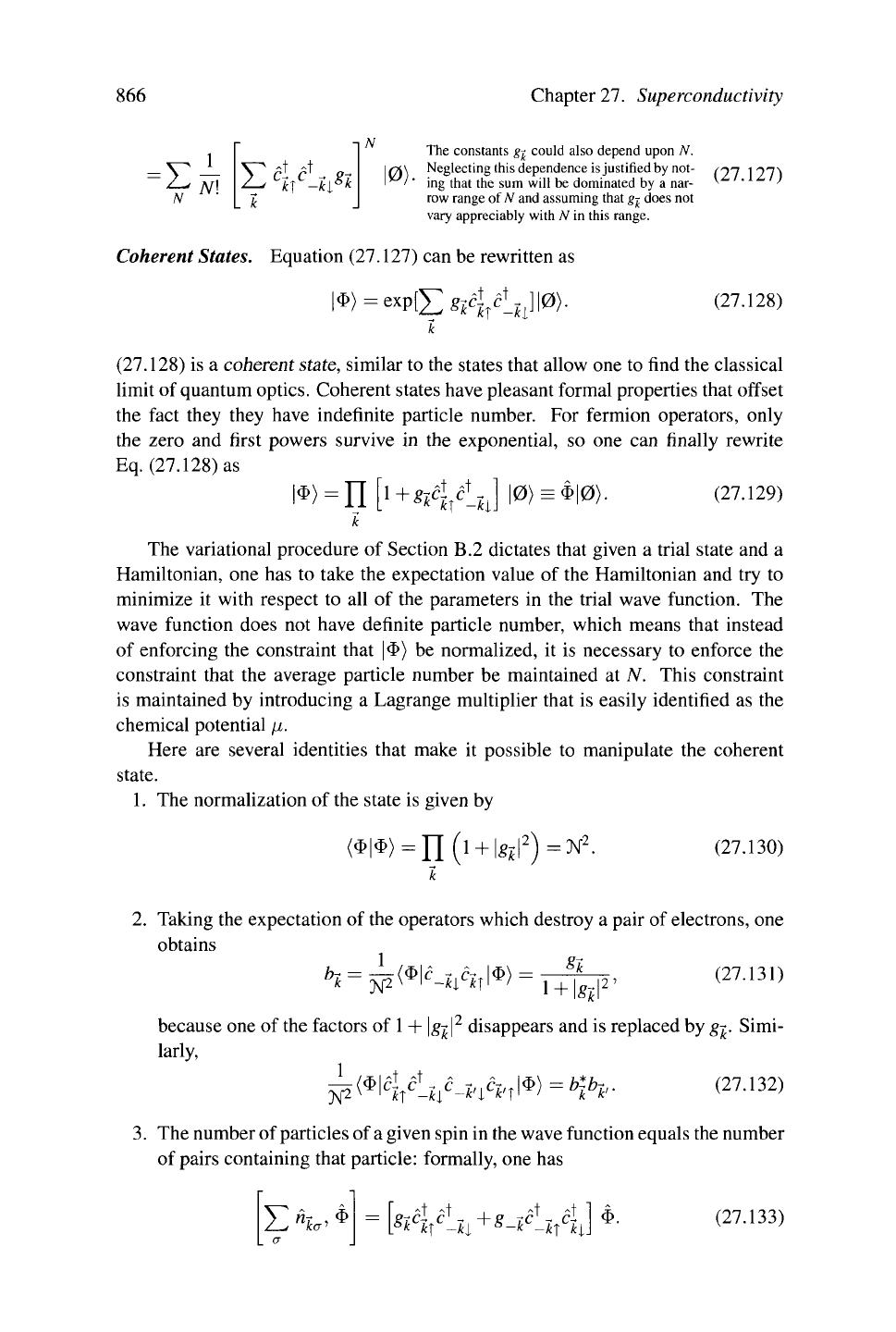
(27.127)
(27.128)
(27.128)
is a
coherent
state,
similar
to the
states that allow
one to
find
the
classical
limit
of
quantum optics. Coherent states have pleasant formal properties that offset
the fact they they have indefinite particle number.
For
fermion operators, only
the zero
and
first powers survive
in the
exponential,
so one can
finally rewrite
Eq. (27.128)
as
i
$
>=n I
1
+MI/-*J i
0
>=
e
'
0)
-
(27
-
i29)
The variational procedure
of
Section
B.2
dictates that given
a
trial state
and a
Hamiltonian,
one has to
take
the
expectation value
of the
Hamiltonian
and try to
minimize
it
with respect
to all of the
parameters
in the
trial wave function.
The
wave function does
not
have definite particle number, which means that instead
of enforcing
the
constraint that |<3>)
be
normalized,
it is
necessary
to
enforce
the
constraint that
the
average particle number
be
maintained
at
TV.
This constraint
is maintained
by
introducing
a
Lagrange multiplier that
is
easily identified
as the
chemical potential
//.
Here
are
several identities that make
it
possible
to
manipulate
the
coherent
state.
1.
The
normalization
of
the state
is
given
by
<*i*>=no+i«*i
2
)=
:N
*-
(27.130)
2.
Taking
the
expectation
of
the operators which destroy
a
pair
of
electrons,
one
obtains
1
er
(27.131)
£>-
=
—/öle
- c-
\®)
= —
-k^kV
|2
I?
'
sir
because one
of
the factors
of
1
+ |^|
2
disappears
and is
replaced
by
gj. Simi-
larly,
(27.132)
^\i/-ki
è
~l'ï
è
l'^
=
b
l
b
l'-
3.
The number of particles
of
a
given spin in the wave function equals the number
of pairs containing that particle: formally,
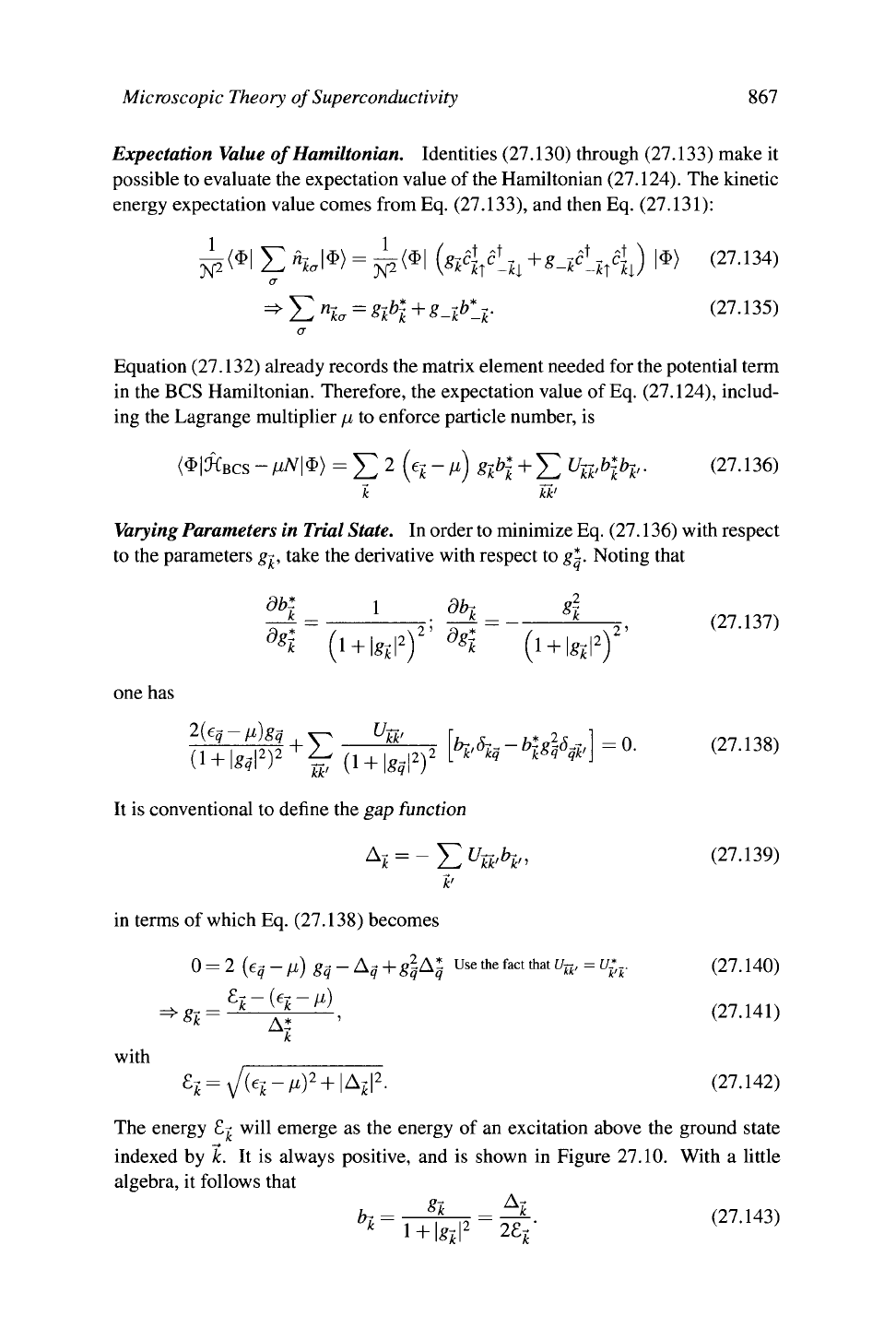
one has
E
«**>
è
st
~t
st
Δ
t
8
k
C
kf
-k[
+
g
-ï
C
'-kfll
$.
(27.133)
Microscopic Theory of Superconductivity 867
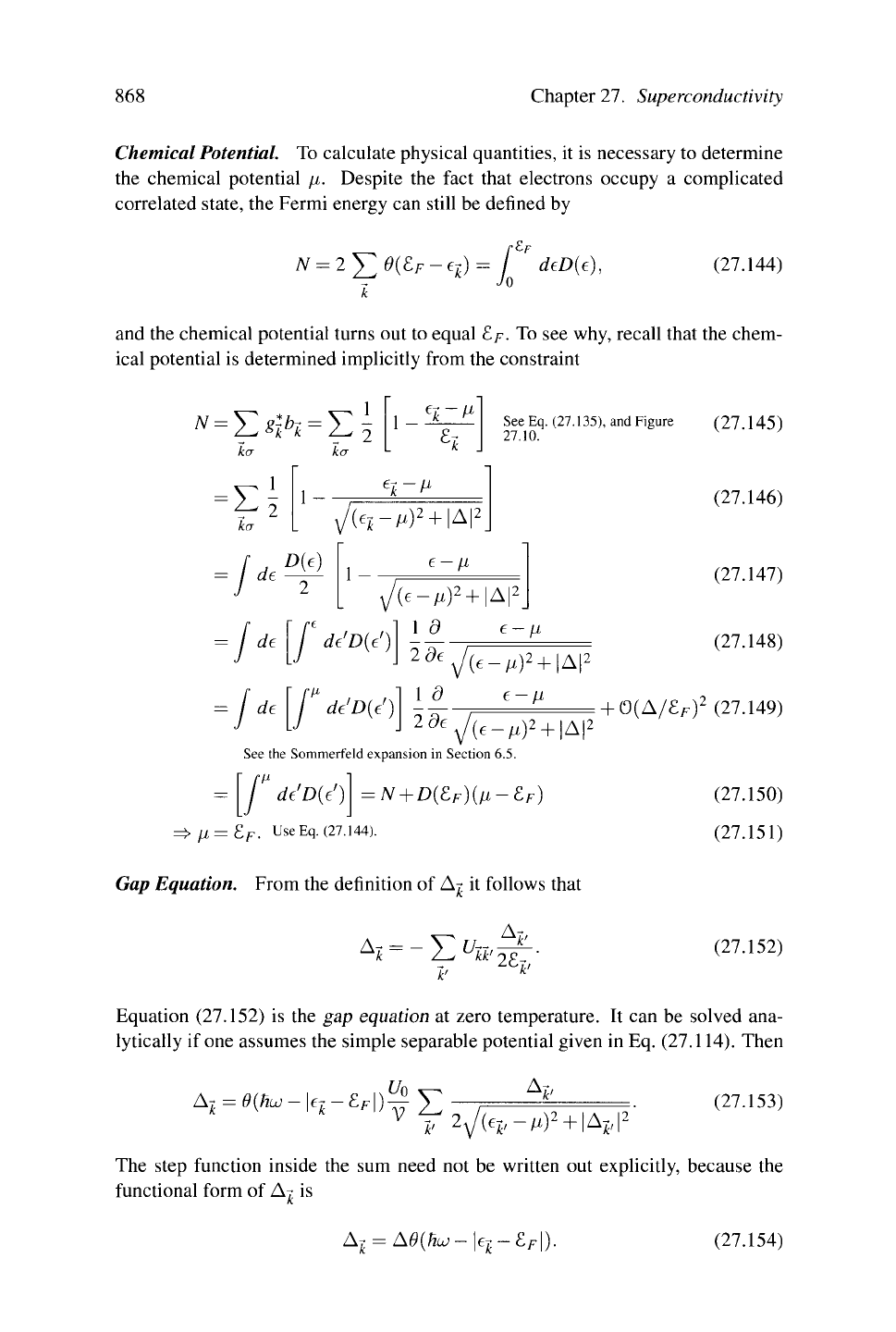
Expectation
Value
of Hamiltonian. Identities (27.130) through (27.133) make it
possible to evaluate the expectation value of the Hamiltonian (27.124). The kinetic
energy expectation value comes from Eq. (27.133), and then Eq. (27.131):
Equation (27.132) already records the matrix element needed for the potential term
in the BCS Hamiltonian. Therefore, the expectation value of
Eq.
(27.124), includ-
ing the Lagrange multiplier
p,
to enforce particle number, is
($|ÄBCS-^I$)
= E
2
fa-»)
s^I+E^IV
(
27
-
136
>
k kk'
Varying
Parameters in
Trial
State.
In order to minimize Eq. (27.136) with respect
to the parameters g^, take the derivative with respect to gt. Noting that
dbï
d8Ï
1
(l + I^P)
4
(I+I^I
2
)'
(27.137)
one has
2{t
n
-p)g
n
v^ U
u
,
o+tai
2
)
2
Iro+tai
2
)
2
h'hq-H^qk'
is conventional to define the gap function
k
Z
U
Tk'h^
1
0. (27.138)
(27.139)
in terms of which Eq. (27.138) becomes
0 = 2 (e
?
- p)
gq
>
- A
?
+ gf Ajf Use the fact that U
u
, = I/-.
k-(
€
k-ri
with
Si
h
A
l
er-
ß
f
+
\Atf.
(27.140)
(27.141)
(27.142)
The energy £^ will emerge as the energy of an excitation above the ground state
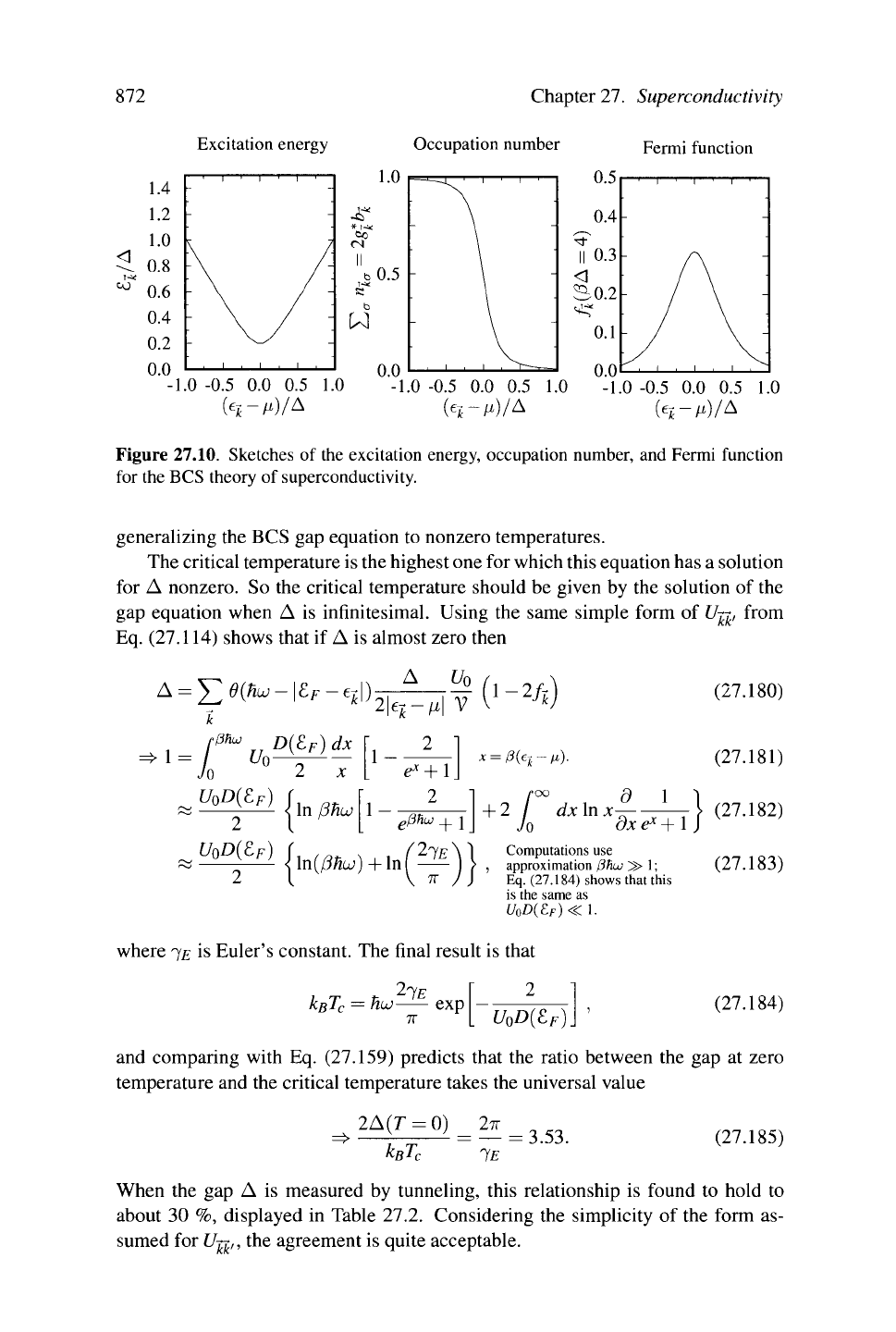
indexed by k. It is always positive, and is shown in Figure 27.10. With a little
algebra, it follows that
bt
81
=
\
1 + |S# 2£;
(27.143)
868 Chapter 27. Superconductivity
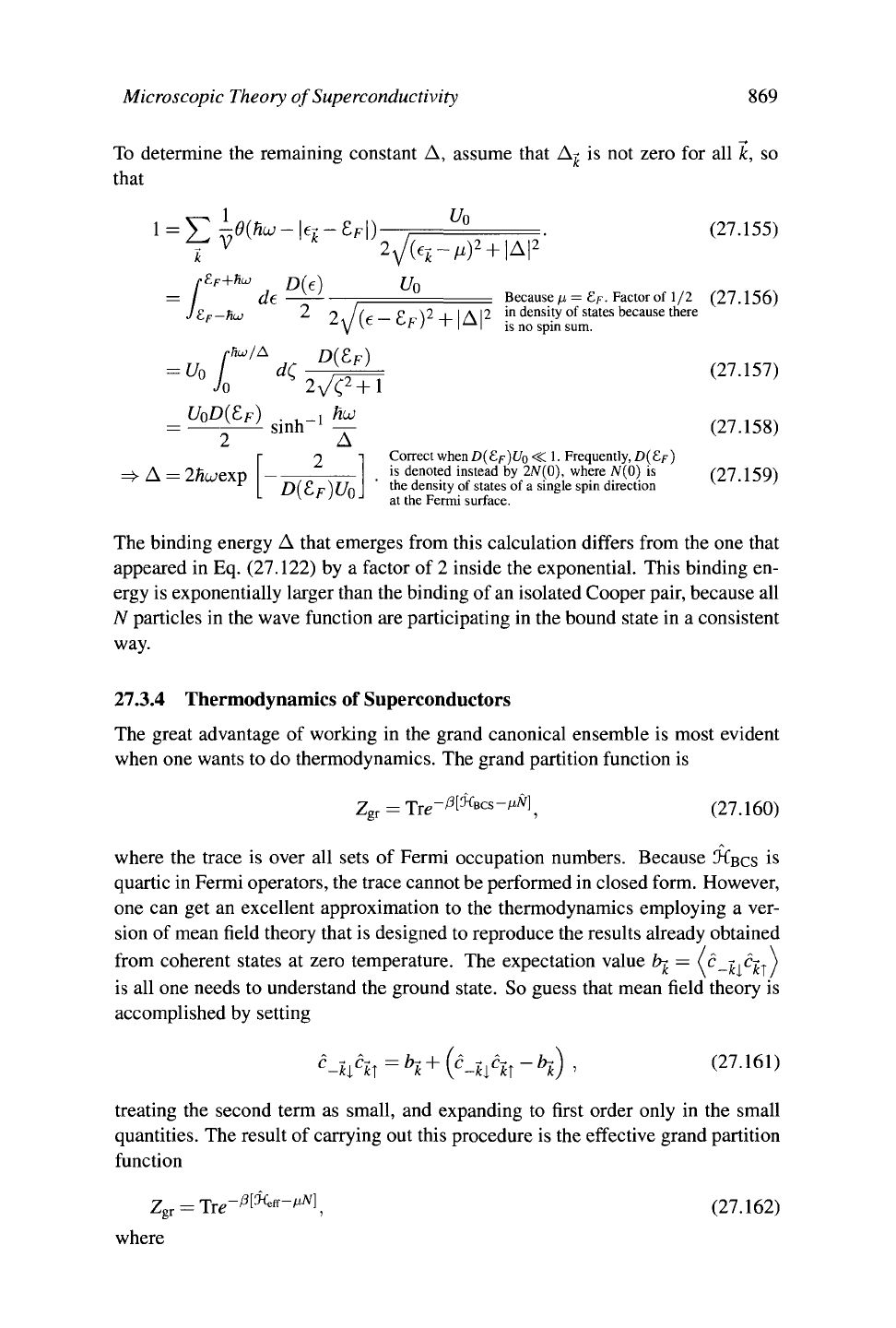
Chemical
Potential.
To calculate physical quantities, it is necessary to determine
the chemical potential
p.
Despite the fact that electrons occupy
a
complicated
correlated state, the Fermi energy can still be defined by
yV
=
2^6>(£/7-ej)=
f
F
deD{e), (27.144)
k
and the chemical potential turns out to equal
Z
F
.
To see why, recall that the chem-
ical potential is determined implicitly from the constraint
"=£#*
=
£
ô
ko
£
ko
e
k~V
ko
et-fi
de
de
de
D(e)
(er-^
+
IAP
e —
[i
de'D(e')
dèDiè
{e-fi)
2
+ \A\
2
_
1
d
e —
p
e-//)
2
+ |A|
2
See the Sommerfeld expansion in Section 6.5.
N + D{E
F
)(p-E.
F
)
SeeEq. (27.135), and Figure
(27 145)
27.10.
(27.146)
(27.147)
(27.148)
G(A/£
F
)
2
(27.149)
29e
^(e-/z)
2
+
|A|2
1
d
e —
ß
Yde
=
/
de'D(e')
^=E
F
. Use Eq. (27.144)
(27.150)
(27.151)
Gap Equation. From the definition
of
Ar.
it follows that
r. ^-W/
(27.152)
Equation (27.152)
is
the gap equation
at
zero temperature.
It
can be solved ana-
lytically if one assumes the simple separable potential given in Eq. (27.114). Then
Vo
A
k>
v
T
iJ^-tf +
W
(27.153)
The step function inside the sum need not be written out explicitly, because the
functional form
of
Ar
is
Ar
=
A9(hiü-\er-E
F
\). (27.154)
Microscopic Theory of Superconductivity 869
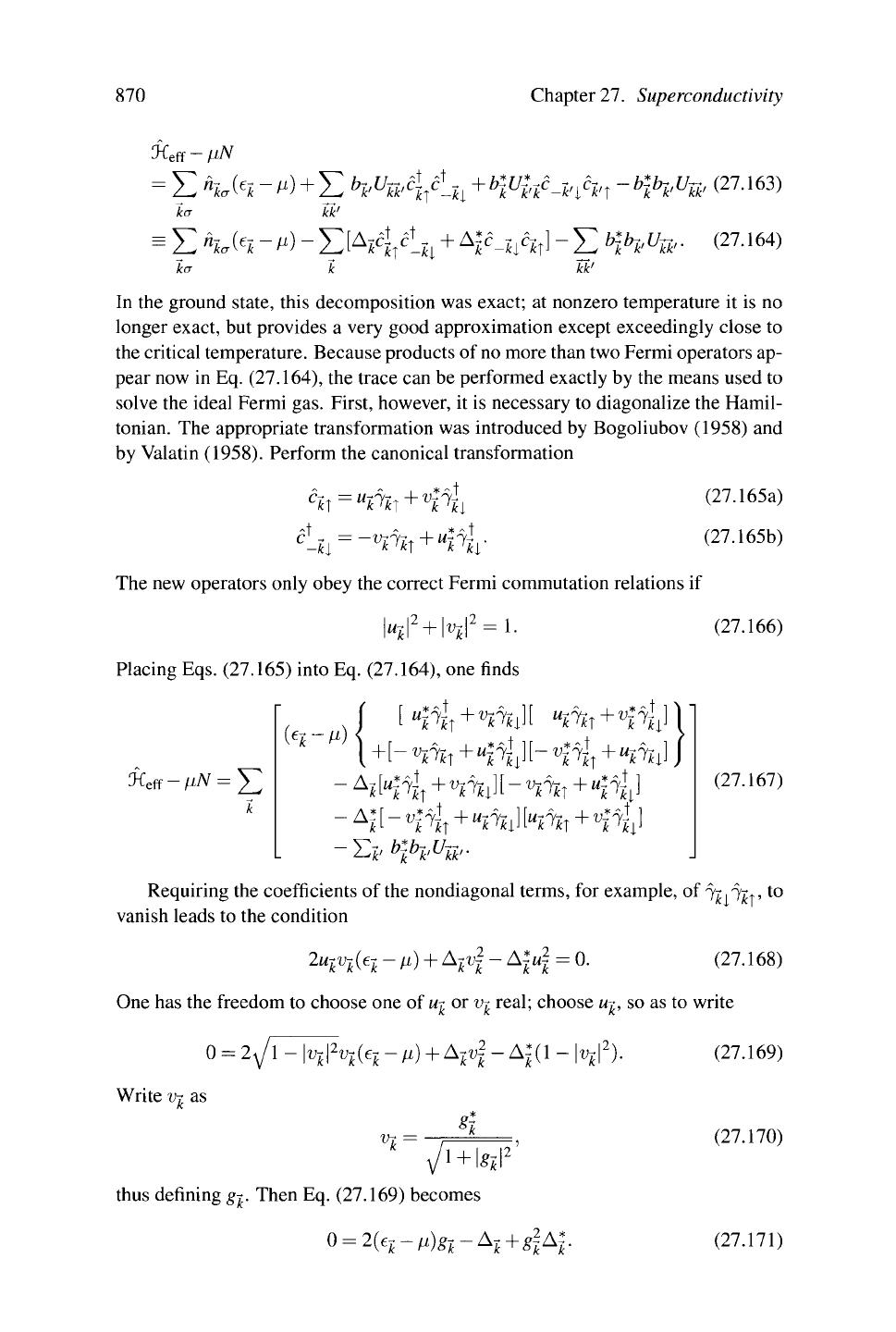
To determine the remaining constant A, assume that A^ is not zero for all k,
so
that
1
=
E^-l
e
r
g
H)-r=
I/o
<
27
-
155
)
T
V
ifa-tf + W
/■
£
f+^
D(e) t/
0
= / de ——
Because
M
=£F-Factor
of 1/2 (27.156)
JS-F—hui
2 9 // _ e\2 I
I
A 12 in density of states because there
Z
\A
f
^ "H^l
is no spin sum.
fiW/A
JA
D
(
£
^)
JO
o 2
V
/
c
i
n
(27.157)
^Msinh-^ (27.158)
A
=
2ftu;exp
2
D{£
F
)U
0
Correct when D(£/r)f/o -C1. Frequently,
D(£f)
is denoted instead by 2W(0), where iV(0)
is
("27 159)
the density of states of a single spin direction
at the Fermi surface.
The binding energy A that emerges from this calculation differs from the one that
appeared in Eq. (27.122) by a factor of 2 inside the exponential. This binding en-
ergy is exponentially larger than the binding of an isolated Cooper pair, because all
N particles in the wave function are participating in the bound state in a consistent
way.
27.3.4 Thermodynamics of Superconductors
The great advantage of working in the grand canonical ensemble is most evident
when one wants to do thermodynamics. The grand partition function is
Z
gr
=
Tr
e
-ß[^Bcs-t^\, (27.160)
where the trace is over all sets of Fermi occupation numbers. Because ÄBCS
is
quartic in Fermi operators, the trace cannot be performed in closed form. However,
one can get an excellent approximation to the thermodynamics employing
a
ver-
sion of mean field theory that is designed to reproduce the results already obtained
from coherent states at zero temperature. The expectation value b^ — (c_^,c^j
is all one needs to understand the ground state. So guess that mean field theory is
accomplished by setting
c
-*r*î
d
kï=
b
k+(
ê
-ïi
ê
kî-
b
i)'
(27.161)
treating the second term as small, and expanding to first order only in the small
quantities. The result of carrying out this procedure is the effective grand partition
function
where
Z
gr
=
j
re
-ßi^-ßN]
;
(27.162)
870 Chapter
27.
Superconductivity
Xzff-ίN
£ hM -/*)
+
£ h'
u
u4/~h+^H*-*I^T - ^^
(
27
-
163
)
iff
kk'
£ %^
-/*)
-£[MA,
+
A
?_^
T
] -E *2***<fr-
(
27
-
164
)
t(T
tt'
In the ground state, this decomposition was exact; at nonzero temperature it is no
longer exact, but provides a very good approximation except exceedingly close to
the critical temperature. Because products of
no
more than two Fermi operators ap-
pear now in Eq. (27.164), the trace can be performed exactly by the means used to
solve the ideal Fermi gas. First, however, it is necessary to diagonalize the Hamil-
tonian. The appropriate transformation was introduced by Bogoliubov (1958) and
by Valatin (1958). Perform the canonical transformation
The new operators only obey the correct Fermi commutation relations if
(27.165a)
(27.165b)
h\
2
+h\
2
-
i.
(27.166)
Placing Eqs. (27.165) into Eq. (27.164), one finds
Jr.
eff
"
~/^
=
£
(
e
ï - M)
t
^^ir_^
T
+ M
|^
kV
(27.167)
Requiring the coefficients of the nondiagonal terms, for example, of \\\+, to
vanish leads to the condition
2urVr(er-v) + A
%
vl-A$ul = 0.
k k
(27.168)
One has the freedom to choose one of
u?
or vr real; choose ur, so as to write
0 = 2^/1 -|^|^
(
^-
M
)
+
A^-Aï(l-|^|
(27.169)
Write
v-
k
as
n
si
'i + kl
2
thus defining
g-
k
.
Then Eq. (27.169) becomes
0 = 2(6j-/i)
ft
-A
ï +
g3A|.
(27.170)
(27.171)
Microscopic Theory of Superconductivity 871
So the definition of
g-f,
is no accident: It satisfies Eq. (27.140) precisely as before.
Once this condition is met, the Hamiltonian becomes diagonal. As before,
£7
—
(er
—
ß)
81=
k
\\ •
(27-172)
A;
k
For future reference, note that
H
2
=
£
*-
(
r
M)
, ki
2
=
£
*
+
r
M
,
nul = ^. (27.173)
Writing out the Hamiltonian in terms of the new operators 7, one finds that
Ä
eff
-pN=Y
J
h [%%+ifa] + E
e
k-i
i
-
E
k—T,H
b
î'
u
kTi>
k'
(27.174)
This expression clearly shows that £^ give the energies of excitations above the
ground state.
There is still one piece of the puzzle missing, because A^ has been defined in
terms of
b^,
but nothing has yet been done to
fix
b^. Write
b
U
=
b
i =
i
ê
l/-ki)
= {^
u
t
(T^l-îlT^+ttrmswith^orrr-
~kî~-kl/
\~k~k
\'kl
'ki
'kl
(27.175)
This expectation value must be identical with what one expects for noninteracting
fermions, because that is what Eq. (27.174) describes. Therefore
where
/*
= -W—T
(27
-
177)
e
pt
-k
+1
is the Fermi function. However, it is an unusual Fermi function. The denominator
features exp[/3£j], rather than exp[/3(£^
—
p)\. The formal reason is that although p
is buried inside the definition of £^, it does not multiply the quantum operators in
Eq. (27.174). Physically, the reason is that 7^ creates an excited state, but does not
change particle number. Because £^ is always positive, /j reaches its maximum
value at the Fermi surface, and it decays to zero when k lies either above or below,
as shown in Figure 27.10. It describes the occupation probability of holes below
the Fermi surface and electrons above the Fermi surface.
Using
Eqs.
(27.170), (27.166), and (27.172) to determine
u^
and
v%
gives finally
that
é
ï
=
^(
1
~
2/
ï)
(27
-
178)
=*
E hv&
= ~
A
k =
E £rt 0 -
2
h)
u
r
k
n
(27-179)
w
k>
k
'
872
Chapter 27. Superconductivity
Excitation energy Occupation number
Fermi function
CO
1.4
1.2
1.0
0.8
0.6
0.4
0.2
n n
—'—i—'—i—i—i—'—
-
7
7
\ /
" \ / "
" \ / "
, 1,1,1,
-1.0 -0.5 0.0 0.5 1.0
(ej-M)/A
-1.0 -0.5 0.0 0.5 1.0
-1.0 -0.5 0.0 0.5 1.0
(^-M)/A
Figure 27.10. Sketches of the excitation energy, occupation number, and Fermi function
for the BCS theory of superconductivity.
generalizing the BCS gap equation to nonzero temperatures.
The critical temperature is the highest one for which this equation has a solution
for A nonzero. So the critical temperature should be given by the solution of the
gap equation when A is infinitesimal. Using the same simple form of £7-^, from
Eq. (27.114) shows that if A is almost zero then
A
=
^2e(Hio-\E
F
-e
l
&*> D{l
F
)dx
A U
0
■
2f
i)
(27.180)
Jo
"" 2
,
U
0
D(E
F
2
U
0
D(£
F
)
In ßhw
2
e
ßhw
+
i
x = ß{ez-ß)-
(27.181)
l
—} (27.182)
C /
2
/
Y£
\ 1 Computations use
<
\n(ßhjj) +ln >, approximation
ßHco
>
1;
(27.183)
I V 7T / J Eq. (27.184) shi
oo
ß
+ 2 / dxlnx
f
Jo
dxe*
;
use
i
ßHco
>
1 ;
i shows that this
is the same as
{/
0
D(£
f
)«l.
where
-JE
is Euler's constant. The final result is that
k
B
T
c
= hiv exp -
7T
L
U
0
D(8.f
(27.184)
and comparing with Eq. (27.159) predicts that the ratio between the gap at zero
temperature and the critical temperature takes the universal value
2A(r = 0)
=5
r
=
kßT
c
IE
(27.185)
When the gap A is measured by tunneling, this relationship is found to hold to
about 30 %, displayed in Table 27.2. Considering the simplicity of the form as-
sumed for
U-fa,,
the agreement is quite acceptable.