
Masujima M. Applied Mathematical Methods in Theoretical Physics
Подождите немного. Документ загружается.


7.7 Problems for Chapter 7 287
φ(x,1)= e
−x
for x ≥ 0,
and
φ
y
(x,1)= 0forx < 0.
7.7. (due to H. C.). Solve
∇
2
φ(x, y) = 0, 0 < y < 1,
subject to the boundary conditions
φ
y
(x,0)= 0for −∞< x < ∞, φ
y
(x,1) = 0forx < 0,
and
φ(x,1)= e
−x
for x ≥ 0.
7.8. (due to H. C.). Solve
∂
2
∂x
2
+ 2
∂
∂x
+
∂
2
∂y
2
φ(x, y) = φ(x, y), y > 0,
with the boundary conditions
φ(x,0)= e
−x
for x > 0, φ
y
(x,0) = 0forx < 0,
and
φ(x, y) → 0asx
2
+ y
2
→∞.
7.9. (due to H. C.). Solve
φ(x) = λ
+∞
0
K(x − y)φ(y)dy, x ≥ 0,
with
K(x) ≡
+∞
−∞
e
−ikx
1
√
k
2
+ 1
dk
2π
and λ>1.
Find also the resolvent H(x, y) of this kernel.

288 7 Wiener–Hopf Method and Wiener–Hopf Integral Equation
7.10. (due to H. C.). Solve
φ(x) = λ
+∞
0
e
−(x−y)
2
φ(y)dy,0≤ x < ∞.
7.11. Solve
φ(x) =
λ
2
+∞
0
E
1
(
x − y
)φ(y)dy , x ≥ 0, 0 <λ≤ 1,
with
E
1
(x) ≡
+∞
x
(e
−ζ
/ζ )dζ.
7.12. (due to H. C.). Consider the eigenvalue equation,
φ(x) = λ
+∞
0
K(x − y)φ(y)dy,whereK(x) = x
2
e
−x
2
.
(a) What is the behavior of φ(x) so that the integral above is convergent?
(b) What is the behavior of ψ(x)asx →−∞(where ψ (x)istheintegral
above for x < 0)? What is the region of analyticity for
ˆ
ψ(k)?
(c) Find
ˆ
K(k). What is the region of analyticity for
ˆ
K(k)?
(d) It is required that φ(x) does not blow up faster than a polynomial of x
as x →∞.Findthespectrumofλ and the number of independent
eigenfunctions for each eigenvalue λ.
7.13. Solve
φ(x) = e
−
|
x
|
+ λ
+∞
0
e
−
|
x−y
|
φ(y)dy, x ≥ 0.
Hint:
∞
−∞
dxe
ikx
e
−
|
x
|
=
2
k
2.
+1
.
7.14. (due to H. C.). Solve
φ(x) = cosh
x
2
+ λ
+∞
0
e
−
|
x−y
|
φ(y)dy, x ≥ 0.
Hint:
+∞
−∞
e
ikx
cosh x
dx =
π
cosh(πk/2)
.

7.7 Problems for Chapter 7 289
7.15. (due to H. C.). Solve
φ(x) = 1 +λ
1
0
1
x + x
φ(x
)dx
,0≤ x ≤ 1.
Hint: Perform the change of the variables from x and x
to t and t
,
x = exp(−t)andx
= exp(−t
)witht, t
∈ [0, +∞).
7.16. Solve
φ(x) = λ
+∞
0
1
α
2
+ (x − y)
2
φ(y)dy + f (x), x ≥ 0, α>0.
7.17. Solve
T
n+1
(z) + T
n−1
(z) = 2zT
n
(z), n ≥ 1, −1 ≤ z ≤ 1,
with
T
0
(z) = 1andT
1
(z) = z.
Hint: Factor the M(ξ) function by inspection.
7.18. Solve
U
n+1
(z) + U
n−1
(z) = 2zU
n
(z), n ≥ 1, −1 ≤ z ≤ 1,
with
U
0
(z) = 0andU
1
(z) =
1 − z
2
.
7.19. Solve
∞
k=0
exp[iρ
j − k
]ξ
k
−λξ
j
= q
j
, j = 0, 1, 2, ...,
with
Im ρ>0and
q
< 1.

290 7 Wiener–Hopf Method and Wiener–Hopf Integral Equation
7.20. (due to H. C.). Solve the inhomogeneous Wiener–Hopf sum equation that
originates from the two-dimensional Ising model
∞
m=0
M
n−m
X
m
= f
n
, n ≥ 0,
with
M(ξ) =
∞
n=−∞
M
n
ξ
n
≡
.
(1 −α
1
ξ)(1 − α
2
ξ
−1
)
(1 −α
1
ξ
−1
)(1 −α
2
ξ)
and f
n
= δ
n0
.
Consider the following five cases:
(a) α
1
< 1 <α
2
,
(b) α
1
<α
2
< 1,
(c) α
1
<α
2
= 1,
(d) 1 <α
1
<α
2
,
(e) α
1
= α
2
.
Hint: Factorize the M(ξ ) function by inspection for the above five cases and
determine the functions N
in
(ξ)andN
out
(ξ).
7.21. Solve the Wiener–Hopf integral equation of the first kind,
+∞
0
1
2π
K
0
(α
x − y
)φ(y)dy = 1, x ≥ 0,
where the kernel is given by
K
0
(x) ≡
+∞
0
cos kx
√
k
2
+ 1
dk =
1
2
+∞
−∞
e
ikx
√
k
2
+ 1
dk.
7.22. (due to D. M.) Solve the Wiener–Hopf integral equation of the first kind,
∞
0
K(x − y)φ(y)dy = 1, x ≥ 0,
where the kernel is given by
K(x) =
|
x
|
exp
[
−
|
x
|
]
.
7.23. Solve the Wiener–Hopf integral equation of the first kind,
+∞
0
K(z − ς)φ(ς)dς = 0, z ≥ 0,
K(z) ≡
1
2
[H
(1)
0
(k
|
z
|
) +H
(1)
0
(k
d
2
+ z
2
)],

7.7 Problems for Chapter 7 291
where H
(1)
0
(k
|
z
|
) is the 0th-order Hankel function of the first kind.
7.24. Solve the Wiener–Hopf integral equation of the first kind,
+∞
0
K(z − ς)φ(ς)dς = 0, z ≥ 0,
K(z) ≡
1
2
[H
(1)
0
(k
|
z
|
) − H
(1)
0
(k
d
2
+ z
2
)],
where H
(1)
0
(k
|
z
|
) is the 0th-order Hankel function of the first kind.
7.25. Solve the integro-differential equation
∂
2
∂z
2
+ k
2
+∞
0
K(z −ς)φ(ς)dς = 0, z ≥ 0,
K(z) ≡
1
2
H
(1)
0
(k
|
z
|
) + H
(1)
0
k
d
2
+ z
2
,
where H
(1)
0
(k
|
z
|
) is the 0th-order Hankel function of the first kind.
7.26. Solve the integro-differential equation,
∂
2
∂z
2
+ k
2
+∞
0
K(z −ς)φ(ς)dς = 0, z ≥ 0,
K(z) ≡
1
2
[H
(1)
0
(k
|
z
|
) − H
(1)
0
k
d
2
+ z
2
],
where H
(1)
0
(k
|
z
|
) is the 0th-order Hankel function of the first kind.
Hint for Problems 7.23 through 7.26:
The 0th-order Hankel function of the first kind H
(1)
0
(kD)isgivenby
H
(1)
0
(kD) =
1
πi
∞
−∞
exp[ik
D
2
+ ξ
2
]
D
2
+ ξ
2
dξ , D > 0,
and hence its Fourier transform is given by
1
2
∞
−∞
H
(1)
0
(k
D
2
+ z
2
)exp[iωz]dz =
exp[iv(ω)D]
v(ω)
, v(ω) =
k
2
− ω
2
,
Im v(ω) > 0.

292 7 Wiener–Hopf Method and Wiener–Hopf Integral Equation
The problems are thus reduced to factoring the following functions:
ψ(ω) ≡ 1 + exp[iv(ω)d] = ψ
+
(ω)ψ
−
(ω),
ϕ(ω) ≡ 1 −exp[iv(ω)d] = ϕ
+
(ω)ϕ
−
(ω),
where ψ
+
(ω)(ϕ
+
(ω)) is analytic and has no zeros in the upper half plane,
Im ω ≥ 0, and ψ
−
(ω)(ϕ
−
(ω)) is analytic and has no zeros in the lower half
plane, Im ω ≤ 0.
As for the integro-differential equations, the differential operator
∂
2
∂z
2
+ k
2
can be brought inside the integral symbol and we obtain the extra factor
v
2
(ω) = k
2
−ω
2
,
for the Fourier transforms, multiplying onto the functions to be factored.
The functions to be factored are given by
˜
K(ω)
Prob. 7.23
=
ψ(ω)
v(ω)
,
˜
K(ω)
Prob. 7.24
=
ϕ(ω)
v(ω)
,
v(ω)
˜
K(ω)
Prob. 7.25
= v(ω)ψ(ω), v(ω)
˜
K(ω)
Prob. 7.26
= v(ω)ϕ(ω).
7.27. Solve the Wiener–Hopf integral equation of the first kind,
+∞
0
K(z − ς)φ(ς)dς = 0, z ≥ 0,
K(z) ≡
a
2
∞
−∞
J
1
(v(ω)a)H
(1)
1
(v(ω)a)exp[iωz]dω,
with
v(ω) =
k
2
− ω
2
,
where J
1
(va) is the first-order Bessel function of the first kind and H
(1)
1
(va)is
the first-order Hankel function of the first kind.
7.28. Solve the integro-differential equation,
∂
2
∂z
2
+k
2
+∞
0
K(z − ς)φ(ς)dς = 0, z ≥ 0,
K(z) ≡
a
2
∞
−∞
J
0
(v(ω)a)H
(1)
0
(v(ω)a)exp[iωz]dω,

7.7 Problems for Chapter 7 293
with
v(ω) =
k
2
−ω
2
,
where J
0
(va) is the 0th-order Bessel function of the first kind and H
(1)
0
(va)is
the 0th-order Hankel function of the first kind.
Hint for Problems 7.27 and 7.28:
The functions to be factored are
˜
K(ω)
Prob. 7.27
= πaJ
1
(va)H
(1)
1
(va),
v
2
˜
K(ω)
Prob. 7.28
= πav
2
J
0
(va)H
(1)
0
(va).
The factorization procedures are identical to the previous problems.
As for the details of the factorizations for Problems 7.23 through 7.28, we
refer the reader to the following monograph.
Weinstein, L.A.: The Theory of Diffraction and the Factorization Method,
Golem Press, (1969). Chapters 1 and 2.
7.29. Solve the dual integral equations of the following form, which shows up in
electrostatics,
∞
0
yf (y)J
n
(yx)dy = x
n
for 0 ≤ x < 1
and
∞
0
f (y)J
n
(yx)dy = 0for1≤ x < ∞,
where n is the nonnegative integer and J
n
(yx)isthenth-order Bessel function
of the first kind.
Hint: Jackson, J.D. : Classical Electrodynamics, 3rd edition, John Wiley &
Sons, New York (1999). Section 3.13.
7.30. Solve the dual integral equations of the following form, which shows up in
magnetstatics,
∞
0
f (y)J
n
(yx)dy = x
n
for 0 ≤ x < 1
and
∞
0
yf (y)J
n
(yx)dy = 0for1≤ x < ∞,

294 7 Wiener–Hopf Method and Wiener–Hopf Integral Equation
where n is the nonnegative integer and J
n
(yx)isthenth order Bessel function
of the first kind.
Hint: Jackson, J.D. : Classical Electrodynamics, 3rd edition, John Wiley &
Sons, New York (1999). Section 5.13.
7.31. Solve the dual integral equations of the following form:
∞
0
y
α
f (y)J
µ
(yx)dy = g(x)for0≤ x < 1
and
∞
0
f (y)J
µ
(yx)dy = 0for1≤ x < ∞.
Hint: Kondo, J.: Integral Equations, Kodansha Ltd., Tokyo (1991), p. 412.
7.32. Consider the integral equation
φ(x) =
+1
−1
H
(1)
0
(α
x − y
)φ(y)dy with − 1 ≤ x ≤+1,
where H
(1)
0
(x) is the 0th order Hankel function of the first kind.Wecan
assume that φ(x) is even. Then the above integral equation becomes
φ(x) = 2
+1
0
H
(1)
0
(α
x − y
)φ(y)dy with 0 ≤ x ≤+1.
(a) By assuming the exponential damping of φ(x)asx →∞,weobtain
the approximate integral equation
ψ(x) = 2
∞
0
H
(1)
0
(α
x − y
)ψ(y)dy with 0 ≤ x < ∞.
The above approximate integral equation is the homogeneous
Wiener–Hopf integral equation of the second kind.
(b) Show that the exact solution to the approximate integral equation is
given by
ψ(x) = 1 +χ(α
|
1 +x
|
) +χ(α
|
1 −x
|
)with0≤ x < ∞,
where
χ(x) =
1
√
πx
exp[−x] −erf [
√
x ].
(c) Ascertain that the function χ(x) exhibits the exponential damping as
x →∞, thus verifying that φ(x) → 0 exponentially as x →∞.

295
8
Nonlinear Integral Equations
8.1
Nonlinear Integral Equation of the Volterra Type
In Chapter 3, the linear integral equations of the Volterra type are examined. We
applied the Laplace transform technique for a translation kernel. As an application
of the Laplace transform technique,wecansolveanonlinear Volterra integral equation
of convolution type:
φ(x) = f (x) + λ
x
0
φ(y)φ(x − y)dy. (8.1.1)
Taking the Laplace transform of Eq. (8.1.1), we obtain
φ(s) = f (s) + λ[φ(s)]
2
. (8.1.2)
Hence we have
φ(s) = [1 ± (1 − 4λf (s))
1/2
]2λ.
We assume that f (s) → 0asRes →∞, and we require that φ(s) → 0asRes →∞.
Then only one of the two solutions survives. Specifically it is
φ(s) = [1 − (1 − 4λf (s))
1/2
]2λ. (8.1.3a)
Inverse Laplace transform provides us the solution
φ(x) = L
−1
[1 − (1 − 4λ
f (s))
1/2
]2λ
=
γ +i∞
γ −i∞
ds
2πi
e
sx
1 − (1 − 4λ
f (s))
1/2
2λ, (8.1.3b)
where the inversion path is to the right of all singularities of the integrand. We
examine two specific cases.
Applied Mathematical Methods in Theoretical Physics, Second Edition. Michio Masujima
Copyright
2009 WILEY-VCH Verlag GmbH & Co. KGaA, Weinheim
ISBN: 978-3-527-40936-5
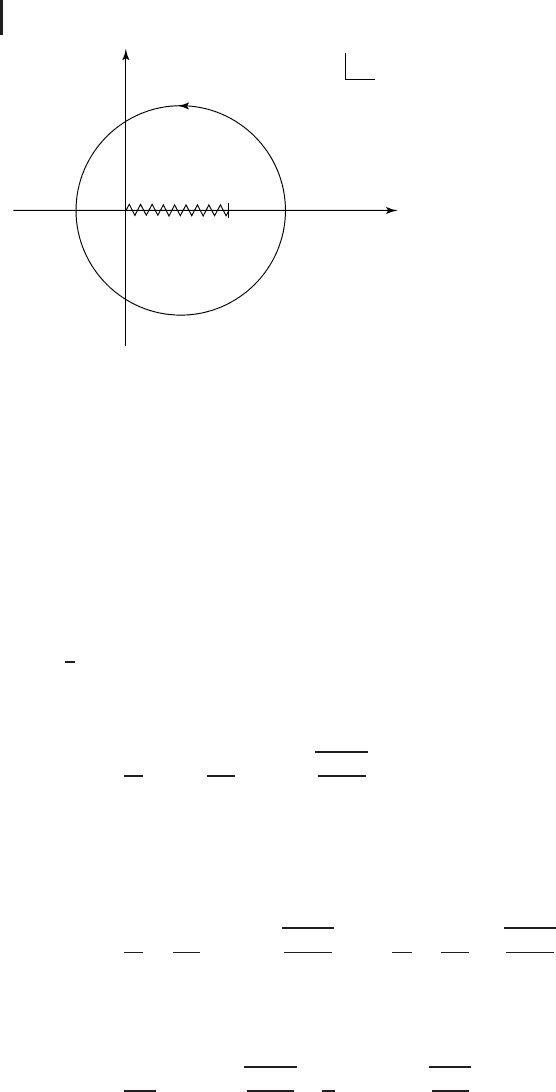
296 8 Nonlinear Integral Equations
C
o
4l
s
s
2
s
1
Fig. 8.1 Branch cut of the integrand of Eq. (8.1.5a) from s = 0tos = 4λ.
Example 8.1. f (x) = 0.
Solution. In this case, Eq. (8.1.3b) gives
φ(x) = 0.
Thus there is no nontrivial solution.
Example 8.2. f (x) = 1.
Solution. In this case,
f (s) = 1s, (8.1.4)
and Eq. (8.1.3b) gives
φ(x) =
1
2λ
γ +i∞
γ −i∞
ds
2πi
e
sx
1 −
s − 4λ
s
. (8.1.5a)
The integrand has a branch cut from s = 0tos = 4λ as in Figure 8.1.
Let λ>0, then the branch cut is as illustrated in Figure 8.2.
By deforming the contour, we get
φ(x) =
1
2λ
C
ds
2πi
e
sx
1 −
s − 4λ
s
=−
1
2λ
C
ds
2πi
e
sx
s − 4λ
s
, (8.1.5b)
where C is the contour wrapped around the branch cut , as shown in Figure 8.2. By
evaluating the values of the integrand on the two sides of the branch cut , we get
φ(x) =
1
2πλ
4λ
0
dse
sx
4λ − s
s
=
2
π
1
0
dte
4λtx
1 − t
t
. (8.1.6)