
Masujima M. Applied Mathematical Methods in Theoretical Physics
Подождите немного. Документ загружается.


8.4 Problems for Chapter 8 307
and generally
I
n
(z) =
1
π
π
0
e
z cos θ
(cos nθ)dθ.
For
|
z
|
→ 0, we have
I
0
(z) → 1,
I
1
(z) → z2.
8.5. Solve the nonlinear integral equation of the Fredholm type
φ(x) −
0.1
0
xy[1 + φ
2
(y)]dy = x + 1.
8.6. Solve the nonlinear integral equation of the Fredholm type
φ(x) − 60
1
0
xyφ
2
(y)dy = 1 + 20x − x
2
.
8.7. Solve the nonlinear integral equation of the Fredholm type
φ(x) − λ
1
0
xy[1 + φ
2
(y)]dy = x + 1.
8.8. Solve the nonlinear integral equation of the Fredholm type
φ
2
(x) −
1
0
xyφ(y)dy = 4 + 10x + 9x
2
.
8.9. Solve the nonlinear integral equation of the Fredholm type
φ
2
(x) − λ
1
0
xyφ(y)dy = 1 + x
2
.
8.10. Solve the nonlinear integral equation of the Fredholm type
φ
2
(x) +
2
0
φ
3
(y)dy = 1 − 2x + x
2
.
8.11. Solve the nonlinear integral equation of the Fredholm type
φ
2
(x) =
5
2
1
0
xyφ(y)dy.
Hint for Problems 8.5 through 8.11: The integrals are at most linear in x.

308 8 Nonlinear Integral Equations
8.12. Solve the nonlinear integral equation of the Volterra type
φ
2
(x) −
x
0
(x − y)φ(y)dy = 1 + 3x +
1
2
x
2
−
1
2
x
3
.
8.13. Solve the nonlinear integral equation of the Volterra type
φ
2
(x) +
x
0
sin(x − y)φ(y)dy = exp [x].
8.14. Solve the nonlinear integral equation of the Volterra type
φ(x) −
x
0
(x − y)
2
φ
2
(y)dy = x.
8.15. Solve the nonlinear integral equation of the Volterra type
φ
2
(x) −
x
0
(x − y)
3
φ
3
(y)dy = 1 + x
2
.
8.16. Solve the nonlinear integral equation of the Volterra type
2φ(x) −
x
0
φ(x − y)φ(y)dy = sin x.
Hint for Problems 8.12 through 8.16: Take the Laplace transform of the
given nonlinear integral equations of the Volterra type.
8.17. Solve the nonlinear integral equation
φ(x) − λ
1
0
φ
2
(y)dy = 1.
In particular, identify the bifurcation points of this equation. What are the
nontrivial solutions of the corresponding homogeneous equations?

309
9
Calculus of Variations: Fundamentals
9.1
Historical Background
The calculus of variations was first found in the late 17th century soon after
calculus was invented. The main figures involved are Newton, the two Bernoulli
brothers, Euler, Lagrange, Legendre,andJacobi.
Isaac Newton (1642–1727) formulated the fundamental laws of motion. The
fundamental quantities of motion were established as the momentum and the
force. Newton’s laws of motion state:
(1) In the inertial frame, every body remains at rest or in uniform motion
unless acted on by a force
F. The condition
F =
0 implies a constant velocity
v and a constant momentum
p = mv.
(2) In the inertial frame, application of force
F alters the momentum
p by an
amount specified by
F =
d
dt
p. (9.1.1)
(3) To each action of a force, there is an equal and opposite action of a force.
Thus if
F
21
is the force exerted on particle 1 by particle 2, then
F
21
=−
F
12
, (9.1.2)
and these forces act along the line separating the particles.
Contrary to the common belief that he discovered the gravitational force by
observing that the apple dropped from the tree at Trinity College, he actually
deduced Newton’s laws of motion from the careful analysis of Kepler’s laws.
He also invented the calculus, named methodus fluxionum in 1666, about 10
year ahead of Leibniz. In 1687, Newton published Philosophiae naturalis principia
mathematica, often called Principia. It consists of three parts: Newton’s laws of
motion, laws of the gravitational force, and laws of motion of the planets.
The Bernoulli brothers, Jacques (1654–1705) and Jean (1667–1748), came from
the family of mathematicians in Switzerland. They solved the problem of Brachis-
tochrone. They established the principle of virtual work as a general principle of
Applied Mathematical Methods in Theoretical Physics, Second Edition. Michio Masujima
Copyright
2009 WILEY-VCH Verlag GmbH & Co. KGaA, Weinheim
ISBN: 978-3-527-40936-5
310 9 Calculus of Variations: Fundamentals
statics with which all problems of equilibrium could be solved. Remarkably, they
also compared the motion of a particle in a given field of force with that of light
in an optically heterogeneous medium and tried to give a mechanical theory of
the refractive index. The Bernoulli brothers were the forerunners of the theory of
Hamilton which has shown that the principle of least action in classical mechanics
and Fermat’s principle of shortest time in geometrical optics are strikingly analo-
gous to each other. They used the notation, g, for the gravitational acceleration for
the first time.
Leonhard Euler (1707–1783) grew up under the influence of Bernoulli family in
Switzerland. He made an extensive contribution to the development of calculus
after Leibniz, and initiated calculus of variations. He started the systematic study
of the isoperimetric problems. He also contributed in an essential way to the
variational treatment of classical mechanics, providing the Euler equation
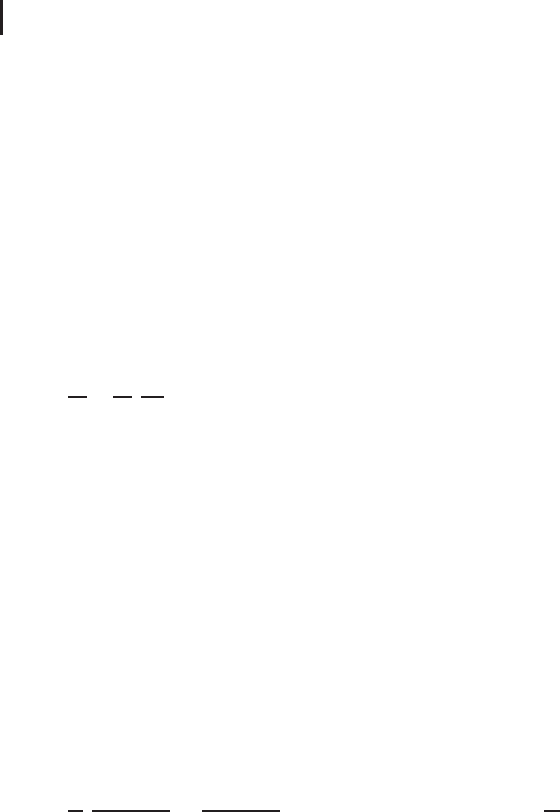
∂f
∂y
−
d
dx
(
∂f
∂y
) = 0, (9.1.3)
for the extremization problem
δI = δ
x
2
x
1
f (x, y, y
)dx = 0, (9.1.4)
with
δy(x
1
) = δy(x
2
) = 0. (9.1.5)
Joseph Louis Lagrange (1736–1813) provided the solution to the isoperimetric
problems by the method presently known as the method of Lagrange multipliers;
quite independent of Euler. He started the whole field of the calculus of varia-
tions . He also introduced the notion of generalized coordinates, {q
r
(t)}
f
r=1
,into
classical mechanics and completely reduced the mechanical problem to that of the
differential equations presently known as Lagrange equations of motion,
d
dt
(
∂L(q
s
,
˙
q
s
, t)
∂
˙
q
r
) −
∂L(q
s
,
˙
q
s
, t)
∂q
r
= 0, r = 1, ..., f ,with
˙
q
r
≡
d
dt
q
r
, (9.1.6)
with the Lagrangian L(q
r
(t),
˙
q
r
(t), t) appropriately chosen in terms of the kinetic
energy and the potential energy. He successfully converted classical mechanics
into analytical mechanics with the variational principle. He also carried out the
research on Fermat problem, the general treatment of the theory of ordinary
differential equations, and the theory of elliptic functions.
Adrien Marie Legendre (1752–1833) announced the research on the form of the
planet in 1784. In his article, the Legendre polynomials was used for the first
time. He provided the Legendre test in the maximization–minimization problem
of the calculus of variations, among his numerous and diverse contributions to
mathematics. As one of his major accomplishments, his classification of elliptic
integrals into three types stated in Exercices de calcul int´egral, published in 1811,

9.1 Historical Background 311
should be mentioned. In 1794, he published
´
El´ements de g´eom´etrie, avec notes.He
further developed the methods of transformations for thermodynamics which are
presently known as the Legendre transformations and are used even in quantum
field theory today.
William Rowan Hamilton (1805–1865) started research on optics around 1823
and introduced the notion of the characteristic function. His results formed the
basis of the later development of the notion of eikonal in optics. He also succeeded
in transforming the Lagrange equations of motion which is of the second order into
a set of differential equations of the first order with twice as many variables, with
the introduction of the momenta {p
r
(t)}
f
r=1
canonically conjugate to the generalized
coordinates {q
r
(t)}
f
r=1
by
p
r
(t) =
∂L(q
s
,
˙
q
s
, t)
∂
˙
q
r
, r = 1, ..., f . (9.1.7)
His equations are known as Hamilton’s canonical equations of motion:
d
dt
q
r
(t) =
∂H(q
s
(t), p
s
(t), t)
∂p
r
(t)
,
d
dt
p
r
(t) =−
∂H(q
s
(t), p
s
(t), t)
∂q
r
(t)
, r = 1, ..., f .
(9.1.8)
He formulated classical mechanics in terms of the principle of least action.
The variational principles formulated by Euler and Lagrange apply only to the
conservative system. He also recognized that the principle of least action in
classical mechanics and Fermat’s principle of shortest time in geometrical optics
are strikingly analogous, permitting the interpretation of the optical phenomena
in terms of mechanical terms and vice versa. He was one step short of discovering
wave mechanics in analogy to wave optics as early as 1834, although he did not
have any experimentally compelling reason to take such step. On the other hand,
by 1924, L. de Broglie and E. Schr
¨
odinger had sufficient experimentally compelling
reasons to take such step.
Carl Gustav Jacob Jacobi (1804–1851), in 1824, quickly recognized the importance
of the work of Hamilton. He realized that Hamilton was using just one particular
choice of a set of the variables {q
r
(t)}
f
r=1
and {p
r
(t)}
f
r=1
to describe the mechanical
system and carried out the research on the canonical transformation theory with
the Legendre transformation. He duly arrived at what is presently known as the
Hamilton–Jacobi equation . His research on the canonical transformation theory
is summarized in Vorlesungen ¨uber Dynamik, published in 1866. He formulated his
version of the principle of least action for the time-independent case. He provided
the Jacobi test in the maximization–minimization problem of the calculus of
variations . In 1827, he introduced the elliptic functions as the inverse functions of
the elliptic integrals.
From what we discussed, we may be led to the conclusion that the calculus of
variations is the finished subject of the 19th century. We shall note that, from
the 1940s to 1950s, we encountered the resurgence of the action principle for the
systemization of quantum field theory. Feynman’s action principle and Schwinger’s

312 9 Calculus of Variations: Fundamentals
action principle are the subject matter. In contemporary particle physics, if we
start out with the Lagrangian density of the system under consideration, the
extremization of the action functional is still employed as the starting point of the
discussion (see Chapter 10). Furthermore, the Legendre transformation is used in
the computation of the effective potential in quantum field theory.
We define the problem of the calculus of variations. Suppose that we have
an unknown function y(x) of the independent variable x which satisfies some
condition C. We construct the functional I[y] which involves the unknown function
y(x ) and its derivatives. We now want to determine the unknown function y(x)
which extremizes the functional I[y] under the infinitesimal variation δy(x)ofy(x)
subject to the condition C. Simple example is the extremization of the following
functional:
I[y] =
x
2
x
1
L(x, y, y
)dx, C : y(x
1
) = y(x
2
) = 0. (9.1.9)
The problem is reduced to solving Euler equation, which we will discuss later. This
problem and its solution are the problem of the calculus of variations.
Many basic principles of physics can be cast in the form of the calculus of
variations. Most of the problems in classical mechanics and classical field theory
are of this form, with a certain generalization, under the following replacements:
for classical mechanics, we replace
x with t,
y with q(t),
y
with
˙
q(t) ≡ dq(t)dt,
(9.1.10)
and for classical field theory, we replace
x with (t,
r),
y with ψ(t,
r),
y
with (∂ψ(t,
r)∂t,
∇ψ(t,
r)).
(9.1.11)
On the other hand, when we want to solve some differential equation subject to
the condition C, we may be able to reduce the problem of solving the original
differential equation to that of the extremization of the functional I[y] s ubject to the
condition C, provided that Euler equation of the extremization problem coincides
with the original differential equation we want to solve. With this reduction, we
can obtain an approximate solution of the original differential equation.
The problem of Brachistochrone to be defined later, the isoperimetric problem to
be defined later, and the problem of finding the shape of the soap membrane with
the minimum surface area are the classic problems of the calculus of variations.

9.2 Examples 313
9.2
Examples
We list examples of the problems to be solved.
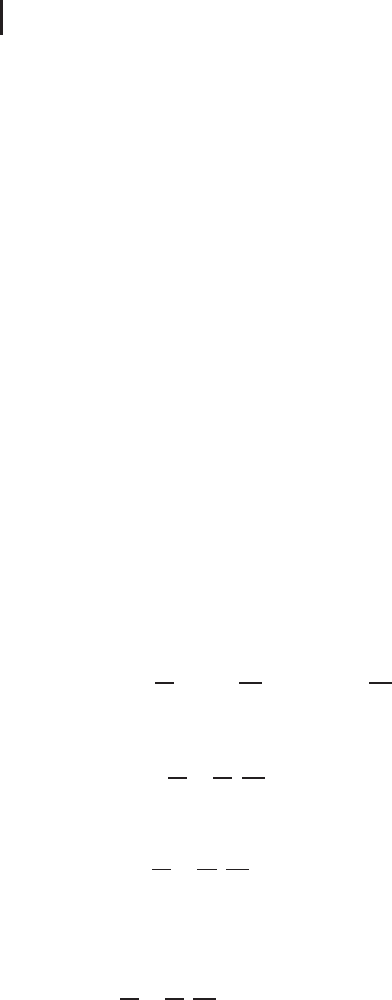
Example 9.1. The shortest distance between two points is a straight line:
minimize
I =
x
2
x
1
1 + (y
)
2
dx. (9.2.1)
Example 9.2. The largest area enclosed by an arc of fixed length is a circle:
minimize
I =
ydx, (9.2.2)
subject to the condition that
1 + (y
)
2
dx fixed. (9.2.3)
Example 9.3. Catenary. Surface formed by two circular wires dipped in a soap
solution: minimize
x
2
x
1
y
1 + (y
)
2
dx. (9.2.4)
Example 9.4. Brachistochrone. Determine a path down which a particle falls
under gravity in the shortest time: minimize
1 + (y
)
2
y
dx. (9.2.5)
Example 9.5. Hamilton’s action principle in classical mechanics: minimize the
action integral I defined by
I ≡
t
2
t
1
L(q,
˙
q)dt with q(t
1
)andq(t
2
) fixed, (9.2.6)
where L(q(t),
˙
q(t)) is the Lagrangian of the mechanical system.
The last example is responsible for starting the whole field of the calculus of
variations.
314 9 Calculus of Variations: Fundamentals
9.3
Euler Equation
We shall derive the fundamental equation for the calculus of variations, Euler
equation.
We shall extremize
I =
x
2
x
1
f (x, y, y
)dx, (9.3.1)
with the end points
y(x
1
), y(x
2
)fixed. (9.3.2)
We consider a small variation of y(x) of the following form:
y(x) → y(x) + εν(x), (9.3.3a)
y
(x) → y
(x) + εν
(x), (9.3.3b)
with
ν(x
1
) = ν(x
2
) = 0, ε = positive infinitesimal. (9.3.3c)
Then the variation of I is given by
δI =
x
2
x
1
∂f
∂y
εν(x ) +
∂f
∂y
εν
(x)
dx =
∂f
∂y
εν(x )
x=x
2
x=x
1
+
x
2
x
1
∂f
∂y
−
d
dx
(
∂f
∂y
)
εν(x )dx
=
x
2
x
1
∂f
∂y
−
d
dx
(
∂f
∂y
)
εν(x )dx = 0, (9.3.4)
for ν(x) arbitrary other than the condition (9.3.3c).
We set
J(x) =
∂f
∂y
−
d
dx
(
∂f
∂y
). (9.3.5)
We suppose that J(x) is positive in the interval [x
1
, x
2
],
J(x) > 0forx ∈ [x
1
, x
2
]. (9.3.6)

9.3 Euler Equation 315
Then, by choosing
ν(x) > 0forx ∈ [x
1
, x
2
], (9.3.7)
we can make δI positive,
δI > 0. (9.3.8)
We now suppose that J(x) is negative in the interval [x
1
, x
2
],
J(x) < 0forx ∈ [x
1
, x
2
]. (9.3.9)
Then, by choosing
ν(x) < 0forx ∈ [x
1
, x
2
], (9.3.10)
we can make δI positive,
δI > 0. (9.3.11)
We lastly suppose that J(x) alternates its sign in the interval [x
1
, x
2
]. Then by
choosing
ν(x) ≷ 0whereverJ(x) ≷ 0, (9.3.12)
we can make δI positive,
δI > 0. (9.3.13)
Thus, in order to have Eq. (9.3.4) for ν(x) arbitrary together with the condition
(9.3.3c), we must have J(x) identically equal to zero,
∂f
∂y
−
d
dx
(
∂f
∂y
) = 0, (9.3.14)
which is known as the Euler equation.
We now illustrate the Euler equation by solving some of the examples listed
above.
Example 9.1. The shortest distance between two points. In this case, f is given
by
f =
1 + (y
)
2
. (9.3.15a)
316 9 Calculus of Variations: Fundamentals
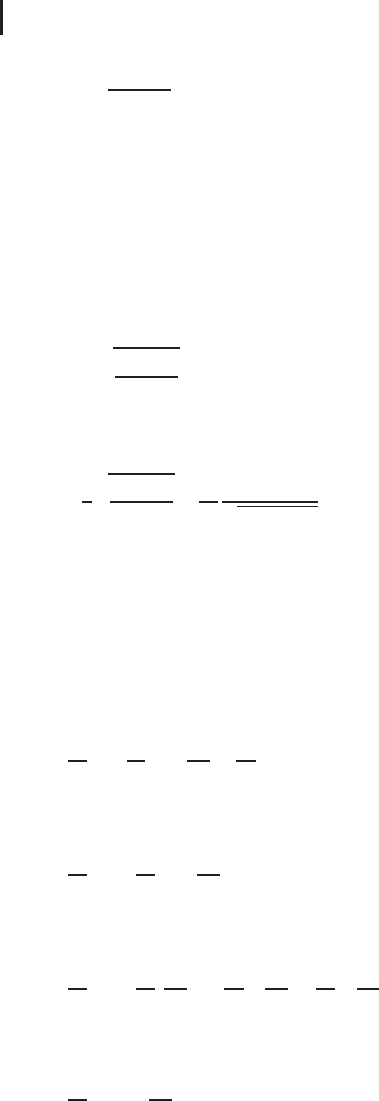
The Euler equation simply gives
y
1 + (y
)
2
= constant, ⇒ y
= c. (9.3.15b)
In general, if f = f (y
), independent of x and y, then the Euler equation always
gives
y
= constant. (9.3.16)
Example 9.4. Brachistochrone problem. In this case, f is given by
f =
1 + (y
)
2
y
. (9.3.17)
The Euler equation gives
−
1
2
1 + (y
)
2
y
3
−
d
dx
y
(1 + (y
)
2
)y
= 0.
This appears somewhat difficult to solve. However, there is a simple way which is
applicable to many cases.
Suppose
f = f (y, y
), independent of x, (9.3.18a)
then
d
dx
= y
∂
∂y
+ y
∂
∂y
+
∂
∂x
,
where the last term is absent when acting on f = f (y, y
). Thus
d
dx
f = y
∂f
∂y
+ y
∂f
∂y
.
Making use of the Euler equation on the first term of the right-hand side, we have
d
dx
f = y
d
dx
(
∂f
∂y
) + (
d
dx
y
)
∂f
∂y
=
d
dx
(y
∂f
∂y
),
i.e.,
d
dx
f − y
∂f
∂y
= 0.