
Masujima M. Applied Mathematical Methods in Theoretical Physics
Подождите немного. Документ загружается.

8.1 Nonlinear Integral Equation of the Volterra Type 297
4l
o
s
s
1
s
2
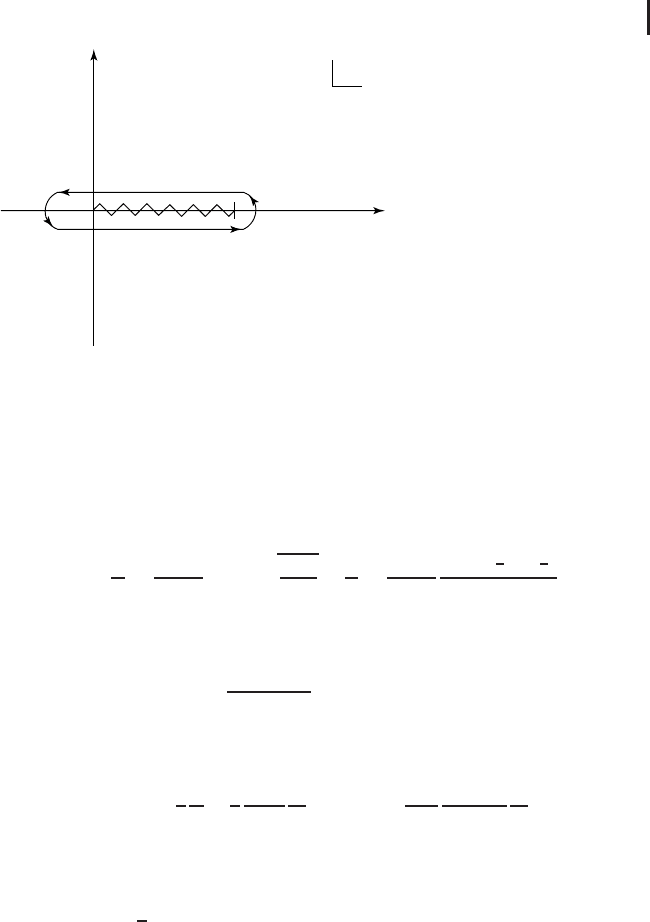
Fig. 8.2 The contour of integration C wrapping around the
branch cut of Figure 8.1 for λ>0.
Here we have changed the variable,
s = 4λt,0≤ t ≤ 1.
The integral in Eq. (8.1.6) can be explicitly evaluated:
φ(x) =
2
π
∞
n=0
(4λx)
n
n!
1
0
dtt
n
1 − t
t
=
2
π
∞
n=0
(4λx)
n
n!
n +
1
2
3
2
(n + 2)
, (8.1.7)
wherewehaveusedtheformula
1
0
dtt
n−1
(1 − t)
m−1
=
(n)(m)
(n ++m)
.
Now, the confluent hypergeometric function is given by
F(a;c;z) = 1 +
a
c
z
1!
+
a
c
a + 1
c + 1
z
2
2!
+···=
∞
n=0
(c)
(a)
(a + n)
(c + n)
z
n
n!
. (8.1.8)
From Eqs. (8.1.7) and (8.1.8), we find that
φ(x) = F
1
2
;2;4λx
(8.1.9)
satisfies the nonlinear integral equation
φ(x) = 1 + λ
x
0
φ(x − y)φ(y)dy. (8.1.10)
Although the above is proved only for λ>0, we may verify that it is also true
for λ<0 by repeating the same argument. Alternatively we may prove this in the

298 8 Nonlinear Integral Equations
following way. Let us substitute Eq. (8.1.9) into Eq. (8.1.10). Since F(
1
2
;2;4λx)is
an entire function of λ, each side of the resulting equation is the entire function of
λ. Since this equation is satisfied for λ>0, it must be satisfied for all λ by analytic
continuation. Thus the integral equation (8.1.10) has the unique solution given by
Eq. (8.1.9), for all values of λ.
At the end of this section, we classify the nonlinear integral equations of Volterra
type in the following manner:
(1) Kernel part is nonlinear,
φ(x) −
x
a
H (x, y, φ(y))dy = f (x). (VN.1)
(2) Particular part is nonlinear,
G(φ(x)) −
x
a
K(x, y)φ(y)dy = f (x). (VN.2)
(3) Both parts are nonlinear,
G(φ(x)) −
x
a
H (x, y, φ(y))dy = f (x). (VN.3)
(4) Nonlinear Volterra integral equation of the first kind,
x
a
H (x, y, φ(y))dy = f (x). (VN.4)
(5) Homogeneous nonlinear Volterra integral equation of the first kind where
the kernel part is nonlinear,
φ(x) =
x
a
H (x, y, φ(y))dy. (VN.5)
(6) Homogeneous nonlinear Volterra integral equation of the first kind where
the particular part is nonlinear,
G(φ(x)) =
x
a
K(x, y)φ(y)dy. (VN.6)
(7) Homogeneous nonlinear Volterra integral equation of the first kind where
both parts are nonlinear,
G(φ(x)) =
x
a
H (x, y, φ(y))dy. (VN.7)

8.2 Nonlinear Integral Equation of the Fredholm Type 299
8.2
Nonlinear Integral Equation of the Fredholm Type
In this section, we shall give a brief discussion of the nonlinear integral equation of
Fredholm type. Recall that the linear algebraic equation
φ = f + λKφ (8.2.1)
has the solution
φ = (1 − λK)
−1
f . (8.2.2)
In particular, the solution of Eq. (8.2.1) exists and is unique as long as the
corresponding homogeneous equation
φ = λKφ (8.2.3)
has no nontrivial solutions.
Nonlinear equations behave quite differently. Consider, for example, the nonlin-
ear algebraic equation obtained from Eq. (8.2.1) by replacing K with φ,
φ = f + λφ
2
. (8.2.4a)
The solutions of Eq. (8.2.4a) are
φ =
1 ±
1 − 4λf
2λ
. (8.2.4b)
We first observe that the solution is not unique. Indeed, if we require the solutions
to be real, then Eq. (8.2.4a) has two solutions if
1 − 4λf > 0, (8.2.5)
and no solution if
1 − 4λf < 0. (8.2.6)
Thus the number of solutions changes from 2 to 0 as the value of λ passes 14f .
The point λ = 14f is called a bifurcation point of Eq. (8.2.4a). Note that at the
bifurcation point, Eq. (8.2.4a) has only one solution.
We also observe from Eq. (8.2.4b) that another special point for Eq. (8.2.4a) is
λ = 0. At this point, one of the two solutions is infinite. Since the number of
solutions remains to be two as the value of λ passes λ = 0, the point λ = 0isnota
bifurcation point. We shall call it a singular point.

300 8 Nonlinear Integral Equations
Consider now the equation
φ = λφ
2
, (8.2.7)
obtained from Eq. (8.2.4a) by setting f = 0. This equation always has the nontrivial
solution
φ = 1λ (8.2.8)
provided that
λ = 0. (8.2.9)
There is no connection between the existence of the solutions for Eq. (8.2.4a) and
the absence of the solutions for Eq. (8.2.4a) with f = 0, quite unlike the case of
linear algebraic equations.
Nonlinear integral equations share these properties. This is evident in the
following examples.
Example 8.3. Solve
φ(x) = 1 + λ
1
0
φ
2
(y)dy. (8.2.10)
Solution. The right-hand side of Eq. (8.2.10) is independent of x.Thusφ(x)is
constant. Let
φ(x) = a.
Then Eq. (8.2.10) becomes
a = 1 + λa
2
. (8.2.11)
Equation (8.2.11) is just Eq. (8.2.4a) with f = 1. Thus
φ(x) =
1 ±
√
1 − 4λ
2λ
. (8.2.12)
There are two real solutions for λ<14, and no real solutions for λ>14. Thus
λ = 14isabifurcationpoint.
Example 8.4. Solve
φ(x) = 1 + λ
1
0
φ
3
(y)dy. (8.2.13)

8.2 Nonlinear Integral Equation of the Fredholm Type 301
Solution. The right-hand side of Eq. (8.2.13) is independent of x.Thusφ(x)is
constant. Letting
φ(x) = a,
we get
a = 1 + λa
3
. (8.2.14a)
Equation (8.2.14a) is cubic and hence has three solutions. Not all of these solutions
are real. Let us rewrite Eq. (8.2.14a) as
a − 1
λ
= a
3
, (8.2.14b)
and plot (a − 1)λ as well as a
3
in the figure. The points of intersection between
these two curves are the solutions of Eq. (8.2.14a). For λ negative, there is obviously
only one real root, while for λ positive and very small, there are three real roots
(two positive roots and one negative root). Thus λ = 0 is a bifurcation point . For
λ large and positive, there is again only one real root. The change of numbers of
roots can be shown to occur at λ = 427, which is another bifurcation point.
We may generalize the above considerations to
φ(x) = c + λ
1
0
K(φ(y))dy. (8.2.15a)
The right-hand side of Eq. (8.2.15a) is independent of x.Thusφ(x)isconstant.
Letting
φ(x) = a,
we get
(a − c)λ = K(a). (8.2.15b)
The roots of the above equation can be graphically obtained by plotting K(a)and
(a − c)λ.
Obviously, with a proper choice of K(a), the number of solutions as well as the
number of bifurcation points may take any value. For example, if
K(φ) = φ sin πφ, (8.2.16)
there are infinitely many solutions as long as
|
λ
|
< 1. As another example, for
K(φ) = sin φ(φ
2
+ 1), (8.2.17)
there are infinitely many bifurcation points .
In summary, we have found the following conclusions for nonlinear integral
equations:

302 8 Nonlinear Integral Equations
(1) There may be more than one solution.
(2) There may be one or more bifurcation points.
(3) There is no significant relationship between the integral equation with f = 0 and
the one obtained from it by setting f = 0.
The above considerations for simple examples may be extended to more general
cases. Consider the integral equation
φ(x) = f (x) +
1
0
K(x, y, φ(x), φ(y))dy. (8.2.18)
If K is separable, i.e.,
K(x, y, φ(x), φ(y)) = g(x, φ(x))h(y, φ(y)), (8.2.19)
then the integral equation (8.2.18) is solved by
φ(x) = f (x) + ag(x, φ(x)), (8.2.20)
with
a =
1
0
h(x , φ(x))dx. (8.2.21)
We may solve Eq. (8.2.20) for φ(x) and express φ(x) as a function of x and a.
There may be more than one solution. Substituting any one of these solutions into
Eq. (8.2.21), we may obtain an equation for a. Thus the nonlinear integral equation
(8.2.18) is equivalent to one or more nonlinear algebraic equations for a.
Similarly, if K is a sum of the separable terms, the integral equation is equivalent
to systems of N coupled nonlinear algebraic equations.
In closing this section, we classify the nonlinear integral equations of the
Fredholm type in the following manner:
(1) Kernel part is nonlinear,
φ(x) −
b
a
H (x, y, φ(y))dy = f (x). (FN.1)
(2) Particular part is nonlinear,
G(φ(x)) −
b
a
K(x, y)φ(y)dy = f (x). (FN.2)
(3) Both parts are nonlinear,
G(φ(x)) −
b
a
H (x, y, φ(y))dy = f (x). (FN.3)

8.3 Nonlinear Integral Equation of the Hammerstein Type 303
(4) Nonlinear Fredholm integral equation of the first kind,
b
a
H (x, y, φ(y))dy = f (x). (FN.4)
(5) Homogeneous nonlinear Fredholm integral equation of the first kind,
where the kernel part is nonlinear,
φ(x) =
b
a
H (x, y, φ(y))dy. (FN.5)
(6) Homogeneous nonlinear Fredholm integral equation of the first kind,
where the particular part is nonlinear,
G(φ(x)) =
b
a
K(x, y)φ(y)dy. (FN.6)
(7) Homogeneous nonlinear Fredholm integral equation of the first kind,
where both parts are nonlinear,
G(φ(x)) =
b
a
H (x, y, φ(y))dy. (FN.7)
8.3
Nonlinear Integral Equation of the Hammerstein Type
The inhomogeneous term f (x) in Eq. (8.2.18) is actually not particularly meaningful.
This is because we may define
ψ(x) ≡ φ(x) − f (x), (8.3.1)
then Eq. (8.2.18) is of the form
ψ(x) =
1
0
K(x, y, ψ(x) + f (x), ψ(y) + f (y))dy. (8.3.2)
The nonlinear integral equation of the Hammerstein type is a special case of
Eq. (8.3.2),
ψ(x) =
1
0
K(x, y)f (y, ψ(y))dy. (8.3.3)
For the remainder of this section, we discuss this latter equation, (8.3.3). We shall
show that if f satisfies uniformly a Lipschitz condition of the form
f (y, u
1
) − f (y, u
2
)
< C(y)
|
u
1
− u
2
|
, (8.3.4)

304 8 Nonlinear Integral Equations
and if
1
0
A(y)C
2
(y)dy = M
2
< 1, (8.3.5)
then the solution of Eq. (8.3.3) is unique and can be obtained by iteration. The
function A(x) in Eq. (8.3.5) is given by
A(x) =
1
0
K
2
(x, y)dy. (8.3.6)
We begin by setting
ψ
0
(x) = 0 (8.3.7)
and
ψ
n
(x) =
1
0
K(x, y)f (y, ψ
n−1
(y))dy. (8.3.8)
If f (y,0) = 0, then Eq. (8.3.3) is solved by ψ(x) = 0. If
f (y,0)= 0, (8.3.9)
we have
ψ
2
1
(x) ≤ A(x)
1
0
f
2
(y,0)dy = A(x)
f
2
, (8.3.10)
where
f
2
≡
1
0
f
2
(y,0)dy. (8.3.11)
Also, as a consequence of the Lipschitz condition (8.3.4),
ψ
n
(x) − ψ
n−1
(x)
<
1
0
K(x, y)
C(y)
ψ
n−1
(y) − ψ
n−2
(y)
dy.
Thus
[ψ
n
(x) − ψ
n−1
(x)]
2
≤ A(x)
1
0
C
2
(y)[ψ
n−1
(y) − ψ
n−2
(y)]
2
dy. (8.3.12)
From Eqs. (8.3.4) and (8.3.5), we get
[ψ
2
(x) − ψ
1
(x)]
2
≤ A(x)
f
2
M
2
.

8.4 Problems for Chapter 8 305
By induction,
[ψ
n
(x) − ψ
n−1
(x)]
2
≤ A(x)
f
2
(M
2
)
n−1
. (8.3.13)
Thus the series
ψ
1
(x) + [ψ
2
(x) − ψ
1
(x)] + [ψ
3
(x) − ψ
2
(x)] +···
is convergent, due to Eq. (8.3.5).
The proof of uniqueness will be left to the reader.
8.4
Problems for Chapter 8
8.1. (due to H. C.). Prove the uniqueness of the solution to the nonlinear
integral equation of the Hammerstein type
ψ(x) =
1
0
K(x, y)f (y, ψ(y))dy.
8.2. (due to H. C.). Consider
d
2
dt
2
x (t) + x(t) =
1
π
2
x
2
(t), t > 0,
with the initial conditions
x (0) = 0and
dx
dt
t=0
= 1.
(a) Transform this nonlinear ordinary differential equation to an integral
equation.
(b) Obtain an approximate solution accurate to a few percent.
8.3. (due to H. C.). Consider
∂
2
∂x
2
+
∂
2
∂y
2
φ(x, y) =
1
π
2
φ
2
(x, y), x
2
+ y
2
< 1,
with
φ(x, y) = 1onx
2
+ y
2
= 1.

306 8 Nonlinear Integral Equations
(a) Construct a Green’s function satisfying
∂
2
∂x
2
+
∂
2
∂y
2
G(x, y;x
, y
) = δ(x − x
)δ(y − y
),
with the boundary condition
G(x, y;x
, y
) = 0onx
2
+ y
2
= 1.
Prove that
G(x, y;x
, y
) = G(x
, y
;x, y).
Hint: To construct Green’s function G(x, y;x
, y
), which vanishes on
theunitcircle,usethemethodofimages.
(b) Transform the above nonlinear partial differential equation to an
integral equation, and obtain an approximate solution accurate to a few
percent.
8.4. (due to H. C.).
(a) Discuss a phase transition of ρ(θ) which is given by the nonlinear
integral equation,
ρ(θ ) = Z
−1
exp[β
2π
0
cos(θ − φ)ρ(φ)dφ],
β = Jk
B
T,0≤ θ ≤ 2π ,
where Z is the normalization constant such that ρ(θ)isnormalizedto
unity,
2π
0
ρ(θ )dθ = 1.
(b) Determine the nature of the phase transition.
Hint: You may need the following special functions:
I
0
(z) =
∞
m=0
1
(m!)
2
z
2
2m
,
I
1
(z) =
∞
m=0
1
m!(m + 1)!
z
2
2m+1
,