
Masujima M. Applied Mathematical Methods in Theoretical Physics
Подождите немного. Документ загружается.

9.6 Differential Equations, Integral Equations, and Extremization of Integrals 327
ee
1 − 2e
h
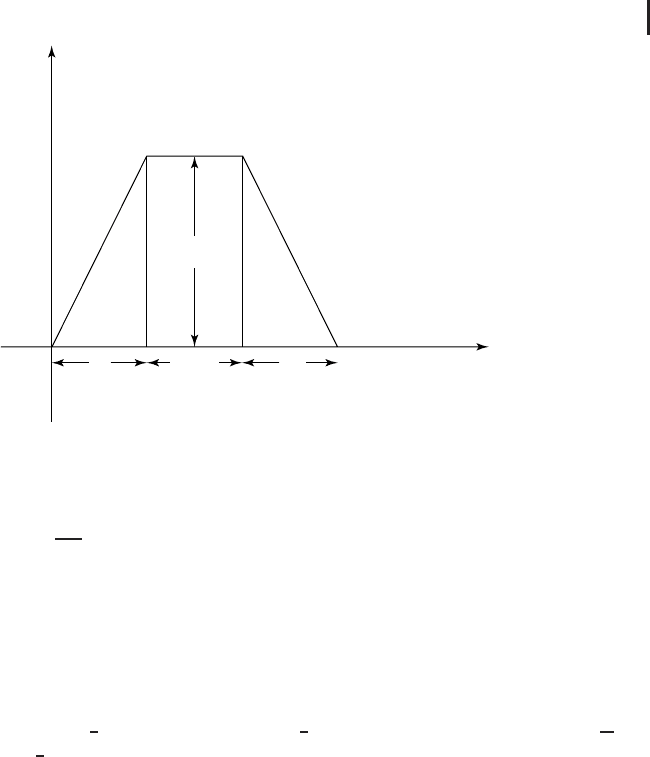
Fig. 9.2 The shape of the trial function for Example 9.16.
Example 9.16. Solve
d
2
dx
2
y(x) =−λy(x), 0 < x < 1, (9.6.8)
with
y(0) = y(1) = 0. (9.6.9)
Solution. WechoosethetrialfunctiontobetheoneinFigure9.2.ThenI = 2 · h
2
ε,
J = h
2
(1 −
4
3
ε), and IJ = 2
ε(1 −
4
3
ε)
, which has a minimum value of
32
3
at
ε =
3
8
. This is compared with the exact value, λ = π
2
.Notethatλ = π
2
is a lower
bound for IJ.Ifwechoosethetrialfunctiontobe
y(x) = x(1 − x),
we get IJ = 10. This is accurate to almost one percent.
In order to obtain an accurate estimate of the eigenvalue, it is important to
choose a trial function that satisfies the boundary condition and looks qualitatively
like the expected solution. For instance, if we are calculating the lowest eigenvalue,
it would be unwise to use a trial function that has a zero inside the interval.
Let us now calculate the next eigenvalue. This is done by choosing the trial
function y(x) which is orthogonal to the exact lowest eigenfunction u
0
(x), i.e.,
1
0
y(x)u
0
(x)r(x)dx = 0, (9.6.10)

328 9 Calculus of Variations: Fundamentals
and find the minimum value of IJ with respect to some parameters in the trial
function. Let us choose the trial function to be
y(x) = x(1 − x)(1 − ax),
and then the requirement that it is orthogonal to x(1 − x), instead of u
0
(x)whichis
unknown, gives a = 2. Note that this trial function has one zero inside the interval
[0, 1]. This looks qualitatively like the expected solution. For this trial function, we
have
I J = 42,
and this compares well with the exact value, 4π
2
.
Example 9.17. Solve the Laplace equation
∇
2
φ = 0, (9.6.11)
with φ given at the boundary.
This problem is equivalent to extremizing
I =
(
∇φ)
2
dV. (9.6.12)
Example 9.18. Solve the wave equation
∇
2
φ = k
2
φ, (9.6.13a)
with
φ = 0 (9.6.13b)
at the boundary.
This problem is equivalent to extremizing
(
∇φ)
2
dV
φ
2
dV
. (9.6.14)
Example 9.19. Estimate the lowest frequency of a circular drum of radius R.
Solution.
k
2
≤
(
∇φ)
2
dV
φ
2
dV. (9.6.15)

9.6 Differential Equations, Integral Equations, and Extremization of Integrals 329
Try a rotationally symmetric trial function,
φ(r) = 1 −
r
R
,0≤ r ≤ R. (9.6.16)
Then we get
k
2
≤
R
0
(φ
r
(r))
2
2πrdr
R
0
(φ(r))
2
2πrdr
=
6
R
2
. (9.6.17)
This is compared with the exact value,
k
2
=
5.7832
R
2
. (9.6.18)
Note that the numerator of the right-hand side of Eq. (9.6.18) is the square of the
smallest zero in magnitude of the 0th order Bessel function of the first kind, J
0
(kR).
The homogeneous Fredholm integral equations of the second kind for the
localized, monochromatic, and highly directive classical current distributions in
two and three dimensions can be derived by maximizing the directivity D in the
far field while constraining C = NT,whereN is the integral of the square of
the magnitude of the current density and T is proportional to the total radiated
power. The homogeneous Fredholm integral equations of the second kind and the
inhomogeneous Fredholm integral equations of the second kind are now derived
from the calculus of variations in general term.
Example 9.20. Solve the homogeneous Fredholm integral equation of the second
kind,
φ(x) = λ
h
0
K(x, x
)φ(x
)dx
, (9.6.19)
with the square-integrable kernel K(x, x
), and the projection unity on ψ(x),
h
0
ψ(x)φ(x)dx = 1. (9.6.20)
This problem is equivalent to extremizing the integral
I =
h
0
h
0
ψ(x)K(x, x
)φ(x
)dxdx
, (9.6.21)
with respect to ψ(x), while keeping
J =
h
0
ψ(x)φ(x)dx = 1 fixed. (9.6.22)

330 9 Calculus of Variations: Fundamentals
The extremization of Eq. (9.6.21) with respect to φ(x), while keeping J fixed, results
in the homogeneous adjoint integral equation for ψ(x),
ψ(x) = λ
h
0
ψ(x
)K(x
, x)dx
. (9.6.23)
With the real and symmetric kernel , K(x, x
) = K(x
, x), the homogeneous integral
equations for φ(x)andψ (x), Eqs. (9.6.19) and (9.6.23), are identical and Eq. (9.6.20)
provides the normalization of φ(x)andψ(x)totheunity,respectively.
Example 9.21. Solve the inhomogeneous Fredholm integral equation of the second
kind
φ(x) − λ
h
0
K(x, x
)φ(x
)dx
= f (x), (9.6.24)
with the square-integrable kernel K(x, x
), 0 <
K
2
< ∞.
This problem is equivalent to extremizing the integral
I =
h
0
[{
1
2
φ(x) − λ
h
0
K(x, x
)φ(x
)dx
}φ(x) + F(x)
d
dx
φ(x)]dx, (9.6.25)
where F(x)isdefinedby
F(x) =
x
f (x
)dx
. (9.6.26)
9.7
The Second Variation
The Euler equation is necessary for extremizing the integral, but it is not sufficient.In
order to find out whether the solution of the Euler equation actually extremizes the
integral, we must study the second variation . This is similar to the case of finding
an extremum of a function: To confirm that the point at which the first derivative
of a function vanishes is an extremum of the function, we must study the second
derivatives.
Consider the extremization of
I =
x
2
x
1
f (x, y, y
)dx, (9.7.1)
with
y(x
1
)andy(x
2
)specified. (9.7.2)
9.7 The Second Variation 331
Suppose y(x)issuchasolution.
Let us consider a weak variation,
y(x) → y(x) + εν(x),
y
(x) → y
(x) + εν
(x),
(9.7.3)
as opposed to a strong variation in which y
(x) is also varied, independent of εν
(x).
Then
I → I + εI
1
+
1
2
ε
2
I
2
+···, (9.7.4)
where
I
1
=
x
2
x
1
[
∂f
∂y
ν(x) +
∂f
∂y
ν
(x)]dx =
x
2
x
1
[
∂f
∂y
−
d
dx
∂f
∂y
]ν(x)dx, (9.7.5)
and
I
2
=
x
2
x
1
[
∂
2
f
∂y
2
ν
2
(x) + 2
∂
2
f
∂y∂y
ν(x)ν
(x) +
∂
2
f
∂y
2
ν
2
(x)]dx. (9.7.6a)
If y = y(x) indeed minimizes or maximizes I,thenI
2
must be positive or negative
for all variations ν(x) vanishing at the end points, when the solution of the Euler
equation, y = y(x), is substituted into the integrand of I
2
.
The integrand of I
2
is a quadratic form of ν(x)andν
(x). Therefore, this integral
is always positive if
(
∂
2
f
∂y∂y
)
2
− (
∂
2
f
∂y
2
)(
∂
2
f
∂y
2
) < 0, (9.7.7a)
and
∂
2
f
∂y
2
> 0. (9.7.7b)
Thus, if the above conditions hold throughout
x
1
< x < x
2
,
I
2
is always positive and y(x) minimizes I. Similar considerations hold, of course,
for maximizations. The above conditions are, however, too crude, i.e., s tronger
than necessary. This is because ν(x)andν
(x) are not independent.
Let us first state the necessary and sufficient conditions for the solution to the
Euler equation to give the weak minimum:

332 9 Calculus of Variations: Fundamentals
Let
P(x) ≡ f
yy
, Q(x) ≡ f
yy
, R (x) ≡ f
y
y
, (9.7.8)
where P(x), Q(x), and R(x) are evaluated at the point which extremizes the integral
I defined by
I ≡
x
2
x
1
f (x, y, y
)dx.
We express I
2
in terms of P(x), Q(x), and R(x)as
I
2
=
x
2
x
1
[P(x)ν
2
(x) + 2Q(x)ν(x)ν
(x) + R(x)ν
2
(x)]dx. (9.7.6b)
Then we have the following conditions for the weak minimum:
Necessary condition Sufficient condition
Legendre test R(x) ≥ 0 R(x) > 0
Jacobi test ξ ≥ x
2
ξ>x
2
,ornosuchξ exists,
(9.7.9)
where ξ is the conjugate point to be defined later. Both the conditions must be
satisfied for sufficiency and both are necessary separately. Before we go on to prove
the above assertion, it is perhaps helpful to have an intuitive understanding of why
these two tests are relevant.
Let us consider the case in which R(x) is positive at x = a, and negative at x = b,
where a and b are both between x
1
and x
2
. Let us first choose ν(x) to be the function
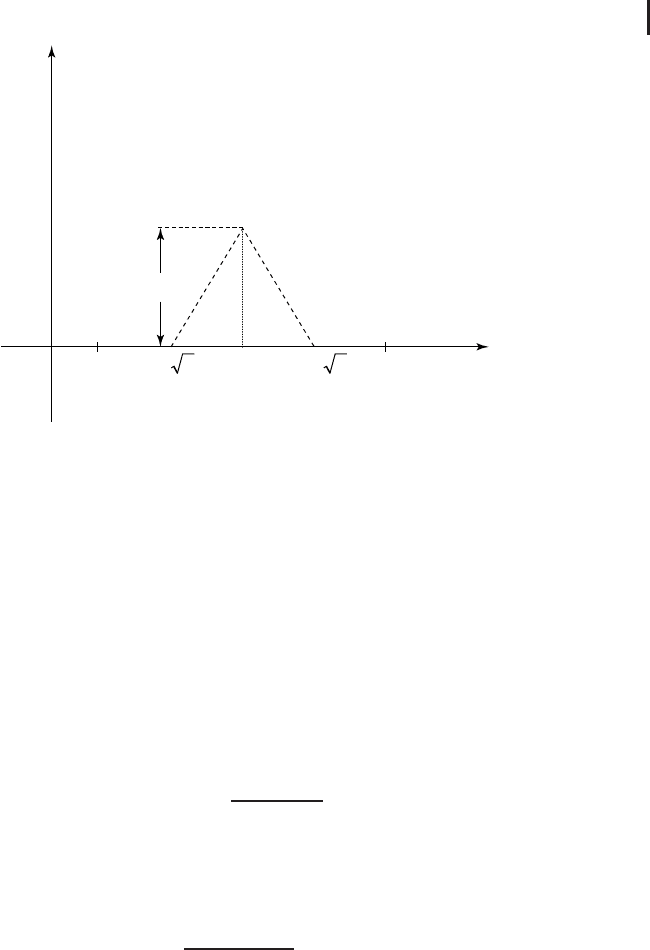
as in Figure 9.3.
Note that ν(x)isoftheorderofε,whileν
(x)isoftheorder
√
ε. If we choose ε to
be sufficiently small, I
2
is positive. Next, we consider the same variation located at
x = b. By the same consideration, I
2
is negative for this variation. Thus y(x)does
not extremize I. This shows that the Legendre test is a necessary condition.
The relevance of the Jacobi test is best illustrated by the problem of finding
the shortest path between two points on the surface of a sphere. The solution is
obtained by going along the great circle on which these two points lie. There are,
however, two paths connecting these two points on the great circle. One of them is
truly the shortest path, while the other is neither the shortest nor the longest. Take
the circle on the surface of the sphere which passes one of the two points. The
other point at which this circle and the great circle intersects lies on the one arc of
the great circle which is neither the shortest nor the longest arc. This point is the
conjugate point ξ of this problem.
We first discuss the Legendre test.WeaddtoI
2
, (9.7.6b), the following term which
is zero,
x
2
x
1
d
dx
(ν
2
(x)ω(x))dx =
x
2
x
1
(ν
2
(x)ω
(x) + 2ν(x)ν
(x)ω(x))dx. (9.7.10)
9.7 The Second Variation 333
x
1
a
− e
a
+ e
ax
2
e
Fig. 9.3 The shape of ν(x) for the Legendre test.
Then we have I
2
to be
I
2
=
x
2
x
1
(P(x) + ω
(x))ν
2
(x) + 2(Q(x) + ω(x ))ν(x)ν
(x) + R(x)ν
2
(x)
dx.
(9.7.11)
We require the integrand to be a complete square, i.e.,
(Q(x) + ω(x ))
2
= (P(x) + ω
(x))R (x). (9.7.12)
Hence, if we can find ω(x) satisfying Eq. (9.7.12), we will have
I
2
=
x
2
x
1
R(x )
ν
(x) +
Q(x) + ω(x)
R(x )
ν(x)
2
dx. (9.7.13)
Now, it is not possible to have R(x) < 0 in any region between x
1
and x
2
for the
minimum. If R(x) < 0 in s ome regions, we can solve the differential equation
ω
(x) =−P(x) +
(Q(x) + ω(x ))
2
R(x )
(9.7.14)
for ω(x) in such regions. Restricting the variation ν(x)suchthat
ν(x) ≡ 0, outside the region where R(x) < 0,
ν(x) = 0, inside the region where R (x) < 0,

334 9 Calculus of Variations: Fundamentals
we can have I
2
< 0. Thus it is necessary to have R(x) ≥ 0 for the entire region for
the minimum. If
P(x)R(x) − Q
2
(x) > 0, P(x) > 0, (9.7.15a)
then we have no need to go further to find ω(x). In many cases, however, we have
P(x)R(x) − Q
2
(x) ≤ 0, (9.7.15b)
and we have to examine further. The differential equation (9.7.14) for ω(x)canbe
rewritten as
(Q(x) + ω(x))
=−P(x) + Q
(x) +
(Q(x) + ω(x ))
2
R(x )
, (9.7.16)
which is the Riccatti differential equation.MakingtheRiccatti substitution
Q(x) + ω(x) =−R(x)
u
(x)
u(x)
, (9.7.17)
we obtain the second-order linear ordinary differential equation for u(x),
d
dx
[R(x)
d
dx
u(x)] + (Q
(x) − P(x))u(x ) = 0. (9.7.18)
Expressing everything in Eq. (9.7.13) in terms of u(x), I
2
becomes
I
2
=
x
2
x
1
[R(x)(ν
(x)u(x) −u
(x)ν(x))
2
u
2
(x)]dx. (9.7.19)
If we can find any u(x)suchthat
u(x) = 0, x
1
≤ x ≤ x
2
, (9.7.20)
we will have
I
2
> 0forR(x) > 0, (9.7.21)
which is the sufficient condition for the minimum . This completes the derivation
of the Legendre test. We further clarify the Legendre test after the discussion of the
conjugate point ξ of the Jacobi test .
The ordinary differential equation (9.7.18) for u(x) is related to the Euler equation
through the infinitesimal variation of the initial condition. In the Euler equation,
f
y
(x, y, y
) −
d
dx
f
y
(x, y, y
) = 0 (9.7.22)

9.7 The Second Variation 335
we make the following infinitesimal variation:
y(x) → y(x) + εu(x), ε = positive infinitesimal. (9.7.23)
Writing out this variation explicitly,
f
y
(x, y + εu , y
+εu
) −
d
dx
f
y
(x, y + εu , y
+ εu
) = 0,
we have, with the use of the Euler equation,
f
yy
u + f
yy
u
−
d
dx
f
y
y
u + f
y
y
u
= 0,
or,
Pu + Qu
−
d
dx
(Qu + Ru
) = 0, (9.7.24)
i.e.,
d
dx
[R(x)
d
dx
u(x)] + (Q
(x) − P(x))u(x) = 0,
which is nothing but the ordinary differential equation (9.7.18). The solution to the
differential equation (9.7.18) corresponds to the infinitesimal change of the initial
condition. We further note that the differential equation (9.7.18) is of the self-adjoint
form.ThusitsWronskianW(u
1
(x), u
2
(x)) is given by
W(x) ≡ u
1
(x)u
2
(x) − u
1
(x)u
2
(x) = CR(x), (9.7.25)
where u
1
(x)andu
2
(x) are the linearly independent solutions of Eq. (9.7.18) and C
in Eq. (9.7.25) is some constant.
We now discuss the conjugate point ξ and the Jacobi test . We claim that the
sufficient condition for the minimum is that R(x) > 0on(x
1
, x
2
) and that the
conjugate point ξ lies outside (x
1
, x
2
), i.e., both the Legendre test and the Jacobi
test are satisfied. Suppose that
R(x ) > 0on(x
1
, x
2
), (9.7.26)
which implies that the Wronskian has the same sign on (x
1
, x
2
). Suppose that u
1
(x)
vanishes only at x = ξ
1
and x = ξ
2
,
u
1
(ξ
1
) = u
1
(ξ
2
) = 0, x
1
<ξ
1
<ξ
2
< x
2
. (9.7.27)
We claim that u
2
(x) must vanish at least once between ξ
1
and ξ
2
.TheWronskian
W evaluated at x = ξ
1
and x = ξ
2
are given, respectively, by
W(ξ
1
) =−u
1
(ξ
1
)u
2
(ξ
1
), (9.7.28a)

336 9 Calculus of Variations: Fundamentals
and
W(ξ
2
) =−u
1
(ξ
2
)u
2
(ξ
2
). (9.7.28b)
By the continuity of u
1
(x)on(x
1
, x
2
), u
1
(ξ
1
) has the opposite sign to u
1
(ξ
2
), i.e.,
u
1
(ξ
1
)u
1
(ξ
2
) < 0. (9.7.29)
But, we have
W(ξ
1
)W(ξ
2
) = u
1
(ξ
1
)u
1
(ξ
2
)u
2
(ξ
1
)u
2
(ξ
2
) > 0, (9.7.30)
from which we conclude that u
2
(ξ
1
) has the opposite sign to u
2
(ξ
2
), i.e.,
u
2
(ξ
1
)u
2
(ξ
2
) < 0. (9.7.31)
Hence u
2
(x) must vanish at least once between ξ
1
and ξ
2
.
Since u(x) provide the infinitesimal variation of the initial condition, we choose
u
1
(x)andu
2
(x)tobe
u
1
(x) ≡
∂
∂α
y(x, α, β), u
2
(x) ≡
∂
∂β
y(x, α, β), (9.7.32)
where y(x, α, β) is the solution of the Euler equation,
f
y
−
d
dx
f
y
= 0, (9.7.33a)
with the initial conditions,
y(x
1
) = α, y(x
2
) = β, (9.7.33b)
and u
i
(x)(i = 1, 2) satisfy the differential equation (9.7.18). We now claim that the
sufficient condition for the weak minimum is that
R(x ) > 0andξ>x
2
. (9.7.34)
We construct U(x)by
U(x) ≡ u
1
(x)u
2
(x
1
) − u
1
(x
1
)u
2
(x), (9.7.35)
which vanishes at x = x
1
. We define the conjugate point ξ as the solution of the
equation,
U(ξ ) = 0, ξ = x
1
. (9.7.36)