
Masujima M. Applied Mathematical Methods in Theoretical Physics
Подождите немного. Документ загружается.


9.8 Weierstrass–Erdmann Corner Relation 347
The point of the discontinuity gets shifted, and yet the solutions are continuous at
x = a + a, i.e.,
y(a) + y
(a)a + εν(a) = Y(a) + Y
(a)a + εV(a),
or,
y
(a) − Y
(a)
a = ε
V(a) − ν(a)
, (9.8.10)
which is the condition on a, V(a), and ν(a).
The integral I gets changed into
I →
a+a
x
1
f (x, y + εν, y
+εν
)dx +
x
2
a+a
f (x, Y + εV, Y
+εV
)dx
=
a
x
1
f (x, y + εν, y
+εν
)dx + f (x , y, y
)
x=a
−
a
+
x
2
a
f (x, Y + εV, Y
+εV
)dx − f (x , Y, Y
)
x=a
+
a.
The integral parts after the integration by parts vanish due to the Euler equation in
the respective region, and what remain are the integrated parts, i.e.,
δI = ενf
y
x=a
−
− εVf
Y
x=a
+
+
f
x=a
−
− f
x=a
+
a
= ε(ν − V) f
y
x=a
+
f
x=a
−
− f
x=a
+
a = 0, (9.8.11)
where the first term of second line above follows from the continuity of f
y
.From
the continuity condition (9.8.10) and expression (9.8.11), we obtain, by eliminating
a,
−
y
(a) − Y
(a)
f
y
+
f
x=a
−
− f
x=a
+
= 0,
or,
f − y
(a)f
y
x=a
−
= f − Y
(a)f
y
x=a
+
,
i.e.,
f − y
f
y
continuous at x = a. (9.8.12)

348 9 Calculus of Variations: Fundamentals
For the solution of the variation problem with the discontinuous derivative, we
have
f
y
−
d
dx
f
y
= 0, Euler equation,
f
y
continuous at x = a,
f − y
f
y
continuous at x = a,
(9.8.13)
which are called the Weierstrass–Erdmann corner relation.
Example 9.23. Extremize
I =
1
0
(y
+ 1)
2
y
2
dx
with the end points fixed as below,
y(0) = 2, y(1) = 0.
Are there solutions with discontinuous derivatives? Find the minimum value of I.
Solution. We have
f (x, y, y
) = (y
+ 1)
2
y
2
,
which is independent of x.Thus
f − y
f
y
= constant,
where f
y
is calculated to be
f
y
= 2(y
+ 1)y
(2y
+ 1).
Hencewehave
f − y
f
y
=−(3y
+ 1)(y
+ 1)y
2
.
(1) If we want to have a continuous solution alone, we have y
= a(constant),
from which, we conclude that y = ax + b. From the end point conditions,
the solution is
y = 2(−x + 1), y
=−2.
Thus the integral I is evaluated to be I
cont.
= 4.

9.9 Problems for Chapter 9 349
(2) Suppose that y
is discontinuous at x = a. Setting
p = y
<
, p
= y
>
,
we have, from the corner relation at x = a,
p(p + 1)(2p + 1) = p
(p
+ 1)(2p
+ 1),
(3p + 1)(p + 1)p
2
= (3p
+ 1)(p
+ 1)p
2
.
Setting
u = p + p
, v = p
2
+ pp
+ p
2
,
we have
3u + 2v + 1 = 0,
3u(2v − u
2
) + u + 4v = 0,
⇒
p = 0,
p
=−1,
or
p =−1,
p
= 0.
Thus the discontinuous solution gives y
+ 1 = 0, or y
= 0. Then we have
I
disc.
= 0 < I
cont.
= 4.
In the above example, the solution y(x) itself became discontinuous. The discon-
tinuous solution may not be present, depending on the given boundary conditions.
9.9
Problems for Chapter 9
9.1. (due to H. C.). Find an approximate value for the lowest eigenvalue E
0
for
∂
2
∂x
2
+
∂
2
∂y
2
− x
2
y
2
ψ(x, y) =−Eψ(x, y), −∞ < x, y < ∞,
where ψ(x, y)isnormalizedtounity,
+∞
−∞
+∞
−∞
ψ(x, y)
2
dxdy = 1.
9.2. (due to H. C.). A light ray in the x–y plane is incident on the lower half-plane
(y ≤ 0) of the medium with the index of refraction n(x, y)givenby
n(x , y) = n
0
(1 + ay), y ≤ 0,
where n
0
and a are the positive constants.

350 9 Calculus of Variations: Fundamentals
(a) Find the path of a ray passing through (0, 0) and (l,0).
(b) Find the apparent depth of the object located at (0, 0) when looked through
(l,0).
9.3. (due to H. C.). Estimate the lowest frequency of a circular drum of radius R
with a rotationally symmetric trial function
φ(r) = 1 −(
r
R
)
n
,0≤ r ≤ R.
Find n which gives the best estimate.
9.4. Minimize the integral
I ≡
2
1
x
2
(y
)
2
dx,withy(1) = 0, y(2) = 1.
Apply the Legendre test and the Jacobi test to determine if your solution is a
minimum. Is it a strong minimum or a weak minimum? Are there solutions with
discontinuous derivatives?
9.5. Extremize
1
0
(1 + y
2
)
2
(y
)
2
dx,withy(0) = 0, y(1) = 1.
Is your solution a weak minimum? Is it a strong minimum? Are there solutions
with discontinuous derivatives?
9.6. Extremize
1
0
(y
2
− y
4
)dx,withy(0) = y(1) = 0.
Is your solution a weak minimum? Is it a strong minimum? Are there solutions
with discontinuous derivatives?
9.7. Extremize
2
0
(xy
+ y
2
)dx,withy(0) = 1, y(2) = 0.
Is your solution a weak minimum? Is it a strong minimum? Are there solutions
with discontinuous derivatives?
9.8. Extremize
2
1
x
3
y
2
dx,withy(1) = 1, y(2) = 4.
Is your solution a weak minimum? Is it a strong minimum? Are there solutions
with discontinuous derivatives?

9.9 Problems for Chapter 9 351
9.9. (due to H. C.). An airplane with speed v
0
flies in a wind of speed a
x
.Whatis
the trajectory of the airplane if it is to enclose the greatest area in a given amount
of time?
Hint: You may assume that the velocity of the airplane is
dx
dt
e
x
+
dy
dt
e
y
= (v
x
+ a
x
)
e
x
+ v
y
e
y
,
with
v
2
x
+ v
2
y
= v
2
0
.
9.10. (due to H. C.). Find the shortest distance between two points on a cylinder.
Apply the Jacobi test and the Legendre test to verify if your solution is a minimum.
9.11. The problem of isochronous oscillator is related to the problem of Brachis-
tochrone. The point particle with mass m is smoothly moving along the cycloid,
x = 2R
sin
2
(
θ
2
)dθ = R(θ − sin θ ), y =−2R sin
2
(
θ
2
) =−R(1 − cos θ ),
which is placed vertically in the uniform gravitational field pointing along the
negative y-axis. We choose the origin of the arclength at the point θ = π,or
(x
0
, y
0
) = (Rπ, −2R).
(a) Show that an infinitesimal arclength ds is given by
ds =
(dx)
2
+ (dy)
2
=
(
dx
dθ
)
2
+ (
dy
dθ
)
2
dθ = 2R sin
θ
2
dθ,
and the arclength s(θ) as a function of θ is given by
s(θ) = 4R(−cos
θ
2
).
(b) Show that the potential energy V(s) of the particle is given by
V(s) = mgy =−mgR(1 − cos θ ) =−2mgR +
1
2
mg
4R
s
2
,
and the motion of the point particle is simple harmonic with the period
T = 2π
m
(
mg
4R
)
= 4π
R
g
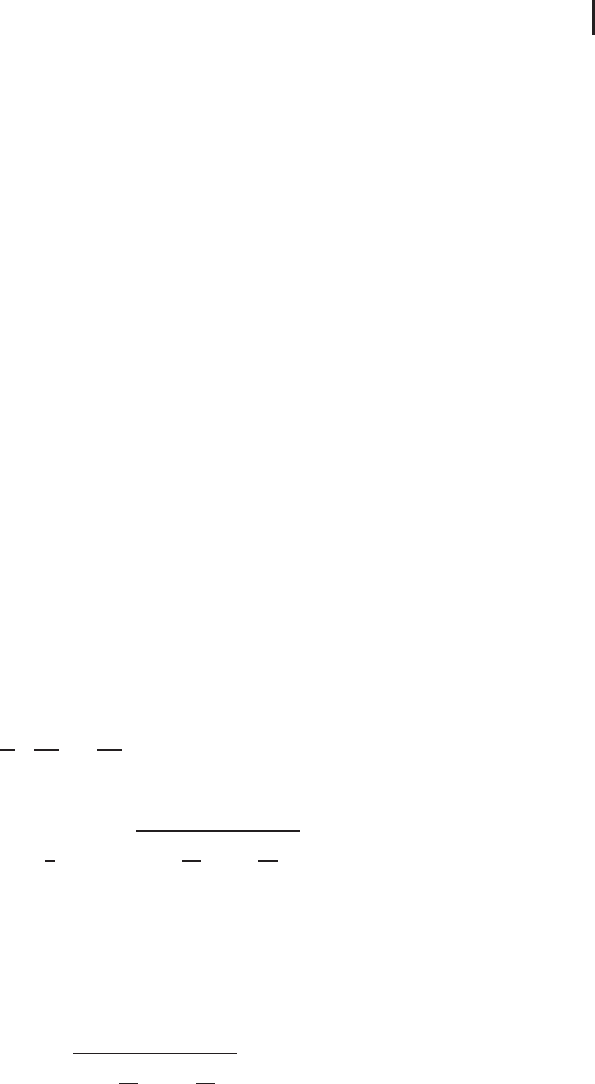
,
which is independent of the initial amplitude.
353
10
Calculus of Variations: Applications
10.1
Hamilton–Jacobi Equation and Quantum Mechanics
In this section, we will discuss, in some depth, canonical transformation theory
and a ‘‘derivation’’ of quantum mechanics from the Hamilton–Jacobi equation
following L. de Broglie and E. Schr
¨
odinger. We will also dwell on the optico-
mechanical analogy of wave optics and wave mechanics.
We can discuss classical mechanics in terms of Hamilton’s action principle
δI ≡ δ
t
2
t
1
L(q
r
(t),
˙
q
r
(t), t)dt = 0, r = 1, ..., f , (10.1.1)
where
δq
r
(t
1
) = δq
r
(t
2
) = 0, r = 1, ..., f , (10.1.2)
where L(q
r
(t),
˙
q
r
(t), t) is the Lagrangian of the mechanical system and we obtained
the Lagrange equation of motion
d
dt
∂L
∂
˙
q
r
−
∂L
∂q
r
= 0, r = 1, ..., f . (10.1.3)
We can also formulate geometrical optics in terms of Fermat’s principle
δT =
1
c
δ
x
2
x
1
dx
1 +
dy
dx
2
+
dz
dx
2
n(x , y, z) = 0, (10.1.4)
where
δx
1
= δx
2
= 0, (10.1.5)
where n(x, y, z) is the index of refraction. If n(x, y, z) is independent of x,weobtain
the equation that determines the path of the light ray in geometrical optics as
n(y, z)
1 +
dy
dx
2
+
dz
dx
2
= constant. (10.1.6)
Applied Mathematical Methods in Theoretical Physics, Second Edition. Michio Masujima
Copyright
2009 WILEY-VCH Verlag GmbH & Co. KGaA, Weinheim
ISBN: 978-3-527-40936-5

354 10 Calculus of Variations: Applications
We first define the momentum {p
r
(t)}
f
r=1
canonically conjugate to the generalized
coordinate {q
r
(t)}
f
r=1
by the following equation:
p
r
(t) ≡
∂L(q
s
(t),
˙
q
s
(t), t)
∂
˙
q
r
(t)
, r, s = 1, ..., f . (10.1.7)
We solve Eq. (10.1.7) for
˙
q
r
(t) as a function of {q
s
(t), p
s
(t)}
f
s=1
and t.Wedefine
the Hamiltonian H(q
r
(t), p
r
(t), t) as the Legendre transform of the Lagrangian
L(q
r
(t),
˙
q
r
(t), t) by the following equation:
H (q
r
(t), p
r
(t), t) ≡
f
s=1
p
s
(t)
˙
q
s
(t) −L(q
r
(t),
˙
q
r
(t), t), (10.1.8)
where we substitute
˙
q
r
(t), expressed as a function of {q
s
(t), p
s
(t)}
f
s=1
and t, into the
right-hand side of Eq. (10.1.8). Then, we take the independent variations of q
r
(t)
and p
r
(t) in Eq. (10.1.8). We obtain Hamilton’s canonical equations of motion
d
dt
q
r
(t) =
∂H(q
s
(t), p
s
(t), t)
∂p
r
(t)
,
d
dt
p
r
(t) =−
∂H(q
s
(t), p
s
(t), t)
∂q
r
(t)
, r = 1, ..., f .
(10.1.9)
We move on to the discussion of canonical transformation theory. We rewrite
the definition of the Hamiltonian H(q
r
(t), p
r
(t), t), (10.1.8), as follows:
L(q
r
(t),
˙
q
r
(t), t) =
f
s=1
p
s
(t)
˙
q
s
(t) −H(q
r
(t), p
r
(t), t). (10.1.10)
We now consider the transformation of the pair of the canonical variables from
{q
r
(t), p
r
(t)}
f
r=1
to {Q
r
(t), P
r
(t)}
f
r=1
. This transformation is said to be canonical
transformation if the following condition holds:
δ
t
2
t
1
dt
f
s=1
p
s
(t)
˙
q
s
(t) −H(q
r
(t), p
r
(t), t)
= δ
t
2
t
1
dt
f
s=1
P
s
(t)
˙
Q
s
(t) −H(Q
r
(t), P
r
(t), t)
= 0. (10.1.11a)
We have the end-point conditions:
δq
r
(t
1,2
) = δp
r
(t
1,2
) = δQ
r
(t
1,2
) = δP
r
(t
1,2
) = 0, r = 1, ..., f . (10.1.11b)
New canonical pair {Q
r
(t), P
r
(t)}
f
r=1
satisfies Hamilton’s canonical equation of
motion, (10.1.9), with
H(Q
r
(t), P
r
(t), t) as the new Hamiltonian. With Eq. (10.1.11b),
Eq. (10.1.11a) is equivalent to the following equation:
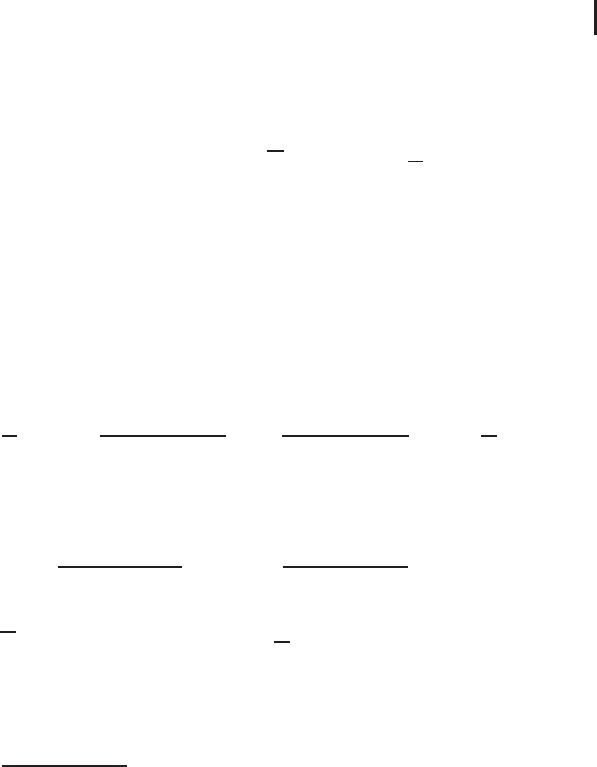
10.1 Hamilton–Jacobi Equation and Quantum Mechanics 355
f
s=1
p
s
(t)
˙
q
s
(t) −H(q
r
(t), p
r
(t), t)
=
f
s=1
P
s
(t)
˙
Q
s
(t) −H(Q
r
(t), P
r
(t), t) +
d
dt
U. (10.1.12)
U is the function of arbitrary pair of {q
r
(t), p
r
(t), Q
r
(t), P
r
(t)} and t, and is the single-
valued continuous function. We call U the generator of canonical transformation.
The generator U can assume only the following four forms:
F
1
(q
r
(t), Q
r
(t), t), F
2
(q
r
(t), P
r
(t), t), F
3
(p
r
(t), Q
r
(t), t), F
4
(p
r
(t), P
r
(t), t). (10.1.13)
(1) We now choose U to be the function of {q
r
(t), Q
r
(t)}
f
r=1
and t,
U = F
1
(q
r
(t), Q
r
(t), t).Sincewehave
d
dt
U =
f
s=1
∂F
1
(q
r
(t), Q
r
(t), t)
∂q
s
(t)
˙
q
s
(t) +
∂F
1
(q
r
(t), Q
r
(t), t)
∂Q
s
(t)
˙
Q
s
(t)
+
∂
∂t
F
1
,
(10.1.14)
we obtain the transformation formula from Eqs. (10.1.12) and (10.1.14),
p
r
(t) =
∂F
1
(q
s
(t), Q
s
(t), t)
∂q
r
(t)
, P
r
(t) =−
∂F
1
(q
s
(t), Q
s
(t), t)
∂Q
r
(t)
, r = 1, ..., f ,
(10.1.15a)
H (Q
r
(t), P
r
(t), t) = H(q
r
(t), p
r
(t), t) +
∂
∂t
F
1
(q
r
(t), Q
r
(t), t). (10.1.15b)
(2) We now choose U to be the function of {q
r
(t), P
r
(t)}
f
r=1
and t, U = F
2
(q
r
(t), P
r
(t), t).
In view of the transformation formula (10.1.15a),
∂F
1
(q
s
(t), Q
s
(t), t)
∂Q
r
(t)
=−P
r
(t),
we can define F
2
(q
r
(t), P
r
(t), t)suitablyintermsofF
1
(q
r
(t), Q
r
(t), t)bythemethod
of Legendre transform much as in thermodynamics,
F
2
(q
r
(t), P
r
(t), t) = F
1
(q
r
(t), Q
r
(t), t) +
f
r=1
P
r
(t)Q
r
(t). (10.1.16)
By solving Eq. (10.1.16) for F
1
(q
r
(t), Q
r
(t), t) and substituting in Eq. (10.1.12), we
obtain
f
s=1
p
s
(t)
˙
q
s
(t) −H(q
r
(t), p
r
(t), t)
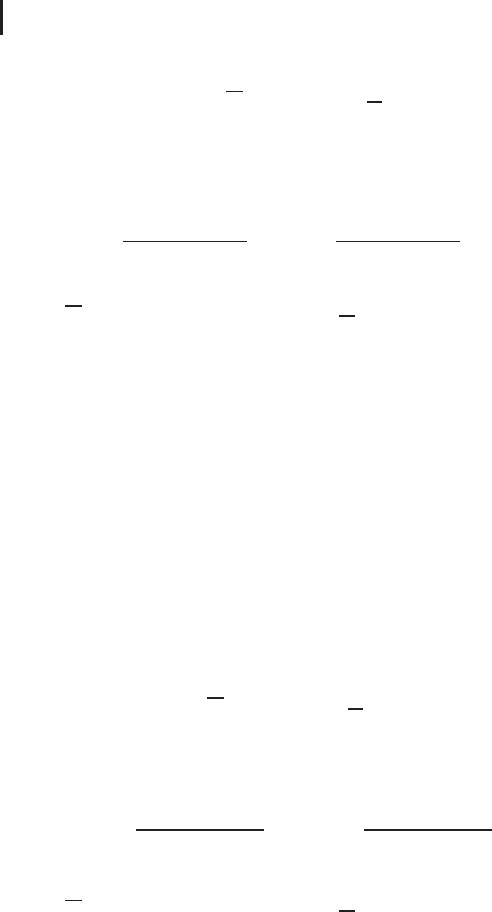
356 10 Calculus of Variations: Applications
=−
f
r=1
Q
r
(t)
˙
P
r
(t) −H(Q
r
(t), P
r
(t), t) +
d
dt
F
2
(q
r
(t), P
r
(t), t).
Carrying out the total time derivative of F
2
(q
r
(t), P
r
(t), t) and equating the coefficients
of
˙
q
r
(t)and
˙
P
r
(t), we obtain the transformation formula
p
r
(t) =
∂F
2
(q
r
(t), P
r
(t), t)
∂q
r
(t)
, Q
r
(t) =
∂F
2
(q
r
(t), P
r
(t), t)
∂P
r
(t)
, r = 1, ..., f ,
(10.1.17a)
H(Q
r
(t), P
r
(t), t) = H(q
r
(t), p
r
(t), t) +
∂
∂t
F
2
(q
r
(t), P
r
(t), t). (10.1.17b)
(3) We now choose U to be the function of {p
r
(t), Q
r
(t)}
f
r=1
and t,
U = F
3
(p
r
(t), Q
r
(t), t). In view of the transformation formula (10.1.15a), we can
define F
3
(p
r
(t), Q
r
(t), t)suitablyintermsofF
1
(q
r
(t), Q
r
(t), t) by the method of
Legendre transform much as in thermodynamics,
F
3
(p
r
(t), Q
r
(t), t) = F
1
(q
r
(t), Q
r
(t), t) −
f
r=1
p
r
(t)q
r
(t). (10.1.18)
Equation (10.1.12) now reads as
−
f
s=1
q
s
(t)
˙
p
s
(t) −H(q
r
(t), p
r
(t), t)
=
f
s=1
P
s
(t)
˙
Q
s
(t) −H(Q
r
(t), P
r
(t), t) +
d
dt
F
3
(p
r
(t), Q
r
(t), t).
Equating the coefficients of
˙
p
r
(t)and
˙
Q
r
(t), we obtain the transformation formula,
q
r
(t) =−
∂F
3
(p
r
(t), Q
r
(t), t)
∂p
r
(t)
, P
r
(t) =−
∂F
3
(p
r
(t), Q
r
(t), t)
∂Q
r
(t)
, r = 1, ..., f ,
(10.1.19a)
H(Q
r
(t), P
r
(t), t) = H(q
r
(t), p
r
(t), t) +
∂
∂t
F
3
(p
r
(t), Q
r
(t), t). (10.1.19b)
(4) We now choose U to be the function of {p
r
(t), P
r
(t)}
f
r=1
and t, U = F
4
(p
r
(t), P
r
(t), t).
We can also define F
4
(p
r
(t), P
r
(t), t)suitablyintermsofF
1
(q
r
(t), Q
r
(t), t)byadouble
Legendre transform as in thermodynamics,
F
4
(p
r
(t), P
r
(t), t) = F
1
(q
r
(t), Q
r
(t), t) +
f
r=1
P
r
(t)Q
r
(t) −
f
r=1
p
r
(t)q
r
(t). (10.1.20)
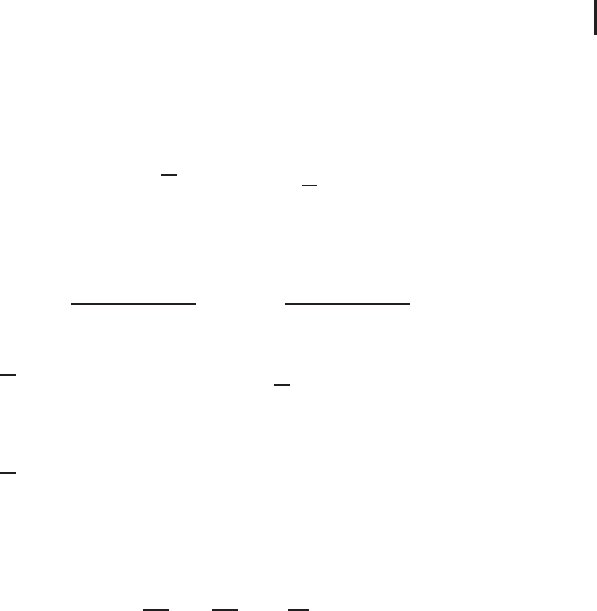
10.1 Hamilton–Jacobi Equation and Quantum Mechanics 357
Equation (10.1.12) reduces to
−
f
s=1
q
s
(t)
˙
p
s
(t) −H(q
r
(t), p
r
(t), t)
=−
f
r=1
Q
r
(t)
˙
P
r
(t) −H(Q
r
(t), P
r
(t), t) +
d
dt
F
4
(p
r
(t), P
r
(t), t).
Equating the coefficients of
˙
p
r
(t)and
˙
P
r
(t) , we obtain the transformation formula,
q
r
(t) =−
∂F
4
(p
r
(t), P
r
(t), t)
∂p
r
(t)
, Q
r
(t) =
∂F
4
(p
r
(t), P
r
(t), t)
∂P
r
(t)
, r = 1, ..., f ,
(10.1.21a)
H (Q
r
(t), P
r
(t), t) = H(q
r
(t), p
r
(t), t) +
∂
∂t
F
4
(p
r
(t), P
r
(t), t). (10.1.21b)
In Case (2), we now try to choose F
2
(q
r
(t), P
r
(t), t) = S(q
r
(t), P
r
(t), t)suchthat
H (Q
r
(t), P
r
(t), t) ≡ 0. (10.1.22)
To satisfy the condition (10.1.22), the generator S must satisfy the following
equation in view of Eqs. (10.1.17a), (10.1.17b), and (10.1.22),
H
q
1
(t), ..., q
f
(t),
∂S
∂q
1
, ...,
∂S
∂q
f
, t
+
∂S
∂t
= 0. (10.1.23)
Equation (10.1.23) is called the Hamilton–Jacobi equation .
We consider the single particle in three-dimensional space with Cartesian
components. From Eq. (10.1.17a), we have
p(t) =
∇
q
S(
q(t),
P(t), t),
which states that the direction of the motion of the particle is always normal to the
surface with
S(
q(t),
P(t), t) = constant.
The situation is similar to geometrical optics. Now the Hamilton–Jacobi equation
provides us the interpretation of classical mechanics as ‘‘geometrical’’ mechanics
much like geometrical optics. We recall that geometrical optics was derived from
wave optics by Eikonal approximation. It is quite natural then to search for
the governing equation of ‘‘wave’’ mechanics by applying the inverse of Eikonal
approximation to the Hamilton–Jacobi equation. This step was taken by de Broglie
and Schr
¨
odinger in 1924–1925 and the governing equation of ‘‘wave’’ mechanics
is the celebrated Schr
¨
odinger wave equation. The time-independent Schr
¨
odinger