
Menon E.S. Liquid Pipeline Hydraulics
Подождите немного. Документ загружается.

Pump Station Design 163
shows that at a flow rate of 2800 gal/min, the differential head generated is
3800 ft. Adding the 50 psi suction pressure, point B on the H-Q curve
corresponds to
3800+50×2.31/0.89=3930 ft
We can see from the point of intersection of the pump H-Q curve and the
pipeline system curve that the operating point will be at point A, which is a
higher flow rate than 2800 gal/min. Also, the pump discharge pressure at A
will be at a higher flow rate than that at C. Unless the pipe MAOP is greater
than the pressure at A, we cannot allow this pump to operate without
pressure control. Thus utilizing the control valve on the pump discharge we
will move the operating point from A to B on the pump curve corresponding
to 2800 gal/min and a higher head of 3930 ft as calculated above. The
control valve will then cause the pressure drop equivalent to the head
difference BC calculated as follows:
Control valve pressure drop, BC=3930-3634=296 ft
This pressure drop across the control valve is also called the pump throttle
pressure:
Throttle pressure=296×0.89/2.31=114 psi
We thus conclude that, due to the slightly oversized pump and the pipe
MAOP limit, we must utilize a control valve on the pump discharge to limit
the pipeline discharge pressure to 1400 psi at the required flow rate of 4000
bbl/hr (2800 gal/min). A hypothetical system head curve, designated as (2),
passing through point B on the pump curve, is the artificial system head
curve due to the restriction imposed by the control valve.
It must be pointed out that as far as the pump is concerned, the suction
pressure, case pressure, discharge pressure, and throttle pressure are as
follows
Pump suction pressure=50 psi
Pump case pressure=1514 psi
Pump station discharge pressure=1400 psi
Pump throttle pressure=114 psi
The above analysis applies to a pump driven by a constant-speed electric
motor. If we had a VSD pump that can vary the pump speed from 60% to
100% rated speed and if the rated speed were 3560 RPM, the pump speed
range would be
3560×0.60=2136 RPM to 3560 RPM
Copyright © 2004 by Marcel Dekker, Inc.
Chapter 8164
Since the pump speed can be varied from 2136 RPM to 3560 RPM, the
pump head curve will correspondingly vary according to the centrifugal
pump Affinity Laws. Therefore we can find some speed (less than 3560
RPM) at which the pump will generate the required head corresponding to
point C in Figure 8.4.
Point C represents a pump differential head of
(1400-50)×2.31/0.89=3504 ft
where 50 psi represents the pump suction pressure. If the given H-Q curve is
based on the rated speed of 3560 RPM, using Affinity Laws we calculate the
approximate speed required for point C as
3560(3504/3800)
1/2
=3419 RPM
If we had the full H-Q curve data at 3560 RPM we could generate the revised
H-Q curve at the desired speed of 3419 RPM. Actually, we may have to
adjust the speed a little to get the required head corresponding to point C.
From the foregoing analysis we can conclude that use of VSD pumps can
provide the right amount of pressure required for a given pump flow rate,
thus avoiding the pump throttle pressures (and hence wasted HP) that are
common with constant-speed motor-driven pumps with control valves.
However, VSD pumps are expensive to install and operate compared with
the use of a control valve. A typical control valve installation may cost
$100,000, whereas a VSD may require $300,000 to $500,000 incremental
cost compared with a constant-speed motor-driven pump. We will have to
factor in the increased operating cost of the VSD pump compared to the
money lost in wasted HP from control valve throttling.
Let us illustrate this function by considering the Essex to Kent pipeline
again. In the first case, we will assume a constant-speed pump at Essex with
a control valve. The pump and control valve installation will cost
approximately
$(X+100,000)
where X represents the cost of the constant-speed motor-driven pump. The
annual maintenance cost for the control valve is estimated at $10,000. Due
to pump throttling, let us assume an average pressure drop in the control
valve to be 100 psi over a 12 month period at an average pipeline flow rate
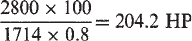
of 4000 bbl/hr. This is equivalent to a wasted HP of
Copyright © 2004 by Marcel Dekker, Inc.
Pump Station Design 165
Assuming 80% pump efficiency, at an average electrical cost of 10 cents/
kWh and 350 days operation per year, the throttled pressure represents a
loss of
$(204.2×0.746×24×350×0.10)=$127,960 per year
If we now replaced the pump at Essex with a VSD pump consisting of a
variable frequency drive (VFD) electric motor with the same pump without
the control valve, the capital cost will be approximately
$(X+500,000)
where $500,000 has been added to account for the additional switchgear
and the VFD motor. The annual maintenance cost for this installation may
be as high as $50,000.
Comparing the two alternatives, we can summarize as follows, assuming
X=250,000 for the pump motor.
Case A: Constant-speed motor-driven pump with control valve
Capital cost $350,000
Annual cost $137,960
(includes HP lost due to control valve)
Case B: VFD motor-driven pump, no control valve
Capital cost $750,000
Annual cost $50,000
It is clear that the VSD pump has higher initial cost but lower annual cost
compared with the constant-speed motor/control valve combination.
In this example, we can perform an economic analysis and compare case
A with case B considering discounted cash flow. If the interest rate is 8% per
year the present value of case A for a 15 year project life is
PV
A
=350,000+PV(137, 960, 15, 8)
where PV(A, N, i) represents the present value of a series of cash flows of $A,
each for N years at an annual interest rate of i percent. Therefore
PV
A
=350,000+1,180,866
=$1,530,866
Similarly,
PV
B
=750,000+PV(50,000, 15, 8)
=750,000+427,974
=$1,177,974
Copyright © 2004 by Marcel Dekker, Inc.
Chapter 8166
It can be seen from the above that the VSD case will be the more
economical alternative, since it has a lower present value of investment.
The advantages of VSD pumps include operational flexibility and lower
power requirements since no HP is wasted as with a control valve. The
disadvantage of VSD pumps include higher capital and operating cost
compared with a constant-speed pump with a control valve.
8.4 Summary
This chapter covered the main components found in a typical pump station
as they relate to pumps and pipeline hydraulics. The concepts of pump
suction pressure, case pressure, pump station discharge pressure, and
throttle pressure were introduced and calculations illustrated using
examples. The impact of pump throttle pressure and how the control valve
is used to protect the discharge piping as well as to provide the necessary
pressure for a particular flow rate were explained. We found that the throttle
pressure contributes to energy loss and therefore wasted money. The
advantages of using VSD pumps to provide just enough pressure for the
specified flow, thereby eliminating throttle pressures, were analyzed. Also
illustrated was a comparison of using a VSD pump versus a control valve.
8.5 Problems
8.5.1 The origin pump station at Harvard on a 50 mile pipeline consists
of two pumps in series, each developing 1450 ft of head at 3000
bbl/hr. Diesel fuel (specific gravity 0.85 and viscosity 5.9 cSt) is
pumped from Harvard to a delivery terminal at Banning. The
required discharge pressure at Harvard has been calculated to be
995 psi. The pump station suction pressure is maintained at 50 psi.
Use a combined pump efficiency of 84% at the given flow rate.
(a) Analyze the pump station pressures and determine the
amount of throttle pressure and HP wasted.
(b) If electrical energy costs 10 cents/kWh, estimate the dollars
lost in control valve throttling.
8.5.2 If a VSD pump is used in Problem 8.5.1 above, determine the speed
at which the pump should be run to maintain the flow rate of 3000
bbl/hr. The rated pump speed is 3560 RPM.
8.5.3 A water pipeline consists of three pump stations, each having one
constant-speed motor-driven pump of 2000 HP. The analysis of
current operations shows that the pipeline has been
operating at a fairly constant flow rate of 3000 gal/min, and the
pump throttle pressures are as follows:
Copyright © 2004 by Marcel Dekker, Inc.
Pump Station Design 167
Pump station 2:75 psi
Pump station 3:85 psi
Pump station 1 has zero throttle pressure. Trimming the pump
impellers to the correct size so as to eliminate wasted HP from
pump throttle is estimated to cost $50,000 per pump station.
Retrofitting each pump station with VFD motor-driven pumps is
estimated to cost $500,000 per pump station. The operating cost
for the VFD units is $50,000 per site.
(a) Determine the economics of installing trimmed impellers and
the payment period based on 8% interest rate. Assume 80%
pump efficiency for HP calculations and an electricity cost of
10 cents/kWh.
(b) If it was decided not to trim the pump impellers, compare the
VFD motor option with the constant-speed pump option.
Consider the control valve annual operating cost to be $5000
per site.
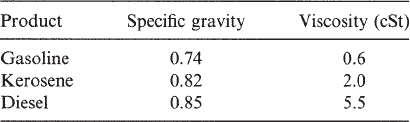
8.5.4 A refined products pipeline is used for batched operations with
gasoline, kerosene and diesel fuel. The pipeline is 80 miles long
and is 14 in. in diameter, 0.250 in. wall thickness. The MAOP of the
pipeline is 1200 psi.
(a) Determine the maximum throughput possible with one pump
station for each product considering each product pumped
alone with no batching. Assume a flat elevation profile with
50 psi pipe delivery pressure. For liquid properties use the
following:
(b) Investigate the use of VSD pumps to provide the required
operational control and flexibility when this pipeline is
operated in a batched mode. Pick a typical pump curve for the
origin pump station to first satisfy the need to maximize
gasoline throughput. Having based pump requirements on
Copyright © 2004 by Marcel Dekker, Inc.
Chapter 8168
gasoline, determine the speed variants required for the other
two products without exceeding the MAOP.
(c) Estimate the annual power cost for each product based on an
electricity cost of 10 cents/kWh.
(d) How would the operating scenario change if VSD pumps were
not used? Estimate the cost of HP wasted in pump throttling
with the control valve.
Copyright © 2004 by Marcel Dekker, Inc.
169
9
Thermal Hydraulics
Thermal hydraulics takes into account the temperature variation of a liquid
as it flows through the pipeline. This is in contrast to isothermal
hydraulics, where there is no significant temperature variation in the
liquid. In previous chapters we have concentrated on water pipelines,
refined petroleum products (gasoline, diesel, etc.) and other light crude oil
pipelines where the liquid temperature was close to ambient temperature.
In many cases where heavy crude oil and other liquids of high viscosity
have to be pumped, the liquid is heated to some temperature (such as
150°F to 180°F) prior to being pumped through the pipeline. In this
chapter we explore how calculations are performed in thermal hydraulics.
9.1 Temperature-Dependent Flow
In the preceding chapters we concentrated on steady-state liquid flow in
pipelines without paying much attention to temperature variations along
the pipeline. We assumed the liquid entered the pipeline inlet at some
temperature such as 70° F. The liquid properties such as specific gravity
and viscosity at the inlet temperature were used to calculate the Reynolds
number and friction factor and finally the pressure drop due to friction.
Similarly, we also used the specific gravity at inlet temperature to calculate
the elevation head based on the pipeline topography. In all cases the liquid
Copyright © 2004 by Marcel Dekker, Inc.
Chapter 9170
properties were considered at some constant flowing temperature. These
calculations are therefore based on isothermal (constant-temperature) flow.
The above may be valid in most cases in which the liquid transported,
such as water, gasoline, diesel, or light crude oil, is at ambient temperature.
As the liquid flows through the pipeline, heat may be transferred to or from
the liquid from the surrounding soil (buried pipeline) or the ambient air
(above-ground pipeline). Significant changes in liquid temperatures due to
heat transfer with the surroundings will affect liquid properties such as
specific gravity and viscosity. This in turn will affect pressure drop
calculations. So far we have ignored this heat transfer effect, assuming
minimal temperature variations along the pipeline. However, there are
instances when the liquid has to be heated to a much higher temperature
than ambient conditions to reduce the viscosity and make it flow easily.
Pumping a higher-viscosity liquid that is heated will also require less
pump horsepower.
For example, a high-viscosity crude oil (200 cSt to 800 cSt or more at
60°F) may be heated to 160°F before it is pumped into the pipeline. This
high-temperature liquid loses heat to the surrounding soil as it flows
through the pipeline by conduction of heat from the interior of the pipe to
the soil through the pipe wall. The ambient soil temperature may be 40°F
to 50°F during the winter and 60°F to 80°F during the summer. Therefore,
a considerable temperature difference exists between the hot liquid in the
pipe and the surrounding soil.
The temperature difference of about 120°F in winter and 100°F during
summer, will cause significant heat transfer between the crude oil and
surrounding soil. This will result in a temperature drop of the liquid and
variation in liquid specific gravity and viscosity as it flows through the
pipeline. Therefore, in such instances we will be wrong in assuming a
constant flowing temperature to calculate pressure drop as we do in
isothermal flow. Such a heated liquid pipeline may be bare or insulated. In
this chapter we will study the effect of temperature variation and friction
loss along the pipeline, known as thermal hydraulics.
Consider a 20 in. buried pipeline transporting 8000 bbl/hr of a heavy
crude oil that enters the pipeline at an inlet temperature of 160°F. Assume
that the liquid temperature has dropped to 124°F at a location 50 miles
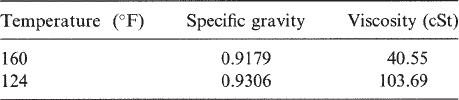
from the pipeline inlet. Suppose the crude oil properties at 160°F inlet
conditions and at 124°F at milepost 50 are as follows:
Copyright © 2004 by Marcel Dekker, Inc.
Thermal Hydraulics 171
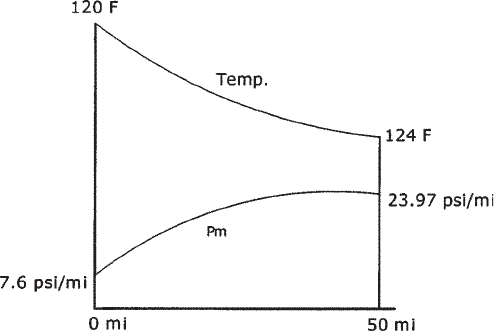
Using the 160°F inlet temperature we calculate the frictional pressure
drop at inlet conditions to be 7.6 psi/mile. At the temperature conditions at
milepost 50, using the given liquid properties we find that the frictional
pressure drop has increased to 23.97 psi/mile. Thus, in a 50 mile section of
pipe the pressure drop due to friction varies from 7.6 to 23.97 psi/mile as
shown in Figure 9.1.
We could use an average value of the pressure drop per mile to calculate
the total frictional pressure drop in the first 50 miles of the pipe. However,
this will be a very rough estimate. A better approach would be to subdivide
the 50 mile section of the pipeline into smaller segments 5 or 10 miles long
and to compute the pressure drop per mile for each segment. We will then
add the individual pressure drops for each 5 or 10 mile segment to get the
total frictional pressure drop in the 50 mile length of pipeline. Of course,
this assumes that we have available to us the temperature of the liquid at 5
or 10 mile increments up to milepost 50. The liquid properties and pressure
drop due to friction can then be calculated at the boundaries of each 5 or 10
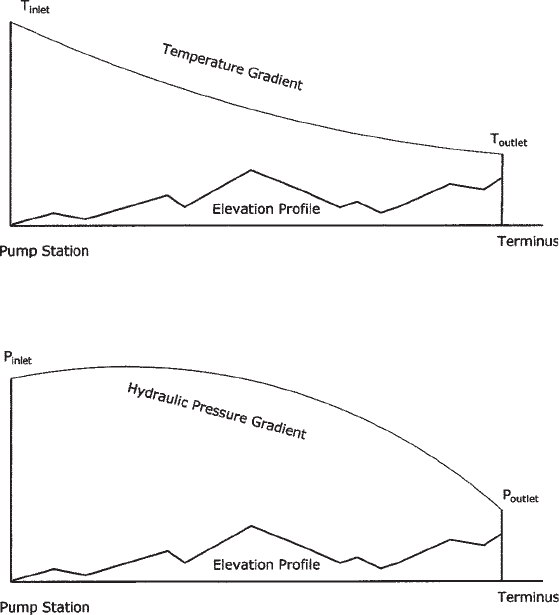
mile segment and the temperature gradient plotted as illustrated in Figure
9.2.
How do we obtain the temperature variation along the pipeline so we
can calculate the liquid properties at each temperature and then calculate
the pressure drop due to friction? This represents the most complicated
aspect of thermal hydraulic analysis. Several approaches have been put
forth for calculating the temperature variation in a pipeline transporting
heated liquid. We must consider soil temperatures along the pipeline,
thermal conductivity of pipe material, pipe insulation (if any), thermal
Figure 9.1 Temperature and pressure drop.
Copyright © 2004 by Marcel Dekker, Inc.
Chapter 9172
conductivity of soil, and pipe burial depth. We will present in this chapter
a simplified approach to calculating the temperature profile in a buried
pipeline. The method and formulas used were developed originally for the
Trans-Alaskan Pipeline System (TAPS). These have been found to be quite
accurate over the range of temperatures and pressures encountered in
heated liquid pipelines today.
The hydraulic gradient showing the pressure profile in a heated liquid
pipeline is illustrated in Figure 9.3. Note the curved shape of the gradient,
compared with the straight-line gradient in isothermal flow (such as
Figures 6.2 or 8.3).
An example will illustrate the use of these formulas. More accurate
methods include using a computer software program that will subdivide
the pipeline into small segments and compute the heat balance and
Figure 9.2 Thermal temperature gradient.
Figure 9.3 Thermal hydraulic pressure gradient.
Copyright © 2004 by Marcel Dekker, Inc.