
Menon E.S. Liquid Pipeline Hydraulics
Подождите немного. Документ загружается.

Thermal Hydraulics 173
pressure drop calculations, to develop the pressure and temperature profile
for the entire pipeline. One such commercially available program is
LIQTHERM developed by SYSTEK (www.systek.us).
9.2 Formulas for Thermal Hydraulics
9.2.1 Thermal Conductivity
Thermal conductivity is the property used in heat conduction through a
solid. In English units it is measured in Btu/hr/ft/°F. In SI units thermal
conductivity is expressed in W/m/°C.
For heat transfer through a solid of area A and thickness dx, with a
temperature difference dT, the formula in English units is:
H=K(A)(dT/dx) (9.1)
where
H=Heat flux perpendicular to the surface area, Btu/hr
K=Thermal conductivity of solid, Btu/hr/ft/°F
A=Area of heat flux, ft
2
dx=Thickness of solid, ft
dT=Temperature difference across the solid, °F
The term dT/dx represents the temperature gradient in °F/ft. Equation
(9.1) is also known as the Fourier heat conduction formula.
It can be seen from Equation (9.1) that the thermal conductivity of a
material is numerically equal to the amount of heat transferred across a
unit area of the solid material with unit thickness, when the temperature
difference between the two faces of the solid is maintained at 1 degree. The
thermal conductivity for steel pipe and soil are as follows:
K for steel pipe=29 Btu/hr/ft/°F
K for soil=0.2 to 0.8 Btu/hr/ft/°F
Sometimes heated liquid pipelines are insulated on the outside with an
insulating material. The K value for insulation may range from 0.01 to
0.05 Btu/hr/ft/°F.
In SI units, Equation (9.1) becomes
H=K(A)(dT/dx) (9.2)
where
H=Heat flux, W
K=Thermal conductivity of solid, W/m/°C
A=Area of heat flux, m
2
dx=Thickness of solid, m
Copyright © 2004 by Marcel Dekker, Inc.
Chapter 9174
dT=Temperature difference across the solid, °C
In SI units, the thermal conductivity for steel pipe, soil and insulation are
as follows:
K for steel pipe=50.19 W/m/°C
K for soil=0.35 to 1.4 W/m/°C
K for insulation=0.02 to 0.09 W/m/°C
As an example, consider heat transfer across a flat steel plate of thickness
8 in. and area 100 ft
2
where the temperature difference across the plate
thickness is 20°F. From Equation (9.1)
Heat transfer=29×(100)×20×12/8=87,000 Btu/hr
9.2.2 Overall Heat Transfer Coefficient
The overall heat transfer coefficient is also used in heat flux calculations.
Equation (9.1) for heat flux can be written in terms of overall heat transfer
coefficient as follows:
H=U(A)(dT) (9.3)
where
U=Overall heat transfer coefficient, Btu/hr/ft
2
/°F
Other symbols in Equation (9.3) are the same as in Equation (9.1).
In SI units, Equation (9.3) becomes
H=U(A)(dT) (9.4)
where
U=Overall heat transfer coefficient, W/m
2
/°C
Other symbols in Equation (9.4) are the same as in Equation (9.2). The
value of U may range from 0.3 to 0.6 Btu/hr/ft
2
/°F in English units and 1.7
to 3.4 W/m
2
/°C in SI units.
When analyzing heat transfer between the liquid in a buried pipeline
and the outside soil, we consider flow of heat through the pipe wall and
pipe insulation (if any) to the soil. If U represents the overall heat transfer
coefficient, we can write from Equation (9.3)
H=U(A)(T
L
-T
S
) (9.5)
where
A=Area of pipe under consideration, ft
2
T
L
=Liquid temperature, °F
Copyright © 2004 by Marcel Dekker, Inc.
Thermal Hydraulics 175
T
S
=Soil temperature, °F
U=Overall heat transfer coefficient, Btu/hr/ft
2
/°F
Since we are dealing with temperature variation along the pipeline length,
we must consider a small section of pipeline at a time when applying
above Equation (9.5) for heat transfer.
For example, consider a 100 ft length of 16 in. pipe carrying a heated
liquid at 150°F. If the outside soil temperature is 70°F and the overall heat
transfer coefficient
U=0.5 Btu/hr/ft
2
/°F
then we can calculate the heat transfer using Equation (9.5) as follows:
H=0.5 A (150-70)
where A is the area through which heat flux occurs:
A=π×(16/12)×100=419 ft
2
Therefore
H=0.5×419×80=16,760 Btu/hr
9.2.3 Heat Balance
The pipeline is subdivided and for each segment the heat content balance is
computed as follows:
H
in
-ΔH+H
w
=H
out
(9.6)
where
H
in
=Heat content entering line segment, Btu/hr
ΔH=Heat transferred from line segment to surrounding medium (soil or
air), Btu/hr
H
w
=Heat content from frictional work, Btu/hr
H
out
=Heat content leaving line segment, Btu/hr
In the above we have included the effect of frictional heating in the term
H
w
. With viscous liquids the effect of friction is to create additional heat
which would raise the liquid temperature. Therefore in thermal hydraulic
analysis frictional heating is included to improve the calculation accuracy.
In SI units, Equation (9.6) will be the same, with each term expressed in
watts instead of Btu/hr.
The heat balance Equation (9.6) forms the basis for computing the
outlet temperature of the liquid in a segment, starting with its inlet
temperature and taking into account the heat loss (or gain) with the
Copyright © 2004 by Marcel Dekker, Inc.
Chapter 9176
surroundings and frictional heating. In the following sections we will
formulate the method of calculating each term in Equation (9.6).
9.2.4 Logarithmic Mean Temperature Difference (LMTD)
In heat transfer calculations, due to varying temperatures it is customary to
use a slightly different concept of temperature difference called the
logarithmic mean temperature difference (LMTD). The LMTD between
the liquid in the pipeline and the surrounding medium is calculated as
follows:
Consider a pipeline segment of length Δx with liquid temperatures T
1
at
the upstream end and T
2
at the downstream end of the segment. If T
s
represents the average soil temperature (or ambient air temperature for an
above-ground pipeline) surrounding this pipe segment, the logarithmic
mean temperature of the pipe (T
m
) segment is calculated as follows:
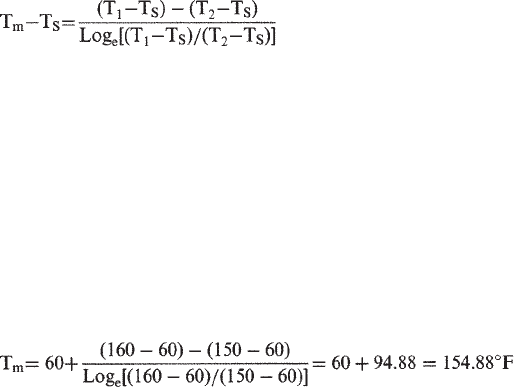
(9.7)
where
T
m
=Logarithmic mean temperature of pipe segment, °F
T
1
=Temperature of liquid entering pipe segment, °F
T
2
=Temperature of liquid leaving pipe segment, °F
T
S
=Sink temperature (soil or surrounding medium), °F
In SI units, Equation (9.7) will be the same, with all temperatures
expressed in °C instead of °F. For example, if the average soil temperature
is 60°F and the temperatures of the pipe segments upstream and
downstream are 160°F and 150°F, respectively, the logarithmic mean
temperature of the pipe segment is:
We have thus calculated the logarithmic mean temperature of the pipe
segment to be 154.88°F. If we had used a simple arithmetic average we
would get the following for the mean temperature of the pipe segment:
Arithmetic mean temperature=(160+150)/2=155°F
This is not too far off the logarithmic mean temperature T
m
calculated
above. It can be seen that the logarithmic mean temperature approach gives
a slightly more accurate representation of the average liquid temperature in
the pipe segment. Note that the use of natural logarithm in Equation (9.7)
Copyright © 2004 by Marcel Dekker, Inc.
Thermal Hydraulics 177
signifies an exponential decay of the liquid temperature in the pipeline
segment. In this example, the LMTD for the pipe segment is
LMTD=154.88-60=94.88°F
If we assume an overall heat transfer coefficient U=0.5 Btu/hr/ft
2
/°F, we
can estimate the heat flux from this pipe segment to the surrounding soil
using Equation (9.4) as follows:
Heat flux=0.5×1×94.88=47.44 Btu/hr per ft
2
of pipe area
9.2.5 Heat Entering and Leaving Pipe Segment
The heat content of the liquid entering and leaving a pipe segment is
calculated using the mass flow rate of the liquid, its specific heat and the
temperatures at the inlet and outlet of the segment. The heat content of the
liquid entering the pipe segment is calculated from
H
in
=w(C
pi
)(T
1
) (9.8)
The heat content of the liquid leaving the pipe segment is calculated from
H
out
=w(C
po
)(T
2
) (9.9)
where
H
in
=Heat content of liquid entering pipe segment, Btu/hr
H
out
=Heat content of liquid leaving pipe segment, Btu/hr
C
pi
=Specific heat of liquid at inlet, Btu/lb/°F
C
po
=Specific heat of liquid at outlet, Btu/lb/°F
w=Liquid flow rate, lb/hr
T
1
=Temperature of liquid entering pipe segment, °F
T
2
=Temperature of liquid leaving pipe segment, °F
The specific heat C
p
of most liquids ranges between 0.4 and 0.5 Btu/lb/°F
(0.84 and 2.09 kJ/kg/°C) and increases with liquid temperature. For
petroleum fluids C
p
can be calculated if the specific gravity or API gravity
and temperatures are known.
In SI units Equations (9.8) and (9.9) become
H
in
=w(C
pi
)(T
1
) (9.10)
H
out
=w(C
po
)(T
2
) (9.11)
where
H
in
=Heat content of liquid entering pipe segment, J/s (W)
H
out
=Heat content of liquid leaving pipe segment, J/s (W)
Copyright © 2004 by Marcel Dekker, Inc.
Chapter 9178
C
pi
=Specific heat of liquid at inlet, kJ/kg/°C
C
po
=Specific heat of liquid at outlet, kJ/kg/°C
w=Liquid flow rate, kg/s
T
1
=Temperature of liquid entering pipe segment, °C
T
2
=Temperature of liquid leaving pipe segment, °C
9.2.6 Heat Transfer: Buried Pipeline
Consider a buried pipeline, with insulation, that transports a heated liquid.
If the pipeline is divided into segments of length L we can calculate the
heat transfer between the liquid and the surrounding medium using the
following equations:
In English units
H
b
=6.28(L)(T
m
-T
s
)/(Parm1+Parm2) (9.12)
Parm1=(1/K
ins
)Log
e
(R
i
/R
p
) (9.13)
Parm2=(1/K
s
)Log
e
[2S/D+((2S/D)
2
-1)
1/2
] (9.14)
where
H
b
=Heat transfer, Btu/hr
T
m
=Log mean temperature of pipe segment, °F
T
S
=Ambient soil temperature, °F
L=Pipe segment length, ft
R
i
=Pipe insulation outer radius, ft
R
p
=Pipe wall outer radius, ft
K
ins
=Thermal conductivity of insulation, Btu/hr/ft/°F
K
s
=Thermal conductivity of soil, Btu/hr/ft/°F
S=Depth of cover (pipe burial depth) to pipe centerline, ft
D=Pipe outside diameter, ft
Parm1 and Parm2 are intermediate values that depend on parameters
indicated.
In SI units, Equations (9.12), (9.13), and (9.14) become
H
b
=6.28(L)(T
m
-T
s
)/(Parm1+Parm2) (9.15)
Parm1=(1/K
ins
)Log
e
(R
i
/R
p
) (9.16)
Parm2=(1/K
s
)Log
e
[2S/D+((2S/D)
2
-1)
1/2
] (9.17)
where
H
b
=Heat transfer, W
T
m
=Log mean temperature of pipe segment, °C
T
s
=Ambient soil temperature, °C
Copyright © 2004 by Marcel Dekker, Inc.
Thermal Hydraulics 179
L=Pipe segment length, m
R
i
=Pipe insulation outer radius, mm
R
p
=Pipe wall outer radius, mm
K
ins
=Thermal conductivity of insulation, W/m/°C
K
s
=Thermal conductivity of soil, W/m/°C
S=Depth of cover (pipe burial depth) to pipe centerline, mm
D=Pipe outside diameter, mm
9.2.7 Heat Transfer: Above-Ground Pipeline
An above-ground insulated pipeline can also be used to transport a heated
liquid. If the pipeline is divided into segments of length L, we can calculate
the heat transfer between the liquid and the ambient air using the following
equations.
In English units
H
a
=6.28(L)(T
m
-T
a
)/(Parm1+Parm3) (9.18)
Parm3=1.25/[R
i
(4.8+0.008(T
m
-T
a
))] (9.19)
Parml=(1/K
ins
)Log
e
(R
i
/R
p
) (9.20)
where
H
a
=Heat transfer, Btu/hr
T
m
=Log mean temperature of pipe segment, °F
T
a
=Ambient air temperature, °F
L=Pipe segment length, ft
R
i
=Pipe insulation outer radius, ft
R
p
=Pipe wall outer radius, ft
K
ins
=Thermal conductivity of insulation, Btu/hr/ft/°F
In SI units, Equations (9.18), (9.19), and (9.20) become
H
a
=
6.28(L) (T
m
-T
a
)/(Parm1+Parm3) (9.21)
Parm3=1.25/[R
i
(4.8+0.008(T
m-
T
a
))] (9.22)
Parm1=(1/K
ins
)Log
e
(R
i
/R
p
) (9.23)
where
H
a
=Heat transfer, W
T
m
=Log mean temperature of pipe segment, °C
T
a
=Ambient air temperature, °C
L=Pipe segment length, m
R
i
=Pipe insulation outer radius, mm
R
p
=Pipe wall outer radius, mm
K
ins
=Thermal conductivity of insulation, W/m/°C
Copyright © 2004 by Marcel Dekker, Inc.
Chapter 9180
9.2.8 Frictional Heating
The frictional pressure drop causes heating of the liquid. The heat gained
by the liquid due to friction is calculated using the following equations:
H
w
=2545 (HHP) (9.24)
HHP=(1.7664×10
-4
)(Q)(Sg)(h
f
)(L
m
) (9.25)
where
H
w
=Frictional heat gained, Btu/hr
HHP=Hydraulic horsepower required for pipe friction
Q=Liquid flow rate, bbl/hr
Sg=Liquid specific gravity
h
f
=Frictional head loss, ft/mile
L
m
=Pipe segment length, miles
In SI units, Equations (9.24) and (9.25) become
H
w
=1000 (Power) (9.26)
Power=(0.00272)(Q)(S
g
)(h
f
)(L
m
) (9.27)
where
H
w
=Frictional heat gained, W
Power=Power required for pipe friction, kW
Q=Liquid flow rate, m
3
/hr
Sg=Liquid specific gravity
h
f
=Frictional head loss, m/km
L
m
=Pipe segment length, km
9.2.9 Pipe Segment Outlet Temperature
Using the formulas developed in the preceding sections and referring to
the heat balance Equation (9.6), we can now calculate the temperature of
the liquid at the outlet of the pipe segment as follows: For buried pipe:
T
2
=(1/wC
p
)[2545 (HHP)-H
b
+(wC
p
)T
1
] (9.28)
For above-ground pipe:
T
2
=(1/wC
p
)[2545(HHP)-H
a
+(wC
p
)T
1
] (9.29)
where
H
b
=Heat transfer for buried pipe, Btu/hr from Equation (9.12)
H
a
=Heat transfer for above-ground pipe, Btu/hr from Equation (9.18)
C
p
=Average specific heat of liquid in pipe segment
Copyright © 2004 by Marcel Dekker, Inc.
Thermal Hydraulics 181
For simplicity, we have used the average specific heat above for the pipe
segment based on C
pi
and C
po
discussed earlier in Equations (9.8) and (9.9).
In SI units, Equations (9.28) and (9.29) can be expressed as
For buried pipe:
T
2
=(1/wC
p
) [1000(Power)-H
b
+(wC
p
)T
1
] (9.30)
For above-ground pipe:
T
2
=(1/wC
p
) [1000(Power)-H
a
+(wC
p
)T
1
] (9.31)
where
H
b
=Heat transfer for buried pipe, W
H
a
=Heat transfer for above-ground pipe, W
Power=Frictional power defined in Equation (9.27), kW
9.2.10 Liquid Heating due to Pump Inefficiency
Since a centrifugal pump is not 100% efficient, the difference between the
hydraulic horsepower and the brake horsepower represents power lost.
Most of this power lost is converted to heating the liquid being pumped.
The temperature rise of the liquid due to pump inefficiency may be
calculated from the following equation:
ΔT=(H/778 C
P
)(1/E-1) (9.32)
where
ΔT=Temperature rise, °F
H=Pump head, ft
C
P
=Specific heat of liquid, Btu/lb/°F
E=Pump efficiency, as a decimal value less than 1.0
When considering thermal hydraulics, the above temperature rise as the
liquid moves through a pump station should be included in the temperature
profile calculation. For example, if the liquid temperature has dropped to
120°F at the suction side of a pump station and the temperature rise due to
pump inefficiency causes a 3°F rise, the liquid temperature at the pump
discharge will be 123°F.
Example Problem 9.1
Calculate the temperature rise of a liquid (specific heat=0.45 Btu/lb/°F)
due to pump inefficiency as it flows through a pump. Pump head=2450 ft
and pump efficiency=75%.
Copyright © 2004 by Marcel Dekker, Inc.

Chapter 9182
Assume a pipe burial depth of 36 in. to the top of pipe and 1.5 in.
insulation thickness with a thermal conductivity (K value) of 0.02 Btu/hr/
ft/°F. Also assume a uniform soil temperature of 60°F with a K value of 0.5
Btu/hr/ft/°F. Using the heat balance equation calculate the outlet
temperature of the crude oil at the end of the first mile segment. Assume an
average specific heat of 0.45 for the crude oil.
Solution
First calculate the heat transfer for buried pipe using Equations (9.12)
through (9.14):
Parm1=(1/0.02)Log
e
(9.5/8)=8.5925
Parm2=(1/0.5)Log
e
[2×44/16+((2×44/16)
2
-1)
1/2
]=4.7791
H
b
=6.28(5280)(T
m
-60)/(8.5925+4.7791)
or
H
b
=2479.76(T
m
-60) Btu/hr (9.33)
The log mean temperature T
m
of this 1 mile pipe segment has to be
approximated first, since it depends on the inlet temperature, soil
temperature, and the unknown liquid temperature at the outlet of the 1 mile
segment.
As a first approximation, assume the outlet temperature at the end of the
1 mile segment to be T
2
=150. Calculate T
m
using Equation (9.7):
Solution
From Equation (9.32), the temperature rise is
ΔT=(2450/(778×0.45))(1/0.75-1)=2.33°F
We will now use the equations discussed in this chapter to calculate the
thermal hydraulic temperature profile of a crude oil pipeline.
Example Problem 9.2
A 16 in., 0.250 in. wall thickness, 50 mile long buried pipeline transports
4000 bbl/hr of heavy crude oil that enters the pipeline at 160°F. The crude
oil has a specific gravity and viscosity as follows:
Temperature (°F): 100 140
Specific gravity: 0.967 0.953
Viscosity (cSt): 2277 348
Copyright © 2004 by Marcel Dekker, Inc.