
Menon E.S. Liquid Pipeline Hydraulics
Подождите немного. Документ загружается.

Pressure Drop due to Friction 63
If DRA costs $10 per gallon, this equates to a daily DRA cost of $756. In
this example, a 20% flow improvement requires a drag reduction of 30.43%
and 15 ppm of DRA, costing $756 per day. Of course, these are simply
rough numbers, used to illustrate the DRA calculations methods. The
quantity of DRA required will depend on the pipe size, liquid viscosity,
flow rate, and Reynolds number, in addition to the percentage drag
reduction required. Most DRA vendors will confirm that drag reduction is
effective only in turbulent flow (Reynolds number>4000) and that it does
not work with heavy (high-viscosity) crude oil and other liquids.
Also, drag reduction cannot be increased indefinitely by injecting more
DRA. There is a theoretical limit to the drag reduction attainable. For a
certain range of flow rates, the percentage drag reduction will increase as
the DRA ppm is increased. At some point, depending on the pumped
liquid, flow characteristics, etc., the drag reduction levels off. No further
increase in drag reduction is possible by increasing the DRA ppm. We
would have reached the point of diminishing returns, in this case.
In Chapter 12 on feasibility studies and pipeline economics, we explore
the subject of DRA further.
3.14 Summary
We have defined pressure and how it is measured in both a static and
dynamic context. The velocity and Reynolds number calculations for pipe
flow were introduced and the use of the Reynolds number in classifying
liquid flow as laminar, critical, and turbulent were explained. Existing
methods of calculating the pressure drop due to friction in a pipeline using
the Darcy-Weisbach equation were discussed and illustrated using
examples. The importance of the Moody diagram was explained. Also, the
trial-and-error solutions of friction factor from the Colebrook-White
equation were covered. The use of the Hazen-Williams, MIT and other
pressure drop equations were discussed. Minor losses in pipelines due to
valves, fittings, pipe enlargements, and pipe contractions were analyzed.
The concept of drag reduction as a means of reducing frictional head loss
was also introduced.
3.15 Problems
3.15.1 Calculate the average velocity and Reynolds number in a 20 in.
pipeline that transports diesel fuel at a flow rate of 250,000
bbl/day. Assume 0.375 in. pipe wall thickness and the diesel
fuel properties as follows: Specific gravity=0.85, Kinematic
viscosity=5.9 cSt. What is the flow regime in this case?
Copyright © 2004 by Marcel Dekker, Inc.
Chapter 364
3.15.2 In the above example, what is the value of the Darcy friction
factor using the Colebrook-White equation? If the modified
Colebrook-White equation is used, what is the difference in
friction factors? Calculate the pressure drop due to friction in a
5 mile segment of this pipeline. Use a pipe roughness value of
0.002 in.
3.15.3 Using the Hazen-Williams equation with a C-factor of 125,
calculate the frictional pressure drop per mile in the 20 in.
pipeline described in Problem 3.15.1 above. Repeat the
calculations using the Shell-MIT and Miller equations.
3.15.4 A crude oil pipeline 500 km long with 400 mm outside
diameter and 8 mm wall thickness is used to transport 600 m
3
/
hr of product from a crude oil terminal at San José to a refinery
located at La Paz. Assuming the crude oil has a specific gravity
of 0.895 and viscosity of 200 SSU at 20°C, calculate the total
pressure drop due to friction in the pipeline. If the MAOP of
the pipeline is limited to 10 MPa, how many pumping stations
will be required to transport this volume, assuming flat terrain?
Use the modified Colebrook-White equation and assume a
value of 0.05 mm for the absolute pipe roughness.
3.15.5 In Problem 3.15.4 the volume transported was 600 m
3
/hr. It is
desired to increase flow rate using DRA in the bottleneck
section of the pipeline.
(a) What is the maximum throughput possible with DRA?
(b) Summarize any changes needed to the pump stations to
handle the increased throughput.
(c) What options are available to further increase pipeline
throughput?
Copyright © 2004 by Marcel Dekker, Inc.
65
4
Pipe Analysis
In this chapter we focus our attention mainly on the strength capabilities of
a pipeline. We discuss different materials used to construct pipelines and
how to calculate the amount of internal pressure that a given pipe can
withstand. We determine the amount of internal pressure a particular size of
pipe can withstand based on the pipe material, diameter, and wall thickness.
Next, we establish the hydrostatic test pressure the pipeline will be subject
to, such that the previously calculated internal pressure can be safely
tolerated. We also discuss the volume content or line fill volume of a
pipeline and how it is used in batched pipelines with multiple products.
4.1 Allowable Operating Pressure and
Hydrostatic Test Pressure
To transport a liquid through a pipeline, the liquid must be under sufficient
pressure so that the pressure loss due to friction and the pressure required for
any elevation changes can be accommodated. The longer the pipeline and
the higher the flow rate, the higher the friction drop will be, requiring a
corresponding increase in liquid pressure at the beginning of the pipeline.
In gravity flow systems, flow occurs due to elevation difference without
any additional pump pressure. Thus, a pipeline from a storage tank on a hill
to a delivery terminus below may not need any pump pressure at the tank.
Copyright © 2004 by Marcel Dekker, Inc.
Chapter 466
However, the pipeline still needs to be designed to withstand pressure
generated due to the static elevation difference.
The allowable operating pressure in a pipeline is defined as the
maximum safe continuous pressure that the pipeline can be operated at. At
this internal pressure the pipe material is stressed to some safe value below
the yield strength of the pipe material. The stress in the pipe material
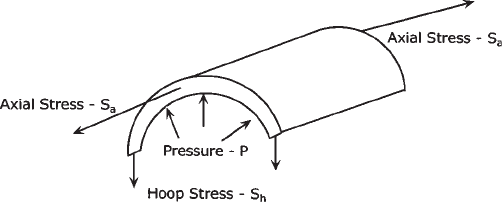
consists of circumferential (or hoop) stress and longitudinal (or axial) stress.
This is shown in Figure 4.1. It can be proven that the axial stress is one-half
the value of the hoop stress. The hoop stress therefore controls the amount
of internal pressure the pipeline can withstand. For pipelines transporting
liquids, the hoop stress may be allowed to reach 72% of the pipe yield
strength.
If pipe material has 60,000 psi yield strength, the safe internal operating
pressure cannot exceed a value that results in a hoop stress of
0.72×60,000=43,200 psi
To ensure that the pipeline can be safely operated at a particular maximum
allowable operating pressure (MAOP) we must test the pipeline using water,
at a higher pressure.
The hydrostatic test pressure is a pressure higher than the allowable
operating pressure. It is the pressure at which the pipeline is tested for a
specified period of time, such as 4 hr (for aboveground piping) or 8 hr (for
buried pipeline) as required by the pipeline design code or by the appropriate
city or government regulations. In the United States, Department of
Transportation (DOT) Code Part 195 applies. Generally, for liquid pipelines
the hydrostatic test pressure is 25% higher than the MAOP. Thus, if the MAOP
is 1000 psig, the pipeline will be hydrostatically tested at 1250 psig.
Calculation of internal design pressure in a pipeline is based on
Barlow’s equation for internal pressure in thin-walled cylindrical pipes,
as discussed next.
Figure 4.1 Hoop stress and axial stress in a pipe.
Copyright © 2004 by Marcel Dekker, Inc.
Pipe Analysis 67
4.2 Barlowís Equation for Internal Pressure
The hoop stress or circumferential stress, S
h
, in a thin-walled cylindrical
pipe due to an internal pressure is calculated using the formula
S
h
=PD/2 (4.1)
where
S
h
=Hoop stress, psi
P=Internal pressure, psi
D=Pipe outside diameter, in.
t=Pipe wall thickness, in.
Similarly, the axial (or longitudinal) stress, S
a
, is
S
a
=PD/4t (4.2)
The above equations form the basis of Barlow’s equation used to determine
the allowable internal design pressure in a pipeline. As can be seen from
Equations (4.1) and (4.2), the hoop stress is twice the longitudinal stress.
The internal design pressure will therefore be based on the hoop stress
(Equation 4.1).
Barlow’s equation can be derived easily as follows: Consider one-half of
a unit length of pipe as shown in Figure 4.1. Due to internal pressure P, the
bursting force on one-half the pipe is
P×D×1
where the pressure P acts on a projected area D×1. This bursting force is
exactly balanced by the hoop stress S
h
acting along both edges of the pipe.
Therefore,
S
h
×t×1×2=P×D×1
Solving for S
h
we get
S
h
=PD/2t
Equation (4.2) for axial stress S
a
is derived as follows. The axial stress S
a
acts
on an area of cross-section of pipe represented by πDt. This is balanced by
the internal pressure P acting on the internal cross-sectional area of pipe
πD
2
/4. Equating the two we get
S
a
×πDt=P×πD
2
/4
Solving for S
a
, we get
S
a
=PD/4t
Copyright © 2004 by Marcel Dekker, Inc.
Chapter 468
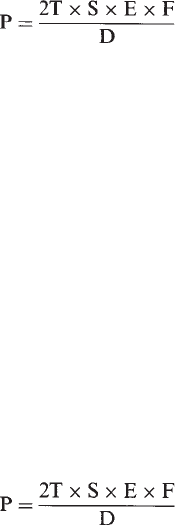
In calculating the internal design pressure in liquid pipelines, we modify
Barlow’s equation slightly. The internal design pressure in a pipe is
calculated in English units as follows:
(4.3)
where
P=Internal pipe design pressure, psig
D=Nominal pipe outside diameter, in.
T=Nominal pipe wall thickness, in.
S=Specified minimum yield strength (SMYS) of pipe material, psig
E=Seam joint factor, 1.0 for seamless and submerged arc welded (SAW)
pipes (see Table A.11 in Appendix A
)
F=Design factor, usually 0.72 for liquid pipelines, except that a design
factor of 0.60 is used for pipe, including risers, on a platform located
off shore or on a platform in inland navigable waters, and 0.54 is used
for pipe that has been subjected to cold expansion to meet the SMYS
and subsequently heated, other than by welding or stress-relieving as
a part of the welding, to a temperature higher than 900°F (482°C) for
any period of time or to over 600°F (316°C) for more than 1 hr.
The above form of Barlow’s equation may be found in Part 195 of DOT
Code of Federal Regulations, Title 49 and ASME standard B31.4 for liquid
pipelines. In SI units, Barlow’s equation can be written as:
(4.4)
where
P=Pipe internal design pressure, kPa
D=Nominal pipe outside diameter, mm
T=Nominal pipe wall thickness, mm
S=Specified minimum yield strength (SMYS) of pipe material, kPa
E and F are defined under Equation (4.3)
In summary, Barlow’s equation for internal pressure is based on
calculation of the hoop stress (circumferential) in the pipe material. The
hoop stress is the controlling stress within stressed pipe material, being
twice the axial stress (Figure 4.1).
The strength of pipe material designated as specified minimum yield
strength (SMYS) in Equations (4.3) and (4.4) depends on pipe material and
grade. In the United States, steel pipeline material used in the oil and gas
industry is manufactured in accordance with American Petroleum Institute
(API) standards 5L and 5LX. For example, grades 5LX-42, 5LX-52, 5LX-60,
Copyright © 2004 by Marcel Dekker, Inc.
Pipe Analysis 69
5LX-65, 5LX-70, and 5LX-80 are used commonly in pipeline applications.
The numbers after 5LX above indicate the SMYS values in thousands of
psi. Thus, 5LX-52 pipe has a minimum yield strength of 52,000 psi. The
lowest grade of pipe material used is 5L Grade B, which has an SMYS of
35,000 psi. In addition, seamless steel pipe designated as ASTM A106 and
Grade B pipe are also used for liquid pipeline systems. These have an SMYS
value of 35,000 psi.
It is obvious from Barlow’s equation (4.3) that, for a given pipe
diameter, pipe material, and seam joint factor, the allowable internal
pressure P is directly proportional to the pipe wall thickness. For example,
a pipe of 16 in. diameter with a wall thickness of 0.250 in. made of 5LX-
52 pipe has an allowable internal design pressure of 1170 psi calculated
as follows:
P=(2×0.250×52,000×1.0×0.72)/16=1170 psig
Therefore if the wall thickness is increased to 0.375 in. the allowable
internal design pressure increases to
(0.375/0.250)×1170=1755 psig
On the other hand, if the pipe material is changed to 5LX-70, keeping the
wall thickness at 0.250 in., the new internal pressure is
(70,000/52,000)1170=1575 psig
Note that we used Barlow’s equation to calculate the allowable internal
pressure based upon the pipe material being stressed to 72% of SMYS. In
some situations more stringent city or government regulations may require
that the pipe be operated at a lower pressure. Thus, instead of using a 72%
factor in Equation (4.3) we may be required to use a more conservative
factor (lower number) in place of F=0.72. As an example, in certain areas of
Los Angeles, liquid pipelines are only allowed to operate at a 66% factor
instead of the 72% factor. Therefore, in the earlier example, the 16 in./ 0.250
in./X52 pipeline can only be operated at
1170(66/72)=1073 psig
As mentioned before, in order to operate a pipeline at 1170 psig, it must be
hydrostatically tested at 25% higher pressure. Since 1170 psig internal
pressure is based on the pipe material being stressed to 72% of SMYS, the
hydrostatic test pressure will cause the hoop stress to reach
1.25(72)=90% of SMYS
Generally, the hydrostatic test pressure is specified as a range of
pressures, such as 90% SMYS to 95% SMYS. This is called the hydrotest
Copyright © 2004 by Marcel Dekker, Inc.
Chapter 470
pressure envelope. Therefore, in the present example the hydrotest
pressure range is
1.25(1170)=1463 psig lower limit (90% SMYS)
(95/90)1463=1544 psig higher limit (95% SMYS)
To summarize, a pipeline with an MAOP of 1170 psig needs to be
hydrotested at a pressure range of 1463 psig to 1544 psig. According to the
design code, the test pressure will be held for a minimum 4 hr for
aboveground pipelines and 8 hr for buried pipelines.
In calculating the allowable internal pressure in older pipelines,
consideration must be given to wall thickness reduction due to corrosion
over the life of the pipeline. A pipeline that was installed 25 years ago with
0.250 in. wall thickness may have reduced in wall thickness to 0.200 in. or
less due to corrosion. Therefore, the allowable internal pressure will have to
be reduced in the ratio of the wall thickness, compared with the original
design pressure.
4.3 Line Fill Volume and Batches
Frequently we need to know how much liquid is contained in a pipeline
between two points along its length, such as between valves or pump
stations.
For a circular pipe, we can calculate the volume of a given length of pipe
by multiplying the internal cross-sectional area by the pipe length. If the
pipe internal diameter is D in. and the length is L ft, the volume of this
length of pipe is
V=0.7854(D
2
/144)L (4.5)
where
V=Volume, ft
3
Simplifying,
V=5.4542×10
-3
D
2
L (4.6)
We will now restate this equation in terms of conventional pipeline units,
such as the volume in bbl in a mile of pipe. The quantity of liquid contained
in a mile of pipe, also called the line fill volume, is calculated as follows:
V
L
=5.129(D)
2
(4.7)
Copyright © 2004 by Marcel Dekker, Inc.

Pipe Analysis 71
where
V
L
=Line fill volume of pipe, bbl/mile
D=Pipe internal diameter, in.
In SI units we can express the line fill volume per km of pipe as follows:
V
L
=7.855×10
-4
D
2
(4.8)
where
V
L
=Line fill volume, m
3
/km
D=Pipe internal diameter, mm
Using Equation (4.7), a pipeline 100 miles long, 16 in. diameter and
0.250 in. wall thickness, has a line fill volume of
5.129(15.5)
2
(100)=123,224 bbl
Many crude oil and refined product pipelines operate in a batched mode, in
which multiple products are simultaneously pumped through the pipeline
as batches. For example, 50,000 bbl of product C will enter the pipeline
followed by 30,000 bbl of product B and 40,000 bbl of product A. If the line
fill volume of the pipeline is 120,000 bbl, an instantaneous snapshot
condition of a batched pipeline is as shown in Figure 4.2.
Example Problem 4.1
A 50 mile pipeline consists of 20 miles of pipe of 16 in. diameter and 0.375
in. wall thickness followed by 30 miles of pipe of 14 in. diameter and 0.250
in. wall thickness. Calculate the total volume contained in the 50 miles of
pipeline.
Solution
Using Equation (4.7) we get, for the 16 in. pipeline
Volume per mile=5.129(15.25)
2
=1192.81 bbl/mile
And for the 14 in. pipeline
Volume per mile=5.129(13.5)
2
=934.76 bbl/mile
Total line fill volume is
20×1192.81+30×934.76=51,899 bbl
Figure 4.2 Batched pipeline.
Copyright © 2004 by Marcel Dekker, Inc.
Chapter 472
Example Problem 4.2
A pipeline 100 km long is 500 mm outside diameter and 12 mm wall
thickness. If batches of three liquids A (3000m
3
), B (5000m
3
) and C occupy
the pipe, at a particular instant, calculate the interface locations of the
batches, considering the origin of the pipeline to be at 0.0 km.
Solution
Using Equation (4.8) we get the line fill volume per km to be
V
L
=7.855×10
-4
(500–24)
2
=177.9754 m
3
/km
The first batch A will start at 0.0 km and will end at a distance of
3000/177.9754=16.86 km
The second batch B starts at 16.86 km and ends at
16.86+(5000/177.9754)=44.95 km
The third batch C starts at 44.95 km and ends at 100 km.
The total volume in the pipe is
177.9754×100=17,798 m
3
Thus the volume of the third batch C is
17,798-3000-5000=9798 m
3
It can thus be seen that line fill volume calculation is important when
dealing with batched pipelines. We need to know the boundaries of each
liquid batch, so that the correct liquid properties can be used to calculate
pressure drops for each batch.
The total pressure drop in a batched pipeline would be calculated by
adding up the individual pressure drops for each batch. Since intermixing
of the batches is not desirable, batched pipelines must run in turbulent flow.
In laminar flow there will be extensive mixing of the batches, which defeats
the purpose of keeping each product separate; so that at the end of the
pipeline each product may be diverted into a separate tank. Some
intermixing will occur at the product interfaces and this contaminated
liquid is generally pumped into a slop tank at the end of the pipeline and
may be blended with a less critical product. The amount of contamination
that occurs at the batch interface depends on the physical properties of the
batched products, batch length, and Reynolds number.
Copyright © 2004 by Marcel Dekker, Inc.