
Menon E.S. Liquid Pipeline Hydraulics
Подождите немного. Документ загружается.

Pressure and Horsepower Required 83
independent of flow rate. We can then calculate the frictional component
(which depends on flow rate) of the total pressure P
t
using Equation 5.1 as
follows:
Frictional pressure drop=1600-300-50=1250 psi
Assuming a pipeline length of 100 miles, the frictional pressure drop per
mile of pipe is
P
m
=1250/100=12.5 psi/mile
This pressure drop occurs at a flow rate of 4000 bbl/hr. From Chapter 3 on
pressure drop calculations, we know that the pressure drop per mile, P
m
,
varies as the square of the flow rate as long as the liquid properties and
pipe size do not change. Using Equation (3.28) we can write
P
m
=K(Q)
2
(5.4)
where
P
m
=Frictional pressure drop per mile of pipe
K=A constant for this pipeline that depends on liquid properties and
pipe diameter
Q =Pipeline flow rate
Note that the K value above is not the same as the head loss coefficient
discussed in Chapter 3. Strictly speaking, K also includes a transmission
factor F (or a friction factor f) which varies with flow rate. However, for
simplicity, we will assume that K is the constant that encompasses liquid
specific gravity and pipe diameter. A more rigorous approach requires an
additional parameter in Equation (5.4) that would include the transmission
factor F, which in turn depends on Reynolds number, pipe roughness, etc.
Therefore, using Equation (5.4) we can write for the initial flow rate of
4000 bbl/hr
12.5=K(4000)
2
(5.5)
In a similar manner, we can estimate the frictional pressure drop per mile
when flow rate is increased to some value Q to fully utilize the 1200 psi
MAOP of the pipeline.
Using Equation (5.3), if we allow each pump station to operate at 1200
psi discharge pressure, we can write
1200=(P
t
+50)/2
or
P
t
=2400-50 =2350 psi
Copyright © 2004 by Marcel Dekker, Inc.
Chapter 584
This total pressure will now consist of friction, elevation, and delivery
pressure components at the higher flow rate Q. From Equation (5.1) we
can write
2350=P
friction
+P
elevation
+P
del
at the higher flow rate Q
or
2350=P
friction
+300+50
Therefore,
P
friction
=2350–300–50=2000 psi at the higher flow rate Q
Thus the pressure drop per mile at the higher flow rate Q is
P
m
=2000/100=20 psi/mile
From Equation (5.4) we can write
20=K(Q)
2
(5.6)
where Q is the unknown higher flow rate in bbl/hr.
By dividing Equation (5.6) by Equation (5.5) we get the following:
20/12.5=(Q/4000)
2
Solving for Q we get
Q=4000(20/12.5)
1/2
=5059.64 bbl/hr
Therefore, by fully utilizing the 1200 psi MAOP of the pipeline with the
two pump stations, we are able to increase the flow rate to approximately
5060 bbl/hr. As previously mentioned, this will definitely require
additional pumps at both pump stations to provide the higher discharge
pressure. Pumps will be discussed in Chapter 7.
In the preceding sections we have considered a pipeline of uniform
diameter and wall thickness for its entire length. In reality, pipe diameter
and wall thickness change, depending on the service requirement, design
code, and local regulatory requirements. Pipe wall thickness may have to
be increased due to differences in the specified minimum yield strength
(SMYS) of pipe because a higher or lower grade of pipe was used at some
locations. As mentioned previously, some cities or counties through which
the pipeline traverses may require different design factors (0.66 instead of
0.72) to be used, thus necessitating a different wall thickness. If there are
drastic elevation changes along the pipeline, the low elevation points may
require higher wall thickness to withstand the higher pipe operating
Copyright © 2004 by Marcel Dekker, Inc.
Pressure and Horsepower Required 85
pressures. If the pipeline has intermediate flow delivery or injections, the
pipe diameter may be reduced or increased for certain portions to optimize
pipe use. In all these cases, we can conclude that the pressure drop due to
friction will not be uniform throughout the entire pipeline length.
Injections and deliveries along the pipeline and their impact on pressure
required are discussed later in this chapter.
When pipe diameter and wall thickness change along a pipeline, the
slope of the hydraulic gradient, as shown in Figure 5.3, will no longer be
uniform. Due to varying frictional pressure drop (because of changes in
pipe diameter and wall thickness), the slope of the hydraulic gradient will
vary along the pipe length.
5.3 Series Piping
Pipes are said to be in series if different lengths of pipes are joined end to
end with the entire flow passing through all pipes, without any branching.
Consider a pipeline consisting of two different lengths and pipe
diameters joined together in series. A pipeline 1000 ft long and 16 in. in
diameter connected in series with a pipeline 500 ft long and 14 in. in
diameter would be an example of a series pipeline. At the connection point
we will need to have a fitting, known as a reducer, that will join the 16 in.
pipe with the smaller 14 in. pipe. This fitting will be a 16 in.×14 in.
reducer. The reducer causes transition in the pipe diameter smoothly from
16 in. to 14 in. We can calculate the total pressure drop through this 16 in./
14 in. pipeline system by adding the individual pressure drops in the 16 in.
and the 14 in. pipe segments and accounting for the pressure loss in the 16
in.×14 in. reducer.
If two pipes of different diameters are connected together in series, we
can also use the equivalent-length approach to calculate the pressure drop
in the pipeline as discussed next.
A pipe is equivalent to another pipe or pipeline system when the same
pressure loss due to friction occurs in the first pipe compared with that in
the other pipe or pipeline system. Since the pressure drop can be caused by
an infinite combination of pipe diameter and pipe length, we must specify
a particular diameter to calculate the equivalent length.
Suppose a pipe A of length L
A
and internal diameter D
A
is connected in
series with a pipe B of length L
B
and internal diameter D
B
. If we were to
replace this two-pipe system with a single pipe of length L
E
and diameter
D
E
, we have what is known as the equivalent length of pipe. This
equivalent length of pipe may be based on one of the two diameters (D
A
or
D
B
) or a totally different diameter D
E
.
Copyright © 2004 by Marcel Dekker, Inc.
Chapter 586
The equivalent length L
E
in terms of pipe diameter D
E
can be written as
L
E
/(D
E
)
5
=L
A
/(D
A
)
5
+L
B
/(D
B
)
5
(5.7)
This formula for equivalent length is based on the premise that the total
friction loss in the two-pipe system exactly equals that in the single
equivalent pipe.
Equation (5.7) is based on Equation (3.28) for pressure drop, since
pressure drop per unit length is inversely proportional to the fifth power of
the diameter. If we refer to the diameter D
A
as the basis, this equation
becomes, after setting D
E
=D
A
,
L
E
=L
A
+L
B
(D
A
/D
B
)
5
(5.8)
Thus, we have an equivalent length L
E
that will be based on diameter D
A
.
This length L
E
of pipe diameter D
A
will produce the same amount of
frictional pressure drop as the two lengths L
A
and L
B
in series. We have
thus simplified the problem by reducing it to one single pipe length of
uniform diameter D
A
.
It must be noted that the equivalent-length method discussed above is
only approximate. Furthermore, if elevation changes are involved it
becomes more complicated, unless there are no controlling elevations
along the pipeline system.
An example will illustrate this concept of equivalent pipe length.
Consider a 16 in. pipeline of 0.281 in. wall thickness and 20 miles long
installed in series with a 14 in. pipeline of 0.250 in. wall thickness and 10
miles long. The equivalent length of this pipeline, using Equation (5.8), is
20+10×(16-0.562)
5
/(14-0.50)
5
=39.56 miles of 16 in. pipe.
The actual physical length of 30 miles of 16 in. and 14 in. pipes is
replaced, for the purpose of pressure drop calculations with a single 16 in.
pipe 39.56 miles long. Note that we have left out the pipe fitting that would
connect the 16 in. pipe with the 14 in. pipe. This would be a 16 in.×14 in.
reducer which would have its own equivalent length. To be precise, we
should determine the equivalent length of the reducer from Table A.10 in
Appendix A and add it to the above length to obtain the total equivalent
length, including the fitting.
Once an equivalent pipe length has been determined, we can calculate
the pressure drop based on this pipe size.
Copyright © 2004 by Marcel Dekker, Inc.
Pressure and Horsepower Required 87
5.4 Parallel Piping
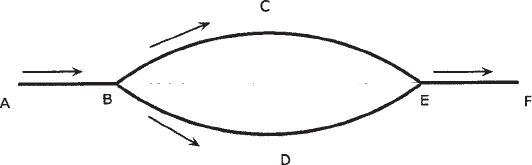
Pipes are said to be in parallel if they are connected in such a way that the
liquid flow splits into two or more separate pipes and rejoins downstream
into another pipe as illustrated in Figure 5.5. In Figure 5.5 liquid flows
through pipe AB until at point B part of the flow branches off into pipe
BCE, while the remainder flows through pipe BDE. At point E, the flows
recombine to the original value and the liquid flows through the pipe EF.
Note that we are assuming that all pipes in Figure 5.5 are shown in plan
view with no elevation changes.
In order to calculate the pressures and flow rates in a parallel piping
system such as the one depicted in Figure 5.5, we use the following two
principles of pipes in parallel:
1. Conservation of total flow
2. Common pressure loss across each parallel pipe
According to principle 1, the total flow entering each junction of pipe must
equal the total flow leaving the junction, or, simply,
Total inflow=Total outflow
Thus, in Figure 5.5, all flows entering and leaving the junction B must
satisfy the above principle. If the flow into the junction B is Q and the flow
in branch BCE is Q
BC
and flow in the branch BDE is Q
BD
, we have from the
above conservation of total flow:
Q=Q
BC
+Q
BD
(5.9)
assuming Q
BC
and Q
BD
represent the flow out of the junction B.
The second principle of parallel pipes, defined as principle 2 above,
requires that the pressure drop across the branch BCE must equal the
pressure drop across the branch BDE. This is simply due to the fact that
point B represents the common upstream pressure for each of these
Figure 5.5 Parallel pipes.
Copyright © 2004 by Marcel Dekker, Inc.
Chapter 588
branches, while the pressure at point E represents the common downstream
pressure. Referring to these pressures as P
B
and P
E
, we can state
Pressure drop in branch BCE=P
B
-P
E
(5.10)
Pressure drop in branch BDE=P
B
-P
E
(5.11)
assuming that the flows Q
BC
and Q
BD
are in the direction of BCE and BDE
respectively. If we had a third pipe branch between B and E, such as that
shown by the dashed line BE in Figure 5.5, we can state that the common
pressure drop P
B
-P
E
would also be applicable to the third parallel pipe
between B and E, as well.
We can rewrite the Equations (5.9) and (5.11) above as follows for the
system with three parallel pipes:
Q=Q
BC
+Q
BD
+Q
BE
(5.12)
and
∆P
BCE
=∆P
BDE
= ∆P
BE
(5.13)
where
∆P=Pressure drop in respective parallel pipes.
Using the Equations (5.12) and (5.13) we can solve for flow rates and
pressures in any parallel piping system. We will demonstrate the above
using an example problem later in this chapter (Example Problem 5.1).
Similar to the equivalent-length concept in series piping, we can
calculate an equivalent pipe diameter for pipes connected in parallel. Since
each of the parallel pipes in Figure 5.5 has a common pressure drop
indicated by Equation (5.13), we can replace all the parallel pipes between
B and E with one single pipe of length L
E
and diameter D
E
such that the
pressure drop through the single pipe at flow Q equals that of the
individual pipes as follows:
Pressure drop in equivalent single pipe length L
E
and diameter D
E
at flow rate Q=∆P
BCE
Assuming now that we have only the two parallel pipes BCE and BDE in
Figure 5.5, ignoring the dashed line BE, we can state that
Q=Q
BC
+Q
BD
and
∆P
EQ
=∆P
BCE
=∆P
BDE
Copyright © 2004 by Marcel Dekker, Inc.
Pressure and Horsepower Required 89
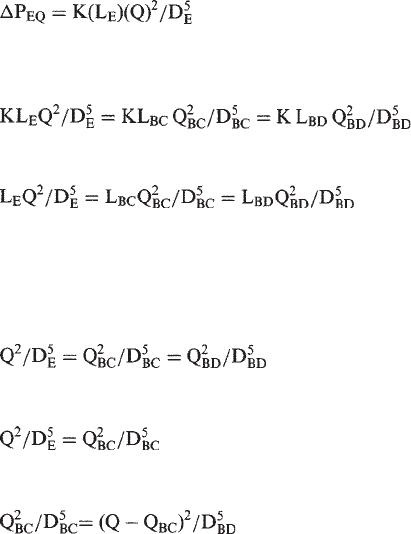
Using Equation (3.28) the pressure ∆P
EQ
for the equivalent pipe can be
written as
where K is a constant that depends on the liquid properties. The above two
equations will then become
Simplifying we get
Further simplifying the problem by setting
L
BC
=L
BD
=L
E
we get
Substituting for Q
BD
in terms for Q
BC
from Equation (5.9) we get
(5.14)
and
(5.15)
From Equations (5.14) and (5.15) we can solve for the two flows Q
BC
and
Q
BD
, and the equivalent diameter D
E
, in terms of the known quantities Q,
D
BC
, and D
BD
.
A numerical example will illustrate the above method.
Example Problem 5.1
A parallel pipe system, similar to the one shown in Figure 5.5, is located in
a horizontal plane with the following data:
Flow rate Q=2000 gal/min of water
Pipe branch BCE=12 in. diameter, 8000 ft
Pipe branch BDE=10 in. diameter, 6500 ft
Calculate the flow rate through each parallel pipe and the equivalent pipe
diameter for a single pipe 5000 ft long between B and E to replace the two
parallel pipes.
Copyright © 2004 by Marcel Dekker, Inc.
Chapter 590
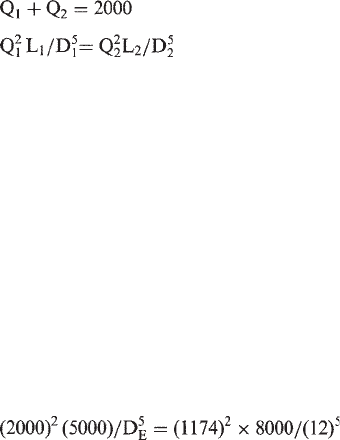
Solution
where suffixes 1 and 2 refer to the two branches BCE and BDE
respectively.
(Q
2
/Q
1
)
2
=(D
2
/D
1
)
5
(L
1
/L
2
)
=(10/12)
5
×(8000/6500)
Q
2
/Q
1
=0.7033
Solving we get
Q
1
=1174 gal/min
Q
2
=826 gal/min
The equivalent pipe diameter for a single pipe 5000 ft long is calculated as
follows:
or
D
E
=13.52 in.
Therefore, a 13.52 in. diameter pipe, 5000 ft long, between B and E will
replace the two parallel pipes.
5.5 Transporting High Vapor Pressure Liquids
As mentioned previously, transportation of high vapor pressure liquids
such as liquefied petroleum gas (LPG) requires that a certain minimum
pressure be maintained throughout the pipeline. This minimum pressure
must be greater than the liquid vapor pressure at the flowing temperature,
otherwise liquid may vaporize causing two-phase flow in the pipeline
which the pumps cannot handle. If the vapor pressure of LPG at the
flowing temperature is 250 psi, the minimum pressure anywhere in the
pipeline must be greater than 250 psi. Conservatively, at high elevation
points or peaks along the pipeline, we must insure that more than the
minimum pressure is maintained. This is illustrated in Figure 5.2.
Additionally, the delivery pressure at the end of the pipeline must also
satisfy the minimum pressure requirements. Thus, the delivery pressure at
the pipeline terminus for LPG may be 300 psi or higher to account for any
Copyright © 2004 by Marcel Dekker, Inc.

Pressure and Horsepower Required 91
meter station and manifold piping losses at the delivery point. Also,
sometimes with high vapor pressure liquids the delivery point may be a
pressure vessel or a pressurized sphere maintained at 500 to 600 psi and
therefore may require even higher minimum pressures compared with the
vapor pressure of the liquid. Hence, both the delivery pressure and the
minimum pressure must be considered when analyzing pipelines
transporting high vapor pressure liquids.
5.6 Horsepower Required
So far we have examined the pressure required to transport a given amount
of liquid through a pipeline system. Depending on the flow rate and
MAOP of the pipeline, we may need one or more pump stations to safely
transport the specified throughput. The pressure required at each pump
station will generally be provided by centrifugal or positive displacement
pumps. Pump operation and performance will be discussed in Chapter 7.
In this section we calculate the horsepower required to pump a given
volume of liquid through the pipeline regardless of the type of pumping
equipment used.
5.6.1 Hydraulic Horsepower
Power required is defined as energy or work performed per unit time. In
English units, energy is measured in foot pounds (ft·lb) and power is
expressed in horsepower (HP). One HP is defined as 33,000 ft·lb/min or
550 ft-lb/s. In SI units, energy is measured in joules and power is measured
in joules/second (watts). The larger unit kilowatt (kW) is more commonly
used. One HP is equal to 0.746 kW.
To illustrate the concept of work, energy, and power required, imagine a
situation that requires 150,000 gal of water to be raised 500 ft to supply the
needs of a small community. If this requirement is on a 24 hr basis we can
state that the work done in lifting 150,000 gal of water by 500 ft is
(150,000/7.48)×62.34×500=625,066,845 ft·lb
where the specific weight of water is assumed to be 62.34 lb/ft
3
and 1
ft
3
=7.48 gal. Thus we need to expend 6.25×10
8
ft·lb of energy over a 24 hr
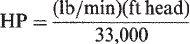
period to accomplish this task. Since 1 HP equals 33,000 ft·lb/min, the
power required in this case is
This is also known as the hydraulic horsepower (HHP), since we have not
considered pumping efficiency.
Copyright © 2004 by Marcel Dekker, Inc.
Chapter 592
As a liquid flows through a pipeline, pressure loss occurs due to
friction. The pressure needed at the beginning of the pipeline to account
for friction and any elevation changes is then used to calculate the amount
of energy required to transport the liquid. Factoring in the time element,
we get the power required to transport the liquid.
Example Problem 5.2
Consider 4000 bbl/hr being transported through a pipeline with one pump
station operating at 1000 psi discharge pressure. If the pump station
suction pressure is 50 psi, the pump has to produce 1000-50 psi, or 950 psi
differential pressure to pump 4000 bbl/hr of the liquid. If the liquid
specific gravity is 0.85 at flowing temperature, calculate the HP required at
this flow rate.
Solution
Flow rate of liquid in lb/min is calculated as follows:
M=4000 bbl/hr (5.6146 ft
3
/bbl)(1 hr/60 min)(0.85)(62.34 lb/ft
3
)
where 62.34 is the specific weight of water in lb/ft.
3
or
M=19,834.14 lb/min
Therefore the HP required is
or
HP=[(19,834.14)(950)(2.31)/0.85)]/33,000=1552
It must be noted that in the above calculation no efficiency value has been
considered. In other words, we have assumed 100% pumping efficiency.
Therefore, the above HP calculated is referred to as hydraulic horsepower
(HHP), based on 100% efficiency.
HHP=1552
5.6.2 Brake Horsepower
The brake horsepower takes into account the pump efficiency. If a pump
efficiency of 75% is used we can calculate the brake horsepower (BHP) in
Copyright © 2004 by Marcel Dekker, Inc.