
Menon E.S. Liquid Pipeline Hydraulics
Подождите немного. Документ загружается.

Pipe Analysis 73
4.4 Summary
In this chapter we discussed how allowable internal pressure in a pipeline is
calculated depending on pipe size and material. We showed that for pipe
under internal pressure the hoop stress in the pipe material will be the
controlling factor. The importance of design factor in selecting pipe wall
thickness was illustrated using an example. Based on Barlow’s equation,
the internal design pressure calculation as recommended by ASME
standard B31.4 and US Code of Federal Regulation, Part 195 of the DOT
was illustrated. The need for hydrostatic testing pipelines for safe operation
was discussed. The line fill volume calculation was introduced and its
importance in batched pipelines was shown using an example.
4.5 Problems
4.5.1 Calculate the allowable internal design pressure at 72% design
factor for an 18 in. pipeline, wall thickness 0.375 in. and pipe
material API 5LX-46. What is the hydrotest pressure range for
this pipeline?
4.5.2 It has been determined that the design pressure for a storage tank
piping system is 720 psi. If API 5L grade B pipe is used, what
minimum wall thickness is required for 14 in. pipe?
4.5.3 In Problem 4.5.2, if the pressure rating were increased to ANSI
600 (1440 psi), calculate the pipe wall thickness required with
14 in. pipe if high-strength 5LX-52 pipe is used. What is the
minimum hydrotest pressure for this system?
4.5.4 Determine the volume of liquid contained in a mile of 14 in.
pipeline with a wall thickness of 0.281 in.
Copyright © 2004 by Marcel Dekker, Inc.
74
5
Pressure and Horsepower
Required
In previous chapters we discussed how to calculate friction factors and
pressure loss due to friction in a pipeline using various equations such as
Colebrook-White, Hazen-Williams, etc. We also analyzed the internal
pressure allowable in a pipe and how to determine pipe wall thickness
required for a specific internal pressure and pipe material, according to
design code.
In this chapter we analyze how much pressure will be required at the
beginning of a pipeline to safely transport a given throughput to the
pipeline terminus, taking into account the pipeline elevation profile and the
pipeline terminus pressure required, in addition to friction losses. We will
also calculate the pumping horsepower required and in many cases also
determine how many pump stations are needed to transport the specified
volume of liquid.
We also examine pipes in series and parallel and how to calculate
equivalent length of pipes in series and the equivalent diameter of parallel
pipes. System head curves will be introduced along with flow injection and
delivery along the pipeline. Incoming and outgoing branch connections
will be studied as well as pipe loops.
Copyright © 2004 by Marcel Dekker, Inc.
Pressure and Horsepower Required 75
5.1 Total Pressure Required
The total pressure P
T
required at the beginning of a pipeline to transport a
given flow rate from point A to point B will depend on
Pipe diameter, wall thickness, and roughness
Pipe length
Pipeline elevation changes from A to B
Liquid specific gravity and viscosity
Flow rate
If we increase the pipe diameter, keeping all other items above constant,
we know that the frictional pressure drop will decrease and hence the total
pressure P
T
will also decrease. Increasing pipe wall thickness or pipe
roughness will cause increased frictional pressure drop and thus increase
the value of P
T
. On the other hand, if only the pipe length is increased, the
pressure drop for the entire length of the pipeline will increase and so will
the total pressure P
T
.
How does the pipeline elevation profile affect P
T
? If the pipeline were
laid in a flat terrain, with no appreciable elevation difference between the
beginning of the pipeline A and the terminus B, the total pressure P
T
will
not be affected. But if the elevation difference between A and B were
substantial, and B was at a higher elevation than A, P
T
will be higher than
that for the pipeline in flat terrain.
The higher the liquid specific gravity and viscosity, the higher will be
the pressure drop due to friction and hence the larger the value of P
T
.
Finally, increasing the flow rate will result in a higher frictional pressure
drop and therefore a higher value for P
T
.
In general, the total pressure required can be divided into three main
components as follows:
Friction head
Elevation head
Delivery pressure at terminus
As an example, consider a pipeline from point A to point B operating at
4000 bbl/hr flow rate. If the total pressure drop due to friction in the
pipeline is 800 psi, the elevation difference from point A to point B is 500
ft (uphill flow), and the minimum delivery pressure required at the
terminus B is 50 psi, we can state that the pressure required at A is the sum
of the three components as follows:
Total pressure at A=800 psi+500 ft+50 psi
Copyright © 2004 by Marcel Dekker, Inc.
Chapter 576
If the liquid specific gravity is 0.85, then using consistent units of psi the
above equation reduces to
Total pressure=800+(500)(0.85/2.31)+50=1033.98 psi
Of course, this assumes that there are no controlling peaks or high
elevation points between point A and point B. If an intermediate point C
located halfway between A and B had an elevation of 1500 ft, compared
with an elevation of 100 ft at point A and 600 ft at point B, then the
elevation of point C becomes a controlling factor. In this case, the
calculation of total pressure required at A is a bit more complicated.
Assume that the example pipeline is 50 miles long, of uniform diameter
and thickness throughout its entire length, and the flow rate is 4000 bbl/hr.
Therefore, the pressure drop per mile will be calculated as a constant value
for the entire pipeline from the given values as
800/50=16 psi/mile
The total frictional pressure drop between point A and the peak C located
25 miles away is
Pressure drop from A to C=16×25=400 psi
Since C is the midpoint of the pipeline, an identical frictional pressure drop
exists between C and B as follows:
Pressure drop from C to B=16×25=400 psi
Now consider the portion of the pipeline from A to C, with a frictional
pressure drop of 400 psi calculated above and an elevation difference
between A and C of 1500 ft-100 ft=1400 ft. The total pressure required at
A to get over the peak at C is the sum of the friction and elevation
components as follows:
Total pressure=400+(1400)(0.85/2.31)=915.15 psi
It must be noted that this pressure of 915.15 psi at A will just about get the
liquid over the peak at point C with zero gauge pressure. Sometimes it is
desired that the liquid at the top of the hill be at some minimum pressure
above the liquid vapor pressure at the flowing temperature. If the
transported liquid were liquefied petroleum gas (LPG), we would require a
minimum pressure in the pipeline of 250 to 300 psi. On the other hand
with crude oils and refined products with low vapor pressure, the
minimum pressure required may be only 10 to 20 psi. In this example, we
assume that we are dealing with low vapor pressure liquids and that
Copyright © 2004 by Marcel Dekker, Inc.
Pressure and Horsepower Required 77
therefore a minimum pressure of 10 psi is adequate at the high points in a
pipeline. Our revised total pressure at A will then be
Total pressure=400+(1400)(0.85/2.31)+10=925.15 psi
Therefore, starting with a pressure of 925.15 psi at A will result in a
pressure of 10 psi at the highest point C after accounting for the frictional
pressure drop and the elevation difference between A and the peak C.
Once the liquid reaches the high point C at 10 psi, it flows downhill
from point C to the terminus B at the given flow rate, being assisted by
gravity. Therefore, for the section of the pipeline from C to B the elevation
difference helps the flow while the friction impedes the flow. The arrival
pressure at the terminus B can be calculated by considering the elevation
difference and frictional pressure drop between C and B as follows:
Delivery pressure at B=10+(1500-600)(0.85/2.31)-400
=-58.83 psi
Since the calculated pressure at B is negative, it is clear that the specified
minimum delivery pressure of 50 psi at B cannot be achieved with a
starting pressure of 925.15 psi at A. Therefore, to provide the required
minimum delivery pressure at B, the starting pressure at A must be
increased to
Pressure at A=925.15+50+58.83=1033.98 psi
The above value is incidentally the same pressure we calculated at the
beginning of this section, without considering the point C. Hence the
revised pressure at peak C=10+50+58.83=118.83 psi.
Thus a pressure of 1033.98 psi at the beginning of the pipeline will
result in a delivery pressure of 50 psi at B and clear the peak at C with a
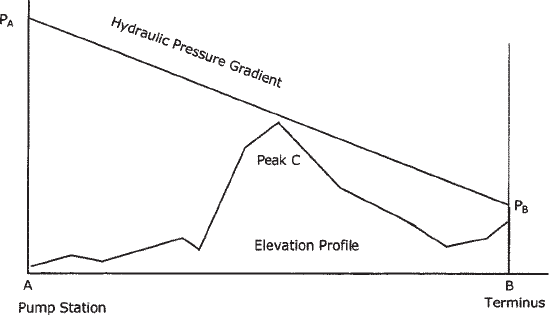
pressure of 118.83 psi. This is depicted in Figure 5.1 where
P
A
=1034 psi
P
C
=119 psi
and
P
B
=50 psi
All pressures have been rounded off to the nearest whole number.
Although the higher elevation point at C appeared to be controlling,
calculation showed that the pressure required at A depended more on the
required delivery pressure at the terminus B. In many cases this may not be
true. The pressure required will be dictated by the controlling peak and
therefore the arrival pressure of the liquid at the pipeline terminus may be
higher than the minimum required.
Copyright © 2004 by Marcel Dekker, Inc.
Chapter 578
Consider a second example in which the intermediate peak will be a
controlling factor. Suppose the above pipeline now operates at 2200 bbl/hr
and the pressure drop due to friction is calculated to be 5 psi/mile.
We will first calculate the pressure required at A, ignoring the peak
elevation at C. The pressure required at A is
5×50+(600-100)×0.85/2.31+50=484 psi
Based on this 484 psi pressure at A, the pressure at the highest point C will
be calculated by deducting from 484 psi the pressure drop due to friction
from A to C and adjusting for the elevation increase from A to C as follows:
P
C
=484-(5×25)-(1500-100)×0.85/2.31 =-156 psi
This negative pressure is not acceptable, since we require a minimum
positive pressure of 10 psi at the peak to prevent liquid vaporization. It is
therefore clear that the pressure at A calculated above is inadequate. The
controlling peak at C therefore dictates the pressure required at A. We will
now calculate the revised pressure at A to maintain a positive pressure of
10 psi at the peak at C:
P
A
=484+156+10=650 psi
Therefore, starting with a pressure of 650 psi at A provides the required
minimum of 10 psi at the peak C. The delivery pressure at B can now be
calculated as
P
B
=650-(5×50)-(600-100)×0.85/2.31=216 psi
Figure 5.1 Hydraulic gradient.
Copyright © 2004 by Marcel Dekker, Inc.
Pressure and Horsepower Required 79
which is more than the required minimum terminus pressure of 50 psi.
This example illustrates the approach used in considering all critical
elevation points along the pipeline to determine the pressure required to
transport the liquid.
Next we repeat this analysis for a higher vapor pressure product.
If we were pumping a high vapor pressure liquid that requires a delivery
pressure of 500 psi at the terminus, we would calculate the required
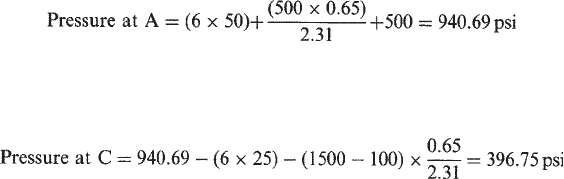
pressure at A as follows:
where the high vapor pressure liquid (Sg=0.65) is assumed to produce a
pressure drop of 6 psi/mile for the same flow rate. The pressure at the peak
will be:
If the higher vapor pressure product requires a minimum pressure of 400
psi, it can be seen from above that we do not have adequate pressure at the
peak C. We therefore need to increase the starting pressure at A to
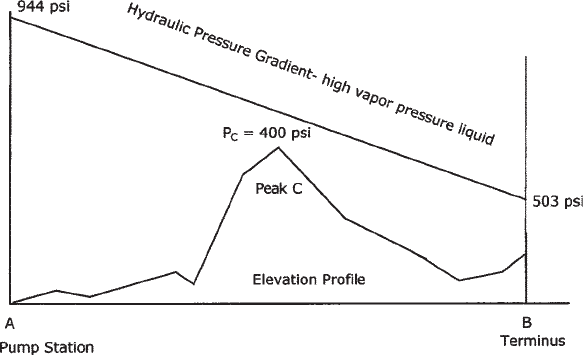
940.69+(400-396.75)=944 psi, rounded off
With this change, the delivery pressure at the terminus B will then be
500+(944-940.69)=503 psi
This is illustrated in Figure 5.2.
5.2 Hydraulic Pressure Gradient
Generally, due to friction losses the liquid pressure in a pipeline decreases
continuously from the pipe inlet to the pipe delivery terminus. If there is no
elevation difference between the two ends of the pipeline and the pipe
elevation profile is essentially flat, the inlet pressure at the beginning of the
pipeline will decrease continuously by the friction loss at a particular flow
rate. When there are elevation differences along the pipeline, the decrease
in pipeline pressure along the pipeline will be due to the combined effect
of pressure drop due to friction and the algebraic sum of pipeline
elevations. Thus with a starting pressure of 1000 psi at the beginning of the
pipeline, and assuming 15 psi/mile pressure drop due to friction in a flat
Copyright © 2004 by Marcel Dekker, Inc.
Chapter 580
pipeline (no elevation difference) with constant diameter, the pressure at a
distance of 20 miles from the beginning of the pipeline would drop to
1000-15×20=700 psi
If the pipeline is 60 miles long, the pressure drop due to friction in the
entire line will be
15×60=900 psi
The pressure at the end of the pipeline will be
1000-900=100 psi
Thus, the liquid pressure in the pipeline has uniformly dropped from 1000
psi at the beginning of the pipeline to 100 psi at the end of the 60 mile
length. This pressure profile is referred to as the hydraulic pressure
gradient in the pipeline. The hydraulic pressure gradient is a graphical
representation of the variation in pressure along the pipeline. It is shown
along with the pipeline elevation profile. Since elevation is plotted in feet,
it is convenient to represent the pipeline pressures also in feet of liquid
head. This is shown in Figures 5.1–5.3.
In the example discussed in Section 5.1, we calculated the pressure
required at the beginning of the pipeline to be 1034 psi for pumping crude
oil at a flow rate of 4000 bbl/hr. This pressure requires one pump station at
Figure 5.2 Hydraulic gradient: high vapor pressure liquid.
Copyright © 2004 by Marcel Dekker, Inc.
Pressure and Horsepower Required 81
the origin of the pipeline (point A). Assume now that the pipe length is 100
miles and the maximum allowable operating pressure (MAOP) is limited
to 1200 psi. Suppose the total pressure required at A is calculated to be
1600 psi at a flow rate of 4000 bbl/hr. We would then require an
intermediate pump station between A and B to limit the maximum pressure
in the pipeline to 1200 psi. Due to the MAOP limit, the total pressure
required at A will be provided in steps. The first pump station at A will
provide approximately half the pressure while a second pump station
located at some intermediate point provides the other half. This results in a
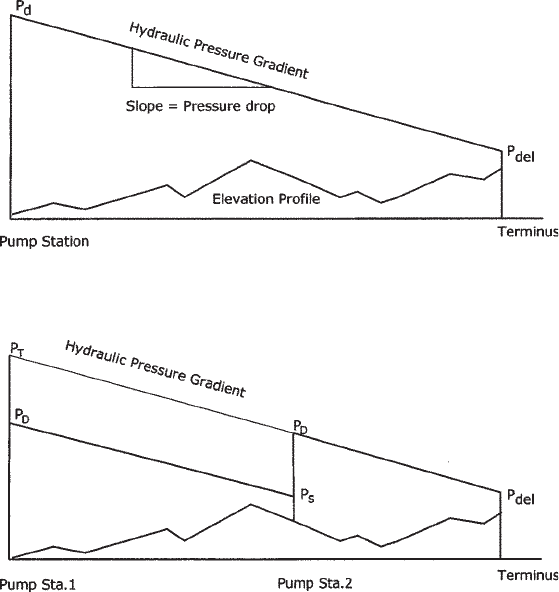
sawtooth-like hydraulic gradient as shown in Figure 5.4. The actual
discharge pressures at each pump station will be calculated considering
pipeline elevations between A and B and the required minimum suction
pressures at each of the two pump stations. An approximate calculation is
described below, referring to Figure 5.4.
Figure 5.3 Hydraulic pressure gradient.
Figure 5.4 Hydraulic pressure gradient: two pump stations.
Copyright © 2004 by Marcel Dekker, Inc.
Chapter 582
Let P
s
and P
d
represent the common suction and discharge pressure,
respectively, for each pump station, while P
del
is the required delivery
pressure at the pipe terminus B. The total pressure P
t
required at A can be
written as follows.
P
t
=P
friction
+P
elevation
+P
del
(5.1)
where
P
t
=Total pressure required at A
P
friction
=Total frictional pressure drop between A and B
P
elevation
=Elevation head between A and B
P
del
=Required delivery pressure at B
Also, from Figure 5.4, based on geometry, we can state that
P
t
=P
d
+P
d
-P
s
(5.2)
Solving for P
d
we get
P
d
=(P
t
+P
s
)/2 (5.3)
where
P
d
=Pump station discharge pressure
P
s
=Pump station suction pressure
For example, if the total pressure calculated is 1600 psi and the MAOP
is 1200 psi we would need two pump stations. Considering a minimum
suction pressure of 50 psi, each pump station would have a discharge
pressure of
P
d
=(1600+50)/2=825 psi using Equation (5.3)
Each pump station operates at 825 psi discharge pressure and the
pipeline MAOP is 1200 psi. It is clear that based on pipeline pressures alone
we have the capability of increasing pipeline throughput further to fully
utilize the 1200 psi MAOP at each pump station. Of course, this would
correspondingly require enhancing the pumping equipment at each pump
station, since more horsepower (HP) will be required at the higher flow rate.
We can now estimate the increased throughput possible if we were to
operate the pipeline at the 1200 psi MAOP level at each pump station.
Let us assume that the pipeline elevation difference in this example
contributes 300 psi to the total pressure required. This simply represents
the station elevation head between A and B converted to psi. This
component of the total pressure required (P
t
=1600 psi) depends only on
the pipeline elevation and liquid specific gravity and therefore does not
vary with flow rate. Similarly, the delivery pressure of 50 psi at B is also
Copyright © 2004 by Marcel Dekker, Inc.