
Mitin V.V., Sementsov D.I., Vagidov N.Z. Quantum mechanics for nanostructures
Подождите немного. Документ загружается.

3.3 An electron in a potential well with finite barriers 83
0
k
max
π
2π
3π
k
f
, f
n
f
1
k
1
k
2
k
3
4π
f
2
f
3
f
4
f = kL
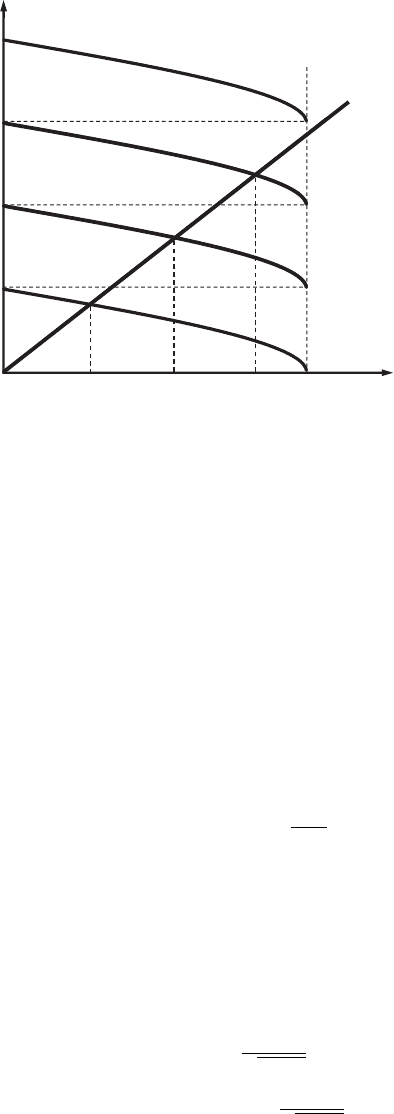
Figure 3.6 Graphical
solution of Eq. (3.99).
Here, f
n
= nπ −
2 arcsin(k/ b).
of electron energy are discrete. For the case shown in Fig. 3.6 there exist only
three solutions of Eq. (3.99) and correspondingly three energy levels in the
potential well, since the line f (k) = kL and curves f
n
(k) have only three points
of intersection, n = 1, 2, and 3, in the region of allowed values of k: k ≤ k
max
.
The larger the width of the well, L, the steeper the line f (k) = kL is, and therefore
there are more roots of Eq. (3.99) and correspondingly more energy levels exist
in the well.
As U
0
→∞, the parameter b tends to infinity. Thus, in this limiting case the
roots of Eq. (3.99)arekL = nπ as was calculated earlier for the well with infinite
potential barriers (compare with Eq. (3.43)). For the given value of the width of
the potential well, L, as the depth, U
0
, of the well decreases the magnitude k
max
also decreases, which leads to a decrease in the number of energy levels in the
well. In the case k
max
<π/L, i.e., at
U
0
L
2
<
h
-
2
π
2
2m
e
, (3.101)
only one energy level can exist in the well. In contrast to the non-symmetric well
with one of the walls being of finite height (Fig. 3.3), for which the bound state
of an electron can exist only if condition (3.82) is satisfied, in the symmetric well
of finite depth there is always at least one bound state for an electron.
To plot the wavefunctions (3.94), let us write the expressions that relate the
constants C
1
, C
2
, and C
3
:
C
1
=
h
-
k
√
2m
e
U
0
C
2
, (3.102)
C
3
=−e
κ L
h
-
k
√
2m
e
U
0
C
2
. (3.103)

84 Layered nanostructures
As has already been mentioned, relations (3.102) and (3.103) were obtained from
the conditions of continuity of the wavefunction at the boundaries of the well.
The constant C
2
can be found from the condition of normalization, which in our
case will have the form
0
−∞
|ψ
1
|
2
dx +
L
0
|ψ
2
|
2
dx +
∞
L
|ψ
3
|
2
dx = 1. (3.104)
Figure 3.5 shows the first two energy levels, E
1
and E
2
, in the potential well with
barriers of finite height and corresponding wavefunctions, ψ
1
and ψ
2
.Wesee
that for E ≤ U
0
there is a symmetric probability of finding an electron outside
the well and inside the barrier. The higher the energy levels, the higher is this
probability.
Example 3.5. Find approximately the energy difference of two levels with energy
E U
0
for an electron in a symmetric potential well of width L and barrier
height U
0
.
Reasoning. Since the energy of the electron E U
0
, the ratio k/b =
√
E/U
0
is
a very small number. Therefore, let us substitute the arcsine function by the first
term of its expansion in series, arcsin(k/b) ≈ k/b; then, from Eq. (3.99), we get
kL ≈ nπ −
2k
b
. (3.105)
On solving this equation with respect to the wavenumber, k, we obtain
k
n
≈
nπ
L + h
-
2/(m
e
U
0
)
. (3.106)
Let us find from this expression the energy of stationary states of an electron in
the potential well. Since E
n
= h
-
2
k
2
n
/(2m
e
),
E
n
≈
π
2
h
-
2
n
2
2m
e
L + h
-
2/(m
e
U
0
)
2
. (3.107)
The values of k
n
and E
n
decrease compared with the case of the well with
impenetrable barriers (compare Eqs. (3.106) and (3.107) with Eqs. (3.43) and
(3.44)). At U
0
→∞Eq. (3.107) coincides with the exact expression for the
energy levels (3.44). The energy distance between the second and first energy
levels is
E
2
− E
1
≈
3π
2
h
-
2
2m
e
L + h
-
2/(m
e
U
0
)
2
. (3.108)
3.4 Propagation of an electron above the potential well
In the previous section we considered restricted motion of an electron when its
energy does not exceed the height of the potential barriers of the quantum well.

3.4 Propagation of an electron above the potential well 85
The confinement of an electron in the potential well leads to the quantization
of its energy, which corresponds to the so-called quantum-confinement effect or
quantum-size effect. Now let us consider the peculiarities of the motion when the
energy of an electron, E, is greater than the height of the potential barrier, U
0
.
3.4.1 Reflection from an asymmetric well with one infinite
potential barrier
Suppose that in the region of the well with one of the barriers having infinite
height (Fig. 3.3) an electron is moving along the x-axis in the negative direction.
The Schr
¨
odinger equation for each of the regions, 1 and 2, has to be written as
follows:
d
2
ψ
1
(x )
dx
2
+ k
2
ψ
1
(x ) = 0, k =
2m
e
E
h
-
2
, (3.109)
d
2
ψ
2
(x )
dx
2
+ κ
2
ψ
2
(x ) = 0,κ=
2m
e
(E − U
0
)
h
-
2
. (3.110)
We see that, in contrast to the case with E ≤ U
0
, only the equation for the second
region (Eq. (3.110)) has changed. Equation (3.110) that corresponds to region 2
now has oscillatory solutions as the solutions in region 1. Therefore, the solutions
for the above-mentioned equations can be sought in the form
ψ
1
(x ) = A
1
e
ikx
+ B
1
e
−ikx
, (3.111)
ψ
2
(x ) = A
2
e
iκx
+ B
2
e
−iκx
. (3.112)
Taking into account the boundary condition ψ
1
(0) = 0, we obtain as before the
relation between the constants, B
1
=−A
1
, and the same expression (3.68)for
the wavefunction ψ
1
(x). By applying the boundary conditions (3.69) and (3.70)
at the point x = L, we obtain the expressions for the coefficients A
2
and B
2
:
A
2
= e
−iκ L
i sin(kL) +
k
κ
cos(kL)
A
1
, (3.113)
B
2
= e
iκ L
i sin(kL) −
k
κ
cos(kL)
A
1
. (3.114)
Since there are no restrictions for the parameters k and κ, the energy E can have
any value greater than U
0
, i.e., in this case the electron has a continuous energy
spectrum.
In each of the regions 1 and 2 the wavefunctions ψ
1
(x) and ψ
2
(x)arethe
sums of two de Broglie waves propagating in opposite directions. The wave that
approaches the well (the part of the total wavefunction proportional to e
−ikx
)
undergoes a partial reflection at the boundary x = L, and then the reflected wave

86 Layered nanostructures
propagates along the x-axis in the positive direction. The wave that penetrated
into region 1 is totally reflected from the boundary x = 0. Then, part of this wave
penetrates the boundary x = L and also propagates along the x-axis infinitely.
The reflection coefficient of the wave incident on the well is defined by the
expression
R =
|A
2
|
2
|B
2
|
2
. (3.115)
It follows from expressions (3.113) and (3.114) for the coefficients A
2
and B
2
that the reflection coefficient R ≡ 1.
The probability density for all values of x ≥ 0 is an oscillating function, which
has different periods of oscillations λ
1
and λ
2
in regions 1 and 2,
λ
1
=
π h
-
√
2m
e
E
, (3.116)
λ
2
=
π h
-
2m
e
(E − U
0
)
. (3.117)
The oscillating character of the probability density is the result of a superposition
of the incident and reflected waves. As a result, the wavefunction has the form
of a standing wave similar to that for the reflection of an electromagnetic wave
from an ideal conductor (see Section B.3.4 in Appendix B).
3.4.2 Reflection from a symmetric well with finite
potential barriers
Let us consider now the propagation of an electron over the symmetric potential
well with profile defined by Eq. (3.93) (see Fig. 3.5). Suppose that the electron
is moving towards the walls of the well in the positive direction along the x-axis
and its energy is E > U
0
. The Schr
¨
odinger equation for each of the three regions
1, 2, and 3 can be written as
d
2
ψ
1
(x )
dx
2
+ κ
2
ψ
1
(x ) = 0, (3.118)
d
2
ψ
2
(x )
dx
2
+ k
2
ψ
2
(x ) = 0, (3.119)
d
2
ψ
3
(x )
dx
2
+ κ
2
ψ
3
(x ) = 0, (3.120)
where the parameters k and κ are defined by the same expressions as in
Eqs. (3.109) and (3.110). The solutions for the three regions 1, 2, and 3 can
be written as
ψ
1
(x ) = A
1
e
iκx
+ B
1
e
−iκx
, x ≤ 0, (3.121)
ψ
2
(x ) = A
2
e
ikx
+ B
2
e
−ikx
, 0 < x < L , (3.122)
ψ
3
(x ) = A
3
e
iκx
+ B
3
e
−iκx
, x ≥ L. (3.123)

3.4 Propagation of an electron above the potential well 87
Let us assume that the electron propagates to the well from the negative part
of the x-axis, then in the region x > L only the outgoing wave proportional to
e
ikx
exists. Since there is no electron coming back from x →∞into the region
of interest, B
3
= 0. Using the standard boundary conditions such as (3.69) and
(3.70) for the wavefunctions ψ
1
, ψ
2
, and ψ
3
, we arrive at the following expression
for the amplitude of the outgoing wave:
A
3
=
2κke
−iκ L
2κk cos(kL) + i(k
2
+ κ
2
)sin(kL)
A
1
. (3.124)
According to Eq. (2.190), the probability density currents of the incident wave,
j
i
, and the wave transmitted through the well, j
t
,havetheforms
j
i
= e
x
h
-
κ
m
e
|A
1
|
2
, (3.125)
j
t
= e
x
h
-
κ
m
e
|A
3
|
2
. (3.126)
Taking into account these expressions, the transmission coefficient, D, which
characterizes the probability of transmission of an electron over the well, can be
written as
D =
|j
t
|
|j
i
|
=
|A
3
|
2
|A
1
|
2
. (3.127)
Taking into account Eq. (3.124) for the transmission coefficient, D, we get the
following expression:
D =
1 +
k
2
− κ
2
2kκ
2
sin
2
(kL)
−1
. (3.128)
Taking into account Eqs. (3.109) and (3.110), Eq. (3.128) can be rewritten in the
form
D =
1 +
U
2
0
4E(E − U
0
)
sin
2
√
2m
e
E
h
-
L
−1
. (3.129)
The reflection coefficient, R, which defines the probability of reflection of the
electron from the potential well when it propagates over this well, can be written
as
R =
|j
r
|
|j
i
|
=
|B
1
|
2
|A
1
|
2
= 1 − D. (3.130)
Using Eq. (3.128), we can write the expression for the reflection coefficient, R,
as
R =
1 +
(2kκ)
2
(k
2
− κ
2
)
2
sin
2
(kL)
−1
=
1 +
4E(E − U
0
)
U
2
0
sin
2
√
2m
e
EL/h
-
−1
. (3.131)
Thus, the transmission and reflection coefficients for the particle propagating
over the potential well strongly depend on the ratio of the energy of the electron,
E, and the height of the potential barrier, U
0
. When the energy, E, is slightly

88 Layered nanostructures
greater than the potential barrier, U
0
, the transmission coefficient D 1, and
the reflection coefficient is close to unity. As the ratio E/U
0
increases, the
transmission coefficient, D, rapidly increases and at E/U
0
= 2 its maximal
value is D ≈ 0.9. The electron’s reflection from the potential well at E > U
0
is a purely quantum effect, which is caused by the wave properties of the
electron.
With the increase of the electron energy, E, both coefficients, D and R,
oscillate. This can be explained by invoking the interference of the de Broglie
waves reflected from the potential barrier at the boundaries of the well at x = 0
and x = L. Since, at kL = nπ , the electron does not undergo reflections, R = 0
and D = 1. The energy of such an electron has to be equal to
E
n
=
π
2
h
-
2
2m
e
L
2
n
2
, (3.132)
where n is an integer number from n = n
min
to n →∞, where n
min
is defined
from the condition E
n
≥ U
0
with E
n
found from Eq. (3.132). The absence
of electron reflection from the potential well is analogous to the effect of an
antireflecting coating of a lens. This effect is connected with the destructive
interference of waves reflected from the two boundaries of the potential well,
which takes place at
L = n
λ
Br
2
, (3.133)
where n = 1, 2, 3,... and λ
Br
is the de Broglie wavelength that is defined by
Eq. (2.88): λ
Br
= 2π/k. The opposite situation, i.e., the minima of the transmis-
sion coefficient and, correspondingly, the maxima of the reflection coefficient,
occurs if the following condition is satisfied:
kL = (2n − 1)
π
2
, (3.134)
which can be rewritten as
L =
2n − 1
4
λ
Br
. (3.135)
Example 3.6. An electron travels over a symmetric rectangular well of width
L and barrier height U
0
. Find the energy of the electron, E, that corresponds
to equal values for the coefficients of transmission, D, and reflection, R.The
well should be considered sufficiently narrow, i.e., the condition kL 1must
be satisfied.
Reasoning. From the given condition we have that R = D = 1/2 and, taking
into account Eqs. (3.129) and (3.131), we obtain
sin
2
(kL) = 4
E
U
0
E
U
0
− 1
. (3.136)

3.5 Tunneling 89
Taking into account the smallness of kL, we can write sin(kL) ≈ kL:
k
2
L
2
= 4
E
U
0
E
U
0
− 1
. (3.137)
Since E = h
-
2
k
2
/(2m
e
), on substituting k
2
by 2m
e
E/h
-
2
in Eq. (3.137) we get the
following quadratic equation for the ratio E/U
0
:
m
e
EL
2
2h
-
2
=
E
U
0
2
−
E
U
0
. (3.138)
On solving this equation and leaving only the positive root (which is the only
one that has physical meaning) we get
E
U
0
= 1 +
m
e
U
0
L
2
2h
-
2
. (3.139)
Therefore, the energy which corresponds to equal values for the reflection and
transmission coefficients is defined as
E = U
0
1 +
m
e
U
0
L
2
2h
-
2
. (3.140)
3.5 Tunneling: propagation of an electron in the
region of a potential barrier
In Section 3.3 we studied the behavior of an electron in a rectangular potential
well with one barrier of finite height. This potential barrier has an infinite width,
see Fig. 3.3. In this case an electron with energy, E, less than the potential-barrier
height, U
0
, cannot move very far from the well since the wavefunction decreases
exponentially (see Eq. (3.85)), i.e., an electron can be found only in the vicinity
of the well in the barrier region. The wavefunctions shown in Fig. 3.3 as well
as Eqs. (3.89) and (3.90) clearly demonstrate the finite probability of finding the
electron in the barrier region. If the well has potential barriers of finite height and
width, then the electron can escape the potential well even when E < U
0
, i.e.,
the electron can penetrate through the potential barrier. The lower the barrier
height, U
0
, and the smaller its width, L, the higher is the probability that the
electron can escape the well.
To understand the peculiarities of electron transmission (or, as it is often called,
tunneling) through a barrier of finite width, let us consider a free (at x ≈−∞)
electron, which is incident on a so-called rectangular potential barrier (see
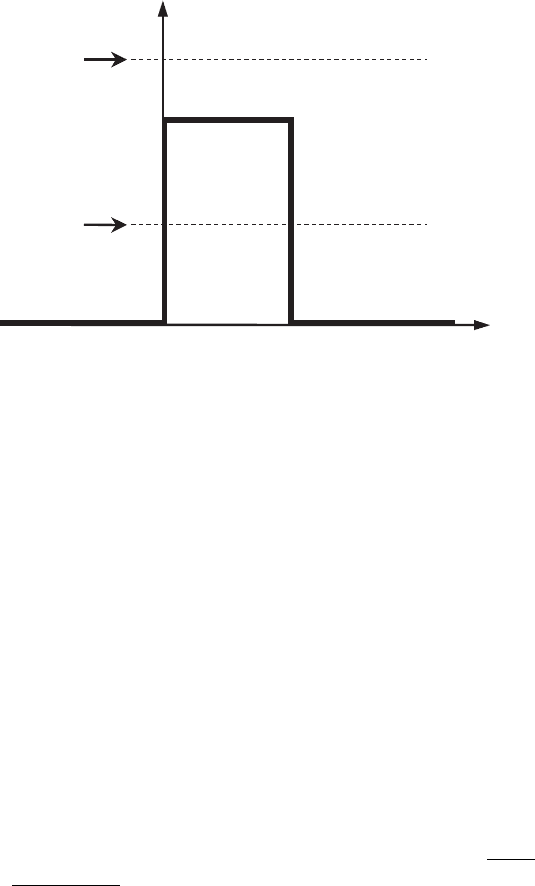
Fig. 3.7). The potential barrier is a region of space where the potential energy
of a particle is greater than in the surrounding area. For a one-dimensional
rectangular potential barrier, as is shown in Fig. 3.7, the potential energy of an
90 Layered nanostructures
x
U
0
E,U
123
0 L
E < U
0
E > U
0
Incident
electron
Incident
electron
Figure 3.7 Electron
transmission through the
rectangular potential
barrier.
electron in different regions can be defined as follows:
U (x ) =
0, x < 0,
U
0
, 0 ≤ x ≤ L,
0, x > L .
(3.141)
Let us consider further two possible situations, which correspond to under-barrier
(E < U
0
) and over-barrier (E > U
0
) electron motion.
3.5.1 Electron tunneling under the barrier
Consider an electron with energy E < U
0
incident from the negative side of the
x-axis on the rectangular potential barrier. The electron can be found on both
sides of the barrier. For the three regions 1, 2, and 3 (see Fig. 3.7) the Schr
¨
odinger
equation can be written as
d
2
ψ
1
(x )/dx
2
+ k
2
ψ
1
(x ) = 0,
d
2
ψ
2
(x )/dx
2
− κ
2
ψ
2
(x ) = 0,
d
2
ψ
3
(x )/dx
2
+ k
2
ψ
3
(x ) = 0,
(3.142)
where k and κ are defined by Eqs. (3.63) and (3.64): k =
√
2m
e
E/h
-
and κ =
√
2m
e
(U
0
− E)/h
-
. The wavefunctions which are the solutions of the above-
mentioned equations can be written as
ψ
1
(x ) = A
1
e
ikx
+ B
1
e
−ikx
,
ψ
2
(x ) = A
2
e
κx
+ B
2
e
−κx
,
ψ
3
(x ) = A
3
e
ikx
+ B
3
e
−ikx
.
(3.143)
Since with the chosen direction of the electron’s incidence only an outgoing
wave can propagate outside of the barrier, B
3
≡ 0 as in the case of Eq. (3.123).
From the continuity conditions for the total wavefunction and its derivative at the

3.5 Tunneling 91
boundaries of the barrier such as (3.69) and (3.70), we obtain a system of four
equations, from which we can find the relation between the coefficients in the
solutions (3.143):
A
1
+ B
1
= A
2
+ B
2
,
ik(A
1
− B
1
) = κ(A
2
− B
2
),
A
2
e
κ L
+ B
2
e
κ L
= A
3
e
ikL
,
κ(A
2
e
κ L
− B
2
e
κ L
) = ikA
3
e
ikL
.
(3.144)
Most interesting for us are the coefficients of reflection and transmission through
the barrier, R and D:
R =
|B
1
|
2
|A
1
|
2
, (3.145)
D =
|A
3
|
2
|A
1
|
2
. (3.146)
To find R and D, we determine the coefficients B
1
and A
3
from the system of
equations (3.144):
B
1
=
(k
2
+ κ
2
)sinh(κ L)
(k
2
− κ
2
)sinh(κ L) +2iκk cosh(κ L)
A
1
, (3.147)
A
3
=
2iκke
−ikL
(k
2
− κ
2
)sinh(κ L) +2iκk cosh(κ L)
A
1
, (3.148)
where we introduce the hyperbolic sine and cosine,
sinh x =
e
x
− e
−x
2
, cosh x =
e
x
+ e
−x
2
.
By substituting Eq. (3.147) into Eq. (3.145) we find the expression for the
reflection coefficient, R:
R =
1 +
4k
2
κ
2
(k
2
+ κ
2
)
2
sinh
2
(κ L)
−1
. (3.149)
The transmission coefficient can be obtained analogously or from the expression
R + D = 1.
As a result this coefficient has the form
D =
1 +
(k
2
+ κ
2
)
2
4k
2
κ
2
sinh
2
(κ L)
−1
. (3.150)
Using relations (3.109) and (3.110), the coefficients R and D can be rewritten in
terms of energy:
k
2
κ
2
(k
2
+ κ
2
)
2
=
E(U
0
− E)
U
2
0
(3.151)

92 Layered nanostructures
and
R =
1 +
4E(U
0
− E)
U
2
0
sinh
2
(κ L)
−1
, (3.152)
D =
1 +
U
2
0
4E(U
0
− E)
sinh
2
(κ L)
−1
. (3.153)
Thus, in the case of a barrier with finite L and U
0
, the electron has a finite
probability of emerging on the other side of the barrier, which from the classical-
physics point of view is impossible. This effect was called tunneling and the
phenomenon of transmission of a particle through the barrier was called the
tunneling phenomenon. This phenomenon is inherent to any quantum particle
regardless of whether the particle has an electric charge.
Suppose that the parameters of the barrier and the energy of the particle satisfy
the condition κ L 1, which can be rewritten in the following form:
(U
0
− E)L
2
h
-
2
2m
e
. (3.154)
In this case
sinh(κ L) ≈
1
2
e
kL
, (3.155)
then the transmission coefficient can be written as
D = D
0
e
−2L
√
2m
e
(U
0
−E)/h
-
, (3.156)
where
D
0
= 16
E(U
0
− E)
U
2
0
. (3.157)
From these expressions it follows that the transmission coefficient rapidly
(exponentially) decreases with increasing barrier width, particle mass, and energy
difference U
0
− E.
In the case of a sufficiently narrow barrier, for which the condition κ L
1or(U
0
− E)L
2
h
-
2
/(2m
e
) is valid, the expressions for the reflection and
transmission coefficients, R and D, take the forms
R =
G
1 +G
, (3.158)
D =
1
1 +G
. (3.159)
Here we introduced the parameter
G =
m
e
2h
-
2
E
(LU
0
)
2
, (3.160)
where the product L × U
0
is often called “the surface” of the potential barrier.
At finite width, L, and height of the potential barrier U
0
→∞, or finite U
0
and width L →∞, the transmission coefficient, D, for passage of the electron