
Mitin V.V., Sementsov D.I., Vagidov N.Z. Quantum mechanics for nanostructures
Подождите немного. Документ загружается.

2.8 Problems 63
2.7 Summary
1. In the framework of classical physics it was impossible to explain the dependence of
the spectral density on the radiation frequency in the spectrum of blackbody radiation.
2. Planck’s formula for the spectral density of blackbody radiation fully describes this
phenomenon over the entire frequency range. The derivation of this formula is based
on the assumption that electromagnetic radiation is emitted by a heated body in the
form of single portions of energy (quanta).
3. The quantum properties of electromagnetic radiation become apparent not only during
its emission, but also upon its absorption by a substance as well as during the propaga-
tion of radiation. Electromagnetic radiation is a flux of photons – particles with mass
at rest equal to zero, energy E
ph
= h
-
ω, and momentum p
ph
= h
-
k. These relationships
connect the particle and wave properties of radiation.
4. Any particle with momentum p is related to a wave process, whose wavelength is
defined by the relationship λ
Br
= 2π h
-
/ p. The wave properties of particles become
apparent when the linear size of the region within which the motion of the particles
takes place is comparable to the de Broglie wavelength, λ
Br
.
5. The product of the uncertainties of two observables whose product has the dimension-
ality of an action, [J s], cannot be less than Planck’s constant, h, i.e., it cannot be less
than the quantum of action, h. The main uncertainty relationships in quantum physics
are r
α
p
α
≥ h and E t ≥ h.
6. The concept of wave–particle duality applied to a substance and a field allows a
complete description of many physical phenomena.
2.8 Problems
Problem 2.1. Using Planck’s formula, find the most probable frequency, ω
prob
,
and mean frequency, ω
mean
, in the blackbody radiation spectrum at T = 2000 K.
(Answer: ω
prob
≈ 7.4 × 10
14
s
−1
and ω
mean
≈ 10
15
s
−1
.)
Problem 2.2. Monochromatic radiation of wavelength λ = 0.55 µm is incident
on the photosensitive surface of the photoelectric cell and it liberates N
ph
= 10
3
electrons from the cell. The sensitivity of the photoelectric cell, which is defined
as γ = N
ph
e/(N
i
h
-
ω), is equal to γ = 10 mA W
−1
. Estimate the number of
photons, N
i
, incident on the surface of the photoelectric cell.
Problem 2.3. An isolated small iron ball of radius r = 1 mm is exposed to
monochromatic light with wavelength λ = 0.2 µm. What is the maximum
potential, ϕ
m
, of the ball’s charging and how many electrons, N
e
, will it emit?
The work function of iron is equal to A
wf
= 4.36 eV. (Answer: ϕ
m
= 1.85 V
and N
e
≈ 1.3 × 10
6
.)
Problem 2.4. The cut-off wavelength for a given metal is λ
c
= 0.62 µm. How
much larger is the highest kinetic energy, K
max
, of photoelectrons emitted by
the metal surface after its exposure to light of wavelength λ = 0.35 µm than
64 Wave–particle duality and its manifestation
the mean thermal electron energy, K
T
. Assume room-temperature conditions.
(Answer: K
max
/K
T
≈ 40.)
Problem 2.5. A laser beam with wavelength λ = 0.35 µm, power N = 5 W, and
cross-sectional diameter d = 200 µm is perpendicularly incident on a cube face
with side length a = 100 µm. Find the number of incident photons per unit time,
n, and the pressure, P, and force, F, that they create. (Answer: n ≈ 2.8 ×10
18
,
P ≈ 1.1 Pa, and F ≈ 1.1 ×10
−8
N.)
Problem 2.6. In a homogeneous magnetic field with magnetic flux density
B = 0.1 T an electron gyrates in a circle with a radius 100 times greater than
the electron de Broglie wavelength. Calculate the radius, r , and the electron de
Broglie wavelength, λ
Br
.(Answer:r ≈ 0.8 µm and λ
Br
≈ 8nm.)
Problem 2.7. A parallel array of electrons is perpendicularly incident on a
narrow slit of width b = 5 µm. The electrons are accelerated by a voltage
U = 100 V. Find the distance, X , between two maxima of the first order in the
diffraction picture. The screen is located at a distance L = 20 cm from the slit.
(Answer: X ≈ 14.8 µm.)
Problem 2.8. The wavefunction of a particle moving along the x-axis has
the form of Eq. (2.149). Considering all parameters of this function as real
parameters, find the dependence on coordinate of the real part of this function,
Re{}, and the square of its modulus, ||
2
,attimet = t
0
.

Chapter 3
Layered nanostructures as the simplest
systems to study electron behavior in a
one-dimensional potential
The description of an electron’s behavior is very simple if the corresponding
probability current density, j, is constant. In this case, as we already found in
Section 2.6.3, the electron wavefunction, (r, t), is the product of a wavefunction
ψ(r) that is the solution of the stationary Schr
¨
odinger equation and an exponential
factor, exp(iEt/h
-
), which depends on time (see Eq. (2.191)). Depending on the
configuration of the potential within which the electron motion takes place, the
solution of the time-independent Schr
¨
odinger equation (Eq. (2.194))
−
h
-
2
2m
e
∇
2
+U (r)
ψ(r) = Eψ(r) (3.1)
defines the allowed energy states and the corresponding wavefunctions. Equa-
tion (3.1) is easier to solve than the time-dependent Schr
¨
odinger equation (2.182).
In this chapter we will consider several important examples of electron behav-
ior in one-dimensional potential wells and demonstrate that the solutions of the
time-independent Schr
¨
odinger equation (3.1) explain the main peculiarities of
the behavior of confined electrons. The main advantage of the examples consid-
ered is that we can find numerical values for electron energy levels (the so-called
electron spectrum) in potentials of different one-dimensional profiles. The dis-
crete character of the electron spectrum, which was discovered experimentally
for various atoms, demonstrates that the classical concepts are irrelevant for the
description of microscopic particle behavior on smaller scales. The solutions of
the time-independent Schr
¨
odinger equation also allow us to explain the proba-
bility of electron penetration into the region of the potential barrier as well as
into the region behind the barrier, which is a purely quantum phenomenon.
As an example of one-dimensional potentials we will use layered nanostruc-
tures, which we have briefly considered in Section 1.3, and whose fabrication
we will consider in Section 8.1. With the help of a modern technology called
molecular-beam epitaxy (MBE) it became possible to fabricate structures with
a precision of up to one atomic layer. The solutions of the Schr
¨
odinger equation
for such structures were available in quantum-mechanical textbooks a long time
before the layered structures were actually grown. This set of toy problems from
65

66 Layered nanostructures
the quantum-mechanical tool box became applicable to real structures and now-
adays they are a hot topic of contemporary nanoelectronics. By combining layers
of semiconductor materials with different forbidden energy gaps, for example
materials such as GaAs and Al
x
Ga
1−x
As, where x is the fraction of Al in the
alloy, we can limit the space within which an electron can freely move. As you
seeinFig.1.4(a), electrons can be confined within the GaAs material, which
has a smaller forbidden energy gap, E
g
, than Al
x
Ga
1−x
As. Electrons can move
freely only in the y- and z-directions, whereas in the x-direction their motion is
restricted. If we allow the percentage of Al in the Al
x
Ga
1−x
As alloy, which serves
as a barrier for electrons in the GaAs layer, to vary with respect to coordinate, we
can create potentials of various profiles, such as those which will be considered
in Section 4.3.2.
The simplest form of space in which electron motion is restricted only in one
of the directions is the so-called quantum well. It can be made in the form of a
sandwich: a thin layer of GaAs is placed between two thick layers of AlGaAs
alloy (see Fig. 1.4). To analyze the peculiarities of electron motion in such
layered (sandwiched) structures we will first consider the quantum-mechanical
description of free electron motion in a vacuum. After that we will consider
electron motion in a quantum well with infinite barriers, which is a simplified
model of a quantum well with real barriers. In such a well an electron cannot
escape from the well or penetrate under the barrier, but it can freely move
in the plane of the well, where its motion is not restricted. Then we will consider
the case when one of the barriers is finite and the other is infinite, and after that
the quantum well with both barriers being finite, which corresponds to a real
quantum well of a layered structure.
In the last sections of Chapter 3 we will consider the case of electron transfer
through a barrier (the so-called electron-tunneling phenomenon). Such a barrier
can easily be fabricated in the form of a layered structure consisting of three
layers, whose middle layer creates a potential barrier for electrons instead of a
well.
3.1 The motion of a free electron in vacuum
The simplest example that is described by the Schr
¨
odinger equation (3.1)isthat
of a free electron moving in an unbounded region. The potential energy of such
an electron does not depend on coordinates, i.e., it is constant, and therefore as
a reference point the condition U (r) = U
0
= 0 can be chosen. From classical
mechanics it is well known that in such a potential the electron momentum, p,
and energy, E, are conserved. Since U (r) = 0 the time-independent Schr
¨
odinger
equation (3.1) for a free electron with mass m
e
has the form
−
h
-
2
2m
e
∂
2
∂x
2
+
∂
2
∂y
2
+
∂
2
∂z
2
ψ(x, y, z) = Eψ(x, y, z). (3.2)

3.1 The motion of a free electron in vacuum 67
Since the electron’s motion along each of the coordinate axes can be considered
independent, the total wavefunction ψ(x, y, z) can be written as a product of sep-
arate wavefunctions ψ
x
(x), ψ
y
(y), and ψ
z
(z) (i.e., we have separated variables),
ψ(x, y, z) = ψ
x
(x )ψ
y
(y)ψ
z
(z), (3.3)
and the total energy E as
E = E
x
+ E
y
+ E
z
. (3.4)
On substituting Eqs. (3.3) and (3.4) into the Schr
¨
odinger equation (3.2) and
dividing it by ψ
x
(x)ψ
y
(y)ψ
z
(z) we obtain the following expression:
1
ψ
x
(x )
h
-
2
2m
e
∂
2
ψ
x
(x )
∂x
2
+ E
x
ψ
x
(x )
+
1
ψ
y
(y)
h
-
2
2m
e
∂
2
ψ
y
(y)
∂y
2
+ E
y
ψ
y
(y)
+
1
ψ
z
(z)
h
-
2
2m
e
∂
2
ψ
z
(z)
∂z
2
+ E
z
ψ
z
(z)
= 0. (3.5)
Since each of the three terms in Eq. (3.5) depends only on one of the independent
variables x, y, and z, each of these terms should be equated to zero to satisfy
Eq. (3.5). Thus, Eq. (3.5) can be rewritten as a system of three independent
second-order differential equations:
−
h
-
2
2m
e
d
2
ψ
x
(x )
dx
2
= E
x
ψ
x
(x ), (3.6)
−
h
-
2
2m
e
d
2
ψ
y
(y)
dy
2
= E
y
ψ
y
(y), (3.7)
−
h
-
2
2m
e
d
2
ψ
z
(z)
dz
2
= E
z
ψ
z
(z). (3.8)
Note that Eqs. (3.6), (3.7), and (3.8) have the same form, and therefore it suf-
fices to find a solution for one of them, for example the solution of Eq. (3.6) only,
and then the solutions of the other two equations can be written by substituting
for the variable x the variables y and z, correspondingly.
Since the electron’s energy E
α
is defined through the wavenumber k
α
as
E
α
=
h
-
2
k
2
α
2m
e
, (3.9)
where α = x, y, z, let us rewrite Eq. (3.6) in the following form:
d
2
ψ
x
(x )
dx
2
+ k
2
x
ψ
x
(x ) = 0, (3.10)
where
k
2
x
=
2m
e
E
x
h
-
2
. (3.11)
There are two types of solutions for the one-dimensional equation (3.10). One
is for an electron moving in the positive direction along the x-axis, and has the

68 Layered nanostructures
following form:
ψ
x
(x ) = Ae
ik
x
x
. (3.12)
The second is for an electron moving in the negative direction along the x-axis:
ψ
x
(x ) = Be
−ik
x
x
. (3.13)
The general solution of Eq. (3.10)isthesumofEqs.(3.12) and (3.13):
ψ
x
(x ) = Ae
ik
x
x
+ Be
−ik
x
x
. (3.14)
Analogously for the y- and z-directions,
ψ
y
(y) = De
ik
y
y
+ Ee
−ik
y
y
, (3.15)
ψ
z
(z) = Fe
ik
z
z
+ Ge
−ik
z
z
. (3.16)
Considering an electron moving in the positive direction along the x-axis,
we can find the time-dependent wavefunction
x
(x, t) of a free particle in a
stationary state if we take into account Eqs. (3.12) and (2.191):
x
(x , t) = ψ
x
(x )e
−iE
x
t/h
-
= Ae
i(k
x
x−E
x
t/h
-
)
. (3.17)
The solutions in the other two directions have analogous forms and the total
wavefunction of an electron moving in an arbitrary direction is
(r, t) = Ce
i(k·r−Et/h
-
)
, (3.18)
where k ·r = k
x
x + k
y
y + k
z
z and E = E
x
+ E
y
+ E
z
. The wavefunction
(3.18) defines the probability amplitude of finding the particle at any arbitrary
point in space as well as at any instant in time. Since this function is complex,
only the square of its modulus has physical meaning. It defines the corresponding
probability density, ρ(r, t):
ρ(r, t ) =|(r, t)|
2
=
∗
(r, t)(r, t ). (3.19)
On substituting Eq. (3.18) into Eq. (3.19) we find that the probability density of
a quantum state of a free electron does not depend on time:
ρ(r, t) =|C|
2
. (3.20)
Example 3.1. Find the probability current density for a free electron that is in a
stationary state with momentum p and energy E.
Reasoning. Let us choose the positive direction of the x-axis along the direction
of the vector p. Then the vector of the probability density flux will have only one
component along the x-axis, which, according to Eq. (2.190), has the form
j
x
=
ih
-
2m
e
x
∂
∗
x
∂x
−
∗
x
∂
x
∂x
. (3.21)
Here the wavefunction,
x
(x, t), of the free electron depends only on one spatial
coordinate x and is defined by Eq. (3.17). The complex-conjugate function

3.2 An electron in a potential well with infinite barriers 69
∗
x
(x, t) is defined as
∗
x
(x , t) = A
∗
e
−i(k
x
x−E
x
t/h
-
)
. (3.22)
Let us calculate the corresponding derivatives from Eq. (3.21):
∂
x
∂x
= ik
x
x
,
∂
∗
x
∂x
=−ik
x
∗
x
. (3.23)
By substituting these expressions into Eq. (3.21) we obtain
j
x
=
ih
-
2m
e
−ik
x
x
∗
x
− ik
x
∗
x
x
=
h
-
k
x
m
e
x
∗
x
=
p
x
m
e
x
∗
x
. (3.24)
Taking into account Eq. (3.19) for the probability density
x
∗
x
=|A|
2
= ρ(x),
we obtain
j
x
=
p
x
m
e
ρ(x) = v
e
ρ(x), (3.25)
where v
e
is the electron’s velocity. The result obtained for a free electron is
consistent with the classical expression for the flux density since it is proportional
to the electron’s velocity, v
e
, and the electron density, ρ.
3.2 An electron in a potential well with infinite barriers
Let us study the energy spectrum of an electron confined in a one-dimensional
rectangular quantum well with impenetrable walls. This case corresponds to an
electron being in a thin (several nanometers thick or even thinner) semiconductor
film. In this case the potential energy of the electron depends only on one
coordinate (in the example considered here, on the x-coordinate) and can be
written as
U (x ) =
∞, x ≤ 0,
0, 0 < x < L,
∞, x ≥ L.
(3.26)
The time-independent Schr
¨
odinger equation (3.1) for this one-dimensional
potential well can be written as
−
h
-
2
2m
e
∂
2
∂x
2
+
∂
2
∂y
2
+
∂
2
∂z
2
+U (x)
ψ(x, y, z) = Eψ(x, y, z). (3.27)
As in the case of a free electron, the wavefunction ψ(x, y, z) can be taken as a
product of three separate wavefunctions ψ
x
(x), ψ
y
(y), and ψ
z
(z) (see Eq. (3.3)).
On repeating the same procedure as for Eq. (3.2) we find that the Schr
¨
odinger
equation in the y- and z-directions is the same as for a free electron (see Eqs. (3.7)
and (3.8)). Thus, the electron motion in the y- and z-directions remains free
and the solutions to the Schr
¨
odinger equation, ψ(y) and ψ(z), are defined by
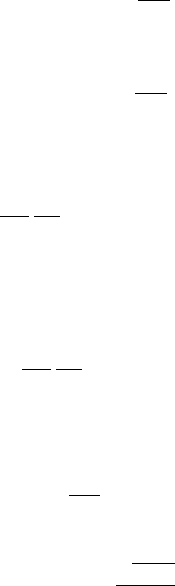
70 Layered nanostructures
Eqs. (3.15) and (3.16), respectively. The values of the kinetic energy for free
motion in the y- and z-directions are defined by Eq. (3.9), i.e.,
E
y
=
h
-
2
k
2
y
2m
e
(3.28)
and
E
z
=
h
-
2
k
2
z
2m
e
. (3.29)
The Schr
¨
odinger equation for the x-coordinate differs from (3.6) since it contains
a term with potential energy U(x):
−
h
-
2
2m
e
d
2
dx
2
+U (x)
ψ
x
(x ) = E
x
ψ
x
(x ). (3.30)
Equation (3.30) is a one-dimensional differential equation and, to avoid unnec-
essary use of subscripts, we will henceforth omit the subscript x from the eigen-
function, ψ
x
, and eigenvalue, E
x
:
−
h
-
2
2m
e
d
2
dx
2
+U (x)
ψ(x) = Eψ(x). (3.31)
For the region 0 < x < L where U (x) = 0 and where the electron is confined,
the Schr
¨
odinger equation (3.31) takes the form
d
2
ψ
dx
2
+ k
2
ψ = 0, (3.32)
where
k =
√
2m
e
E
h
-
.
Here, for simplicity, we omitted the subscript x from the wavenumber k
x
.The
solutions to differential equations similar to (3.32) can be sought in the form of a
combination either of harmonic functions or of exponential functions as we have
already done in Eq. (3.14):
ψ(x) = A sin(kx) + B cos(kx), (3.33)
ψ(x) = A
e
ikx
+ B
e
−ikx
. (3.34)
Let us seek solutions for the case of a potential well with infinite walls in the
form of Eq. (3.33):
ψ(x) = A sin(kx) + B cos(kx) = C sin(kx + φ). (3.35)
Here we introduced two unknown parameters, C and φ. To find these parameters
we should take into account the boundary conditions imposed by the potential of
the well. Since the potential barriers at the boundaries of the well are infinite (see
Eq. (3.26)), the electron cannot penetrate into the regions outside of the well.

3.2 An electron in a potential well with infinite barriers 71
Thus, we can write
ψ(0) = 0, (3.36)
ψ(L) = 0. (3.37)
By substituting the wavefunction (3.35) into Eqs. (3.36) and (3.37) we obtain a
system of two equations for three unknowns, C,φ, and k:
ψ(0) = C sin φ = 0 (3.38)
and
ψ(L) = C sin(kL + φ) = 0. (3.39)
Since the parameter C = 0(C = 0 corresponds to the trivial solution ψ(x) ≡ 0),
from Eq. (3.38) it follows that
φ = 0. (3.40)
Equations (3.35) and (3.39) can be rewritten as
ψ(x) = C sin(kx), (3.41)
sin(kL) = 0. (3.42)
From the last equation we obtain the following allowed values of the wavenumber,
k, for the electron’s wavefunction in the potential well being considered:
k
n
=±
πn
L
, where n = 1, 2, 3,... (3.43)
Taking into account the relation of this parameter with the electron’s energy,
we come to the important conclusion that the electron energy in the potential
well cannot change continuously – it can have only certain discrete values of
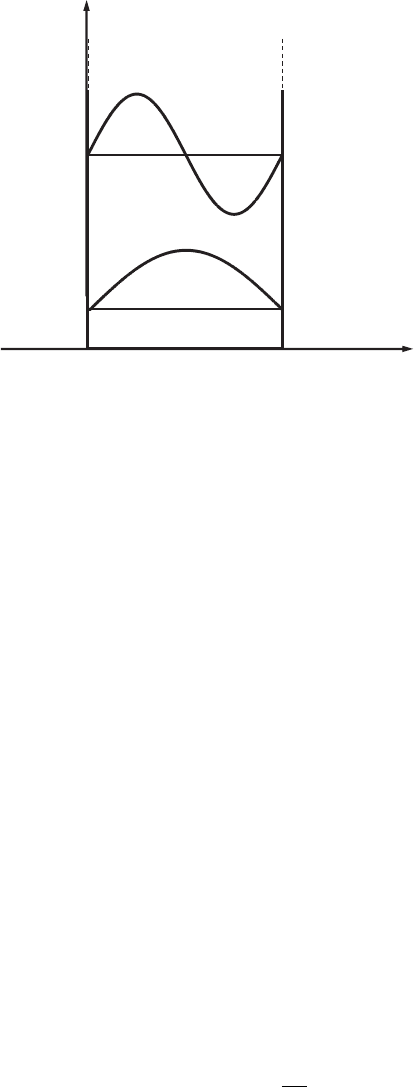
allowed energies (see Fig. 3.1):
E
n
=
h
-
2
k
2
n
2m
e
=
π
2
h
-
2
2m
e
L
2
n
2
, (3.44)
where n = 1, 2, 3,... The electron energy, E
n
, in the potential well is thus
quantized and the parameter n, which defines the electron energy state, is called
the principal quantum number.Forn = 1 the electron’s energy is minimal and
equal to
E
1
=
π
2
h
-
2
2m
e
L
2
=
0.3737
L
2
eV. (3.45)
This state, which has the lowest energy, is often called the ground state.The
energy E
1
is inversely proportional to L
2
and its numerical value in electron-volts
for an electron with free electron mass m
e
can be calculated with the coefficient
0.3737 when the width of the well, L, is measured in nanometers. The quantum
number n cannot be equal to zero because this would mean that the wavenumber
k = k
0
= 0 and there would be no electron in the well because ψ(x) = 0atk = 0
72 Layered nanostructures
E
2
E
1
x
L0
E
n
,U
ψ
1
U(0)= ∞
ψ
2
U(L)=∞
Figure 3.1 Quantization of
an electron’s energy in a
potential well with
impenetrable walls of
U(0) =∞and U(L) =∞.
The two lowest energy
levels, E
1
and E
2
,andthe
corresponding
wavefunctions, ψ
1
and ψ
2
,
are shown.
(see Eq. (3.41)). This leads us to the important conclusion that a confined electron
can never be in a state of rest. Even in its ground state the electron has non-zero
momentum, i.e., from the point of view of classical mechanics the electron is in a
state of constant motion. This is a direct consequence of Heisenberg’s uncertainty
principle and wave–particle duality.
For the type of potential well considered here the positions of the energy states
are not equidistant. The distance between adjacent energy states increases with
increasing quantum number, n, according to the law
E = E
n+1
− E
n
= (2n + 1)E
1
. (3.46)
If the width of the potential well, L, within which the electron is confined
(for example the width of the above-mentioned semiconductor film) increases,
then the energy of the ground state E
1
decreases and therefore the distance
between the energy states, E, decreases and tends to zero at L →∞.The
energy spectrum transforms from a discrete spectrum into a quasicontinuous or
practically continuous spectrum and the electron’s behavior becomes classical.
The unknown coefficient in the expression for the wavefunction (3.41) can be
found from the normalization condition (2.140):
∞
−∞
|ψ(x)|
2
dx = C
2
L
0
sin
2
(k
n
x)dx = 1. (3.47)
Calculation of this integral gives us
L
0
sin
2
(k
n
x)dx =
1
2k
n
[
−sin(k
n
L)cos(k
n
L) + k
n
L
]
. (3.48)