
Mitin V.V., Sementsov D.I., Vagidov N.Z. Quantum mechanics for nanostructures
Подождите немного. Документ загружается.

3.7 Problems 103
E
2
E
1
U
0
x
0
E
n
,U
ψ
2
ψ
1
L
2
L
2
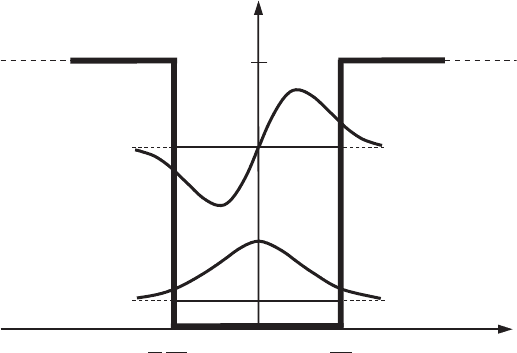
Figure 3.15 A rectangular
symmetric potential
well with respect to the
origin of coordinates
with barriers of height
U
0
= 10 eV.
Problem 3.7. An electron is in a one-dimensional rectangular potential well
with width equal to L. One of the barriers has infinite height: U (x) →∞at
x < 0. The height of the second barrier at x > L is finite and is equal to U
0
.
In the region 0 ≤ x ≤ L the potential energy is equal to zero: U (x) = 0 (see
Fig. 3.3). What are the conditions on the value of U
0
L
2
for there to be at least
one energy level or only one level in the well? If the energy level is equal to
E = U
0
/2, how does this condition change?
Problem 3.8. An electron is in a symmetric rectangular potential well with
width L = 10 nm and with barriers of finite height: U
0
= 10 eV. The electron
wavefunction is symmetric with respect to the coordinate origin placed at the
center of the well (see Fig. 3.15), in contrast to the case shown in Fig. 3.5.
For which values of quantum numbers, n, can we apply the approximation of
barriers with infinite height? (Answer: n 52.)
Problem 3.9. An electron with energy E = 32 eV, which is moving in the
positive direction along the x-direction, encounters an obstacle – an infinitely
long rectangular potential step. Find the reflection, R, and transmission, D,
coefficients of the electron de Broglie waves for a given potential step in two
cases: (a) the height of the potential step is lower than the electron energy
(U
1
= 30 eV) and (b) the height of the potential step is higher than the electron
energy (U
2
= 34 eV). (Answer: (a) R ≈ 0.36 and D ≈ 0.64; (b) R ≈ 1.0 and
D ≈ 0.)
Problem 3.10. Estimate the transmission coefficient, D, of an electron with
energy E = 18 eV for passage through a potential barrier with the following

104 Layered nanostructures
dependence of potential energy on coordinate:
U (x ) = U
0
1 −
x
2
L
2
(3.196)
in the region |x|≤L and
U (x ) = 0 (3.197)
in the region |x| > L. Here, U
0
= 20 eV and L = 2 nm. (Answer: D ≈ 0.24.)
Chapter 4
Additional examples of quantized motion
In the previous chapter we have analyzed the peculiarities of quantized elec-
tron motion in layered structures with one-dimensional potential wells. From
the mathematical point of view, the solution of the Schr
¨
odinger equation for
one-dimensional potential profiles is much simpler. However, many quantum
objects, such as atoms, molecules, and quantum dots, are three-dimensional
objects. Thus, in order to analyze electron motion in such objects we need to find
solutions of the Schr
¨
odinger equation for three-dimensional potential profiles.
The electron motion in spaces with dimensionality higher than one, especially
for rectangular potential profiles with infinite potential barriers, is not so difficult
to analyze. At the same time we have to keep in mind that such potential profiles
frequently represent some approximation of the more complex, real potential pro-
files. Depending on the type of structure and on the form of the potential profile,
the electron motion may be limited in two directions (two-dimensional quanti-
zation) or in three directions (three-dimensional quantization). In this chapter
we will show that the existence of discrete energy levels in the electron spec-
trum is an intrinsic feature of electron motion in potential wells of any form and
dimensionality.
4.1 An electron in a rectangular potential
well (quantum box)
In the previous chapter we studied the electron motion in one-dimensional poten-
tial wells. An electron’s motion along one direction was confined by the potential
profile and the momentum in this direction was quantized. In the two other direc-
tions the motion of the electron was free. For the specific potential profiles that
we studied we were able to express the solution of the Schr
¨
odinger equation
in the form of a product of three separate wavefunctions. In the direction of
electron confinement the wavefunction is a standing wave and in the direction
of free motion the wavefunctions have the form of traveling waves. Here, we
will consider the main features of the electron energy spectrum in a rectangular
potential box with impenetrable walls. The limitation of electron motion in each
105

106 Additional examples of quantized motion
of the three directions is defined by the following conditions:
0 ≤ x ≤ L
x
, 0 ≤ y ≤ L
y
, 0 ≤ z ≤ L
z
, (4.1)
where L
x
, L
y
, and L
z
are the dimensions of the box in the x-, y-, and z-directions,
respectively. The above-mentioned conditions are realized if the electron potential
energy satisfies the following conditions:
U (r) =
0, 0 ≤ r
α
≤ L
α
,
∞, r
α
< 0, r
α
> L
α
,
(4.2)
where α = x, y, and z and r
α
= α. In this case the Schr
¨
odinger equation inside
the potential box, where U(r) = 0, takes the form
−
h
-
2
2m
e
∂
2
∂x
2
+
∂
2
∂y
2
+
∂
2
∂z
2
ψ(x, y, z) = Eψ(x, y, z). (4.3)
Since the electron cannot penetrate the region where the potential tends to infinity,
for r
α
< 0 and r
α
> L
α
the electron wavefunction, ψ(x, y, z), is equal to zero
in those regions. Therefore, at the boundaries of the box the following boundary
conditions should hold:
ψ(0, y, z) = ψ(x, 0, z) = ψ(x, y, 0) = ψ(L
x
, y, z) = ψ (x, L
y
, z) = ψ(x, y, L
z
) = 0.
(4.4)
For the potential profile of Eq. (4.2) and the boundary conditions of Eq. (4.4)the
wavefunction can be written as a product of three wavefunctions, each of which
depends on a single coordinate,
ψ(x, y, z) = ψ
x
(x )ψ
y
(y)ψ
z
(z), (4.5)
and the total electron energy, E, can be written as a sum of energies, E
α
, in each
of the three directions of confinement:
E = E
x
+ E
y
+ E
z
. (4.6)
Here, each of the wavefunctions ψ
α
(r
α
) describes the electron motion along one
specific coordinate r
α
and this motion is independent from motion in the two
other directions, r
β
= r
α
. On substituting Eqs. (4.5) and Eqs. (4.6) into Eq. (4.3)
and dividing by the wavefunction of Eqs. (4.5), we obtain
1
ψ
x
(x )
∂
2
ψ
x
(x )
∂x
2
+
2m
e
h
-
2
E
x
ψ
x
(x )
+
1
ψ
y
(y)
∂
2
ψ
y
(y)
∂y
2
+
2m
e
h
-
2
E
y
ψ
y
(y)
+
1
ψ
z
(z)
∂
2
ψ
z
(z)
∂z
2
+
2m
e
h
-
2
E
z
ψ
z
(z)
= 0. (4.7)
Each of the three terms on the left-hand side of Eq. (4.7) depends only on one
independent variable, r
α
. Since the sum of these three terms is equal to zero for
any values of the variables x, y, and z, each of the terms must itself be equal

4.1 An electron in a rectangular potential well 107
to zero. Therefore, Eq. (4.7) may be presented as a system of three independent
equations (compare with Eqs. (3.6)–(3.8)):
d
2
ψ
x
(x )
dx
2
+ k
x
ψ
x
(x ) = 0, (4.8)
d
2
ψ
y
(y)
dy
2
+ k
y
ψ
y
(y) = 0, (4.9)
d
2
ψ
z
(z)
dz
2
+ k
z
ψ
z
(z) = 0, (4.10)
where we introduced the parameters
k
α
=
√
2m
e
E
α
h
-
, (4.11)
which are the projections of the wavevector k onto the coordinate axes, α = x, y,
and z. The solution of each of Eqs. (4.8)–(4.10), taking into account boundary
conditions (4.4) as in the case of a one-dimensional potential well, has the form
ψ
x
(x ) =
2
L
x
sin(k
x
x), (4.12)
ψ
y
(y) =
2
L
y
sin(k
y
y), (4.13)
ψ
z
(z) =
2
L
z
sin(k
z
z), (4.14)
where
k
α
=±
πn
α
L
α
(4.15)
and n
α
= 1, 2, 3,... It follows from Eqs. (4.11) and (4.15) that the eigenvalues
of energy, E
α
, are defined by the expression
E
α
=
π
2
h
-
2
n
2
α
2m
e
L
2
α
. (4.16)
As a result, the eigenfunctions of Eq. (4.3)havetheform
ψ
n
x
n
y
n
z
(x , y, z) =
8
L
x
L
y
L
z
sin
πn
x
x
L
x
sin
πn
y
y
L
y
sin
πn
z
z
L
z
. (4.17)
The corresponding eigenvalues are
E = E
n
x
n
y
n
z
=
π
2
h
-
2
2m
e
n
2
x
L
2
x
+
n
2
y
L
2
y
+
n
2
z
L
2
z
. (4.18)
Here, the quantum numbers n
x
, n
y
, and n
z
are positive integers. The wavefunc-
tions (4.12)–(4.14) and (4.17) are orthonormal, which can be verified directly by
substituting them into Eq. (2.144).
The most important property of the electron quantization in a three-
dimensional potential box, as in the case of the one-dimensional confinement,

108 Additional examples of quantized motion
is the quantization of the electron energy. The energy levels are defined by
the set of three quantum numbers, n
x
, n
y
, and n
z
(Eq. (4.18)). The minimum
energy with the quantum numbers n
x
= n
y
= n
z
= 1 corresponds to the ground
state:
E
min
= E
111
=
π
2
h
-
2
2m
e
1
L
2
x
+
1
L
2
y
+
1
L
2
z
. (4.19)
This means that the state of the electron with minimum energy is not a state of
rest. This property is of purely quantum origin and is the direct consequence
of the uncertainty relations (2.118). Indeed, the state of rest must correspond to
the electron energy and momentum being equal to zero. Since these values are
defined exactly, the uncertainties in the momenta p
x
, p
y
, and p
z
are equal
to zero too. Thus, according to the uncertainty relations (2.118) the electron state
at rest corresponds to complete uncertainty in coordinates, since in this case x,
y, and z tend to infinity. But this contradicts the limited uncertainties of the
electron coordinates, because we know for sure that the electron is in the box and
the uncertainty in coordinates cannot be larger than the dimensions of the box,
i.e., x ≈ L
x
, y ≈ L
y
, and z ≈ L
z
.
As a result, the electron motion in a limited space, in contrast to the case
of the free electron in infinite space, cannot have zero momentum and, as a
consequence, zero uncertainty of the momentum. From the uncertainty relations
(2.118) it follows that for the electron confined in a box the uncertainty in the
momenta is the following:
p
x
∼
h
L
x
,p
y
∼
h
L
y
,p
z
∼
h
L
z
. (4.20)
Since projections p
α
of momentum p should be of the order of the uncertainty
p
α
, we may conclude that Eqs. (4.15) are direct consequences of Eq. (4.20). It
follows from Eqs. (4.15) and (4.18) that the smallest differences between discrete
values of the momentum k
α
and energy E
n
x
n
y
n
z
correspond to the α-axes with
the largest value of the length L
α
. For example, if L
z
> L
x
, L
y
then the set of
quantum numbers n
x
= n
y
= 1 and n
z
= 2 corresponds to the energy state next
to E
111
, namely E
112
. In this case the energy E
112
differs from the minimal energy
E
111
by E:
E = E
112
− E
111
=
3π
2
h
-
2
2m
e
L
2
z
. (4.21)
By changing the set of quantum numbers (n
x
, n
y
, n
z
) we can calculate the energy
of the confined electron for an arbitrary electron quantum state for the given
dimensions of the box.
4.2 An electron in a spherically-symmetric potential well 109
z
x
y
e
r
0
j
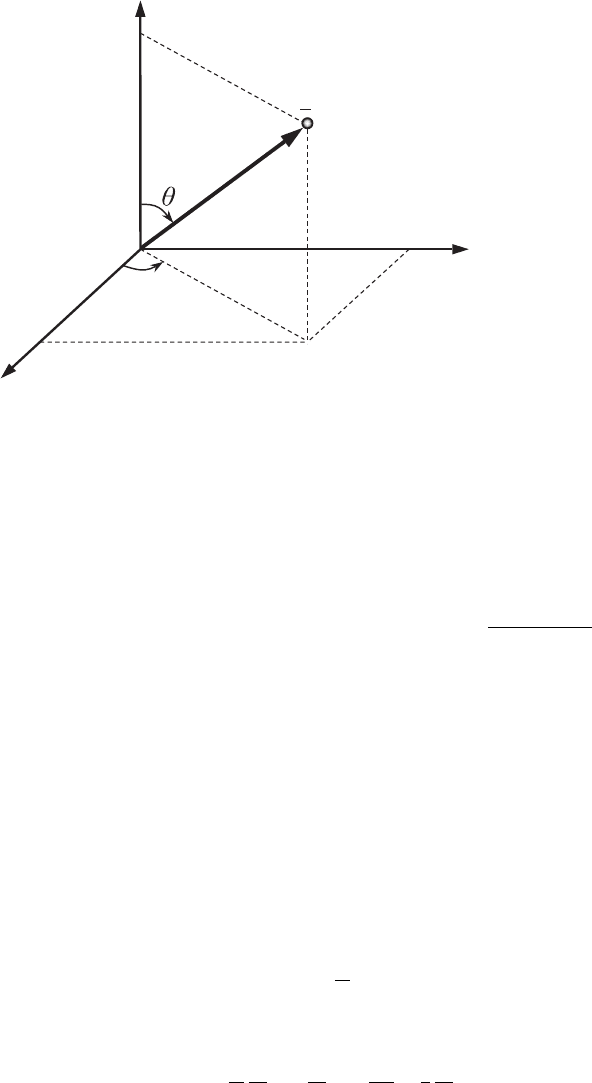
Figure 4.1 The spherical
system of coordinates.
4.2 An electron in a spherically-symmetric potential well
4.2.1 The Schr
¨
odinger equation in spherical coordinates
Let us consider first the motion of an electron in a spherically-symmetric poten-
tial:
U = U (r), (4.22)
where the potential U (r) depends only on the distance r =
x
2
+ y
2
+ z
2
from
the origin of the coordinate system (r = 0).
Taking into account the spherical symmetry of the potential, the Schr
¨
odinger
equation may be solved using spherical coordinates, in which the position of the
electron in space is given by the radial distance r and two angles – polar and
azimuthal,θ andϕ, respectively. The origin of coordinates, r = 0, coincides with
the center of the potential profile U (r); the azimuthal angle takes values in the
interval 0 ≤ ϕ ≤ 2π ; and the polar angle takes values in the interval 0 ≤ θ ≤ π
(see Fig. 4.1). The wavefunction can be written as a function of the spherical
coordinates, i.e., ψ(r) = ψ (r,θ,ϕ).
The Laplace operator, ∇
2
, in spherical coordinates includes radial and spher-
ical parts, ∇
2
r
and ∇
2
ϕ,θ
, respectively:
∇
2
=∇
2
r
+
1
r
2
∇
2
ϕ,θ
. (4.23)
The radial part of the Laplace operator can be written as
∇
2
r
=
1
r
2
∂
∂r
r
2
∂
∂r
=
∂
2
∂r
2
+
2
r
∂
∂r
(4.24)

110 Additional examples of quantized motion
and its spherical part can be written as
∇
2
ϕ,θ
=
1
sin θ
∂
∂θ
sin θ
∂
∂θ
+
1
sin
2
θ
∂
2
∂ϕ
2
. (4.25)
Thus, the Schr
¨
odinger equation for an electron in a spherically-symmetric poten-
tial well can be written as
∇
2
r
+
1
r
2
∇
2
ϕ,θ
+
2m
e
h
-
2
(E − U (r))
ψ(r,ϕ,θ) = 0. (4.26)
Since the potential that acts on the electron, U (r), does not depend on the angles
ϕ and θ, the variables in Eq. (4.26) can be separated and the wavefunction can
be expressed in the form of a product of two functions – a radial function,
X(r), which depends only on the coordinate r, and an angle-dependent function
Y (ϕ, θ):
ψ(r,ϕ,θ) = X(r)Y (ϕ, θ). (4.27)
4.2.2 Eigenvalues and eigenfunctions of the
angular-momentum operators
The angular component of the wavefunction Y (ϕ, θ)ofEq.(4.27) in the case
of the spherically-symmetric potential with arbitrary U(r) is an eigenfunction of
the operator for the square of the angular momentum, i.e., it is the solution of the
equation
(
ˆ
L
2
− L
2
)Y (ϕ, θ) = 0. (4.28)
Here L
2
is the eigenvalue of the operator
ˆ
L
2
, which coincides up to a constant
factor with the angular part of the Laplace operator (4.25):
ˆ
L
2
=
ˆ
L
x
ˆ
L
x
+
ˆ
L
y
ˆ
L
y
+
ˆ
L
z
ˆ
L
z
=−h
-
2
∇
2
ϕ,θ
. (4.29)
Operators of the projections of angular momentum
ˆ
L
α
(α = x, y, z) are defined
by the following expressions for rectangular and spherical coordinates, respec-
tively:
ˆ
L
x
=−ih
-
y
∂
∂z
− z
∂
∂y
= ih
-
cos ϕ cot θ
∂
∂ϕ
+ sin ϕ
∂
∂θ
, (4.30)
ˆ
L
y
=−ih
-
z
∂
∂x
− x
∂
∂z
= ih
-
sin ϕ cot θ
∂
∂ϕ
− cos ϕ
∂
∂θ
, (4.31)
ˆ
L
z
=−ih
-
x
∂
∂y
− y
∂
∂x
=−ih
-
∂
∂ϕ
. (4.32)
To write these expressions we used the equation for the angular momentum of a
particle L = r ×p and found the projections of angular momentum by writing
L as the determinant:
L
x
= yp
z
− zp
y
, L
y
= zp
x
− xp
z
, L
z
= xp
y
− yp
x
. (4.33)

4.2 An electron in a spherically-symmetric potential well 111
Then, in Eq. (4.33) we substitute the variables by their corresponding operators.
In the coordinate representation, that we use, the operator of coordinate is the
coordinate itself, and the operators of the projections of momentum are defined
by Eqs. (2.159):
ˆ
p
α
=−ih
-
∂
∂r
α
,
where α = x, y, z are Cartesian coordinates and r
α
= α. In order to change
Cartesian coordinates to spherical coordinates we used the relations
x = r sin θ cos ϕ, y = r sin θ sin ϕ, z = r cos θ. (4.34)
The eigenfunctions in Eq. (4.28)arespherical harmonics Y
l,m
(ϕ, θ), which are
defined by two integer quantum numbers, l and m. The quantum number l, which
is called the orbital quantum number, has the values l = 0, 1, 2,..., and quantum
number m, which is called the orbital magnetic quantum number, has the values
m = 0, ±1, ±2,...,±l. (4.35)
Using the normalizing conditions of Eq. (2.140) for spherical harmonics we have
2π
0
π
0
Y
l,m
(ϕ, θ)
2
sin θ dθ dϕ = 1. (4.36)
We get the following expressions for the spherical harmonics for the first few
values of quantum numbers l and m:
Y
0,0
=
1
√
4π
, Y
1,0
=
3
4π
cos θ, Y
2,0
=
5
16π
(3 cos
2
θ −1),
Y
1,±1
=∓
3
8π
sin θ e
±iϕ
, Y
2,±1
=∓
15
16π
sin(2θ)e
±iϕ
,
Y
2,±2
=
15
32π
sin
2
θ e
±2iϕ
. (4.37)
The spectrum of eigenvalues of the operator
ˆ
L
2
, which is defined by Eq. (4.28),
is discrete:
L
2
= l(l + 1)h
-
2
. (4.38)
Each eigenvalue L
2
corresponds to 2l + 1 eigenfunctions Y
l,m
(ϕ, θ), where the
orbital magnetic quantum number, m, is defined by Eq. (4.35). Thus, each state
with a given value of the square of the orbital angular momentum, L
2
,is(2l + 1)-
fold degenerate.
4.2.3 The equation for the radial function
On substituting the wavefunction (4.27) into the Schr
¨
odinger equation (4.26),
separating the radial part of this equation, and taking into account Eq. (4.38),

112 Additional examples of quantized motion
we obtain
d
2
dr
2
+
2
r
d
dr
+ k
2
−
2m
e
U (r)
h
-
2
−
l(l + 1)
r
2
X(r) = 0, (4.39)
where
k
2
=
2m
e
E
h
-
2
. (4.40)
Let us consider the simplest case of U(r):
U (r) =
0, r ≤ a,
∞, r > a,
(4.41)
where r is the distance from the center of the sphere. It is clear that with such
a potential the region outside the sphere is not available for the electron and its
wavefunction at the boundary is equal to zero, i.e.,
X(r) = 0, r ≥ a. (4.42)
The behavior of an electron inside of the region r < a is described by the
time-independent Schr
¨
odinger equation Eq. (3.1) with the potential U(r) = 0.
Then, Eq. (4.39) with the help of the substitution
X(r) =
R(r)
r
(4.43)
can be reduced to the following equation:
d
2
dr
2
+ k
2
−
l(l + 1)
r
2
R(r) = 0. (4.44)
The function R(r) must satisfy the following two boundary conditions:
R(0) = 0andR(a) = 0. (4.45)
The first of these conditions is written by taking into account that the wavefunction
X(r) must be finite throughout the entire region of the electron’s motion, in
particular at r = 0. The second condition comes from the continuity of the
wavefunction at the boundary of the potential well r = a and the boundary
condition (4.42).
Let us consider first the purely radial motion of the electron when its orbital
angular momentum is equal to zero, i.e., L = 0. The orbital quantum number
l = 0 corresponds to such a motion and to the following solution of Eq. (4.44):
R
0
(r) = A
0
sin(kr) + B
0
cos(kr). (4.46)
Note that for l = 0Eq.(4.39) and its solution Eq. (4.46) coincide with the case
of the one-dimensional quantum well considered earlier. Taking into account the
boundary conditions (4.45), we find that B
0
= 0 and k = nπ/a, where the radial
quantum number n is a positive integer number: n = 1, 2, 3,... The energy of