
Mitin V.V., Sementsov D.I., Vagidov N.Z. Quantum mechanics for nanostructures
Подождите немного. Документ загружается.


4.2 An electron in a spherically-symmetric potential well 113
the corresponding quantum levels is equal to
E
n0
=
π
2
h
-
2
2m
e
a
2
n
2
. (4.47)
The normalization condition of the wavefunction X
0
(r) gives us the value of
the constant A
0
=
√
2/a. As a result the radial function, X
0
(r), in the case of
electron confinement being considered here has the form
X
0
(r) =
2
a
sin(kr)
r
. (4.48)
In the case of electron motion with orbital angular momentum L = 0, the solution
of Eq. (4.44) depends on the orbital quantum number l. This solution can be
written in the form of special functions called cylindrical Bessel functions J
l+1/2
:
R
l
(r) = C
l
√
rJ
l+1/2
(kr). (4.49)
In the general case when the index l is a non-integer number the Bessel functions
cannot be reduced to well-known elementary mathematical functions, but in the
case of integer values of l, the Bessel functions can be expressed in terms of
trigonometric functions as follows:
J
l+1/2
(x ) = (−1)
l
2x
π
x
l
d
x dx
l
sin x
x
. (4.50)
Note that [d/(x dx)] in Eq. (4.50) is an operator, which must be applied to
(sin x/x) in this equation l times. Taking into account Eqs. (4.49) and (4.50), the
solutions of Eq. (4.44) for the first three values of the orbital quantum number
(l = 0, 1, 2) are the following functions of coordinate r:
R
0
(r) = C
0
2
πk
sin(kr),
R
1
(r) = C
1
2
πk
sin(kr)
kr
− cos(kr)
, (4.51)
R
2
(r) = C
2
2
πk
3
kr
sin(kr)
kr
− cos(kr)
− sin(kr)
.
Here C
0
=
√
πk/a and C
1
and C
2
can be found from the general normalization
condition for the total wavefunction:
|ψ(r,ϕ,θ)|
2
r
2
dr sin θ dθ dϕ = 1, (4.52)
where we integrate over the coordinate r from 0 to a, over the angle θ ,from0to
π, and over the angle ϕ,from0to2π .
From Eq. (4.49), using the boundary condition (4.45)forr = a we can deter-
mine the values of wavevector k that satisfy the condition J
l+1/2
(ka) = 0:
k =
1
a
g
nl
, (4.53)

114 Additional examples of quantized motion
Table 4.1. Values of g
nl
for the first few states
nl 10 11 12 20 13 21 22 30
g
nl
π 4.49 5.76 2π 6.992 7.73 9.09 3π
where the parameters g
nl
are the roots of the corresponding Bessel functions.
From Eqs. (4.53) and (4.40) we can find the expression for the energy of the
allowed stationary states:
E
nl
=
h
-
2
2m
e
a
2
g
2
nl
. (4.54)
For states with l = 0 the corresponding roots are g
n0
= nπ. Values of g
nl
for the
first few states are given in Table 4.1.
Thus, in a spherically-symmetric well described by the potential (4.41)the
stationary states are defined by three quantum numbers, n, l, and m. The radial
wavefunctions (4.43) correspond to these quantum numbers and the energy of
the corresponding states is defined by Eq. (4.54).
Example 4.1. Consider an electron in a spherically-symmetric potential well
with finite potential barriers (compare this with Eq. (4.41)):
U (r) =
0, 0 ≤ r ≤ a,
U
0
, r > a.
(4.55)
Solve Eq. (4.39) and find the normalized radial function X (r). Also find the
equation that defines the energy of stationary states with zero orbital angular
momentum for E < U
0
.
Reasoning. Zero orbital angular momentum corresponds to the orbital quantum
number l = 0. Within the potential well where U (r) = 0, Eq. (4.39) coincides
with Eq. (4.44) and its solutions for l = 0 have already been found (Eqs. (4.43)
and (4.46)). As before, we have B
0
= 0. Now, we need to define the normalization
constant A
0
that would be different from A
0
=
√
2/a that was found for the
quantum well with barriers of infinite height (see Eq. (4.48)).
Outside of the potential well where U (r) = U
0
the square of the wavenumber
is a negative number. This is why we introduce a new parameter for E < U
0
:
κ
2
=
2m
e
(U
0
− E)
h
-
2
, (4.56)
and Eq. (4.39) can be written in the form
d
2
dr
2
+
2
r
d
dr
− κ
2
X(r) = 0. (4.57)
The solution of Eq. (4.57) in the region r > a is an exponentially decreasing
function. Thus, the expression for the radial wavefunction inside and outside the

4.3 Quantum harmonic oscillators 115
potential well is
X(r) =
A
0
sin(kr)/r, 0 < r < a,
A
1
(1/r)e
−κr
, r ≥ a.
(4.58)
From the condition of continuity of the wavefunction X (r) and its derivative we
obtain the following two equations:
A
0
sin(ka) = A
1
e
−κa
, (4.59)
A
0
[ka cos(ka) − sin(ka)] =−A
1
(1 + κa)e
−κa
. (4.60)
By solving this system of equations and taking into account the expressions for
k and κ (Eqs. (4.40) and (4.56), respectively) we obtain the dispersion equation
which defines the energy of an electron in the stationary states with l = 0:
cot
√
2m
e
Ea
h
-
=−
U
0
E
− 1. (4.61)
For the coefficients A
0
and A
1
we obtain the relationship
A
1
= A
0
sin(ka)e
κa
=
A
0
k
√
k
2
+ κ
2
e
κa
. (4.62)
The normalization condition of the radial function, X (r) (see Eq. (4.58)), can be
written as follows:
A
2
0
a
0
sin
2
(kr)dr +
k
2
k
2
+ κ
2
e
2κa
∞
a
e
−2κr
dr
= 1. (4.63)
By carrying out the integration in Eq. (4.63) we obtain the following expression
for the normalization constant A
0
:
A
0
=
κ
1 + κa
. (4.64)
Note that, for U
0
→∞, when κ →∞ the wavefunction coincides with
Eq. (4.48).
4.3 Quantum harmonic oscillators
4.3.1 An electron in a parabolic potential well
Modern methods of fabrication of crystalline nanostructures using computerized
technological regimes allow us to design potential wells with the desired pro-
files. Alongside the rectangular potential wells that we considered in the previous
chapter, nowadays more complex dependences of U (x, y, z) are realized. Of spe-
cial interest are structures with parabolic potential wells, where, in contrast to
Eqs. (4.16) and (4.47), the distance between levels is constant and is determined

116 Additional examples of quantized motion
only by the parameter of the parabolic well. Moreover, in a structure with an arbi-
trary non-homogeneous potential profile U (x, y, z) near the equilibrium position
that corresponds to the minimum, the potential energy, U (r), can be expanded in
a Taylor series, taking into account the first three terms:
U (r) = U
0
+
dU
dr
r=r
0
(r − r
0
) +
d
2
U
dr
2
r=r
0
(r −r
0
)
2
. (4.65)
Here, U
0
= U (r
0
).
Let us assume that the origin of coordinates, (x
0
, y
0
, z
0
), is at the bottom
of a potential well, i.e., let us measure the energy of an oscillating particle
from U
0
= U (x
0
, y
0
, z
0
) = 0. The term with the first derivative for any potential
profile at its minimum is equal to zero. Then, the particle’s potential energy can
be represented with the following function:
U (x , y, z) =
1
2
β
x
x
2
+ β
y
y
2
+ β
z
z
2
, (4.66)
where x, y, z are displacements from the position (x
0
, y
0
, z
0
) since we put the
origin of the new coordinate system onto U (x
0
, y
0
, z
0
). The coefficients β
α
are
defined as
β
α
=
∂
2
U
∂r
2
α
. (4.67)
Classical motion of a particle in such a potential takes place under the influence
of the force
F =−∇U =−
iβ
x
x + jβ
y
y + kβ
z
z
. (4.68)
Note that F vanishes at the origin. In each of three independent directions a
particle with mass m executes simple harmonic motion (see Eq. (A.73)) with
angular frequency
ω
α
=
β
α
m
, (4.69)
where α = x, y, z. The region within which this particle is allowed to move
is limited by the interval of values of the corresponding coordinates −A
α
≤
r
α
≤ A
α
, where the amplitude of oscillations, A
α
, is related to the energy of the
particle’s motion in this direction as
A
α
=
2E
α
mω
2
α
. (4.70)
At the turning points r
α
=±A
α
the corresponding projection of the velocity v
α
of the particle vanishes. Motion outside of the interval (−A
α
, A
α
)impliesthat
the kinetic energy of a particle is negative, which is meaningless in classical
mechanics. A particle that moves in such a way is called a classical harmonic
oscillator. Examples of such motion in real structures, alongside the electron
oscillations, are the oscillations of atoms and ions in a crystalline lattice.

4.3 Quantum harmonic oscillators 117
If the amplitude of the particle’s oscillations is comparable to its de Broglie
wavelength, then such a particle is called a quantum oscillator. An exact solution
of the steady-state oscillatory motion of a quantum harmonic oscillator, which
can be represented by a bound electron in a parabolic potential (Eq. (4.66)), must
be based on the Schr
¨
odinger equation. In this case the Schr
¨
odinger equation has
the form
−
h
-
2
2m
e
∂
2
∂x
2
+
∂
2
∂y
2
+
∂
2
∂z
2
+
1
2
β
x
x
2
+
1
2
β
y
y
2
+
1
2
β
z
z
2
ψ(x, y, z) = Eψ(x, y, z).
(4.71)
Since the potential energy is a sum of three terms, each of which depends on one
coordinate only, by analogy to Eq. (4.3) the general solution of the Schr
¨
odinger
equation (4.71) can be expressed in the form
ψ(x, y, z) = ψ
x
(x )ψ
y
(y)ψ
z
(z), (4.72)
where the wavefunctions ψ
α
(r
α
)(α = x, y, z) describe the electron motion along
the α-directions. The total energy can be written as a sum of individual energies:
E = E
x
+ E
y
+ E
z
.AsaresultEq.(4.71) can be rewritten as a set of three
independent differential equations (compare with Eqs. (4.7)–(4.10)):
d
2
ψ
α
(α)
dr
2
α
+
2m
e
h
-
2
E
α
−
β
α
2
r
2
α
ψ
α
(α) = 0,α= x, y, z. (4.73)
Thus, the solution of the Schr
¨
odinger equation (4.71) that describes the motion of
a three-dimensional harmonic oscillator is reduced to three equations of motion
of one-dimensional harmonic oscillators.
4.3.2 A one-dimensional harmonic oscillator
Let us consider now the one-dimensional motion of an electron along the x-
axis in a parabolic potential well U (x) = βx
2
/2. This motion is described by
Eq. (4.73), which for α = x takes the form
d
2
dx
2
+
2m
e
h
-
2
E −
β
2
x
2
ψ(x) = 0. (4.74)
Here, the indices of ψ
x
, E
x
, and β
x
are omitted for convenience. The wavefunc-
tion, ψ(x), and its derivative, dψ(x)/dx, must be finite and continuous for all
values of x.Forx →±∞the electron potential energy tends to infinity. As a
result, the wavefunction ψ(x) at large distances from the equilibrium position
tends to zero. Equation (4.74) can be rewritten by introducing dimensionless
variable ξ = x/x
0
= x
√
m
e
ω/h
-
:
d
2
ψ(ξ )
dξ
2
+
2E
h
-
ω
− ξ
2
ψ(ξ ) = 0. (4.75)

118 Additional examples of quantized motion
Here, x
0
=
√
h
-
/m
e
ω is the turning point for a classical oscillator in its ground
state E
0
= h
-
ω/2. Let us introduce into Eq. (4.75) the dimensionless parameter
λ =
2E
h
-
ω
. (4.76)
Then, Eq. (4.75) takes the form
d
2
ψ(ξ )
dξ
2
+ (λ − ξ
2
)ψ(ξ ) = 0. (4.77)
We will seek the solution of this equation in the form of the following product
of two functions:
ψ(ξ ) = f (ξ )e
−ξ
2
/2
. (4.78)
The unknown function f (ξ ) must behave in such a way that as ξ →∞the wave-
function ψ(ξ ) is bounded. By substituting Eq. (4.78) into Eq. (4.77) we derive
the following equation for the function f (ξ):
d
2
f (ξ )
dξ
2
− 2ξ
d f (ξ)
dξ
+ (λ − 1) f (ξ) = 0. (4.79)
The solution of this differential equation can be found in the form of the following
power series:
f (ξ ) =
k=0
a
k
ξ
k
. (4.80)
Let us find the first and second derivatives of the function f (ξ ):
d f (ξ)
dξ
=
k=0
ka
k
ξ
k−1
, (4.81)
d
2
f (ξ )
dξ
2
=
k=0
k(k − 1)a
k
ξ
k−2
. (4.82)
Let us substitute Eqs. (4.80)–(4.82) into Eq. (4.79). As a result we obtain
k=0
k(k − 1)a
k
ξ
k−2
− 2ξ
k=0
ka
k
ξ
k−1
+ (λ − 1)
k=0
a
k
ξ
k
= 0. (4.83)
In order for a power series of the form
c
k
ξ
k
to be identically equal to zero, all
the coefficients c
k
of the series must be equal to zero. Let us find from Eq. (4.83)
the coefficient c
k
before ξ
k
and equate it to zero:
c
k
= (k + 1)(k + 2)a
k+2
− (2k + 1 −λ)a
k
= 0. (4.84)
As a result we obtain the following recurrence formula, which relates coefficients
a
k+2
and a
k
:
a
k+2
=
2k + 1 −λ
(k + 1)(k + 2)
a
k
. (4.85)
The wavefunction (4.78) will be limited as ξ →∞if the power series (4.80)
has a finite number of terms. To satisfy this condition the power series (4.80)

4.3 Quantum harmonic oscillators 119
must end at some value of k. For example, for a
k
= 0 the coefficient a
k+2
must
be equal to zero. Then, according to Eq. (4.85) the coefficients after a
k+2
must
be equal to zero too. Thus, the function f (ξ) reduces to a kth-order polynomial.
The condition a
k+2
= 0, taking into account Eq. (4.85), gives us the expression
for the nth energy level, E
n
:
λ = 2n + 1, (4.86)
or
2E
n
h
-
ω
= 2n + 1, (4.87)
which we can rewrite as
E
n
= h
-
ω
n +
1
2
, (4.88)
where the quantum number, n, has the values n = 0, 1, 2,... The quantum
number n defines the energy of oscillatory motion of a quantum oscillator and it
is called the oscillatory quantum number.
The nth-order polynomial, f (ξ ), is one of the so-called Hermite polynomials,
which are usually denoted as H
n
(ξ ). Then, the normalized wavefunction of a
one-dimensional quantum oscillator in the nth energy state can be written as
ψ
n
(ξ) = A
n
f
n
(ξ)e
−ξ
2
/2
= A
n
H
n
(ξ)e
−ξ
2
/2
. (4.89)
The normalization constant A
n
in this case depends on the quantum number n
and is equal to
A
n
=
1
√
2
n
n!
m
e
ω
π h
-
1/4
. (4.90)
The Hermite polynomials, H
n
(ξ ), in a general case can be defined as follows:
H
n
(ξ) = (−1)
n
e
ξ
2
d
n
dξ
n
e
−ξ
2
. (4.91)
For the first five values of the quantum number n the Hermite polynomials have
the following values:
H
0
(ξ) = 1, H
1
(ξ) = 2ξ, H
2
(ξ) = 4ξ
2
− 2,
H
3
(ξ) = 8ξ
3
− 12ξ, H
4
(ξ) = 16ξ
4
− 48ξ
2
+ 12.
(4.92)
According to Eq. (4.88) the electron spectrum in a one-dimensional parabolic
potential well consists of equidistant energy levels. The distance between adjacent
energy levels is
E
n+1
− E
n
= h
-
ω. (4.93)
The energy of the electron ground state, which corresponds to the quantum
number n = 0, is the lowest and equal to
E
0
=
h
-
ω
2
. (4.94)

120 Additional examples of quantized motion
Since E
0
> 0, then the lowest energy state is not the state at rest. This distin-
guishes the quantum oscillator from its classical counterpart and it is a direct
consequence of Heisenberg’s uncertainty principle. Indeed, the uncertainty of
the electron coordinate in the ground energy state is of the order of the maxi-
mum value of the electron coordinate, i.e., x ≈ x
max
= A
0
. At the turning point
where x = A
0
the kinetic energy equals zero and the total energy coincides with
the potential energy, which, in accordance with Eqs. (4.66) and (4.70), is
E =
m
e
ω
2
A
2
0
2
. (4.95)
The potential energy becomes zero at x = 0 and the total energy is equal to the
kinetic energy E = p
2
max
/(2m
e
). Thus
p
max
= m
e
ω A
0
. (4.96)
Thus, the uncertainty of the momentum is of the order of the maximum value of
the momentum, i.e., p ≈ p
max
= m
e
ω A
0
. If we write the uncertainty relation
as x p ≥ h
-
, then from the expression
x p ≥ m
e
ω A
2
0
≥ h
-
, (4.97)
we obtain the condition for the amplitude A
0
:
A
2
0
≥
h
-
m
e
ω
. (4.98)
Taking into account the inequality (4.98) and (4.95), we come to the expression
E ≥
h
-
ω
2
, (4.99)
which gives us the minimum energy of the quantum oscillator in the parabolic
potential well:
E
min
= E
0
=
h
-
ω
2
. (4.100)
The oscillations of a quantum oscillator for the lowest energy state are called
zeroth oscillations. They have purely quantum origin and are not connected with
the thermal energy of an electron. Such oscillations in real systems exist at
temperatures even close to absolute zero.
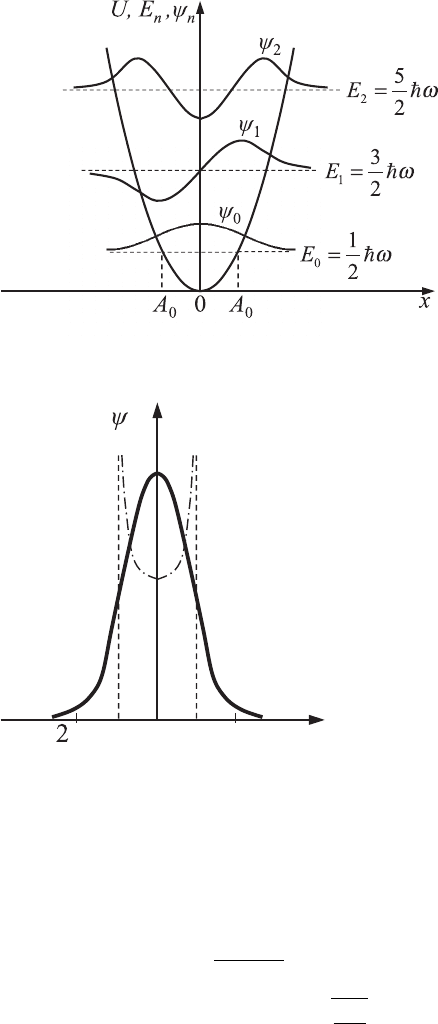
The forms of the electron wavefunctions for the first three lowest energy
levels are shown in Fig. 4.2. For the classical oscillator, which has a fixed
amplitude of oscillation, the increase of energy of oscillations is connected
according to Eq. (4.95) with the increase in amplitude, A
0
. The interval within
which the particle is allowed to move is (−A
0
, A
0
). For the quantum oscillator
the wavefunctions are not equal to zero outside of this interval. This fact
demonstrates that there is a certain probability of finding the electron outside of
the interval (−A
0
, A
0
), where motion is forbidden classically. The distribution
of the probability density of the particle’s location in the ground state (n = 0),
which is characterized by |ψ
0
|
2
, is shown in Fig. 4.3.
4.3 Quantum harmonic oscillators 121
−
Figure 4.2 A quantum
harmonic oscillator: the
three lowest levels and
corresponding
wavefunctions are shown
schematically.
x
A−−
0
2A
0
0
A
0
A
0
|
0
|
2
Figure 4.3 The probability
density distribution, |ψ
0
|
2
,
for the ground energy
state, E
0
. Classical turning
points are located at
x =−A
0
and x = A
0
. The
dash–dotted line shows
the classical probability
distribution of a harmonic
oscillator with the same
energy.
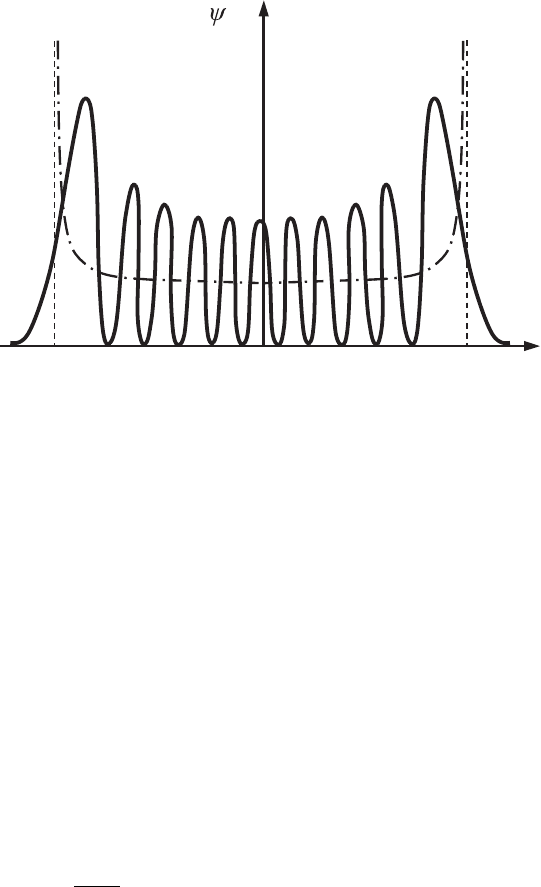
At high values of the quantum number, n, the behavior of a quantum oscillator
increasingly resembles the behavior of the classical oscillator, for which the
probability density changes smoothly from a minimum at x = 0 to infinity at
the turning points, −A
n
and A
n
(Fig. 4.4). Note that for a parabolic potential
A
n
> A
0
for n > 0. The behavior of the quantum oscillator becomes classical
if its oscillation amplitude A
n
becomes much greater than the amplitude of the
zeroth oscillation, A
0
=
√
h
-
/(m
e
ω):
A
n
h
-
m
e
ω
. (4.101)
Taking into account that the de Broglie wavelength for the maximum momentum
on the nth level, p
max
= m
e
ω A
n
, is equal to λ
Br
= h
-
/ p = h
-
/(m
e
ω A
n
), we see
122 Additional examples of quantized motion
xA−
10
A
10
0
|
10
|
2
Figure 4.4 The probability
density distribution,
|ψ
10
|
2
, for the energy state
with the principal
quantum number n = 10.
The dash–dotted line
shows the classical
probability distribution of
a harmonic oscillator with
thesameenergy
(compare it with the one
in Fig. A.8).
that Eq. (4.101) satisfies the condition that A
n
is greater than λ
Br
, i.e., an oscillator
with large amplitude (4.101)isalwaysclassical.
4.3.3 Two-dimensional and three-dimensional
harmonic oscillators
A two-dimensional harmonic oscillator
In the case of an isotropic two-dimensional quantum oscillator whose motion
takes place in the xy-plane the harmonic coefficients are as follows: β
x
= β
y
= β
and β
z
= 0. The Schr
¨
odinger equations (4.73)forthex- and y-directions are
exactly the same as Eq. (4.74). The eigenvalue, E , is a sum of two energies,
E
x
and E
y
. The wavefunctions which are the solutions of these two differential
equations have the same form as in Eq. (4.89) and the energies E
x
and E
y
are
given by Eq. (4.88). As a result, the energy eigenvalues are
E = h
-
ω(N + 1), (4.102)
where the angular frequency of the isotropic two-dimensional harmonic oscillator
is ω =
√
β/m
e
, and the quantum number N is the sum of two quantum numbers,
n
x
and n
y
: N = n
x
+ n
y
. The quantum numbers n
x
and n
y
are positive integer
numbers 0, 1, 2,...The energy level E = E
N
with a given number N = n
x
+ n
y
corresponds to N + 1 degenerate wavefunctions. It follows that at a given value
of N the corresponding quantum number takes the values n
x
= 0, 1,...,N
and n
y
= N − n
x
. Because the energy level E
N
corresponds to N + 1 different
wavefunctions ψ(x, y), the order of degeneracy is
g
N
= N + 1. (4.103)