
Mitin V.V., Sementsov D.I., Vagidov N.Z. Quantum mechanics for nanostructures
Подождите немного. Документ загружается.


4.5 Summary 133
Suppose that the magnitude h
-
ω
q
/(k
B
T ) 1, then
e
h
-
ω
q
/(k
B
T )
≈ 1 +
h
-
ω
q
k
B
T
. (4.151)
Taking this into account, we get
n
q
=
k
B
T
h
-
ω
q
, (4.152)
and
ε
q
=
h
-
ω
q
2
+ k
B
T. (4.153)
From Eq. (4.153) we find the energy of a single phonon:
h
-
ω
q
= 2
ε
q
−k
B
T
. (4.154)
On substituting Eq. (4.154) into Eq. (4.152) for the average number of phonons
we get the expression
n
q
=
k
B
T
2
ε
q
− k
B
T
, (4.155)
which in our case of relation (4.148) reduces to
n
q
=
1
2
(
γ − 1
)
. (4.156)
Note that for a high temperature (h
-
ω
q
/(k
B
T ) 1) comparison of Eqs. (4.153)
and (4.148) gives us (γ − 1) 1. From Eqs. (4.152) and (4.156) we find that
n
q
1.
4.5 Summary
1. Quantization of electron motion in two-dimensional or three-dimensional potential
wells is defined by two or three quantum numbers. An energy level is degenerate if it
corresponds to more than one set of quantum numbers (n
x
, n
y
)or(n
x
, n
y
, n
z
).
2. In a square or cubic potential well, where n
x
= n
y
or n
x
= n
y
= n
z
, the energy levels
are non-degenerate. All other levels are degenerate with the corresponding order of
degeneracy.
3. In a spherically-symmetric potential well the bound-electron stationary states are
defined by the set of three quantum numbers (n, l, m). The lack of dependence of
the force field on angular variables allows presentation of the electron wavefunction
in the form of a product of two functions – a radial function, which depends on the
distance of the electron from the center of the well, and an angular function, which
depends on the azimuthal and polar angles.
4. In a spherically-symmetric potential well for the electron motion the following
quantities are conserved: the total energy, E , the square of the angular momentum
L
2
= h
-
2
l(l + 1), where l is the orbital quantum number, and the projection of angular
momentum L
z
= h
-
m,wherem is the magnetic quantum number.
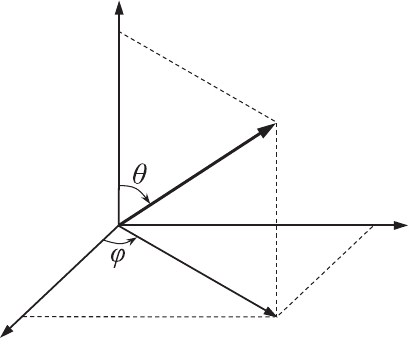
134 Additional examples of quantized motion
5. The peculiarities of the electron energy spectrum in a parabolic potential well, i.e.,
a harmonic oscillator, are that (a) the energy levels, separated by E = h
-
ω,are
equidistant; (b) the lowest energy level E
0
= h
-
ω/2, which corresponds to the quantum
number n=0, exists; and (c) there are so-called zeroth oscillations.
6. The energy of elastic waves in a crystalline lattice can be quantized and this energy
can be considered as the energy of the normal modes, each of which consists of n
q
phonons with energy h
-
ω
q
. Phonons are not real particles. They are members of the
family of quasiparticles that do not possess mass. The total number of phonons is three
times greater than the number of atoms in a crystal.
7. Phonons do not have momentum. Their motion in a crystal is described by a quasi-
momentum p = h
-
q (see Eq. (4.130)). Phonons possess integer spin and belong to the
family of particles called bosons, and their statistics is defined by Eq. (4.135).
4.6 Problems
Problem 4.1. A free electron of mass m
e
, moves in the direction defined by
the polar angle θ and the azimuthal angle ϕ (see Fig. 4.6). Find the electron
wavefunction (r, t) if the electron energy is equal to ε.
Problem 4.2. The dispersion equation Eq. (4.61) defines the allowed energy
states of an electron in a spherically-symmetric potential well and in a general
case it has to be solved numerically. Find the energy of stationary states in the
limit of infinitely high potential barriers.
Problem 4.3. Find the energy levels and the wavefunctions of a positively
charged harmonic oscillator in a homogeneous electric field E. The charge of
the oscillating particle is e and its mass is m.
z
x
y
p
Figure 4.6 Momentum p
in a spherical system of
coordinates.

4.6 Problems 135
Problem 4.4. An electron is in its ground state in a cubic potential well with
impenetrable barriers. Find the length, L, of the edge of the confining cube and
the energy of the electron if the electron’s highest probability density is equal to
P
m
.
Problem 4.5. An electron is in its ground state in a cubic potential well
with impenetrable barriers and with edge length L =5 nm. Estimate the
pressure which the electron puts on the walls of the potential well. (Answer:
P = 0.35 × 10
6
Pa.)
Problem 4.6. At instant t = 0 the electron behavior is described by the following
wavefunction:
(r, 0) = Ae
−r
2
/α
2
+ikr
. (4.157)
Find the normalization constant, A, the most probable value r
pr
, and the radial
part of the probability current, j.
Problem 4.7. An electron is in an infinitely deep spherically-symmetric potential
well, i.e., U (r) = 0atr ≤ r
0
and U(r) =∞at r > r
0
, where r
0
is the radius
of the well. Find the form of the radial electron function, the electron energy in
s-states (l = 0), the magnitudes
r
and r
sq
=
r
2
, the most probable value
r
pr
, and the probability of the electron being in the region r ≤ r
pr
.
Problem 4.8. For an electron in an infinitely deep spherically-symmetric
potential well, i.e., U(r) = 0atr ≤ r
0
and U (r) =∞at r > r
0
, where r
0
is the
radius of the well, find the dispersion equation for s-states in the energy region
E < U
0
and interval of values of U
0
r
2
0
when the well contains only one electron
energy level.
Problem 4.9. The wavefunction of the ground state of a one-dimensional har-
monic oscillator (particle with mass m in a one-dimensional parabolic potential
U (x) = mω
2
x
2
/2) has the following form:
ψ(x) = Ae
−bx
2
. (4.158)
Solve the Schr
¨
odinger equation and find the constant b and the energy of the
oscillator in the ground state.
Problem 4.10. The wavefunction of the one-dimensional harmonic oscillator in
a particular state has the following form:
ψ(x) = Axe
−bx
2
. (4.159)
Find the constant b and the energy of an oscillator in this state.
Problem 4.11. A particle with mass m moves in a three-dimensional parabolic
potential U (r) = mω
2
r
2
/2. Find the dependence of the oscillator’s energy on
the orbital quantum number.
Chapter 5
Approximate methods of finding
quantum states
The solution of most problems associated with electron quantum states in phys-
ical systems and structures (atoms, molecules, quantum nanostructure objects,
and crystals) is hard to find because of the mathematical difficulties of getting
exact solutions of the Schr
¨
odinger equation. Therefore, approximate methods of
solving such problems are of special interest. We will consider some of these
methods, such as the adiabatic approximation now and later the effective-mass
method, using real physical systems as examples. In this chapter we will consider
several widely used approximation methods for finding the wavefunctions and
energies of quantum states as well as the probabilities of transitions between
quantum states. First of all, we will consider stationary and non-stationary per-
turbation theories. What is common to these two theories is that it is assumed that
the perturbation is weak and that it changes negligibly the state of the unperturbed
system. Stationary perturbation theory is used for the approximate description of
a system’s behavior if the Hamiltonian of the quantum system being considered
does not directly depend on time. In the opposite case, non-stationary theory
is used. Then, we will briefly consider the quasiclassical approximation, which
is used for the problems of quantum mechanics which are close to analogous
problems of classical mechanics.
5.1 Stationary perturbation theory for a system
with non-degenerate states
This theory is used for the approximate calculation of the energy levels and the
wavefunctions of stationary states of systems that are subjected to the influence
of small perturbations. Let us assume that the Hamiltonian of the quantum system
may be expressed in the following form:
ˆ
H =
ˆ
H
0
+
ˆ
V , (5.1)
where
ˆ
H
0
is the Hamiltonian of the unperturbed system and
ˆ
V is the perturba-
tion operator. For the unperturbed Hamiltonian the solution of the Schr
¨
odinger
136
5.1 Stationary perturbation theory, non-degenerate states 137
equation,
ˆ
H
0
ψ
(0)
n
= E
(0)
n
ψ
(0)
n
, (5.2)
is assumed to be known, i.e., the complete set of eigenfunctions ψ
(0)
n
and eigen-
values E
(0)
n
of the unperturbed system is given. Let us assume, first, that the unper-
turbed Hamiltonian,
ˆ
H
0
, has a discrete spectrum and all states are non-degenerate.
This means that each eigenvalue E
(0)
n
corresponds to only one eigenfunction ψ
(0)
n
.
The complete set of these functions is orthonormalized, i.e., unperturbed wave-
functions satisfy the condition (2.144):
ψ
(0)∗
n
ψ
(0)
l
dV = δ
nl
. (5.3)
It is necessary to find the eigenvalues E
n
and the eigenfunctions ψ
n
of the
operator
ˆ
H, i.e., the solutions of the following Schr
¨
odinger equation:
ˆ
H
0
+
ˆ
V
ψ
n
= E
n
ψ
n
. (5.4)
This equation differs from Eq. (5.2)bytheterm
ˆ
V ψ
n
, which is assumed to be
small in comparison with
ˆ
H
0
ψ
n
, i.e., the state of the system must not change
considerably as a result of perturbation.
LetuslookforasolutionofEq.(5.4) in the form of a series expansion using
the complete set of eigenfunctions of the unperturbed Hamiltonian,
ˆ
H
0
:
ψ
n
=
l
C
l
ψ
(0)
l
. (5.5)
Let us substitute this solution into Eq. (5.4) and use the fact that ψ
(0)
l
are the
eigenfunctions of the unperturbed Hamiltonian,
ˆ
H
0
. As a result we get
l
C
l
E
(0)
l
+
ˆ
V
ψ
(0)
l
=
l
C
l
E
n
ψ
(0)
l
. (5.6)
Let us multiply both parts of this equation by ψ
(0)∗
k
and integrate it over the entire
volume available for the quantum system:
l
C
l
E
n
− E
(0)
l
ψ
(0)∗
k
ψ
(0)
l
dV =
l
C
l
ψ
(0)∗
k
ˆ
V ψ
(0)
l
dV. (5.7)
Taking into account the orthogonality condition (5.3), we arrive at the following
expression:
l
C
l
E
n
− E
(0)
l
δ
kl
=
l
C
l
V
kl
, (5.8)
where V
kl
is the matrix element of the perturbation operator
ˆ
V , in the basis of
the unperturbed wavefunctions, ψ
(0)
n
:
V
kl
=
ψ
(0)∗
k
ˆ
V ψ
(0)
l
dV. (5.9)
138 Approximate methods of finding quantum states
The important feature of the Kronecker delta, δ
kl
, is that it allows us to reduce
the number of indices in the summation. Taking into account the property of the
Kronecker delta, Eq. (5.8) reduces to
E
n
− E
(0)
k
C
k
=
l
V
kl
C
l
. (5.10)
Equation (5.10) constitutes a system of linear algebraic equations for the unknown
coefficients C
l
. This system is identical to the initial equation (5.4) since the
set of coefficients C
l
completely defines the wavefunction (5.5). Finding the
exact solution of the system of Eqs. (5.10) is not much simpler than finding
the solution of Eq. (5.4). However, the system of Eqs. (5.10) can be solved
approximately using a series expansion over some small parameter. Let us present
the perturbation operator,
ˆ
V ,intheform
ˆ
V =
ˆ
W . (5.11)
Here, is a small dimensionless parameter and
ˆ
W is some perturbation operator.
Using the fact that is small, we can present E
n
and C
l
in the form of a series
over the small parameter :
E
n
= E
(0)
n
+ E
(1)
n
+
2
E
(2)
n
+···, (5.12)
C
l
= C
(0)
l
+ C
(1)
l
+
2
C
(2)
l
+···. (5.13)
Here the magnitudes E
(1)
n
and C
(1)
l
are of the same order as the perturbation
ˆ
V , and the magnitudes
2
E
(2)
n
and
2
C
(2)
l
are of the second order of smallness,
i.e., the order of smallness is
ˆ
V
2
,etc.
On substituting Eqs. (5.12) and (5.13)into(5.10) we get
E
(0)
n
− E
(0)
k
C
(0)
k
+
E
(0)
n
− E
(0)
k
C
(1)
k
+ E
(1)
n
C
(0)
k
+
2
E
(2)
n
C
(0)
k
+···
=
l
W
kl
C
(0)
l
+
2
l
W
kl
C
(1)
l
+···. (5.14)
Let us find the corrections to the energy E
(0)
n
and to the wavefunction ψ
(0)
n
for
the nth quantum state of the system. Since in the zeroth approximation ψ
n
= ψ
(0)
n
,
there is only one term in Eq. (5.14) that does not depend on , and it follows
that C
(0)
n
= 1 and all other coefficients are equal to zero, C
(0)
k
= 0. Let us now
consider separately equations for k = n and k = n.Fork = n there is one term
on the left-hand side and one term on the right-hand side of Eq. (5.14)ofthe
first order of smallness, i.e., proportional to . As a result, in the first order of
approximation the correction to the energy E
(0)
n
is defined as
E
(1)
n
= W
nn
= V
nn
=
ψ
(0)∗
n
ˆ
V ψ
(0)
n
dV =
V
n
, (5.15)
which is the average value of perturbation calculated using the corresponding
unperturbed state. Let us note that V
nn
are usually called the diagonal matrix
elements of the perturbation operator,
ˆ
V. For k = n from Eq. (5.14) it follows

5.1 Stationary perturbation theory, non-degenerate states 139
that
C
(1)
k
=
V
nk
E
(0)
n
− E
(0)
k
, (5.16)
where the non-diagonal matrix elements of the perturbation operator, V
nk
,are
defined as
V
nk
=
ψ
(0)∗
n
ˆ
V ψ
(0)
k
dV, (5.17)
and C
(1)
n
= 0. Then, the corrections to the wavefunction in the first order of
approximation are
ψ
(1)
n
=
n=k
V
nk
E
(0)
n
− E
(0)
k
ψ
(0)
k
. (5.18)
To find the corrections to the energy for the second order of approximation, we
equate the terms proportional to
2
on both sides of Eq. (5.14). As a result the
correction E
(2)
n
is defined as
2
E
(2)
n
=
n=k
|V
nk
|
2
E
(0)
n
− E
(0)
k
. (5.19)
As a rule, for the perturbed wavefunction it is sufficient to determine the first two
terms of the expansion and for the energy, the first three terms of the expansion
of these magnitudes. As a result the wavefunction and the energy of the nth
perturbed state can be written as
ψ
n
= ψ
(0)
n
+
n=k
V
nk
E
(0)
n
− E
(0)
k
ψ
(0)
k
, (5.20)
E
n
= E
(0)
n
+
V
n
+
n=k
|V
nk
|
2
E
(0)
n
− E
(0)
k
. (5.21)
These expressions are justified only when the next term of the expansion is
considerably smaller than the previous one. This condition is satisfied if the
matrix elements of the perturbation operator are considerably smaller than the
distance between the unperturbed levels, i.e.,
|
V
nk
|
E
(0)
n
− E
(0)
k
, n = k. (5.22)
Example 5.1. An electron is confined in a one-dimensional potential well with
infinite-height barriers of width L and is affected by a perturbation, which has
the following coordinate dependence:
ˆ
V (x ) = V
0
cos
2
π x
L
. (5.23)
Find the change of electron energy levels in the potential well using the second-
order approximation of the perturbation theory. Find the condition of applicability
of the perturbation theory in the case considered here.

140 Approximate methods of finding quantum states
Reasoning. Let us find the matrix elements of the perturbation operator
ˆ
V (x)
using the wavefunctions defined by Eq. (3.51),
ψ
(0)
n
(x ) =
2
L
sin
nπ x
L
,
of the unperturbed problem:
V
nk
=
L
0
ψ
(0)∗
n
ˆ
V (x )ψ
(0)
k
dx =
2V
0
L
L
0
cos
2
π x
L
sin
nπ x
L
sin
kπ x
L
dx.
(5.24)
As a result of integration we obtain for the matrix elements, V
nk
,thefollowing
expression:
V
nk
=
V
0
4
1, n = k = 1,
2, n = k = 1,
1, n = k ± 2,
0, n and k are other than the above.
(5.25)
The first-order correction with regard to energy is equal to E
(1)
n
= V
nn
, and as
follows from Eq. (5.25), in the case when n = k = 1 we get
E
(1)
1
= V
11
=
V
0
4
. (5.26)
In the case when n = k = 1 we get
E
(1)
n
= V
nn
=
V
0
2
. (5.27)
Taking into account Eq. (5.25), the second-order correction, defined according
by Eq. (5.19), is equal to
2
E
(2)
n
=
n=k
|V
nk
|
2
E
(0)
n
− E
(0)
k
=−
m
e
L
2
V
2
0
64π
2
h
-
2
1, n = 1,
2/3, n = 2,
−4/[(n + 1)(n − 1)], n ≥ 3,
(5.28)
where E
(0)
n
is defined by Eq. (3.44):
E
(0)
n
=
π
2
h
-
2
2m
e
L
2
n
2
.
In deriving Eq. (5.28) we took into account that for n = k only V
nk
with n = k ±
2 are not equal to zero. The condition of applicability of the perturbation theory
(5.22) in the current problem taking into account the unperturbed eigenvalues of
energy (Eq. (3.44)) reduces to the following inequality:
V
0
2π
2
h
-
2
m
e
L
2
(
n − 1
)
. (5.29)

5.2 Stationary perturbation theory, degenerate states 141
5.2 Stationary perturbation theory for a system
with degenerate states
Very often we deal with degenerate states of an unperturbed quantum system.
Let us assume that the eigenvalues of the unperturbed Hamiltonian,
ˆ
H
0
,are
degenerate and that the order of degeneracy of the nth energy level, E
(0)
n
,is
equal to s. In this case s orthogonal wavefunctions ψ
(0)
n1
,...,ψ
(0)
ns
correspond to a
single eigenvalue E
(0)
n
. The perturbation splits the degenerate energy level, E
(0)
n
,
into s closely spaced sublevels. Each of the sublevels is described by its own
wavefunction, which is a linear combination of the unperturbed wavefunctions
ψ
(0)
nk
. Let us assume that the perturbation
ˆ
V is small. Therefore, we are expecting
closely spaced energy levels in the first order of approximation of perturbation
theory.
Let us consider the case of a doubly degenerate energy level E
(0)
n
with corre-
sponding eigenfunctions, ψ
(0)
n1
and ψ
(0)
n2
. The wavefunction of the perturbed state,
ψ
n
, can be written as a superposition of unperturbed wavefunctions:
ψ
n
= C
1
ψ
(0)
n1
+ C
2
ψ
(0)
n2
. (5.30)
After the substitution of ψ
n
into Eq. (5.4), multiplication of Eq. (5.4)bythe
complex-conjugate function ψ
∗
n
, and its integration (as we did in the previous
section), we get the following system of algebraic equations with the unknown
coefficients C
1
and C
2
:
E
(0)
n
+ V
11
− E
n
C
1
+ V
12
C
2
= 0,
V
21
C
1
+
E
(0)
n
+ V
22
− E
n
C
2
= 0,
(5.31)
where the matrix elements of the perturbation operator are defined by Eq. (5.17):
V
nk
=
ψ
(0)∗
n
ˆ
V ψ
(0)
k
dV. (5.32)
Non-zero solutions for C
1
and C
2
exist only in the case when the determinant of
the system of Eqs. (5.31) equals zero. By equating the determinant to zero we
obtain the following quadratic equation with respect to energy E
n
:
E
2
n
−
2E
(0)
n
+ V
11
+ V
22
E
n
+
E
(0)
n
+ V
11
E
(0)
n
+ V
22
− V
12
V
21
= 0. (5.33)
The solution of this equation can be written as
E
n
= E
(0)
n
+ E
(1±)
n
, (5.34)
where the corrections of the first order E
(1±)
n
to the unperturbed energy state E
(0)
n
are defined by the expression
E
(1±)
n
=
V
11
+ V
22
2
±
(V
11
− V
22
)
2
4
+|V
12
|
2
, (5.35)

142 Approximate methods of finding quantum states
and V
12
V
21
=|V
12
|
2
. The sign “±” in Eq. (5.35) indicates that in the presence of
perturbation the degeneracy of the unperturbed quantum system is lifted and the
energy levels split into two sublevels.
On substituting the expressions for the energy into the system of Eqs. (5.31)
we get for the coefficients of expansion the following relation:
C
2
= C
1
E
n
− E
(0)
n
− V
11
V
12
≡ C
1
V
21
E
n
− E
(0)
n
− V
22
. (5.36)
In a system of homogeneous linear algebraic equations such as Eq. (5.31) one
of the coefficients is always arbitrary. In our case we take the coefficient C
1
as
arbitrary. We will find C
1
later, from the normalization condition of the wave-
function ψ
n
. Taking into account the normalization and orthogonality conditions
of the unperturbed wavefunctions, ψ
(0)
n1
and ψ
(0)
n2
, the normalization condition of
the wavefunction ψ
n
takes the form
|C
1
|
2
+|C
2
|
2
= 1. (5.37)
On substituting Eq. (5.36) into Eq. (5.37) we obtain the following expressions
for the expansion coefficients C
1
and C
2
:
C
±
1
=
V
12
2|V
12
|
1 ±
V
11
− V
22
(V
11
− V
22
)
2
+ 4|V
12
|
2
1/2
, (5.38)
C
∓
2
=
V
12
2|V
12
|
1 ∓
V
11
− V
22
(V
11
− V
22
)
2
+ 4|V
12
|
2
1/2
. (5.39)
Thus, in the case of doubly degenerate states the corresponding energy level
splits into two sublevels, which correspond to the following wavefunctions:
ψ
±
n
= C
±
1
ψ
(0)
n1
+C
∓
2
ψ
(0)
n2
. (5.40)
5.3 Non-stationary perturbation theory
Very often it is necessary to solve problems in which the perturbation which
acts on the quantum-mechanical system depends on time. Let us assume that
the initial state of a quantum system is a stationary state. It is necessary to find
the state of the system at a later time t if at the initial instant, t = 0, the small
perturbation, which depends on time, begins to act. In this case the first term,
ˆ
H
0
, in the Hamiltonian of the quantum system (5.1) does not depend on time,
while the perturbation,
ˆ
V (t), depends on time. We have to find the change of the
system’s state with time. Generally this can be described by the non-stationary
Schr
¨
odinger equation
ˆ
H
(0)
+
ˆ
V (t)
(x, t) = ih
-
∂(x, t)
∂t
. (5.41)