
Mitin V.V., Sementsov D.I., Vagidov N.Z. Quantum mechanics for nanostructures
Подождите немного. Документ загружается.


5.3 Non-stationary perturbation theory 143
The eigenfunctions
(0)
(x, t) and eigenvalues E
(0)
n
of the unperturbed Hamilto-
nian are assumed to be known, i.e., the solutions of the following equation are
known:
ˆ
H
(0)
(0)
(x , t) = ih
-
∂
∂t
(0)
(x , t). (5.42)
For the nth quantum state they have the following form:
(0)
n
(x , t) = e
−iE
(0)
n
t/h
-
ψ
(0)
n
(x ). (5.43)
As follows from Eq. (5.41), the states of the perturbed system depend on time
and the energy of the system is not a constant. Since the system does not have
stationary states, the problem is not in finding these states but in the calculation of
the system’s wavefunction, which depends on time, and in finding the probability
of the system’s transition under the influence of the perturbation from the initial
state to the final state. Therefore, the method of approximate solution of the
Schr
¨
odinger equation, which is used for the case of a stationary perturbation, is
not applicable here and must be modified.
Let us express the wavefunction (x, t) in the form of an expansion over the
complete set of unperturbed orthonormalized wavefunctions,
(0)
k
(x, t):
(x, t) =
k
b
k
(t)
(0)
k
(x , t), (5.44)
where the expansion coefficients b
k
(t) are functions only of time, and the magni-
tude |b
k
(t)|
2
defines the probability of the system being in the state with energy
E
(0)
k
at the instant of time t. By substituting the expansion (5.44) into Eq. (5.41)
we obtain the following system of differential equations:
ih
-
k
db
k
dt
(0)
k
(x , t) + b
k
∂
(0)
k
(x , t)
∂t
=
k
b
k
ˆ
H
(0)
+
ˆ
V (t)
(0)
k
(x , t). (5.45)
Let us multiply both sides of Eq. (5.45)by
(0)∗
m
(x, t) and integrate over the entire
space. Taking into account the form of the unperturbed wavefunctions (5.43) and
their orthonormality, we get
ih
-
db
m
dt
=
k
V
mk
e
iω
mk
t
b
k
, (5.46)
where we introduced the frequency ω
mk
= (E
(0)
m
− E
(0)
k
)/h
-
and the matrix ele-
ment of the perturbation operator,
V
mk
(t) =
ψ
(0)∗
m
(x )
ˆ
V (t)ψ
(0)
k
(x )dx. (5.47)
The system of equations (5.46) is exact and it is equivalent to the initial equa-
tion (5.41). In order to solve Eq. (5.46) approximately, let us assume that at
t ≤ 0 the system was in the nth quantum state with the wavefunction
(0)
n
.
Then, for the initial instant of time all the coefficients with the index k = n

144 Approximate methods of finding quantum states
in the expansion (5.44) equal zero and the coefficient b
n
(0) = 1. Beginning
from the instant t = 0, the system is affected by the small perturbation and as
a result the wavefunction of the initial state changes a little with time. There-
fore, let us look for the coefficients b
k
(t) for the instant t > 0intheformof
expansion:
b
k
(t) = b
(0)
k
(t) +b
(1)
k
(t) +b
(2)
k
(t) +···, (5.48)
where b
(0)
k
(t) = b
(0)
k
(0) = δ
kn
. The correction b
(1)
k
(t) has the same order of small-
ness as the perturbation; b
(2)
k
(t) is quadratic with respect to the perturbation,
and so on. On substituting the expansion (5.48) into Eq. (5.46), we obtain the
equation for the correction of the first order of smallness:
ih
-
db
(1)
m
dt
=
k
V
mk
e
iω
mk
t
b
(0)
k
= V
mn
e
iω
mn
t
, (5.49)
where we omitted all terms of second and higher orders of smallness with respect
to the perturbation. By integrating the differential equation (5.49) we get
b
(1)
m
(t) =
1
ih
-
t
0
V
mn
(t)e
iω
mn
t
dt. (5.50)
The probability of finding the system at instant t in the state with energy E
(0)
m
in
the first order of perturbation theory is defined as
P
mn
=|b
m
(t)|
2
=|b
(1)
m
(t)|=
1
h
-
2
t
0
V
mn
(t)e
iω
mn
t
dt
2
. (5.51)
Thus, knowing the dependence of the perturbation on time, we can find the
probability of transition of the system from the initial state,
(0)
n
, to the final
state,
(0)
m
. Equation (5.51) is very often written as
P
mn
=
4π
2
h
-
2
|
V
mn
(ω
mn
)
|
2
, (5.52)
where we introduced the Fourier transform of the matrix element of the pertur-
bation operator (5.47), which corresponds to the frequency ω
mn
:
V
mn
(ω
mn
) =
1
2π
∞
−∞
V
mn
(t)e
iω
mn
t
dt. (5.53)
One of the most important applied problems is the case of periodic perturbation
when
ˆ
V (t) =
ˆ
V
0
e
iωt
. (5.54)
In this case the probability of the corresponding transition during a sufficiently
long time interval (t 2π/ω) is given by the expression
P
mn
=
2π
h
-
|
(V
0
)
mn
|
2
tδ(E
(0)
m
− E
(0)
n
− h
-
ω), (5.55)
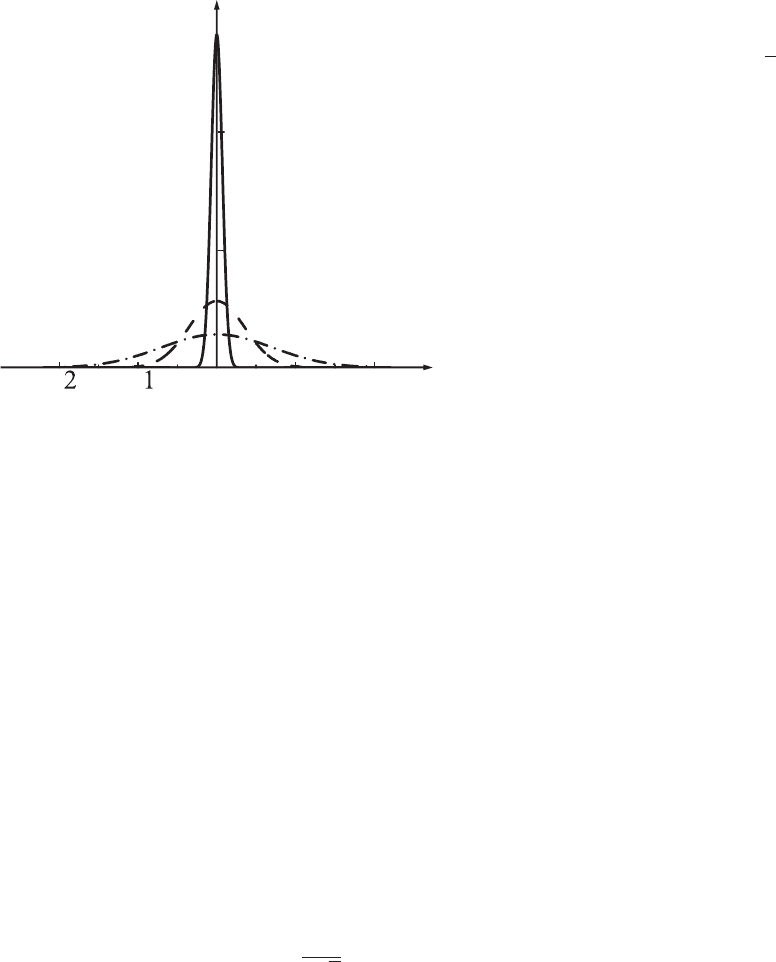
5.3 Non-stationary perturbation theory 145
d
a
x
012
2
−−
4
Figure 5.1 Dirac’s
δ-function can be thought
of as a function
δ
α
(x) = [1/ (α
√
π)]e
−x
2
/ α
2
when α tends to zero.
Then its amplitude tends
to ∞, while its width
tends to zero. The solid
line corresponds to
α = 0.1, the dashed line to
α = 0.5, and the
dash–dotted line to α = 1.
where Dirac’s δ-function, δ(E
(0)
m
− E
(0)
n
− h
-
ω), shows the resonant character of
the corresponding quantum transition, which is possible only at h
-
ω = E
(0)
m
−
E
(0)
n
. Therefore, the probability of the corresponding transition is not equal to
zero if the magnitude h
-
ω is close to the energy difference E
(0)
m
− E
(0)
n
. Let us first
introduce Dirac’s δ-function and then continue our analysis.
Dirac’s delta-function can be defined by the following two relationships:
δ(x) =
0, x = 0,
∞, x = 0,
(5.56)
∞
−∞
f (x)δ(x)dx = f (0), (5.57)
where f (x) is an arbitrary function, which is continuous at the point x = 0. For
convenience Dirac’s δ-function can be presented in the form of the limit of the
δ
α
-function:
δ(x) = lim
α→0
δ
α
(x ), (5.58)
where
δ
α
(x ) =
1
α
√
π
e
−x
2
/α
2
. (5.59)
The function shown in Fig. 5.1 can be transformed into Dirac’s δ-function by
equating the parameter α to zero. Dirac’s δ-function belongs to the mathematical
class of so-called generalized functions, which can be considered as an extreme
case for several continuous functions that depend on some accessory parameter.

146 Approximate methods of finding quantum states
Very often the δ-function is introduced as
lim
K →∞
K
−K
e
ikx
dk
= 2πδ(x) (5.60)
or in shorter notation as
1
2π
∞
−∞
e
ikx
dk = δ(x). (5.61)
Now let us continue our analysis of quantum transitions. For the rate of the
transition probability the following expression is used:
dP
mn
dt
=
2π
h
-
|
(V
0
)
mn
|
2
δ
E
(0)
m
− E
(0)
n
− h
-
ω
. (5.62)
If the perturbation of an atom is caused by electromagnetic radiation, whose
wavelength is much greater than the dimensions of the atom, then the perturbation
operator,
ˆ
V , can be expressed as
ˆ
V =−d · E(t ). (5.63)
Here, E is the electric field and d =−er is the dipole moment of the electron
in an atom, which is under the influence of the alternating electric field of the
incident electromagnetic wave. Under the influence of this wave the atom can
make a transition from the nth to the mth state with the following probability:
P
mn
=
4π
2
h
-
2
|
d
mn
|
2
|
E(ω
mn
)
|
2
, (5.64)
where
E(ω
mn
) =
1
2π
∞
−∞
E(t)e
iω
mn
t
dt. (5.65)
The system can make such a transition if E(ω
mn
) = 0, i.e., if there is a spectral
line in the emission spectrum that corresponds to this transition, and if the
corresponding matrix elements of the operator of dipole moment,
ˆ
d,
d
mn
(t) =−
ψ
(0)∗
m
(r)er(t)ψ
(0)
n
(r)dV, (5.66)
are not equal to zero. These conditions define the so-called selection rules for
the quantum systems to have allowed states.
Let us consider now the perturbation, which after switching on stays small
and continues to act for an infinitely long time. In this case the expression for
the probability of transition (5.51) is not valid since for the upper limit (t →∞)
the integral diverges. We can show that in this case the probability of transition
is defined by the expression
P
mn
=
1
h
-
2
ω
2
mn
t
0
dV
mn
dt
e
iω
mn
t
dt
2
. (5.67)

5.3 Non-stationary perturbation theory 147
If the perturbation
ˆ
V (t) is small and weakly changes during the time interval
T
mn
= 2π/ω
mn
, then the magnitude of the integral in Eq. (5.51) and, correspond-
ingly, the probability of transition are small. In the limit of infinitesimally slow
changes of the perturbation, the probability of any transition between the energy
levels tends to zero. In another limiting case, that of very fast (sudden) switching
on of the perturbation, the derivatives dV
mn
/dt tend to infinity at the instant of
switching on of the perturbation. Taking this into account, we can take the slowly
changing factor e
iω
mn
t
out of the integral in Eq. (5.67). After this the integral can
be easily evaluated and as a result we obtain the following expression:
P
mn
=
1
h
-
2
ω
2
mn
|
V
mn
|
2
. (5.68)
The transition probability of a system at a sudden switching on of the pertur-
bation can also be found in cases when the perturbation is not small. Let the
system be in one of the quantum states ψ
(0)
n
of the unperturbed Hamiltonian
ˆ
H
0
.
If the change of the Hamiltonian happens during a time that is small in compari-
son with the time of transition, 2π/ω
mn
, then the wavefunction of the system
does not have enough time to change and will stay the same as it was before
the switching on of the perturbation. Thus, it will not be an eigenfunction of
the new Hamiltonian,
ˆ
H =
ˆ
H
0
+
ˆ
V , and, therefore, the initial state ψ
(0)
n
will not
be stationary. The probability of the transition of a system to a new stationary
state is defined according to Eq. (5.44) by the corresponding expansion coef-
ficient of the function ψ
n
, which is decomposed over the set of unperturbed
eigenfunctions ψ
(0)
n
:
P
mn
=
ψ
∗
m
ψ
(0)
n
dx
2
. (5.69)
Example 5.2. Under the influence of a suddenly switched-on homogeneous
electric field E the charged oscillator makes a transition from the ground state
to the excited state. Find the probability of such a transition if the mass of the
oscillator is equal to m and its charge is equal to e.
Reasoning. The potential energy of the charged oscillator in a homogeneous
electric field can be written as follows:
U (x ) =
mω
2
2
x
2
− e
|
E
|
x =
mω
2
2
(x − x
0
)
2
−
e
2
|
E
|
2
2mω
2
, (5.70)
where the coordinate x
0
is equal to x
0
= e
|
E
|
/(mω
2
). Equation (5.70) has the
form of the potential energy of a linear oscillator with shifted equilibrium position
x
0
. If the wavefunction of the unperturbed oscillator has the form ψ
(0)
n
(x), then
for the perturbed oscillator this function must have the form ψ
n
(x − x
0
). The
wavefunctions of the unperturbed harmonic oscillator (4.89)havetheform
ψ
(0)
n
(ξ) = A
n
H
n
(ξ)e
−ξ
2
/2
,

148 Approximate methods of finding quantum states
where ξ = x
√
mω/h
-
. The probability of transition from the ground state (n = 0)
to the excited state (n = k) is defined according to Eq. (5.51) by the corresponding
coefficient b
k
of the expansion of the perturbed wavefunction in the series (5.44)
over the unperturbed wavefunctions, i.e.,
P
k0
=|b
k
|
2
=
∞
−∞
ψ
(0)∗
0
(x )ψ
(0)
k
(x − x
0
)dx
2
. (5.71)
Using the explicit form of the wavefunctions, let us determine the expansion
coefficient b
k
:
b
k
=
(−1)
k
√
2
k
πk!
e
−ξ
2
0
/2
∞
−∞
e
−ξξ
0
d
k
dξ
k
e
−ξ
2
+2ξξ
0
dξ, (5.72)
where
ξ
0
= x
0
mω
h
-
=
e|E|
√
mh
-
ω
3
.
By integrating Eq. (5.72) by parts k times we reduce the integral in Eq. (5.72)to
the following form:
∞
−∞
e
−ξξ
0
d
k
dξ
k
e
−ξ
2
+2ξξ
0
dξ = ξ
k
0
∞
−∞
e
−ξ
2
+ξξ
0
dξ = ξ
k
0
√
πe
ξ
2
0
/4
. (5.73)
On substituting this expression into Eq. (5.72) and then into Eq. (5.71) we obtain
the following expression for the transition probability:
P
k0
=
ξ
2k
0
2
k
k!
e
−ξ
2
0
/2
. (5.74)
5.4 The quasiclassical approximation
If the de Broglie wavelength of a particle is small in comparison with the charac-
teristic dimensions of the region within which the particle’s motion takes place,
then the behavior of a particle is approximately classical. The formal passage to
the limit from the quantum description of the particle’s behavior to the classical
one can be brought about by making the reduced Planck constant, h
-
, tend to zero
in the expression for the particle’s wavefunction, which can be presented as
(r, t) = Ae
iS(r,t)/h
-
. (5.75)
Here, S(r, t) is the action of the particle. As we noted in Section 2.3.3, the
reduced Planck constant h
-
is the quantum of action. For a free particle, the action
is defined as
S(r, t) = p ·r − Et. (5.76)
The wavefunction of a free particle (2.145) can be written in the form (5.75). The
expression for the wavefunction stays the same in the case of a particle’s motion
5.4 The quasiclassical approximation 149
in a potential field U(r). For the stationary state of the particle in the field, U (r),
the action can be written as
S(r, t) =
L
p ·dr − Et = S
0
(r) − Et, (5.77)
where the integration is carried out along the trajectory of the particle, L.The
action, S
0
, depends only on the particle’s coordinates and thus S
0
is called the
reduced action.
In the quasiclassical case the reduced Planck constant, h
-
, can be considered
a small parameter and the physical magnitudes A and S can be considered
independent of h
-
. On substituting Eq. (5.75) into the Schr
¨
odinger equation (2.182)
and leaving only the terms proportional to h
-
0
and h
-
1
we arrive at the following
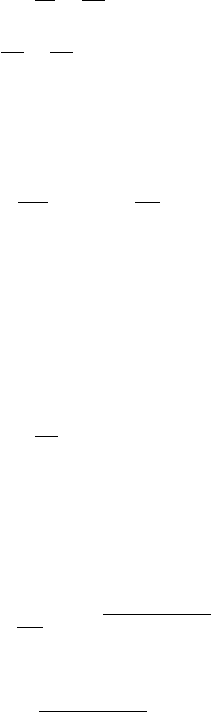
two equations for the phase and amplitude of the wavefunction, (r, t):
∂ S
∂t
+
1
2m
(∇ S)
2
+U = 0, (5.78)
∂ A
∂t
+
A
2m
∇
2
S + ∇ S ∇ A = 0. (5.79)
The first of these equations represents a well-known equation of classical mechan-
ics – the Hamilton–Jacobi equation for the particle’s action. The second equation,
after its multiplication by 2A, can be rewritten as
∂ A
2
∂t
+ div
A
2
∇ S
m
= 0. (5.80)
Here, A
2
=||
2
is the probability density of the particle’s location, and ∇ S/m =
p/m is the classical velocity of the particle. Thus, Eq. (5.80) is the continuity
equation, which shows that the probability density moves in each point of space
according to the laws of classical mechanics with the velocity p/m.
For stationary states, taking into account Eq. (5.77), the reduced action, S
0
,
and amplitude, A, satisfy the following equations:
1
2m
(
∇ S
0
)
2
+U = E, (5.81)
div
A
2
∇ S
0
2
= 0. (5.82)
Let us write the wavefunction for stationary states in the case of a particle’s
one-dimensional motion in the field U (x). Taking into account that
(
∇ S
0
)
2
=
(
dS
0
/dx
)
2
,Eq.(5.81) reduces to
dS
0
dx
=±
2m[E −U (x)]. (5.83)
The solution of this equation can be written as
S
0
=±
2m[E −U (x)]dx =±
p(x)dx, (5.84)
150 Approximate methods of finding quantum states
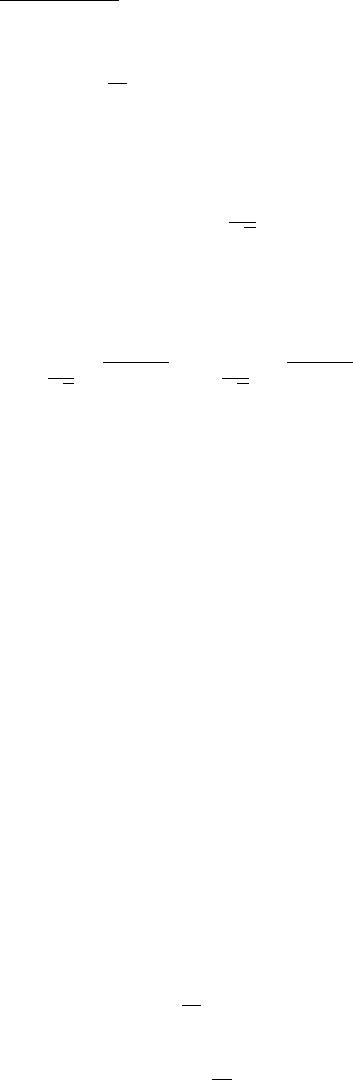
where p(x) =
√
2m[E − U (x)] is the momentum of the particle. Then, Eq. (5.82)
and its solution can be written as
d
dx
(A
2
p) = 0, (5.85)
A
2
p = constant, (5.86)
where for the amplitude of the wavefunction we get
A = constant ×
1
√
p
. (5.87)
Thus, in the quasiclassical approximation the wavefunction can be considered as
the superposition of the wavefunctions of two states, which describe the motion
of the particle along the x-axis in two possible directions:
ψ(x) =
A
1
√
p
e
i
√
2m[E−U(x)]dx/h
-
+
A
2
√
p
e
−i
√
2m[E−U(x)]dx/h
-
. (5.88)
As we have already mentioned, the quasiclassical approximation is valid only
for those regions of the particle’s motion where its de Broglie wavelength, λ
Br
,
slightly changes at distances x of the order of λ
Br
itself. This condition is not
satisfied near the turning points where the direction of motion is reversed and
the velocity of the particle tends to zero. Thus, at the turning points p → 0 and
therefore the de Broglie wavelength cannot be considered small.
Example 5.3. Estimate the probability of electron transmission through the
potential barrier (3.182):
U (x ) =
0, x < −a,
U
0
(1 + x /a), −a ≤ x ≤ 0,
U
0
(1 − x /b), 0 < x ≤ b,
0, x > b,
with a linear dependence of the potential in the regions of its increase and
decrease. The electron is incident on the barrier from the negative part of the
x-axis and has the energy E < U
0
.
Reasoning. This probability can be estimated on the basis of the quasiclassical
approximation if we assume that the electron potential energy, U (x), and the
momentum, p(x), change slowly. The interval of electron motion under the
barrier is limited by the coordinates x
1
and x
2
, where
x
1
= a
E
U
0
− 1
, (5.89)
x
2
= b
1 −
E
U
0
(5.90)

5.5 Summary 151
(see Example 3.9 and Fig. 3.11). In the classically unavailable region the electron
wavefunction has the form of a damping exponent:
|p(x)|ψ(x) = e
−
x
x
1
|p(x)|dx/h
-
, (5.91)
where |p(x)|=
√
2m
e
[U(x) − E]dx. Thus, the amplitude of the electron
wavefunction at the second boundary (x
2
= b) decreases by a factor of
exp[
x
2
x
1
|p(x)|dx/h
-
]. The probability of electron transmission through the barrier
is equal to the square of its magnitude, i.e.,
D = e
−2
x
2
x
1
√
2m
e
[U(x)−E]dx /h
-
. (5.92)
This formula can be used until the exponent’s argument has become large in
comparison with unity (compare it with Eq. (3.183)). On integrating Eq. (5.92)
we arrive at the following expression:
D = e
−4
√
2m
e
(
a+b
)(
U
0
−E
)
3/2
/(3h
-
U
0
)
, (5.93)
which coincides with the exact solution (see Eq. (3.189)) that was obtained earlier
to within a factor of order one.
5.5 Summary
1. The approximate methods are especially important for the solution of many problems
concerning electron quantum states. Perturbation theory uses weak perturbation, which
negligibly changes the state of the unperturbed system. If the Hamiltonian does not
depend directly on time, stationary perturbation theory is used; for the opposite case
non-stationary perturbation theory is used.
2. In the first order of approximation of stationary perturbation theory the correction to
the unperturbed energy, E
(0)
n
, is defined by the diagonal matrix element of perturbation,
which is an average perturbation, i.e., E
(1)
n
= W
nn
=W
n
.
3. If all unperturbed quantum states are non-degenerate, then for the wavefunction and
energy the following expressions are used:
ψ
n
= ψ
(0)
n
+
i=n
W
in
E
(0)
n
− E
(0)
i
ψ
(0)
i
,
E
n
= E
(0)
n
+
W
n
+
i=n
|W
in
|
2
E
(0)
n
− E
(0)
i
.
These relationships are valid if the matrix elements of the perturbation operator are
significantly smaller than the distance between the unperturbed levels, i.e.,
|W
n
|
E
(0)
n
− E
(0)
i
.
152 Approximate methods of finding quantum states
4. If the unperturbed energy level is s-fold degenerate, then it corresponds to s self-
orthogonal wavefunctions ψ
(0)
n1
,...,ψ
(0)
ns
. The perturbation splits a degenerate energy
level into s close sublevels. Each of them corresponds to its own wavefunction, which
is a linear combination of unperturbed wavefunctions ψ
(0)
nk
.
5. The probability of transition of the system from the initial state to the final state
is proportional to the square of the Fourier transform of the matrix element of the
perturbation operator, which corresponds to the transition frequency, ω
mn
= (E
(0)
m
−
E
(0)
n
)/h
-
, i.e.,
P
mn
=
4π
2
h
-
2
|W
mn
(ω
mn
)|
2
.
6. If the de Broglie wavelength of the particle is small compared with the characteristic
size of the region within which the particle motion takes place, then the particle
behavior can be described in the framework of the quasiclassical approximation. In
this case the wavefunction can be presented as a superposition of two states, which
describe the particle motion along and against the x-direction:
ψ = ψ
+
+ ψ
−
,
ψ
±
=
A
±
√
p
e
∓
√
2m(E−U(x))dx/h
-
.
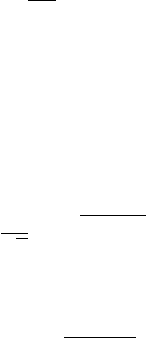
7. The quasiclassical probability of electron transmission through the barrier is defined
by the approximate expression
D = e
−2
x
2
x
1
√
2m
e
(U(x)−E)dx /h
-
.
At the turning points, x
1
and x
2
, the momentum of a particle tends to zero ( p → 0)
and the de Broglie wavelength is not small. Therefore, these points must be excluded
from the integration.
5.6 Problems
Problem 5.1. The unperturbed system has two close energy levels, E
(0)
1
and
E
(0)
2
, which are separated by an energy comparable to the energy of perturbation.
Find the first-order corrections to the energy of these states.
Problem 5.2. A harmonic oscillator with charge e and mass m is placed in a
homogeneous electric field E directed along the axis of oscillations. Considering
the electric field as a perturbation, find the shift in the energy levels of the
oscillator.
Problem 5.3. An electron in a one-dimensional rectangular potential well with
the barriers of infinite height,
U (x ) =
0, 0 ≤ x ≤ L ,
∞, x < 0, x > L ,