
Mitin V.V., Sementsov D.I., Vagidov N.Z. Quantum mechanics for nanostructures
Подождите немного. Документ загружается.

6.1 The hydrogen atom 163
L
r
v
m
e
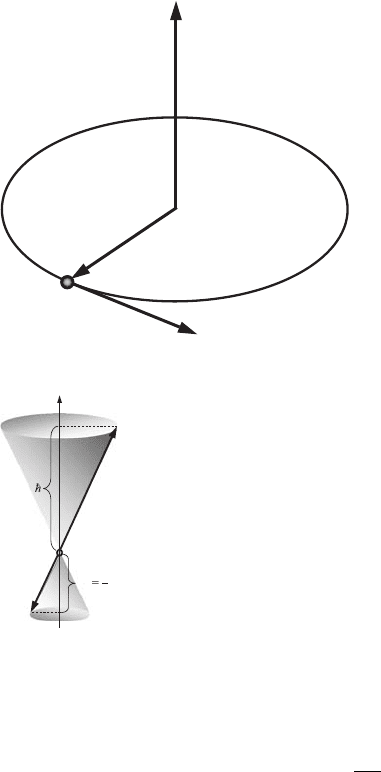
Figure 6.4 The electron
angular momentum, L.
m
lz
mm
B
m
l
L
z
L
z
= m
Figure 6.5 The electron
orbital magnetic moment,
µ
l
, and angular
momentum, L.
an electron possesses a negative electric charge. Such a circular current
with the surface area S = πr
2
corresponds to an orbital magnetic moment
with a magnitude
µ
l
= I
e
S =−
evr
2
. (6.27)
The orbital magnetic moment, µ
l
, is a vector, whose direction is perpendicular
to the plane of the electron orbit. The direction of the electron angular momentum,
L = r × p (see Fig. 6.4) is defined by the right-hand rule and the magnitude of
the electron angular momentum is equal to
L = m
e
vr. (6.28)
The angular momentum, L, is also perpendicular to the plane of the electron
orbit. Since the charge of the electron is negative, the direction of the vector of
orbital magnetic moment, µ
l
, is opposite to the direction of the vector L (see
Fig. 6.5).
Let us introduce the so-called gyromagnetic ratio, γ , which defines the rela-
tion between the electron angular momentum and orbital magnetic moment
164 Quantum states in atoms and molecules
in an atom:
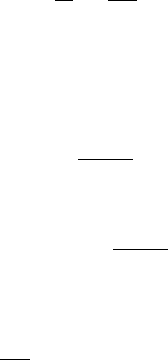
γ =
µ
l
L
=
e
2m
e
. (6.29)
Quantum-mechanical calculations of the gyromagnetic ratio, which will be con-
sidered in Example 6.2, lead to expression (6.29).
Thus, in any quantum-mechanical state the electron in the hydrogen atom has
not only angular momentum, L, with magnitude
L = h
-
l(l + 1), (6.30)
but also orbital magnetic moment µ
l
with magnitude
µ
l
= γ L = µ
B
l(l + 1). (6.31)
Here, we introduced the constant µ
B
, known as the Bohr magneton:
µ
B
=
eh
-
2m
e
= 9.27 × 10
−24
JT
−1
, (6.32)
which serves as a unit for measuring the orbital magnetic moment of an atom.
The physical meaning of the orbital magnetic quantum number, m, can be
understood by taking into account that the wavefunction ψ
nlm
(r,ϕ,θ)ofan
electron in the hydrogen atom is simultaneously the eigenfunction of the operator
of the projection of angular momentum,
ˆ
L
z
:
ˆ
L
z
ψ
nlm
= mh
-
ψ
nlm
. (6.33)
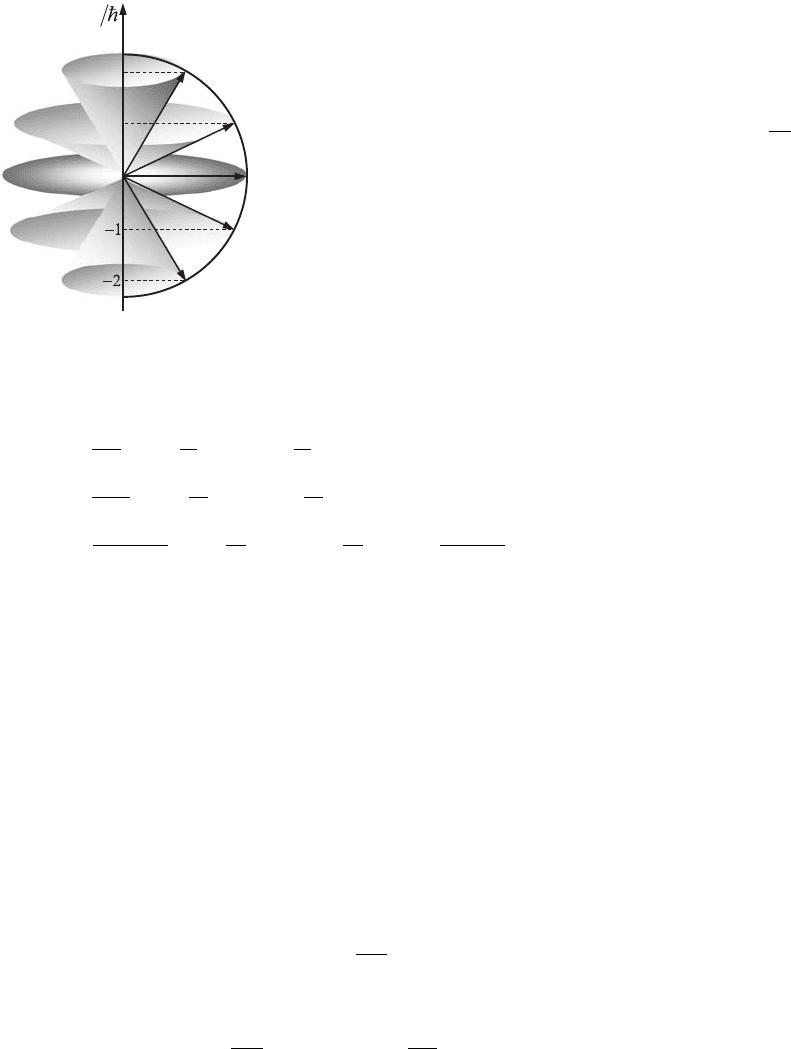
It follows from Eq. (6.33) that the projection of angular momentum, L
z
, onto the
chosen direction (for example, the z-axis) can have only the following certain
values:
L
z
= mh
-
. (6.34)
The axis direction is chosen taking into account the direction of an external
magnetic or electric field. The maximum value of L
z
= lh
-
is always smaller
than L, which is defined by Eq. (6.30) (see Fig. 6.6). The possible values of the
projection of the atom’s orbital magnetic moment, µ
l
, along the z-axis, are also
quantized and are determined by the orbital magnetic quantum number, m:
µ
lz
=−γ L
z
=−mµ
B
. (6.35)
Example 6.2. Find the orbital magnetic moment of the hydrogen atom µ
l
, which
occurs because of the orbital motion of an electron and find the gyromagnetic
ratio, γ .
Reasoning. Let us use Eq. (2.190) for the probability current, j. Since the wave-
function given in spherical coordinates depends on variables r , θ, and ϕ,for
the projections of the vector j onto the radial, polar, and azimuthal directions,
6.1 The hydrogen atom 165
2
1
0
L
L
z
L
L
Figure 6.6 Projections of
angular momentum, L,on
the z-axis. The maximum
value of L
z
for l = 2
(L
zmax
= 2h
--
) is smaller
than the modulus of L
(|L|=L = 2h
--
√
1.5).
respectively, we get
j
r
=
ih
-
2m
e
ψ
nlm
d
dr
ψ
∗
nlm
− ψ
∗
nlm
d
dr
ψ
nlm
= 0,
j
θ
=
ih
-
2m
e
r
ψ
nlm
d
dθ
ψ
∗
nlm
− ψ
∗
nlm
d
dθ
ψ
nlm
= 0,
j
ϕ
=
ih
-
2m
e
r sin θ
ψ
nlm
d
dϕ
ψ
∗
nlm
− ψ
∗
nlm
d
dϕ
ψ
nlm
=
h
-
m
m
e
r sin θ
|
ψ
nlm
|
2
.
(6.36)
The projections j
r
and j
θ
are equal to zero because the parts of the wavefunction
which depend on r and θ are real. In order to calculate the projection j
ϕ
we
used the explicit form of the angular part of the wavefunction (Eq. (4.37)). The
probability current density, j, corresponds to the electric current density, j
e
,as
j
e
=−ej, j
e
=−ej
ϕ
. (6.37)
Let us present the orbital magnetic moment of an atom as a sum of moments
from the elementary circular currents with radius r sin θ and cross-section ds.
The magnitude of such an elementary current is
dI
e
= j
e
ds =−ej
ϕ
ds. (6.38)
The area of the circular orbit is S = πr
2
sin
2
θ. The orbital magnetic moment
created by the elementary current is equal to
dµ
l
= S dI
e
=−πr sin θ
meh
-
m
e
|
ψ
nlm
|
2
ds. (6.39)
The total orbital magnetic moment, µ
l
, may be written as
µ
l
=−
meh
-
2m
e
|
ψ
nlm
|
2
dV =−
eh
-
2m
e
m, (6.40)
where dV = 2πr sin θ ds is the volume of a tube, and integration is carried out
over the entire space. Taking into account that L = h
-
m, we find the gyromagnetic
166 Quantum states in atoms and molecules
n
0
12
n=1
n=2
n=3
n=4
E
free electron
Balmer
series
Lyman
series
E
1
E
2
E
3
E
4
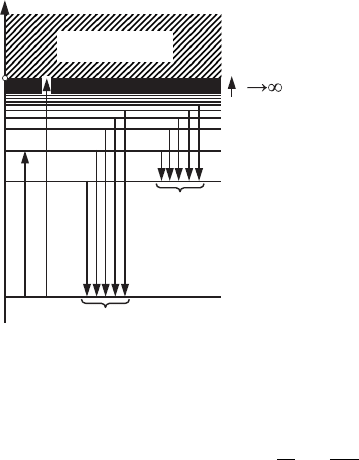
Figure 6.7 The electron
energy spectrum in the
hydrogen atom; E
1
, E
2
,
E
3
,andE
4
are the
discrete energy levels of
theelectroninthe
potential well of the
hydrogen atom.
ratio, γ :
γ =
µ
l
L
=
e
2m
e
. (6.41)
6.2 The emission spectrum of the hydrogen atom
Figure 6.7 shows the electron energy spectrum of the hydrogen atom, which was
calculated using Eq. (6.7). If the electron has positive energy then it is free and
its energy spectrum is continuous as shown in Fig. 6.7. In the region of negative
values of the total energy the energy spectrum of the electron of the hydrogen
atom is discrete. In the stationary state the electron can be in one of the energy
states with E
n
< 0. The undisturbed atom is in its ground state with energy E
1
.If
the atom is given additional energy, i.e., if the atom is excited, then it may make
a transition to a state with higher energy E
n
> E
1
(see Fig. 6.7, where transition
1 for the electron from level E
1
to level E
3
is shown). If the energy given to the
atom is sufficiently high, then the electron may overcome the Coulomb attraction
of the nucleus and become free. This process is called ionization of the atom.The
minimal energy necessary for ionization, E
i
, of a hydrogen atom (see transition
2inFig.6.7)is|E
i
|=13.6eV.
An atom may stay in the excited state only for a short time τ . This time
is called the lifetime of the atom in the given quantum state and for different
quantum states it can be of the order of τ = 10
−6
–10
−10
s. During time τ the
electron spontaneously makes transitions to levels with lower energy, including
the ground state. During such a transition the atom emits an energy quantum in
the form of electromagnetic radiation, i.e., the atom emits a photon. Experiments
show that the emission from hydrogen atoms corresponds to certain regions of
the electromagnetic spectrum and that it has the form of narrow spectral lines.
6.2 The emission spectrum of the hydrogen atom 167
Knowing the structure of the energy levels, it is easy to find the structure
of the optical emission spectrum of a hydrogen atom. During the transition of
the electron from the mth energy level to the nth level (m > n, E
m
> E
n
), the
electron loses energy E
m
− E
n
by emitting a photon with angular frequency
ω
nm
=
E
m
− E
n
h
-
. (6.42)
By substituting the expressions for energies E
m
and E
n
defined by Eq. (6.7)into
Eq. (6.42) we obtain the equation for the emission frequency of the hydrogen
atom for the different transitions from higher energy levels to lower:
ω
nm
= 2π cR
∞
1
n
2
−
1
m
2
, m > n. (6.43)
Here, we introduced the so-called Rydberg constant R
∞
:
R
∞
=
m
e
4π h
-
c
e
2
4π
0
h
-
2
= 1.0974 × 10
7
m
−1
, (6.44)
whose value was first found experimentally; later it was obtained theoretically
by Niels Bohr.
According to Eq. (6.43), there must be a series of spectral lines in the emission
spectrum of a hydrogen atom corresponding to different parts of the optical
spectrum. Such series were experimentally found a long time before they were
theoretically predicted. The most well known of these series are the following.
The Lyman series
The Lyman series corresponds to transitions to the ground level n = 1from
higher energy levels with m = 2, 3, 4,...Its spectral lines are in the ultraviolet
region. The minimal emission frequency in this series is ω
12
= 1.55 × 10
16
s
−1
,
which corresponds to the maximal wavelength
λ
12
=
2πc
ω
12
= 121.4nm. (6.45)
The maximal frequency, which corresponds to the short-wavelength boundary,
i.e., when m →∞,isω
1∞
= 2.07 × 10
16
s
−1
, which corresponds to λ
1∞
=
91 nm.
The Balmer series
The Balmer series has the following n and m numbers: n = 2 and m = 3, 4, 5,...
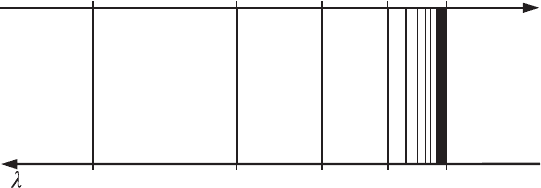
The spectral lines of this series are in the visible range. The structure of these
spectral lines is shown in Fig. 6.8. The symbols Hα,Hβ,Hγ, and Hδ label
characteristic lines of this series. The spectral line Hr is the short-wavelength
boundary of the series, which corresponds to m →∞and maximal frequency
ω
2∞
= 5.17 × 10
15
s
−1
. The spectral line Hα corresponds to the minimal fre-
quency ω
23
= 2.87 × 10
15
s
−1
. The color of Hα is red and Hδ is in the ultraviolet
region.
168 Quantum states in atoms and molecules
, nm
656.3
486.1 434.0 410.2 364.6
Hαβ
γ
δ
HHH H
r
E,eV
1.88 2.55 2.86
3.02
3.40
Figure 6.8 The Balmer
series. The symbols Hα,
Hβ,Hγ,andHδ label
characteristic spectral
lines of this series. Hα is a
red line, whereas Hδ is in
the ultraviolet region.
The Paschen series
The Paschen series has the following n and m numbers: n = 3 and m =
4, 5, 6,... All spectral lines of this series are in the near-infrared region of
the electromagnetic spectrum. The Brackett (n = 4, m ≥ 5) and Pfund (n = 5,
m ≥ 6) series are in the same spectral region.
The absorption spectra have the same spectral rules. Absorption occurs when
an electron in a lower energy state absorbs a photon and is promoted to a
higher energy state. Thus, emission and absorption of energy quanta in the
form of photons happen as a result of electron transitions from one energy level
to another. However, not all the transitions in an atom are allowed. The only
transitions allowed are those between quantum states whose orbital quantum
numbers, l, differ by unity:
l =±1, (6.46)
i.e., transitions between s- and p-states, between p- and d-states, and so on are
allowed. At the same time the orbital magnetic quantum number, m, must either
stay the same or change by unity, i.e.,
m = 0, ±1. (6.47)
Equations (6.46) and (6.47) are called the selection rules. They are derived from
the calculations of transition probabilities between different stationary states with
emission or absorption of a photon.
The existence of these rules for the quantum transitions of an electron is related
to the conservation of the square of angular momentum, L
2
, and its projection
L
z
. Indeed, as a result of the corresponding transition of an electron from one
energy level to another a photon is emitted (or absorbed). The photon takes away
(or transmits to the atom) not only an energy quantum, E = h
-
ω, but also a
quantum of angular momentum, L = h
-
. This fact leads to the condition defined
by Eq. (6.46) for the orbital quantum number, l.
The selection rule for the orbital magnetic quantum number, m =±1, shows
that the emitted or absorbed photon may impart to the atom angular momentum
with a certain projection on a chosen axis. This projection may be equal to
±h
-
, which corresponds to the left-handed or right-handed circular polarization
6.3 The spin of an electron 169
of the photon. The selection rule m = 0 shows that a photon having angular
momentum h
-
does not have a certain projection on the chosen axis and does not
take away (or transmit) any projections of angular momentum. This happens in
the case when the photon has linear polarization, which can be presented as a
sum of two opposite circular polarizations – left-handed and right-handed.
The study of spectral lines using high-resolution spectrometers revealed that
the spectral lines that correspond to the transitions between the energy levels with
l ≥ 1aredoublets. The energy difference between the lines constituting doublets
is very small. Therefore, it is said that spectral lines have fine structure. Such a
splitting of spectral lines may be connected only with the splitting of energy levels
themselves. Indeed, the experimentally established value of the splitting of the
energy level of the 2p-state of the hydrogen atom is equal to E = 4.5 ×10
−5
eV
and the corresponding splitting frequency of the main spectral line of the Lyman
series is equal to ν = ω/(2π) = 11 GHz. However, such a splitting cannot
be obtained from the solutions of the Schr¨odinger equation which we wrote for
the electron in a spherically-symmetric potential. Understanding the atomic fine
structure became possible only after the discovery that the electron has intrinsic
angular momentum and an intrinsic magnetic moment not related to the electron
orbital motion. In previous chapters we have mentioned this property called spin,
and now we will consider it in more detail.
6.3 The spin of an electron
The following experimental facts that could not be explained by the quantum
theory developed by Bohr and Schr¨odinger forced scientists to revise their con-
cepts.
1. Analysis of the spectral lines of alkali metals shows that p-, d-, etc. terms are doublets,
i.e., consist of two closely spaced spectral lines, whereas the s-term stays a singlet.
2. The Stern–Gerlach experiment showed that a beam of silver atoms splits into two
beams in the presence of an inhomogeneous external magnetic field, a result that was
not expected. Since the outermost electron in a silver atom is in its ground state its
orbital quantum number, l, must be equal to zero and thus its orbital magnetic quantum
number, m, must also be equal to zero, and the beam must not split.
3. Many atoms in the presence of an external magnetic field have even multiplets in the
spectra, whereas it was expected that multiplets must be only odd:2l + 1 for all values
of l is odd.
To explain these experimental facts George Uhlenbeck and Samuel Goudsmit
suggested in 1925 that an electron, in addition to its orbital motion, also has
intrinsic angular momentum, S, which they called spin. Later it was established
that spin is not connected with the rotation of an electron around its own axis
as was first suggested, but is a quantum-mechanical and at the same time a
relativistic internal property of the electron. Together with the spin angular

170 Quantum states in atoms and molecules
momentum, S, an electron has an intrinsic spin magnetic moment, µ
s
. Similarly
to angular momentum, the values of electron spin angular momentum, S, and
spin magnetic moment, µ
s
, are defined by the same expressions:
S = h
-
s(s + 1), (6.48)
µ
s
= 2µ
B
s(s + 1), (6.49)
where s is the spin quantum number, which is also called simply spin.
It has been established experimentally that for electrons s = 1/2, and therefore
S =
√
3
2
h
-
, (6.50)
µ
s
=
√
3µ
B
. (6.51)
The spin gyromagnetic ratio, which relates the electron spin magnetic moment,
µ
s
, and spin angular momentum, S,asµ
s
= γ
S
S, is equal to
γ
S
=
µ
s
S
=
2µ
B
h
-
=
e
m
e
. (6.52)
Its magnitude is twice the orbital gyromagnetic ratio defined by Eq. (6.29).
As in the case of orbital motion, the magnitude of the spin angular momentum,
S, may have the following values:
S
2
= h
-
2
s(s + 1). (6.53)
Its projections onto an arbitrarily chosen axis (for example the z-axis) are equal
to
S
z
= h
-
m
s
, (6.54)
where the magnetic quantum number, m
s
, is called the spin magnetic quantum
number and may take 2s + 1 values:
m
s
= s, s − 1,...,−s + 1, −s. (6.55)
Since for an electron s = 1/2, two spin states are possible. These states corre-
spond to two different projections with m
s
=±1/2 of spin angular momentum
onto the chosen axis (see Fig. 6.9).
The existence of the electron spin magnetic moment, µ
s
, and orbital magnetic
moment, µ
l
, leads to an additional interaction called spin–orbit coupling.Its
energy is described by
U
sl
(r) =
µ
0
4π
µ
s
· µ
l
r
3
, (6.56)
where r is the radius of the corresponding orbit of the electron in the atom. The
spin–orbit coupling is not taken into account in the Schr¨odinger equation (6.2).
The existence of such an interaction leads to the splitting of energy levels that
correspond to the states with orbital quantum number l ≥ 1.
6.3 The spin of an electron 171
0
S
z
S
2
2
(m
s
= +1/2
)
(m
s
1/2)
Figure 6.9 Projections of
spin angular momentum,
S, onto the chosen z-axis
with two different values
of m
s
.
2p
1/2
2p
3/2
3d
3/2
3d
5/2
3p
3/2
3p
1/2
1s
1/2
2s
1/2
3s
1/2
= 11 GHz
E
E
3
E
2
E
1
E=
Figure 6.10 The splitting
of energy levels due to
spin–orbit coupling in the
hydrogen atom. The
quantum transitions that
belong to the Lyman and
Balmer series are shown.
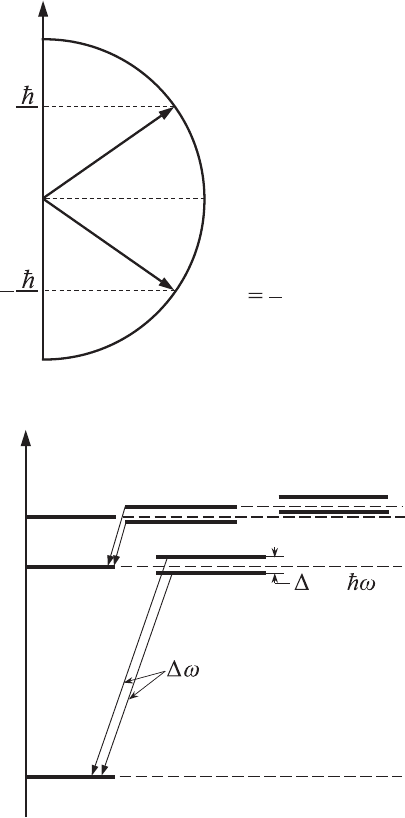
Figure 6.10 shows the scheme of the splitting for the lower levels of the
hydrogen atom. It also shows the quantum transitions which correspond to two
doublet lines in the Lyman and Balmer series.
The quantum state of the electron in the hydrogen atom can be defined by the
set of four quantum numbers whose values are given in Table 6.3.
Let us note again that many elementary particles have their own intrinsic
angular momentum, i.e., spin. Particles whose spin is a half-integer are called
Fermi particles or fermions. Electrons, protons, and neutrons are examples of
fermions. For these particles s = 1/2. For other types of particles spin is an

172 Quantum states in atoms and molecules
Table 6.3. The four quantum numbers, n, l, m, and m
s
, which define
the state of an electron in a hydrogen atom
Quantum number Symbol Possible values
Principal n 1, 2, 3, . . .
Orbital l 0, 1, 2,...,n − 1
Magnetic (orbital) m −l, −l + 1,...,−1, 0, 1,...,l − 1, l
Magnetic (spin) m
s
−1/2, +1/2
integer and these particles are called Bose particles or bosons. Some of the
mesons (π and K), photons, and the α-particle (the nucleus of a
2
He
4
helium
atom) are bosons. Ensembles of particles consisting of Fermi and Bose particles
behave differently, and we will talk about this subject later.
Example 6.3. Estimate the splitting of energy level E
2
in the hydrogen atom
which is due to spin–orbit coupling. Compare it with the splitting caused by
the interaction of the spin magnetic moment of the electron, µ
s
, with the spin
magnetic moment of the nucleus (proton), µ
p
.
Reasoning. The magnitude of splitting of the E
2
energy level has to be of the
order of the energy of dipole–dipole interaction of the corresponding magnetic
moments, which is defined by Eq. (6.56):
U
sl
(r) =
µ
0
4π
µ
s
· µ
l
r
3
, (6.57)
U
sp
(r) =
µ
0
4π
µ
s
· µ
p
r
3
. (6.58)
Here, r is the effective distance between the magnetic moments. This distance is
of the order of the radius of the second Bohr orbit, r
2
= 2.1 × 10
−10
m, for both
types of interaction. The magnitudes of the corresponding magnetic moments
are
µ
s
=
eh
-
m
e
,µ
l
=
eh
-
2m
e
,µ
p
= 2.8
eh
-
2m
p
, (6.59)
where m
p
= 1.67 × 10
−27
kg is the proton mass. Thus, the energy separations
between the sublevels for the two cases are defined by the expressions
E
sl
≈
µ
0
4π
e
2
h
-
2
2m
2
e
1
r
3
1
≈ 1.1 × 10
−5
eV, (6.60)
E
sp
≈ 1.4
µ
0
4π
e
2
h
-
2
m
e
m
p
1
r
3
1
≈ 1.25 × 10
−8
eV. (6.61)
The estimated values agree to within an order of magnitude with the experimental
data as well as with the theoretical results which were obtained on the basis of
exact quantum-mechanical calculations. For example, the exact value of E
sl
is 4.5 ×10
−5
eV. We see that E
sl
caused by the spin–orbital coupling is three
orders of magnitude larger than E
sp
. Therefore, the splitting of the spectral