
Moser A.P., Folkman S. Buried Pipe Design
Подождите немного. Документ загружается.

from actual three-edge bearing tests, from empirical evaluations of for-
mer tests (as given in ASTM standards), or from design procedures
derived from reinforced concrete theory and evaluations of appropriate
tests. The required W
3-edge
strengths in these indirect designs are
obtained from the loads and bedding factors calculated using the
Marston-Spangler soil-structure interaction analyses for earth loads.
The Marston-Spangler indirect method has been the most prevalent
procedure for designing buried concrete pipe. However, the direct design
procedures are becoming more accepted and, in many instances, pre-
ferred. Direct design procedures usually require more design information
Rigid Pipe Products 279
TABLE 5.12 Standard Embankment Installation Soils and Minimum Compaction
Requirements
Installation Haunch and
type Bedding thickness outer bedding Lower side
Type 1 D
o
/24 minimum, not less 95% SW 90% SW,
than 3 in (75 mm). If rock 95% ML, or
foundation, use D
o
/12 mini- 100% CL
mum, not less than 6 in
(150 mm).
Type 2 D
o
/24 minimum, not less 90% SW 85% SW,
than 3 in (75 mm). If rock or 90% ML, or
foundation, use D
o
/12 min- 95% ML 95% CL
imum, not less than 6 in
(150 mm).
Type 3 D
o
/24 minimum, not less 85% SW, 85% SW,
than 3 in (75 mm). If rock 90% ML, 90% ML, or
foundation, use D
o
/12 min- or 95% CL
imum, not less than 6 in 95% CL
(150 mm).
Type 4 No bedding required, No compaction No compaction
except if rock foundation, required, except if required, except if
use D
o
/12 minimum, CL, use 85% CL CL, use 85% CL
not less than 6 in (150 mm).
NOTES:
1. Compaction and soil symbols (i.e., 95% SW) refer to SW soil material with a minimum
standard Proctor compaction of 95 percent.
2. Soil in the outer bedding, haunch, and lower side zones, except within D
o
/3 from the pipe
spring line, shall be compacted to at least the same compaction as the majority of soil in
the overfill zone.
3. Subtrenches
a. A subtrench is defined as a trench with its top below finished grade by more than 0.1H
or, for roadways, its top at an elevation lower than 1 ft (0.3 m) below the bottom of the
pavement base material.
b. The minimum width of a subtrench shall be 1.33D
o
or wider if required for adequate
space to attain the specified compaction in the haunch and bedding zones.
c. For subtrenches with walls of natural soil, any portion of the lower side zone in the sub-
trench wall shall be at least as firm as an equivalent soil placed to the compaction
requirements specified for the lower side zone and as firm as the majority of soil in the
overfill zone, or shall be removed and replaced with soil compacted to the specified level.

than does the indirect method. For example, direct design usually con-
siders the distribution and variation of earth pressure around the pipe
circumference. Two assumptions for earth pressure distribution have
been presented in the technical literature, and they are identified by
the principal characteristics of the assumptions about pressure varia-
tion. These are termed uniform (uniform distributed vertical and hori-
zontal components of pressure) and radial (pressures act normal to the
pipe surface and vary as a trigonometric function). These assumed
pressure variations are often referred to by the names of the individu-
als who proposed them: uniform, Paris
34
; radial, Olander.
32
280 Chapter Five
TABLE 5.13 Standard Trench Installation Soils and Minimum Compaction
Requirements
Installation Haunch and
type Bedding thickness outer bedding Lower side
Type 1 D
o
/24 minimum, not less 95% SW 90% SW,
than 3 in (75 mm). If rock 95% ML,
foundation, use D
o
/12 mini- 100% CL,
mum, not less than 6 in or natural soils of
(150 mm). equal firmness
Type 2 D
o
/24 minimum, not less 90% SW 85% SW,
than 3 in (75 mm). If rock or 90% ML,
foundation, use D
o
/12 mini- 95% ML 95% CL,
mum, not less than 6 in or natural soils of
(150 mm). equal firmness
Type 3 D
o
/24 minimum, not less 85% SW, 85% SW,
than 3 in (75 mm). If rock 90% ML, or 90% ML,
foundation, use D
o
/12 mini- 95% CL 95% CL,
mum, not less than 6 in or natural soils of
(150 mm). equal firmness
Type 4 No bedding required, No compaction 85% SW,
except if rock foundation, required, except 90% ML,
use D
o
/12 minimum, not in CL, use 85% CL 95% CL,
less than 6 in (150 mm). or natural soils of
equal firmness
NOTES:
1. Compaction and soil symbols (i.e., 95% SW) refer to SW soil material with a minimum
standard Proctor compaction of 95 percent.
2. The trench top elevation shall be no lower than 0.1H below finished grade or, for roadways,
no lower than an elevation of 1 ft (0.3 m) below the bottom of the pavement base material.
3. Soil in bedding and haunch zones shall be compacted to at least the same compaction as
specified for the majority of soil in the backfill zone.
4. The trench width shall be wider than shown if required for adequate space to attain the
specified compaction in the haunch and bedding zones.
5. For trench walls that are within 10° of vertical, the compaction or firmness of the soil in
the trench walls and lower side zone need not be considered.
6. For trench walls with greater than 10° slopes that consist of embankment, the lower side
shall be compacted to at least the same compaction as specified for the soil in the backfill
zone.
Soil-Pipe Interaction Design and Analysis
(SPIDA)
Another computer program that has been developed for the design and
analysis of buried concrete pipe is named SPIDA. The SPIDA program
is owned and made available by the American Concrete Pipe
Association. SPIDA was developed as a fundamental analysis tool for
determining the earth loads and pressure distribution on a buried con-
crete pipe having a wide variety of embedment soils, backfill, and nat-
ural soils around and over the pipe.
The program has versatile capability for soil-structure interaction
analysis and design of buried concrete pipe installations. Its more sig-
nificant capabilities and limitations are as follows:
1. The program is capable of analysis and design of circumferential
structural effects in a buried circular concrete pipe.
2. It is limited to circular pipe with constant wall thickness.
3. It assumes installations are symmetric about a vertical plane.
4. It is capable of analyzing both trench and embankment installa-
tions; sloping trench walls are approximated with the use of steps
in the finite element mesh.
5. It is capable of providing pipe designs with the following reinforce-
ment cage arrangements:
■
Nonreinforced pipe
■
Single circular
■
Double circular
■
Single elliptical
■
Combination of circular plus elliptical
■
Combination of circular plus Mat at invert, or Mats at invert and
crown, or Mats at invert, crown, and spring line
6. Surface loads may include AASHTO HS-series and interstate
trucks, Cooper E-series railroad, user-specified concentrated and
uniformly distributed surcharge.
7. Fluid effects may include specified unit weight of fluid in full
pipe and internal pressure [up to maximum head of 50 ft (21.7
lb/in
2
)].
8. The program is capable of providing pipe designs at intermediate
levels of backfill height in a single computer run.
Pipe system designers interested in using SPIDA should contact the
American Concrete Pipe Association.
Rigid Pipe Products 281
References
1. American Association of State Highway and Transportation Officials (AASHTO). T-
99, Standard Methods of Test For the Moisture-Density Relations of Soils and Soil-
Aggregate Mixtures Using 5.5-lb (2.49-kg) Rammer and 12-in. (304.8-mm) Drop.
Washington.
2. AASHTO. T-180, Standard Method of Test Moisture-Density Relations of Soils and
Soil-Aggregate Mixtures Using 10-lb (4.54-kg) Rammer and 18-in. (457-mm) Drop.
Washington.
3. AASHTO. 1992. Standard Specifications for Highway Bridges. Washington.
4. AASHTO. M 145, The Classification of Soils and Soil-Aggregate Mixtures for
Highway Construction Purposes, Standard Specifications for Transportation
Materials and Methods of Sampling and Testing, Part 1. Washington.
5. American Concrete Institute (ACI). 1989. Building Code Requirements for
Reinforced Concrete, ACI 318, and ACI 318R Commentary. Detroit.
6. American Concrete Pipe Association (ACPA). 1994. Concrete Pipe Technology
Handbook. Vienna, Va.
7. American Railway Engineering Association (AREA). 1972. Manual for Railway
Engineering. Washington.
8. American Society for Testing and Materials. ASTM Standards C 14, C 39, C 76, C
497, C 506, C 507, C 655, C 985, D 698, D 1557, D 2487. Philadelphia.
9. American Society of Civil Engineers (ASCE). 1969. Manual of Practice No. 37,
Design and Construction of Sanitary and Storm Sewers (also Water Pollution
Control Federal Manual of Practice No. 9, Design and Construction of Sanitary and
Storm Sewers). New York.
10. ASCE. 1993. Standard Practice for Direct Design of Buried Precast Concrete Pipe
Using Standard Installations (SIDD) with Appendix A—Manufacturing
Specification, and Commentary. New York.
11. ASCE. 1982. Gravity Sanitary Sewer Design and Construction. ASCE Manuals and
Reports on Engineering Practice, No. 60 (see also Water Pollution Control Federal
Manual of Practice No. FD-5). New York.
12. American Water Works Association. AWWA Standard M11, M9, M23, C150, C200,
C206, C300, C301, C302, C303, C304, C400, C401, C402, C403, C900, C901, C905,
and C950. Denver.
13. Concrete Pipe Division of U.S. Pipe and Foundry Company. Bulletin 200.
Birmingham, Ala.
14. Federal Aviation Authority (FAA). Aircraft Pavement Design and Evaluation. AC
150/5320-6C.
15. FAA. Aircraft Data. AC 150/5325-5C.
16. Federal Highway Administration (FHWA). 1992. PIPECAR Version 2.0, User
Manual. FHWA-IP-89-019. U.S. Department of Transportation (available from
McTrans Center, 512 Weil Hall, Gainesville, Fla.).
17. Heger, F. J. 1988. New Installation Designs for Buried Concrete Pipe. In Pipeline
Infrastructure—Proceedings of the Concrete, pp. 117–135. New York: American
Society of Civil Engineers.
18. Heger, F. J., and T. J. McGrath. January-February, 1983. Radial Tension Strength
of Pipe and Other Curved Flexural Members. Detroit: American Concrete Institute.
19. Heger, F. J., and T. J. McGrath. March-April 1984. Crack Width Control in Design
of Reinforced Concrete Pipe and Box Sections. Detroit: American Concrete
Institute.
20. Hild, J. W. 1975. Compacted Fill. In Foundation Engineering Handbook. Eds. H. F.
Winterkorn and H. Y. Fang. New York: Van Nostrand Reinhold.
21. Janbu, N. 1963. Soil Compressibility as Determined by Odometer and Triaxial
Tests. In Proceedings of European Conference on Soil Mechanics and Foundation
Engineering, pp. 19–25. Wiesbaden, Germany: Soil Mechanics Foundation.
22. Katona, M. G., J. B. Forrest, F. J. Odello, and J. R. Allgood. 1976. CANDE—A
Modern Approach for the Structural Design and Analysis of Buried Culverts. Report
FHWA-RD-77-5. U.S. Department of Transportation.
23. Katona, M. G., P. D. Vittes, C. H. Lee, and H. T. Ho. 1981. CANDE-1980: Box
Culverts and Soil Models. Springfield, Va.: National Technical Information Service.
282 Chapter Five
24. Konder, R. L., and J. S. Zelasko. 1963. A Hyperbolic Stress-Strain Formulation of
Sands. In Proceedings of the Second Pan American Conference on Soil Mechanics
and Foundation Engineering. 1:209.
25. Krizek, R. J., R. A. Parmelee, N. J. Kay, and H. A. Elnaggar. 1971. Structural
Analysis and Design of Buried Culverts. National Cooperative Highway Research
Program Report 116. Washington: National Research Council.
26. Kulhawy, F. H., J. M. Duncan, and H. B. Seed. 1969. Finite Element Analysis of
Stresses and Movements in Embankments during Construction. Report TE-69-4.
Berkeley: Office of Research Services, University of California.
27. Marston, A. 1930. The Theory of External Loads on Closed Conduits in the Light of
the Latest Experiments. Bulletin 96. Ames: Iowa Engineering Experiment Station.
28. Marston, A., and A. O. Anderson. 1913. The Theory of Loads on Pipes in Ditches and
Tests of Cement and Clay Drain Tile and Sewer Pipe. Bulletin 31. Ames: Iowa State
College.
29. Marston, A., W. J. Schlick, and H. F. Clemmer. 1917. The Supporting Strength of
Sewer Pipe in Ditches and Methods of Testing Sewer Pipe in Laboratories to
Determine Their Ordinary Supporting Strength. Bulletin 47. Ames: Iowa State
College.
30. Moser, A. P. 1990. Buried Pipe Design, 1st ed. New York: McGraw-Hill.
31. Nyby, D. W. 1981. Finite Element Analysis of Soil Sheet Pipe Interaction. Ph.D. dis-
sertation. Logan: Department of Civil and Environmental Engineering, Utah State
University.
32. Olander, H. C. October 1950. Stress Analysis of Concrete Pipe. Engineering
Monograph No. 6. U.S. Department of the Interior, Bureau of Reclamation.
33. Ozawa, Y., and J. M. Duncan. 1973. ISBILD: A Computer Program for Analysis of
Static Stresses and Movements in Embankments. Report No. TE-73-4. Berkeley:
Office of Research Services, University of California.
34. Paris, J. M. November 10, 1921. Stress Coefficients for Large Horizontal Pipes.
Engineering News Record 87(19).
35. Piping Systems Institute. 1980. Course Notebook. Logan: Utah State University.
36. Portland Cement Association. 1944. Vertical Pressure on Culverts under Wheel
Loads on Concrete Pavement Slabs. Skokie, Ill.
37. Schlick, W. J., and J. W. Johnson. 1926. Concrete Cradles for Large Pipe Conduits.
Bulletin 80. Ames: Iowa State College.
38. Schlick, W. J. 1932. Loads on Pipe in Wide Ditches. Bulletin 108. Ames: Iowa State
College.
39. Schlick, W. J. 1920. Supporting Strength of Drain Tile and Sewer Pipe under
Different Pipe-Laying Conditions. Bulletin 57. Ames: Iowa State College.
40. Selig, E. T
. 1988. Soil Parameters for Design of Buried Pipelines. In Pipeline
Infrastructure—Proceedings of the Conference, pp. 99–116. New York: American
Society of Civil Engineers.
41. Smith, W. W. May 1978. Stresses in Rigid Pipe. ASCE Transportation Engineering
Journal 104(TE3).
42. Spangler, M. G. 1950. Field Measurements of the Settlement Ratios of Various
Highway Culverts. Bulletin 170. Ames: Iowa State College.
43. Spangler, M. G. 1933. The Supporting Strength of Rigid Pipe Culverts. Bulletin 112.
Ames: Iowa State College.
44. Spangler, M. G., and R. L. Handy. 1982. Soil Engineering, 4th ed. New York: Harper
& Row.
45. Spangler, M. G., and W. J. Schlick. 1953. Negative Projecting Conduits. Report 14.
Ames: Iowa State College.
46. The Asphalt Institute. March 1978. Soils Manual for the Design of Asphalt
Pavement Structures. Manual Series No. 10 (MS-10). College Park, Md.
47. Timoshenko, S., and D. H. Young. 1962. Elements of Strength of Materials, 4th ed.,
pp. 111, 139. Princeton, N.J.: Van Nostrand Company.
48. Timoshenko, S. P. 1968. Strength of Materials: Part II—Advanced Theory and
Problems. Princeton, N.J.: Van Nostrand Company.
49. Watkins, R. K., and M. G. Spangler. 1958. Some Characteristics of the Modulus of
Passive Resistance of Soil: A Study in Similitude. In Highway Research Board
Proceedings 37:576–583.
Rigid Pipe Products 283
50. Wilson, E. 1971. Solid SAP: A Static Analysis Program for Three-Dimensional Solid
Structures. SESM Report 71-19. Berkeley: Structural Engineering Laboratory,
University of California.
51. Wong, K. S., and J. M. Duncan. 1974. Hyperbolic Stress-Strain Parameters for
Nonlinear Finite Element Analysis of Stresses and Movements in Soil Masses.
Report TE-74-3. Berkeley: Office of Research Services, University of California.
52. Zienkiewitcz, O. C. 1977. The Finite Element Method, 3d ed. New York: McGraw-
Hill.
284 Chapter Five

285
Steel and Ductile Iron Flexible
Pipe Products
Steel Pipe
Steel pipe is used in many diverse applications. It is available in vari-
ous sizes, shapes, and wall configurations. For pressure application,
the cross-section is circular. However, for gravity flow, steel pipes can
have cross sections which are vertical elongated ellipses, arch-shaped
for low head room, called long-span arched sections, and other shapes.
For the most part, steel pipes used for gravity applications have a
corrugated wall. The corrugated shape produces a larger moment of
inertia which results in a larger pipe stiffness. Such pipes are usually
galvanized for corrosion protection, but are also available as alu-
minized steel. Common coatings and linings available include bitumen-
type materials, Portland cement-type materials, and polymers. In
certain applications, the lining may be applied after installation. The
linings and coatings are usually ignored in strength calculations.
Corrugated steel pipes
Introduction.
The use of corrugated steel pipes as buried conduits has
increased phenomenally since they first appeared on the market about
100 years ago. Both producers and consumers have conducted innu-
merable tests and continual observation since that time. No purpose
could be served here by reviewing the findings. More important are the
design techniques that have evolved from these tests and observations.
At first, corrugated metal pipe design tables showed up with only
the metal thicknesses (gages) available in each diameter. However, a
Chapter
6
Copyright © 2008, 2001, 1990 by The McGraw-Hill Companies, Inc. Click here for terms of use.
preferred gage was designated which would produce a reasonably stiff
pipe for handling and installation.
Later, fill height tables were developed on the basis of favorable expe-
rience on actual installations and then were extended as pipes were
placed under higher fills. Limits were imposed when trouble developed.
These tables were sometimes shown in manufacturers’ literature and
were often reproduced in highway design standards. This procedure
was sometimes reversed when an agency examined its experience on a
large number of installations made under controlled conditions.
Development of the art in this fashion was appropriate for the rela-
tively low fills used in highway construction and the conservative per-
formance limits that evolved were of little consequence from an
economic standpoint. However, as pipe applicability expanded and as
depth of cover increased, greater attention was focused on significant
bases for design. At least three emerged:
1. Excessive ring deflection or flattening of the pipe
2. The strength of longitudinal and helical seams
3. Ring compression stress in large pipes (wall crushing or elastic
buckling of the pipe wall)
Champions of each of the design criteria could cite examples and
propose installation procedures which tended to limit the investigation
to one basis and obviate the others. With the advent of modern high-
way design and construction methods, larger culverts and higher fills
demanded more rigorous design procedures in order to provide safe,
economical installations. With a considerable amount of cooperation,
effort, and compromise, design factors and other considerations have
been established. Design factors should be verified and modified if nec-
essary. Maximum allowable limits of performance should be reviewed.
Various simplified theories have been proposed for the design of
buried, corrugated steel pipes. Each may be valid, but only within lim-
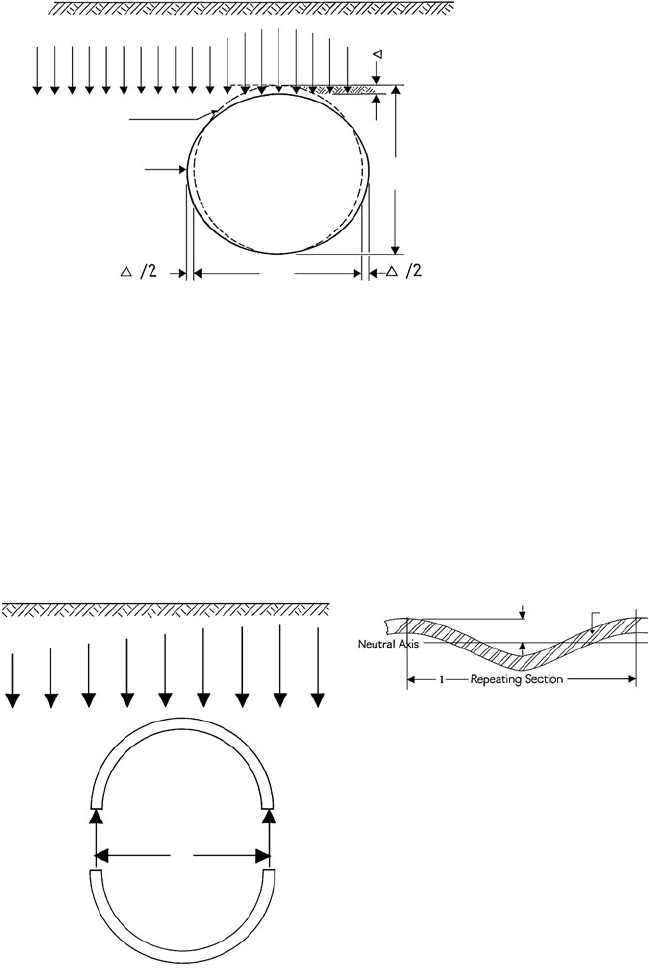
itations. One theory is based on ring deflection y/D. (See Fig. 6.1.)
The external soil load on a buried pipe generally causes the cross-
section (or ring) to deflect such that the vertical diameter decreases
and the horizontal diameter increases. According to the ring deflection
theory, to design the pipe, some maximum allowable ring deflection is
specified, then the actual ring deflection is predicted by one of several
available equations. The vertical deflection Δy is usually more pre-
dictable and more meaningful than the horizontal deflection x. How-
ever, y and x are approximately the same for steel pipe (although
opposite in sign) with y usually the larger.
Other design theories are based on the compressive ring stress in
the pipe wall. The ultimate (or maximum allowable) compressive
286 Chapter Six
stress f
c
is specified, then the computed compressive stress S is deter-
mined by the formula S P
v
(D/2A). (See Fig. 6.2.)
The vertical soil pressure P
v
is usually defined as the soil pressure
at the level of the top of the pipe if no pipe were in place. This implies
that the ring cross section compresses precisely as much as the soil.
Actually the pipe in place may cause pressure concentration or pres-
sure relief (if the soil is more or less compressible than the ring cross
section) which could possibly be taken into account by a stress concen-
tration factor.
Steel and Ductile Iron Flexible Pipe Products 287
Original Pipe
(No Load)
Deformed Pipe
(Vertical Soil
Pressure P
v
)
D
D
y
x
x
P
v
Figure 6.1 Ring deflection of buried flexible pipe.
P
V
D/2
P
V
D/2
D
c
A
Figure 6.2 Ring compression of buried flexible pipe. A area of wall cross-section per
unit length of pipe area/l; I moment of inertia about neutral axis per unit length of
pipe; E modulus of elasticity of pipe material; c distance to most remote fiber from
neutral axis; l unit length of pipe.
The ring compression method specifies that the ring compression
thrust P
v
D/2 must be less than the allowable thrust, which is the
allowable strength of longitudinal seam per unit length of pipe. This
method assumes that the vertical soil pressure on the pipe is P
v
and
that the soil completely supports the ring radially.
A modification of the ring compression concept includes wall crushing
and wall buckling in addition to seam strength as performance limits.
The computed stress is S P
v
(D/2A) (see Fig. 6.2), and the ultimate
stress f
c
is the crushing strength of the wall (yield point stress), the buck-
ling strength of the wall, or seam strength. Again, it must be assumed
that the soil is precisely as compressible as the ring cross-section.
Actually soil is not precisely as compressible as the ring cross-section,
and so the soil pressure on the ring is not exactly P
v
. But another prob-
lem arises also. Which wall strength, crushing or buckling, actually con-
trols performance and so limits design? At one extreme, if the soil could
resist all ring deflection, crushing would control and f
c
would be the
yield point stress. At the other extreme, if the soil were fluid, (i.e., could
resist no ring deflection), buckling may control. Of course, soil is some-
where between the two extremes and is compressible.
Still other theories are based on a predicted stress S in the pipe wall
as calculated by classical formulas such as
S
where P ring compression thrust, that is, P P
v
D/2
A area of wall cross-section
M moment on the wall
I moment of inertia of wall
c distance from neutral axis to most remote fiber
R
i
radius of curvature
R
o
original pipe radius
S total stress
bending stress
bending strain
E
bending
R
i
Thus
M ⇒
R
i
1
R
o
1
R
i
t
2R
i
t
EI
t/2
EI
t/2
EI
c
1
R
o
1
R
i
t
2R
o
t
Mc
I
Mc
I
P
A
288 Chapter Six