
Moser A.P., Folkman S. Buried Pipe Design
Подождите немного. Документ загружается.

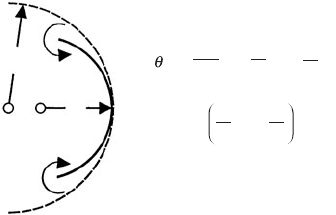
Then
M EI
To use this formula, the radius of curvature R
i
of the deformed pipe ring
must be known. The pipe wall is not crushed just because the stress S
reaches yield point. Stress S is the stress in the most remote fiber only,
and it may already be at the yield point due to cold-forming. See Fig. 6.3.
The design limit is performance limit divided by a safety factor. The
performance limit is excessive distortion of the soil-pipe system so that
either the pipe or the soil cannot perform adequately its designed func-
tion. Performance limits do not include a yield point stress in the most
remote fiber, or necessarily a specific ring deflection.
The performance limit of a buried corrugated steel pipe ring is defor-
mation of the ring beyond which the system can no longer perform the
purpose for which it was designed. If an unacceptable hump or dip or
crack develops in the soil surface above the pipe, the performance limit
is exceeded. If the flow characteristics of the pipe are reduced below
designed values because of ring deformation, the performance limit is
exceeded. The final definition of performance limit must be left up to
the design engineer.
For most installations, the definition of the performance limit is
incipient ring failure, as shown in Fig. 6.4. Incipient ring failure is
defined as some deformation of the ring beyond which the ring would
continue to deform (to collapse) if loads on it were not relieved by the
arching action of the soil. This is an arbitrary performance limit. It does
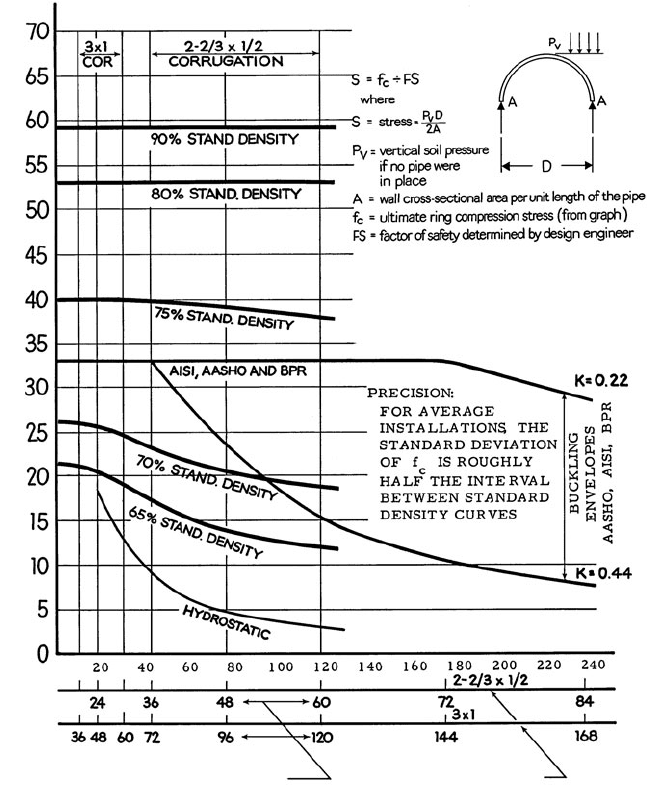
not mean collapse. The proposed strength envelopes shown in Fig. 6.4
become a design chart for this performance limit. The strength enve-
lope for dense soil exceeds the yield point for steel because part of the
vertical soil pressure is supported by the soil in arching action. An addi-
tional safety factor is built in because the ring does not collapse even
though it is deformed to incipient ring failure.
1
R
o
1
R
i
Steel and Ductile Iron Flexible Pipe Products 289
Figure 6.3 Relationship of
moment to change in radius of
curvature of pipe ring.
R
o
R
i
M
M
d
M
M
EI
EI
R
i
R
i
R
o
R
o
1
1
1
1
=
=
=
–
–
The performance limit for buried corrugated steel pipes is not a single
phenomenon, but the interaction of a number of phenomena. For exam-
ple, performance limit is not simply crushing of the wall, buckling of the
wall, shearing of the longitudinal seam, or ring deflection. Each of these
influences the others, and all are interrelated to varying degrees under
varying circumstances. As might be anticipated, the crushing strength
of the wall is less if the ring deflection is large. This is due to flexural
290 Chapter Six
Ultimate Ring Compression Stress F
c
(kips per square inch)
Design Method
Pipe Diameter D (inches)
Corrugations
Figure 6.4 Ultimate ring compression stress as a function of diameter and corrugations for
various values of soil density in percent of standard as determined by AASHTO method T-99.
stresses. A longitudinal seam in one panel causes a stress concentration
in the wall of the adjacent panel and triggers wall crushing. Of course,
as wall crushing develops, wall buckling is initiated and buckling near
seams causes seam failure—truly an interaction phenomenon.
In every case, the performance limit is a ring deformation observable
inside the pipe. The probable deviation in observing performance lim-
its may be as much as 10 percent of vertical soil pressure, especially
near the critical void ratio. The following are some deformations iden-
tified as performance limits in these tests.
Wall crushing. When the pipe is buried in densely compacted soil
(denser than the critical void ratio), wall crushing is often the first
indication that performance limit has been reached. Slight dimpling of
the corrugations is the first visual indication of distress. Dimpling is
not a performance limit, but dimpling portends the location of general
wall crushing. This crushing usually occurs between 10 and 2 o’clock
in the ring. Deep corrugations dimple as soon as or sooner than shal-
low corrugations, but general wall crushing shows up at equal or
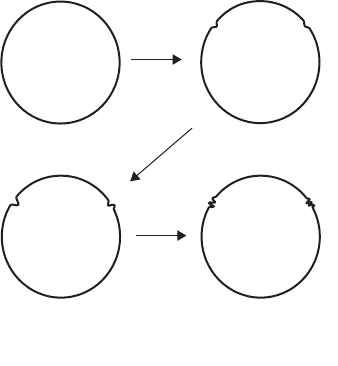
slightly higher pressures. In general, wall crushing develops as shown
in Fig. 6.5. It starts with a dimpling of the corrugations and progresses
into an accordion effect.
The crushing strength of the wall is the yield point stress times the
wall cross-sectional area per unit length of pipe. The yield point stress of
the steel involved in this experiment varied between 35 and 45 kips/in
2
.
This variation was not significant because the influence is partially
masked out by other variables, such as seam strength and ring deflec-
tion. There is little doubt that crushing strength would be directly pro-
portional to the yield point stress if seams were 100 percent efficient
Steel and Ductile Iron Flexible Pipe Products 291
Initial ring Beginning of
wall crushing
Advanced stages
of wall crushing
(accordion effect)
Continued wall
crushing
Figure 6.5 Diagrammatic sketch
of the mechanism of wall crushing.
and ring deflection were constrained to zero. Also, for a given gage of
steel, the cross-sectional area increases as the corrugations height is
increased.
In Utah State University tests, it was shown that ring flexibility
(D/r)
2
influences crushing strength in loose soil. This is seen in Fig. 6.4
where the curves drop off to the right as the ring flexibility increases.
Reversal of curvature. As the load increases, a section of the ring may
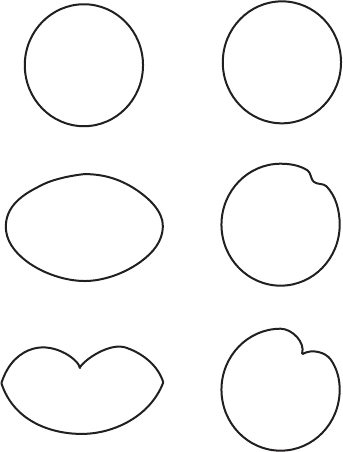
tend to flatten and then reverse curvature (Fig. 6.6). There are two gen-
eral types of reversal of curvature. In the case of very loose soil (density
less than the critical void ratio), as the soil is compressed downward the
pipe tends to form an ellipse, but in so doing high flexural stresses
develop at the sides. These stresses combined with some ring compres-
sion cause plastic hinges. If this deformation is carried to the extreme,
the top of the pipe comes down in a reversal of curvature, and ultimately
a third plastic hinge forms in the top center. The other type of reversal
occurs in dense soil and may be referred to as localized buckling. This is
not confined to top center. It usually forms between 10 and 2 o’clock, but
not necessarily so. Occasionally the reversal occurs in the bottom
between 5 and 7 o’clock. None has been seen in the sides between about
2 and 5 o’clock or between almost 7 and 10 o’clock. The performance
292 Chapter Six
Figure 6.6 Comparison of the types of reversal of curvature
observed in dense and loose soil.
Initial
Pipe
Initial
Pipe
Flattening of top precedes
reversal of
curvature
Ogree curve
starts reversal
of curvature
General Reversal of Curvature
(Extreme Deformation)
Localized Reversal of Curvature
(Extreme Deformation)
Hinge
Hinge
Hinge
Cusp
Loose Soil
Dense Soil
limit for deep corrugations tends to be plastic hinges at the sides rather
than reversed curvature. For shallow corrugation, plastic hinges at the
sides form only if the soil is very compressible; otherwise, the perfor-
mance limit is reversal of curvature. The difference is insignificant in
light of uncertainties in soil placement, density, or boundaries.
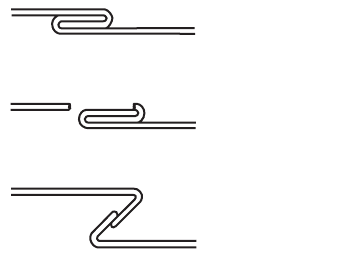
Seam separation. There is no question about identifying seam separa-
tion; the question usually relates to what triggers seam separation. In
the case of the helical lockseam, when a reversal of curvature com-
mences, and more especially as it develops into a cusp, the seam tends
to open. This is a simple tension separation. See Fig. 6.7. Apparently,
cold working of the metal in processing the seam weakens it enough
that the separation occurs in the metal adjacent to the seam due to a
combination of tensions and unfolding of the seam. If the reversal pro-
ceeds faster on one side of the lockseam, one side of the seam may lift
with respect to the other and so open the seam by unfolding it. This
usually happens in the bottom of the pipe and is due to nonuniform
bedding conditions. See Fig. 6.7.
In all cases, it is important to note that dimpling of the crests of the
corrugations is not a performance limit. Neither is slipping of riveted
or lockseam joints. These should be accepted as stress relievers. It is
highly significant that the extreme deformations referred to earlier are
not typical of field installations, but can be observed in a test cell.
Each design theory is based on an entirely different performance
limit based on entirely different phenomena. For example, ring deflec-
tion is based on compression of the soil and flexibility of the pipe ring.
Conversely, the ring compression theory is based on soil pressure and
either the strength of the wall (crushing or buckling) or the strength of
the seam, and soil compression and ring flexibility are not usually
included. A buried pipe can begin to register distress of one type which
then triggers a response and complete failure in another category.
Steel and Ductile Iron Flexible Pipe Products 293
F
F
Lockseam
initially
Lockseam tension
separation
Lockseam flexure
separation
F
F
Figure 6.7 Diagrammatic sketch
of seam separation of lockseam
joint.
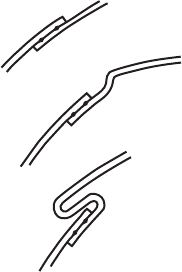
Under soil loading the pipe tends to form an ellipse, but in doing so,
flexural stresses develop. These stresses combined with some ring
compression cause what appears to be a wall crushing, which may be
described better as a plastic hinge (see Fig. 6.8). If this deformation is
carried to the extreme, the top of the pipe comes down in an inversion,
and ultimately a third plastic hinge forms in the top center.
The other type of reversal occurs in dense soil and may better be
referred to as localized buckling. This is not confined to top center. It
usually forms between 10 and 2 o’clock, but not always. Occasionally,
the reversal occurs in the bottom half between 5 and 7 o’clock. None
have been seen in the sides between about 2 and 5 o’clock or between
about 7 and 10 o’clock.
The most important factors influencing the above described perfor-
mance limits are the pipe wall crushing strength and the soil compres-
sion. Of lesser influence are the ring flexibility and the longitudinal
seam strength. Other factors such as soil friction angle are insignificant
or unknown.
The most significant results of the Utah State University tests are
shown in Fig. 6.4. The ordinate is the apparent ring compression
strength f
c
. It is defined as the apparent ring compression stress at the
performance limit, i.e.,
f
c
at performance limit (6.1)
where P apparent vertical soil pressure, i.e., calculated pressure at
level of top of pipe if no pipe were in place
D nominal diameter of pipe
A cross-sectional area of pipe wall per unit length of pipe
PD
2A
294 Chapter Six
Figure 6.8 Diagrammatic sketch
of welded seam showing typical
formation of hinge followed by
plastic flow.
Spot-welded seam
initially
Spot-welded seam
as it begins to hinge
Spot-welded seam
as hinge starts to
flow
Performance limit is ring deformati on beyond which the soil-pipe
system does not perform adequately. To design the pipe ring, one can
employ the well-known, universal design criterion stress < strength,
i.e.,
(6.2)
where P D
L
L
L
apparent vertical soil pressure (i. e., calculated
pressure at level of top of pipe if no pipe were in place)
that compromises dead load D
L
and live load L
L
D
L
␥H or unit weight of soil ␥ times the height of fill H
over the top of pipe
L
L
vertical soil pressure at level of top of pipe due to surface
loads
f
c
apparent ring compression strength that can be simply
picked off the plots (Fig. 6.4)
N safety factor
The ordinate in Fig. 6.4 is labeled ultimate ring compression stress.
The abscissa is ring flexibility (D/r)
2
. More correctly this should be
(D/r)
2
/E, where D is the diameter, r is the centroidal radius of gyration
of the longitudinal pipe wall cross-section, and E is the modulus of
elasticity of the pipe material. However, in these tests the only mater-
ial used in the pipes is steel for which E 29 10
6
lb/in
2
so E is a con-
stant and is not included in the variable (D/r)
2
.Within the precision of
these tests, the radius of gyration r is constant for a given corrugation
configuration (i.e., it is essentially independent of gage of steel); so the
abscissa can be displayed as a pipe diameter D for each given corru-
gation configuration.
In dense soil, the ring flexibility does not have a significant effect on
the ultimate ring compression stress. This is so because the ring
deflection is so small that any stress in the ring is pure compression
(not flexure). The performance limit is wall crushing and is indepen-
dent of ring flexibility. However, the factor of safety against reversal of
curvature is greater if the depth of corrugation is increased.
It is noteworthy that the strength envelopes dip down to the
ri ght with increasing ring flexibility. This is due to the increased
sensitivity of the very flexible ring to nonuniform soi l density. If
the soil could be placed particle by particle, the strength envelopes
would not dip down so much (especially in well-compacted soil).
However, present soil placement techniques result in nonhomoge-
neous soil that causes pressure spots and preci pitates wall buck-
li ng in the very flexible rings. This is shown as the ring buckling
zone.
f
c
N
PD
2A
Steel and Ductile Iron Flexible Pipe Products 295
Compression of the soil has a major effect on performance limits.
Compression is determined by the average vertical soil pressure P
v
and the soil modulus E.Soil modulus E is increased by increasing
the soil density. From the tests, the greater the soil density (greater E),
the greater the ultimate ring compression stress f
c
in the pipe wall.
Quantitative results are shown in Fig. 6.4. The difference between
the values of f
c
in dense and loose soil is roughly a 3:1 ratio. Why
should the strength of the pipe be greater in dense soi l if the pipe is
exactly the same? Even though the value f
c
is called an ultimate
ring compression stress, it actually is a measure of strength of the
soil-pipe system—not just the pipe. The contri bution of the soil as a
supportive structure increases the system strength if the soil is
dense and relatively rigid. On the other hand, if the soil is loose and
highly compressi ble, it will develop a pressure concentration on the
pipe as the soil compresses down under vertical pressure. Moreover,
soil compression causes ri ng deflection which further weakens the
system by adding flexural stress into the conduit wall and by
increasing the wall thrust by increasing the horizontal diameter. If
the pipe compresses down exactly as much as the soil, then the ver-
tical pressure on the pipe is the same as the vertical pressure P
v
in
the soil. If the soil is dense, then soil compression is small and the
cross sectional area of the pipe may be reduced more than the cross-
sectional area of the soil. So the pipe will relieve itself of vertical
soil pressure. This is tantamount to arching action inasmuch as the
soil is forced to bridge or arch over the pipe. Of major significance
is the critical void ratio of the soil. If a soil is compacted such that
it is denser than critical void ratio, then the pressure concentra-
tions on these corrugated steel pipes are only about 20 to 40 percent
of the pressure concentrations if the soil is looser than the critical
void ratio.
Parti cularly noteworthy is the great difference in the general
slope of the load-deflection plots for pipes buried in loose soil in con-
tradistinction to pipes buried in dense soil. The horizontal deflection
data are about the same as the vertical deflection data; however, it
has been found that vertical deflection data can be measured with
greater precision and, for most analyses, are considerably more
meaningful.
Some plots of general results are indicated in Fig. 6.4, which
shows the ultimate ring compression stress as a function of the
ring flexibility. Because the material is steel with a constant mod-
ulus, the ring flexibility can be reduced to (D/r)
2
or because the
radi us of gyration is essentially constant for any depth of corruga-
tion, this reduces to just pipe diameter D for specific corrugation
confi gurations.
296 Chapter Six
It must be understood, of course, that this presentation applies only
for a gi ven yield point stress. In this case, about 35 to 40 kips/in
2
.
If the yield point were twice as high, all the allowable stress lines
would go up roughly twice as high. This is not precise, however,
because ring flexibility, soil compressibility, and ring deflection, as
well as yield point of the material, influence the allowable stress lines.
The test data indicate that the longitudinal seams do influence the
ultimate ring compression stress lines, but show that this influence is
much less significant than the soil compression and pipe wall crush-
ing strength.
Example 6.1 Suppose that a 48-in-diameter 2
2
/
3
- by
1
/
2
-in corrugated steel
pipe is to be installed under 120 ft of soil embankment. The soil about the
pipe is to be compacted to 90 percent modified density (found to have a unit
weight of about 120 lb/ft
3
). Determine the pipe wall thickness (gage) if the
performance limit is defined as incipient ring failure (Fig. 6.4). Suppose that
H-20 loading will pass over the surface. If control of the installation is dubi-
ous, a safety factor of N 2 will be assumed.
The apparent vertical soil pressure on the pipe ring is
P D
L
L
L
14.4 kip/ft
2
where D
L
␥H 120 lb/ft
3
120 ft
L
L
negligible
The apparent ring compression stress is
where A area per unit length
The apparent ring compression strength (based on 40 ksi yield point) is
f
c
60 kips/in
2
which is the ordinate to the strength envelope shown in Fig. 6.4 corre-
sponding to soil density of 90 percent and a pipe diameter of 4.0 ft in a 2
2
/
3
-by
1
/
2
-inch corrugation. (Where the yield point is something other than 40 ksi,
the apparent ring compression strength f
c
is modified proportionally.)
Equating stress to strength divided by safety factor yields
or
60 kips/in
2
2
28.8 kips/ft
A
f
c
N
PD
2A
28.8 kips/ft
A
(14.4 kips/ft
2
) (4.0 ft)
2A
PD
2A
Steel and Ductile Iron Flexible Pipe Products 297
Solving for the area yields A 0.96 in
2
/ft. One should use 12-gage steel that
has an area of 1.356 in
2
/ft.
A check on ring deflection would predict a ring deflection of less than 3
percent at a soil density of 90 percent.
The ring flexibility factor (handling factor) is adequate.
Three-dimensional FEA modeling of a corrugated steel pipe arch.
Finite
element modeling of a corrugated structure presents special problems
that must be addressed if a solution is to be meaningful. If the struc-
ture is to be used as an underground shelter, it must be designed to
withstand very large longitudinal forces. These forces are developed
from large dynamic pressure loads acting on the shelter’s concrete end
walls, which in turn transmit a longitudinal load to the side of the cor-
rugated arch.
The modulus of elasticity and shear modulus of steel are material
properties that are usually considered to be independent of geometry.
In the case of corrugated pipe, the corrugations behave somewhat as
springs and allow structural deformation in addition to material elas-
ticity. The combined structural and material deformation may be
determined such that an equivalent modulus of elasticity and shear
modulus can be defined. The use of equivalent properties allows the
structural analysis to be completed by assuming orthotropic plate con-
ditions. The equivalent properties determined here represent analyti-
cal approximations that depend upon hypothetical boundary and
loading conditions. The purpose of these approximations is to assist in
the simplification of design.
Two separate finite element analysis (FEA) models were created for
determining the extensional elastic modulus and shear modulus of cor-
rugated plates. These models were created using the preprocessing
graphics capabilities of CAEDS finite element software. Then nodes
and elements were transported to NASTRAN for computer analysis.
Each computer model was run multiple times to provide results for
various material thicknesses of a 6 2 corrugation. The same basic
geometry was used for each of the different thicknesses. Uncoated
material thicknesses were used for all analyses.
The extensional elastic modulus of the corrugated plate was deter-
mined by applying increasing forces to one end of a finite element corru-
gation model one wavelength in length and 1 in wide. Load-deflection
curves were then constructed from the FEA results. The equivalent
extensional elastic modulus of the corrugation may be calculated from
the slope of the load-deflection curve in the linear region
E /
force/area
elongation/length
298 Chapter Six