
Moser A.P., Folkman S. Buried Pipe Design
Подождите немного. Документ загружается.

Plastic Flexible Pipe Products 499
Hinging.
The term hinging is used to describe yielding of the mater-
ial due to an excessive bending moment in the wall. These hinges usu-
ally take place at the 3 and 9 o’clock positions. These plastic hinges,
although primarily due to bending, can be influenced by a combination
of localized buckling and wall yielding caused by thrust in the wall of
the pipe. Hinging is usually considered to be a structural performance
limit.
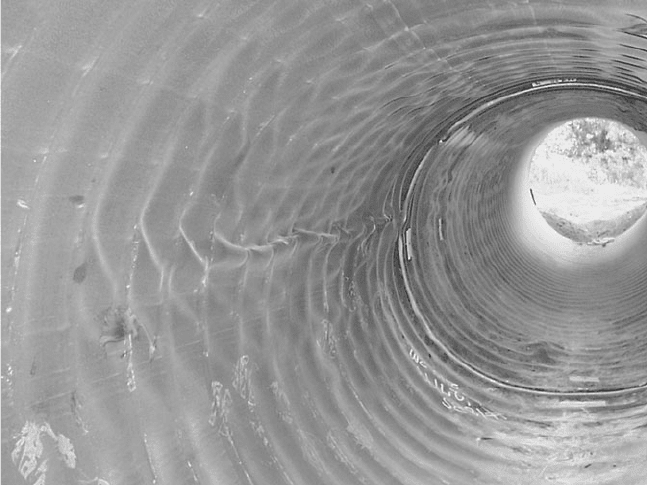
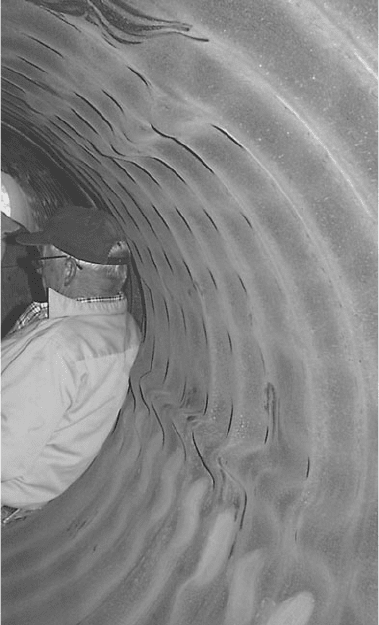
Wall crushing. The term wall crushing is used to describe yielding in
the wall produced by excessive compressive stresses resulting from
thrust in the wall. These large compressive stresses produce local
yielding and/or local buckling. Crushing is usually considered to be a
structural performance limit (see Figs. 7.74 and 7.75).
Summary and conclusions. The pipe cross section started out circular
and became elliptical as the height of cover increased. For the 75 and
77 percent dense soils, this deviation from a circle to an elliptical
shape was quite pronounced, and for the 83 percent dense soil the
deflected shape was elliptical, but less pronounced. The shape of the
pipe in the 95 percent dense soil remained closer to being circular even
Figure 7.74 Wall crushing and dimpling pattern on left side. Density 95 percent, and
load is 152 ft of cover.
500 Chapter Seven
for extremely high heights of cover. None of the test pipes ever exhib-
ited a so-called squaring or a square shape at any load. This result is
just what one would expect. The ratio of ring compression stress to
bending stress for the 75 percent dense soil is very low (much less
than 1). For the 83 percent dense soil, this ratio is low, but may
approach a value of 1. The ratio of ring compression stress to bending
stress, for the pipe tested in soil compacted to 95 percent of standard
Proctor density, is much greater than unity.
For polyethylene, which has a fairly low modulus, ring compression
stresses cause circumferential ring shortening. This ring shortening is
small for pipes installed with low heights of cover and in low to mod-
erately compacted soils. For high-density soils, at high earth covers,
Figure 7.75 Wall crushing and dimpling pattern on
right side. Density 95 percent and load is 152 ft
of cover.
Plastic Flexible Pipe Products 501
this circumferential ring shortening is very significant and is the pri-
mary deformation that takes place. This circumferential shortening is
extremely beneficial in the performance of the pipe. The decrease in
circumference relieves the pipe ring of some of the soil pressure and
causes the surrounding granular pipe zone material to carry a higher
percentage of the load. This works on exactly the same principle as the
slotted bolt hole in corrugated metal pipe. In a very large measure, the
pipe in test 3 was able to withstand extremely high loads because of
the substantial circumferential shortening that took place
Noteworthy is the high load that can be applied without distress to
the pipe ring. Clearly, the pipes deflect more in loose soil than in dense
soil because loose soil compresses more. The pipes do not collapse, even
in loose soil.
The soil should be granular and carefully compacted if the pipe is
buried under high soil cover or under heavy surface loads. Granular
pipe-zone backfill material at moderate to high densities ensures that
the pipes will perform well at high earth covers.
Incipient dimpling occurred at equivalent depths of cover in the
range of 44 to 126 ft (see Table 7.21). For the pipes tested, this incipi-
ent dimpling load is primarily a function of soil density. Dimpling is
not a structural performance limit.
The load at which a structural performance limit takes place is also
a function of the soil density. For a relatively poor installation (75 per-
cent standard Proctor), the performance limit is at 55 ft of cover. For a
good installation (83 percent standard Proctor density), hinging or
cracking begins at about 70 ft of cover. For an excellent installation
(95 percent standard Proctor), the lowest performance limit was 143 ft
of cover (see Table 7.22).
Performance limits and preliminary design
recommendations for profile-wall HDPE
pipes
A performance limit for a pipe is reached when the pipe no longer per-
forms in an acceptable manner. For a polyethylene pipe, overdeflection,
wall buckling, and wall crushing are usually considered unacceptable.
Deflection is usually controlled by proper installation. Wall buckling
can be controlled by controlling strains and by maintaining proper wall
thicknesses. Wall crushing is controlled by maintaining an adequate
area per unit length. Thus, area per unit length is the most important
parameter since wall thickness is directly related to the area.
Pipe stiffness is directly related to moment of inertia which, in turn,
is a function of area, shape, and corrugation height. It is important to
meet minimum requirements for pipe stiffness. Increasing the pipe stiff-
ness above the minimum will give some added performance benefits.
TABLE 7.21 Dimpling of HDPE Pipes Tested
Load at start of Deflection
Manufacturer, Diameter, Percent of dimpling, ft at start of
Test no. & type in Proctor density of cover dimpling, percent
1 Y, type 1 60 75 44 13
2 Y, type 1 60 83 51 12
3 Y, type 1 60 95 108 3.5
4 Y, type 2 42 75 48 13
5 Y, type 2 42 83 55 12
6 Y, type 2 42 95 126 6
7 Z, type 3 48 77 52 18
8 Z, type 3 48 95 113 4.9
502
TABLE 7.22 Performance Limit for HDPE Pipes Tested
Load at Deflection
Manufacturer, Diameter, Percent of performance at performance
Test no. & type in Proctor density limit limit, percent
1 Y, type 1 60 75 Excessive deflection 17
and dimpling at
55 ft of cover
2 Y, type 1 60 83 Cracks at 72 ft 17
of cover
3 Y, type 1 60 95 Excessive dimpling 5.7
at 143 ft of cover
4 Y, type 2 42 75 Excessive deflection at 16, 20
55 ft of cover, hinging
at 69 ft of cover
5 Y, type 2 42 83 Hinging at 69 ft of 15.6, 18
cover, cracks at 76 ft
6 Y, type 2 42 95 Cracks at 168 ft of cover 9.3
7 Z, type 3 48 77 Excessive deflection 15
and rib buckling at 46 ft
8 Z, type 3 48 95 Rib buckling at 87 ft 3.6
of cover
503
504 Chapter Seven
However, a higher pipe stiffness without a sufficient wall area can lead
to premature pipe failure. The proper design sequence for a specific
installation condition is as follows:
1. Choose area to prevent wall crushing.
2. Choose wall thickness to prevent buckling.
3. Corrugation height will be fairly well defined by the first two
items if pitch and shape are predetermined.
Test data were analyzed, and numerous finite element analysis
(FEA) runs were made using the computer program PIPE5 for HDPE
pipe buried in a silty-sand soil. Various combinations of wall area, wall
thickness, and corrugation height were run to determine the minimum
wall area for various depths of cover. Because of space limitations in
this book, FEA data are not presented. Also, the theoretical basis for
much of the following discussion is the field of dimensional analysis,
sometimes called similitude, which is well documented in engineering
texts. The conditions under which one may use results from one sys-
tem (test setup) to predict the behavior of another similar system are
determined by dimensional analysis and the use of dimensionless
numbers. One major advantage of such a theory is that a solution that
works for one diameter can be immediately extrapolated to other
diameters.
Area and thickness. The most important parameters in controlling
performance are area per unit length and wall thickness. Corrugation
height is a direct function of the area and thickness and can be calcu-
lated if the area per unit length, thickness, and shape are known.
It is recommended that all thicknesses, including the thickness of
the liner, be as close to equal as possible. The reason for this is that the
liner is strained close to the same level as the crown of the corrugation
(rib top). This is due to high ring compressive stresses at the spring
line. The thinner the wall, the more likely it is that localized buckling
will occur. It may be a detriment to make one part of the profile thick
and another thin. The one area that will be thicker is where the liner
joins the valley of the corrugation. The strains across the cross section
are fairly uniform because a major contributor to strain is thrust in the
wall which is uniform through the cross section. The above discussion
should not be construed to mean that thickness alone will control
buckling, since it is well known that controlling the unsupported
length of a section is of equal importance.
Corrugation height. If the corrugation height is too large, bending
strains become significant; and if one increases corrugation height

Plastic Flexible Pipe Products 505
while holding the area constant, then thickness has to decrease, which
leads to early wall buckling.
Pitch. Geometrically, pitch should be a function of diameter. That is, if
a pitch of 4 in works well for a 24-in-diameter pipe, a pitch of 8 in will
work well for a 48-in-diameter pipe.
Nondimensional parameters. Test data and finite element data suggest
that, for a profile-wall pipe, certain dimensionless parameters be set
within limits to ensure satisfactory performance of pipes subjected to
earth loadings. Table 7.23 is a list of possible parameters that arise
from the data, along with suggested limiting values. These values
appear to provide adequate structural stability. The pipes tested gen-
erally meet these requirements. However, these studies are still in
progress, and these values are provided as guidelines only.
Acrylonitrile-Butadiene-Styrene Pipes
ABS plastic for pipe manufacture is available in several types and
grades per ASTM D 1788. The physical properties of the various ABS
materials vary quite widely, as is indicated by Table 7.24. Most ABS
TABLE 7.23 Profile Wall Pipe Dimensionless Geometric
Parameters to Control
Dimensionless Possible value for
parameters HDPE
t
min
/r 0.005
t
min
/l
uns
0.02
I/r
3
4 10
5
A/r 0.02
L
p
/r 0.3
A area per unit length of cross section of profile
r effective radius of pipe
t
min
minimum thickness of any particular section of profile
l
uns
unsupported length (or width) of any particular
section of profile
I moment of inertia per unit length of profile section
L
p
length of profile section
TABLE 7.24 ABS Design Properties
Hydrostatic-design basis, lb/in
2
1600–3200
Hydrostatic-design stress, lb/in
2
800–1600
Elastic modulus, lb/in
2
200,000–400,000
Tensile stress, lb/in
2
2500–7000
Hazen-Williams coefficient C 150
Manning’s coefficient n 0.009

506 Chapter Seven
pipes, especially pressure pipes, are manufactured from grades with
the higher tensile properties.
Solid-wall ABS is used widely for drain, waste, and vent piping. It is
also used for smaller-diameter sanitary sewers. It is used to a very lim-
ited extent for smaller-diameter pressure piping.
The design methods and procedures are essentially the same as
those for PVC pipes with the appropriate elastic modulus for calculat-
ing pipe stiffness and the appropriate hydrostatic-design stress for
pressure pipe design.
A list of selected ASTM standards for ABS plastic pipes is given in
Table 7.25.
Example 7.15—An 8-in ABS pipe An 8-in solid-wall ABS pipe has been
selected for a sewer installation. The native soil is clay, and the water table
is about 8 ft deep. Most of the line will be installed about 10 ft deep, but one
section has depths up to 20 ft. The long-term deflection is not to exceed 5
percent. What pipe-zone soil and soil density should be specified?
From ASTM D 2751, SDR 42 and PS F/y 20 lb/in
2
. Use Spangler’s
equation. See Eq. (7.4) of Example 7.1.
Required E′
H 20 ft PS 20 lb/in
2
0.05
y
D
0.56H/(y/D) PS
0.41
TABLE 7.25 Selected Standards for ABS Plastic Pipe
ASTM D 1788 Rigid Acrylonitrile-Butadiene-Styrene (ABS) Plastics
ASTM D 2680 Acrylonitrile-Butadiene-Styrene Composite Sewer Piping
ASTM D 2661 Acrylonitrile-Butadiene-Styrene Plastic Drain, Waste and Vent Pipe,
and Fittings
ASTM D 628 Acrylonitrile-Butadiene-Styrene Plastic Drain, Waste and Vent Pipe
Having a Foam Core
ASTM D 2468 Acrylonitrile-Butadiene-Styrene Plastic Pipe Fittings, Schedule 40
ASTM D 1527 Acrylonitrile-Butadiene-Styrene Plastic Pipe, Schedules 40 and 80
ASTM D 2282 Acrylonitrile-Butadiene-Styrene Plastic Pipe (SDR-PR)
ASTM D 2750 Acrylonitrile-Butadiene-Styrene Plastic Utilities Conduit and Fittings
ASTM D 2751 Acrylonitrile-Butadiene-Styrene Sewer Pipe and Fittings
ASTM D 2469 Socket-type Acrylonitrile-Butadiene-Styrene Plastic Pipe Fittings,
Schedule 80
ASTM D 2235 Solvent Cement for Acrylonitrile-Butadiene-Styrene Plastic Pipe and
Fittings
ASTM D 3138 Solvent Cements for Transition Joints between Acrylonitrile-Butadiener
Styrene and Poly(vinyl Chloride) (PVC) Nonpressure Piping
Components
ASTM D 2465 Threaded Acrylonitrile-Butadiene-Styrene Plastic Pipe Fittings,
Schedule 80
Plastic Flexible Pipe Products 507
E′ 498 lb/in
2
500 lb/in
2
The pipe-zone material should be either a granular material compacted
to 90 percent Proctor density or a crushed angular stone. Because of the
high water table, the crushed stone should be specified since little or no com-
paction will be required for an angular stone. See Table 3.4 for E′ values for
various soils.
Other Thermoplastic Pipes
In addition to the thermoplastic piping materials discussed previously,
there are other types of thermoplastic piping materials which are used
to a lesser degree. These materials include polybutylene (PB), cellulose
acetate butyrate (CAB), and styrene-rubber (SR). A selected list of
standards for these materials is given in Tables 7.26, 7.27, and 7.28.
The design techniques which are used for thermoplastics such as PVC
can also be applied to these thermoplastic materials. The design engi-
neer should obtain necessary design parameters such as the hydrosta-
tic-design stress and pipe stiffness for the particular pipe and
material. These parameters may be used in design equations discussed
previously.
Example 7.16—Brittle behavior A strain-sensitive plastic sewer pipe has been
installed in an area where expansive soils are known to exist. The pipe
deflects as a flexible pipe, has a high pipe stiffness, and has a somewhat
brittle behavior. A TV inspection made 2 years after installation indicates
vertically elongated pipe with many pipe sections showing longitudinal
cracks along the 3 and 9 o’clock positions. The pipe was installed with a com-
pacted granular material around the pipe and 10 ft of cover. The expansive
soil is to the sides and under the pipe but not over the pipe. The TV pho-
tographs indicate the pipe to be vertically elongated in the 3 to 8 percent
range. Estimate the horizontal swell pressure exerted by the soil. (Assume
E′ 1000 lb/in
2
.)
The actual buried pipe may be used as a transducer to obtain a fair estimate
of the in situ horizontal swell pressures. This is accomplished by use of the
Iowa formula and the actual deflection behavior of the pipe. In short, this
formula may be used by providing pipe properties, soil properties, and pipe
deflection and then back-calculating the pressure necessary to produce that
deflection. [See Eqs. (7.1) and (7.2).]
Soil modulus E′ 1000 lb/in
2
Pressure (deflection ratio) (10)
0.061(soil modulus)
or
P
(10)
0.061E′
F/y
6.7
y
D
pipe stiffness
6.7
508 Chapter Seven
Table 7.29 indicates probable swell pressures in the range of 23 to 60 lb/in
2
for deflections of 3 to 8 percent.
Thermoset Plastic Pipe
Thermosetting resins give off heat during the curing process
(exotherm). Such resins cannot be melted and reformed as thermo-
plastics can. Epoxy, polyester, and phenolic resins are part of the ther-
mosetting resin family. Pipes made from such resins are usually
fiber-reinforced, and the fiber is normally E-type glass. The glass may
be continuous strands or rovings placed in a winding process, or it may
be chopped and placed in a centrifugal casting process. Glass fabric
and glass mats may also be used.
TABLE 7.26 Selected Standards for Polybutylene
ASTM F 809 Large-Diameter Polybutylene
Plastic Pipe
ASTM F 809M Large-Diameter Polybutylene
Plastic Pipe (Metric)
ASTM F 845 Plastic Insert Fittings for
Polybutylene (PB) Tubing
ASTM D 2662 Polybutylene Plastic Pipe
(SDR-PR)
ASTM D 3000 Polybutylene Plastic Pipe (SDR-
PR) Based on Outside Diameter
ASTM D 2666 Polybutylene Plastic Tubing
AWWA C902 Polybutylene Pressure Pipe,
Tubing, and Fitting,
1
2
in
through 3 in, for Water
TABLE 7.27 Selected Standards for CAB
ASTM D 2446 Cellulose-Acetate-
Butyrate-Plastic Pipe
(SDR-PR) and Tubing
ASTM D 1503 Cellulose-Acetate-
Butyrate Plastic Pipe,
Schedule 40
ASTM D 2560 Solvent, Cements for
Cellulose-Acetate-
Butyrate Plastic Pipe,
Tubing, and Fittings
TABLE 7.28 Selected Standards for Styrene-Rubber (SR) Pipe
ASTM D 3122 Solvent Cements for Styrene-Rubber Plastic
Pipe and Fittings
ASTM D 3298 Styrene-Rubber Plastic Drain Pipe, Perforated
ASTM D 2852 Styrene-Rubber Plastic Drain Pipe and Fittings