
Moser A.P., Folkman S. Buried Pipe Design
Подождите немного. Документ загружается.

Plastic Flexible Pipe Products 469
the most important part of the ductile-to-brittle curve is the brittle
region. A single value of selected stress at any value below the transition
stress can be used. This single point test drastically shortens the overall
testing time and can be applied as a MQC test.
Dr. Hsuan also reported on the utilization of postconsumer resins
(PCRs). The primary concern is the effects on long-term performance of
material. This obviously includes the stress crack resistance (SCR). She
incorporated into her study the influence of PCR on SCR of virgin PE
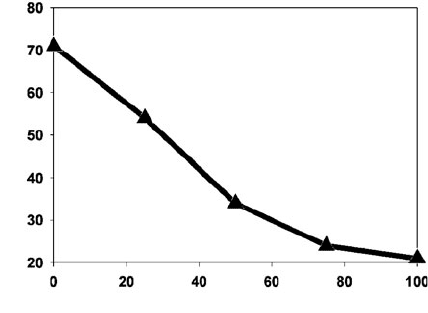
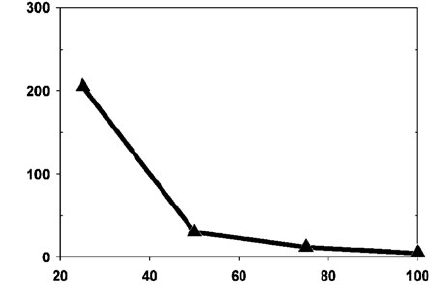
resins. A single PCR was blended with two virgin resins in fractions of
25, 50, and 75 percent. The two types of virgin resins used were blow
molding grade HDPE and PE 3408. The SCR of the blended and virgin
materials was evaluated using the SP-NCTL test at 10 percent yield
stress. Figures 7.43
24
and 7.44 show the failure times corresponding to
the PCR fraction in the blends. The failure time decreased as the
amount of PCR increased in both sets of blends.
As is evident from Dr. Hsuan’s research, the SP-NCTL test, which is
relatively simple and quick to conduct, can be used to establish the
long-term crack resistance of a PE. Additional research still needs to
be done to establish a suitable empirical correlation between the SP-
NCTL test results and field performance of PE pipe. Also the use of
postconsumer resins in the manufacture of PE pipe could lead to long-
term crack failures.
Structural performance of buried profile-wall
HDPE pipe
HDPE profile-wall pipes. Manufacturing techniques make it possible to
provide smooth liners for corrugated or profile-wall polyethylene pipes.
AT 10% of Yield Stress
Percent of PCR in the Blend
Failure Time (Hours)
Figure 7.43 Effect of PCR on the blow molding grade of
HDPE resin. (From Hsuan.
24
)
470 Chapter Seven
The ribbed profile wall adds ring stiffness to the pipe to maintain the
cross-sectional shape during installation and to support the soil over-
burden. The plastic wall has a very low frictional resistance for
improved flow characteristics. Also, the plastic wall provides most of
the longitudinal stiffness of the pipe.
Full-scale testing. Analytical methods for predicting performance of
buried pipes use empirical constants to make them work
13,18,22,29,61
—all
require experimental investigation to determine the unknown con-
stants. The full-scale testing procedure has been used with great suc-
cess at various research laboratories such as those at Utah State
University, the U.S. Bureau of Reclamation, and Ohio University. Data
obtained in this manner can be used directly in the design of pipe-soil
systems and in the prediction of overall performance. The possibility of
buckling, overdeflection, and wall crushing is evaluated simultane-
ously by actual tests. No attempt to explain the pipe-soil interaction
phenomenon is necessary in the use of this method, and the end
results leave nothing to be estimated on the basis of judgment. In the
collection of test data, a pipe is installed in a manner similar to that
used in practice, and the height of cover is increased until performance
levels are exceeded. The use of empirical curves or data eliminates the
need to determine the actual soil pressure since the pipe performance
as a function of height of cover is determined.
Profile of the pipe wall. Profile-wall pipes are designed and manu-
factured to minimize the use of material by increasing the section
modulus of the pipe wall. The concept of a profile-wall pipe is not
new, since corrugated steel pipe is truly a profile-wall pipe and has
AT 15% of Yield Stress
Percent of PCR in the Blend
Failure Time (Hours)
Figure 7.44 Effect of PCR on the HDPE 3408 resin. (From
Hsuan.
24
)
Plastic Flexible Pipe Products 471
been available for many years. Some of the newer plastic pipe prod-
ucts are of this type. Many of these products have been shown to per-
form with the profile section acting as a unit as designed. For
adequate safety for any such product, the design should include suffi-
cient plastic between the inner and outer walls and/or between the ribs
to carry shear and to ensure that the profile section indeed acts as a
unit. Also, the cross-sectional area per unit length and the individual
wall component thickness should be sufficient to resist localized buck-
ling.
The most important parameters for flexible pipe analysis and design
are (1) load, (2) soil stiffness, (3) pipe stiffness, and (4) profile design.
37
Any design method that does not include a consideration of these para-
meters is incomplete. For many flexible pipes, vertical deflection is the
variable that must be controlled by proper installation design.
Deflection is a function of the first three parameters discussed above.
Note that controlling vertical deflection may not control localized
buckling as a performance limit.
Test results. Tests on profile-wall polyethylene pipes were conducted
to provide information on performance. A list of the tests that were
performed is given in Table 7.19.
Procedure. High-density polyethylene pipes were tested at Utah
State University (USU). The objective of the tests was to determine
structural performance characteristics as a function of depth of cover.
The observed parameters (dependent variables) were ring deflection
and any visual evidence of distress. The independent variables were
soil type, soil density (compaction), and the vertical soil load simulat-
ing a high soil cover.
The basic soil type was silty sand and is designated as a class III soil by
ASTM D 2321. This soil is classified as SM according to the Unified Soil
Classification System. The maximum dry density (T-99) is 124.8 lb/ft
3
(1997 kg/m
3
), and the optimum moisture is 9.5 percent. SM soil is used
because it is common, it is of lesser quality than most soils specified as
backfill (and so is a worst-case test for most installations), and it can be
compacted over a wide range of soil densities.
These tests permitted an investigation of the performance limits of the
pipes subjected to external soil pressures. Tests were performed in the USU
large soil cell into which the sample pipe is buried and onto which a verti-
cal soil load is applied by means of 50 hydraulic cylinders (see Fig. 7.55).
The large pipe test cell has 10 loading beams with 5 cylinders on
each beam for a total of 50 hydraulic cylinders. These cylinders (rams)
provide
the vertical load on the soil simulating an embankment con-
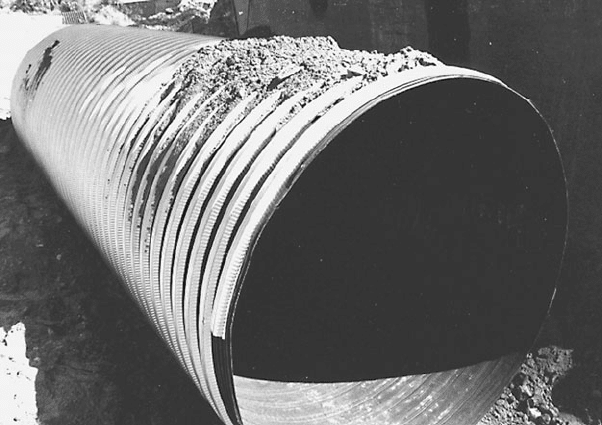
dition. Figure
7.45 shows a steel-ribbed HDPE pipe being installed in
the soil test cell.
471 Chapter Seven

TABLE 7.19 Overall Test Results
Test data Local buckling General buckling
Test Manu- Diameter, % Proctor Deflection, Deflection,
no facturer in density Cover, m percent Cover, m percent
X-1 X 48 95 10.4 2.0 21.0 6.0
X-2 X 48 75 6.7 6.5 10.4 9.0
X-3 X 48 85 5.8 3.0 14.0 8.7
X-4* X 48 85 10.4 5.5 15.8 9.8
X-5 X 60 94 20.0 5.3 32.0 12.2
X-6 X 60 85 16.0 6.5 22.0 11.7
Y-1 Y 48 75 8.5 10.0 10.4 13.1
Y-2 Y 48 85 8.8 5.0 18.0 11.5
Y-3 Y 48 96.5 36.6 3.5 55.0 6.3
*Double-thickness liner.
472
Plastic Flexible Pipe Products 473
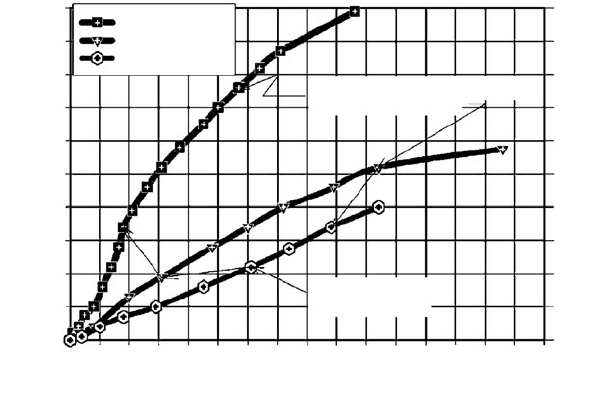
Test X-1.
A 48-in-diameter pipe with a single-thickness liner was
placed in soil compacted to 95 percent of standard Proctor density.
At 10.4 m of cover and about 2 percent vertical deflection, a dimpling
pattern on the inside wall became noticeable to the eye. This pattern,
which is the beginning of localized buckling, started at about the 2 and
10 o’clock positions. The center distance between dimples was about
the same as the external rib spacing. This pattern was somewhat
checkerboard in appearance and, of course, just the beginning of local-
ized instability of the thin inner wall.
General buckling of the wall at the 3 and 9 o’clock positions began at
21 m of cover. As the load was increased, general buckling became
more pronounced. Buckling of a pipe in soil is not like classical buck-
ling. In classical buckling, once the critical load is reached, cata-
strophic failure is imminent. However, for a buried pipe, it normally
takes another increment of load to produce another increment in the
buckling phenomenon. Loading was terminated at 30 m of cover. Data
for this test are given in Fig. 7.46.
Test X-2. In test X-2, a pipe with a single-thickness liner was
installed in soil compacted to 75 percent of standard Proctor density.
At 6.7 m of cover and about 6.5 percent vertical deflection, local buck-
ling, as described in test X-1, began to form. At 34 ft of cover, general
Figure 7.45 Test pipe being placed in test cell.
474 Chapter Seven
buckling of the wall began at the 3 and 9 o’clock positions. Loading was
terminated at 12.2 m of cover as general buckling was extremely pro-
nounced. Data are shown in Fig. 7.46.
Test X-3. In this test, a 48-in-diameter pipe with a single-thickness
liner was installed in soil compacted to 85 percent of standard Proctor
density. Local buckling began to form at 5.8 m of cover and about 6 per-
cent vertical deflection. At 14 m of cover, general buckling of the wall
began at the 3 and 9 o’clock positions. Buckling became more pro-
nounced as cover was increased from 14 m. Loading was terminated at
17.7 m of cover as general buckling was extremely pronounced. Data
for this test are given in Fig. 7.46.
Test X-4. In test X-4, the test setup was the same as that of test X-3
except the 48-in-diameter test pipe had a double-thickness liner. The
soil was compacted to 85 percent of standard Proctor density. Local
buckling, as described in test X-1, began to form at 10.4 m of cover and
about 5.5 percent vertical deflection. This buckling became more pro-
nounced as the soil load was increased and moved toward the 3 and
9 o’clock positions. General buckling (hinges in the pipe wall) began to
form at the 3 and 9 o’clock positions at 15.8 m of cover. Loading was
terminated at 17.7 m of cover as general buckling was pronounced.
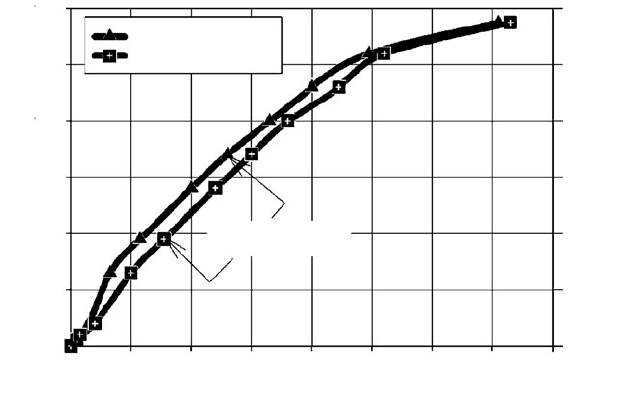
Figure 7.46 also shows graphically the importance of soil density in
controlling the pipe deflection. Figure 7.47 compares data for the pipe
with the double-thickness liner to data from the pipe with the single-
thickness liner. It is interesting to note that the first visual indication
Vertical Deflection (Percent)
Height of Cover (Meters)
Height of Cover (Feet)
30.5
27.4
24.4
21.3
18.3
15.2
12.2
9.1
6.1
3.0
0.0
0 1 2 3 4 5 6 7 8 9 1011 121314 1516
0
10
20
30
40
50
60
70
80
90
100
First Sign of
Local Buckling
Beginning of General Buckling
& Imminent Collapse
95% Std. Proctor
85% Std. Proctor
75% Std. Proctor
Figure 7.46 Data for tests X-1, X-2, and X-3.
Plastic Flexible Pipe Products 475
of local buckling took place at 10.4 m of cover, but for the single-thickness
liner pipe (test X-3) local buckling took place at only 5.8 m of cover.
Test X-5. A 60-in-diameter pipe was placed in soil compacted to
94 percent of standard Proctor density. At 20 m of cover and about
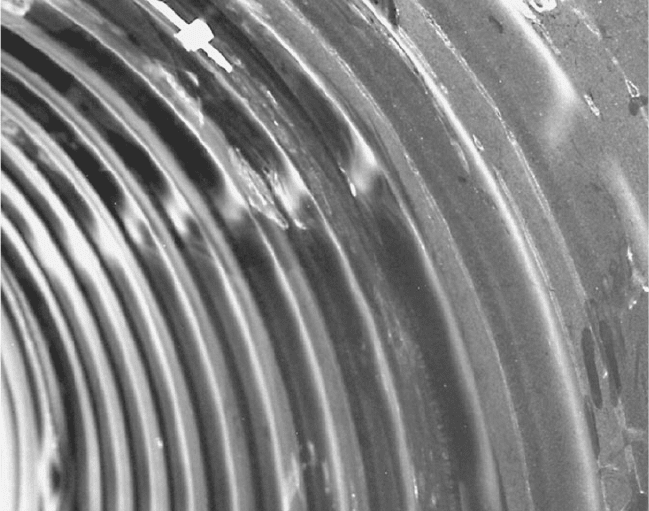
5.3 percent vertical deflection, a dimpling pattern on the inside wall
became apparent (see Fig. 7.48). This pattern, which is the beginning
of localized buckling, started at about the 2 and 10 o’clock positions.
The center distance between dimples was about the same as the exter-
nal rib spacing. This dimpling became more pronounced as the height
of cover was increased and spread toward the crown and the 3 and
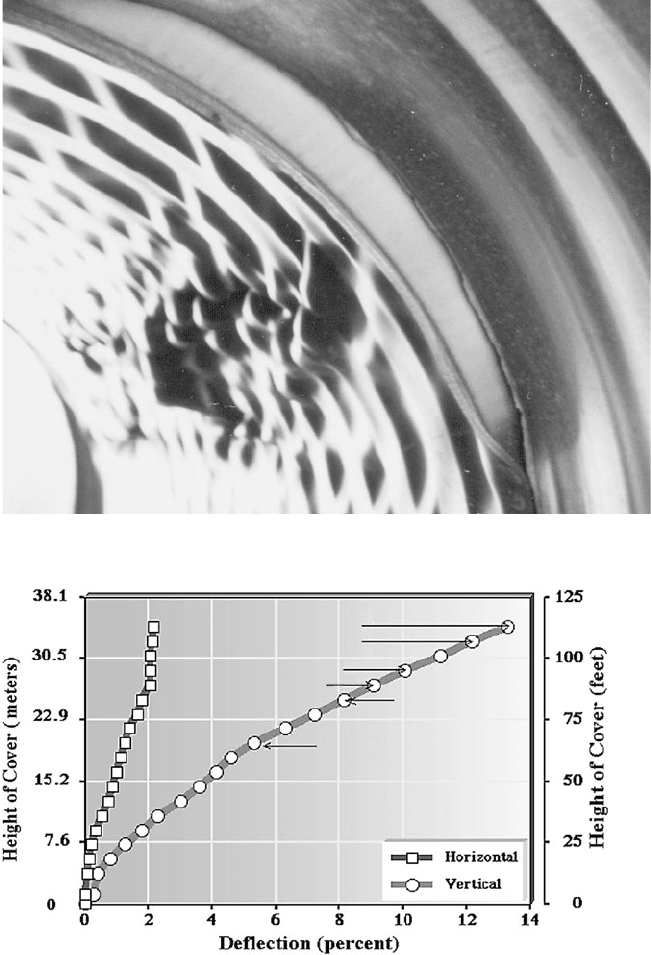
9 o’clock positions. The dimpling formed a waffle pattern at 25 m of
cover. Such a pattern is typical in classical wall buckling in pressure
vessels. This waffling pattern is somewhat checkerboard in appear-
ance and is just the beginning of instability of the pipe wall. Also, a
slight flattening was noted at the 8 o’clock position. Figure 7.49 shows
the waffling pattern and some localized buckling.
General wall buckling became apparent as the vertical cover
approached 32 m. At 34 m of cover, the top of the pipe began to form
an inverse curvature which is considered to be general buckling of
the pipe wall. The pipe could not maintain the imposed load of 34 m
of cover, and the test was terminated. Data for this test are given in
Fig. 7.50.
Test X-6. In this test, a 60-in-diameter pipe was installed in soil com-
pacted to 85 percent of standard Proctor density. At 16 m of cover, local
Vertical Deflection (Percent)
Height of Cover (Meters)
Height of Cover (Feet)
Double-Thickness Liner
Single-Thickness Liner
First Visual Sign of
Local Buckling
18.3
15.2
12.2
9.1
6.1
3.0
0.0
0
0
10
20
30
40
50
60
2 4 6 8 10 12 14 16
Figure 7.47 Data for test X-4 and a comparison with test X-3.
476 Chapter Seven
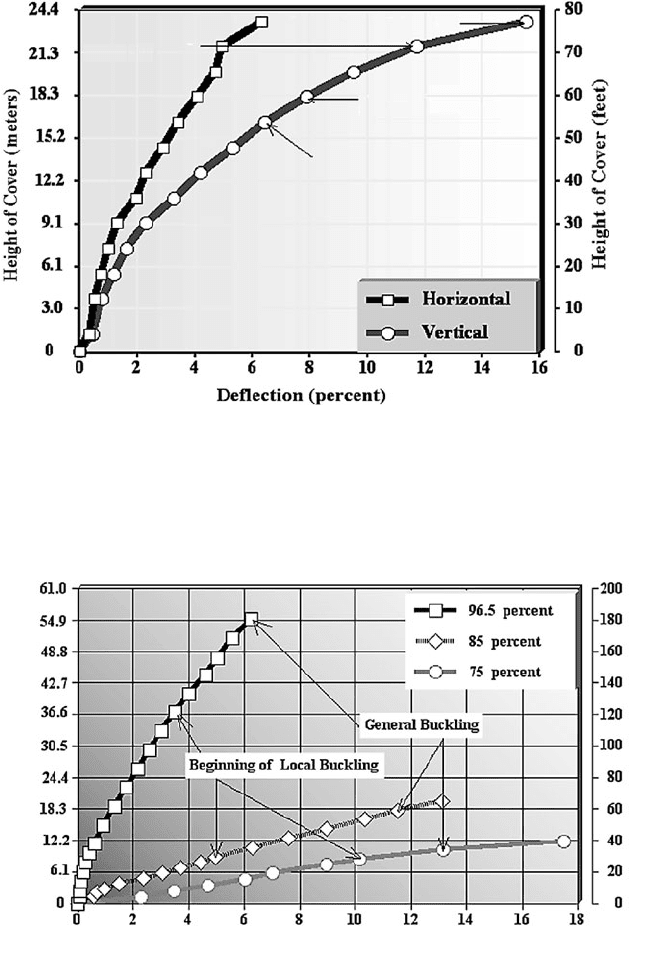
buckling began at about the 3 o’clock position. As the vertical load was
increased, this spread to the 2 o’clock position. The buckling formed a
waffling pattern at 18 m of cover. The pipe wall began to buckle on the
east side of the pipe at 22 m of cover. General wall buckling occurred
at the crown of the pipe at 23 m of cover. The pipe could not sustain
this load, and the test was terminated (see Fig. 7.51).
Test Y-1. A 48-in-diameter pipe was placed in soil compacted to 75
percent of standard Proctor density. A dimpling pattern on the inside
wall became noticeable to the eye at 8.5 m of cover and at about 10 percent
vertical deflection. A hinge line in the wall began to form at the 3 and
9 o’clock positions at 10.4 m of cover. This hinge-line (crease) is due to
high compression stresses produced by a combination of ring compres-
sion, ring bending, and localized buckling. As the load was increased
from 10.4 m of cover, this hinge became more pronounced (see Fig. 7.52
for data).
Test Y-2. A 48-in-diameter pipe was installed in soil placed at
85 percent of standard Proctor density. At about 5.8 m of cover and
about 3 percent vertical deflection, the weld/ribbing began to become
pronounced (more visible). Small dimples began to form near the 3 and
9 o’clock positions at about 8.8 m of cover and about 5 percent deflection.
Figure 7.48 Test X-5, inception of dimpling (18 m of cover).
Plastic Flexible Pipe Products 477
Figure 7.49 Test X-5, waffling pattern and local buckling (25 m of cover).
Inverse Curvature Starts
General Buckling Starts
Slight Flattening @ 8 o’clock
Waffling Pattern Starts
Buckling More
Pronounced
Local Buckling
Figure 7.50 Test X-5, 60-in-diameter HDPE pipe tested in silty-sand soil compacted
to 94 percent of standard Proctor density.
478 Chapter Seven
General Buckling
East Side
General Buckling from Top
Local Buckling
at 9, 2, 2:30 o’clock
Local Buckling 3 o’clock
Figure 7.51 Test X-6, 60-in-diameter HDPE pipe tested in silty-sand soil com-
pacted to 85 percent of standard Proctor density.
Vertical Deflection (Percent)
Height of Cover (feet)
Height of Cover (Meters)
Figure 7.52 Data for tests Y-1, Y-2, and Y-3; vertical pipe deflections for the three soil
densities tested.