
Moser A.P., Folkman S. Buried Pipe Design
Подождите немного. Документ загружается.

At 18 m of cover, a hinge (crease) began to form in the wall at the 9 o’clock
position (west side). Loading was terminated at 19.8 m of cover. Data
for this test are given in Fig. 7.52.
Test Y-3. This 48-in-diameter pipe was placed in soil at 96.5 percent
of standard Proctor density. The weld/ribbing became visually notice-
able at 18.9 m of cover and about 1.35 percent vertical deflection. A
slight dimpling pattern began at 36.6 m of cover. General localized
buckling of the wall began at the 3 and 9 o’clock positions at 55 m of
cover (see Fig. 7.52). This shows graphically the importance of soil den-
sity in controlling the pipe deflection.
Comments on test results. Noteworthy is the high load that can be
applied without distress to the pipe ring. Clearly the pipes deflect more
(for the same load) in loose soil than in dense soil because loose soil
compresses more. From a structural point of view, there are no reasons
why high-density polyethylene pipes cannot perform well. The soil
should be granular and carefully compacted if the pipe is buried under
high soil cover or under heavy surface loads. Granular pipe-zone back-
fill material at moderate to high densities ensures that the pipes will
perform well even at high earth covers.
The load at which localized buckling occurs is primarily due to ring
compression stress and is a function of soil density. At this point it is
not totally clear what the exact role of soil density is in preventing
buckling. It is clear that pipes installed in soils at high densities will
support higher loads without buckling. However, in the range of 75 to
85 percent standard Proctor, the effect of soil density is not clear.
General wall buckling in these tests was considered the upper per-
formance limit. The height of cover at which general wall buckling
takes place is as low as 10.4 m for lower-density soils. However, the
height of cover for generalized wall buckling can be as high as 55 m for
well-compacted soils.
The pipe cross sections started out circular and became elliptical as
the height of cover increased. None of the test pipes exhibited a so-
called squaring or a square shape at any load. For polyethylene, which
has a fairly low modulus, ring compression stresses cause circumfer-
ential ring shortening. This ring shortening is small for pipes installed
with low heights of cover and in low to moderately compacted soils. For
high-density soils at high earth covers, this circumferential ring short-
ening is very significant and is the primary deformation that takes
place. This circumferential shortening is extremely beneficial in the
performance of the pipe. The decrease in circumference relieves the
pipe ring of some of the soil pressure and causes the surrounding gran-
ular pipe-zone material to carry a higher percentage of the load. This
works on exactly the same principle as the slotted bolthole in corrugated
Plastic Flexible Pipe Products 479
480 Chapter Seven
metal pipe. In a very large measure, the pipes in these tests were able
to withstand high loads because of substantial circumferential short-
ening that took place.
HDPE pipes with a steel rib. In another design, a polyethylene profile
section is wound helically to form the pipe; then a steel rib is also
wound helically, interlocking mechanically with the profile section of
the polyethylene. The result is a polyethylene pipe with an external
steel rib. In this design, the steel rib is much stiffer than the plastic.
Thus, in ring deflection, the steel rib carries most of the load. When
buried in soil, polyethylene relaxes with time if the ring configuration
is held constant. In good backfill, for a given height of cover, the soil
does hold the pipe in a constant cross section; so the polyethylene expe-
riences stress relaxation, and the steel rib carries essentially all the
load on the pipe. In addition, the composite pipe (steel and HDPE) is
flexible so the soil takes a large share of the vertical load. The stati-
cally indeterminate soil-structure interaction is mutually beneficial.
The pipe serves as a form for the soil arch, and the soil supports and
protects the pipe against vertical loads by arching action of the soil.
The steel rib stiffens the pipe and helps to maintain the cross-sectional
shape during backfilling. However, for a HDPE pipe with a steel rib,
catastrophic failure is possible if the pipe is subjected to a load suffi-
cient to cause either yielding or buckling in the steel rib.
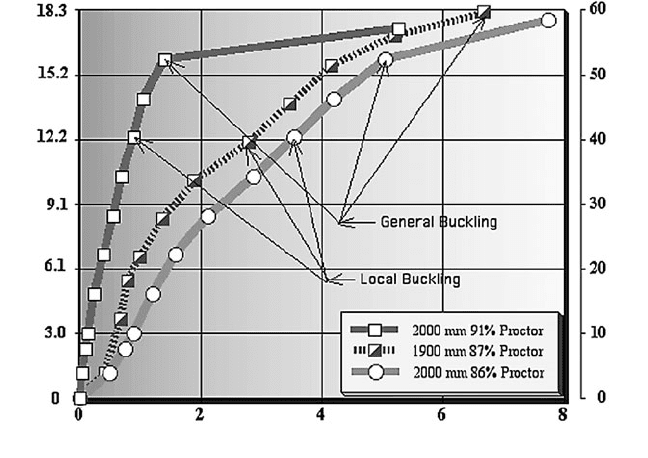
Test C-1. A 1900-mm steel-ribbed HDPE pipe was installed in soil
compacted to 87 percent of standard Proctor density. Audible sounds
were heard, indicating a slipping of the steel with respect to the plas-
tic at 8.5 m of cover. Yielding of the steel may have been taking place.
A slight bulging was noted near the 3 and 9 o’clock positions at about
10.4 m of cover. As the vertical load was increased, this bulging
increased. Localized buckling occurred at 15.5 m of cover. At 18 m of
cover, general wall buckling was evident, the pipe began to collapse,
and the test was terminated. For results, see Fig. 7.53.
Test C-2. A 2000-mm pipe was installed in soil compacted to 86 per-
cent of standard Proctor density. Audible sounds were heard, indicat-
ing a slipping of the steel with respect to the plastic at 10.4 m of cover.
Yielding of the steel may have been taking place. Local wall buckling
was noted, and the joint liner buckled at about 14 m of cover. General
buckling occurred at the top of the pipe at 15.8 m of cover. At 17.7 m of
cover, the pipe could no longer sustain the load, and the test was ter-
minated (see data in Fig. 7.53).
Test C-3. A 2000-mm pipe was installed in soil compacted to 91 percent
of standard Proctor density. Localized buckling began near the
5 and 7 o’clock positions at 12.2 m of cover. At about 14 m of cover, local
Plastic Flexible Pipe Products 481
wall buckling at the 5 and 7 o’clock positions became more pronounced.
This buckling became more prominent as the vertical load was increased.
General buckling began near the 2, 3, 9, and 10 o’clock positions at 15.9 m
of cover. At 17.4 m of cover, the pipe could no longer sustain the load, and
the test was terminated (see data in Fig. 7.53 and Table 7.20).
The steel-ribbed pipe behaves essentially the same as a low-stiffness
corrugated metal pipe. This is because the steel rib is much stiffer than
the polyethylene material. The higher-stiffness steel essentially car-
ries all of the load. Thus, the behavior of the steel rib is essentially the
behavior of the pipe. The load-deflection curves for the steel-ribbed
pipes do not resemble curves for other plastic pipe; rather, they resem-
ble curves for low-stiffness corrugated metal pipes. For example, for
polyethylene pipe, the horizontal deflection is substantially less than
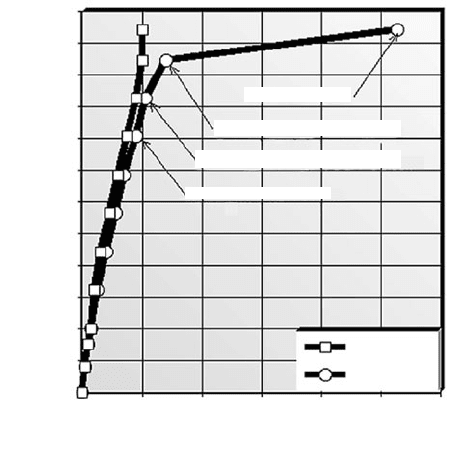
the vertical deflection (see Fig. 7.50). On the other hand, for steel-
ribbed pipe, the horizontal and vertical deflections are close to being
equal up to the point where the pipes begin to fail (see Fig. 7.54). This
is the way a metal pipe behaves. Also, in the tests of plastic pipe, signs
of distress at the 5 to 7 o’clock positions do not occur. However, on the
steel-ribbed pipe, localized buckling took place on the invert section of
the pipe. Tests of corrugated metal pipe installed in highly compacted
soil show this same type of behavior. Also, failure is much more cata-
strophic in the steel-ribbed polyethylene than in either corrugated
steel or HDPE (i.e., collapse can progress without an increase in load).
Height of Cover (Meters)
Vertical Deflection (Percent)
Height of Cover (Feet)
Figure 7.53 Data for tests C-1, C-2, and C-3; vertical deflections and buckling.

TABLE 7.20 Overall Test Results for Steel-Ribbed HDPE Pipe
Test data Local buckling General buckling
Test Manu- Diameter, % Proctor Deflection, Deflection,
no facturer mm density Cover, m percent Cover, m percent
C-1* C 1900 87 12.0 2.8 18.0 6.7
C-2* C 2000 86 12.2 3.5 15.8 5.0
C-3* C 2000 91 12.2 0.9 15.9 1.4
*Steel-ribbed polyethylene pipe.
482
Plastic Flexible Pipe Products 483
The behavior of this pipe shows that pipe stiffness alone will not control
localized buckling.
Test results for HDPE profile-wall pipe. Part of the data included in the
previous section were published in Transportation Research Record No.
1624, 1998. Data reported here are from a follow-on study. These data are
for 42-, 48-, and 60-in-diameter pipes. Profile design parameters have sig-
nificant influence on the structural performance of a pipe. Stable wall
designs will exhibit higher performance limits than less stable designs,
in terms of both dimpling of the interior and ultimate failure.
Procedure. During the summer of 1999, tests were performed on profile-
wall polyethylene pipes. These tests permitted an investigation of the
performance limits of the pipes subjected to external soil pressures.
Tests were performed in the USU large soil cell into which the sample
pipe is buried and onto which a vertical soil load is applied by means
of 50 hydraulic cylinders (see Figs. 7.55 through 7.60 for test cell and
testing procedure). The basic soil type was silty sand and is designated
as a class III soil by ASTM D 2321. This soil is classified as SM accord-
ing to the Unified Soil Classification System. See Figs. 6.11 and 6.12
for soil gradation and Proctor data.
Depth of Cover (Feet)
Deflection (Percent)
Horizontal
Vertical
0123456
Buckling at 5 & 7 o'clock
Continued Buckling at 5 & 7 o'clock
Buckling at 2, 3, 9, & 10 o'clock
Incipient Collapse
45
50
55
60
40
35
30
25
20
15
10
5
0
Figure 7.54 Performance of 2000-mm steel-ribbed HDPE
pipe tested in silty-sand soil compacted to 91 percent of stan-
dard Proctor density shows that horizontal and vertical
deflections are almost equal.
484 Chapter Seven
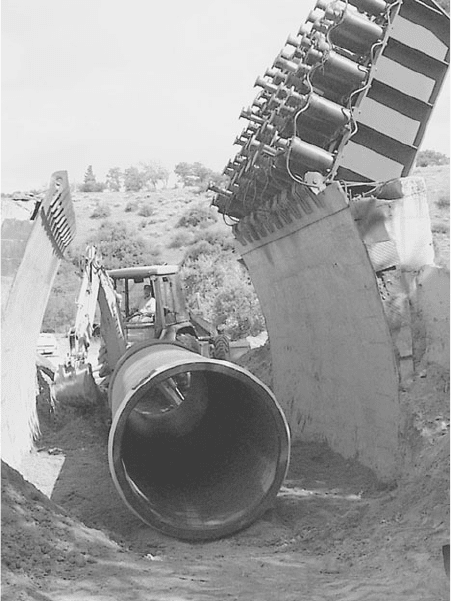
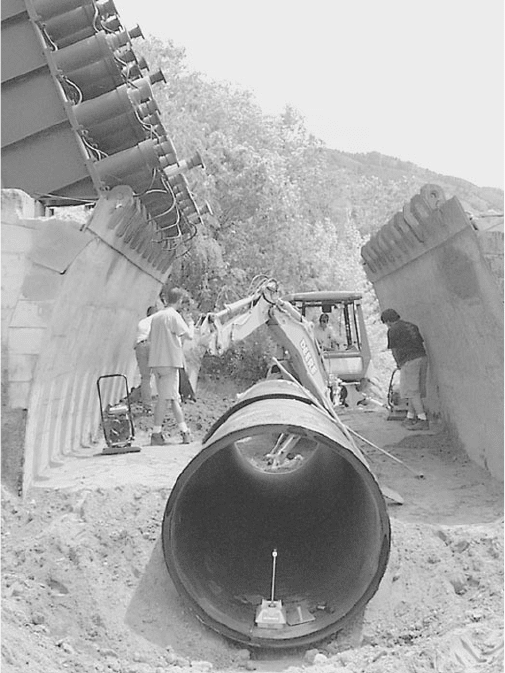
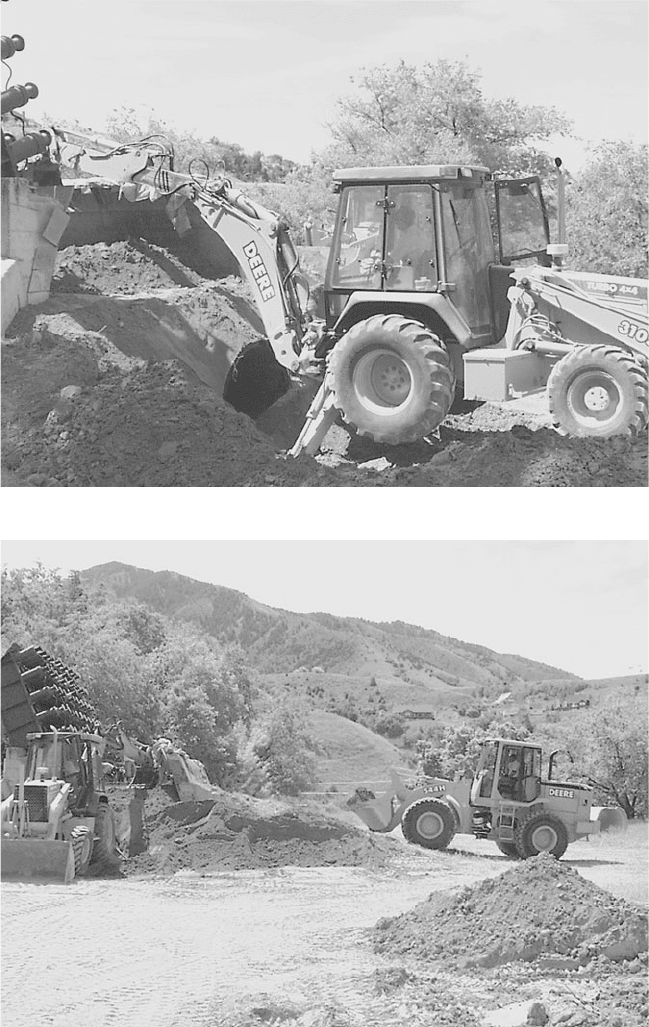
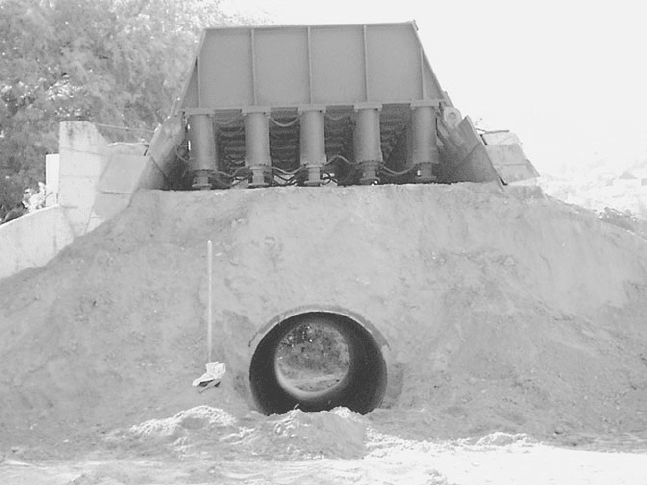
Figure 7.55 shows the test pipe being placed in the large soil test
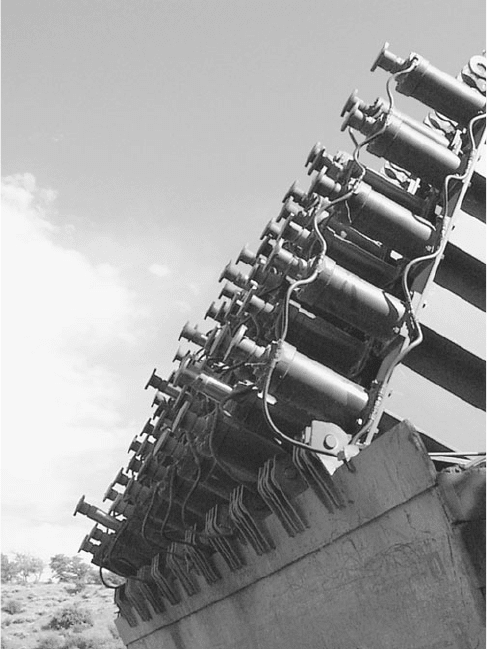
cell. Figure 7.56 is a photo of the loading rams used to apply the verti-
cal load simulating a soil embankment. Figure 7.57 shows the embed-
ment soil being compacted to the required density. Figures 7.58 and
7.59 show part of the process used to fill the test cell. Figure 7.60
shows the test cell full with the vertical load being applied.
Test details
Test 1
Pipe: 60-in diameter. Profile 1, HDPE
Embedment soil: silty sand
Compaction: 83% of standard Proctor
Test date: 6/24/99
Figure 7.55 A 60-in HDPE pipe being placed in the test cell.
Plastic Flexible Pipe Products 485
Test 2
Pipe: 60-in diameter. Profile 1, HDPE
Embedment soil: silty sand
Compaction: 95% of standard Proctor
Test date: 7/07/99
Test 3
Pipe: 60-in diameter. Profile 1, HDPE
Embedment soil: silty sand
Compaction: 75% of standard Proctor
Test date: 7/15/99
Figure 7.56 Photograph showing the 50 hydraulic cylinders used
for loading.
486 Chapter Seven
Test 4
Pipe: 42-in diameter. Profile 1, HDPE
Embedment soil: silty sand
Compaction: 83% of standard Proctor
Test date: 7/30/99
Test 5
Pipe: 42-in diameter. Profile 1, HDPE
Embedment soil: silty sand
Compaction: 95% of standard Proctor
Test date: 8/09/99
Figure 7.57 Soil placement, compaction, and density measurement.
Plastic Flexible Pipe Products 487
Figure 7.59 Soil placement process.
Figure 7.58 Backhoe loading soil in test cell.
488 Chapter Seven
Test 6
Pipe: 42-in diameter. Profile 1, HDPE
Embedment soil: silty sand
Compaction: 75% of standard Proctor
Test date: 8/15/99
Test 7
Pipe: 48-in diameter. Profile 2, HDPE
Embedment soil: silty sand
Compaction: 77% of standard Proctor
Test date: 9/14/99
Test 8
Pipe: 48-in diameter. Profile 2, HDPE
Embedment soil: silty sand
Compaction: 95% of standard Proctor
Test date: 9/22/99
Test 1 results. The pipe was placed in soil compacted to 83 percent of
standard Proctor density and the vertical soil load was increased to
8664 lb/ft
2
(72.2 ft of cover based on a soil weight of 120 lb/ft
3
). At a soil
Figure 7.60 Soil cell full, loading beams down, and load being applied to soil surface.