
Moser A.P., Folkman S. Buried Pipe Design
Подождите немного. Документ загружается.

required performance. “Turn-key” projects are typical of performance
specifications. Details on how to do it are left to the engineer and manu-
facturer. After the project is completed, the owner only has to turn the
key and operate it with assurance of adequate performance for the
design life of the project. Many products, such as home appliances, are
sold on the basis of performance specifications—with guarantee that per-
formance will be satisfactory over the life of the product.
In buried flexible pipe design, procedural specifications have been
the traditional basis for design. Pipe materials, shape, strength, mod-
ulus, seams, etc. are all spelled out. Soil type, placement, compaction,
and zones of backfill soil are all carefully specified. Even the installa-
tion procedure is described in detail.
In reinforced concrete pipe design, from experience, pipe design is so
complex and specialized that pipeline engineers favor performance
specifications leaving the burden of pipe manufacture to the specialists.
Besides the complexities of forming and casting the pipes, design
details include a multitude of variables such as reinforcing steel—size,
strength, smooth or deformed, spacing, directions, bonding, shear-steel,
cages, longitudinal steel, etc. Likewise, the concrete is a function of
many variables such as strength, aggregate size and distribution,
water-cement ratio, type of cement, admixtures, length of pipe sections,
etc. Consequently, engineers who specify reinforced concrete pipe, write
performance specifications based on the D-load strength of the pipe. D-
load strength is essentially a parallel plate load to failure. A section of
pipe is compressed between the two heads of a testing machine. D-load
is the load per unit length of pipe at failure. Failure is defined either as
the load at the opening of a 0.01-in crack in the wall of the pipe, or as
the maximum load that the pipe section can take. The pipe engineer
must then relate D-load strength to anticipated loads:internal pressure,
external pressure (soil, water table, and pressure due to live loads), and
soil bedding conditions. The pipe is specified by performance—i.e., the
minimum D-load. The D-load is assured by testing a statistically repre-
sentative number of the pipe sections.
The design of plastic inserts for rehabilitation of deteriorated pipes,
like reinforced concrete pipes, is specialized and complex. Specialists
are emerging with technology based on testing and on experience with
in-service performance. They are identifying the most important per-
formance limits, such as resistance to persistent external hydrostatic
pressure for a period of 50 years. Long-term testing is essential
because plastics creep. Long-term performance cannot simply be
related to strength regression test data. As the plastic insert creeps, it
changes shape with consequent increase in stress. Stress does not
remain constant as reported by strength regression data. Long-term
performance tests are essential.
Pipe Installation and Trenchless Technology 539
Whenever performance specifications are in conflict with procedural
specifications, performance usually prevails over procedure. Courts
usually construe for, i.e., weigh more heavily for, performance specifi-
cations and construe against procedural specifications.
Legal liability for performance
As products and installation methods become more complex and more
specialized, legal obligations of the manufacturer are tightened. The
traditional “caveat emptor” (let the buyer beware) is yielding to doc-
trines such as strict liability. According to caveat emptor, once the prod-
uct is sold, the contract is executed, ownership is transferred, and the
previous owner has no further liability. This doctrine began to change
when guarantees and warranties became part of the sales contract.
Statutes of limitation (time limit for filing a lawsuit) were adjusted in
common law to accommodate warranties. Further changes are occurring
as a doctrine of strict liability takes shape. Strict liability holds that the
statute of limitations for filing a lawsuit against any previous owner, or
anyone involved in manufacture, handling, marketing, dealership, repair,
modification, installation, etc., of a product, begins at the time of injury—
not the time of sale. The manufacturer has continuing liability and legal
exposure. The legal exposure may be mitigated by modification or abuse
of the product, or by reasonable anticipated wear or deterioration.
Testing of Insituform Pipes
Introduction
Insitupipes stop leaks in broken buried rigid pipes. But to what extent
does the liner contribute to the structural strength and shape of the bro-
ken pipes? The cracked rigid pipe will take some additional load without
collapse. The Insitupipe liner itself has structural strength and has sig-
nificant pipe stiffness. What is the strength of the composite ring, i.e., of
the cross-section, of buried, broken, lined pipe? Because theoretical analy-
ses are extremely complex and because of the many assumptions needed
for solution, full-scale physical tests were undertaken. Two full-scale tests
were performed in the large soil cell at Utah State University.
Procedure
The experiment comprised two tests, each with two parallel test sections,
in the USU large soil cell shown in Fig. 8.1. In each test, the two parallel test
sections were 30-inch pipes placed in the soil cell separated by a spacing of
7.5 ft center to center. The test sections were 20 to 25 ft long. The height
of soil cover over the tops of the test sections was 3 ft. The bedding was
firm and uniformly compacted soil. The pipe zone backfill soil was silty
540 Chapter Eight
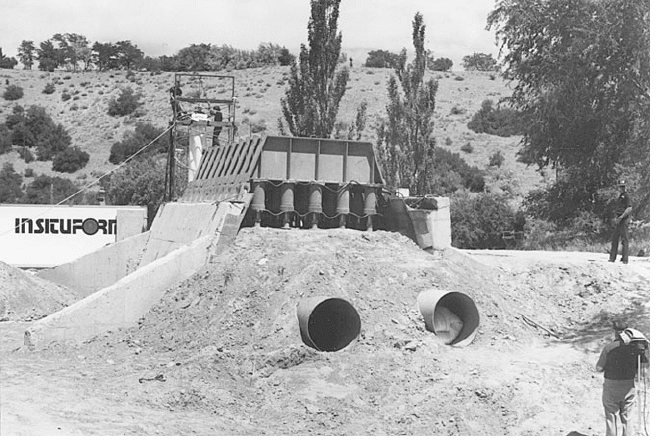
sand placed in layers and compacted to a uniform density. A vertical soil
load was applied by 50 hydraulic cylinders attached to ten beams as
shown in the photographs. Vertical diameters of the test sections were
measured after each increment of load.
Each of the two parallel pipe sections in the first test was made up
of 4 ft lengths of unreinforced concrete pipes, 30-inch inside diameter.
These were Class 3 pipes with a minimum specified three-edge bearing
strength of 3000 lb per linear ft. The joints were tongue-and-groove. No
gaskets or sealants were used at the joints. Each test section com-
prised five of these 4-ft-long pipe sections for a laid length of 20 ft. Both
of the test sections in the first test were broken. An unbroken pipe 4 ft
long was placed on each end of each of the parallel test sections to serve
as a transition. Access pipes were placed in tandem with each of the
transition pipes to provide for entrance of personnel. After backfill was
placed, one of the test sections was lined with Insituform pipe. See
Fig. 8.2. The 10 broken sections of concrete pipe were cracked in a three-
edge-bearing device. The average ultimate load was 3806.4 lb per linear
ft of pipe. The standard deviation was 398.04 lb per linear ft of pipe.
Before loading in the three-edge-bearing device, each pipe section was
banded with steel bands and stuffed with three 14-in diameter paper
sonotubes to serve as mandrels for holding the circular pipe cross sec-
tion during transportation and installation in the soil cell. Figure 8.3 is
a photograph of broken rigid pipes.
Pipe Installation and Trenchless Technology 541
Figure 8.1 The testing of Insituform pipe in the USU large test cell.
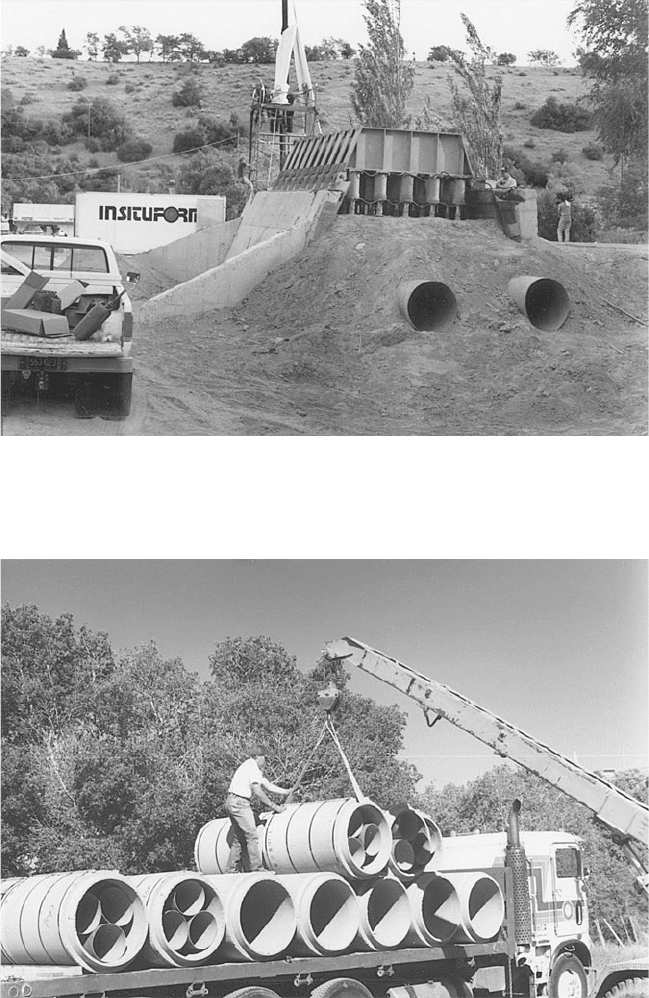
542 Chapter Eight
Figure 8.2 Test sections of pipe in place showing the process of inserting the Insituform
pipe. The pipes visible are access pipes.
Figure 8.3 Broken rigid pipe after breaking in three-edge-bearing device. Broken pipes
have paper sonotubes inside and are steel-banded on the outside to hold broken seg-
ments together.
The two test pipes in the second test were Insitupipes that had been
inverted and cured in paper sonotubes of 30-inch ID. One of the
Insitupipes was made from a standard resin with modulus of elastic-
ity of 300 to 400 kips per square inch. Its thickness was about 21 mm.
The other was a formulation of resin with a modulus of elasticity of
about 500 to 600 ksi. Its thickness was about 16.5 mm.
For each test, two parallel test pipe sections were placed in the cell
on a level soil bedding. A twelve-inch uncompacted lift of backfill soil
was located on each side of both test sections and hand-shoveled into
place under the haunches. Shoveling or shovel-slicing soil under the
haunches is a typical procedure on the job. Backfill soil was then
brought up in one ft lifts to 3 ft above the tops of the test pipe sections.
The surface was leveled and covered with steel plates onto which the
hydraulic cylinders would bear for loading the cell.
For the first test, each of the soil lifts was dropped into place from a
conveyor and leveled, but was not mechanically compacted. Moisture
content was kept on the dry side of optimum so that the soil density
was as uniform as possible under the weight of the soil itself. The aver-
age soil density was 75.7 percent AASHTO.
For the second test, each of the one ft lifts of backfill soil was leveled
and then compacted by one pass of a vibroplate compactor. The aver-
age soil density was 83.4 percent AASHTO T-99.
Test 1
This test comprised two parallel 20-ft-long test sections of 30-inch ID
rigid pipes that had been previously cracked by a vertical line load in
a three-edge-bearing test device. The cracks occurred approximately at
3:00, 6:00, 9:00, and 12:00 o’clock. The pipes were so oriented in the soil
cell that the top cracks in all of the five pipes in each test section were
at the top and were in-line. One of the two test sections was lined with
a 21-mm-thick Insitupipe. The objective of the first test was to provide
a direct comparison between the structural performance of two buried
broken rigid pipes under increasing vertical soil pressures; one test
section Insituformed and the other noninsituformed. Structural sup-
port is tantamount to an increase in safety factor or a margin of safety
against further deformation or collapse. Collapse of broken rigid pipes
can occur if cracks in the pipes allow leaks large enough for in-migra-
tion of soil particles from around the pipe, thus, leaving an empty vault
in the soil at the sides and over the pipe. A soil vault is the prime con-
dition for collapse of a broken rigid pipe. With no side support, the bro-
ken pipe collapses when the soil vault collapses. The test also provided
data for comparing the load-deflection diagram with the load-deflection
relationship predicted by theory.
Pipe Installation and Trenchless Technology 543
With the two test sections positioned in the soil cell, the sonotube
mandrels were removed. Access pipes were then located in-line with
the test sections for entrance of personnel. The first backfill soil lift was
placed on the bedding, shoveled under the haunches and leveled. A sec-
ond lift was then placed and leveled. With two lifts of soil backfill to
support the broken rigid pipes, the steel bands holding the pipes
together were cut and removed. The backfill was placed in one ft lifts,
but was not compacted. The soil lifts were continued on up to 3 ft above
the tops of the test sections. Soil embankments were then shaped up
at the ends of the cell. Loading beams were lowered and pinned into
place. A preliminary vertical soil pressure of 1450 lb/ft
2
was applied
with a corresponding pipe deflection less than one percent. This con-
figuration was established as the configuration of the broken rigid
pipes for Insituforming. Pipe deflections during loading were based on
this initial pipe deflection as zero and on this vertical diameter of the
broken rigid pipes. Insides of pipes were cleaned and an Insitutube
was placed and inverted in one test pipe. The Insitupipe with wall
thickness of t 21 mm, the dimension ratio DR, was in the range of 36
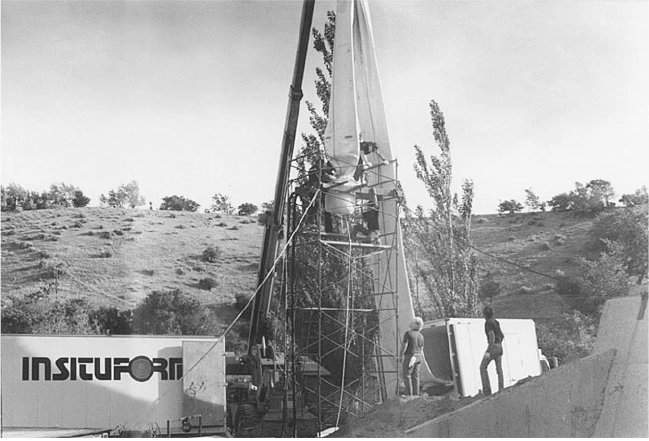
to 38. The Insitutube was inverted (see Figs. 8.4 and 8.5) at the rec-
ommended pressure head using a polyester resin and standard cure.
Vertical loads were applied in increments equivalent to about 6-ft of
soil cover at a unit weight of 120 lb/ft
3
. After each increment of load,
the vertical ring deflections were measured at various locations. All
other pertinent observations were recorded. This procedure continued
544 Chapter Eight
Figure 8.4 Equipment for inverting the Insitutube.
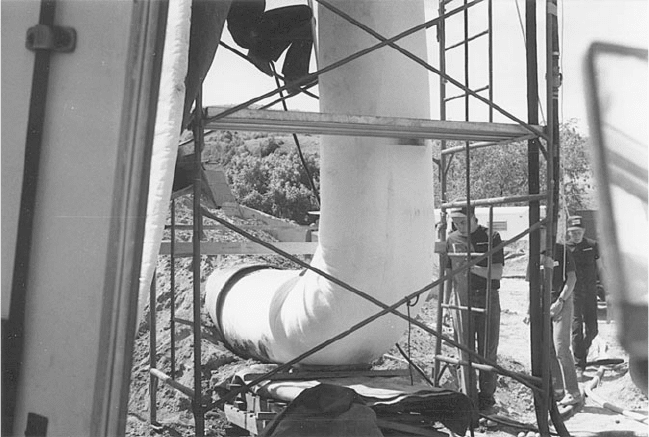
until a soil load of 8700 lb/ft
2
was reached which is equivalent to 72.5 ft
of soil cover at unit weight 120 lb/ft
3
. Measurements and observations
were recorded and the test was terminated.
Results of test 1
Pertinent observations from test 1 follow:
1. The Insitupipe contributes significant strength to the pipe-soil
system. The strength contribution is the result of two phenom-
ena, the reinforcement phenomenon and the stiffener phenome-
non as explained in the next paragraphs.
2. As the soil load increased above P = 2200 lb/ft
2
, the uninsituformed
test section began to deflect. The Insituformed test section did not
begin to deflect until the soil load was 2900 lb/ft
2
.This increase in
strength is the reinforcement phenomenon. The Insitupipe serves
as reinforcement. As cracks inside the rigid pipe widen at 6:00 and
12:00 o’clock, the Insitupipe holds the cracks together.
3. Above a soil pressure of 2900 lb/ft
2
, the load-deflection curves were
approximately linear up to about 10 percent deflection, but the
slope of the Insituformed curve is 1.5 times as steep as the unin-
situformed curve. This is the stiffener phenomenon. This increase
in strength is the contribution of pipe stiffness by the Insitupipe.
Pipe Installation and Trenchless Technology 545
Figure 8.5 Process of inverting the Insitutube.
4. The safety factor due to the reinforcement phenomenon is 1.4.
The safety factor due to the stiffener phenomenon is 1.5. The two
are not cumulative, but clearly the safety factor is not less than
1.5, even if bond is not achieved. In this test, the soil load was
increased. Therefore, the pipe deflection increased. In practice,
the pipe deflection does not increase—it has already occurred,
probably at the time the rigid pipe broke. Therefore, the increased
strength contributed by the Insitupipe is available as a margin of
safety of at least 1.5.
5. It is noteworthy that neither of the two test sections collapsed
completely even though both were deformed beyond what most
engineers would accept as performance limits.
6. As the pipe deflection increases in the broken rigid pipe sections,
the cracks widen and the potential for leakage increases. If the
leakage allows for in-migration of soil particles into the pipe, in
time, an empty soil vault will develop around and over the pipe.
The pipe loses its sidefill soil support. When the soil vault becomes
large, it collapses and soil falling on the broken pipe collapses the
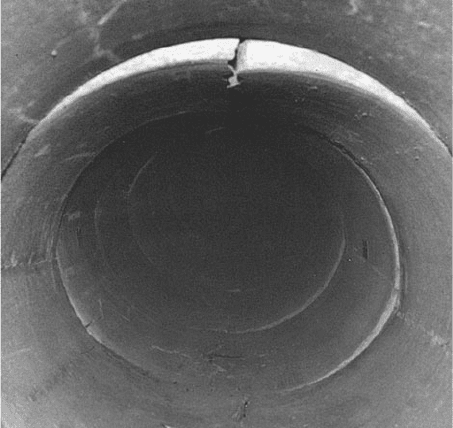
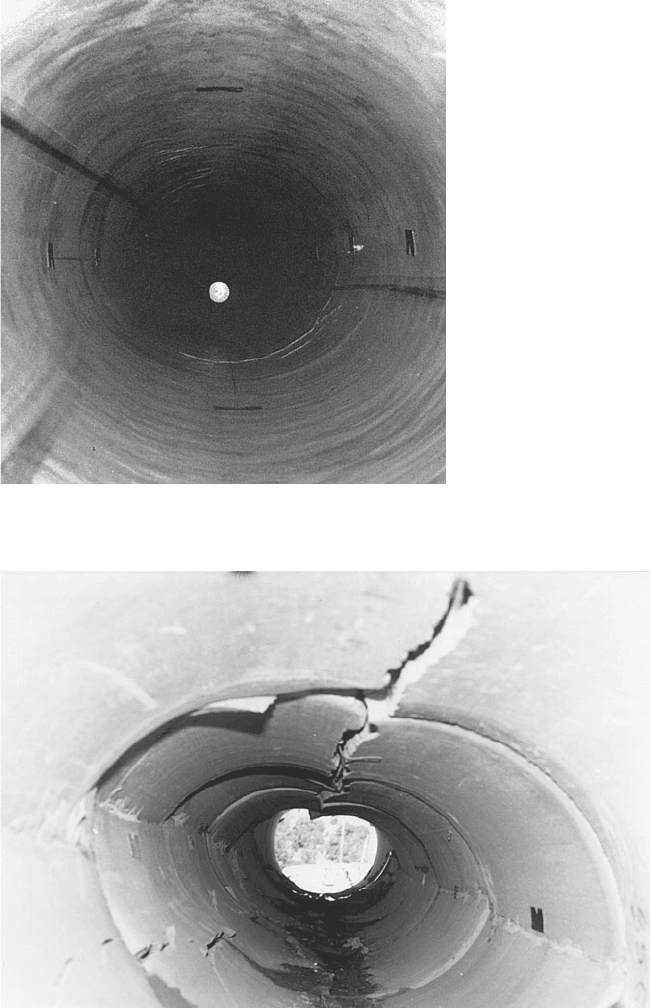
pipe. The photograph of Figs. 8.6 and 8.7 show the potential for
leakage and in-migration of soil particles into the uninsituformed
section. No such leakage potential occurred in the Insituformed
section. See Figs 8.8 and 8.9.
546 Chapter Eight
Figure 8.6 The inside of the broken rigid pipe test section
after loading to a vertical soil pressure of 5040 lb/ft
2
(equiva-
lent burial depth of 42 ft).
Pipe Installation and Trenchless Technology 547
Figure 8.8 The inside of the lined broken rigid pipe test section. The vertical soil pres-
sure is 5040 lb/ft
2
(equivalent burial depth of 42 ft).
Figure 8.7 The inside of the broken rigid pipe test section
after loading to a vertical soil pressure of 8700 lb/ft
2
.
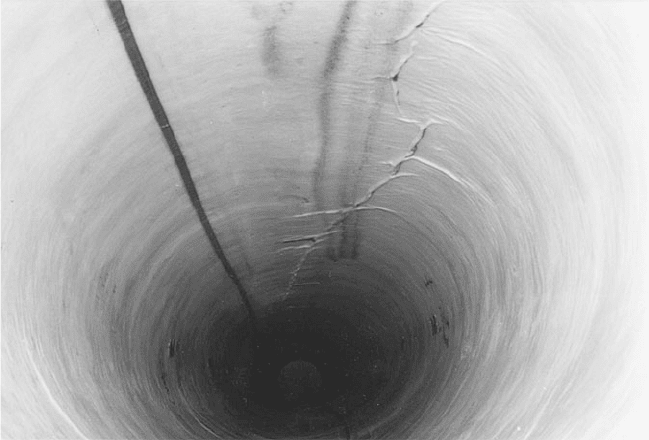
7. At the highest vertical soil pressure of P 8700 lb/ft
2
,a discon-
tinuous, longitudinal hair crack was observed inside the pipe in
the crown of the Insitupipe. This was not a leak, but is indicative
of the high tensile stress in the Insitupipe due to increasing deflec-
tion of the rigid pipe. The probability of such a crack in practice is
low because the broken rigid pipe does not continue to deflect.
Test 2
The purpose of the second test was to provide a comparison between
two 30-in OD buried Insitupipes—one of standard resin formula-
tion, with a 21-mm wall thickness, DR = 36 to 38; and the other of
a new resin formulation with a 16.5-mm wall thickness, DR = 46 to 48.
The two test sections were located in parallel i n the soil cell, and so,
for comparison, were subjected to the same backfill soil conditions
and the same vertical soil pressures. This test provided a quantita-
tive comparison of the load carrying capacity of each Insitupipe and
provided load-deflection diagrams of each for comparison.
The Insitupipes for this test were formed inside paper sonotubes.
Soil was placed to at least 1 ft over the 2 sonotubes into which Insitupipes
were formed. This soil cover provided a uniform insulation and heat
transfer medium during curing and cooling of the two 30-ft sections of
Insitupipe.
548 Chapter Eight
Figure 8.9 The inside of the lined broken rigid pipe test section. The vertical soil pres-
sure is 8700 lb/ft
2
.