
Moser A.P., Folkman S. Buried Pipe Design
Подождите немного. Документ загружается.


The two parallel test sections of the Insitupipe were placed in the
test cell. Access pipes were located in tandem at the other end of each
test section. Backfill was placed in 1-ft lifts. Each soil lift was compacted
by one pass of a vibroplate compactor. Compaction was continued in lifts
on up to 3 ft above the tops of the test sections. The average soil density
was 83.4 percent AASHTO T-99. Vertical soil pressure was applied in
increments of 50 psi in the hydraulic cylinders. Measurements and
observations were the same as in the first test.
Results of test 2
Data for standard Insitupipes and Insitupipes with Additive A are as
follows:
Data Standard Insitupipe Type 2 Insitupipe
OD (in) outside diameter 30 30
T mm wall thickness 21 16.5
DR dimension ratio3747
E (ksi) modulus of elasticity 350 550
1. The ratio of pipe stiffnesses for the Type 2 Insitupipe and the
Standard Insitupipe is R 0.75. Despite the greater modulus of
elasticity E for the Type 2 Insitupipe, its lesser wall thickness
prevails and the pipe stiffness is only three-fourths as great as
the Standard insitupipe.
2. The Standard pipe deflected slightly less than the Type 2 pipe.
3. No distress was observed in either of the test pipe sections. Even
at vertical soil pressure of 7300 lb/ft
2
, both pipes would perform
adequately in service.
Trenchless Technology Methods
Trenchless technology methods include all methods of installing or
renewing underground utility systems with minimum disruption of
the surface or subsurface. The demand for installing new under-
ground utility systems in congested areas with existing utility lines
has increased the necessity for innovative systems to go underneath
in-place facilities. Environmental concerns, social (indirect) costs,
new safety regulations, difficult underground conditions (existence of
natural or artifici al obstructions, high water table, etc.), and new
developments in equipment have increased the demand for trenchless
technology.
Trenchless methods have many advantages over conventional open-
cut methods, such as following (Najafi, 2005)
24
:
Pipe Installation and Trenchless Technology 549

■
Minimize the need to disturb existing environment, traffic, or con-
gested living and working areas.
■
Use predetermined paths provided by existing piping, reducing the
steering and control problems associated with new routing.
■
Require less space underground, minimizing chances of interfering
with existing utilities or abandoned pipes.
■
Provide the opportunity to upsize a pipe (within the technology lim-
its) without open-trench construction.
■
Require less exposed working area, therefore, is safer for both work-
ers and the community.
■
Eliminate the need for spoil removal and minimizes damage to the
pavement (the life expectancy of pavements have been observed to
be reduced by up to 60 percent with dig-up repairs), and disturbance
to other utilities.
Trenchless Technology (TT) methods are divided into two main areas:
Trenchless construction methods (TCM) and Trenchless renewal meth-
ods (TRM) as shown in Fig. 8.10. Trenchless construction methods (TCM)
include all the methods for new utility and pipeline installations, where
a “new” pipeline or utility is installed. Trenchless renewal methods
(TRM) include all the methods of renewing, rehabilitating, renovating,
and/or repairing an “existing,” “old,” or “host” pipeline or utility system.
Each of these main categories is further divided into subcategories as
defined in the following sections.
Requirements for new installation methods Soil information needed for tun-
neling and trenchless construction may be different from what is needed
for design. The project designers usually use the Unified Soil
Classification System (USCS, see Chap. 3). For trenchless technology con-
struction, additional information is required. The trenchless technology
contractor is concerned with the behavior of the soil during excavation
and removal. The terms commonly used in the trenchless technology
industry are running ground, flowing ground, raveling ground, squeezing
ground, and swelling ground. Some trenchless contractors are more famil-
iar with such terms as wet running sand, wet stable sand, dry sand, dry
550 Chapter Eight
Trenchless Construction Methods
(TCM)
Trenchless Renewal Methods
(TRM)
Trenchless Technology Methods
(TT)
Figure 8.10 Main divisions of trenchless technology methods (Najfi,
2005).
clay, wet clay, soil with small gravel, soil with large gravel, cobbles, boul-
ders, hard pan, soft or hard rock, and fill and mixed face conditions.
The successful completion of a trenchless construction project requires
a clear understanding of underground conditions and the selection and
utilization of equipment used for the specific conditions of the project.
The trenchless contractor must navigate through soil without seeing the
excavation face and conduit installation process. Trenchless construction
requires appropriate planning for expected underground conditions.
Once the trenchless excavation has started, it might be too late to make
any changes in equipment and method without extra costs and delays.
Contractors involved with construction of underground utility sys-
tems should familiarize themselves with compatibility of these meth-
ods and characteristics of underground conditions for a specific project.
The subsurface conditions will be important in the selection of the
proper trenchless equipment and method.
No one trenchless construction method (TCM) is best suited for all
conditions. It is important that all the project participants, including
the owner, installer, designer, contractor, and regulatory agencies
involved with TCM’s be familiar with the capabilities of the available
methods as some methods provide more flexibility than others. Due to
the increasingly critical nature of installations of utility systems in
congested areas, the need for monitoring and control systems has
increased. In many situations, it has become necessary that the sys-
tems be installed with a high degree of precision. However, conditions
may vary from project to project. Therefore, the methods permitted
should be based on an evaluation of the specific project. Methods con-
sidered acceptable in stable clay may not be suitable in wet sand and
the required precision for a sanitary gravity sewer line is not neces-
sary, in most cases, for pressure systems or cables.
At critical locations which involve public health and safety, it becomes
the designer’s and the regulatory agencys responsibility to limit pro-
posed methods to only those compatible for the conditions. This should
be accomplished with adequate and complete specifications prepared
with an understanding of the operating principles of available methods.
Requirements for trenchless renewal methods The term “renewal” refers to all
aspects of pipeline renewal, upgrade, and renovation activities where the
design life of the pipeline is extended. The term “repair” refers to when a
problem is fixed without adding to the design life of the pipeline system.
The most common step in design of trenchless renewal method is selec-
tion of the most appropriate, cost-effective, and reliable method.
Obviously, selection of a solution is based on recognition of the problem or
problems with the existing pipeline system. Since there is no “universal
problem” there is no “universal solution.” Sometimes the best method is
Pipe Installation and Trenchless Technology 551
found in application of multiple systems to achieve the most cost-effective
solution. The trenchless renewal solution can be applied to address struc-
tural problems, hydraulic problems infiltration/inflow problems, capacity
problems, corrosion problems, etc. The problem area can be found through
a complete evaluation of as-built drawings and other records, and inspec-
tion and monitoring of the existing pipeline systems. The process for
design and selection of a specific renewal method include many steps,
such as the following considerations:
■
Problem recognition and classification of the existing pipe, such as
ⴰ Type of existing pipe and any previous repair work performed on
the pipe
ⴰ Cracks, fractures, holes
ⴰ Corrosion
ⴰ Infiltration, inflow, and exfiltration
ⴰ Pipe deformations
ⴰ Line misalignments
ⴰ Capacity (hydraulic) problems
ⴰ Joint separation problems
ⴰ Debris, obstructions
ⴰ Existence and number of lateral connections
■
Capabilities and limitations of renewal method, such as
ⴰ Flow bypassing requirements of renewal method
ⴰ Requirements for reinstatement of laterals
ⴰ Material and durability considerations
ⴰ Maintenance and inspection requirements of the renewal system
ⴰ Availability of qualified contractors and service providers
ⴰ Life-cycle-cost analysis of the renewal system
ⴰ Constructability of the renewal system based on the project spe-
cific conditions
Just as for any other construction project, a renewal project is site and
project specific and many factors for selection of a specific renewal
method need to be considered. For example, local laws and regulations,
such as restrictions on personnel entry into manholes and pipelines is
site dependent. This is a major issue for selecting a renewal method and
should be resolved before initiating a pipeline renewal program. Life
expectancy is important for selection of a renewal method. Not all the
methods are able to provide a design life of, say, 50 years. Each pipeline
operator needs to make appropriate decisions based on its operation,
reliability and maintenance (ORM) strategy. Short-term and long-term
plans for use of pipeline, availability of local service providers and expe-
rienced contractors, budgetary requirements, new pipe material, type of
fluid and its acidity and corrosivity, are examples of other project factors
to consider.
552 Chapter Eight
Trenchless renewal methods
The basic trenchless pipeline renewal methods can be categorized into
the following types: (1) Cured-in-place pipe (CIPP), (2) Sliplining, (3)
In-line replacement, (4) Close-fit pipe, (5) Point source repair.
Cured-in-place pipe (CIPP). CIPP is a liquid thermoset resin-saturated
material inserted into the existing pipeline by hydrostatic or air inver-
sion or by mechanically pulling with a winch and cable. The material
is heat-cured in place. Insituform introduced CIPP in the United
Kingdom in 1971 and entered the U.S. market in 1977. In 1989, the
InLiner USA process was introduced in Houston, Texas. Other CIPP
systems have since been introduced into the market.
The primary components of the CIPP are a flexible fabric tube and
a thermosetting resin system. For typical CIPP applications, the resin
is the primary structural component of the system. These resins gen-
erally fall into one of the following generic groups: (1) unsaturated
polyester,
(2) vinyl ester, and (3) epoxy. Each resin has distinct chemi-
cal resistance and structural properties. All have excellent chemical
resistance to domestic sewage.
Polyester resins were originally selected for the first CIPP installa-
tions due to their chemical resistance to municipal sewage and eco-
nomic feasibility. Unsaturated polyester resins have remained the most
widely used systems for the CIPP processes for more than two decades.
Pressure pipeline and industrial applications typically use vinyl
ester and epoxy resin systems where their special corrosion and/or sol-
vent resistance and higher temperature performances are needed and
higher cost justified. In drinking water pipelines, epoxy resins are
required.
The primary function of the fabric tube is to carry and support the
resin until it is in-place in the existing pipe and cured. This requires
that the fabric tube withstand installation stresses with a controlled
amount of stretch, but with enough flexibility to dimple at side con-
nections and expand to fit against existing pipeline irregularities. The
fabric tube material can be woven or nonwoven with the most common
material being nonwoven. These fabrics provide some reinforcement to
the plastic after it has set.
The primary differences between the various CIPP systems are i n
the composition and structure of the tube, method of resin impreg-
nation (at the project site by hand or by vacuum, or at the factory),
installation procedure, and curing processes. There are two primary
approaches to installing the flexible tube-inverting in place and
winching in place. Specific variations of installation procedures and
materials are employed by different manufacturers. (see Figs. 8.11
to 8.15).
Pipe Installation and Trenchless Technology 553
554 Chapter Eight
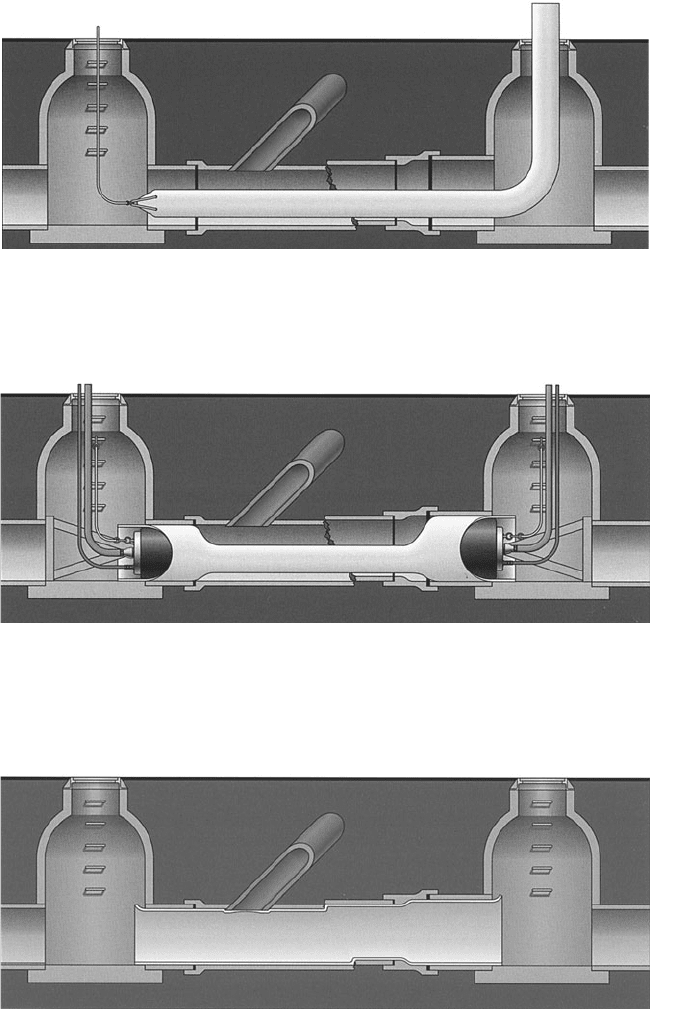
Figure 8.11 Diagram of liner pipe being pulled in a prepared host pipe. (Courtesy of
Ultraliner.)
Figure 8.12 Diagram of plugged liner pipe to be expanded with steam pressure.
(Courtesy of Ultraliner.)
Figure 8.13 Diagram of liner pipe after expansion. The liner forms a permanent, tight-
fitting new pipe. (Courtesy of Ultraliner.)
Sliplining. Sliplining is one of the earliest forms of trenchless pipeline
rehabilitation. A new pipe of smaller diameter is inserted by pulling or
pushing into a deteriorated host pipe and the annulus space between
the existing pipe and new pipe is usually grouted. In spite of a decrease
in cross-sectional area, there is often an increase in hydraulic capacity
due to smoothness of new pipe. This system is used where the host pipe
does not have excessive joint settlements, severe misalignments, large
deformations, and similar defects. The new pipe can form a continuous,
Pipe Installation and Trenchless Technology 555
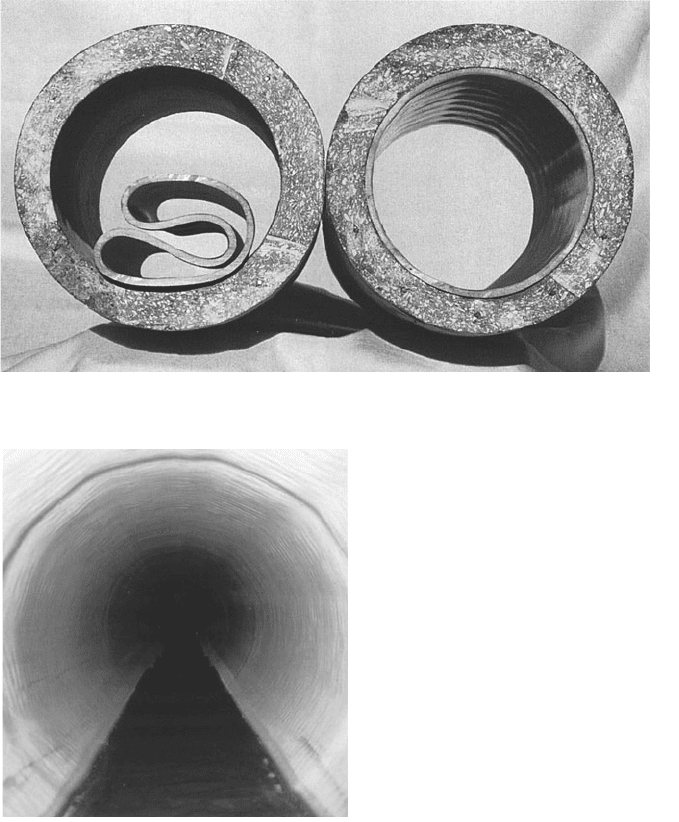
Figure 8.15 A 24-in-diameter
pipe after relining. (Courtesy of
Ultraliner.)
Figure 8.14 Portrayal of the folded pipe as inserted and how it appears after expansion.
(Courtesy of Ultraliner.)
watertight pipe within the existing pipe after installation. The service
connections are then reconnected to the new pipe. The new pipe has
the same grade as the existing pipe. Dependent on the type of loading
on the new pipe, grouting may be required. Sliplining can be catego-
rized into three types—continuous, segmental, and spiral wound. Each
method is discussed below.
The continuous slip-lining method involves accessing the deterio-
rated pipe at strategic points and inserting HDPE pipe joined into a
continuous tube through the existing pipe structure. This technique
has been used to renew gravity sewers, sanitary force-mains, water
mains, outfall lines, gas mains, highway and drainage culverts, and
other pipeline structures. The technique has been used to restore pipe
as small as 1 in (25.4 mm) and the maximum pipe diameter is limited
by the availability of factory-made pipes. An installation shaft long
enough to handle the bending radius of HDPE pipe and the depth of the
existing pipe is required. Existing flow may need to be plugged or
bypassed during the installation process. More than 30 years of field
experience shows that this is a proven cost-effective means that gives a
new structure minimum disruption of service, surface traffic, or prop-
erty damage that would be caused otherwise by extensive excavation.
The segmental slip-lining method involves the use of individual sec-
tions of pipe (usually 20 ft or less) that incorporate a low profile joint
(for smaller diameters) or a flush gasket sealed joint (for larger diam-
eters). Segments of the new pipe are assembled at entry points and
pushed inside the host pipe. After the new pipe is positioned in place,
the annular space can be grouted. This is a very simple method and
can be carried out by a general pipe contractor. Another advantage of
this method is that installation can be carried out without plugging or
bypassing existing flow. In fact, existing flow helps the insertion
process by floating the new pipe and lowering the frictional resistance.
The laterals are usually reconnected by excavation from outside. A
number of plastic pipe products, such as GRP, PVC, PP, and PE, which
include short-length sections with a variety of proprietary smooth
joints (both inside and outside) have been specially developed for slip-
lining sewers. Dependent on how the new pipe is pushed inside the
existing pipe, an installation shaft, 3 to 6 ft (1 or 2 m) more than the
length of the pipe section is required. This method is applicable for
diameters more than 12 in (300 mm) with typical diameters of 24 in
(600 mm) and larger.
The spiral wound slip-lining method uses a PVC ribbed profile sec-
tion with interlocking edges. A pipe is formed in-situ by spirally insert-
ing the profile section into the existing pipe. The edges of the profile
lock as it is inserted. This method can be used for either structural or
nonstructural purposes depending on the grouting requirements.
556 Chapter Eight
In-line replacement. This method of pipeline renewal is relatively
expensive since the existing pipe is removed and a completely new
pipe is installed. In-line replacement should be considered when
pipelines no longer have sufficient capacity or have failed structurally.
This trenchless method is broken into two categories: pipe bursting
and pipe removal.
Pipe bursting, was originally developed for the gas industry, but the
method has found application in the replacement of waterlines and
gravity sewers especially where upsizing is necessary. Pipe bursting is a
technique for breaking out the existing pipe by use of radial forces from
inside the existing pipe. The fragments are forced outward into the soil
and a new pipe is pulled into the bore formed by the bursting device. The
deteriorated host pipe (made of friable materials such as clay, concrete,
and cement asbestos) is broken outward by means of an expansion tool
and the new pipe is either towed behind the bursting machine or jacked
into place using conventional pipe jacking techniques. This method
requires the reconstruction of laterals by excavation from the surface.
Pipe removal. Pipe removal without trenching has been made possible
with the development of microtunneling machines with the capability
of crushing rocks and stones. Pipe removal equipments are modified
remote-controlled microtunneling systems with crushing capacities.
This method can be used to upsize an existing pipe. However, this tech-
nique has had little use in the United States because of the high costs
of equipment associated with this method of pipe removal. A patented
pipe removal system using directional drilling equipment to replace
and upsize an existing pipe has been used with success. This system
removes the existing clay, PVC, asbestos-cement, or non-reinforced
concrete pipe and simultaneously replaces it with a new pipe of equal
or greater diameter. The removal process is accomplished by back
reaming using a regular directional drilling machine. The directional
drilling machine is equipped with a cutterhead having spirally placed
carbide tipped teeth that grind and pulverize the existing pipe into
pieces. The pipe particles and excess materials, resulting from upsiz-
ing, are carried with drilling fluid to manholes or receiving pits and
are retrieved with a vacuum truck or slurry pump for disposal. The
new pipe (PVC or HDPE) is attached behind the mandrel and follows
the cutterhead as it progresses. Thus the destruction of the existing
pipe, cutting the soil to the required size, and the installation of the
new pipe is a simultaneous process. Another advantage of this system
is that the primary equipment is a directional drilling system which
can also be used in other trenchless technology projects. In recent
years, an auger boring method also has been used to remove an exist-
ing pipe and install a new pipe.
Pipe Installation and Trenchless Technology 557
Close-fit pipe. This type of trenchless pipeline renewal uses new pipe
before that is coiled, and deformed before it is installed. After placement
it is then expanded to its original size and shaped to give a close fit to the
existing pipe. Most lining pipe is first deformed in the manufacturing
plant, shipped to the job site, then inserted and finally reformed by heat
and pressure or naturally. Compared with CIPP, and assuming other pro-
ject factors to be the same, closed-fit technology does not require a long
curing process, therefore, requires less time to complete a project. This
method can be used for both structural and nonstructural purposes.
The modified cross-section method uses a jointless extruded PVC or
HDPE pipe folded or deformed to reduce the cross-sectional area. The
folded pipe is mechanically pulled into the existing pipeline, then
formed to the shape of the existing pipeline using heat, pressure, and
in come cases with a mechanized rounding device.
The drawdown method sliplines a HDPE solid wall pipe into an
existing pipeline after joints are butt-fused and the HDPE pipe is
swaged down in diameter. Diameter reduction depends on historic
memory that depends on the deforming temperature. Compressing the
pipe temporarily crushes the chain structure allowing the pipe to be
reduced in diameter and later reverted to its original size without
affecting performance. Pipes 3 to 24 in (76 to 600 mm) in diameter can
be installed utilizing this method. After long, continuous lengths of the
tube are pulled into the existing pipe, pressure is applied to the inside
of the new pipe to speed up the reversion process. The pipe in its
reverted form usually fits closely to the existing pipe wall and no annu-
lar space remains.
The rolldown system is similar to drawdown except that the new
pipe diameter is reduced for insertion by running the new pipe
through a cold rolling machine. This rearranges the long chain struc-
ture of the plastic pipe to produce a smaller diameter pipe with thicker
walls and minimal elongation.
Point source repair. Point source repairs are considered when local
defects are found in a structurally sound pipeline. This method of
pipeline rehabilitation covers a broad range of techniques such as
robotics repairs, grouting, link-sleeve, shotcrete, coatings, spray-on lin-
ings, CIPP, etc.
Coatings are fixed to the interior wall of the existing pipe by adhe-
sion or for robotics repairs, the defect is filled with epoxy. Systems are
available for remote-controlled resin injection to seal localized defects
between 4 and 30 in (100 to 760 mm) in diameter.
The new spot repair devices are used to address four basic problems.
The first purpose involves maintaining the loose and separated pieces of
unreinforced existing pipe aligned to ensure the load-bearing equivalent
558 Chapter Eight