
Moser A.P., Folkman S. Buried Pipe Design
Подождите немного. Документ загружается.

ground conditions, length of the drive, and experience of the oper-
ator. However, once the operation has started, there is no method
to control or change the direction of the drive unless sensing and
guiding devices are used. This method is generally not used for
installing lines that require a very high degree of accuracy such
as gravity sewer lines. A tolerance of 1 percent of the borehole
length is normally acceptable for this method. However, for cables
and other lines which do not require a very high degree of accu-
racy, it is accepted where it exits. When sensing and guiding sys-
tems are used, a tolerance of within a 1 ft (300-mm) radius of the
desired point is acceptable.
8. Recommended ground conditions. Since the method compresses
the soil around the borehole to create extra volume, moderately
soft to medium hard compressible soils are best suited for this
method. Dense and hard soils are the worst soils for this method.
Major advantages. Compaction method is a rapid, economic, and effec-
tive method of installing small diameter lines. This method can install
any type of utility line since the installation process is independent of
the boring process. The stability of the soil around the borehole is
increased since the soil around the borehole is compacted. The increase
in soil density decreases permeability which decreases the possibility of
borehole collapse until the desired line is installed. The capital invest-
ment in equipment is minimum and several pieces of equipment like
the air compressor and hydraulic power source are multifunctional.
Major limitations. Compaction methods are limited in their useful
drive length by their reliability. The present systems are basically
unintelligent, unguided tools that tend to bury themselves, surface in
the middle of the road, or damage existing utility lines. The use of
sensing and guidance systems on the compaction tools is still rare
because this has been recently developed and is not very popular.
However, the field test results appear positive.
Pipe jacking and utility tunneling. Pipe jacking (PJ) and utility tunnel-
ing (UT) are trenchless construction methods which require workers
inside the jacking pipe or tunnel. The tunnel is generally started from
an entry pit. The excavation can be done manually or by using
machines. However, it is accomplished with workers inside the pipe or
tunnel. The excavation method varies from the very basic process of
workers digging the face with pick and shovel to the use of highly
sophisticated tunnel boring machines (TBM). Since the method
requires personnel working inside the tunnel, the method is limited to
personnel entry size tunnels. Hence, the minimum tunnel diameter
recommended by this method is 42-in (1075-mm) outside diameter.
Pipe Installation and Trenchless Technology 569
Even though it is theoretically possible for a person to enter a 36-in
(900-mm) diameter tunnel, it is very difficult and unpractical for the
person to work in such tight quarters.
Irrespective of the method, the excavation is generally accomplished
inside an articulated shield which is designed to provide a safe work-
ing environment for the people working inside and to allow the bore to
remain open for the pipe to be jacked in place or the tunnel lining to
be constructed. The shield is guidable to some extent with individually
controlled hydraulic jacks.
Pipe jacking. Pipe jacking is differentiated from horizontal earth bor-
ing (HEB) in the sense that pipe jacking requires workers inside the
pipe. Although it is possible to install pipes up to 60 in using the HEB
method, it should be classified as HEB if the excavation is done by a
cutting head and the spoil is removed by augers or by any means
which does not require workers inside the pipe.
The process involves a simple, cyclic procedure of utilizing the thrust
power of hydraulic jacks to force the pipe forward. In unstable condi-
tions, the face is excavated simultaneously with the jacking operation
to minimize the amount of over excavation and risk of face collapse. In
stable ground conditions, excavation may precede the jacking process
if necessary. The spoil is removed through the inside of the pipe to the
jacking pit. After a section of pipe has been installed, the rams are
retracted and another joint is placed into position so that the thrust
operation can be started again.
The first step in any pipe jacking operation is site selection and
equipment selection as per the site requirements. A pipe jacking pro-
ject should be planned properly for a smooth operation. The site must
provide space for storage and handling of pipes, hoisting equipment for
the pipe, spoil storage and handling facility, etc. If adequate space is
available, a big jacking pit is preferred so that longer pipe segments
can be jacked and the total project duration is reduced.
The jacking pit size is a function of the pipe diameter, length of pipe
segment, shield dimensions, jack size, thrust wall design, pressure
rings, and guide rail system. The space available at the site governs the
selection of all the above components. The operator should be located
near the face so that he can readily see what is going on and can take
necessary action to encounter any situation that might develop.
The spoil is commonly removed by small carts. These carts are either
battery powered or powered by a winch cable. The spoil can also be
removed by using small diameter augers or by using a conveyer belt
system.
Packing material is placed between the pipe joints to provide cush-
ioning and flexibility. The most commonly and the only industry-wide
packing material is 0.5 to 0.75-in (12 to 19 mm) plywood.
570 Chapter Eight
Utility tunneling. Utility tunnels are differentiated from the major tun-
neling industry by virtue of the tunnel’s typical sizes and use. These
tunnels are used primarily as conduits for utilities rather than as pas-
sages for pedestrian and/or vehicular traffic. While methods of excava-
tion for pipe jacking and utility tunneling are similar, the difference is
in the lining. In the pipe jacking technique, pipe is the lining, while in
the utility tunneling technique, either tunnel liner plates or rib and
lagging become the lining. The linings for utility tunnels are consid-
ered to be temporary structures providing support until the utility is
installed and the annular void between the utility and tunnel lining is
filled with an adequate filler material.
In this case too, the excavation takes place inside a specially
designed tunneling shield. The excavation can be either manual or
mechanical. Manual excavation is done by craftsmen utilizing either
pneumatic tools or simply by picks and shovels. Mechanical excavation
can be done either by using a full face cutting head similar to those
used in the auger horizontal earth boring method or by a hydraulic
backhoe mounted inside the shield. In either technique, the operator is
located near the face so that he can readily see what is going on and can
take necessary action to encounter any situation that might develop. In
cohesive soil conditions and in some instances where the shield cannot
be removed due to not having a relieving pit, steel liner plates can be
installed without the use of a shield. Experienced and properly trained
tunnel operators are required when a shield is not used.
Major advantages. Pipe jacking and utility tunneling can be accom-
plished through almost all types of soils. A high degree of accuracy can
be obtained with a minimum amount of skilled labor. Since the operator
is located at the excavation face, he can see what is taking place and
take immediate corrective action for changing subsurface conditions.
The face can be readily inspected personally or by using a video camera.
When unforeseen obstacles are encountered, they can be identified and
removed. Many options are available for handling the sod conditions.
In utility tunneling, only a small jacking force sufficient to drive only
the shield has to be developed. Also, large sections of prefabricated
pipe do not have to be handled or stored.
Major limitations. Pipe jacking and utility tunneling are specialized
operations. It requires a lot of coordination. While these operations can
be conducted on a radius, it is recommended that all direction changes
be made at the shafts. The pipe and liners used for the operation
should be strong enough to resist the jacking forces. Hence not all
types of pipes and liner systems can be used for this operation.
The liner systems are classified as temporary structures. Therefore,
a carrier pipe or utility must be inserted through the tunnel liner and
Pipe Installation and Trenchless Technology 571
the void between the carrier pipe and the tunnel liner filled to provide
adequate support.
Microtunneling
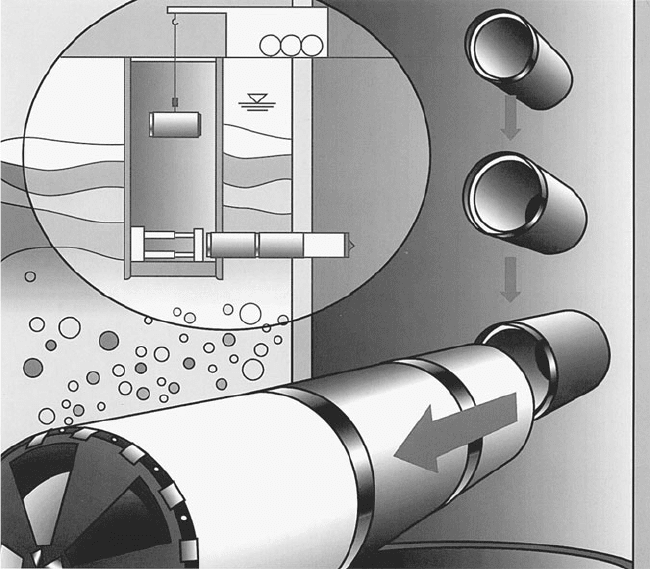
One definition of microtunneling (MT), as used in Europe, is that
microtunneling is a pipe jacking operation for lines that are less than
or equal to 36 in (900 mm) and, therefore, require non-worker entry
tunneling machines (see Fig. 8.16). However, in North America, the
term microtunneling is used for remote-controlled pipe jacking opera-
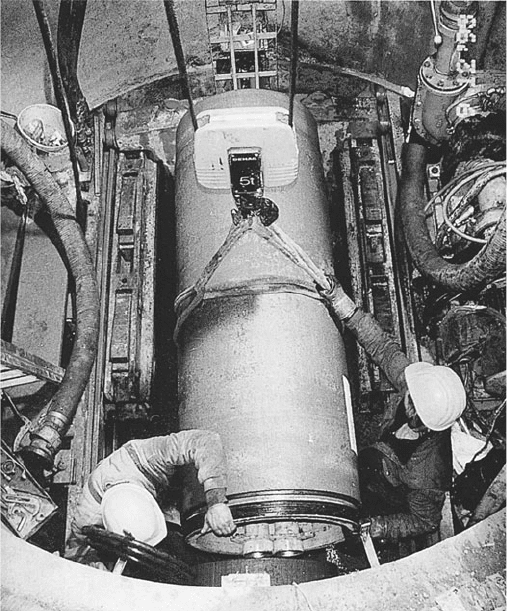
tions, even for larger diameters and worker-entry pipes (see Figs. 8.17
and 8.18). Microtunneling machines are laser-guided, remotely-controlled,
and have the capability to install pipelines on precise line and grade.
The MT method i s used to install pipe within a tolerance of 1 in
(25.4 mm) with respect to both the horizontal and vertical alignments.
This method can be used to install pipes in virtually any type of ground
conditions up to 45 m (150 ft) below the ground surface and usually up
572 Chapter Eight
Figure 8.16 Diagram of how pipe is installed by jacking with a boring machine. (Courtesy
of Meyer-Polycrete.)
to 225 m (750 ft) in length from the drive shaft to the reception shaft,
without intermediate jacking stations (Iseley and Najafi, 1999).
In 1984, North America witnessed the first, difficult but successful,
microtunneling trial for a sewer installation project in Florida. Since
then, this advanced new technology has been slowly making its way
across the continent and gradually receiving wider and wider accep-
tance in the United States. In 1995, Akkerman Inc. of Brownsdale,
Minnesota, manufactured the first microtunneling system completely
designed and built in the United States.
Najafi and Iseley (1994) reported a field testing at Louisiana Tech
University in Ruston, Louisiana, where a PVC sewer pipe was
installed with a microtunnel boring machine (MTBM) in a test bed
consisting of clay, silt, sand, and clayey gravel ground conditions. The
PVC sewer pipe used in this research study utilizes a joint system
developed by Lamson Vylon Pipe, Cleveland, Ohio. The joint provides
Pipe Installation and Trenchless Technology 573
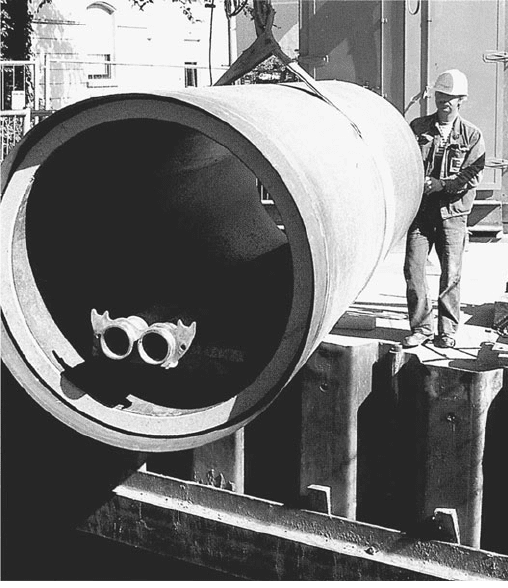
Figure 8.17 Polycrete pipe is being placed in the jacking pit. Note
prepackaged tubes for supplying fluid to boring machine and remov-
ing slurry. (Courtesy of Meyer-Polycrete.)
a smooth outside and inside transition from one pipe section to
another, making the pipe suitable for both sliplining and microtunnel-
ing applications. This connection permits the pipe and joint system to
mate up with the MTBM.
The microtunneling method (MT) is a remotely controlled pipe jack-
ing process which controls the applied pressure and provides continu-
ous support at the excavation face. A laser is typically used to establish
the desired line and grade. Gravity sanitary and storm server lines are
the most common type of underground infrastructure system installed by
microtunneling. The pipes, most often jacked in these nonpressure appli-
cations, include PC, RCP, GRP, and VCP. All of these pipe materials have
a substantial microtunnel installation history in sewer applications.
However, MT can be used to install other underground utility systems
that require a high degree of installation accuracy. In addition, the
newest microtunneling pipe is solid wall PVC, first installed in the
USA in 1997. Microtunneling of pressure pipes has been limited prior
574 Chapter Eight
Figure 8.18 Polycrete pipe in jacking pit. (Courtesy of Meyer-Polycrete.)

to 1998. Suitable for this application include DI, RCP, reinforced con-
crete cylinder pipe, GRP, and steel pipe.
Steel pipe, although rarely used in sewers without proper coating, is
routinely installed by jacking and microtunneling for casings and var-
ious other structural applications. New methods of joining steel pipe,
such as a new push-on jointing process offered by Permalok Corporation
of St. Louis, Missouri, and new coating and lining technology will
likely broaden the application of steel pipe to include both for gravity
and pressure systems.
Microtunneling pipe should meet the following general requirements:
1. Strength sufficient to withstand both the installation loads and
the in-place, long-term service loads.
2. Circular shape with a flush outside surface (including at the joints).
3. Dimensional tolerances on length, straightness, roundness, end
squareness, and allowable angular deflection.
4. Durability for the service exposure (internal and external corro-
sion resistance).
5. Joints capable of the specified level of water tight performance
and transfer of jacking loads between pipes.
6. Strength sufficient to withstand both the installation loads and
the in-place, long-term service loads.
The following are seven general types of pipe materials that have
the most use in microtunneling (listed alphabetically; see Table 8.3):
Pipe Installation and Trenchless Technology 575
TABLE 8.3 Product Standards and Available Dimensions
Range of Range of
Material Standards nominal available
type Nonpressure Pressure diameters, in lengths, ft
DI AWWA C150/C151 AWWA C150/CI51 4–24 to 19.5
ASTM A 716, A 746
PC DIN 54815-1 & 2 N/A 6–102 3–10
PVC ASTM F 789 N/A 12–18 2–10
RCP ASTM C 76 ASTM C 361 12–144 7.5–24
AWWA C300/C302
RPM ASTM D 3262 ASTM D 3517 18–102 4–20
AWWA C950
Steel ASTM A 139 grade B AWWA C200 3–144 2–40
API 2B API 2B
VCP ASTM C 1208 N/A 4–48 2–10
EN 295-7
1. Ductile iron (DI)
2. Glassfiber reinforced polymer mortar (GRP)
3. Polymer concrete (PC)
4. Polyvinyl chloride (PVC)
5. Reinforced concrete (RCP)
6. Steel
7. Vitrified clay (VCP)
The selection criteria, for the type of pipe to use, includes many fac-
tors some of which are listed here:
1. Pipe properties and performance capabilities. Except in pressure
applications, the most critical material property is normally com-
pressive strength. While the specific value impacts the wall
design (thickness required), the load capacity (strength times
minimum cross-sectional area) is generally the governing para-
meter. The compressive strengths, for the pipes listed, range from
approximately 3000 to 50,000 psi (21 to 345 MPa), yet all can be
used successfully in microtunneling and jacking.
2. Jacking machine (type and diameter), anticipated jacking loads,
and drive lengths.
3. Pipeline operating conditions (operating pressure, test, transient,
and vacuum).
4. External loads (soil loads, surface live loads, and water head).
5. Pipe deformation and rebound (during jacking) for plastic/elastic
materials.
6. Pipeline service environment (fluid, temperature, and corrosivity).
7. Pipe inside diameter required.
8. Pipe hydraulic characteristics.
9. Pipe availability, reliability, and durability.
10. Life-cycle cost.
Jacking forces
A pipe installed by microtunneling is subject to large transient axial
loads called jacking forces. These forces are applied during the instal-
lation process in order to advance the pipe and microtunnel boring
machine (MTBM). The nominal factor of safety for jacking loads is the
ratio of the pipe’s design jacking strength for an evenly distributed
load divided by actual applied load at the jacks. This nominal factor of
safety may be fully utilized or exceeded because of eccentric loading or
576 Chapter Eight
end squareness tolerances. The required safety factor against failure
due to jacking is not the same for all pipe materials.
Jacking forces are largest on sections of pipe nearest jacking shafts
or just in front of intermediate jacking stations. These forces are rarely
distributed evenly around the pipes’ end circumference because the
squareness and mating of joints and the pipe alignment are seldom per-
fect. Some eccentricity of the axial load will typically occur in the field.
The result is force concentrations in portions of the pipe ends (joints).
The maximum jacking stress at any point in the pipe is at least as great
as the maximum jacking force recorded at the jack (minus any friction
losses along the drive between the jacking shaft and the point in ques-
tion) divided by the effective minimum cross-sectional area of the pipe
wall. The pipe and joints must be able to withstand these stresses with-
out cracking, breaking, or suffering other damage.
As the pipes are jacked through the ground behind the MTBM, the
pipe and joint exterior surfaces will experience skin friction from the
surrounding soils. The pipes and joints must have sufficient durability
and toughness to withstand this phenomenon without significant
abrasion, loss of joint seal, damage, or failure. Adequate overcut and
lubrication can significantly reduce skin friction.
A lubricant is applied in the annular space by injection under pressure
from the MTBM and/or through ports in the pipe walls. The lubricant, as
well as groundwater and earth loads, can impose external pressure on
the pipe. The pipes and joints must not leak, be damaged, or fail from
applications of these pressures.
Pipes, in diameters large enough to permit personnel entry, are nor-
mally equipped with lubrication ports (fittings) in the wall to permit
injection of a lubricant (usually bentonite) during jacking, or to permit
the placement of grout after jacking to fill any residual annular space.
When the pipe’s dimensional tolerances are controlled within cer-
tain limits, jacking is easier and installation performance is increased.
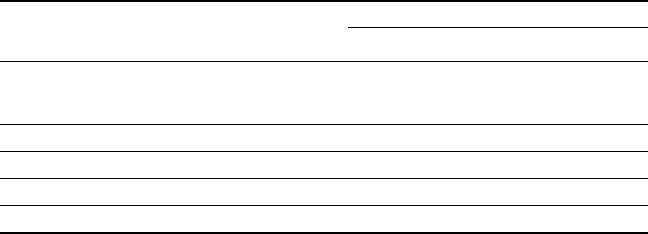
The range and desirable tolerances for pipe products used in micro-
tunneling operations are shown in Table 8.4
Pipe may perform if tolerances are outside of the desirable limits, but
jacking loads will be higher, possible drive distance shortened, and the
probability of achieving the desired safety factor will be diminished.
Square, plane pipe ends and straight sections improve the jacking
load distribution uniformity on the pipe ends and the load transfer.
Deviations in straightness, squareness, and planeness increase
uneven loading on the pipe ends and also increase load concentrations.
These load concentrations, when severe enough, may cause pipe dam-
age or failure. Poor control of the pipe end geometry results in concen-
trated loads on the pipe ends and increases the required steering of the
MTBM. When steering becomes excessive, typically jacking loads tend
to increase significantly.
Pipe Installation and Trenchless Technology 577
The pipe’s length must be controlled to within tolerance. Some of the
microtunnel equipment, particularly the spoil removal transfer sys-
tem, is made in preset, uniform, discrete lengths and is connected
through the pipes during the microtunneling operation.
Variations in the outside diameter increase the jacking loads. This
can result in decreased safe jacking drive distances and/or increased
need for intermediate jacking stations, and ultimately, in severe cases,
pipe failures.
Joints
All microtunneling pipe should have these characteristics:
1. Gasket-sealed joints to facilitate rapid assembly.
2. Flush joints “joint OD same as OD of pipe barrel” (see Fig. 8.19).
3. Smooth outer surface (to reduce jacking force).
4. Pipe performance should not be significantly degraded by
scratches and gouges internally and externally. Unique to micro-
tunneling installation is the exterior pipe friction during the jack-
ing drive and the extensive activity inside the pipes throughout
the operation. These events may have an effect.
5. Pipes should tolerate exposure to long-term fluids and/or gases
conveyed internally and/or externally to ground water and soil
chemicals and occasionally, to stray electrical currents and hydro-
carbon contamination.
6. High compressive strength.
Major advantages
This method is capable of installing pipes to extremely accurate line
and grade tolerances. It has the capability of performing in very difficult
ground conditions without expensive dewatering systems and/or
578 Chapter Eight
TABLE 8.4 Tolerances of Pipe Used in Microtunneling
Tolerances
Dimensional characteristic Range of all products Desirable limit
End squareness/planeness
Diameter 48 in 0.04–0.25 in 0.06 in
Diameter 54 in 0.04–0.25 in 0.12 in
Pipe length 0.08–±0.5 in 0.25 in
Straightness (per 10-ft length) 0.06–0.5 in deviation Within 0.12 in
Outside diameter 0.1%–2.0% deviation Within 0.5%
Exterior roundness 0.1%–2.0% deviation Within 0.5%