
Norman D.A. Emotional Design: Why We Love (Or Hate) Everyday Things
Подождите немного. Документ загружается.

90
Emotional Design
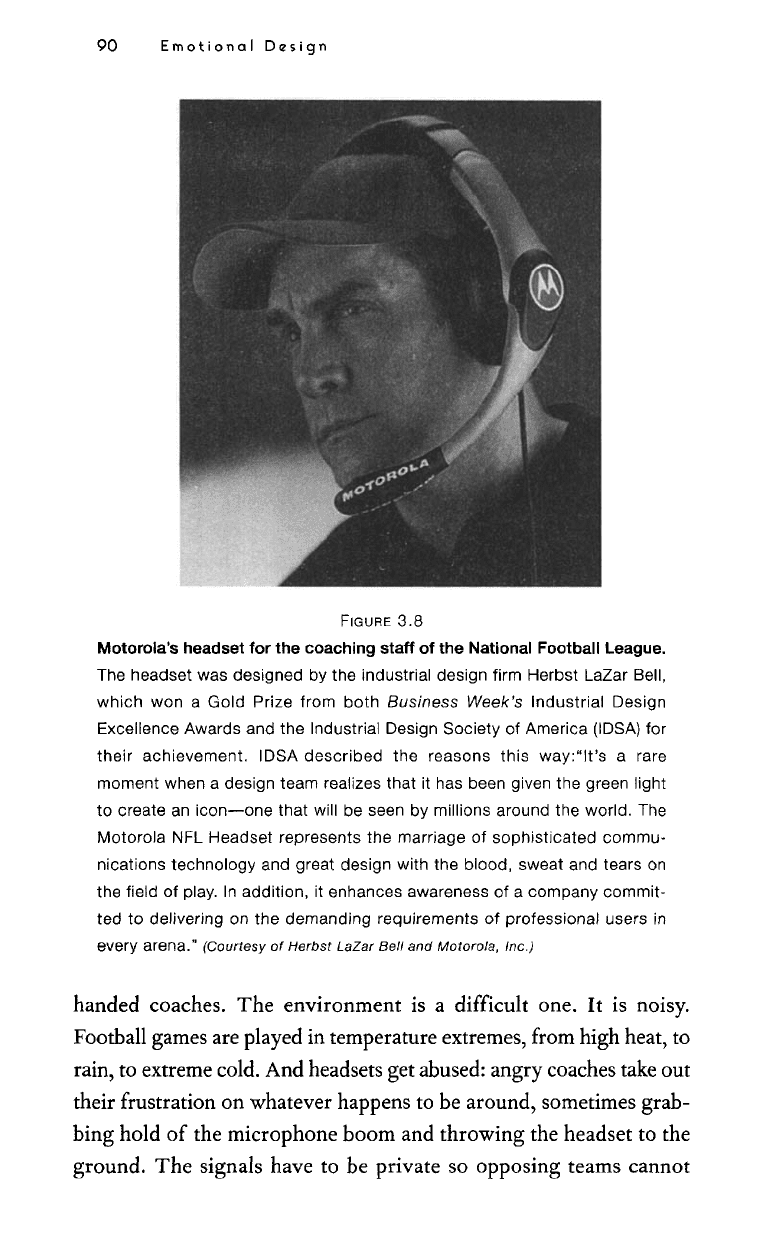
FIGURE
3.8
Motorola's headset
for the
coaching staff
of the
National Football League.
The
headset
was
designed
by the
industrial design firm Herbst LaZar Bell,
which
won a
Gold Prize from
both
Business Week's Industrial Design
Excellence
Awards
and the
Industrial Design Society
of
America
(IDSA)
for
their
achievement.
IDSA
described
the
reasons
this
way:"lt's
a
rare
moment when
a
design team realizes that
it has
been given
the
green light
to
create
an
icon—one that will
be
seen
by
millions around
the
world.
The
Motorola
NFL
Headset represents
the
marriage
of
sophisticated commu-
nications technology
and
great design with
the
blood,
sweat
and
tears
on
the
field
of
play.
In
addition,
it
enhances awareness
of a
company commit-
ted to
delivering
on the
demanding requirements
of
professional users
in
every
arena."
(Courtesy
of
Herbst LaZar Bell
and
Motorola,
Inc.)
handed coaches.
The
environment
is a
difficult
one.
It is
noisy.
Football games
are
played
in
temperature extremes,
from
high
heat,
to
rain,
to
extreme cold.
And
headsets
get
abused: angry coaches take
out
their frustration
on
whatever happens
to be
around, sometimes
grab-
bing
hold
of the
microphone boom
and
throwing
the
headset
to the
ground.
The
signals have
to be
private
so
opposing teams cannot
TLFeBOOK
Three
:
Three
Levels
of
Design
91
eavesdrop.
The
headset
is
also
an
important advertising symbol,
exposing
the
Motorola name
to
television viewers,
so the
brand name
has
to be
visible regardless
of
camera angle.
And
finally,
the
coaches
have
to be
satisfied.
They
have
to
want
to use it. So not
only does
the
headset have
to
stand
up to the
rigors
of the
game,
it has to be
com-
fortable
to
wear
for
hours
at a
time.
The
headset design
was a
challenge. Small, lightweight headsets,
though more comfortable,
are not
strong
enough.
More importantly,
though,
coaches rejected them.
The
coaches
are the
leaders
of a
large,
active
team. Football players
are
among
the
largest, most muscular
players
in
team sports.
The
headset
had to
reinforce
this image:
it had to
be
muscular itself
to
convey
the
image
of a
coach
in
charge
of
things.
So,
yes,
the
design
had to
have visceral appeal; and, yes,
it had to
meet
the
behavioral objectives.
The
biggest challenge, however,
was
to do all
this while
satisfying
the
coaches, projecting
the
heroic, manly
self-image
of
strong, disciplined leaders
who
managed
the
world's
toughest players,
and who
were always
in
control.
In
short:
reflective
design.
Accomplishing
all
this took
a lot of
work.
This
was not a
design
to
be
scribbled
on the
side
of a
napkin (although
a lot of
trial designs
were,
in
fact,
done
on
napkins). Sophisticated computer-aided draw-
ing
tools that allowed
the
designers
to
visualize
just
how the
headset
looked
from
all
angles before anything
had
been built, optimizing
the
interaction
of ear
cups
and
microphone, headband
adjustment,
and
even
the
placement
of the
logos
(maximizing their visibility
to the TV
audience
while simultaneously minimizing
it to the
coaches,
to
avoid
distraction).
"The main goal
in
designing
the
Coaches Headset," said Steve
Remy, project manager
for
Herbst
LaZar
Bell, "was
to
create
a
cool
new
look
for the
product that
is
often
overlooked
as a
background
item,
and
turn
it
into
an
image-building product that attracts
the
view-
er's attention even
in the
high energy, action-packed context
of the
professional
football
game."
It
worked.
The
result
is a
"cool"
prod-
uct—one that
not
only
functions
well,
but
also serves
as an
effective
TLFeBOOK
92
Emotional
Design
advertising
tool
for
Motorola
and
enhances
the
self-image
of the
coaches.
This
is an
excellent
example
of how the
three
different
aspects
of
design
can
work
well
with
one
another.
The
Devious
Side
of
Design
To the
uninitiated, walking into
the
Diesel
jeans
store
on
Union
Square West feels
a lot
like stumbling into
a
rave.
Techno
music
pounds
at a
mind-rattling level.
A
television plays
a
videotape
of a
Japanese
boxing match, inexplicably. There
are no
helpful
signs point-
ing to
men's
or
women's departments,
and no
obvious
staff
members
in
sight.
While large clothing retailers like
Banana
Republic
and Gap
have
standardized
and
simplified
the
layout
of
their stores
in an
effort
to put
customers
at
ease, Diesel's approach
is
based
on the
unconventional
premise
that
the
best customer
is a
disoriented one.
"We 're
conscious
of the
fact
that, outwardly,
we
have
an
intimidat-
ing
environment," said
Niall
Maher, Diesel's director
of
retail opera-
tions.
"We
didn't design
our
stores
to be
user-friendly because
we
want
you to
interact with
our
people.
You
can't understand Diesel
without talking
to
someone."
Indeed,
it is at
just
the
moment when
a
potential Diesel customer
reaches
a
kind
of
shopping vertigo that members
of the
company's
intimidatingly
with-it
staff
make their move. Acting
as
salesmen-in-
shining-armor, they rescue—or prey upon, depending
on
one's
point
of
view—wayward shoppers.
—Warren
St.
John,
New
York
Times
To the
practitioner
of
human-centered
design,
serving
customers
means
relieving
them
of
frustration,
of
confusion,
of a
sense
of
help-
lessness.
Make
them
feel
in
control
and
empowered.
To the
clever
salesperson,
just
the
reverse
is
true.
If
people
don't
really
know
what
they
want,
then
what
is the
best
way to
satisfy
their
needs?
In the
case
TLFeBOOK
Three
:
Three
Levels
of
Design
93
of
human-centered
design,
it is to
provide them with
the
tools
to
explore
by
themselves,
to try
this
and
that,
to
empower themselves
to
success.
To the
sales
staff,
this
is an
opportunity
to
present themselves
as
rescuers
"in-shining-armor,"
ready
to
offer
assistance,
to
provide
just
the
answer customers will
be led to
believe they
had
been seeking.
In
the
world
of
fashion—which encompasses everything
from
clothes
to
restaurants, automobiles
to
furniture—who
is to say
which
approach
is
right, which wrong?
The
solution through confusion
is a
pure play
on
emotions, selling you,
the
customer,
the
idea that
the
pro-
posed item will precisely serve your needs and, more important,
advertise
to the
rest
of the
world what
a
superior,
tasteful,
"with
it"
person
you
are. And,
if you
believe
it, it
will
probably
come
to
pass,
for
strong emotional attachment provides
the
mechanism
for
self-
fulfilling
prophecy.
So,
again, which approach
is
right:
that
of the Gap and
Banana
Republic,
which
"have
standardized
and
simplified
the
layout
of
their
stores
in an
effort
to put
customers
at
ease";
or
Diesel, which deliber-
ately
confuses
and
intimidates,
the
better
to
prepare
the
customer
to
welcome
the
helpful,
reassuring salesperson?
I
know
my
preferences;
I'll
go
with
Gap and
Banana
Republic
any
day,
but the
very success
of
Diesel shows that
not
everyone shares this view.
In the
end,
the
stores
serve
different
needs.
The
first
two
stores
are
more utilitarian
(although
they
would shudder
to be
called
that);
the
second pure fash-
ion, where
the
whole goal
is
caring about what others think.
"When
you're wearing
a
thousand-dollar
suit,"
super salesman
Mort
Spivas told
the
media critic Douglass
Rushkoff,
"you project
a
different
aura.
And
then people treat
you
differently.
You
exude confi-
dence.
And if you can
feel
confident, you'll
act
confident."
If
sales-
people believe that wearing
an
expensive suit makes them
different,
then
it
does make them
different.
For
fashion, emotions
are
key. Stores
that manipulate emotions
are
simply playing
the
game consumers
have
invited themselves into. Now,
the
fashion world
may
have inap-
propriately
brainwashed
the
eager public into believing that
the
game
counts,
but
that
is the
belief, nonetheless.
TLFeBOOK
94
Emotional
Design
To
disconcert shoppers
as a
selling
tool
is
hardly news.
Supermarkets long
ago
learned
to put the
most frequently desired
items
at the
rear
of the
store, forcing buyers
to
pass
by
isles
of
tempt-
ing
impulse purchases. Moreover, related items
can be
placed nearby.
Do
people rush
to the
store
to buy
milk?
Put the
milk
at the
rear
of the
store,
and put
cookies nearby.
Do
they rush
in to buy
beer?
Put the
beer next
to
snacks. Similarly,
at the
checkout counter, display
the
small,
last-minute items people might
be
tempted
to buy
while waiting
in
line.
Creating
these
"point
of
purchase"
displays
has
become
a big
business.
I can
even imagine stores deliberately slowing
up the
check-
out
procedure
to
give customers more time
to
make those last-minute,
impulse
purchases.
Once
a
customer
has
learned
the
shop
or
shelf layout,
it is
time
to
redo
it,
goes this marketing philosophy. Otherwise,
a
shopper want-
ing a can of
soup will simply
go
directly
to the
soup
and not
notice
any of the
other enticing items. Rearranging
the
store
forces
the
shopper
to
explore previously unvisited aisles. Similarly, rearranging
how the
soups
are
stored prevents
the
shopper
from
buying
the
same
type
of
soup each time without ever trying
any
other variety.
So
shelves
get
rearranged,
and
related items
are put
nearby. Stores
get
restructured,
and the
most popular items
are
placed
at the
furthest
ends
of the
store, with impulse items placed either
adjacent
or at the
"end
caps,"
the
ends
of the
aisles where they
are
most visible.
There
is
a
perverse
set of
usability principles
at
play here: make
it
difficult
to buy the
most desired items,
and
extremely easy
for the
impulse
items.
When these tricks
are
used,
it is
critically important that
the
shop-
per not
notice.
Make
the
store layout appear normal. Indeed, make
the
disorientation part
of the
fun. Diesel gets away with their
confusion
because they
are
famous
for it,
because their clothes
are
very popular,
and
because wandering through
the
store
is
part
of the
experience.
The
same philosophy would
not
work
for a
hardware store.
In the
supermarket,
the
fact
that milk
or
beer
is at the
farthest
end of the
store
doesn't
appear deliberate,
it
seems natural.
After
all,
the
coolers
TLFeBOOK
Three
:
Three
Levels
of
Design
95
are
there
at the
back, which
is
where these items
are
kept.
Of
course,
no one
ever asks
the
real question,
Why are the
coolers located there?
Once shoppers realize that they
are
being manipulated
in
these
ways,
a
backlash
may
occur whereby shoppers desert
the
manipulative
stores
and
visit
the
ones that make their experiences more pleasant.
Stores that
try to
profit
through confusion
often
enjoy
a
meteoric rise
in
sales
and
popularity,
but
suffer
a
similar meteoric
fall
as
well.
The
staid, conventional,
helpful
store
is
more stable, with neither
the
great
ups nor the
great
downs
in
popularity. Yes,
shopping
can be a
sensual,
emotional experience,
but it can
also
be a
negative, traumatic one.
But
when stores
do
things correctly, when they understand "The Science
of
Shopping,"
to use the
subtitle
of
Paco Underbill's
book,
then
the
experience
can be
both
a
positive emotional
one for the
shopper
and a
profitable
one for the
seller.
Just
as the
scary rides
of an
amusement park
pit the
anxiety
and
fear
of
the
visceral level against
the
calm reassurance
of the
intellect,
the
Diesel store pits
the
initial confusion
and
anxiety
at
both
the
behav-
ioral
and
reflective levels against
the
relief
and
welcome
of the
rescu-
ing
sales person.
In
both cases,
the
initial negative
affect
is
necessary
to set up the
relief
and
delight
at the
end.
In the
park,
the
ride
is now
safely
over,
and the
rider
can
reflect
upon
all the
positive experiences
of
having successfully mastered
the
adventure.
In the
store,
the
relieved customer
reflects
back upon
the
calm guidance
and
reassur-
ance
offered
by the
salesperson.
In the
store,
the
customer
is apt to
bond with
the
salesperson,
not
unlike
the
"Stockholm syndrome,"
in
which kidnap victims develop such
a
positive emotional bond with
their
captors
that,
after
they
are
freed
and the
captors
in
custody, they
plead
for
mercy
for the
kidnappers. (The name comes
from
a
bank
robbery
in the
early
1970s
in
Stockholm, Sweden, where
a
hostage
developed
a
romantic attachment
to one of her
captors.)
But
there
is a
real
difference
between these
two
cases.
In the
amusement park,
the
fear
and
excitement
is the
draw.
It is
public, advertised.
In the
Diesel
store,
it is
artificial,
manipulative.
One is
natural,
the
other not. Guess
which
will last over time.
TLFeBOOK
96
Emotional
Design
Design
by
Committee
Versus
by an
Individual
Although reflective
thought
is the
essence
of
great literature
and
art,
films
and
music,
web
sites
and
products, appealing
to the
intellect
is no
guarantee
of
success. Many well-acclaimed
serious
works
of art and
music
are
relatively unintelligible
to the
average person.
I
suspect they
may
even
be
unintelligible
to
those
who
proclaim them,
for in the
exalted
realm
of
literature, art,
and
professional criticism,
it
would
appear that when something
can be
clearly understood,
it is
judged
as
flawed,
whereas
when something
is
impenetrable,
it
must
of
necessity
be
good.
And
some items convey such subtle, hidden intellectual mes-
sages, that they
are
lost
on the
average viewer
or
user, perhaps lost
on
everyone
except
the
creator
and
dutiful
students
in
universities, listen-
ing to the
learned critiques
from
their professors.
Consider
the
fate
of
Fritz
Lang's
classic film
"Metropolis,"
"a
wildly ambitious, hugely expensive science
fiction
allegory
of
filial
revolt, romantic love, alienated labor
and
dehumanizing technology."
It was
first
shown
in
Berlin
in
1926
but the
American distributor,
Paramount Films, complained that
it was
unintelligible.
They
hired
Channing Pollock,
a
playwright,
to
reedit
the
film.
Pollock com-
plained
that "symbolism
ran
such riot that people
who saw it
couldn't
tell
what
the
picture
was all
about." Whether
or not one
agrees with
Pollock's criticism, there
is no
doubt that
too
much intellectualism
can
certainly
get in the way of
pleasure
and
enjoyment. (Which,
of
course,
is
often
beside
the
point:
The
purpose
of a
serious essay,
movie,
or
piece
of art is to
educate
and
inform,
not to
amuse.)
There
is a
fundamental
conflict
between
the
preferences
of the
pop-
ular
audience
and the
desires
of the
intellectual
and
artistic community.
The
case
is
most easily made with respect
to
movies,
but
also applies
to all
design
as
well
as to
serious music, art, literature, drama,
and
tel-
evision.
Making
a
movie
is a
complex process. Hundreds
of
people
are
ulti-
TLFeBOOK
Three
:
Three
Levels
of
Design
97
mately
involved, with layers
of
producers, directors, screenwriters,
cameramen,
editors,
and
studio executives
all
having some legitimate
say in the end
product. Artistic integrity,
a
cohesive thematic
approach,
and
deep substance seldom come
from
committees.
The
best designs come
from
following
a
cohesive theme throughout, with
a
clear vision
and
focus.
Usually, such designs
are
driven
by the
vision
of
one
person.
You
may
think that
I am
contradicting
one of my
standard design
rules: test
and
redesign, test
and
redesign.
I
have long championed
human-centered
design,
where
a
product undergoes continual
revi-
sion based upon tests with potential users
of the
product.
This
is a
time-tested,
effective
method
for
producing usable products whose
end
result
fits
the
needs
of the
largest
number
of
people.
Why do I
now
claim
that
a
single designer
who has a
clear model
of the end
product
and
ensures that
it
gets
developed
can be
superior
to
that cau-
tious design cycle
of
design, test,
and
then redesign?
The
difference
is
that
all my
previous work
focused
upon behav-
ioral
design.
I
still maintain that
an
iterative, human-centered
approach
works well
for
behavioral design,
but it is not
necessarily
appropriate
for
either
the
visceral
or the
reflective
side. When
it
comes
to
these levels,
the
iterative method
is
design
by
compromise,
by
com-
mittee,
and by
consensus.
This
guarantees
a
result that
is
safe
and
effective,
but
invariably dull.
This
is
what happens with movies.
Movie
studio executives
often
subject
movies
to
screen tests, where
a
film
is
shown
to a
test audience
and
their
reactions
gauged.
As a
result,
scenes
are
deleted,
story
lines
changed.
Frequently
an
ending
is
changed
to
make
it
more comfort-
able
to the
viewers.
All of
this
is
done
to
increase
the
popularity
and
sales
of the
movie.
The
problem
is
that
the
director, cameramen,
and
writers
are apt to
feel
that
the
changes have destroyed
the
soul
of the
film.
Who to
believe?
I
suspect both
the
test results
and the
opinions
of
the
creative crew
are
valid.
Films
are
judged
by a
variety
of
standards.
On the one
hand, even
an
"inexpensive"
film
can
cost millions
of
dollars
to
produce, while
an
TLFeBOOK
98
Emotional
Design
expensive
one can
cost hundreds
of
millions.
A
film
can be
both
a
major
business investment
and an
artistic statement.
Business versus
art or
literature:
the
debate
is
real
and
appropriate.
In the
end,
the
decision
is
whether
one
wishes
to be an
artist making
a
statement,
in
which case profits
are
irrelevant,
or a
business person,
changing
the
film
or
product
to
make
it
appeal
to as
many people
as
possible, even
at the
cost
of
artistic merit. Want
a
popular
film,
one
that appeals
to the
masses? Show
the
film
to
test audiences
and
revise.
Want
an
artistic
masterpiece? Hire
a
great
creative
crew that
you can
trust.
Henry Lieberman,
a
research scientist
at the MIT
Media
Laboratory
has
described
the
case against
"design
by
committee"
most eloquently,
so let me
simply repeat
his
words here:
The
brilliant conceptual artists Vitaly Komar
and
Alex
Melamid
con-
ducted surveys asking people questions like,
What's
your favorite
color?
Do you
prefer landscapes
to
portraits?
Then
they produced
exhibitions
of
perfectly
"user-centered
art."
The
results
were
pro-
foundly
disturbing.
The
works were completely lacking
in
innovation
or
finesse
of
craftsmanship, disliked even
by the
very same survey
respondents. Good
art is not an
optimal point
in a
multidimensional
space; that was,
of
course, their point. Perfectly "user-centered
design"
would
be
disturbing
as
well, precisely because
it
would lack that
artistry.
One
thing
is
certain, this debate
is
fundamental:
it
will continue
as
long
as the
creators
of
art, music,
and
performance
are not the
same
people
as
those
who
must
pay to get
them distributed
to the
world.
If
you
want
a
successful
product, test
and
revise.
If you
want
a
great
product,
one
that
can
change
the
world,
let it be
driven
by
someone
with
a
clear vision.
The
latter presents more
financial
risk,
but it is the
only
path
to
greatness.
TLFeBOOK
CHAPTER
FOUR
Fun
and
Games
PROFESSOR
HIROSHI
ISHII
of the MIT
Media
Laboratory
runs back
and
forth,
eager
to
show
me all his
exhibits.
"Pick
up a
bot-
tle,"
he
says, standing
in
front
of a
colorfully
lit
stand
of
glass bottles.
I
do so and am
rewarded
by a
playful
tune.
I
pick
up a
second bottle
and
another instrument joins
in,
playing
in
harmony with
the
first.
Pick
up the
third bottle,
and the
instrumental trio
is
complete.
Put
down
one of the
bottles
and the
instrument associated with
it
stops.
I'm
intrigued,
but
Hiroshi
is
anxious
for me to
experience more.
"Here,
look
at
this," Hiroshi
is
calling
from
the
other side
of the
room, "try this." What
is
going
on? I
don't know,
but it
certainly
is
fun.
I
could spend
the
whole
day
there.
But
Hiroshi
has
more delights
to
show. Imagine trying
to
play table
tennis
on a
school
of
fish,
as in
figure 4.1.
There
they are, swimming
about
the
table, their images delivered
by a
projector located
in the
ceiling above
the
table. Each time
the
ball hits
the
table surface,
the
ripples
spread
out and the
fish
scatter.
But the
fish
can't
get
away—it's
a
small table,
and no
matter where
the
fish
go, the
ball soon scatters
99
TLFeBOOK