
Norman D.A. Emotional Design: Why We Love (Or Hate) Everyday Things
Подождите немного. Документ загружается.

70
Emotional Design
principles
of
good
behavioral design
are
well known
and
often
told;
indeed,
I
laid them
out in my
earlier
book,
The
Design
of
Everyday
Things.
What matters here
are
four
components
of
good
behavioral
design:
function, understandability, usability,
and
physical
feel.
Sometimes
the
feel
can be the
major
rationale behind
the
product.
Consider
the
shower shown
in
figure
3.3.
Imagine
the
sensual pleas-
ure,
the
feel—quite literally—of
the
water streaming across
the
body.
IN
MOST behavioral design,
function
comes
first
and
foremost;
what does
a
product
do,
what function does
it
perform?
If the
item
doesn't
do
anything
of
interest, then
who
cares
how
well
it
works?
Even
if its
only
function
is to
look
good,
it had
better succeed. Some
well-designed items miss
the
target when
it
comes
to
fulfilling
their
purpose
and
thus deserve
to
fail.
If a
potato peeler doesn't actually
peel potatoes,
or a
watch
doesn't
tell accurate time, then nothing else
matters.
So the
very
first
behavioral test
a
product must pass
is
whether
it
fulfills
needs.
On the
face
of it,
getting
the
function
right would seem like
the
eas-
iest
of the
criteria
to
meet,
but in
fact,
it is
tricky. People's needs
are
not as
obvious
as
might
be
thought. When
a
product category already
exists,
it is
possible
to
watch people using
the
existing products
to
learn what improvements
can be
made.
But
what
if the
category does
not
even exist?
How do you
discover
a
need that nobody
yet
knows
about?
This
is
where
the
product breakthroughs come
from.
Even with existing products,
it is
amazing
how
seldom
the
design-
ers
watch their
customers.
I
visited
a
major software
developer
to
meet
with
the
design team
for one of
their more widely used products,
one
that
has an
overabundance
of
features,
but
nonetheless still
fails
to
meet
my
everyday needs.
I
came prepared with
a
long list
of
problems
that
I had
encountered while attempting
to do
routine activities.
Moreover,
I had
checked with other
dissatisfied
users
of
this product.
To my
great surprise, much
of
what
I
told
the
design team seemed
to
be
novel. "Very interesting," they kept saying, while taking copious
TLFeBOOK
Three
:
Three
Levels
of
Design
71
notes.
I was
pleased
that
they paid attention
to me, but
disturbed
by
the
fact
that these rather basic points appeared
to be
new.
Had
they
never watched people
use
their products?
These
designers—like
many
design teams
in all
industries—tend
to
keep
to
their desks,
thinking
up new
ideas, testing them
out on one
another.
As a
result,
they kept adding
new
features,
but
they
had
never studied
just
what
patterns
of
activities their customers performed,
just
what tasks need-
ed
to be
supported. Tasks
and
activities
are not
well supported
by
iso-
lated features.
They
require attention
to the
sequence
of
actions,
to
the
eventual
goal—that
is, to the
true needs.
The
first
step
in
good
behavioral design
is to
understand
just
how
people
will
use a
product.
This
team
had not
done
even this most elementary
set of
observations.
There
are two
kinds
of
product development: enhancement
and
innovation. Enhancement means
to
take some existing product
or
service
and
make
it
better. Innovation provides
a
completely
new way
of
doing something,
or a
completely
new
thing
to do,
something that
was
not
possible
before.
Of the
two, enhancements
are
much easier.
Innovations
are
particularly
difficult
to
assess.
Before
they
were
introduced,
who
would have thought
we
needed typewriters, personal
computers, copying machines,
or
cell phones? Answer: Nobody.
Today
it is
hard
to
imagine
life
without these items,
but
before they
existed almost
no one but an
inventor could imagine what purpose
they would serve,
and
quite
often
the
inventors were wrong. Thomas
Edison thought that
the
phonograph would eliminate
the
need
for
let-
ters written
on
paper: business people would dictate their thoughts
and
mail
the
recordings.
The
personal computer
was so
misunder-
stood that several
then-major
computer
manufacturers
completely
dismissed
them: some
of
those once-large companies
no
longer exist.
The
telephone
was
thought
to be an
instrument
for
business,
and in
the
early days, telephone companies tried
to
dissuade customers
from
using
the
phone
for
mere conversation
and
gossip.
One
cannot evaluate
an
innovation
by
asking potential customers
for
their views.
This
requires people
to
imagine something they have
no
experience with.
Their
answers, historically, have been notoriously
TLFeBOOK
72
Emotional Design
bad. People have said they would really like some products that then
failed
in the
marketplace. Similarly, they have said they were simply
not
interested
in
products that went
on to
become huge market
suc-
cesses.
The
cellular telephone
is a
good example.
It was
originally
thought
to be of
value
to a
limited number
of
business people. Very
few
people could imagine carrying
one
simply
for
personal interac-
tion.
Indeed, when individuals
first
purchased cell phones, they
often
explained
that they didn't intend
to use
them,
but
that they were
"in
case
I
have
an
emergency." Predicting
the
popularity
of a new
prod-
uct is
almost impossible
before
the
fact,
even though
it may
seem obvi-
ous
afterward.
Enhancements
to a
product come primarily
by
watching
how
peo-
ple
use
what exists today, discovering
difficulties,
and
then overcom-
ing
them. Even here, however,
it can be
more
difficult
to
determine
the
real needs than might seem obvious. People
find
it
difficult
to
articulate
their real problems. Even
if
they
are
aware
of a
problem,
they
don't
often
think
of it as a
design issue. Ever struggle with
a
key,
to
discover that
you are
inserting
it
upside down?
Or
ever lock your
keys inside
the
automobile?
Or
lock
the
car,
only
to
realize that
you
left
the
windows open,
so you
have
to
unlock
the car and
lean inside
to
close them?
In any of
these cases, would
you
think these were design
flaws?
Probably
not,
probably
you
just
blamed yourself. Well, they
all
could
be
corrected
by
appropriate designs.
Why not
design
a
symmet-
rical
key
that works
no
matter which
way it is
inserted
into
a
lock?
Why not
design cars
so
that
the key is
required
to
lock
the
doors,
mak-
ing it
much less likely that
the car can be
locked with
the key
inside?
Why not
make
it
possible
to
close
the
windows
from
outside
the
car?
All
of
these designs
now
exist,
but it
took clever observations
for the
designers
to
recognize that
the
problems could
be
overcome.
Ever
put
batteries into
a
product
in the
wrong orientation?
Why is
this even possible?
Why
shouldn't batteries
be
designed
so
that they
can
only
go
into their
slots
in one
orientation, making
it
impossible
to
insert
them improperly?
I
suspect battery makers
don't
care,
and
that
manufacturers
who
purchase
and
specify
batteries
for
their equipment
TLFeBOOK
Three
:
Three
Levels
of
Design
73
never considered that
it was
possible
to do
things
better.
Standard
cylindrical batteries
are
excellent examples
of
poor
behavioral design,
of
a
failure
to
understand
the
problems facing people
who
must figure
out
just
which orientation
is
required
for
each device—moreover
in
the
face
of
warning labels that point
out
that
the
equipment might
be
damaged
if the
batteries
are
inserted incorrectly.
Consider
the
automobile. Sure,
it is
easy
to
note that
storage
areas
ought
to be
bigger
or
seat adjustments easier,
but how
about such
an
obvious item
as cup
holders
for
beverages? People like
to
drink
coffee
and
sodas while riding
in
their vehicles.
Today
this seems like
an
obvi-
ous
necessity
in an
automobile,
but it was not
always thought
so.
Automobiles have been around roughly
a
century,
but cup
holders
were
not
considered appropriate
for
their interiors until quite recently,
and
the
innovation didn't come
from
the
automobile manufacturers—
they resisted them.
What
happened
was
that small manufacturers real-
ized
the
need, probably because they
had
built
cup
holders
for
themselves,
and
then discovered that other people wanted them also.
Soon,
all
sorts
of
add-on devices were
being
manufactured.
These
were relatively inexpensive
and
easy
to
install
in a
car: stick-on hold-
ers, magnetic holders,
bean-bag
holders. Some attached
to the
win-
dows, some
to the
dashboards,
and
some
to the
space between
the
seats.
It was
only because these were
so
popular that manufacturers
slowly started
to add
them
as
standard items inside
the
car.
Now
there
is
a
vast array
of
clever
cup
holders. Some people
claim
that they pur-
chased
a
particular automobile solely because
of its cup
holders.
Buy a
car
solely because
of the cup
holders?
Why
not?
If the car is
used pri-
marily
for
daily commuting
and
short errands around
a
city, conven-
ience
and
comfort
for
drivers
and
passengers
are the
most important
needs.
Even
after
the
need
for cup
holders seemed obvious, German auto-
mobile
manufacturers resisted them, explaining that automobiles were
for
driving,
not
drinking.
(I
suspect that this attitude
reflects
the
old-
fashioned
German automobile design culture, which proclaims that
the
engineer knows best,
and
considers studies
of
real people driving their
TLFeBOOK
74
Emotional Design
vehicles irrelevant.
But if the
automobile
is
only
for
driving,
why do
Germans provide ashtrays, cigarette lighters,
and
radios?)
The
Germans reconsidered only when decreases
in
sales
in the
United
States
were attributed
to the
lack
of cup
holders. Engineers
and
designers
who
believe
they
do not
need
to
watch
the
people
who use
their products
are a
major
source
of the
many poor designs that
con-
front
us.
My
friends
at the
industrial
design
firm
of
Herbst LaZar Bell told
me
that they
had
been asked
by a
company
to
redesign their
floor-
cleaning machine
to
satisfy
a
long list
of
requirements.
Cup
holders
were
not on the
list,
but
perhaps they should have been. When
the
designers visited maintenance workers
in the
middle
of the
night
to
observe
just
how
they cleaned
the floors of
large commercial build-
ings, they discovered that workers
had
difficulty
drinking
coffee
while
manipulating
the
huge cleaning
and
waxing machines.
As a
result,
the
designers added
cup
holders.
The new
design
had
numerous
major
enhancements
to the
product
in
both appearance
and
behavior—vis-
ceral
and
behavioral design—and
has
proven
to be a
market success.
How
important
was the cup
holder
to the
success
of the new
design?
Probably
not
much, except that
it is
symptomatic
of the
attention
to
true customer needs that signifies quality products.
As
Herbst
LaZar
Bell
properly emphasizes,
the
real
challenge
to
product
design
is
"understanding end-user unmet
and
unarticulated needs."
That's
the
design
challenge—to
discover real needs that even
the
people
who
need them cannot
yet
articulate.
How
does
one
discover "unarticulated needs"? Certainly
not by
asking,
not by
focus
groups,
not by
surveys
or
questionnaires.
Who
would have thought
to
mention
the
need
for cup
holders
in a
car,
or on
a
stepladder,
or on a
cleaning machine?
After
all,
coffee
drinking
doesn't seem
to be a
requirement
for
cleaning
any
more than
for
driv-
ing in an
automobile.
It is
only
after
such enhancements
are
made that
everyone believes them
to be
obvious
and
necessary. Because most
people
are
unaware
of
their
true
needs,
discovering
them
requires
careful
observations
in
their natural environment.
The
trained
observ-
TLFeBOOK
Three
:
Three
Levels
of
Design
75
er can
often
spot
difficulties
and
solutions that even
the
person experi-
encing them does
not
consciously recognize.
But
once
an
issue
has
been pointed out,
it is
easy
to
tell when
you
have
hit the
target.
The
response
of the
people
who
actually
use the
product
is apt to be
some-
thing like, "Oh, yeah,
you're
right, that's
a
real pain.
Can you
solve
that?
That would
be
wonderful."
After
function
comes understanding.
If you
can't understand
a
product,
you
can't
use
it—at least
not
very well.
Oh,
sure,
you
could
memorize
the
basic
operating
steps,
but you
probably will have
to be
reminded
over
and
over again what they are. With
a
good understand-
ing, once
an
operation
is
explained,
you are apt to
say, "Oh, yes,
I
see,"
and
from
then
on
require
no
further
explanation
or
reminding.
"Learn once, remember forever," ought
to be the
design mantra.
Without understanding, people have
no
idea what
to do
when
things
go
wrong—and things always
go
wrong.
The
secret
to
good
understanding
is to
establish
a
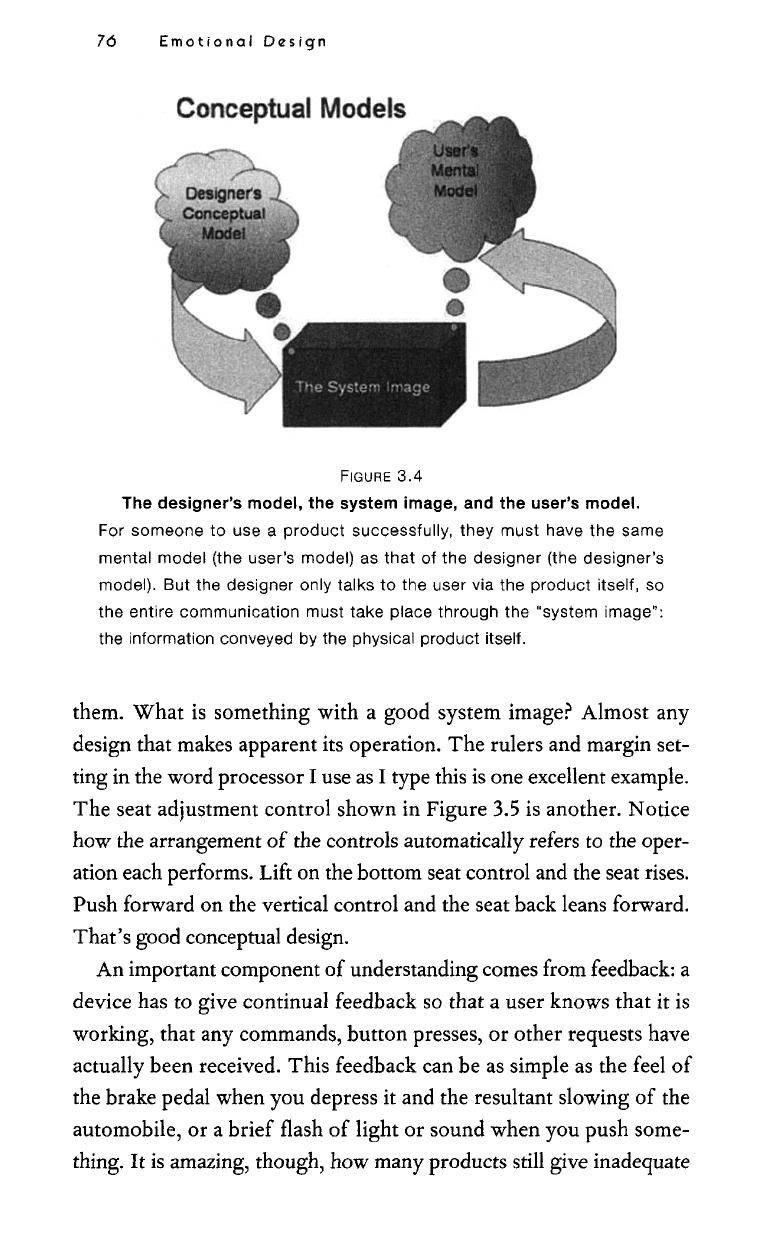
proper conceptual model.
In The
Design
of
Everyday
Things,
I
pointed
out
that there
are
three
different
mental
images
of any
object. First
is the
image
in the
head
of the
designer—call that
the
"designer's model." Then
the
image that
the
person using
the
device
has of it and the way it
works:
call
this
the
"user's
model."
In an
ideal world,
the
designer's model
and the
user's
model should
be
identical and,
as a
result,
the
user understands
and
uses
the
item properly. Alas, designers
don't
talk
to the
final
users;
they only specify
the
product.
People
form
their models entirely
from
their
observations
of the
product—from
its
appearance,
how it
oper-
ates,
what
feedback
it
provides,
and
perhaps,
any
accompanying writ-
ten
material, such
as the
advertising
and
manuals. (But most people
don't read
the
manuals.)
I
called
the
image conveyed
by the
product
and
written material
the
"system image."
As
Figure
3.4
indicates, designers
can
communicate with
the
even-
tual
users only through
the
system image
of a
product.
Thus,
a
good
designer will make sure that
the
system image
of the
final
design con-
veys
the
proper user model.
The
only
way to
find
this
out is
through
testing: develop early prototypes, then watch
as
people
try to use
TLFeBOOK
76
Emotional Design
FIGURE
3.4
The
designer's model,
the
system image,
and the
user's model.
For
someone
to use a
product
successfully,
they must have
the
same
mental
model
(the
user's
model)
as
that
of the
designer
(the
designer's
model).
But the
designer only talks
to the
user
via the
product itself,
so
the
entire communication must take place through
the
"system image":
the
information conveyed
by the
physical product itself.
them. What
is
something with
a
good
system image? Almost
any
design that makes apparent
its
operation.
The
rulers
and
margin
set-
ting
in the
word processor
I use as I
type this
is one
excellent example.
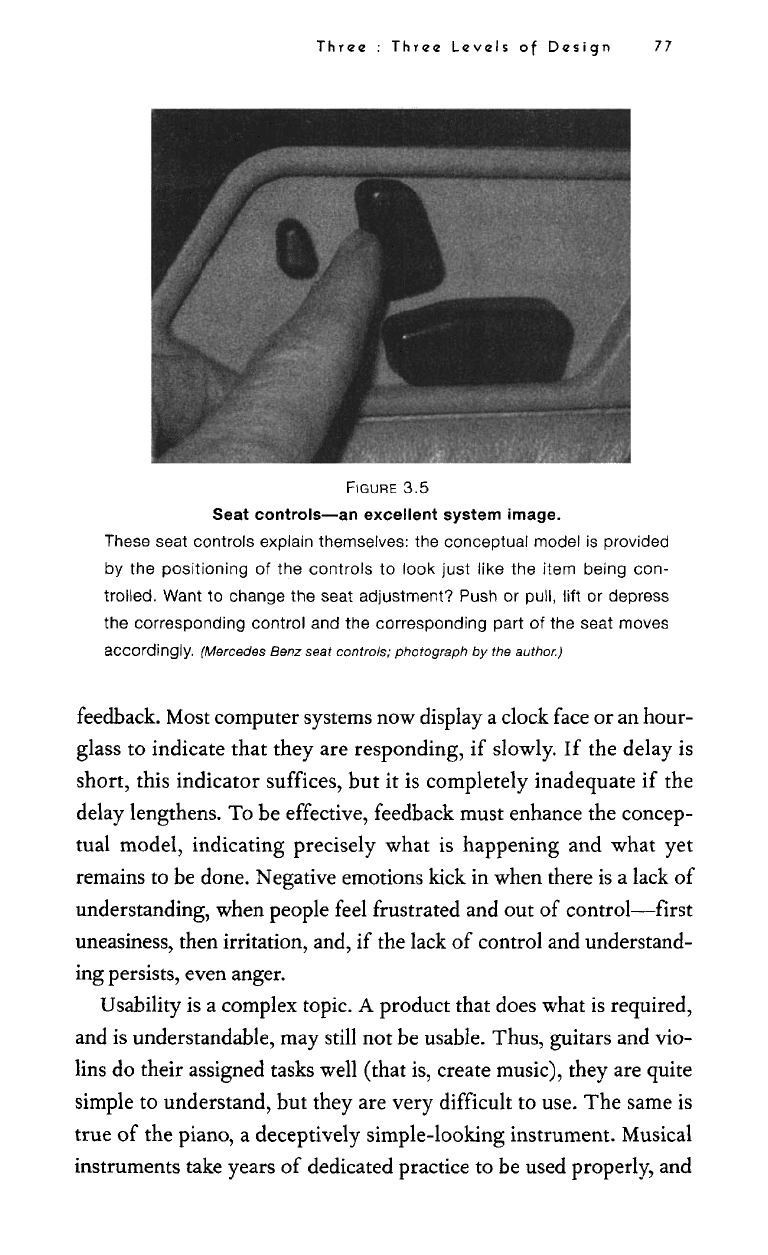
The
seat
adjustment
control shown
in
Figure
3.5 is
another. Notice
how the
arrangement
of the
controls automatically
refers
to the
oper-
ation
each performs.
Lift
on the
bottom seat control
and the
seat rises.
Push forward
on the
vertical control
and the
seat back leans forward.
That's
good
conceptual design.
An
important component
of
understanding comes
from
feedback:
a
device
has to
give continual feedback
so
that
a
user knows that
it is
working, that
any
commands, button presses,
or
other requests have
actually
been received.
This
feedback
can be as
simple
as the
feel
of
the
brake pedal when
you
depress
it and the
resultant slowing
of the
automobile,
or a
brief
flash
of
light
or
sound when
you
push some-
thing.
It is
amazing,
though,
how
many products still
give
inadequate
TLFeBOOK
Three
:
Three Levels
of
Design
77
FIGURE
3.5
Seat
controls—an
excellent system
image.
These seat
controls
explain
themselves:
the
conceptual
model
is
provided
by
the
positioning
of the
controls
to
look
just
like
the
item being con-
trolled.
Want
to
change
the
seat adjustment? Push
or
pull,
lift
or
depress
the
corresponding
control
and the
corresponding
part
of the
seat moves
accordingly.
(Mercedes Benz seat
controls;
photograph
by the
author.)
feedback.
Most computer systems
now
display
a
clock
face
or an
hour-
glass
to
indicate that they
are
responding,
if
slowly.
If the
delay
is
short, this indicator suffices,
but it is
completely inadequate
if the
delay
lengthens.
To be
effective,
feedback must enhance
the
concep-
tual
model, indicating precisely what
is
happening
and
what
yet
remains
to be
done. Negative emotions kick
in
when there
is a
lack
of
understanding, when people
feel
frustrated
and out of
control—first
uneasiness, then irritation, and,
if the
lack
of
control
and
understand-
ing
persists, even anger.
Usability
is a
complex topic.
A
product that does what
is
required,
and
is
understandable,
may
still
not be
usable.
Thus,
guitars
and
vio-
lins
do
their assigned tasks well (that
is,
create music), they
are
quite
simple
to
understand,
but
they
are
very
difficult
to
use.
The
same
is
true
of the
piano,
a
deceptively simple-looking instrument.
Musical
instruments take years
of
dedicated practice
to be
used properly,
and
TLFeBOOK
78
Emotional Design
even
then,
errors
and
poor
performance
are
common among nonpro-
fessionals.
The
relative unusability
of
musical instruments
is
accepted,
in
part because
we
know
of no
other alternative,
in
part because
the
results
are so
worthwhile.
But
most
of the
things
you use in
everyday
life
should
not
require
years
of
dedicated practice.
New
items appear every week,
but who
has
the
time
or
energy
to
spend
the
time required
to
learn each one?
Bad
design
is a
frequent cause
of
error,
often
unfairly blamed
on
users
rather than
on
designers. Errors
can
lead
to
accidents that
not
only
are
financially
expensive
but can
cause
injury
or
death.
There
is no
excuse
for
such
flaws, for we
understand
how to
build functional, under-
standable,
and
usable
things.
Moreover, everyday things have
to be
used
by a
wide variety
of
people: short
and
tall, athletic
and
not,
who
speak
and
read
different
languages,
who may be
deaf
or
blind,
or
lack
physical mobility
or
agility—or even hands. Younger people have dif-
ferent
skills
and
abilities than older ones.
Usage
is the
critical test
of a
product: Here
is
where
it
stands alone,
unsupported
by
advertising
or
merchandising material.
All
that mat-
ters
is how
well
the
product performs,
how
comfortable
the
person
using
it
feels
with
the
operation.
A
frustrated
user
is not a
happy one,
so
it is at the
behavioral stage
of
design that applying
the
principles
of
human-centered
design
pay
off.
Universal
design, designing
for
everyone,
is a
challenge,
but one
well
worth
the
effort.
Indeed,
the
"Universal Design" philosophy
argues persuasively that designing
for the
handicapped,
the
hard
of
hearing
or
seeing,
or
those
less
agile than average invariably makes
an
object
better
for
everyone. There
is no
excuse
not to
design usable
products that everyone
can
use.
"HERE,
TRY
this."
I am
visiting IDEO,
the
industrial design com-
pany.
I am
being shown their "Tech Box,"
a big
cabinet with
an
appar-
ently endless
set of
small
drawers
and
boxes, loaded with
an
eclectic
combination
of
toys, textures, knobs, clever mechanical mechanisms,
TLFeBOOK
Three
:
Three
Levels
of
Design
79
and
objects that
I
cannot
classify.
I
peer into
the
boxes, trying
to
figure
out
what they
are
for, what purpose they serve. "Just turn
the
knob,"
I'm
told,
as
something
is
thrust into
my
hands.
I
find
the
knob
and
rotate
it. It
feels
good:
smooth, silky.
I try a
different
knob:
it
doesn't
feel
as
precise.
There
are
dead regions where
I
turn
and
nothing
seems
to
happen.
Why the
difference? Same mechanism,
I am
told:
the
difference
is the
addition
of a
special, very viscous oil.
"Feel
mat-
ters,"
a
designer explains,
and
from
the
"Tech
Box" appear
yet
more
examples:
silky cloth, microfiber textiles, sticky rubber, squeezable
balls—more
than
I can
assimilate
at one
experience.
Good designers worry
a lot
about
the
physical
feel
of
their prod-
ucts. Physical touch
and
feel
can
make
a
huge
difference
in
your
appreciation
of
their creations. Consider
the
delights
of
smooth, pol-
ished
metal,
or
soft
leather,
or a
solid, mechanical knob that moves
precisely
from
position
to
position, with
no
backlash
or
dead zones,
no
wobbling
or
wiggling.
No
wonder IDEO designers love their
"Tech
Box," their collection
of
toys
and
textures, mechanisms
and
controls.
Many
design professionals
focus
on
visual appearance,
in
part because
this
is
what
can be
appreciated
from
a
distance and,
of
course,
all
that
can
be
experienced
in an
advertising
or
marketing photograph
or
printed illustration.
Touch
and
feel,
however,
are
critical
to our
behav-
ioral
assessment
of a
product. Recall
the
shower
of
figure 3.3.
Physical objects have
weight,
texture,
and
surface.
The
design
term
for
this
is
"tangibility."
Far too
many high-technology creations have
moved
from
real physical controls
and
products
to
ones that reside
on
computer screens,
to be
operated
by
touching
the
screen
or
manipulat-
ing a
mouse.
All the
pleasure
of
manipulating
a
physical object
is
gone
and, with
it, a
sense
of
control. Physical
feel
matters.
We
are,
after
all,
biological creatures, with physical bodies, arms,
and
legs.
A
huge
amount
of the
brain
is
taken
up by the
sensory systems, continually
probing
and
interacting with
the
environment.
The
best
of
products
make
full
use of
this interaction. Just imagine cooking, feeling
the
comfort
of a
balanced, high-quality
knife,
hearing
the
sound
of
cut-
ting
on the
chopping board
or the
sizzle
when
you
drop
food
into
the
TLFeBOOK