
Norman D.A. Emotional Design: Why We Love (Or Hate) Everyday Things
Подождите немного. Документ загружается.

100
Emotional
Design
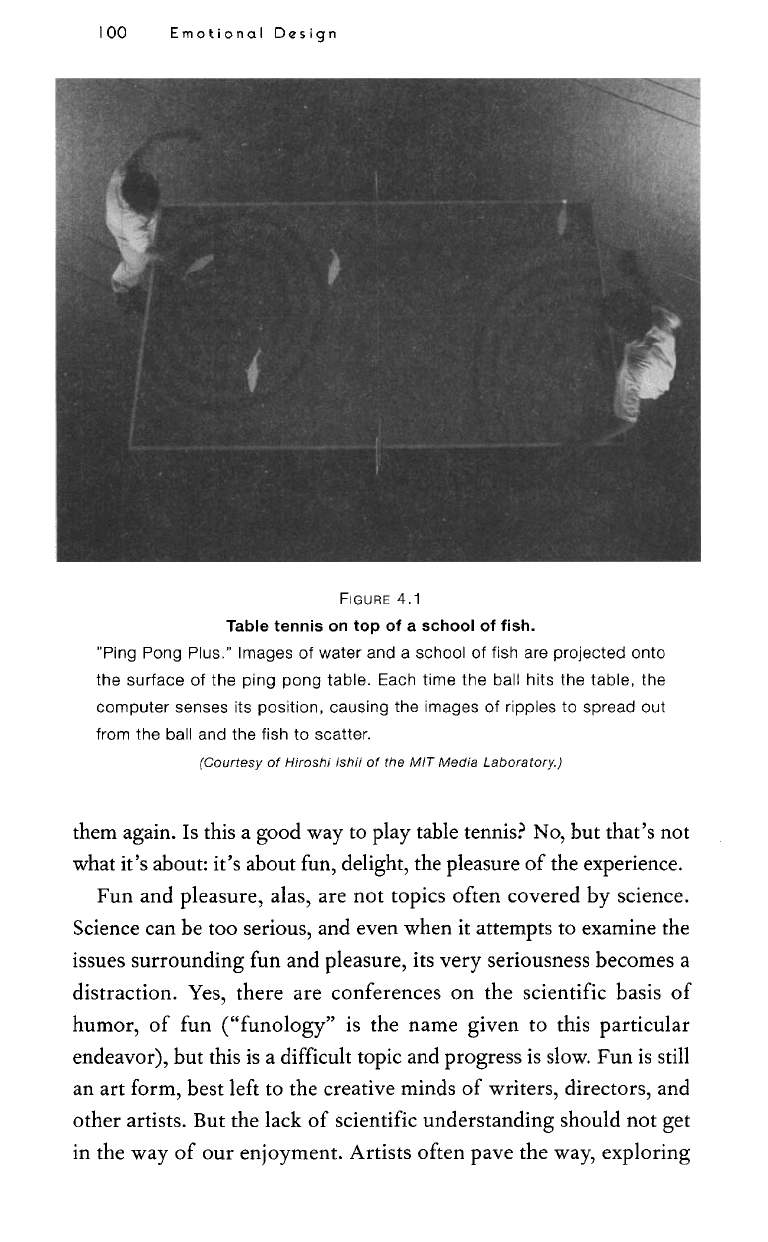
FIGURE
4.1
Table
tennis
on top of a
school
of
fish.
"Ping
Pong
Plus."
Images
of
water
and a
school
of
fish
are
projected
onto
the
surface
of the
ping
pong
table.
Each
time
the
ball
hits
the
table,
the
computer
senses
its
position,
causing
the
images
of
ripples
to
spread
out
from
the
ball
and the
fish
to
scatter.
(Courtesy
of
Hiroshi
Ishii
of the MIT
Media
Laboratory.)
them again.
Is
this
a
good
way to
play table tennis?
No, but
that's
not
what it's about: it's about fun, delight,
the
pleasure
of the
experience.
Fun and
pleasure, alas,
are not
topics
often
covered
by
science.
Science
can be too
serious,
and
even when
it
attempts
to
examine
the
issues surrounding
fun and
pleasure,
its
very seriousness becomes
a
distraction. Yes, there
are
conferences
on the
scientific basis
of
humor,
of fun
("funology"
is the
name given
to
this particular
endeavor),
but
this
is a
difficult
topic
and
progress
is
slow.
Fun is
still
an art
form, best
left
to the
creative minds
of
writers, directors,
and
other artists.
But the
lack
of
scientific understanding should
not get
in
the way of our
enjoyment. Artists
often
pave
the
way, exploring
TLFeBOOK
Four:
Fun and
Games
101
approaches
to
human interaction that science then struggles
to
under-
stand.
This
has
long been true
in
drama, literature, art,
and
music,
and
it is
these
areas that
provide
lessons
for
design.
Fun and
games:
a
worthwhile pursuit.
Designing
Objects
for
Fun
and
Pleasure
Why
must information
be
presented
in a
dull, dreary fashion, such
as
in
a
table
of
numbers? Most
of the
time
we
don't
need actual numbers,
just
some indication
of
whether
the
trend
is up or
down,
fast
or
slow,
or
some rough estimate
of the
value.
So why not
display
the
informa-
tion
in a
colorful manner, continually available
in the
periphery
of
attention,
but in a way
that delights rather than distracts? Once again,
Professor
Ishii suggests
the
means: Imagine colorful pinwheels spin-
ning above your head, enjoyable
to
contemplate,
but
where
the
rate
of
spin
is
meaningful, perhaps coupled
to the
outside temperature,
or
maybe volume
of
traffic
on the
roads
you use for
your
daily commute,
or for any
statistic that
is
useful
to
watch.
Do you
need
to be
reminded
to do
something
at a
specific time?
Why not
have
the
pinwheels
increase their speed
as the
time
approaches,
the
higher
rate
of
speed
being more likely
to
attract your attention and, simultaneously,
to
indicate
the
urgency. Spinning pinwheels?
Why
not?
Why not
have
information
displayed
in a
pleasant, comfortable way?
Technology should bring more
to our
lives than
the
improved per-
formance
of
tasks:
it
should
add
richness
and
enjoyment.
A
good
way
to
bring
fun and
enjoyment
to our
lives
is to
trust
in the
skill
of
artists.
Fortunately, there
are
many around.
Consider
the
pleasure
of the
Japanese lunchbox, which started
as a
simple
work lunch.
In the box
lunch
you can
enjoy
a
wide assortment
of
foods, wide enough
so
that even
if you do not
like some
of the
entrees, there
are
other choices.
The box is
small,
yet
fully
packed,
which poses
an
aesthetic challenge
to the
chef.
In the
best
of
cases
TLFeBOOK
102
Emotional Design
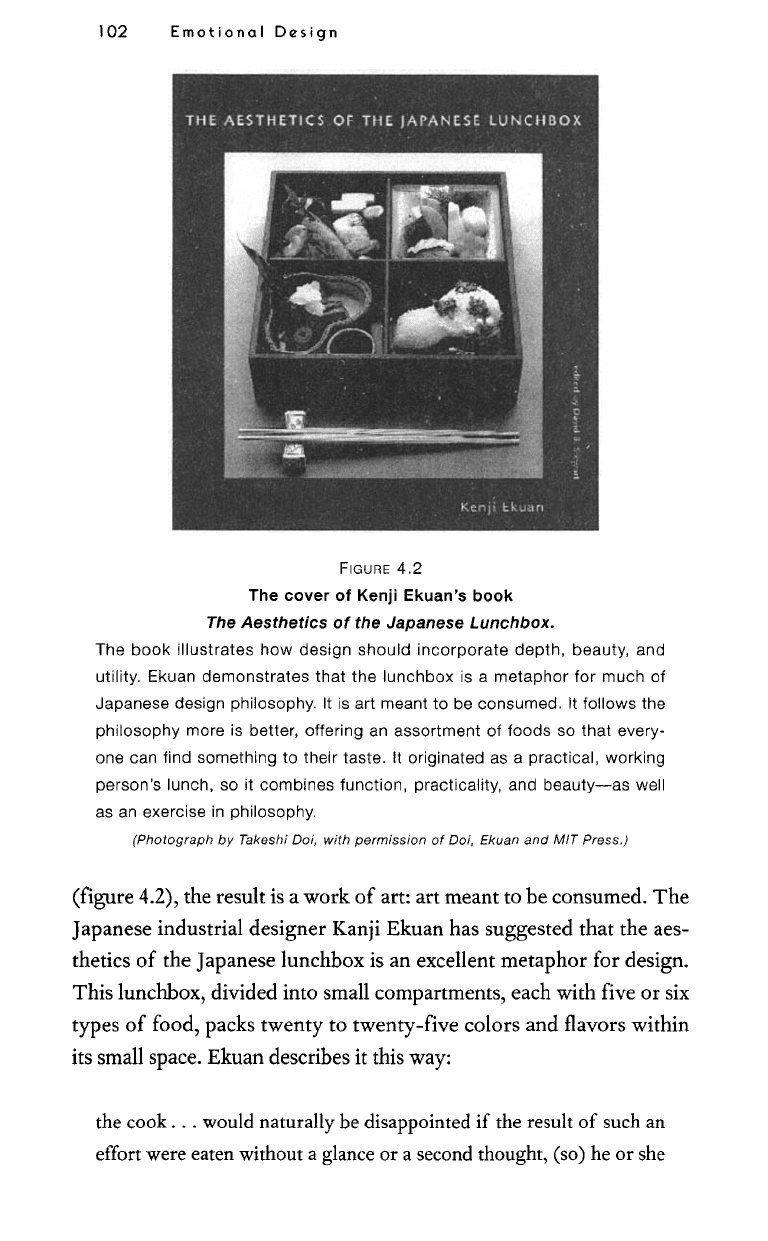
FIGURE
4.2
The
cover
of
Kenji
Ekuan's book
The
Aesthetics
of the
Japanese Lunchbox.
The
book illustrates
how
design should incorporate depth, beauty,
and
utility. Ekuan demonstrates that
the
lunchbox
is a
metaphor
for
much
of
Japanese design philosophy.
It is art
meant
to be
consumed.
It
follows
the
philosophy more
is
better,
offering
an
assortment
of
foods
so
that
every-
one can
find something
to
their
taste.
It
originated
as a
practical, working
person's lunch,
so it
combines function, practicality,
and
beauty—as
well
as
an
exercise
in
philosophy.
(Photograph
by
Takeshi
Do/,
with
permission
of
Do/, Ekuan
and MIT
Press.)
(figure
4.2),
the
result
is a
work
of
art:
art
meant
to be
consumed.
The
Japanese industrial designer
Kanji
Ekuan
has
suggested
that
the
aes-
thetics
of the
Japanese lunchbox
is an
excellent metaphor
for
design.
This
lunchbox, divided into small compartments, each with
five
or six
types
of
food, packs twenty
to
twenty-five colors
and
flavors
within
its
small space. Ekuan describes
it
this way:
the
cook.
. .
would naturally
be
disappointed
if the
result
of
such
an
effort
were
eaten without
a
glance
or a
second thought,
(so)
he or she
TLFeBOOK
Four:
Fun and
Games
103
works
to
make lunchbox meals
so
attractive that guests
are
actually
reluctant
to
take
up
their chopsticks
and
begin eating.
But
even
so, it is
only
a
matter
of
time before
the
masterwork
is
consumed.
The
guest
senses
the
formal
layout even
as he
proceeds
to
break
up the
perfected
layout.
This
is the
inherent
and
paradoxical relationship between
the
provision
and the
acceptance
of
beauty.
The
crowded nature
of the
lunchbox
has
many virtues.
It
forces
attention
to
detail
in the
arrangement
and
presentation
of the
food.
This
essence
of
design, packing
a lot
into
a
small space while main-
taining
an
aesthetic sense, says Ekuan,
is the
essence
of
much
of
Japan's design
for
high technology, where
one
goal
is "to
establish
multifunctionality
and
miniaturization
as
equal values. Packing
numerous
functions
into something
and
making
it
smaller
and
thinner
are
contradictory aims,
but one had to
pursue contradiction
to the
limit
to
find
a
solution."
The
trick
is to
compress multiple
functions
into limited space
in a
way
that does
not
compromise
the
various dimensions
of
design.
Ekuan
clearly prizes beauty—aesthetics—first.
"A
sense
of
beauty
that
lauds lightness
and
simplicity,"
he
continues, "desire that precipi-
tates
functionality, comfort, luxury, diversity.
Fulfillment
of
beauty
and
its
concomitant desire will
be the aim of
design
in the
future."
Beauty,
fun,
and
pleasure
all
work together
to
produce enjoyment,
a
state
of
positive
affect.
Most scientific studies
of
emotion have
focused
upon
the
negative side, upon anxiety,
fear,
and
anger,
even
though fun, joy,
and
pleasure
are the
desired attributes
of
life.
The
cli-
mate
is
changing, with articles
and
books
on
"positive psychology"
and
"well-being"
becoming popular. Positive emotions trigger many
benefits:
They
facilitate
coping with stress.
They
are
essential
to
peo-
ple's
curiosity
and
ability
to
learn. Here
is how the
psychologists
Barbara
Fredrickson
and
Thomas Joiner describe positive emotions:
positive emotions
broaden
people's thought-action repertoires, encour-
aging
them
to
discover novel lines
of
thought
or
action.
Joy,
for
TLFeBOOK
104
Emotional Design
instance,
creates
the
urge
to
play, interest creates
the
urge
to
explore,
and
so on.
Play,
for
instance,
builds
physical,
socioemotional,
and
intellectual skills,
and
fuels
brain development. Similarly, exploration
increases knowledge
and
psychological
complexity.
It
doesn't take much
to
transform otherwise dull data into
a bit of
fun.
Contrast
the
style
of
three
major
internet search companies.
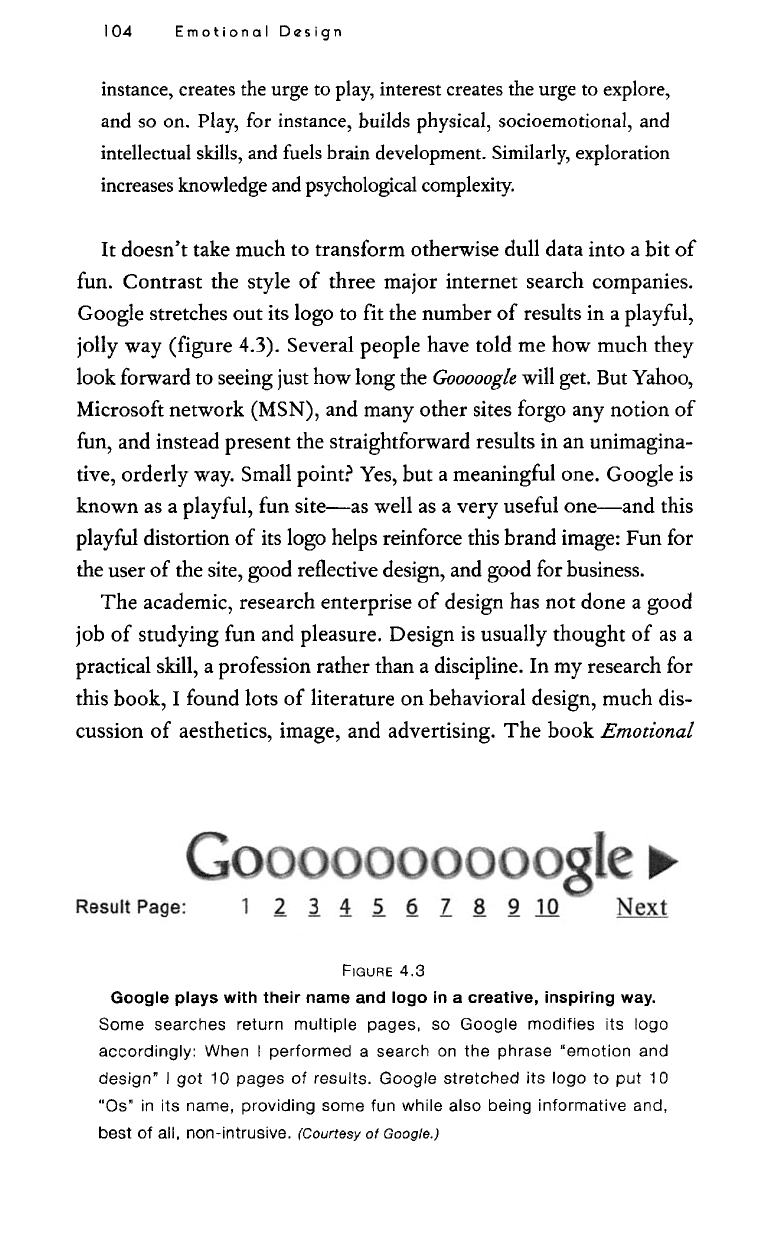
Google stretches
out its
logo
to fit the
number
of
results
in a
playful,
jolly
way
(figure
4.3).
Several people have told
me how
much they
look forward
to
seeing
just
how
long
the
Gooooogle
will
get.
But
Yahoo,
Microsoft
network (MSN),
and
many other sites forgo
any
notion
of
fun,
and
instead present
the
straightforward results
in an
unimagina-
tive, orderly way. Small point? Yes,
but a
meaningful
one.
Google
is
known
as a
playful,
fun
site—as
well
as a
very
useful
one—and this
playful
distortion
of its
logo helps reinforce this brand image:
Fun for
the
user
of the
site, good reflective design,
and
good
for
business.
The
academic, research enterprise
of
design
has not
done
a
good
job
of
studying
fun and
pleasure. Design
is
usually thought
of as a
practical
skill,
a
profession rather than
a
discipline.
In my
research
for
this
book,
I
found lots
of
literature
on
behavioral design, much
dis-
cussion
of
aesthetics, image,
and
advertising.
The
book Emotional
Result
Page:
FIGURE
4.3
Google
plays with their name
and
logo
in a
creative, inspiring way.
Some
searches return multiple pages,
so
Google modifies
its
logo
accordingly:
When
I
performed
a
search
on the
phrase "emotion
and
design"
I got 10
pages
of
results. Google stretched
its
logo
to put 10
"Os"
in its
name, providing some
fun
while also being informative
and,
best
of
all,
non-intrusive.
(Courtesy
of
Google.)
TLFeBOOK
Four:
Fun and
Games
105
Branding
is a
treatment
of
advertising,
for
example. Academics have
concentrated primarily upon
the
history
of
design,
or the
social histo-
ry or
societal implications,
or if
they
are
from
the
cognitive
and
com-
puter sciences, upon
the
study
of
machine interfaces
and
usability.
In
Designing
Pleasurable
Products,
one of the few
scientific studies
of
pleasure
and
design,
the
human factors expert
and
designer Patrick
Jordan builds
on the
work
of
Lionel
Tiger
to
identify
four
kinds
of
pleasure. Here
is my
interpretation:
Physio-pleasure. Pleasures
of the
body.
Sights, sounds,
smells,
taste,
and
touch.
Physio-pleasure combines many aspects
of the
visceral level with some
of the
behavioral level.
Socio-pieasure.
Social pleasure derived
from
interaction with
others.
Jordan points
out
that many products play
an
important
social role, either
by
design
or by
accident.
All
communication
technologies—whether telephone, cell phone, email, instant
messaging,
or
even regular mail—play important social roles
by
design. Sometimes
the
social pleasure derives serendipitously
as
a
byproduct
of
usage.
Thus,
the
office
coffeemaker
and
mail-
room serve
as
focal
points
for
impromptu gatherings
at the
office.
Similarly,
the
kitchen
is the
focal
point
for
many social
interactions
in the
home. Socio-pleasure, therefore, combines
aspects
of
both behavioral
and
reflective
design.
Psycho-pleasure.
This
aspect
of
pleasure deals with
people's
reactions
and
psychological state during
the use of
products.
Psycho-pleasure resides
at the
behavioral level.
Ideo-pleasure. Here lies
the
reflection
on the
experience.
This
is
where
one
appreciates
the
aesthetics,
or the
quality,
or
perhaps
the
extent
to
which
a
product enhances
life
and
respects
the
envi-
ronment.
As
Jordan points out,
the
value
of
many products
comes
from
the
statement they make.
When
displayed
so
that
others
can see
them, they provide ideo-pleasure
to the
extent that
they
signify
the
value judgments
of
their
owner.
Ideo-pleasure
clearly
lies
at the
reflective
level.
TLFeBOOK
106
Emotional
Design
Take
the
Jordan/Tiger
classification,
mix
with
equal
parts
of the
three design levels,
and you
have
a fun and
pleasurable
end
result.
But
fun
and
pleasure
are
elusive concepts.
Thus,
what
is
considered
delightful
depends
a lot
upon
the
context.
The
actions
of a
kitten
or
human
baby
may be
judged
fun and
cute,
but the
very same actions
performed
by a cat or
human adult
can be
judged irritating
or
disgust-
ing. Moreover, what
is fun at
first
can
outwear
its
welcome.
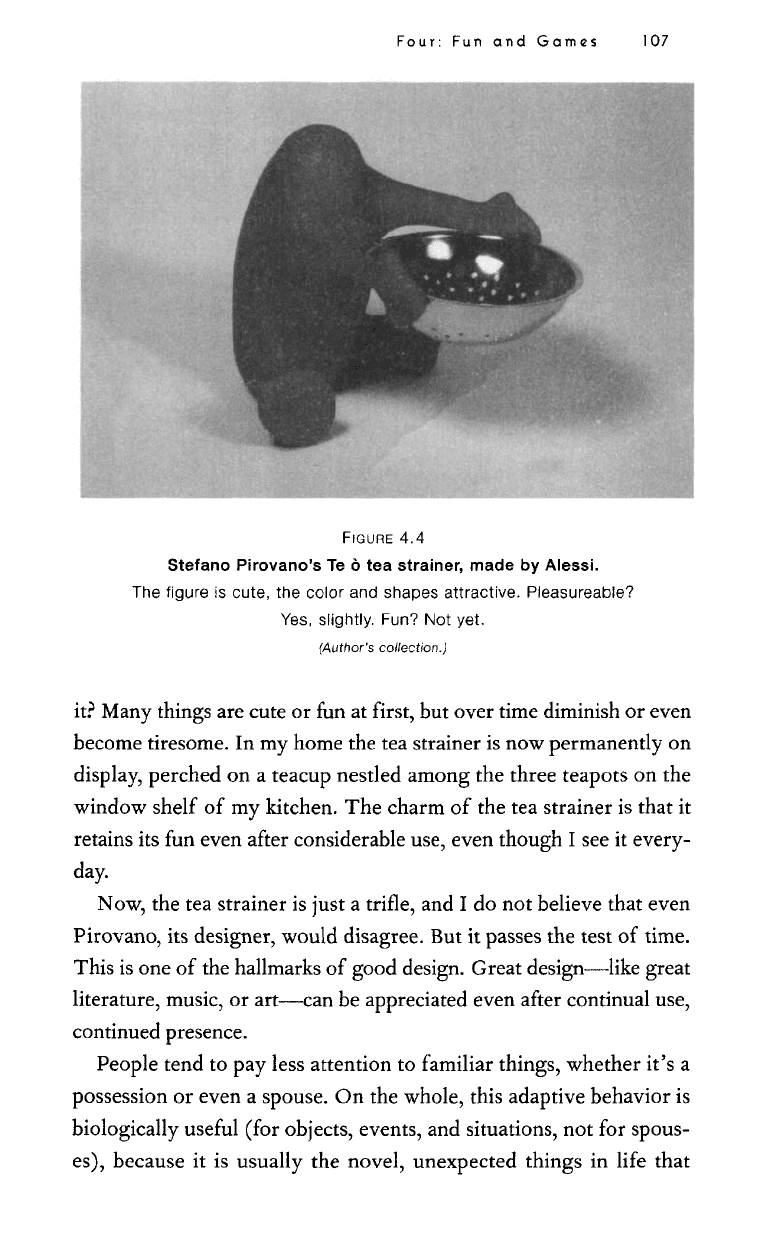
Consider
the "Te 6" tea
strainer (figure 4.4), designed
by
Stefano
Pirovano
for the
Italian manufacturing
firm
Alessi.
At
first
glance
it is
cute, childish even.
As
such,
it
doesn't
qualify
as
fun—not yet.
It is a
simple
animate figure.
The day I
purchased
it, I had
lunch with
Keiichi Sato,
a
professor
of
design
at the
Illinois Institute
of
Technology's
Institute
of
Design
in
Chicago.
At the
lunch table,
I
proudly displayed
my new
purchase. Sato's
first
response
was
skepti-
cal.
"Yes,"
he
said, "it's pleasant
and
cute,
but to
what purpose?"
But
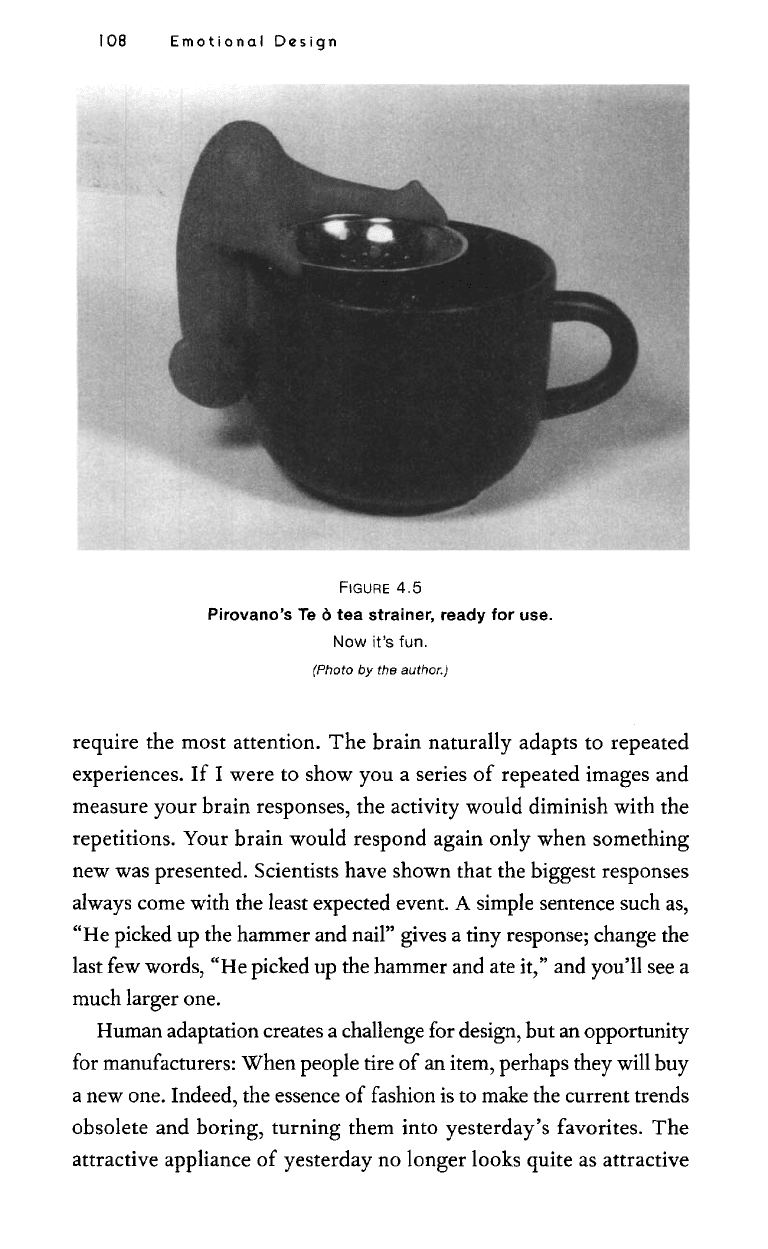
when
I
placed
the
strainer
on a
cup,
his
eyes
lit up, and he
laughed (see
figure
4.5).
At
first sight,
the
arms
and
legs
of the
figure
are
simply cute,
but
when
it
becomes apparent that
the
cuteness
is
also
functional,
then
"cute"
becomes transformed into "pleasure"
and
"fun,"
and
this,
moreover,
is
long-lasting. Sato
and I
spent much
of the
next hour try-
ing to
understand what transforms
an
impression
of
shallow cuteness
into
one of
deep, long-lasting pleasure.
In the
case
of the Te 6
strainer,
the
unexpected transformation
is the
key. Both
of us
noted that
the
essence
of the
surprise
was the
separation between
the two
viewings:
first
the tea
strainer alone, then
on the
teacup.
"If you
publish this
in
your
book,"
Sato warned
me,
"make sure that
you
have only
the
pic-
ture
of the
strainer visible
on one
page,
and
make
the
reader turn
the
page
to see the
strainer
on a
teacup.
If you
don't
do
that,
the
sur-
prise—and
the
fun—will
not be as
strong."
As you
see,
I
have fol-
lowed that advice.
What transforms
the
strainer
from
"cute"
into "fun"?
Is it
sur-
prise?
Cleverness? Certainly both
of
those traits play
a big
role.
Does familiarity breed contempt,
as the old
folk
saying would have
TLFeBOOK
Four:
Fun and
Games
107
FIGURE
4.4
Stefano
Pirovano's
Te 6 tea
strainer, made
by
Alessi.
The
figure
is
cute,
the
color
and
shapes attractive. Pleasureabie?
Yes,
slightly. Fun?
Not
yet.
(Author's
collection.)
it?
Many
things
are
cute
or fun at
first,
but
over time diminish
or
even
become tiresome.
In my
home
the tea
strainer
is now
permanently
on
display,
perched
on a
teacup nestled among
the
three teapots
on the
window shelf
of my
kitchen.
The
charm
of the tea
strainer
is
that
it
retains
its fun
even
after
considerable use, even though
I see it
every-
day.
Now,
the tea
strainer
is
just
a
trifle,
and I do not
believe that even
Pirovano,
its
designer,
would
disagree.
But it
passes
the
test
of
time.
This
is one of the
hallmarks
of
good design. Great design—like great
literature,
music,
or
art—can
be
appreciated even
after
continual use,
continued
presence.
People tend
to pay
less attention
to
familiar
things, whether it's
a
possession
or
even
a
spouse.
On the
whole, this adaptive behavior
is
biologically
useful
(for objects, events,
and
situations,
not for
spous-
es), because
it is
usually
the
novel, unexpected things
in
life
that
TLFeBOOK
108
Emotional Design
FIGURE
4.5
Pirovano's
Te 6 tea
strainer,
ready
for
use.
Now
it's fun.
(Photo
by the
author.)
require
the
most attention.
The
brain naturally adapts
to
repeated
experiences.
If I
were
to
show
you a
series
of
repeated images
and
measure
your brain responses,
the
activity would diminish with
the
repetitions. Your brain would respond again only when something
new
was
presented. Scientists have shown that
the
biggest responses
always come with
the
least expected
event.
A
simple sentence such
as,
"He
picked
up the
hammer
and
nail" gives
a
tiny response; change
the
last
few
words,
"He
picked
up the
hammer
and ate
it,"
and
you'll
see a
much
larger
one.
Human
adaptation creates
a
challenge
for
design,
but an
opportunity
for
manufacturers:
When people tire
of an
item, perhaps they will
buy
a
new
one.
Indeed,
the
essence
of
fashion
is to
make
the
current trends
obsolete
and
boring,
turning them into yesterday's favorites.
The
attractive
appliance
of
yesterday
no
longer looks quite
as
attractive
TLFeBOOK
Four:
Fun and
Games
109
today. Some
of the
examples
in
this book
may
have already followed
this
trajectory:
the
Mini
Cooper automobile,
so
charming
and
cute
to
the
reviewers
at the
time
of
this
book's
writing,
may
look dated, old-
fashioned,
and
dull
by the
time
you
flip
through these
pages—so
much
so
that
you may
wonder
how I
came
to
choose
it as an
example.
The
concern
for the
diminishing impact
of
familiarity
has led
some
designers
to
propose hiding
beautiful
views, lest continual encounter
might diminish their emotional impact.
In the
book
A
Pattern
Language,
the
architect Christopher Alexander
and his
colleagues
describe
253
different
design patterns derived
from
their observations
and
analyses.
These
patterns provide
the
basis
of
their guidelines
for
"a
timeless
way of
building," which structures buildings
in
ways cal-
culated
to
enhance
the
experience
of the
people living within them.
Pattern number
134
deals with
the
problem
of
overexposure:
Pattern
134:
Zen
View.
If
there
is a
beautiful
view, don't spoil
it by
building huge windows that gape incessantly
at it.
Instead,
put the
windows which look onto
the
view
at
places
of
transition—along
paths,
in
hallways,
in
entry ways,
on
stairs, between
rooms.
If
the
view window
is
correctly placed, people will
see a
glimpse
of
the
distant view
as
they come
up to the
window
or
pass
it: but the
view
is
never visible
from
the
places where people stay.
The
name "Zen View" comes
from
"the parable
of a
Buddhist
monk
who
lived
on a
mountain with
a
beautiful
view.
The
monk built
a
wall that obscured
the
view
from
every angle, except
for a
single
fleeting
glimpse along
the
walk
up to his
hut."
In
this way, said
Alexander
and
colleagues, "the view
of the
distant
sea is so
restrained
that
it
stays alive forever. Who, that
has
ever seen that view,
can
ever
forget
it? Its
power will never
fade.
Even
for the man who
lives there,
coming past that view
day
after
day,
it
will
still
be
alive."
Most
people, however,
are not
Buddhist monks.
Most
of us
would
be
unable
to
resist
the
temptation
to
engulf ourselves
in
such beauty.
Whether hiding beauty
is
appropriate
for all of us is up for
debate,
and
TLFeBOOK