
Norman D.A. Emotional Design: Why We Love (Or Hate) Everyday Things
Подождите немного. Документ загружается.

80
Emotional Design
skillet, smelling
the
odors released
from
the
fresh-cut food.
Or
imag-
ine
gardening, feeling
the
tenderness
of a
plant,
the
grittiness
of the
earth.
Or
playing tennis, hearing
the
twang
of the
ball against
the
racket's strings,
its
feel
in
your hands.
Touch,
vibration,
feel,
smell,
sound, visual appearance.
And now
imagine
doing
all
this
on a
com-
puter screen, where what
you see may
look real,
but
with
no
feel,
no
scent,
no
vibrations,
no
sound.
The
world
of
software
is to be
commended
for its
power
and
chameleon-like ability
to
transform
itself into whatever function
is
needed.
The
computer provides
for
abstract actions. Computer scien-
tists
call these environments "virtual worlds,"
and
although they have
many
benefits, they eliminate
one of the
great delights
of
real interac-
tions:
the
delight that comes
from
touching,
feeling,
and
moving
real
physical
objects.
The
virtual worlds
of
software
are
worlds
of
cognition: ideas
and
concepts presented without physical substance. Physical objects
involve
the
world
of
emotion, where
you
experience things, whether
the
comfortable sensuousness
of
some surfaces
or the
grating,
uncom-
fortable
feel
of
others. Although software
and
computers have
become indispensable
to
daily
life,
too
much adherence
to the
abstrac-
tion
of the
computer screen
subtracts
from
emotional
pleasure.
Fortunately, some designers
of
many computer-based products
are
restoring
the
natural,
affective
pleasures
of the
real, tangible world.
Physical
controls
are
back
in
style: knobs
for
tuning, knobs
for
vol-
ume, levers
for
turning
or
switching. Hurrah!
Badly
conceived behavioral design
can
lead
to
great frustration,
leading
to
objects
that have lives
of
their
own,
that
refuse
to
obey, that
provide
inadequate
feedback
about their actions, that
are
unintelligible,
and
all in
all,
putting
anyone
who
tries
to use
them into
a
big,
gray
funk.
No
wonder this
frustration
often
erupts
in
rage, causes
the
user
to
kick, scream,
and
curse. Worse, there
is no
excuse
for
such frustration.
The
fault
does
not lie
with
the
user;
the
fault
lies with
the
design.
Why do so
many designs
fail?
Mainly
because designers
and
engi-
neers
are
often
self-centered.
Engineers
tend
to
focus
upon
technology,
TLFeBOOK
Three
:
Three
Levels
of
Design
81
putting into
a
product whatever special
features
they themselves pre-
fer.
Many
designers
fail
as
well through their fondness
for the
sophis-
ticated
use of
images, metaphors,
and
semantics that
win
prizes
in
design competitions
but
create products that
are
inaccessible
to
users.
Web
sites
fail
here
as
well,
for the
creators
focus
either upon
the
tech-
nical
sophistication
of
images
and
sounds,
or
upon making sure that
each
division
of a
company receives
the
recognition that
its
political
power dictates.
None
of
these
cases
takes
into
account
the
concerns
of the
poor
user, people like
you and me, who use a
product
or web
site
to
satisfy
some need.
You
need
to
accomplish
a
task
or to
find
some informa-
tion.
You
don't
know
the
organizational chart
of the
company
on
whose
web
site
you
seek information,
nor do you
wish
to. You may
enjoy
flashy
images
and
sounds
briefly,
but not
when that cleverness
and
sophistication
get in the way of
getting your
job
done.
Good behavioral design should
be
human-centered, focusing upon
understanding
and
satisfying
the
needs
of the
people
who
actually
use
the
product.
As I
have said,
the
best
way to
discover these needs
is
through observation, when
the
product
is
being
used naturally,
and
not in
response
to
some arbitrary request
to
"show
us how you
would
do x." But
observation
is
surprisingly rare.
You
would think that man-
ufacturers
would want
to
watch people
use
their products,
the
better
to
improve them
for the
future.
But no,
they
are too
busy designing
and
matching
the
features
of the
competition
to
find
out
whether their
products
are
really
effective
and
usable.
Engineers
and
designers explain that,
being
people themselves,
they understand people,
but
this argument
is flawed.
Engineers
and
designers simultaneously know
too
much
and too
little.
They
know
too
much about
the
technology
and too
little
about
how
other people
live
their lives
and do
their activities.
In
addition, anyone involved
with
a
product
is so
close
to the
technical details,
to the
design
difficul-
ties,
and to the
project
issues that they
are
unable
to
view
the
product
the way an
unattached person can.
Focus groups, questionnaires,
and
surveys
are
poor tools
for
learn-
TLFeBOOK
82
Emotional
Design
ing
about behavior,
for
they
are
divorced
from
actual use.
Most
behav-
ior is
subconscious
and
what people actually
do can be
quite
different
from
what they think they
do. We
humans like
to
think that
we
know
why we act as we do, but we
don't,
however much
we
like
to
explain
our
actions.
The
fact
that both visceral
and
behavioral reactions
are
subconscious makes
us
unaware
of our
true reactions
and
their causes.
This
is why
trained professionals
who
observe real
use in
real situa-
tions
can
often
tell more about
people's
likes
and
dislikes—and
the
reasons
for
them—than
the
people themselves.
An
interesting
exception
to
these problems comes when
designers
or
engineers
are
building something
for
themselves that they will
use
frequently
in
their
own
everyday lives. Such products tend
to
excel.
As a
result,
the
best products today,
from
a
behavioral point
of
view,
are
often
those that come
from
the
athletic, sports,
and
craft
industries,
because
these products
do get
designed, purchased,
and
used
by
peo-
ple
who put
behavior above everything else.
Go to a
good hardware
store
and
examine
the
hand tools used
by
gardeners, woodworkers,
and
machinists. These tools, developed over centuries
of
use,
are
care-
fully
designed
to
feel
good,
to be
balanced,
to
give precise feedback,
and
to
perform
well.
Go to a
good outfitter's shop
and
look
at a
moun-
tain
climber's tools
or at the
tents
and
backpacks used
by
serious hikers
and
campers.
Or go to a
professional chef's supply house
and
examine
what real
chefs
buy and use in
their
kitchens.
I
have
found
it
interesting
to
compare
the
electronic equipment sold
for
consumers with
the
equipment sold
to
professionals. Although
much
more expensive,
the
professional equipment tends
to be
simpler
and
easier
to
use. Video recorders
for the
home market have numerous
flashing
lights, many buttons
and
settings,
and
complex menus
for
set-
ting
the
time
and
programming
future
recording.
The
recorders
for
the
professionals
just
have
the
essentials
and are
therefore
easier
to use
while
functioning
better.
This
difference
arises,
in
part, because
the
designers will
be
using
the
products themselves,
so
they know
just
what
is
important
and
what
is
not.
Tools
made
by
artisans
for
them-
selves
all
have this property. Designers
of
hiking
or
mountain climb-
TLFeBOOK
Three
:
Three
Levels
of
Design
83
ing
equipment
may one day
find
their lives depending upon
the
quali-
ty and
behavior
of
their
own
designs.
When
the
company Hewlett Packard
was
founded, their main
product
was
test equipment
for
electrical
engineers.
"Design
for the
person
on the
next bench,"
was the
company motto,
and it
served
them
well. Engineers
found
that
HP
products were
a joy to use
because they
fitted
the
task
of the
electrical engineer
at the
design
or
test bench perfectly.
But
today,
the
same
design
philosophy
no
longer
works:
the
equipment
is
often
used
by
technicians
and
field
crew
who
have little
or no
technical background.
The
"next bench" philosophy
that worked when
the
designers were also users
fails
when
the
popula-
tions change.
Good behavioral design
has to be a
fundamental
part
of the
design
process
from
the
very start;
it
cannot
be
adopted once
the
product
has
been completed. Behavioral design
begins
with understanding
the
user's needs, ideally derived
by
conducting studies
of
relevant behav-
ior in
homes, schools, places
of
work,
or
wherever
the
product will
actually
be
used.
Then
the
design team produces quick, rapid
proto-
types
to
test
on
prospective users, prototypes that take hours (not
days)
to
build
and
then
to
test. Even simple sketches
or
mockups
from
cardboard, wood,
or
foam
work well
at
this stage.
As the
design
process continues,
it
incorporates
the
information
from
the
tests. Soon
the
prototypes
are
more complete, sometimes
fully
or
partially work-
ing, sometimes simply simulating working devices.
By the
time
the
product
is
finished,
it has
been
thoroughly
vetted through
usage:
final
testing
is
necessary only
to
catch minor mistakes
in
implementation.
This iterative design process
is the
heart
of
effective,
user-centered
design.
Reflective
Design
Reflective
design covers
a lot of
territory.
It is all
about message,
about
culture,
and
about
the
meaning
of a
product
or its
use.
For
one,
TLFeBOOK
84
Emotional Design
FIGURE
3.6
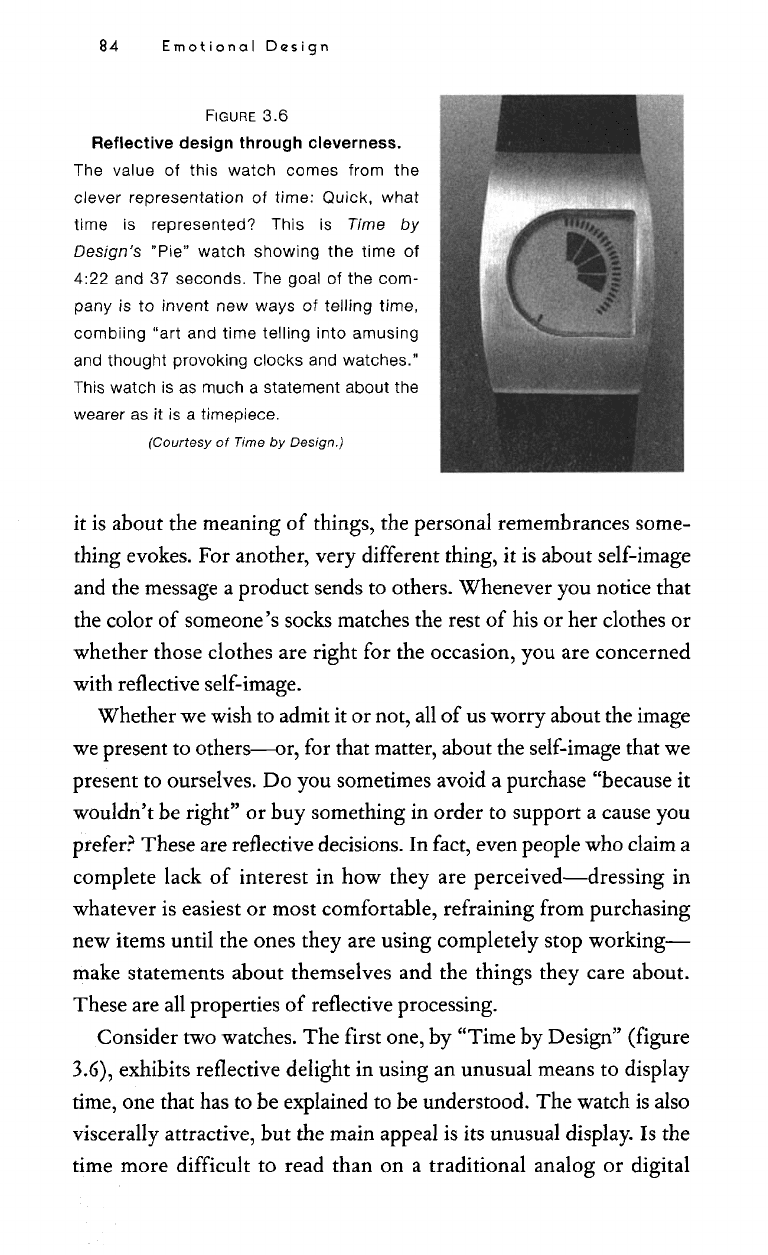
Reflective
design
through
cleverness.
The
value
of
this watch comes from
the
clever
representation
of
time: Quick, what
time
is
represented? This
is
Time
by
Design's
"Pie"
watch showing
the
time
of
4:22
and 37
seconds.
The
goal
of the
com-
pany
is to
invent
new
ways
of
telling time,
combiing
"art
and
time telling into amusing
and
thought provoking clocks
and
watches."
This
watch
is as
much
a
statement about
the
wearer
as it is a
timepiece.
(Courtesy
of
Time
by
Design.)
it is
about
the
meaning
of
things,
the
personal remembrances some-
thing evokes.
For
another, very
different
thing,
it is
about self-image
and
the
message
a
product sends
to
others. Whenever
you
notice that
the
color
of
someone's socks matches
the
rest
of his or her
clothes
or
whether those
clothes
are right for the
occasion,
you are
concerned
with reflective self-image.
Whether
we
wish
to
admit
it or
not,
all of us
worry about
the
image
we
present
to
others—or,
for
that matter, about
the
self-image that
we
present
to
ourselves.
Do you
sometimes avoid
a
purchase "because
it
wouldn't
be right" or buy
something
in
order
to
support
a
cause
you
prefer?
These
are
reflective decisions.
In
fact, even people
who
claim
a
complete
lack
of
interest
in how
they
are
perceived—dressing
in
whatever
is
easiest
or
most comfortable, refraining
from
purchasing
new
items until
the
ones they
are
using completely stop working—
make
statements about themselves
and the
things
they
care
about.
These
are all
properties
of
reflective processing.
Consider
two
watches.
The
first
one,
by
"Time
by
Design"
(figure
3.6), exhibits reflective delight
in
using
an
unusual means
to
display
time,
one
that
has to be
explained
to be
understood.
The
watch
is
also
viscerally attractive,
but the
main appeal
is its
unusual display.
Is the
time
more
difficult
to
read than
on a
traditional analog
or
digital
TLFeBOOK
Three
:
Three
Levels
of
Design
85
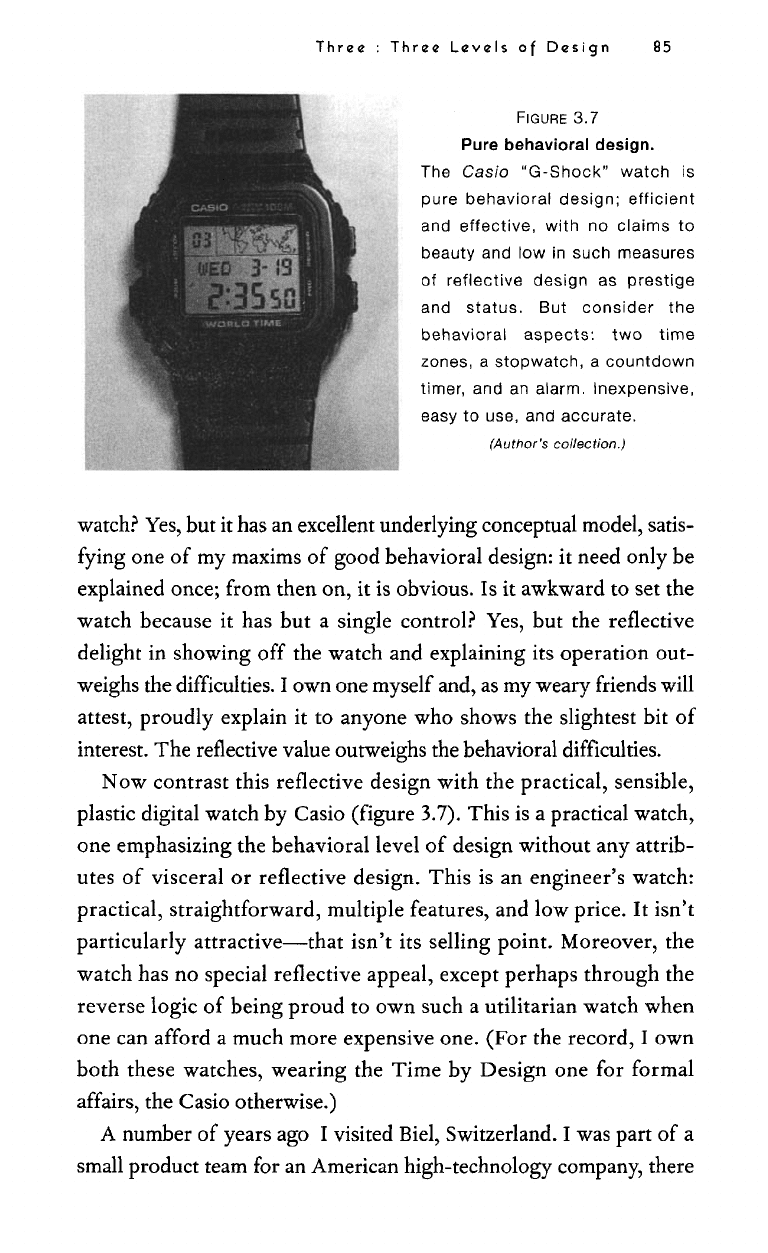
FIGURE
3.7
Pure
behavioral design.
The
Casio
"G-Shock" watch
is
pure behavioral design;
efficient
and
effective, with
no
claims
to
beauty
and low in
such measures
of
reflective design
as
prestige
and
status.
But
consider
the
behavioral aspects:
two
time
zones,
a
stopwatch,
a
countdown
timer,
and an
alarm. Inexpensive,
easy
to
use,
and
accurate.
(Author's
collection.)
watch?
Yes,
but it has an
excellent underlying conceptual model, satis-
fying
one of my
maxims
of
good
behavioral design:
it
need only
be
explained
once;
from
then
on, it is
obvious.
Is it
awkward
to set the
watch because
it has but a
single control? Yes,
but the
reflective
delight
in
showing
off the
watch
and
explaining
its
operation out-
weighs
the
difficulties.
I own one
myself and,
as my
weary
friends
will
attest, proudly explain
it to
anyone
who
shows
the
slightest
bit of
interest.
The
reflective value outweighs
the
behavioral
difficulties.
Now
contrast this reflective design with
the
practical, sensible,
plastic
digital watch
by
Casio (figure 3.7).
This
is a
practical watch,
one
emphasizing
the
behavioral level
of
design without
any
attrib-
utes
of
visceral
or
reflective design.
This
is an
engineer's watch:
practical,
straightforward, multiple features,
and low
price.
It
isn't
particularly
attractive—that isn't
its
selling point. Moreover,
the
watch
has no
special reflective appeal, except perhaps
through
the
reverse
logic
of
being proud
to own
such
a
utilitarian watch when
one can
afford
a
much more expensive one. (For
the
record,
I own
both
these watches, wearing
the
Time
by
Design
one for
formal
affairs,
the
Casio otherwise.)
A
number
of
years
ago I
visited Biel, Switzerland.
I was
part
of a
small
product team
for an
American
high-technology
company, there
TLFeBOOK
86
Emotional
Design
to
talk with
the
folks
at
Swatch,
the
watch company that
had
trans-
formed
the
Swiss watchmaking industry. Swatch,
we
were proudly
told,
was not a
watch company;
it was an
emotions company. Sure,
they made
the
precision
watches
and
movements used
in
most watches
around
the
world (regardless
of the
brand displayed
on the
case),
but
what
they
had
really done
was to
transform
the
purpose
of a
watch
from
timekeeping
to
emotion.
Their
expertise, their president
boldly
proclaimed,
was
human emotion,
as he
rolled
up his
sleeves
to
display
the
many watches
on his
arm.
Swatch
is
famous
for
transforming
the
watch into
a
fashion state-
ment,
arguing
that people should
own as
many watches
as
ties,
or
shoes,
or
even shirts.
You
should change your watch, they proclaimed,
to
match mood, activity,
or
even
the
time
of
day.
The
executive team
of
Swatch patiently tried
to
explain this
to us:
Yes,
the
watch mecha-
nism
had to be
inexpensive,
yet of
high quality
and
reliable (and
we
were very impressed
by our
tour
of
their completely automated man-
ufacturing
facilities),
but the
real opportunities
lay in
exploiting
the
face
and
body
of the
watch.
Their
web
site puts
it
like
this:
Swatch
Is
Design.
The
form
of a
Swatch watch
is
always
the
same.
The
tiny space
it
offers
for
creative design exerts
an
irresistible power
of
attraction
on
artists. Why? Because
the
watch
face
and
strap
can
take
on the
wildest imaginative concepts,
the
most unusual ideas, bril-
liant
colors, rousing messages,
art and
comics, dreams
for
today
and
tomorrow,
and
much, much
more.
And
that's
exactly what makes each
Swatch model
so
fascinating:
it is
design that incorporates
a
message,
handwriting that bears witness
to a
personality.
At
the
time
of my
visit,
we
were impressed,
but
puzzled.
We
were
technologists.
The
concept that
a
piece
of
advanced technology should
really
be
thought
of as a
vehicle
for
emotions rather than
for
function
was a bit
difficult
for us
engineers
to
fathom.
Our
group
could never
get its act
together enough
to
work
in
such
a
creative way,
so
nothing
ever
came
of
that venture—except
for the
long-lasting impression
it
TLFeBOOK
Three
:
Three
Levels
of
Design
87
made
on me. I
learned that products
can be
more than
the sum of the
functions
they perform.
Their
real value
can be in
fulfilling
people's
emotional needs,
and one of the
most important needs
of all is to
estab-
lish
one's
self-image
and
one's
place
in the
world.
In his
important
book about
the
role
of
industrial design,
Watches
Tell
More
than Time,
the
designer
Del
Coates explains that
"it is
impossible,
in
fact,
to
design
a
watch that tells
only
time. Knowing nothing more,
the
design
of a
watch alone—or
of any
product—can suggest assumptions about
the
age,
gender,
and
outlook
of the
person
who
wears it."
Did you
ever consider buying
an
expensive, hand-crafted watch?
Expensive
jewelry? Single malt scotch
or a
prestige vodka?
Can you
really
distinguish among
the
brands? Blind-tasting
of
many whiskeys,
where
the
taster
has no
idea which glass contains which drink, reveals
that
you
probably can't taste
the
difference.
Why is an
expensive
orig-
inal
painting superior
to a
high-quality reproduction? Which would
you
prefer
to
have?
If the
painting
is
about aesthetics, then
a
good
reproduction should
suffice.
But, obviously, paintings
are
more than
aesthetics: they
are
about
the
reflective value
of
owning—or
view-
ing—the
original.
These
questions
are all
cultural.
There
is
nothing
practical, nothing
biological, about
the
answers.
The
answers
are
conventions, learned
in
whatever society
you
inhabit.
For
some
of
you,
the
answers will
be
obvious;
for
others,
the
questions will
not
even make sense.
That
is the
essence
of
reflective
design:
it is all in the
mind
of the
beholder.
Attractiveness
is a
visceral-level phenomenon—the response
is
entirely
to the
surface look
of an
object. Beauty comes
from
the
reflective
level. Beauty looks below
the
surface. Beauty comes
from
conscious reflection
and
experience.
It is
influenced
by
knowledge,
learning,
and
culture. Objects that
are
unattractive
on the
surface
can
give pleasure. Discordant music,
for
example,
can be
beautiful.
Ugly
art can be
beautiful.
Advertising
can
work
at
either
the
visceral
or the
reflective
level.
Pretty products—sexy automobiles, powerful-looking trucks, seduc-
tive bottles
for
drinks
and
perfume—play with
the
visceral level.
TLFeBOOK
88
Emotional
Design
Prestige, perceived rarity,
and
exclusiveness work
at the
reflective
level. Raise
the
price
of
Scotch,
and
increase
the
sales.
Make
it
difficult
to get
reservations
to a
restaurant
or
entrance
to a
club,
and
increase
their desirability.
These
are
reflective-level ploys.
Reflective-level
operations
often
determine
a
person's overall
impression
of a
product. Here,
you
think back about
the
product,
reflecting
upon
its
total appeal
and the
experience
of
using
it.
Here
is
where many factors come into play
and
where
the
deficiencies
of one
aspect
can be
outweighed
by the
strengths
of
another. Minor
difficul-
ties might very well
be
overlooked
in the
overall assessment—or
enhanced, blown
all out of
proportion.
The
overall impact
of a
product comes through reflection—in ret-
rospective memory
and
reassessment.
Do you
fondly
show your pos-
sessions
to
friends
and
colleagues,
or do you
hide them and,
if you
talk
at
all,
is it
only
to
complain?
Things
that
an
owner
is
proud
of
will
be
displayed
prominently,
or, at the
least, shown
to
people.
Customer relationships play
a
major
role
at the
reflective
level,
so
much
so
that
a
good
relationship
can
completely reverse
an
otherwise
negative experience with
the
product.
Thus,
a
company that goes
out
of
its way to
assist
and
help disgruntled customers
can
often
turn them
into
its
most loyal fans. Indeed,
the
person
who
buys
a
product
and
has
nothing
but
pleasant experiences with
it may be
less
satisfied
than
the one who has an
unhappy experience,
but is
well treated
by the
company
as it
fixes
the
problem.
This
is an
expensive
way to win
cus-
tomer loyalty,
but it
shows
the
power
of the
reflective
level.
Reflective
design
is
really
about
long-term
customer
experience.
It is
about
serv-
ice, about providing
a
personal touch
and a
warm interaction. When
a
customer
reflects
on the
product
in
order
to
decide what next
to
pur-
chase
or to
advise
friends,
a
pleasant
reflective
memory
can
overcome
any
prior negative experiences.
Amusement
park rides
are a
good example
of the
interplay between
reflection
and
reaction.
The
ride appeals both
to
those
who
value
the
feelings
that accompany high arousal
and
fear
for its own
sake
and to
those
for
whom
the
ride
is all
about
the
reflective
power
afterward.
At
TLFeBOOK
Three
:
Three
Levels
of
Design
89
the
visceral level,
the
whole point
is to
thrill riders, scaring them
in the
process.
But
this
has to be
done
in a
reassuring way. While
the
visceral
system
is
operating
at
full
force,
the
reflective system
is a
calming
influence.
This
is a
safe
ride,
it is
telling
the
rest
of the
body.
It
only
appears
to be
dangerous.
It is
okay. During
the
ride,
the
visceral
sys-
tem
probably
wins.
But in
retrospect,
when memory
has
dimmed,
the
reflective
system wins.
Now,
it is a
badge
of
honor
to
have experi-
enced
the
ride.
It
provides stories
to
tell other people. Here
an
effec-
tive amusement park enhances
the
interaction
by
selling photographs
of the
rider
at the
peak
of the
experience.
They
sell photographs
and
souvenirs,
so the
riders
can
brag
to
friends.
Would
you go on a
ride
if the
amusement park
was old and
shabby,
with clearly broken components, rusty railings,
and a
general
air of
incompetence?
Obviously
not.
The
rational reassurance will
not be
nearly
as
effective.
Once
the
reflective
system
fails,
then
the
appeal
is
apt
to
collapse
as
well.
A
Case
Study:
The
National
Football League Headset
"You know what
the
hardest part
of
this design was?" Walter Herbst,
of the
design
firm Herbst LaZar Bell, asked, proudly
showing
me the
Motorola
headset (figure
3.8).
"Reliability?"
I
answered, hesitantly, thinking that
it
looked
so big
and
strong,
it
must
be
reliable.
"Nope,"
he
answered,
"it was the
coaches—making
the
coaches
feel
good about wearing
it."
Motorola
had
asked Herbst LaZar
Bell
to
design
the
headset
to be
used
by the
coaches
of the
National Football League.
Mind
you,
these
couldn't
be
just
any
headset.
They
had to be
highly
functional,
deliv-
ering intelligible messages between coaches
and
their
staff
scattered
about
the
stadium.
The
microphone boom
had to be
movable
so
that
it
could
be
placed
on
either side
of the
head
for
left-handed
and
right-
TLFeBOOK