
Quinn J.J., Yi K.-S. Solid State Physics: Principles and Modern Applications
Подождите немного. Документ загружается.

Uncorrected Proof
BookID 160928 ChapID 06 Proof# 1 - 29/07/09
170 6 More Band Theory and the Semiclassical Approximation
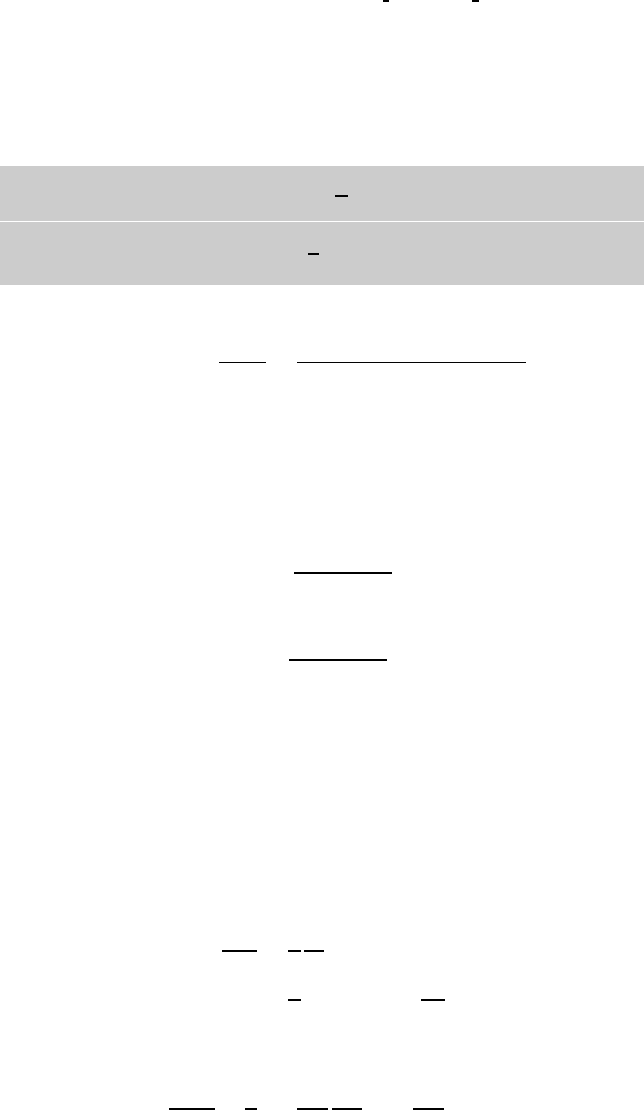
The semiclassical description of Bloch electrons satisfies the following rules: 166
1. The band index n is a constant of the motion; no interband transitions are 167
allowed. 168
2.
˙
r = v
n
(k)=
1
¯h
∇
k
ε
n
(k). (6.43)
169
3.
¯h
˙
k = −e
E +
1
c
v
n
(k) × B
. (6.44)
170
4. The contribution of the nth band to the electron density will be 171
2f
0
(ε
n
(k))
d
3
k
(2π)
3
=
d
3
k/4π
3
1+exp[(ε
n
(k) − μ) /k
B
T ]
. (6.45)
For free electrons (Sommerfeld model), electrons are not restricted to one
172
band but move continuously in k-space according to ¯h
˙
k = Force. For Bloch 173
electrons k is restricted to the first Brillouin zone and k ≡ k + K. Clearly the 174
restriction to band n requirement must break down when the gap E
GAP
(k) 175
becomes very small. It can be shown (but not very easily) that the conditions 176
eEa
[E
GAP
(k)]
2
E
F
(6.46)
and
177
¯hω
c
[E
GAP
(k)]
2
E
F
. (6.47)
must be satisfied for the semiclassical treatment of Bloch electrons to be valid.
178
Here, E is the electric field and a the atomic spacing. ω
c
is the electron 179
cyclotron frequency and E
F
the Fermi energy. The breakdown of the inequali- 180
ties (6.46) and (6.47) lead to interband transitions; they are known as electric 181
breakdown and magnetic breakdown, respectively. 182
6.4.1 Effective Mass 183
The acceleration of a Bloch electron in band n can be written as 184
a
n
≡
dv
n
dt
=
1
¯h
d
dt
∇
k
ε
n
(k)
=
1
¯h
∇
k
∇
k
ε
n
(k) ·
dk
dt
(6.48)
If we write this tensor equation in terms of components, we have
185
dv
(n)
i
dt
=
1
¯h
j
∂
∂k
j
∂
∂k
i
ε
n
(k)
dk
j
dt
. (6.49)

Uncorrected Proof
BookID 160928 ChapID 06 Proof# 1 - 29/07/09
6.4 Semiclassical Approximation for Bloch Electrons 171
But ¯h
dk
j
dt
= F
j
,thej-component of the force. Thus, we can write 186
dv
n
dt
= m
∗
n
−1
· F (6.50)
where the effective mass tensor is defined by
187
m
∗
n
−1
ij
=
1
¯h
2
∂
2
ε
n
(k)
∂k
i
∂k
j
. (6.51)
188
Measured effective masses in different materials have widely different values. 189
For example, in nickel there are electrons with m
∗
15 m while in InSb there 190
are electrons with m
∗
0.015 m. 191
6.4.2 Concept of a Hole 192
Symmetry requires that if a band has an energy ε(k), then the solid must have 193
an energy ε(−k) satisfying ε(−k)=ε(k). The group velocity of the states k 194
and −k are equal in magnitude and opposite in direction. In equilibrium, if 195
the state k is occupied, so is the state −k. Since the velocities are equal in 196
magnitude and opposite in direction, there is no current. A current is obtained 197
by changing the probability of occupancy of the electron states. 198
A filled band cannot carry any current even in the presence of an electric 199
field. Each electron is accelerated according to the equation: 200
dk
dt
=
1
¯h
F. (6.52)
If F is in the x-direction, the electrons move in k space with k
x
(t)=k
x
(0) + 201
1
¯h
F
x
t. An electron arriving at k
x
=
π
a
(for a cubic crystal), the edge of the 202
Brillouin zone, reappears at k
x
= −
π
a
(i.e., it is Bragg reflected through k
x
− 203
k
x
= K =
2π
a
. Thus at all times the band is filled; for each electron at k 204
there is one at −k with equal but oppositely directed velocity. Therefore, the 205
electrical current density j =0. 206
For a partially filled band we can write 207
j =
1
V
k occupied
(−ev
k
) . (6.53)
This can be rewritten as j =
1
V
entire bandk
(−ev
k
) −
k unoccupied
(−ev
k
)
. 208
The first term vanishes, so that 209
j =
1
V
k empty
+ ev
k
. (6.54)
210
Thus, for a nearly filled band, we can think of the current as being carried 211
by holes, empty states in the almost filled band. These act as if they have a 212
charge +e instead of −e, the charge on an electron. 213
Uncorrected Proof
BookID 160928 ChapID 06 Proof# 1 - 29/07/09
172 6 More Band Theory and the Semiclassical Approximation
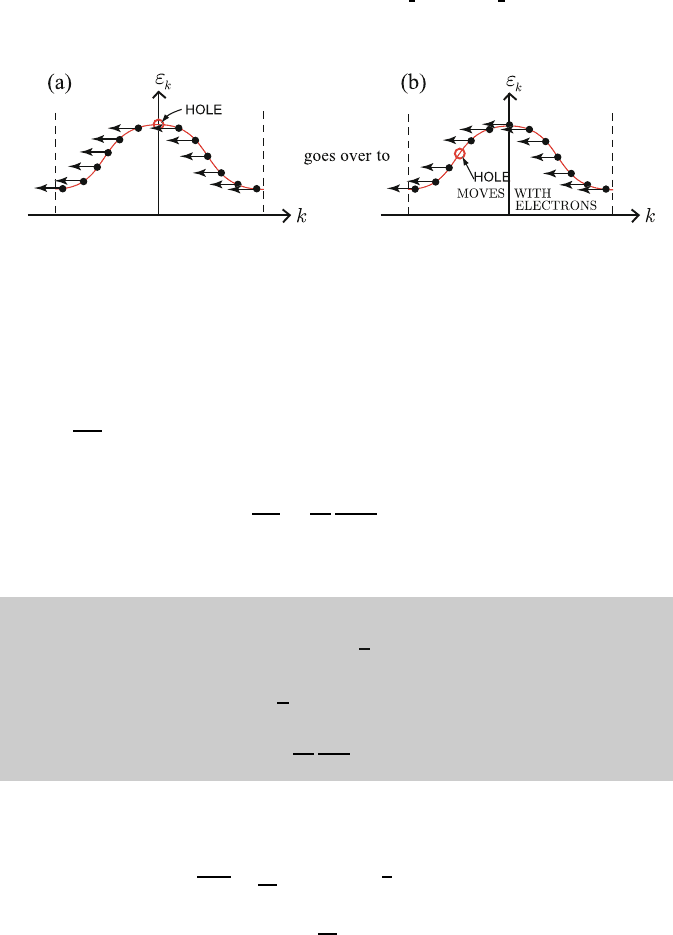
Fig. 6.4. Motion of an electron and a hole: panel (a)goesovertopanel(b), and a
hole moves with electrons
Because the equation of motion in k space is 214
¯h
˙
k
x
= −eE
x
(6.55)
every electron in the nearly filled band moves in k space according to k
x
(t)= 215
k
x
(0) −
eE
x
¯h
t. Therefore, the hole moves in the same direction; Fig. 6.4a goes 216
over to b. Of course, the effective mass m
∗
near the top of a valence band is 217
negative since 218
1
m
∗
=
1
¯h
2
∂
2
ε
k
∂k
2
< 0. (6.56)
It is interesting to write down the following equations that describe the motion
219
of a hole:
220
¯h
˙
k = −e
E +
1
c
v
h
× B
. (6.57)
v
h
=
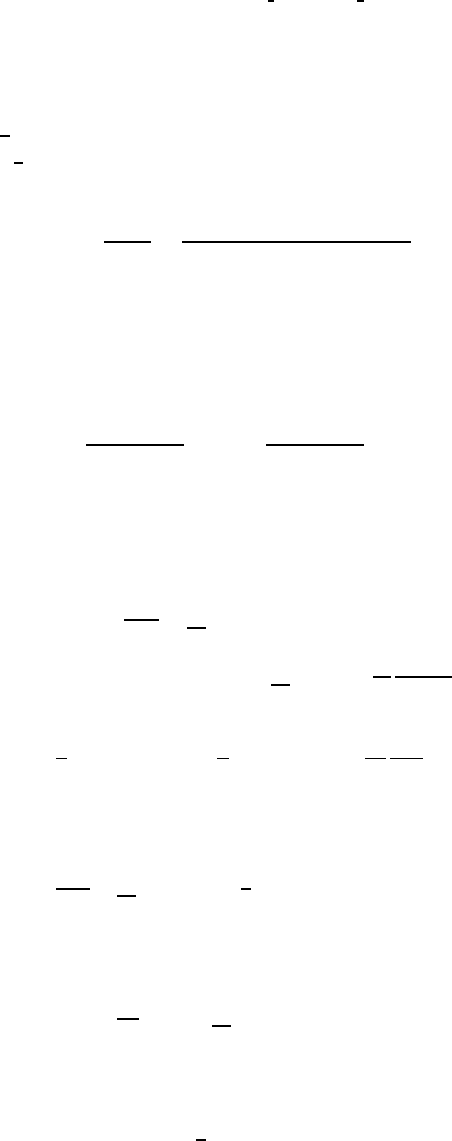
1
¯h
∇
k
ε
k
. (6.58)
m
∗
k
= −
1
¯h
2
∂
2
ε
∂k
2
> 0. (6.59)
221
We can assume that a hole has a positive mass near the top of the band where 222
an electron has a negative mass. Then, 223
dv
h
dt
= m
∗
k
−1
·
eE +
e
c
v
k
× B
. (6.60)
Here, we have used a positive mass m
∗
k
and a positive charge +e to describe 224
the hole. In the valence band of a semiconductor, a few holes can be thermally 225
excited. They can be treated as particles having positive mass and positive 226
charge. 227
6.4.3 Effective Hamiltonian of Bloch Electron 228
We know that for Bloch electrons we can write 229
1. E = ε
n
(k) for the energy of an electron in the nth band. 230
2. Ψ
nk
(r)=e
ik·r
u
nk
(r), where u
nk
(r) is periodic with the lattice periodicity. 231

Uncorrected Proof
BookID 160928 ChapID 06 Proof# 1 - 29/07/09
6.4 Semiclassical Approximation for Bloch Electrons 173
We have seen that close to a minimum (e.g. at k =0)wecanwrite 232
ε
n
(k)=ε
n
(0) +
¯h
2
2
k · m
∗
−1
·k. (6.61)
The form of this equation might lead us to write an effective Hamiltonian
233
H
eff
= ε
n
(0) +
¯h
2
2
(−i∇) · m
∗
−1
· (−i∇) , (6.62)
234
and an effective Schr¨odinger equation 235
H
eff
ϕ(r)=Eϕ(r). (6.63)
236
The solution ϕ(r) of (6.63) is not a true wave function for an electron. For 237
example, if we set ϕ(r)=V
−1/2
e
ik·r
,weobtainE = ε
n
(0) +
¯h
2
2
k · m
∗
−1
· k. 238
However, the true wave function Ψ is obtained from the pseudo-wavefunction 239
ϕ by multiplying it by u
nk
, the periodic part of the Bloch function. 240
So far, we have not really done anything new. However, if we introduce a 241
potential W (r) which is very slowly varying on the atomic scale, we can take 242
as the effective Hamiltonian 243
H
eff
= ε
n
(0) +
¯h
2
2
(−i∇) ·m
∗
−1
· (−i∇)+W (r). (6.64)
Then the solutions to (H
eff
− E) ϕ(r) = 0 will mix Bloch wave functions with 244
different values of k. The smooth function ϕ(r) is called the envelope function. 245
This approach can be justified rigorously if the perturbing potential W (r)and 246
the energy band ε
n
(k) satisfy certain conditions. 247
It turns out that the effective Hamiltonian approach works not only in the 248
regime of the effective mass approximation. In fact, for a Bloch electron (in 249
band n) in the presence of a time independent vector potential A(r)anda 250
scalar potential ϕ(r,t), which is slowly varying in space and time, we may 251
define an effective Hamiltonian 252
H
eff
= ε
n
−i∇ +
e
c
A(r)
− eφ(r,t). (6.65)
253
This effective Hamiltonian leads to the semiclassical equation of motion 254
˙
r =
1
¯h
∇
k
ε
n
(k)=v
n
(k) (6.66)
¯h
˙
k = −eE −
e
c
v
n
(k) × B, (6.67)
where E = −∇φ and B = ∇×A.
255
Uncorrected Proof
BookID 160928 ChapID 06 Proof# 1 - 29/07/09
174 6 More Band Theory and the Semiclassical Approximation
Problems 256
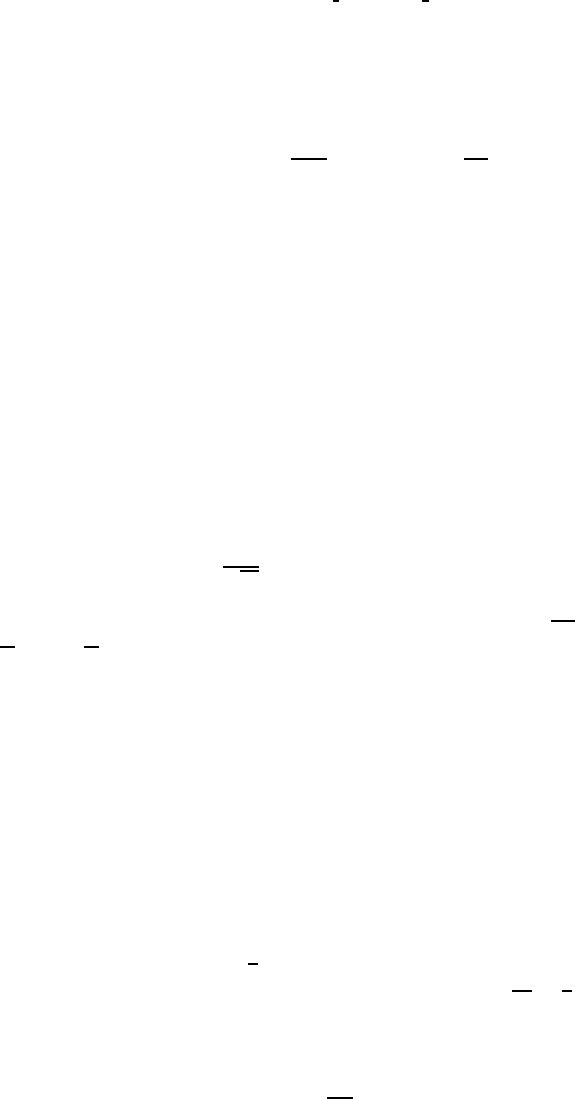
6.1. For a one-dimensional δ-function potential V (z)=−λδ(z), show that 257
the lowest energy state occurs at ε
0
= −
¯h
2
κ
2
2m
,where| κ |=
mλ
¯h
2
. Determine 258
the normalized wave function Ψ
0
(z). 259
6.2. Consider a periodic one-dimensional potential 260
V (z)=−λ
∞
l=−∞
δ(z − la).
(a) Use the tight binding approximation (keeping overlap between near-
261
est neighbors only) to determine the energy ε
0
(k) as a function of 262
wave number k. 263
(b) Use the tight binding form of the wave function to express the Bloch 264
function in the form Ψ
0
(k, z)=e
ikz
u
0
(k, z), where u
0
(k, z)isaperiodic 265
function of z. Write down an expression for u
0
(k, z) valid in the region 266
0 ≤ z ≤ a. 267
6.3. A Wannier function for the nth band of a one-dimensional lattice can be 268
written as 269
a
n
(z − la)=
1
√
N
k
e
−ikla
Ψ
nk
(z).
Here, Ψ
nk
(z) is a Bloch function, a
n
(z−la) a Wannier function, and k =
2π
Na
n, 270
where −
N
2
≤ n ≤
N
2
− 1. 271
(a) Use the orthogonality relation Ψ
nk
|Ψ
nk
= δ
kk
to show that 272
Wannier functions on different sites are orthogonal, i.e., 273
a
n
(z − l
a)|a
n
(z − la) = δ
ll
.
(b) For the model described in Problem 2, determine the Wannier function
274
for the site at the origin, i.e., l =0. 275
6.4. In the semiclassical treatment of Bloch electrons, one constructs wave 276
packets by making linear combinations of Bloch functions within a single band, 277
with a spread Δk in wave vectors about some particular value of k.Thewave 278
packets are localized in coordinate space in a region Δx
i
(i =1, 2, 3) centered 279
on some point r =(x
1
,x
2
,x
3
), and Δx
i
Δk
i
1. The electron velocity is 280
given by the group velocity v
n
(k)=
1
¯h
∇
k
ε
n
(k). (Let us omit the band index 281
n hereafter.) The time rate of change of the wave vector k is given by
dk
dt
=
1
¯h
F, 282
where F is the external force on the electron. 283
(a) If F = −eE ˆx, show that 284
k
x
(t)=k
x
(0) −
eE
¯h
t.
What happens when k
x
(t) reaches the Brillouin zone boundary? 285

Uncorrected Proof
BookID 160928 ChapID 06 Proof# 1 - 29/07/09
6.4 Semiclassical Approximation for Bloch Electrons 175
(b) If F = −
e
c
v
n
×Bˆz, the Lorentz force in a magnetic field B = Bˆz,show 286
that the electron moves on a path in k-space that is the intersection of a 287
plane k
z
= constant and a surface of constant energy ε(k)=constant. 288
Uncorrected Proof
BookID 160928 ChapID 06 Proof# 1 - 29/07/09
176 6 More Band Theory and the Semiclassical Approximation
Summary 289
In this chapter, we studied more theories of band structure calculation and 290
semiclassical description of Bloch electrons. We first introduced orthogonal- 291
ized plane wave method for expanding the periodic part of the Bloch functions 292
and discussed pseudopotential method and k ·p effective mass theory as prac- 293
tical alternative ways of including the effects of periodic symmetry of crystal 294
potential. Then, the semiclassical wave packet picture is discussed to describe 295
the motion of the Bloch electrons in a given band. In addition, ideas of effec- 296
tive mass and hole are shown to be convenient in describing the behavior of 297
band electrons. 298
It often occurs that the series for u
(k, r)=
K
C
(k)e
K
·r
converges 299
very slowly so that many different plane waves must be included in the expan- 300
sion. In an orthogonalized plane wave calculation, the periodic part of the 301
Bloch function is expanded in orthogonalized plane waves instead of in plane 302
waves. This improves the convergence. In many calculations, model pseudopo- 303
tentials W (r) are introduced in such a way that W (r) is taken to be a local 304
potential which has 305
1. A constant value V
0
inside a core or radius d and 306
2. The actual potential V (r)forr>d. 307
Both V
0
and d are used as adjustable parameters to fit the energy bands to 308
experimental observation. 309
In discussing properties of semiconductors, it is often more important to 310
have a single analytic description of the band structure very close to a conduc- 311
tion band minimum or valence band maximum than to have detailed numerical 312
calculations of E
n
(k)andΨ
nk
throughout the Brillouin zone. In a k·p method, 313
energy eigenvalue E
(n)
k
is written as 314
E
(n)
k
= E
(n)
0
+
¯h
2
2
k · m
∗
−1
·k,
where the inverse effective mass tensor (for the band n)isgivenby
315
m
∗
ij
−1
= m
−1
δ
ij
+
2
m
2
l
u
(n)
0
|p
i
|u
(l)
0
!
u
(l)
0
|p
j
|u
(n)
0
!
E
(n)
0
− E
(l)
0
.
The semiclassical wave packet picture can be used to describe the motion
316
of Bloch electrons in a given band in response to slowly varying perturbations, 317
and the group velocity of a wave packet gives 318
v
n
(k)=
1
¯h
∇
k
ε
n
(k)
as the velocity of a Bloch electron of wave vector k in the nth band. In the
319
presence of a force F,wehave
˙
k =¯h
−1
F. The semiclassical description of 320
Bloch electrons satisfies the following rules: 321
Uncorrected Proof
BookID 160928 ChapID 06 Proof# 1 - 29/07/09
6.4 Semiclassical Approximation for Bloch Electrons 177
1. The band index n is a constant of the motion; no interband transitions are 322
allowed. 323
2.
˙
r = v
n
(k)=
1
¯h
∇
k
ε
n
(k). 324
3. ¯h
˙
k = −e
E +
1
c
v
n
(k) × B
. 325
4. The contribution of the nth band to the electron density is 326
2f
0
(ε
n
(k))
d
3
k
(2π)
3
=
d
3
k/4π
3
1+exp[(ε
n
(k) − μ) /k
B
T ]
.
For free electrons, electrons are not restricted to one band but move continu-
327
ously in k-space according to ¯h
˙
k = Force. For Bloch electrons k is restricted 328
to the first Brillouin zone and k ≡ k + K. Clearly the restriction to band 329
n requirement must break down when the gap E
GAP
(k) becomes very small. 330
The conditions 331
eEa
[E
GAP
(k)]
2
E
F
;¯hω
c
[E
GAP
(k)]
2
E
F
.
must be satisfied for the semiclassical treatment of Bloch electrons to be valid.
332
Here, E is the electric field and a the atomic spacing. ω
c
is the electron 333
cyclotron frequency and E
F
the Fermi energy. 334
The equation of motion becomes 335
dv
n
dt
= m
∗
n
−1
· F
where the effective mass tensor ] is defined by
m
∗
n
−1
ij
=
1
¯h
2
∂
2
ε
n
(k)
∂k
i
∂k
j
. 336
The motion of a hole is described by 337
¯h
˙
k = −e
E +
1
c
v
h
× B
; v
h
=
1
¯h
∇
k
ε
k
; m
∗
k
= −
1
¯h
2
∂
2
ε
∂k
2
> 0.
Since a hole has a positive mass near the top of the band where an electron
338
has a negative mass, we have 339
dv
h
dt
= m
∗
k
−1
·
eE +
e
c
v
k
× B
.
The effective Hamiltonian of Bloch electron is written, in the presence of
340
slowly varying potential W(r), as 341
H
eff
= ε
n
(0) +
¯h
2
2
(−i∇) · m
∗
−1
·(−i∇)+W (r).
In the presence of a time-independent vector potential A(r)andascalar
342
potential ϕ(r,t), which is slowly varying in space and time, we have an effective 343
Hamiltonian 344
H
eff
= ε
n
−i∇ +
e
c
A(r)
− eφ(r,t).

Uncorrected Proof
BookID 160928 ChapID 06 Proof# 1 - 29/07/09
178 6 More Band Theory and the Semiclassical Approximation
This effective Hamiltonian leads to the semiclassical equation of motion 345
˙
r =
1
¯h
∇
k
ε
n
(k)=v
n
(k)and¯h
˙
k = −eE −
e
c
v
n
(k) × B,
where E = −∇φ and B = ∇×A.
346

Uncorrected Proof
BookID 160928 ChapID 07 Proof# 1 - 29/07/09
7 1
Semiconductors 2
7.1 General Properties of Semiconducting Material 3
In earlier sections, we have seen that a perfect crystal will be 4
1. An insulator at T = 0 K, if there is a gap separating the filled and empty 5
energy bands. 6
2. A conductor at T = 0 K, if the conduction band is only partially occupied. 7
A special case of the insulating crystal is that of the semiconductor. In a 8
semiconductor, the gap separating the filled and empty bands is very small, 9
and at finite temperature some electrons from the filled valence band are 10
thermally excited across the energy gap giving n
e
(T ) electrons per unit volume 11
in the conduction band and n
h
(T ) holes per unit volume in the valence band 12
(of course n
e
= n
h
). 13
If we recall the expression for the conductivity of a free electron model 14
σ =
ne
2
τ
m
, (7.1)
where n is the number of carriers per unit volume, we find that different types
15
of materials can be described by different values of n. For a metal n 10
22
16
to 10
23
cm
−3
and is independent of temperature. For a semimetal n 10
18
to 17
10
20
cm
−3
and is also roughly temperature independent. For an insulator or 18
a semiconductor 19
n n
0
e
−
E
G
2k
B
T
,
where n
0
10
22
to 10
23
cm
−3
and the energy gap E
G
is large (E
G
≥ 4eV) 20
for an insulator and is small (E
G
≤ 2 eV) for a semiconductor. 21
At room temperature, k
B
T 25 meV, so that e
−
E
G
2k
B
T
≤ e
−80
10
−35
for 22
an insulator, while for a semiconductor e
−
E
G
2k
B
T
≥ e
−20
10
−9
.Thefactor 23
10
−35
even when multiplied by 10
23
cm
−3
gives n 0 for an insulator. With 24