
Quinn J.J., Yi K.-S. Solid State Physics: Principles and Modern Applications
Подождите немного. Документ загружается.

Uncorrected Proof
BookID 160928 ChapID 07 Proof# 1 - 29/07/09
190 7 Semiconductors
c
c
v
v
type
type
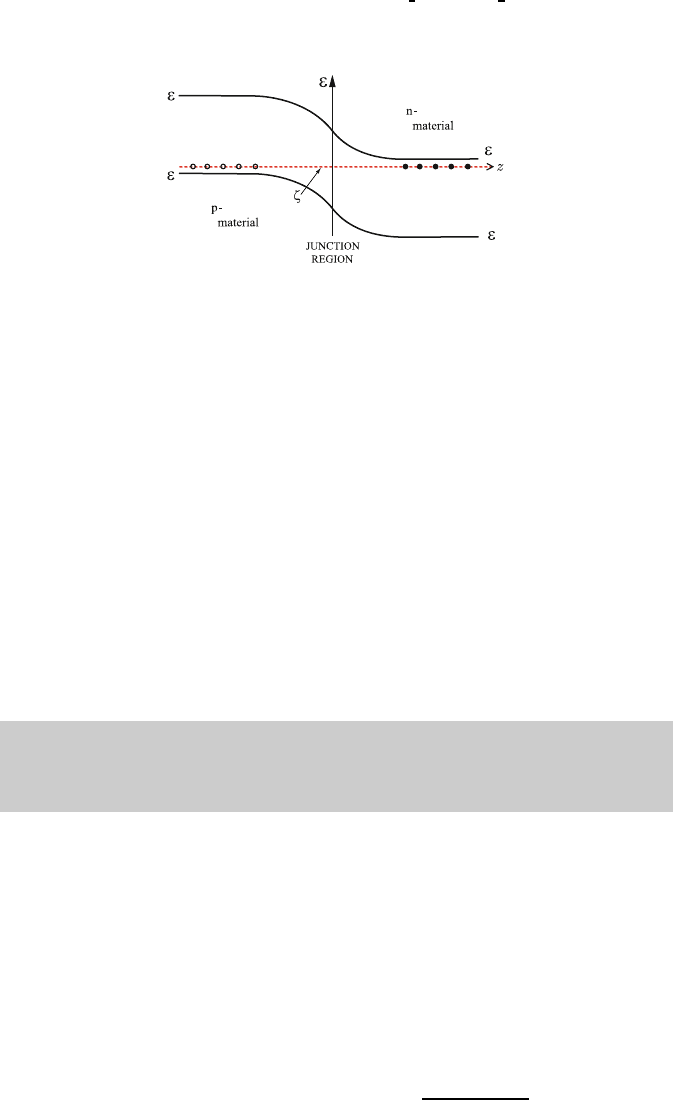
Fig. 7.4. Impurity levels and chemical potential across the p–n junction
7.5.1 Semiclassical Model 258
The effective Hamiltonian describing the conduction or valence band of a 259
system containing a p-n junction can be written 260
H = ε (−i¯h∇) − eφ(z), (7.52)
where φ(z) is an electrostatic potential that must be slowly varying on the
261
atomic scale in order for the semiclassical approximation to be valid. The 262
energies of the conduction and valence band edges will be given by 263
ε
c
(z)=ε
c
− eφ(z),
ε
v
(z)=ε
v
− eφ(z). (7.53)
The concentration of electrons and holes will vary with position z as
264
n
c
(z)=N
c
(T )e
−β[ε
c
−eφ(z)−ζ]
,
p
v
(z)=P
v
(T )e
−β[ζ−ε
v
+eφ(z)]
. (7.54)
265
The most important case to study is the high concentration limit where 266
N
d
n
i
and N
a
n
i
on the right and left sides of the junction, respec- 267
tively. In that case, the concentration of electrons and holes will vary with 268
position z as 269
lim
z→∞
n
c
(z)=N
c
(T )e
−β[ε
c
−eφ(∞)−ζ]
≈ N
d
,
lim
z→−∞
p
v
(z)=P
v
(T )e
−β[ζ−ε
v
+eφ(−∞)]
≈ N
a
. (7.55)
These two equations can be combined to give
270
eΔφ = e [φ(∞) − φ(−∞)] = E
G
+Θln
N
d
N
a
N
c
(T )P
v
(T )
. (7.56)

Uncorrected Proof
BookID 160928 ChapID 07 Proof# 1 - 29/07/09
7.5 p–n Junction 191
The potential φ(z) must satisfy Poisson’s equation given by 271
∂
2
φ(z)
∂z
2
= −
4πρ(z)
s
, (7.57)
272
where the charge density ρ(z)isgivenby 273
ρ(z)=e [N
d
(z) − N
a
(z) − n
c
(z)+p
v
(z)] . (7.58)
274
In using (7.55), we are assuming that all donors and acceptors are ionized 275
[since n
c
(∞)=N
d
, all the donor electrons are in the conduction band so the 276
donors must be positively charged ]. Thus we have 277
N
d
(z)=N
d
Θ(z), (7.59)
278
N
a
(z)=N
a
[1 − Θ(z)] , (7.60)
279
n
c
(z)=N
d
e
−β[φ(∞)−φ(z)]
, (7.61)
280
p
v
(z)=N
a
e
−β[φ(z)− φ(−∞)]
. (7.62)
Equations (7.57)–(7.62) form a complicated set of nonlinear equations. The
281
solution is simple if we assume that the change in φ(z) occurs entirely over a 282
relatively small region near the junction known as the depletion region. 283
We will assume that 284
φ(z)=φ(−∞)forz<−d
p
;regionI
φ(z)=φ(∞)forz>d
n
;regionII
φ(z)varies withz for − d
p
<z<d
n
; region III (7.63)
The length d
p
(or d
n
) is called the depletion length of the p-type (or n-type) 285
region. In region II the concentration of electron in the conduction band n
c
is 286
equal to the number of ionized donors N
d
so that ρ
II
(z)=− en
c
+ eN
d
=0. 287
In region I, the concentration of holes p
v
is equal to the number of ionized 288
acceptors so that ρ
I
(z)=ep
v
−eN
a
= 0. In region III, there are no electrons or 289
holes (the built-in junction potential sweeps them out) so p
v
(z)=n
c
(z)=0 290
in this region. Therefore, for ρ(z)wehave 291
ρ
III
(z)=
#
+eN
d
for 0 <z<d
n
,
−eN
a
for − d
p
<z<0.
(7.64)
We can integrate Poisson’s equation. In the region 0 <z<d
n
,wehave 292
∂
2
φ(z)
∂z
2
= −
4πe
s
N
d
, (7.65)
and integration gives
293
∂φ(z)
∂z
= −
4πe
s
N
d
z + C
1
. (7.66)
Uncorrected Proof
BookID 160928 ChapID 07 Proof# 1 - 29/07/09
192 7 Semiconductors
Here, C
1
is a constant of integration. Integrating (7.66) gives 294
φ(z)=−
2πeN
d
s
z
2
+ C
1
z + C
2
. (7.67)
We choose the constants so that φ(z) evaluated at z = d
n
has the value φ(∞) 295
and
∂φ(z)
∂z
=0atz = d
n
.Thisgives 296
φ(z)=φ(∞) −
2πeN
d
s
(z − d
n
)
2
, for 0 <z<d
n
. (7.68)
297
Doing exactly the same thing in the region −d
p
<z<0gives 298
φ(z)=φ(−∞)+
2πeN
a
s
(z + d
p
)
2
, for − d
p
<z<0. (7.69)
299
Of course, for z>d
n
, φ(z)=φ(∞)andforz<−d
p
, φ(z)=φ(−∞) 300
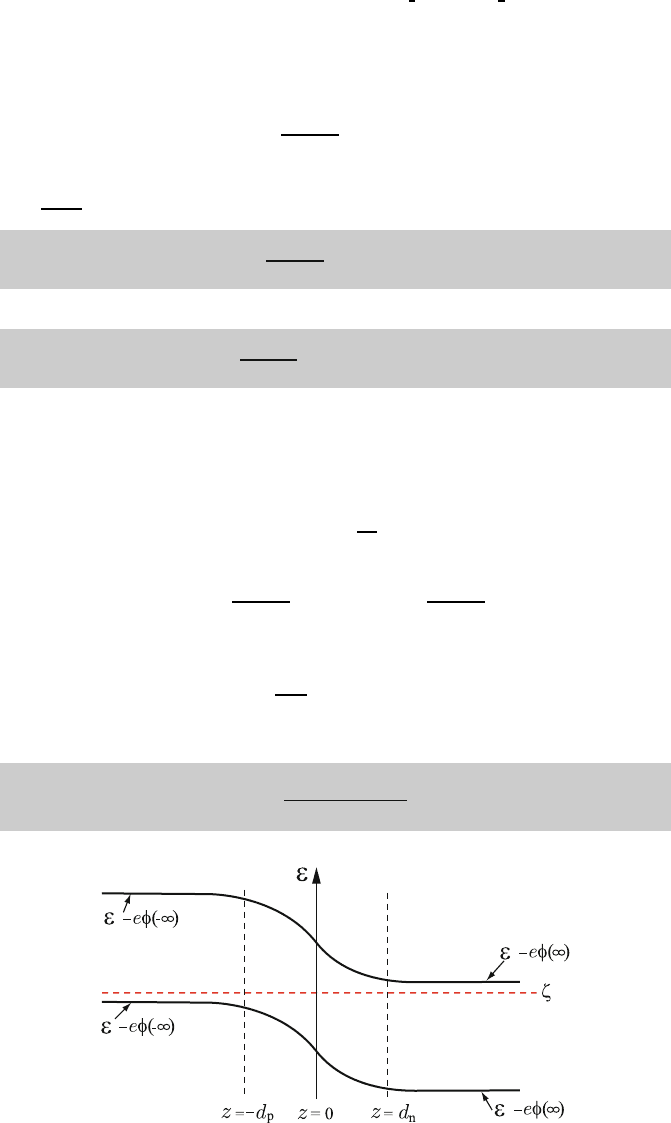
(see Fig. 7.5). 301
Charge conservation requires that 302
N
d
d
n
= N
a
d
p
. (7.70)
This condition insures the continuity of
∂φ
∂z
at z = 0. The continuity of φ(z) 303
at z =0requiresthat 304
φ(∞) −
2πeN
d
s
d
2
n
= φ(−∞)+
2πeN
a
s
d
2
p
. (7.71)
We can solve (7.71) for Δφ ≡ φ(∞) − φ(−∞)toobtain
305
Δφ =
2πe
s
N
d
d
2
n
+ N
a
d
2
p
. (7.72)
Combining (7.70) and (7.72) allows us to determine d
n
and d
p
306
d
n
=
(N
a
/N
d
)
s
Δφ
2πe(N
a
+ N
d
)
1/2
. (7.73)
307
308
c
c
v
v
Fig. 7.5. Band bending across the p–n junction

Uncorrected Proof
BookID 160928 ChapID 07 Proof# 1 - 29/07/09
7.5 p–n Junction 193
The equation for d
p
is obtained by interchanging N
a
and N
d
.IfN
a
were equal 309
to N
d
then d
n
= d
p
= d and is given by 310
d
s
eΔφ
4πe
2
N
1/2
≈
s
E
G
4πe
2
N
1/2
, (7.74)
where N = N
d
= N
a
. In the last result, we have simply put eΔφ ≈ E
G
. 311
7.5.2 Rectification of a p–n Junction 312
The region of the p–n junction is a high resistance region because the carrier 313
concentration in the region (−d
p
<z<d
n
) is depleted. When a voltage V 314
is applied, almost all of the voltage drop occurs across the high resistance 315
junction region. We write Δφ in the presence of an applied voltage V as 316
Δφ =(Δφ)
0
− V. (7.75)
Here, (Δφ)
0
is, of course, the value of Δφ when V = 0. The sign of V is 317
taken as positive (forward bias)whenV decreases the voltage drop across the 318
junction. The depletion layer width d
n
changes with voltage 319
d
n
(V )=d
n
(0)
1 −
V
(Δφ)
0
1/2
. (7.76)
A similar equation holds for d
p
(V ). When V = 0, there is no hole current J
h
320
and no electron current J
e
.WhenV is finite both J
e
and J
h
are nonzero. Let 321
us look at J
h
. It has two components: 322
Generation current This current results from the small concentration of holes 323
on the n-side of the junction that are created to be in thermal equilib- 324
rium, i.e., to have ζ remain constant. These holes are immediately swept 325
into the p-side of the junction by the electric field of the junction. This 326
generation current is rather insensitive to applied voltage V ,sincethe 327
built-in potential (Δφ)
0
is sufficient to sweep away all the carriers that 328
are thermally generated. 329
Recombination current This current results from the diffusion of holes from 330
the p-side to the n-side. On the p-side there is a very high concentration 331
of holes. In order to make it cross the depletion layer (and recombine with 332
an electron on the n-side), a hole must overcome the junction potential 333
barrier −e [(Δφ)
0
− V ]. This recombination current does depend on V as 334
J
rec
h
∝ e
−e[(Δφ)
0
−V ]/Θ
. (7.77)
Here, J
rec
h
indicates the number current density of holes from the p- to 335
n-side. 336
Uncorrected Proof
BookID 160928 ChapID 07 Proof# 1 - 29/07/09
194 7 Semiconductors
Θ
−1)
(
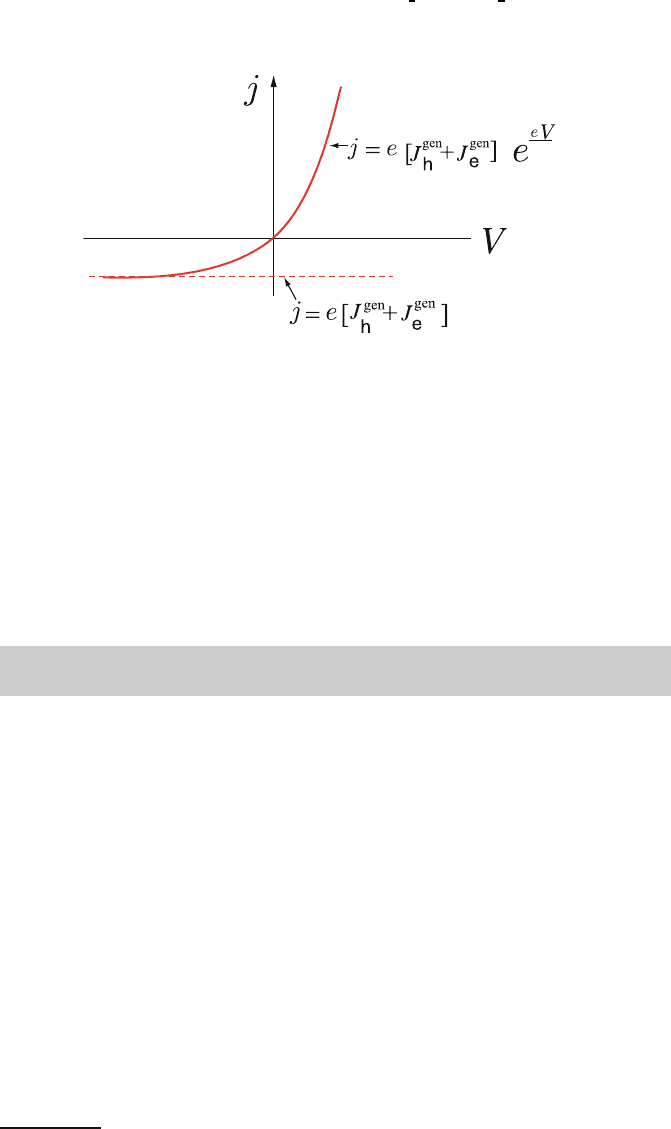
Fig. 7.6. Current–voltage characteristic across the p–n junction
Now, at V = 0 these two currents must cancel to give J
h
= J
rec
h
− J
gen
h
=0 337
We can write 338
J
h
= J
gen
h
e
eV /Θ
− 1
. (7.78)
The electrical current density due to holes is j
h
= eJ
h
, and it vanishes at 339
V = 0 and has the correct V dependence for J
rec
h
.Ifwedothesamefor 340
electrons, we obtain the current density J
e
= J
gen
e
e
eV /Θ
− 1
, which flows 341
oppositely to the J
h
. The electrical current density of electrons j
e
is parallel to 342
the j
h
. Therefore, the combined electrical current density becomes as follows: 343
344
j = e (J
gen
h
+ J
gen
e
)
e
eV /Θ
− 1
. (7.79)
345
Aplotofj versus V looks as shown in Fig. 7.6. The applied-voltage behavior 346
of an electrical current across the p–n junction is called rectification because 347
a circuit can easily be arranged in which no current flows when V is negative 348
(smaller than some value) but a substantial current flows for positive applied 349
voltage. 350
7.5.3 Tunnel Diode 351
In the late 1950s, Leo Esaki
1
was studying the current voltage characteristics 352
of very heavily doped p–n junctions. He found and explained the j −V charac- 353
teristic shown in Fig. 7.7. Esaki noted that, for very heavily doped materials, 354
impurity band was formed and one would obtain degenerate n-type and p- 355
type regions where the chemical potential ζ was actually in the conduction 356
band on the n-side and in the valence band on the p-side as shown in Fig. 7.8. 357
For a forward bias the electrons on the n-side can tunnel through the energy 358
gap into the empty states (holes) in the valence band. This current occurs 359
only for V>0, and it cuts off when the voltage V exceeds the value at 360
1
L. Esaki, Phys. Rev. 109, 603–604 (1958).
Uncorrected Proof
BookID 160928 ChapID 07 Proof# 1 - 29/07/09
7.6 Surface Space Charge Layers 195
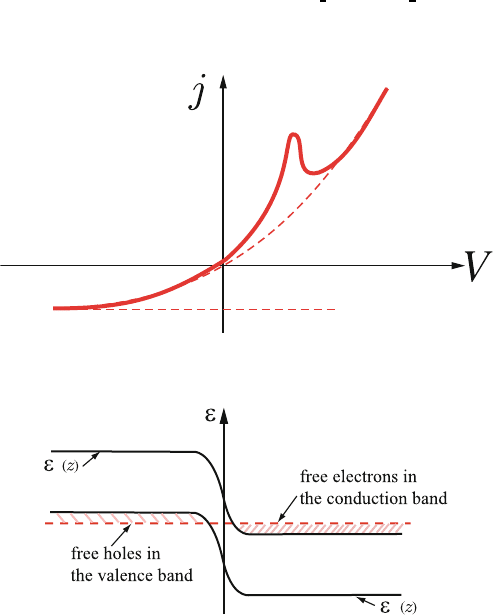
Fig. 7.7. Current–voltage characteristic across a heavily doped p–n junction
c
v
Fig. 7.8. Chemical potential across the heavily doped p–n junction
which ε
c
(∞)=ε
v
(−∞). When the tunnel current is added to the normal p–n 361
junction current, the negative resistance region shown in Fig. 7.7 occurs. 362
7.6 Surface Space Charge Layers 363
The metal–oxide–semiconductor (MOS) structure is the basis for all of current 364
microelectronics. We will consider the surface space charge layers that can 365
occur in an MOS structure. Assume a semiconductor surface is produced 366
with a uniform and thin insulating layer (usually on oxide), and then on top 367
of this oxide a metallic gate electrode is deposited as is shown in Fig. 7.9. 368
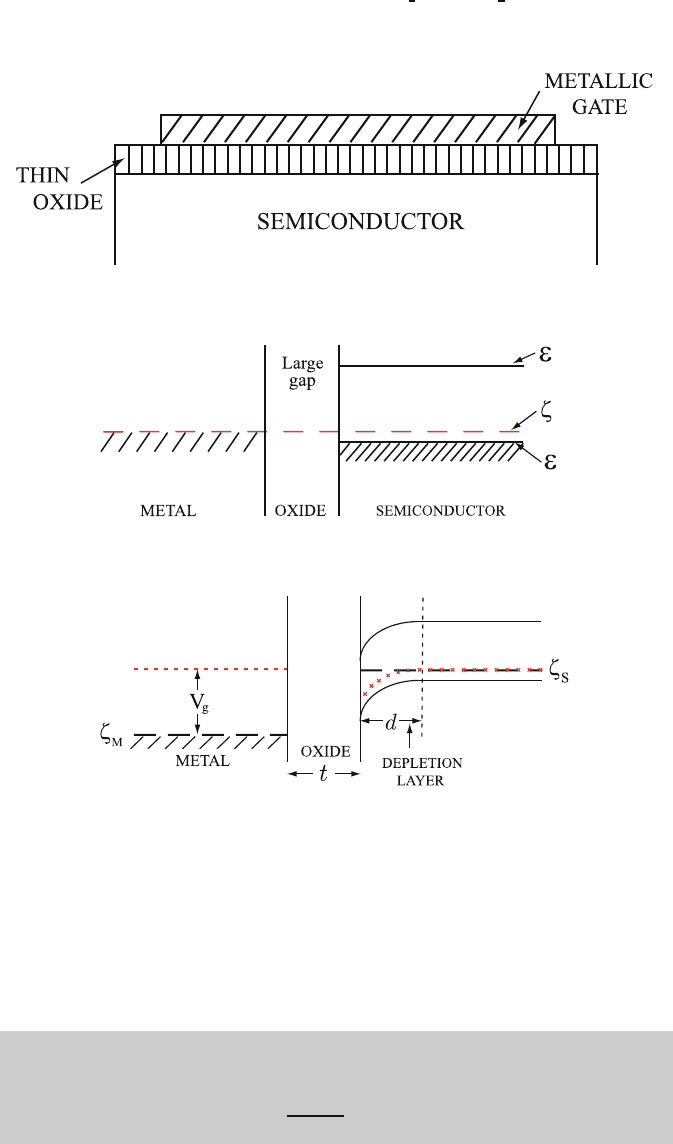
In the absence of any applied voltage, the bands line up as shown in 369
Fig. 7.10. If a voltage is applied which lowers the Fermi level in the metal 370
relative to that in the semiconductor, most of the voltage drop will occur 371
across the insulator and the depletion layer of the semiconductor. 372
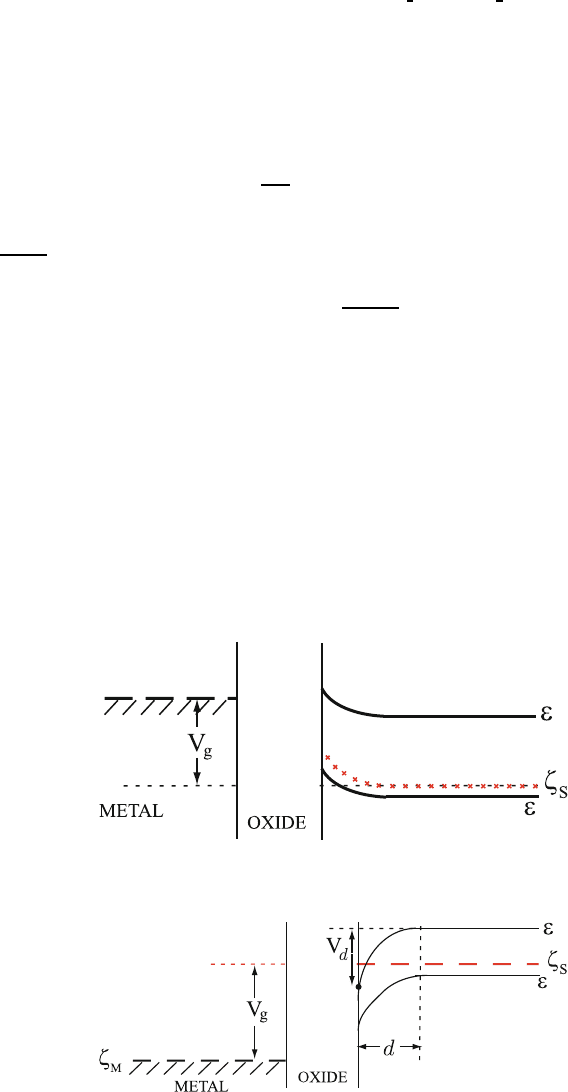
For a relatively small applied voltage, we obtain a band alignment as shown 373
in Fig. 7.11. In the depletion layer all of the acceptors are ionized and the hole 374
concentration is zero since the field in the depletion layer sweeps the holes into 375
Uncorrected Proof
BookID 160928 ChapID 07 Proof# 1 - 29/07/09
196 7 Semiconductors
Fig. 7.9. Metal–oxide–semiconductor structure
c
v
Fig. 7.10. Band edge alignment across an MOS structure
Fig. 7.11. Band alignment across an MOS structure in the presence of a small
applied voltage
the bulk of the semiconductor. The normal component of the displacement 376
field D = E must be continuous at the semiconductor–oxide interface, and 377
the sum of the voltage drop V
d
across the depletion layer and V
ox
across the 378
oxide must equal the applied voltage V
g
. If we take the electrostatic potential 379
to be φ(z), then 380
φ(z)=φ(∞)forz>d,
φ(z)=φ(∞)+
2πeN
a
s
(z − d)
2
for 0 <z<d. (7.80)
381
Uncorrected Proof
BookID 160928 ChapID 07 Proof# 1 - 29/07/09
7.6 Surface Space Charge Layers 197
The potential energy V is −eφ. V
ox
is simply E
ox
t,whereE
ox
and t are the 382
electric field in the oxide and the thickness of the oxide layer, respectively. 383
Equating
0
E
ox
to −ε
s
φ
(z =0)gives 384
e
V
ox
t
0
=4πe
2
N
a
d. (7.81)
Equation (7.81) gives us d in terms of V
ox
. Adding V
ox
to the voltage drop 385
2πeN
a
s
d
2
across the depletion layer gives 386
V
ox
= V
g
−
2πeN
a
s
d
2
. (7.82)
Note that d must grow as V
g
increases since the voltage drop is divided between 387
the oxide and the depletion layer. The only way that V
d
can grow, since N
a
is 388
fixed, is by having d grow. The surface layer just discussed is called a surface 389
depletion layer since the density of holes in the layer is depleted from its bulk 390
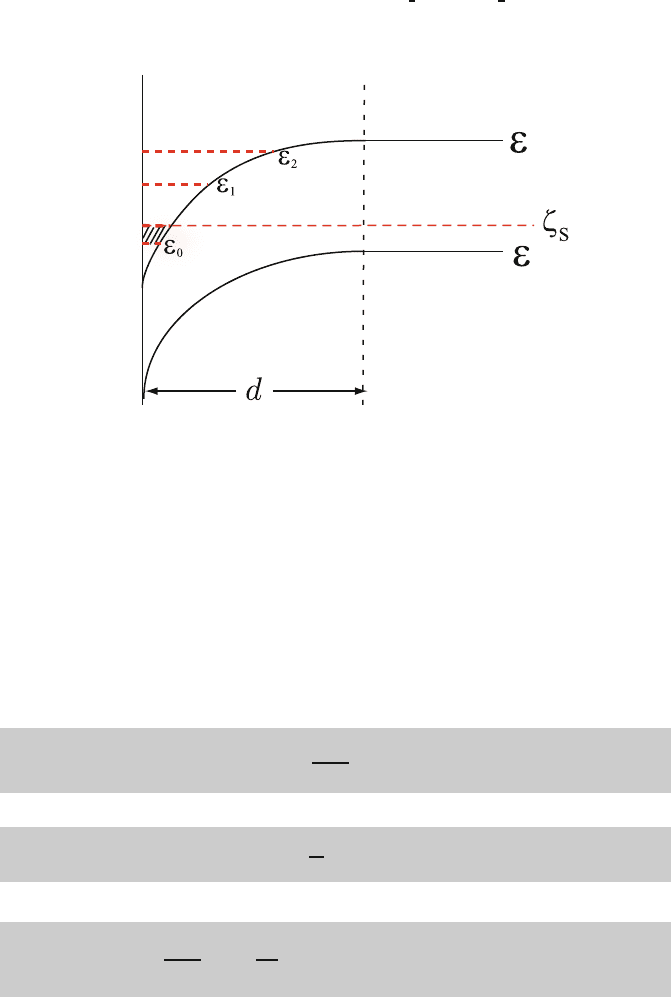
value. For a gate voltage in the opposite direction the bands look as shown 391
in Fig. 7.12. Here, the surface layer will have an excess of holes either bound 392
to the acceptors or in the valence band. This is called an accumulation layer 393
since the density of holes is increased at the surface. If the gate voltage V gis 394
increased to a large value in the direction of depletion, one can wind up with 395
the conduction band edge at the interface below ζ
s
, the chemical potential of 396
the semiconductor. This is shown in Fig. 7.13. 397
c
v
Fig. 7.12. Band alignment across an MOS structure in the presence of a small
negative gate voltage
c
v
Fig. 7.13. Band alignment across an MOS structure in the presence of a large
applied voltage
Uncorrected Proof
BookID 160928 ChapID 07 Proof# 1 - 29/07/09
198 7 Semiconductors
c
v
OXIDE
SEMICONDUCTOR
Fig. 7.14. Band edge near the interface of the semiconductor–insulator in the MOS
structure in the presence of a large applied voltage
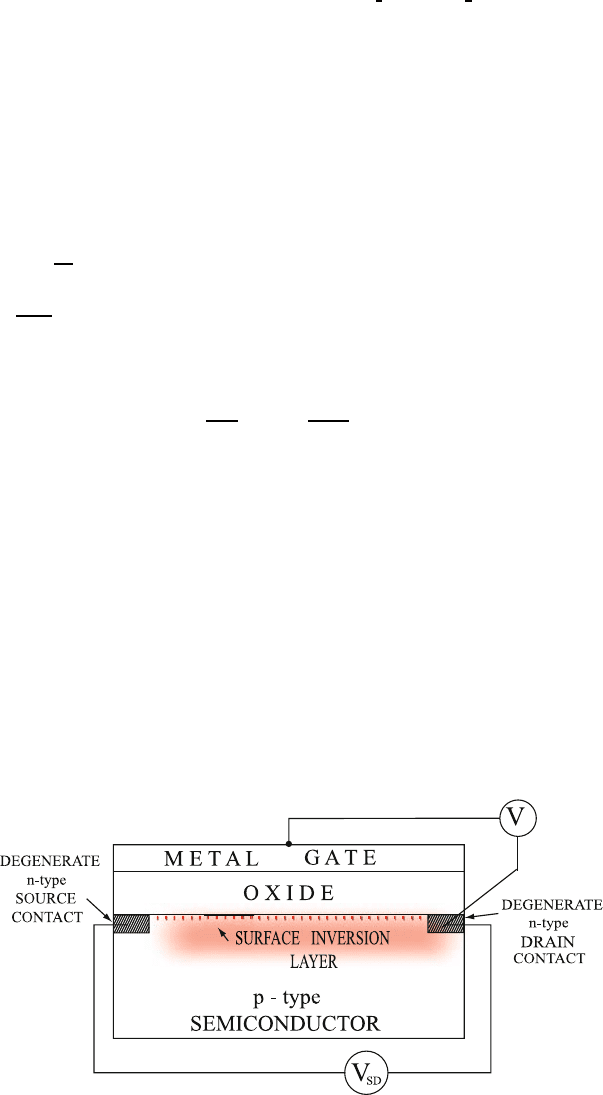
Now, there can be electrons in the conduction band because ζ
s
is higher 398
than ε
c
(z) evaluated at the semiconductor–oxide interface. The part of the 399
diagram near this interface is enlarged in Fig. 7.14. This system is called a 400
semiconductor surface inversion layer because in this surface layer we have 401
trapped electrons (minority carriers in the bulk). The motion of the electrons 402
in the direction normal to the interface is quantized, so there are discrete 403
energy levels ε
0
, ε
1
, ... forming subband structure.Ifonlyε
0
lies below the 404
chemical potential and ε
1
− ζ 0, the electronic system behaves like a two- 405
dimensional electron gas (2DEG) because 406
ε = ε
0
+
¯h
2
2m
∗
c
k
2
x
+ k
2
y
, (7.83)
407
and 408
Ψ
n,k
x
,k
y
=
1
L
e
i(k
x
x+k
y
y)
ξ
n
(z). (7.84)
409
Here, ξ
n
(z)isthenth eigenfunction of a differential equation given by 410
1
2m
∗
c
−i¯h
∂
∂z
2
+ V
eff
(z) − ε
n
ξ
n
(z)=0. (7.85)
411
In (7.85) the effective potential V
eff
(z) must contain contributions from the 412
depletion layer charge, the Hartree potential of the electrons trapped in the 413
inversion layer, an image potential if the dielectric constants of the oxide 414
and semiconductor are different, and an exchange–correlation potential of the 415
electrons with one another beyond the simple Hartree term. Because the elec- 416
trons are completely free to move in the x −y plane, but “frozen” into a single 417
Uncorrected Proof
BookID 160928 ChapID 07 Proof# 1 - 29/07/09
7.6 Surface Space Charge Layers 199
quantized level ε
0
in the z-direction, the z-degree of freedom is frozen out 418
of the problem, and in this sense the electrons behave as a two-dimensional 419
electron gas. We fill up a circle in k
x
− k
y
space up to k
F
,and 420
2
k
x
,k
y
ε<ε
F
1=N, (7.86)
giving 2
L
2π
2
πk
2
F
= N . This means that k
2
F
=2πn
s
,wheren
s
≡ N/L
2
421
is the number of electrons per unit area of the inversion layer. Of course 422
ε
F
≡
¯h
2
k
2
F
2m
∗
c
= ζ −ε
0
. 423
The potential due to the depletion charge is calculated exactly as before. 424
The Hartree potential is a solution of Poisson’s equation given below 425
∂
2
∂z
2
V
H
= −
4πe
2
s
ρ
e
(z). (7.87)
The electron density is given by
426
ρ
e
(z)=
n,k
f
0
(ε
nk
) |Ψ
nk
(z)|
2
, (7.88)
where Ψ
nk
(z)=L
−1
ξ
n
(z)e
ik·r
is the envelope wave function for the electrons 427
in the effective potential. The exchange–correlation potential V
xc
is a func- 428
tional of the electron density ρ
e
(z). This surface inversion layer system is the 429
basis of all large scale integrated circuit chips that we use every day. The 430
basic unit is the MOS field effect transistor (MOSFET) shown in Fig. 7.15. 431
The source–drain conductivity can be controlled by varying the applied gate 432
voltage V
g
. This allows one to make all kinds of electronic devices like oscil- 433
lators, transistors etc. This was an extremely active field of semiconductor 434
g
Fig. 7.15. Schematic diagram of the metal–oxide–semiconductor field effect
transistor