
Quinn J.J., Yi K.-S. Solid State Physics: Principles and Modern Applications
Подождите немного. Документ загружается.

Uncorrected Proof
BookID 160928 ChapID 07 Proof# 1 - 29/07/09
200 7 Semiconductors
physics from the late 60’s till the present time. Some basic problems that 435
were investigated include: 436
• Transport along the layer 437
surface electron density n
s
and relaxation time τ as a function of the gate 438
voltage V
g
, cyclotron resonance, localization, magnetoconductivity, and 439
Hall effect. 440
• Transport perpendicular to the layer 441
optical absorption; Raman scattering, coupling to optical phonons, intra 442
and intersubband collective modes. 443
• Many-body effects on subband structure and on effective mass and effective 444
g-value. 445
7.6.1 Superlattices 446
By novel growth techniques like molecular beam epitaxy (MBE) novel struc- 447
tures can be grown almost one atomic layer at a time. The requirements for 448
such growth are 449
1. The lattice constants of the two materials must be rather close. Otherwise, 450
large strains lead to many crystal imperfections. 451
2. The materials must form appropriate bonds with one another. 452
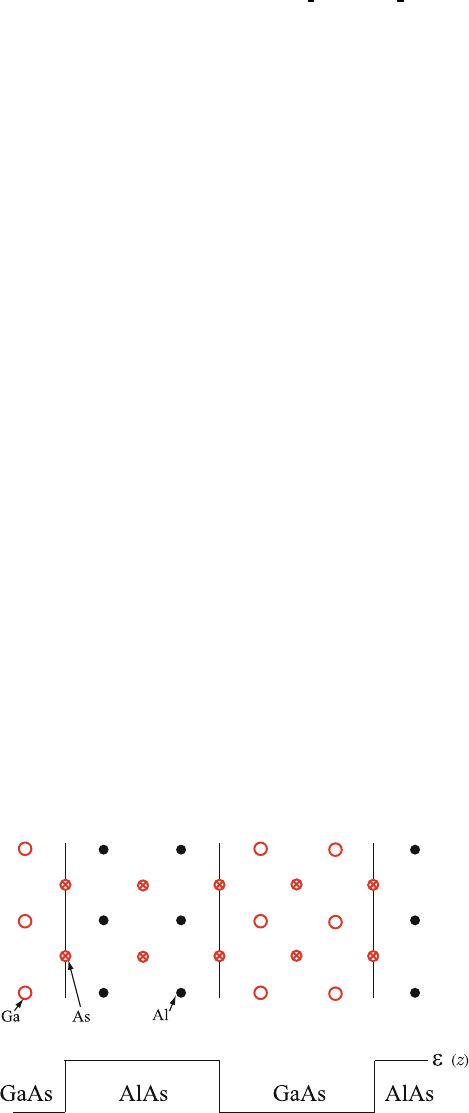
One very popular example is the GaAs–AlAs system shown in Fig. 7.16. A 453
single layer of GaAs in an AlAs host would be called a quantum well.A454
periodic array of such layers is called a superlattice. It can be thought of as a 455
new material with a supercell in real space that goes from one GaAs to AlAs 456
interface to the next GaAs to AlAs interface. 457
7.6.2 Quantum Wells 458
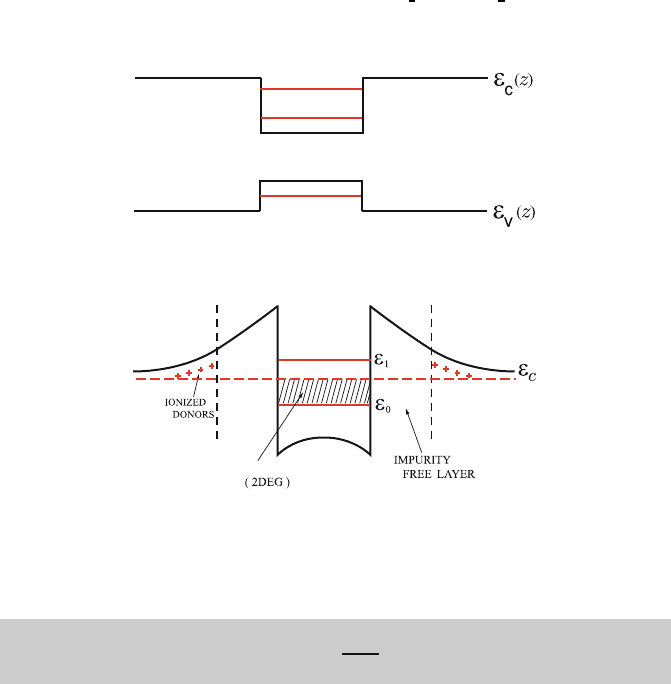
If a quantum well is narrow, it will lead to quantized motion and subbands 459
just as the MOS surface inversion layer did (see, for example, Fig. 7.17). For 460
F
Fig. 7.16. Schematic diagram of the GaAs–AlAs superlattice system
Uncorrected Proof
BookID 160928 ChapID 07 Proof# 1 - 29/07/09
7.6 Surface Space Charge Layers 201
(v)
0
ε
(c)
0
ε
(c)
1
ε
Fig. 7.17. Schematic diagram of the subbands formation in a quantum well of the
GaAs–AlAs structure
FREE CARRIERS
Fig. 7.18. Schematic diagram of a quantum well in a modulation doped
GaAs/Ga
1−x
Al
x
As quantum well
the subbands in the conduction band we have 461
ε
(c)
n
(k)=ε
(c)
n
+
¯h
2
2m
∗
c
k
2
x
+ k
2
y
. (7.89)
462
The band offsets are difficult to predict theoretically, but they can be mea- 463
sured. 464
7.6.3 Modulation Doping 465
The highest mobility materials have been obtained by growing modulation 466
doped GaAs/Ga
1−x
Al
x
As quantum wells. In these materials, the donors are 467
located in the GaAlAs barriers, but no closer than several hundred Angstroms 468
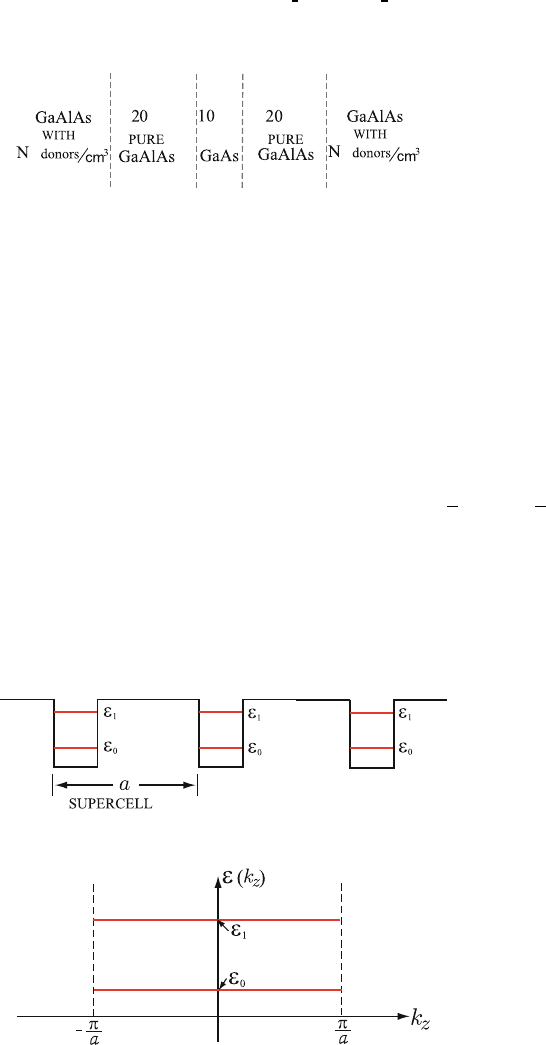
to the quantum well. The bands look as shown in Fig. 7.18. A typical sample 469
structure would look like GaAlAs with N
d
donors/cm
3
pure GaAlAs of 470
20 nm thick // GaAs of 10 nm thick // pure GaAlAs of 20 nm thick // GaAlAs 471
with N
d
donors/cm
3
(see, e.g., Fig. 7.19). Because the ionized impurities are 472
rather far away from the quantum well electrons, ionized impurity scattering 473
is minimized and very high mobilities can be attained. 474
7.6.4 Minibands 475
When the periodic array of quantum wells in a superlattice has very wide 476
barriers, the subband levels in each quantum well are essentially unchanged 477
Uncorrected Proof
BookID 160928 ChapID 07 Proof# 1 - 29/07/09
202 7 Semiconductors
nm
nm nm
d
d
Fig. 7.19. Schematic layered structure of a typical modulation doped GaAs/
Ga
1−x
Al
x
As quantum well system
(see, for example, Fig. 7.20). However, a new periodicity has been introduced, 478
so we have a quantum number k
z
that has to do with the eigenvalues of the 479
translation operator. 480
T
a
Ψ
nk
(z)=e
ik
z
a
Ψ
nk
(z) (7.90)
This looks just like the problem of atomic energy levels that give rise to
481
band structure when the atoms are brought together to form a crystal. For 482
very large values of the barrier width, no tunneling occurs, and the minibands 483
are essentially flat as is shown in Fig. 7.21. The supercell in real space extends 484
from z =0toz = a. The first Brillouin zone in k-space extends −
π
a
≤ k
z
≤
π
a
. 485
The minibands ε
n
(k
z
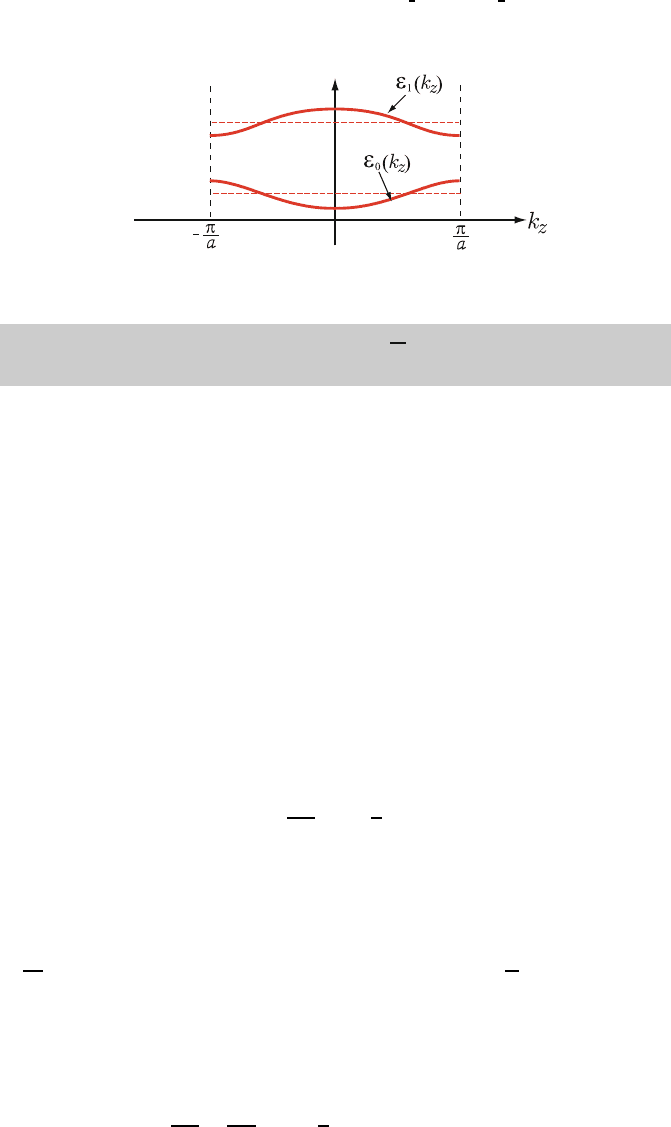
) are flat if the barriers are so wide that no tunneling 486
from one quantum well to its neighbor is possible. When the barriers are nar- 487
rower and tunneling can take place, the flat bands become k
z
-dependent. One 488
can easily show that in tight binding calculation one would get bands with 489
sinusoidal shape as shown in Fig. 7.22 below. Of course, the same band struc- 490
ture would result from taking free electrons moving in a periodic potential 491
Fig. 7.20. Schematic subband alignments in a superlattice of supercell width a
Fig. 7.21. Schematic miniband alignment in a superlattice of very large barrier
width
Uncorrected Proof
BookID 160928 ChapID 07 Proof# 1 - 29/07/09
7.7 Electrons in a Magnetic Field 203
Fig. 7.22. Miniband structure in a superlattice of very narrow barrier width
V (r)=
n
V
n
e
i
2π
a
nz
. (7.91)
492
During the past 20 years, there has been an enormous explosion in the study 493
(both experimental and theoretical) of optical and transport properties of 494
quantum wells, superlattices, quantum wires, and quantum dots. One of the 495
most exciting developments was the observation by Klaus von Klitzing of 496
the quantum Hall effect in a 2DEG in a strong magnetic field. Before we 497
give a very brief description of this work, we must discuss the eigenstates of 498
free electrons in two dimensions in the presence of a perpendicular magnetic 499
field. 500
7.7 Electrons in a Magnetic Field 501
Consider a 2DEG with n
s
electrons per unit area. In the presence of a dc 502
magnetic field B applied normal to the plane of the 2DEG, the Hamiltonian 503
of a single electron is written by 504
H =
1
2m
p +
e
c
A
2
. (7.92)
Here, p =(p
x
,p
y
)andA(r) is the vector potential whose curl gives 505
B =(0, 0,B), i.e., B = ∇×A. There are a number of different possible 506
choices for A(r) (different gauges) that give a constant magnetic field in the 507
z-direction. For example, the Landau gauge chooses A =(0,Bx,0) giving us 508
ˆx
∂
∂x
× (ˆyBx)=Bˆz. Another common choice is A =
B
2
(−y, x,0); this is 509
called the symmetric gauge. Different gauges have different eigenstates, but 510
the observables have to be the same. 511
Let us look at the Schr¨odinger equation in the Landau gauge. (H − E) 512
Ψ = 0 can be rewritten as 513
p
2
x
2m
+
1
2m
p
y
+
e
c
Bx
2
− E
Ψ(r)=0. (7.93)
Uncorrected Proof
BookID 160928 ChapID 07 Proof# 1 - 29/07/09
204 7 Semiconductors
Because H is independent of the coordinate y,wecanwrite 514
Ψ(x, y, z)=e
iky
ϕ(x). (7.94)
Substituting this into the Schr¨odinger equation gives
515
p
2
x
2m
+
1
2
mω
2
c
x +
¯hk
mω
c
2
− E
ϕ(x)=0. (7.95)
516
Here, of course, ω
c
=
eB
mc
is the cyclotron frequency. If we define ˜x = x +
¯hk
mω
c
, 517
∂
∂x
=
∂
∂ ˜x
and the Schr¨odinger equation is just the simple harmonic oscillator 518
equation. Its solutions are as follows: 519
E
nk
=¯hω
c
n +
1
2
,n=0, 1, 2,...
Ψ
nk
(x, y, z)=e
iky
u
n
x +
¯hk
mω
c
. (7.96)
520
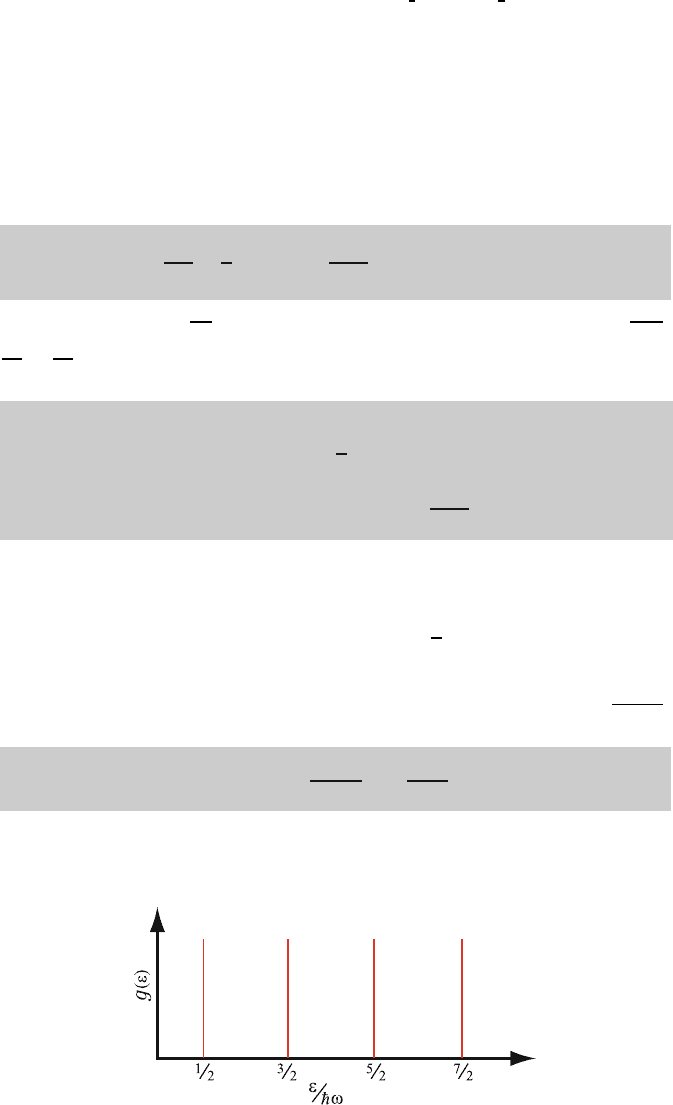
The energy is independent of k, so the density of states (per unit length) is a 521
series of δ-functions, as is shown in Fig. 7.23. 522
g(ε) ∝
n
δ
ε − ¯hω
c
n +
1
2
. (7.97)
The constant of proportionality for a finite size sample of area L
2
is
mω
c
L
2
2π¯h
, 523
so that the total number of states per Landau level is 524
N
L
= L
mω
c
L
2π¯h
=
BL
2
hc/e
. (7.98)
525
For a sample of area L
2
,eachLandaulevel can accommodate N
L
electrons (we 526
have omitted spin) and N
L
is the magnetic flux through the sample divided 527
c
Fig. 7.23. Density of states for electrons in a dc magnetic field
Uncorrected Proof
BookID 160928 ChapID 07 Proof# 1 - 29/07/09
7.7 Electrons in a Magnetic Field 205
by the quantum of magnetic flux
hc
e
. We note that the degeneracy of each 528
Landau level can also be rewritten by N
L
=
L
2
2πλ
2
in terms of the magnetic 529
length λ =
2
¯hc
eB
. 530
7.7.1 Quantum Hall Effect 531
If we make contacts to the 2DEG, and send a current I in the x-direction, 532
then we expect 533
σ
xx
∝
I
V
x
and σ
xy
∝
I
V
y
. (7.99)
Here, V
x
is the applied voltage in the direction of I and V
y
is the Hall voltage. 534
In the simple classical (Drude model) picture, we know that 535
σ
xx
= σ
yy
=
σ
0
1+(ω
c
τ)
2
and σ
xy
= −σ
yx
= −
ω
c
τσ
0
1+(ω
c
τ)
2
, (7.100)
where σ
0
=
n
s
e
2
τ
m
. In the limit as τ →∞we have σ
0
→∞, σ
xx
→ 0, and 536
σ
xy
→−
n
s
ec
B
. 537
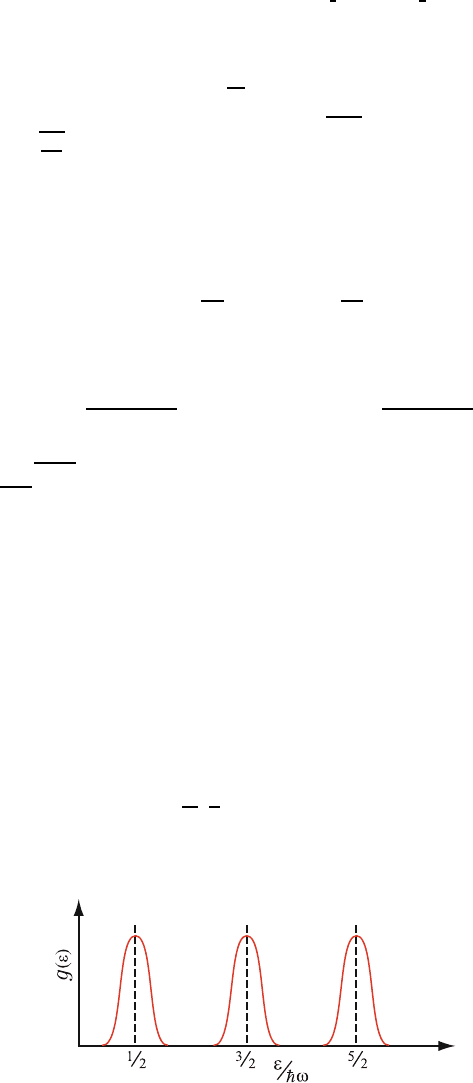
In the absence of scattering, g(ε)isaseriesofδ-functions. With scattering, 538
the δ-functions are broadened as shown in Fig. 7.24. We know that, when one 539
Landau level is completely filled and the one above it is completely empty, 540
there can be no current, because to modify the distribution function f
0
(ε) 541
would require promotion of electrons to the next Landau level. There is a 542
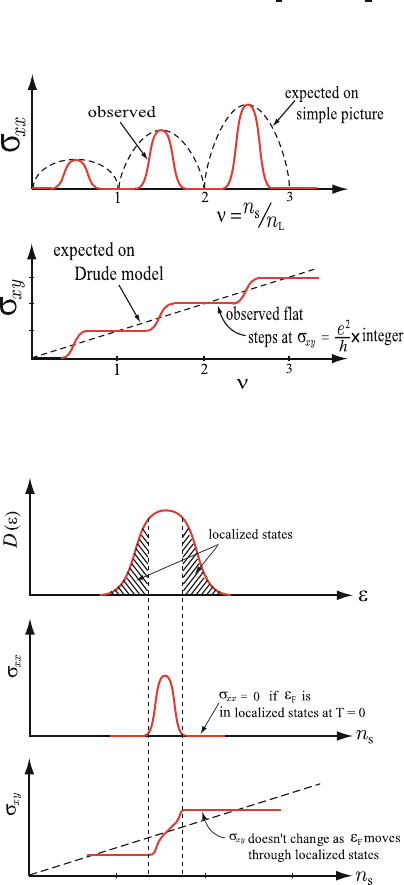
gap for doing this, and at T = 0 there will be no current. If we plot σ
xx
versus 543
n
s
/n
L
≡ ν,thefilling factor
n
L
= N
L
/L
2
we expect σ
xx
to go to zero at 544
any integer values of ν as shown in Fig. 7.25. 545
Our understanding of the integral quantum Hall effect is based on the 546
idea that within the broadened δ-functions representing the density of states, 547
we have both extended states and localized states as shown in Fig. 7.26. The 548
quantum Hall effect was very important because it led to 549
1. A resistance standard ρ =
h
e
2
1
n
. 550
2. Better understanding of Anderson localization. 551
3. Discovery of the fractional quantum Hall effect. 552
c
Fig. 7.24. Density of states for electrons in a dc magnetic field in the presence of
scattering
Uncorrected Proof
BookID 160928 ChapID 07 Proof# 1 - 29/07/09
206 7 Semiconductors
Fig. 7.25. Conductivities as a function of the Landau level filling factor.
(a) Longitudinal conductivity σ
xx
,(b) Hall conductivity σ
xy
Fig. 7.26. Scattering effects on the density of states and conductivity components
in an integral quantum Hall state
7.8 Amorphous Semiconductors 553
Except for introducing donors and acceptors in semiconductors, we have essen- 554
tially restricted our consideration to ideal, defect-free infinite crystals. There 555
are two important aspects of order that crystals display. The first is short 556
range order. This has to do with the regular arrangement of atoms in the 557

Uncorrected Proof
BookID 160928 ChapID 07 Proof# 1 - 29/07/09
7.8 Amorphous Semiconductors 207
vicinity of any particular atom. This short range order determines the local 558
bonding and the crystalline fields acting on a given atom. The second aspect 559
is long range order. This is responsible for the translational and rotational 560
invariance that we used in discussing Bloch functions and band structure. 561
It allowed us to use Bloch’s theorem and to define the Bloch wave vector k 562
within the first Brillouin zone. 563
In real crystals, there are always 564
• Surface effects associated with the finite size of the sample. 565
• Elementary excitations (dynamic perturbations like phonons, magnons, 566
etc.) 567
• Imperfections and defects (static disorder). 568
For an ordered solid, one can start with the perfect crystal as the zeroth 569
approximation and then treat static and dynamic perturbations by per- 570
turbation theory. For a disordered solid this type of approximation is not 571
meaningful. 572
7.8.1 Types of Disorder 573
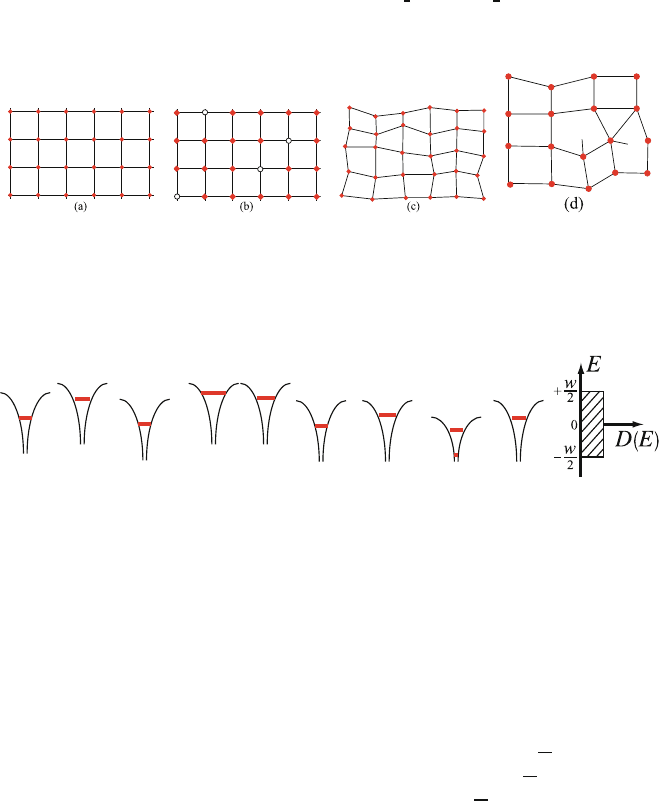
We can classify disorder by considering some simple examples in two dimen- 574
sions that we can represent on a plane. 575
Perfect Crystalline Order Atoms in perfect crystalline array (see Fig. 7.27a). 576
Compositional Disorder Impurity atoms (e.g. in an alloy) are randomly dis- 577
tributed among crystalline lattice sites (See Fig. 7.27(b).) 578
Positional Disorder Some separations and some bond angles are not perfect 579
(See Fig. 7.27(c).) 580
Topological Disorder Fig. 7.27d shows some topological disorder. 581
Because we cannot use translational invariance and energy band concepts, 582
it is difficult to evaluate the eigenstates of a disordered system. What has 583
been found is that in disordered systems, some of the electronic states can 584
be extended states and some can be localized states. An extended state 585
is one in which, if |Ψ(0)|
2
is finite, |Ψ(r)|
2
remains finite for r very large. 586
A localized state is one in which |Ψ(r)|
2
falls off very quickly as r becomes large 587
(usually exponentially). There is an enormous literature on disorder and local- 588
ization (starting with a classic, but difficult, paper by P.W. Anderson
2
in the 589
1950s). 590
7.8.2 Anderson Model 591
The Anderson model described a system of atomic levels at different sites n 592
and allowed for hopping from site n to m. The Hamiltonian is written by 593
H =
n
ε
n
c
†
n
c
n
+ T
nm
c
†
m
c
n
(7.101)
2
P.W. Anderson, Phys. Rev. 109, 1492 (1958).
Uncorrected Proof
BookID 160928 ChapID 07 Proof# 1 - 29/07/09
208 7 Semiconductors
Fig. 7.27. Various types of disorder. (a) Atoms in perfect crystalline array.
(b) Impurity atoms are randomly distributed among crystalline lattice sites.
(c) Some separations and some bond angles are not perfect. (d) Not all fourfold
rings, but some five and sixfold rings leaving dangling bonds represent topological
disorder
Fig. 7.28. Basic assumption of energy level distribution on different sites in the
Anderson model
This is just the description of band structure in terms of an atomic level 594
ε on site n where the periodic potential gives rise to the hopping term.In 595
tight binding approximation, we would restrict T , the hopping term to near- 596
est neighbor hops, and that is what the prime on
in the second-term 597
means. 598
In Anderson model, it was assumed that ε
n
the energy on site n was not 599
a constant, but that it was randomly distributed over a range w (see, for 600
example, Fig. 7.28). Anderson showed that if the parameter
w
B
,whereB is 601
the band width (caused by and proportional to T )satisfied
w
B
≥ 5, the state 602
at E = 0 (the center of the band) is localized, while if
w
B
≤ 5 it is extended. 603
7.8.3 Impurity Bands 604
Impurity levels in semiconductors form Anderson-like systems. In these sys- 605
tems, the energy E is independent of n; it is equal to the donor energy ε
d
. 606
However, the hopping term T is randomly distributed between certain limits, 607
since the impurities are randomly distributed. Sometimes (when two impuri- 608
ties are close together) it is easy to hop and T is large. Sometimes, when they 609
are far apart, T is small. 610
7.8.4 Density of States 611
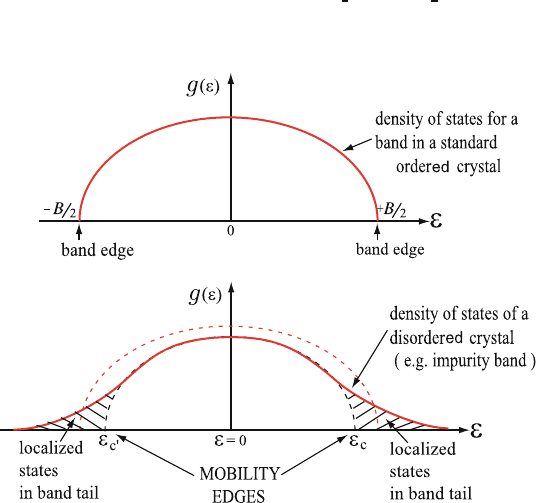
Although the eigenvalues of the Anderson Hamiltonian can not be calculated 612
in a useful way, it is possible to make use of the idea of density of states. In 613
Uncorrected Proof
BookID 160928 ChapID 07 Proof# 1 - 29/07/09
7.8 Amorphous Semiconductors 209
Fig. 7.29. Density of states of an ordinary crystal and that of a disordered material
Fig. 7.29, we sketch the density of states of an ordinary crystal and then the 614
density of states of a disordered material. In the latter, the tails on the density 615
of states usually contain localized states, while the states in the center of the 616
band are extended. The energies E
c
and E
c
are called mobility edges.They 617
separate localized and extended states. When E
F
is in the localized states, 618
there is no conduction at T = 0. The field of amorphous materials, Anderson 619
localization, and mobility edges are of current research interest, but we do not 620
have time to go into greater detail. 621