
Quinn J.J., Yi K.-S. Solid State Physics: Principles and Modern Applications
Подождите немного. Документ загружается.

Uncorrected Proof
BookID 160928 ChapID 11 Proof# 1 - 29/07/09
324 11 Many Body Interactions – Introduction
One can now return to the equation for the ground state energy W 228
W
GS
=
¯h
2
2m
"
d
3
k
(2π)
3
k
2
cos
2
θ
k
+(k + Q)
2
sin
2
θ
k
−
1
2
"
d
3
k d
3
k
(2π)
6
V
k−k
cos
2
(θ
k
− θ
k
)
(11.81)
229
and replace V
k−k
by the constant γ and substitute 230
1. g = 0 for the trivial solution corresponding to the usual paramagnetic state 231
and 232
2. g =
κ
μ
2sinh
8π
2
μ
γκ
2
⊥
for the spin density wave state 233
If we again take the occupied region in k space to be a cylinder of radius κ
⊥
234
and length κ
centered at k
z
= −
Q
2
, we obtain the deformation energy of the 235
spin density wave state 236
W
SDW
− W
P
= −
μκ
2
κ
2
⊥
32π
2
coth
8π
2
μ
γκ
2
⊥
− 1
< 0. (11.82)
237
This quantity is negative definite, so that the spin density wave state always 238
has the lower energy than the paramagnetic state, i.e. 239
W
P
>W
SDW
.
Note that in evaluation of W
P
as well as of W
SDW
, the occupied region of 240
k space was taken to be a cylinder of radius κ
⊥
and length κ
centered at 241
k
z
= −
Q
2
. The result does not prove that the spin density wave has lower 242
energy than the actual paramagnetic ground state (which will be a sphere 243
in k space instead of a cylinder, and hence have a smaller kinetic energy 244
than the cylinder. Overhauser gave a general (but somewhat difficult) proof 245
that a spin density wave state always exists which has lower energy than the 246
paramagnetic state in the Hartree–Fock approximation. 247
The proof involves taking the wave vector of the spin density wave Q to 248
be slightly smaller than 2k
F
. Then, the spin up states at k
z
are coupled by the 249
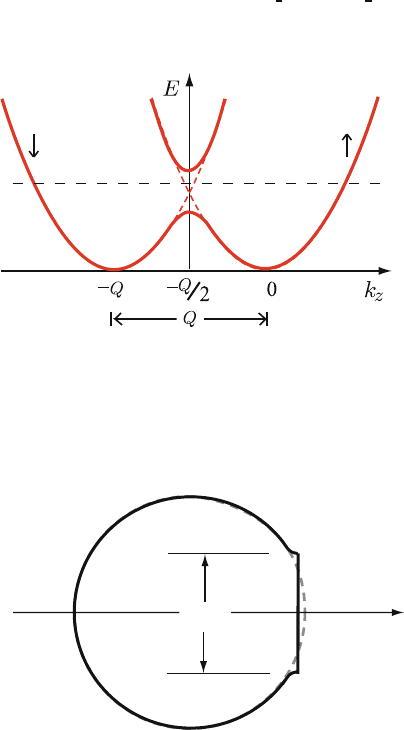
exchange interaction to the spin down states at k
z
+ Q as shown in Fig. 11.2. 250
The gap (at |k
z
| = Q/2) of the strongly coupled states causes a repopulation of 251
k-space as indicated schematically (for the states that were spin ↓ without the 252
spin density wave coupling) in Fig. 11.3. The flattened areas occur, of course, 253
at the energy gap centered at k
z
= −
Q
2
.Therepopulation energy depends on 254
κ
⊥
,whichisgivenbyκ
⊥
=
k
2
F
− Q
2
/4 and is much smaller than k
F
.The 255
dependence of the energy on the value of κ
⊥
can be used to demonstrate that 256
the kinetic energy increase due to repopulation is small for κ
⊥
k
F
and that 257
in the Hartree–Fock approximation a spin density wave state always exists 258
with energy lower than that of the paramagnetic state. 259
Uncorrected Proof
BookID 160928 ChapID 11 Proof# 1 - 29/07/09
11.3 Spin Density Waves 325
F
e
Fig. 11.2. Energies of ↑ and ↓ spin electrons as a function of k
z
.Thespin↑ and spin
↓ minima have been separated by Q the wave number of the spin density wave. The
thin solid lines omit the spin density wave exchange energy. The thick solid lines
include it and give rise to the spin density wave gap. Near the gap, the eigenstates
are linear combinations of |k
z
↑ and |k
z
+ Q ↓
k
z
2
⊥
κ
Fig. 11.3. Schematics of repopulation in k-space from originally occupied k ↓ states
(inside sphere of radius k
F
denoted by dashed circle) to inside of solid curve ter-
minated plane k
z
= Q/2 at which spin density wave gas occurs. The size of κ
⊥
is
exaggerated for sake of clarity
For a spiral spin density wave the flat surface at |k
z
| = Q/2 occur at 260
opposite sides of the Fermi surface for spin ↑ and spin ↓ electrons. Near these 261
positions in k-space, one cannot really speak of spin ↑ and spin ↓ electrons 262
since the eigenstates are linear combinations of the two spins with comparable 263
amplitudes. Far away from these regions (on the opposite sides of the Fermi 264
surface) the spin states are essentially unmixed. The total energy can be 265
lowered by introducing a left-handed spiral spin density wave in addition to 266
the right-handed one. The resulting spiral spin density waves form a linear 267
spin density wave which has flat surfaces separated by the wave vector Q of 268
the spin density wave at both sides of the Fermi surface for each of the spins. 269
Uncorrected Proof
BookID 160928 ChapID 11 Proof# 1 - 29/07/09
326 11 Many Body Interactions – Introduction
11.3.1 Comparison with Reality 270
It is not at all clear what correlation effects will do to the balance which gave 271
W
P
>W
SDW
. So far no one has performed correlation calculations using the 272
spin density wave state as a starting point. Experiment seems to show that at 273
low temperatures the ground state of some metals, for example chromium, is 274
a spin density wave state. Shortly after introducing spin density wave states, 275
Overhauser.
2
introduced the idea of charge density wave states In a charge 276
density wave state the spin magnetization vanishes everywhere, but the elec- 277
tron charge density has an oscillating position dependence. For a spin density 278
wave distortion, exchange favors the distortion but correlation does not. For a 279
charge density wave distortion, both exchange and correlation favor the distor- 280
tion. However, the electrostatic (Hartree) energy associated with the charge 281
density wave is large and unfavorable unless some other charge distortion can- 282
cels it. For soft metals like Na, K, and Pb, Overhauser claims the ground state 283
is a charge density wave state. Some other people believe it is not. There is 284
absolutely no doubt (from experiment) that the layered compounds like TaS
2
285
(and many others) have charge density wave ground states. There are many 286
experimental results for Na, K, and Pb that do not fit the nearly free electron 287
paramagnetic ground state, which Overhauser can explain with the charge 288
density wave model. At the moment, the question is not completely settled. 289
In the charge density wave materials, the large electrostatic energy (due to the 290
Hartree field produced by the electronic charge density distortion) must be 291
compensated by an equal and opposite distortion associated with the lattice. 292
11.4 Correlation Effects–Divergence of Perturbation 293
Theory 294
Correlation effects are those electron–electron interaction effects which come 295
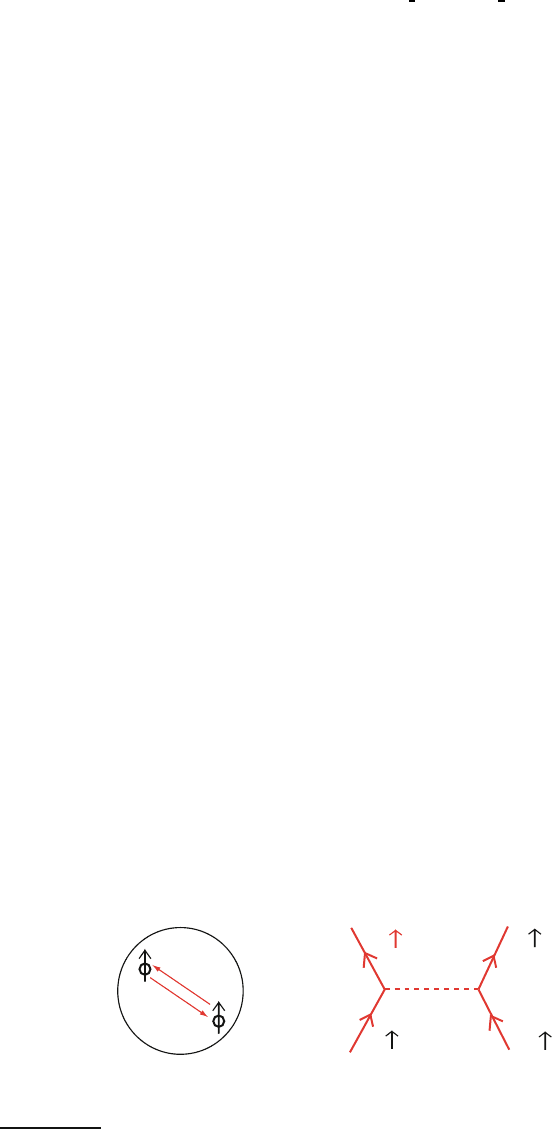
beyond the exchange term. Picturesquely we can represent the exchange term 296
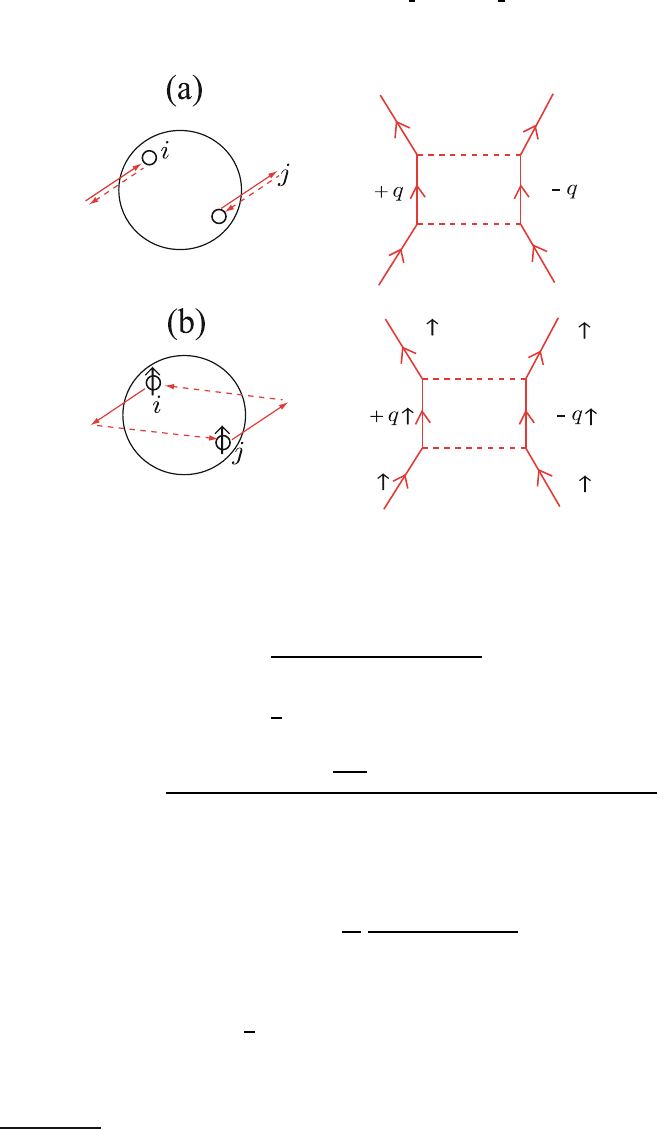
as shown in Fig. 11.4. The diagrams corresponding to the next order in per- 297
turbation theory are the second-order terms shown in Fig. 11.5 for (a) direct 298
and (b) exchange interactions, respectively The second-order perturbation to 299
or
i
j
k'
k
k
k'
Fig. 11.4. Diagrammatic representation of the exchange interaction in the lowest
order
2
A.W. Overhauser, Phys. Rev. 167, 691 (1968)
Uncorrected Proof
BookID 160928 ChapID 11 Proof# 1 - 29/07/09
11.4 Correlation Effects–Divergence of Perturbation Theory 327
or
or
k
k'
k
k'
k
k
k
k
k'
k'
k'
k'
Fig. 11.5. Diagrammatic representation of the (a)directand(b) exchange
interactions in the second-order perturbation calculation
the energy is 300
E
2
=
m
Φ
0
|H
|Φ
m
Φ
m
|H
|Φ
0
E
0
− E
m
(11.83)
Look at one term H
ij
of H
=
1
2
i=j
V
ij
. 301
E
2D
(k
i
, k
j
)=
q=0
e
ik
i
·x
e
ik
j
·x
q
1
4πe
2
q
2
1
e
iq
1
·(x−x
)
e
i(k
i
+q)·x
e
i(k
j
−q)·x
!
2
E
k
i
+ E
k
j
−
E
k
i
+q
+ E
k
j
−q
,
(11.84)
where the subscript D denotes the contribution of the direct interaction.
302
Equation (11.84) can be reduced to 303
E
2D
(k
i
,k
j
)=−m(4πe
2
)
2
q=0
1
q
4
1
q
2
+ q · (k
i
− k
j
)
, (11.85)
wherewehaveset¯h =1.Thus,wehave
304
E
TOTAL
2D
=
1
2
k
i
= k
j
; k
i
,k
j
<k
F
|k
i
+ q|, |k
j
− q| >k
F
E
2D
(k
i
,k
j
). (11.86)
Summing over spins and converting sums to integrals we have
3
305
3
M. Gell-Mann, K.A. Brueckner, Phys. Rev. 106, 364 (1957).

Uncorrected Proof
BookID 160928 ChapID 11 Proof# 1 - 29/07/09
328 11 Many Body Interactions – Introduction
E
Total
2D
= −
e
4
m
16π
7
d
3
q
q
4
k
i
<k
F
|k
i
+ q| >k
F
d
3
k
i
k
j
<k
F
|k
j
+ q| >k
F
d
3
k
j
1
q
2
+ q · (k
i
+ k
j
)
.
(11.87)
306
It is not difficult to see that E
Total
2D
diverges because of the presence of the 307
factor q
−4
. In a similar way, one can show that 308
E
Total
2X
=
e
4
m
32π
7
d
3
q
q
2
k
i
<k
F
|k
i
+ q| >k
F
d
3
k
i
k
j
<k
F
|k
j
+ q| >k
F
d
3
k
j
1
q
2
+q·(k
i
+k
j
)
×
1
(q+k
i
+k
j
)
2
.
(11.88)
309
This number is finite and has been evaluated numerically (a very complicated 310
numerical job) with the result 311
E
Total
2X
= N ·
e
2
2a
0
× 0.046 ± 0.002. (11.89)
All terms beyond second-order diverge because of the factor (
1
q
2
)
m
coming 312
from the matrix elements of the Coulomb interaction. 313
The divergence results from the long range of the Coulomb interaction. 314
Gell-Mann and Brueckner overcame the divergence difficulty by formally 315
summing the divergent perturbation expansion to infinite order. 316
What they were actually accomplishing was, essentially, taking account of 317
screening. For the present, we will concentrate on understanding something 318
about screening in an electron gas. Later, we will discuss the diagrammatic 319
type expansions and the ground state energy. 320
11.5 Linear Response Theory 321
We will investigate the self-consistent (Hartree) field set up by some external 322
disturbance in an electron gas. In order to accomplish this it is very useful to 323
introduce the single particle density matrix. 324
11.5.1 Density Matrix 325
Suppose that we have a statistical ensemble of N systems labelled k = 326
1, 2, 3,...,N. Let the normalized wave function for the kth system in the 327
ensemble be given by Ψ
k
.ExpandΨ
k
in terms of a complete orthonormal set 328
of basis functions φ
n
329
Ψ
k
=
n
c
nk
φ
n
;
n
| c
nk
|
2
=1. (11.90)

Uncorrected Proof
BookID 160928 ChapID 11 Proof# 1 - 29/07/09
11.5 Linear Response Theory 329
The expectation value of some quantum mechanical operator
ˆ
A in the k
th
330
system of the ensemble is 331
A
k
=
dτ Ψ
∗
k
ˆ
AΨ
k
. (11.91)
The statistical average (over all systems in the ensemble) is given by
332
A =
1
N
N
k=1
A
k
,
=
1
N
N
k=1
"
d
3
τ Ψ
∗
k
ˆ
AΨ
k
.
(11.92)
Substitute for Ψ
k
in terms of the basis functions φ
n
.Thisgives 333
A =
1
N
N
k=1
m,n
c
∗
mk
c
nk
φ
m
|
ˆ
A|φ
n
. (11.93)
But φ
m
|
ˆ
A|φ
n
= A
mn
,the(m, n) matrix element of
ˆ
A in the representation 334
{φ
n
}. Now define a density matrix ˆρ as follows 335
ρ
nm
=
1
N
N
k=1
c
∗
mk
c
nk
. (11.94)
Then, A can be written
336
A =
m,n
ρ
nm
A
mn
=
n
ˆρ
ˆ
A
nn
=Tr
ˆρ
ˆ
A
. (11.95)
337
This states that the ensemble average of a quantum mechanical operator
ˆ
A 338
is simply the trace of the product of the density operator (or density matrix ) 339
and the operator
ˆ
A. 340
11.5.2 Properties of Density Matrix 341
From the definition (11.94), it is clear that ρ
∗
nm
= ρ
mn
. Because the unit 342
operator 1 must have an ensemble average of unity, we have that 343
Tr ˆρ =1. (11.96)
Because Trˆρ =
ρ
nn
= 1, it is clear that 0 ≤ ρ
nn
≤ 1 for every n. ρ
nn
is 344
simply the probability that the state φ
n
is realized in the ensemble. 345
11.5.3 Change of Representation 346
Let S be a unitary matrix that transforms the orthonormal basis set {φ
n
} 347
into a new orthonormal basis set {
˜
φ
n
}.Ifwewrite 348
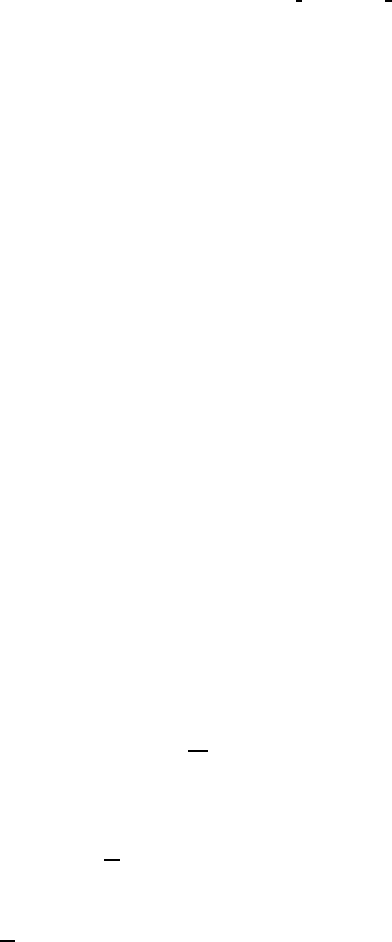
Uncorrected Proof
BookID 160928 ChapID 11 Proof# 1 - 29/07/09
330 11 Many Body Interactions – Introduction
˜
φ
l
=
n
φ
n
S
nl
, (11.97)
then we have
349
φ
m
=
l
S
∗
ml
˜
φ
l
. (11.98)
It can be proved by remembering that, because S is unitary, S
−1
= S
†
=
˜
S
∗
350
or S
∗
ml
=(S
−1
)
lm
. Now, write the wave function for the k
th
system in the 351
ensemble, in terms of new basis functions, as 352
Ψ
k
=
l
˜c
lk
˜
φ
l
. (11.99)
Remember that
353
Ψ
k
=
n
c
nk
φ
n
. (11.100)
By substituting (11.98) in (11.100), we find
354
Ψ
k
=
n
c
nk
l
S
∗
nl
˜
φ
l
=
l
9
n
c
nk
S
∗
nl
:
˜
φ
l
. (11.101)
By comparing (11.101) with (11.99), we find
355
˜c
lk
=
n
c
nk
S
∗
nl
. (11.102)
The expression for the density matrix in the new representation is
356
˜ρ
lp
=
1
N
k=1
N
˜c
∗
pk
˜c
lk
. (11.103)
Now, use (11.102) and its complex conjugate in (11.103) to obtain
357
˜ρ
lp
=
1
N
k=1
N
m
c
∗
mk
S
mp
n
c
nk
S
∗
nl
=
mn
S
mp
ρ
nm
S
∗
nl
,
(11.104)
since ρ
nm
=
1
N
N
k=1
c
∗
mk
c
nk
. But (11.104) can be rewritten 358
˜ρ
lp
=
mn
S
−1
ln
ρ
nm
S
mp
or 359
˜ρ = S
−1
ˆρS = S
†
ˆρS. (11.105)
The average (over the ensemble) of an operator
ˆ
A is given in the new
360
representation by 361

Uncorrected Proof
BookID 160928 ChapID 11 Proof# 1 - 29/07/09
11.5 Linear Response Theory 331
˜
A =Tr
˜ρ
˜
A
=Tr
S
−1
ρSS
−1
AS
=Tr
S
−1
ρAS
.
But the trace of a product of two matrices is independent of the order, i.e.
362
TrAB =TrBA. Therefore, we have 363
˜
A =Trρ
ˆ
A = A. (11.106)
364
This means that the ensemble average of a quantum mechanical operator
ˆ
A 365
is independent of the representation chosen for the density matrix. 366
11.5.4 Equation of Motion of Density Matrix 367
The Schr¨odinger equation for the k
th
system in the ensemble can be written 368
i¯h
˙
Ψ
k
=
ˆ
HΨ
k
. (11.107)
Expressing Ψ
k
in terms of the basis functions φ
m
gives 369
i¯h
m
˙c
mk
φ
m
=
ˆ
H
m
c
mk
φ
m
. (11.108)
Taking the scalar product with φ
n
gives 370
i¯h ˙c
nk
=
l
n|
ˆ
H|lc
lk
=
l
H
nl
c
lk
. (11.109)
The complex conjugate of (11.107) can be written
371
− i¯h
˙
Ψ
∗
k
=
ˆ
H
†
Ψ
∗
k
. (11.110)
Expressing Ψ
∗
k
in terms of the basis functions φ
l
gives 372
− i¯h
l
˙c
∗
lk
φ
∗
l
=
l
ˆ
H
†
c
∗
lk
φ
∗
l
. (11.111)
Now, multiply by φ
n
and integrate using 373
d
3
τφ
∗
l
φ
n
= δ
ln
and 374
d
3
τφ
∗
l
ˆ
H
†
φ
n
= H
†
ln
= H
ln
,
since the Hamiltonian is a Hermitian operator. This gives
375
i¯h ˙c
∗
nk
= −
l
c
∗
lk
H
ln
. (11.112)

Uncorrected Proof
BookID 160928 ChapID 11 Proof# 1 - 29/07/09
332 11 Many Body Interactions – Introduction
Now, look at the time rate of change of ρ
mn
. 376
i¯h ˙ρ
mn
=
1
N
N
k=1
i¯h [˙c
∗
nk
c
mk
+ c
∗
nk
˙c
mk
] . (11.113)
Now, use (11.109) and (11.112) for ˙c
nk
and ˙c
∗
nk
to have 377
i¯h ˙ρ
mn
=
1
N
N
k=1
[−
l
H
ln
c
∗
lk
c
mk
+
l
c
∗
nk
H
ml
c
lk
] ,
=
l
[−H
ln
ρ
ml
+ ρ
ln
H
ml
] .
(11.114)
We can reorder the terms as follows:
378
i¯h ˙ρ
mn
=
l
[H
ml
ρ
ln
− ρ
ml
H
ln
] ,
=(Hρ − ρH)
mn
.
(11.115)
This is the equation of motion of the density matrix
379
i¯h ˙ρ =[H, ρ]
−
. (11.116)
380
11.5.5 Single Particle Density Matrix of a Fermi Gas 381
Suppose that the single particle Hamiltonian H
0
has eigenvalues ε
n
and 382
eigenfunctions |n. 383
H
0
|n = ε
n
|n. (11.117)
Corresponding to H
0
, there is a single particle density matrix ρ
0
which is time 384
independent and represents the equilibrium distribution of particles among the 385
single particle states at temperature T . Because ˙ρ
0
=0,H
0
and ρ
0
must com- 386
mute. Thus, ρ
0
can be diagonalized by the eigenfunctions of H
0
.Wecanwrite 387
ρ
0
|n = f
0
(ε
n
)|n. (11.118)
388
For f
0
(ε
n
)=
exp(
ε
n
−ζ
Θ
)+1
−1
, ρ
0
is the single particle density matrix for 389
the grand ensemble with Θ = k
B
T and the chemical potential ζ. 390
11.5.6 Linear Response Theory 391
We consider a degenerate electron gas and ask what happens when some 392
external disturbance is introduced. For example, we might think of adding an 393
external charge density (like a proton) to the electron gas. The electrons will 394
respond to the disturbance, and ultimately set up a self-consistent field. We 395
want to know what the self-consistent field is, how the external charge density 396
is screened etc.
4
397
4
See, for eample, M.P. Greene, H.J. Lee, J.J. Quinn, S. Rodriguez, Phys. Rev. 177,
1019 (1969).

Uncorrected Proof
BookID 160928 ChapID 11 Proof# 1 - 29/07/09
11.5 Linear Response Theory 333
Let the Hamiltonian in the absence of the self-consistent field be simply 398
given by H
0
=
p
2
2m
399
H
0
|k = ε
k
|k. (11.119)
H
0
is time independent, thus the equilibrium density matrix ρ
0
must be 400
independent of time. This means 401
[H
0
,ρ
0
]=0, (11.120)
and therefore
402
ρ
0
|k = f
0
(ε
k
)|k, (11.121)
where
403
f
0
(ε
k
)=
1
e
ε
k
−ζ
Θ
+1
(11.122)
is the Fermi–Dirac distribution function. Now, let us introduce some external
404
disturbance. It will set up a self-consistent electromagnetic fields
E(r,t), 405
B(r,t)
. We can describe these fields in terms of a scalar potential φ and a 406
vector potential A 407
B = ∇×A, (11.123)
and
408
E = −
1
c
∂A
∂t
−∇φ. (11.124)
The Hamiltonian in the presence of the self-consistent field is written as
409
H =
1
2m
p +
e
c
A
2
− eφ. (11.125)
410
ThiscanbewrittenasH = H
0
+ H
1
, where up to terms linear in the 411
self-consistent field 412
H
1
=
e
2c
(v
0
·A + A · v
0
) − eφ. (11.126)
Here, v
0
=
p
m
.Now,letρ = ρ
0
+ ρ
1
,whereρ
1
is a small deviation from ρ
0
413
caused by the self-consistent field. The equation of motion of ρ is 414
∂ρ
∂t
+
i
¯h
[H, ρ]
−
=0. (11.127)
415
Linearizing with respect to the self-consistent field gives 416
∂ρ
1
∂t
+
i
¯h
[H
0
,ρ
1
]
−
+
i
¯h
[H
1
,ρ
0
]
−
=0. (11.128)
We shall investigate the situation in which A, φ, ρ
1
are of the form e
iωt−iq·r
. 417
Taking matrix elements gives 418
k|ρ
1
|k
=
f
0
(ε
k
) − f
0
(ε
k
)
ε
k
− ε
k
− ¯hω
k|H
1
|k
. (11.129)
419